
The first clue is usually small. A thumb bends to scroll, pinch a mug, or press a key, and it gives a tiny shake that feels out of place. That moment can look alarming, but a tremor in a thumb when bent is often a position-specific signal, not a diagnosis by itself.
Clinicians pay attention to the shape of the movement. A thumb that trembles only when it's flexed, held up, or pushed against mild resistance points them toward action-related tremor, physiological tremor, or sometimes a nerve problem, rather than a constant shaking problem at rest. The thumb is a compact joint with tendons, muscles, and nerves all working in a tight space, so small changes can show up visibly.
A calm pattern check matters more than panic. If the shake appears only in one posture, it gives useful information about what's driving it. If it comes with numbness, weakness, stiffness, or spread beyond the hand, the meaning changes.
Table of Contents
- What a Bent-Thumb Tremor Is Telling You
- How Clinicians Classify Tremor
- The Most Common Causes of a Bent-Thumb Shake
- Less Common but Important Causes to Consider
- A Simple Self-Check You Can Do at Home
- What a Clinical Evaluation Actually Looks Like
- Treatment Pathways Matched to the Cause
- When to Worry and What to Ask Your Doctor
What a Bent-Thumb Tremor Is Telling You
A bent thumb that shakes is usually giving a movement clue, not a mystery label. The position matters because a thumb can look steady at rest, then start to wobble only when it is bent, held out, or used against a light load. That pattern tells a clinician to look at posture, muscle control, and nerve input instead of treating every shake as the same problem.
Why position changes the meaning
A thumb is a small structure with fine control demands. Even a mild change in muscle tension can create visible movement. Holding a full mug while trying not to spill it makes the hand do constant tiny corrections, and the thumb often shows that effort first.
Practical rule: if the shake appears in one position and not another, the position itself is part of the diagnosis.
That is why a bent-thumb tremor gets attention in a room full of ordinary hand complaints. The patient is not just saying, “my hand shakes.” The pattern is, “my thumb shakes when I do this specific thing.” That difference helps separate tremor, twitching, and weakness-related instability.
There is also a useful historical reason clinicians take this pattern seriously. Older physiologic studies found irregular fluctuations in thumb force at 8 to 11 Hz when people tried to hold a steady flexing force against resistance, a frequency range associated with physiological tremor in classic thumb tremor research. That work showed the thumb could reveal a measurable mechanical pattern long before today's motion sensors.
The main takeaway is simple. A bent-thumb tremor often points to something being amplified by posture, effort, or load. That does not mean it is harmless, but it does mean the next step is usually pattern recognition, not guessing.
How Clinicians Classify Tremor
A bent-thumb shake is easier to interpret once the movement is sorted by when it appears. Clinicians usually start there, because timing often separates a harmless pattern from one that needs a different workup.
Rest, posture, and action
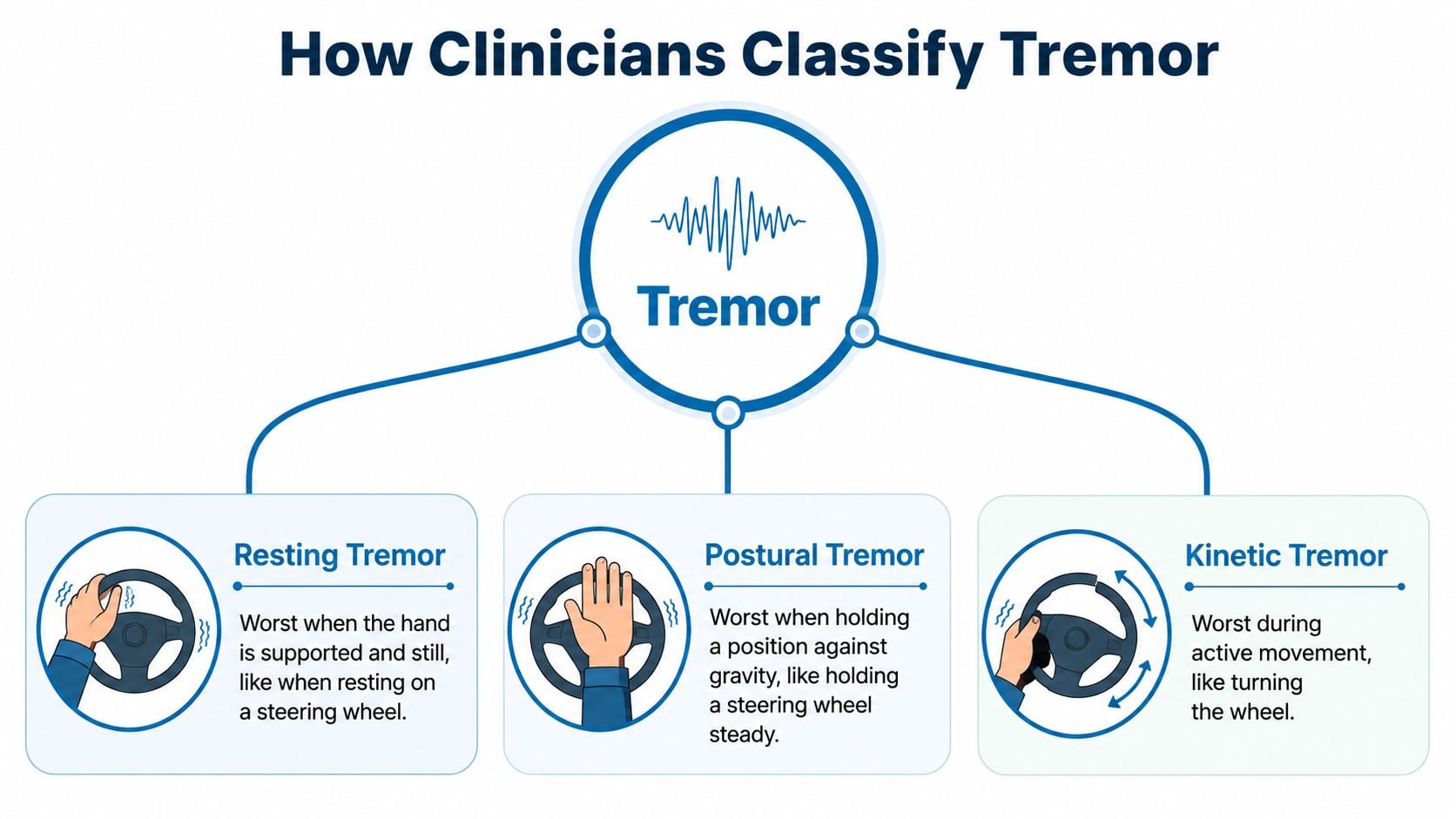
A resting tremor shows up when the hand is supported and still. A postural tremor appears when the hand or thumb is held in place against gravity. An action tremor comes out during movement, like reaching, pinching, texting, or pressing. A task-specific tremor appears during a narrow activity, such as writing or using a key.
The same hand can look different depending on what it is being asked to do. A thumb resting in the lap is quiet. A thumb held out to keep a mug steady or to hover over a phone has to make tiny constant corrections, and that is often when the shake becomes visible. For a bent-thumb complaint, the pattern usually falls into the postural or action group, which helps narrow the possibilities early.
Speed matters too
The speed of the movement can add another clue. In the classic thumb study cited earlier, the measured fluctuation sat in the 8 to 11 Hz range, which fits the frequency band described for physiological tremor in the same foundational paper. That kind of fast, fine movement can feel very different from a slower shake that is easier to see across the room.
A tremor type is a pattern, not a diagnosis by itself. The pattern helps the clinician decide what systems to examine next.
Once the movement is classified, the visit becomes more focused. A bent-thumb tremor that behaves like a postural or action tremor points the conversation toward load, overuse, nerve irritation, or a broader movement disorder. A resting tremor sends the examiner in a different direction, because a thumb that shakes only in one position is often giving a position-specific clue, not a general one. If the pattern suggests possible nerve irritation, a clinical review for issues such as carpal tunnel syndrome may also help explain what the thumb is doing in the room.
The Most Common Causes of a Bent-Thumb Shake
The most common explanation is still the least dramatic one. Physiological tremor can become visible when the nervous system is temporarily more excitable, and the thumb is often the place where that extra activity is easiest to spot. The National Institute of Neurological Disorders and Stroke lists caffeine, stress or anxiety, fatigue, diabetes, thyroid disorder, and certain medicines among recognized tremor triggers in its tremor overview.
Start with temporary amplifiers
A thumb that shakes after a long day, poor sleep, or too much caffeine often fits the “amplified normal” pattern. That's not a diagnosis anyone should self-assign, but it is a useful first pass. The movement often comes and goes, then settles when the trigger settles.
A good mental order is simple. First think about fatigue and stress, then stimulants, then recent overuse. Those are common, reversible, and often clustered together. A hand that has been gripping a phone, typing, and holding a steering wheel all day is already working harder than it looks.
Modern overuse is easy to miss
Repetitive thumb loading deserves more attention than it usually gets. Texting, scrolling, gaming, and long device sessions keep the same small muscles and tendons active over and over. Globally, people spend about 4.8 hours per day on mobile internet use, and U.S. adults spend roughly 4 hours and 37 minutes per day on mobile phones, which makes repetitive thumb exposure a realistic modern driver of localized fatigue and tremor in this modern overuse discussion.
That doesn't mean phones are the only cause. It means the thumb may be showing load-related strain in a way older explanations didn't fully account for.
Nerve pressure changes the picture
When the tremor comes with numbness, tingling, or weakness, the concern shifts toward median-nerve irritation or another neuropathy. Carpal tunnel syndrome can affect thumb motor control because the nerve supply is under pressure at the wrist, and that can change how the thumb holds position. For a hand-focused overview of that pathway, carpal tunnel syndrome is a useful reference point.
Pattern to remember: pure fatigue tends to fade with rest, nerve-related symptoms tend to add numbness or weakness, and repeated loading tends to show up during the same task again and again.
A bent-thumb tremor often becomes less confusing once the cause is ranked by likelihood. Start with temporary amplifiers, then overuse, then nerve irritation. That sequence keeps the symptom grounded in real-world mechanics instead of worst-case thinking.
Less Common but Important Causes to Consider
Some causes show up less often, but they matter because they change the next step. Essential tremor is the most common adult movement disorder, and it usually shows up as an action-based hand tremor rather than a resting one. A meta-analysis of 42 population-based studies across 23 countries and 6 continents screened 540,558 participants, identified 3,263 ET cases, and estimated a pooled worldwide prevalence of 1.33% in that review.
Essential tremor and family patterns
ET often affects both hands, though one side can stand out more at first. Reviews also report higher prevalence in older adults, and ET is often described as affecting about 1% of all people worldwide and about 5% of people over age 60, with hand and arm tremor worsening at an average rate of 1.5% to 5% per year. A bent-thumb tremor that comes back during the same action, or slowly becomes more noticeable over time, can fit that broader pattern.
The pattern matters more than the label. A thumb that shakes while texting, pinching, or holding a mug is giving a position clue, and ET is one of the causes clinicians consider when that clue shows up in more than one setting.
Movement disorders that look like clumsiness
Focal hand dystonia can be mistaken for awkwardness or poor coordination. The thumb may flex oddly, clamp, or tremble during a specific task, almost as if the hand is “misfiring” only when asked to do one practiced movement. Parkinsonian tremor is different again, usually paired with slowness or stiffness, and often more noticeable at rest. Parkinson's Foundation notes that Parkinson's motor symptoms include tremor, rigidity, and bradykinesia, and that resting tremor often affects one side early in the course in its motor-symptom guide.
That distinction helps in the exam room. If the thumb only trembles when a person bends, grips, or reaches for a key, clinicians think differently than they do when the hand shakes while resting in the lap.
Other causes that deserve a review
Medication effects, thyroid disease, metabolic issues, and toxic exposures can all enter the differential. Harvard Health's hand-shaking overview emphasizes that a tremor can arise from many body systems, not just the hand itself, in its explanation of shaky hands. That is why a bent-thumb tremor that does not behave like a simple load-related shake deserves a broader review.
Pain changes the question too. Complex regional pain syndrome is another reason clinicians stay alert when hand symptoms do not match a straightforward overuse story, especially if pain, color change, or stiffness are also part of the picture.
A useful shortcut is this. If the tremor is bilateral and action-based, ET rises on the list. If it is task-specific, dystonia gets attention. If it is asymmetric with slowness or stiffness, Parkinsonism moves up. If new medications or body-wide symptoms are involved, the lens widens further.
A Simple Self-Check You Can Do at Home
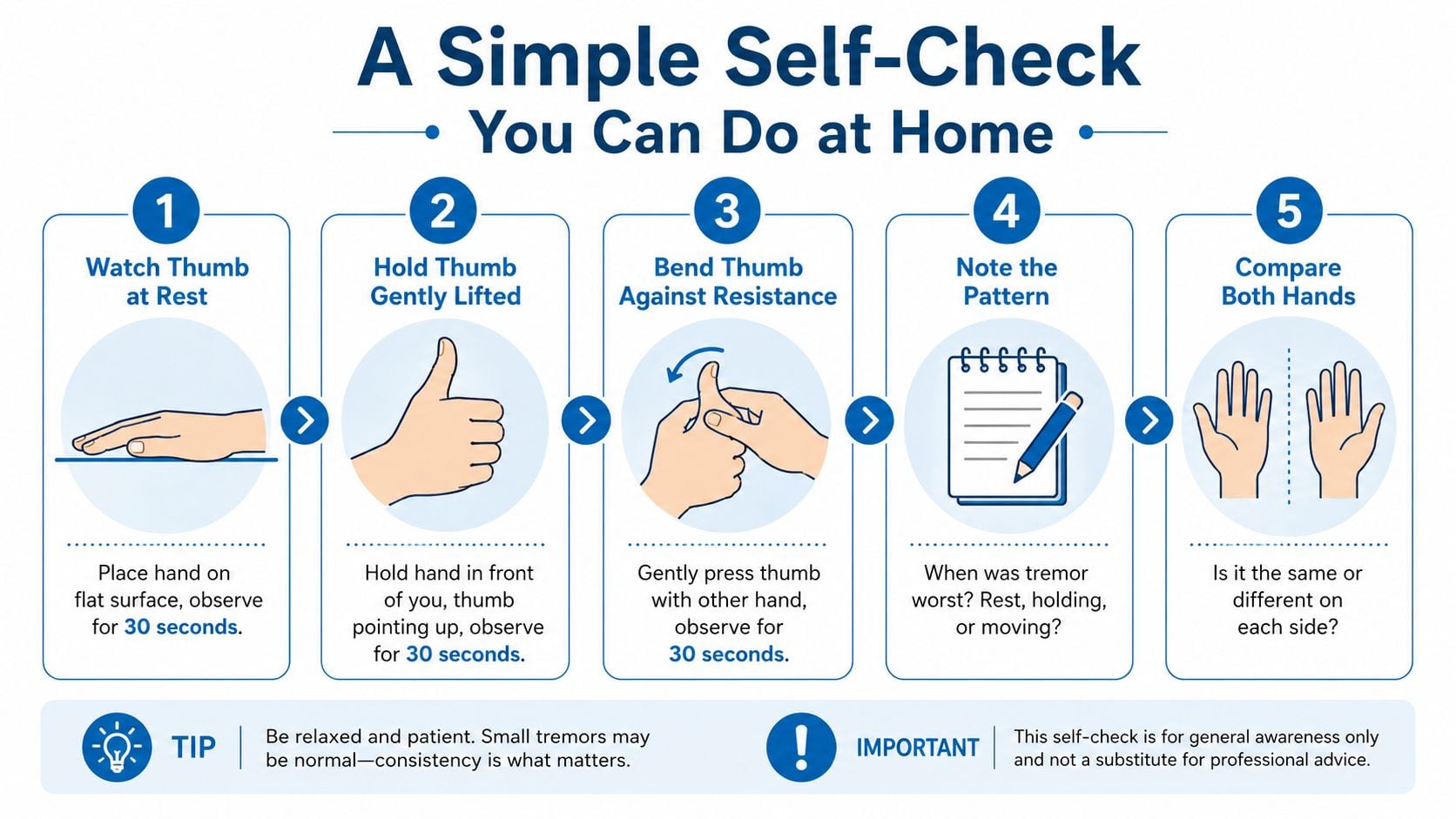
A short self-check can show whether the thumb shake is tied to rest, posture, movement, or load. That's useful because the same thumb can look normal in one setting and tremulous in another. The point isn't to diagnose anything at home, it's to notice the pattern that a clinician will ask about later.
Watch the thumb in three positions
First, rest the hand flat on a table for about 30 seconds and watch for shaking. Then hold the hand gently lifted, thumb pointing up, and see whether the movement appears against gravity. Next, bend the thumb lightly against the other hand's resistance and notice whether the tremor gets stronger.
A fourth check is practical. Grip a full mug for about 30 seconds and notice whether load makes the movement louder. If the thumb only trembles during bending or gripping, that leans toward a position- or action-dependent pattern.
Check for nerve symptoms
After the movement check, notice sensation. Any numbness, tingling, or weakness in the thumb, index finger, or middle finger makes nerve involvement more likely than a pure tremor. That's especially important if the hand also feels clumsy when buttoning, pinching, or holding a small object.
Red-flag pattern: a symptom that moves from “shaky” to “weak or numb” deserves faster attention than a symptom that stays mild and position-specific.
Know when the self-check ends
A watch-and-adjust period is reasonable when the tremor is mild, comes and goes, and clearly tracks with fatigue, caffeine, or repetitive use. A same-week appointment is better when the tremor is sudden, rapidly worsening, one-sided with weakness, or spreading beyond the hand. Slurred speech, facial droop, trouble walking, or a tremor that doesn't settle are not the kinds of signals to wait on.
The home check works best as a snapshot. It gives the clinician a clearer starting point and helps separate a temporary load issue from a movement problem that needs a workup.
What a Clinical Evaluation Actually Looks Like
The visit usually starts with questions, not machines. A clinician wants the timeline, what makes the tremor better or worse, whether there's family history, and whether caffeine, new medicines, or sensory changes are part of the picture. That history often narrows the list before the exam even begins.
The exam is designed to sort patterns
The physical exam usually includes watching the hand at rest, then while it's held out, then during a movement task. Finger-to-nose testing can help show whether the tremor behaves like a broader coordination issue. Resisted thumb testing can reveal whether force or posture brings it out more clearly.
A quick median-nerve screen is often added when numbness or thumb weakness is part of the story. Phalen and Tinel maneuvers are common bedside checks for wrist-level nerve irritation. If those signs line up with the symptom pattern, the next step often moves toward nerve-focused testing rather than a tremor-only workup.
Tests are chosen to answer a narrow question
Nerve conduction studies and EMG help show how the median nerve and thumb muscles are firing. Imaging is used when a structural cause is suspected. Basic labs are ordered when body-wide causes need to be ruled out, including thyroid and glucose-related problems, plus electrolyte issues.
For readers trying to interpret a thyroid result before the appointment, thyroid test result interpretation can help make the lab language less opaque.
The best test is the one that answers a specific question. A broad symptom gets a broad history first, then targeted testing.
The value of this visit is precision. A clinician is not just deciding whether the thumb shakes. They're deciding whether the source looks muscular, nerve-related, medication-related, or neurologic, and that changes treatment completely.
Treatment Pathways Matched to the Cause
Treatment works best when it matches the cause already identified. A thumb that shakes from temporary excitability needs a different plan than a thumb that shakes because the median nerve is irritated. That's why the treatment conversation should follow the pattern, not the other way around.
First steps by likely cause
| Likely cause | First self-care step | Escalation trigger |
|---|---|---|
| Amplified physiologic tremor | Reduce caffeine, sleep more consistently, hydrate, and give the thumb brief rest cycles | Tremor stays frequent after the trigger is removed |
| Repetitive thumb overuse | Lower repetitive loading, alternate hands, adjust device posture, and consider hand therapy | Pain, fatigue, or shakiness keeps returning with the same task |
| Suspected carpal tunnel or neuropathy | Neutral-position splinting, gentle nerve-gliding work, and avoidance of prolonged wrist strain | Numbness, weakness, or sensory loss persists |
| Essential tremor or dystonia | Ask for a neurology evaluation when the pattern is persistent or task-linked | Bilateral spread, progression, or functional interference |
| Parkinsonism or medication effect | Review the medication list and seek specialist assessment | Tremor is asymmetric, paired with stiffness or slowness, or clearly linked to a drug change |
For nerve-related care, a hand specialist may discuss conservative measures first, then injection or release if symptoms don't improve. For a practical example of an interventional hand and nerve pathway, nerve block care may be part of the conversation when a clinician is targeting a pain or irritation source more directly.
Matching treatment to the real driver
A load-related tremor often improves when the hand gets a break from repetitive strain and posture is cleaned up. A nerve-related tremor often needs pressure reduction at the wrist and a closer look at the surrounding structures. A movement-disorder tremor needs a different specialist lens, because the hand is usually only one expression of a wider neurologic pattern.
If the symptom changes with how the hand is used, treatment should change with that same logic.
The key is not to force every tremor into the same lane. A patient who keeps the thumb in a neutral position, changes device habits, and still sees the tremor can use that persistence as a signal to escalate rather than keep guessing.
When to Worry and What to Ask Your Doctor
A thumb that shakes only when it bends can seem minor in the moment, especially if it shows up while texting, gripping a mug, or pinching a phone case. The pattern still matters. Sudden onset, one-sided weakness, speech changes, trouble walking, or tremor with numbness should not be written off as stress or overuse. When a hand symptom appears with broader neurologic change, it deserves prompt attention.
Timing matters
A same-week appointment makes sense when the tremor is new, persistent, worsening, or paired with sensory loss. A short period of watchful adjustment is more reasonable when the movement is mild, clearly tied to repetitive use or caffeine, and stays limited to one hand position. New numbness, weakness, or loss of dexterity should shorten that timeline.
For adults in New Jersey and Staten Island who want a hands-on, multidisciplinary assessment, the most useful setup is one that can consider nerve, joint, muscle, and spine factors together. That kind of evaluation lowers the chance that a bent-thumb tremor gets mistaken for a simple hand habit when the source is more complex.
Three questions to bring to the appointment
- What pattern does the tremor fit? Ask whether it looks like resting, postural, action, or task-specific tremor.
- Could this be nerve-related? Ask whether numbness, tingling, or weakness changes the differential.
- What should change first? Ask which trigger to address now, and what symptom would justify faster follow-up.
A bent-thumb tremor is best approached like a clue, not a verdict. The more clearly the pattern is described, the easier it is for a clinician to separate a temporary load problem from a nerve issue or a movement disorder.
If the thumb shake keeps showing up during bending, gripping, or device use, Interventional Pain Management can help sort out whether the problem is coming from a nerve, joint, muscle, or spine-related source. Their multi-specialty team can match the exam to the next step, from conservative care to targeted intervention, and readers can visit Interventional Pain Management to learn how that evaluation works.