
A parent may be looking at a school calendar while a teenager rests upstairs after scoliosis surgery. A working adult may be trying to decide how much leave to request, whether driving will be possible, and when a short walk will stop feeling exhausting. Both are asking about scoliosis surgery healing time, but the answer depends on which part of recovery they mean.
Walking around the house, managing a school day, returning to physical work, and developing a mature spinal fusion aren't interchangeable milestones. A useful recovery plan separates them and gives the patient's surgical team, rather than a calendar alone, the final say.
Table of Contents
- Why Scoliosis Surgery Healing Time Is Not One Number
- The First Six Weeks After Scoliosis Surgery
- Weeks Six to Twelve and Functional Milestones
- Returning to School, Work, and Sport
- The Bone Fusion Timeline Beyond Six Months
- Factors That Can Speed Up or Slow Down Healing
- Warning Signs of Delayed or Complicated Recovery
- Tracking Your Own Scoliosis Surgery Recovery
Why Scoliosis Surgery Healing Time Is Not One Number
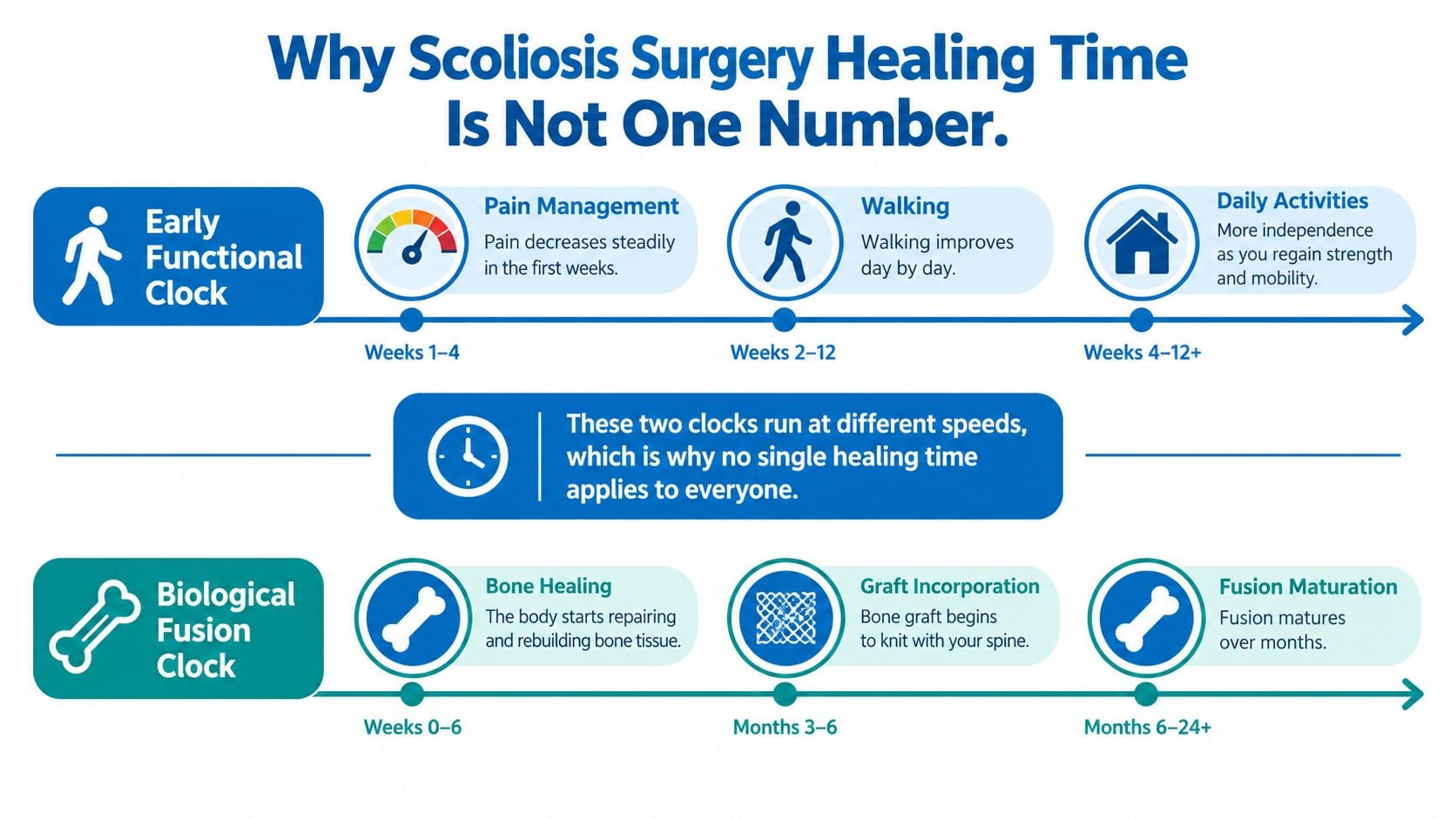
After scoliosis fusion surgery, patients recover along two parallel tracks. The first involves everyday function. The second involves the bone healing needed to create a lasting fusion.
The functional track is visible. A patient needs less help getting out of bed, walks more comfortably, and gradually tolerates ordinary activities. The biological track is harder to observe because the bone graft continues healing beneath the skin, even after the incision looks settled.
What the Different Recovery Terms Mean
Families can avoid confusion by separating the language used at follow-up appointments:
- Early functional recovery means regaining practical abilities, such as walking to the bathroom or managing light household tasks.
- Medical clearance means the surgeon considers a particular activity appropriate under specified conditions. It isn't permission for every activity.
- Radiographic assessment means reviewing imaging for the position of the implants, maintained correction, and evidence of healing.
- Full functional recovery concerns strength, endurance, independence, and the demands of the patient's usual life.
A teenager who returns to class may still need help carrying books. An adult who prepares breakfast independently may still be unable to complete a physically demanding shift. Neither situation means recovery has failed.
Planning principle: The useful question isn't simply whether the patient is healed. It's which activity is safe, what support is still needed, and what evidence supports the next step.
Why Adolescents and Adults Need Different Plans
Adolescent and adult recovery evidence shouldn't be treated as interchangeable. Their procedures, baseline health, school or work demands, and rehabilitation needs may differ substantially.
Even patients of similar ages can have different priorities. For one person, success means sitting through lessons comfortably; for another, it means standing at work or returning to a twisting sport. A meaningful estimate of scoliosis surgery healing time therefore identifies the task, the restrictions, and the conditions for progression, rather than offering a single completion date.
The First Six Weeks After Scoliosis Surgery
A patient may be home, walking to the bathroom, and still need help getting dressed or preparing a meal. That is a normal distinction in early recovery: functional recovery begins with safe, manageable activities, while the bone fusion continues healing on a much longer timeline.
For adults, pain, fatigue, and mobility limits are often most noticeable during the first six weeks. Progress may mean taking several short walks in a day, then gradually spending more time on one's feet. Adult spinal deformity recovery guidance describes this early period as a gradual return to movement, not a date when restrictions automatically end.
Making the First Days at Home Safer
Before discharge, patients and caregivers need clear directions for medication, incision care, permitted movements, and whom to contact with concerns. A prepared home can reduce the need to bend, twist, or lift while completing ordinary tasks.
For example, keep a phone, medications, and frequently used clothing within easy reach. Clear the route between the resting area, bathroom, and kitchen. Caregivers can take on laundry, shopping, and other chores that exceed the patient's restrictions. Wound care, including showering and dressing changes, should follow the surgical team's instructions.
Lifting limits and medication schedules vary. A plan that suited another patient may not be safe here, so ask the care team for specific instructions.
A Routine That Can Be Repeated
Walking works best as a small, repeatable part of the day. A short walk that leaves the patient comfortable enough to continue with daily needs is more useful than a longer outing followed by exhaustion.
Rest and movement both need to fit the surgeon's restrictions. Ask the care team to demonstrate safe ways to get in and out of bed, and to suggest comfortable sleeping positions. Caregivers should not improvise by pulling or lifting the patient.
Medication changes belong with the prescribing clinician. Keeping a written record of doses, relief, and unwanted effects gives the care team practical information when reviewing the plan.
The emotional side can be difficult, too. Pain, broken routines, and relying on others may bring frustration. Families can acknowledge a hard day without assuming it means a complication.
By the end of these early weeks, the goal is a more predictable home routine, not unrestricted activity. Follow-up visits allow the team to check the incision, symptoms, mobility, and current restrictions. Feeling better is encouraging, but the next steps still depend on an individualized plan.
Weeks Six to Twelve and Functional Milestones
At a follow-up visit, a patient may be walking comfortably but still need help with a longer commute or a full day at work. That gap is normal: functional recovery means rebuilding the ability to do specific tasks, while bone fusion continues on a separate, longer timeline.
The checklist shows areas the care team may review during weeks six through twelve. It is a guide, not a deadline. Some patients are ready for certain tasks sooner than others, and an aid such as a stair railing can remain useful even as independence improves.
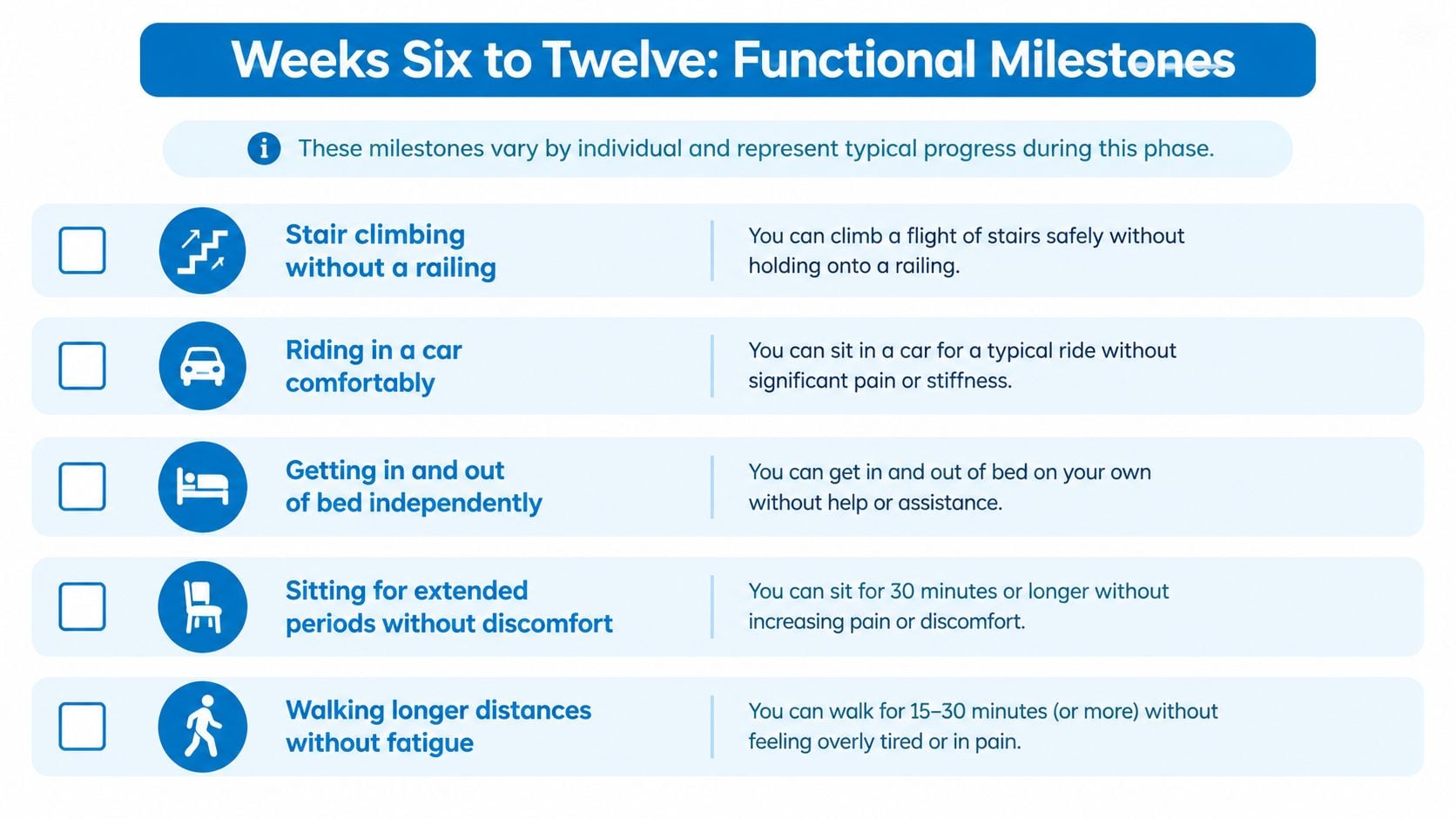
A practical assessment looks at what happens during and after everyday activities. Can the patient get in and out of a chair using the approved method? Is walking controlled, and does the patient feel comfortable afterward? How long can they sit before needing to change position? Can they manage a light household task within their movement and lifting limits?
These answers separate three things that can look similar: a task the patient cannot yet do, one that causes discomfort, and one the care team has restricted to protect healing. Each calls for a different response. The surgical team can also decide whether rehabilitation is appropriate after reviewing the patient's clinical and imaging results; its timing and pace should follow that guidance.
Driving calls for its own decision. Being able to ride in a car does not show that someone can drive safely. The care team needs to consider medication effects, alertness, access to the controls, visibility of traffic, and whether the patient could brake in an emergency before clearing them to drive.
Work readiness also depends on the whole routine, not just time spent at a desk. Commuting, sitting, concentration, and recovery afterward all count. For example, an adult may manage messages from a supportive chair but find that a commute and uninterrupted sitting are still too much. A reduced schedule or remote work, if available, may better match current ability. That is a plan for continued recovery, not proof that healing is behind schedule.
Returning to School, Work, and Sport
School attendance often returns before athletic performance. In a retrospective cohort of adolescents after posterior spinal fusion, the average return to school or college was 6.2 weeks, with a 4- to 13-week range; athletic clearance occurred at approximately three months when patients were pain-free and imaging showed stable implants and correction, according to the study of school and sports recovery after adolescent fusion.
Those findings support planning flexibility, not a fixed school return date. A school day combines transport, sitting, stairs, concentration, and carrying materials, and each may need a separate accommodation.
School Attendance Isn't Sports Clearance
A systematic review of six studies reported sports return across six to eighteen months, with approximately 50% to 60% returning by six months and more than 90% by eighteen months in studies with longer follow-up, as summarized in the review of return to sport after adolescent scoliosis fusion.
These are study populations, not a forecast for an individual athlete. Returning to some sporting activity also isn't necessarily the same as returning to the previous competitive level.
Typical Return to Activity After Scoliosis Fusion
| Activity | Typical earliest window | Considerations |
|---|---|---|
| Walking | Early postoperative recovery, as instructed | Assistance, symptoms, and permitted progression matter |
| School | After classroom and travel tolerance improve | Modified attendance and help with materials may be needed |
| Desk work | After work tasks and the commute are manageable | Position changes and reduced duties may help |
| Driving | After explicit clearance | Medication effects and vehicle control require assessment |
| Low-impact conditioning | During a surgeon-approved progression | Exercise selection must respect restrictions |
| Contact or competitive sport | Later, after activity-specific assessment | Collision, rotation, strength, and confidence matter |
| Heavy labor | After clearance for actual job demands | Attendance at work doesn't establish lifting readiness |
Match Permission to the Actual Activity
Employers need a description of permitted tasks, not just a return date. An adult who can perform administrative work shouldn't be assumed ready to lift equipment, repeatedly bend, or stand throughout a demanding shift.
Likewise, clearance for gentle conditioning shouldn't be interpreted as clearance for collision, heavy lifting, or competition. School staff, coaches, and employers can support recovery by following a written plan that names permitted activities, remaining restrictions, and the process for reassessment.
The Bone Fusion Timeline Beyond Six Months
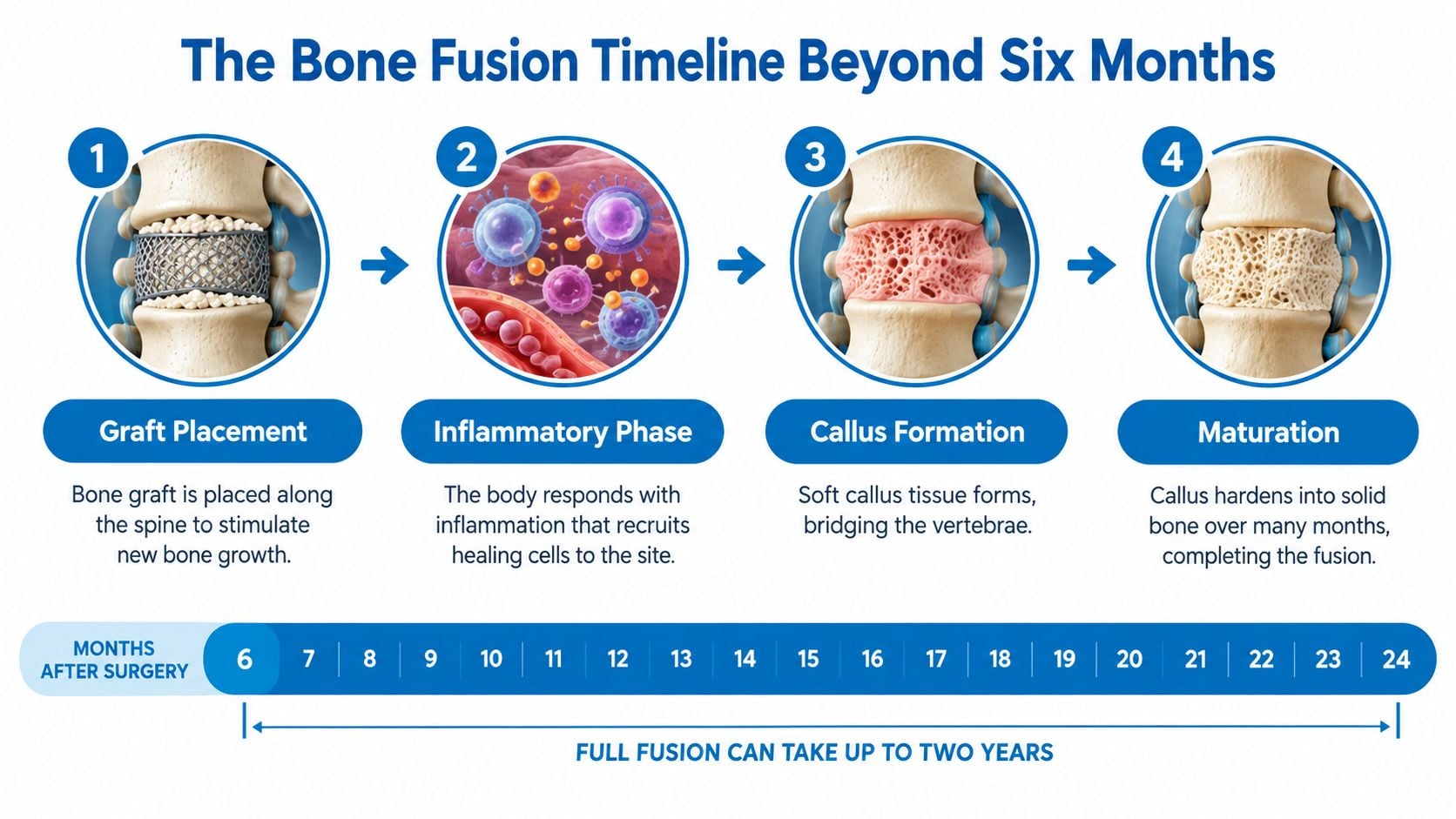
A settled incision and comfortable walking don't prove that the fusion has matured. Biological healing takes place within the operated spinal levels, where grafted bone develops a blood supply, forms bridging bone, and gradually remodels.
The adult guidance discussed earlier places this process well beyond the initial recovery at home. It requires clinical assessment rather than a conclusion based on how the patient feels during ordinary activity.
How the Graft Becomes a Fusion
The process illustration should be read as a simplified sequence, not a schedule assigning every stage to the period named in this heading. Graft placement happens during surgery, and healing begins before this later phase.
Blood vessels must enter the grafted area. New bone then develops across the intended fusion levels and matures under mechanical load. Patients seeking a plain-language explanation of the procedure can consult this overview of spinal fusion.
Hardware supports the corrected spine while this process develops. Its presence doesn't mean that bone maturation is complete or that every movement is appropriate.
Imaging and Long-Term Adaptation
Surgeons review imaging alongside pain, neurologic findings, function, and the procedure performed. A report of stable implants and maintained correction answers important questions, but patients should also ask what the imaging shows about fusion progress and which restrictions remain.
Long-term recovery includes adapting to altered spinal mobility. Published sports evidence describes variation in postoperative protocols and performance outcomes across different patient and athletic groups, discussed in the review of sports participation after scoliosis surgery.
- Comfort and flexibility are separate. Less pain doesn't necessarily restore the movement available before fusion.
- Technique may need adjustment. A sport involving substantial rotation can require a different progression from gentle conditioning.
- Performance needs its own assessment. Participation, confidence, endurance, and competitive ability shouldn't be treated as identical outcomes.
The appropriate question at later appointments is what the surgeon can confirm about healing and how that finding changes the permitted activity plan.
Factors That Can Speed Up or Slow Down Healing
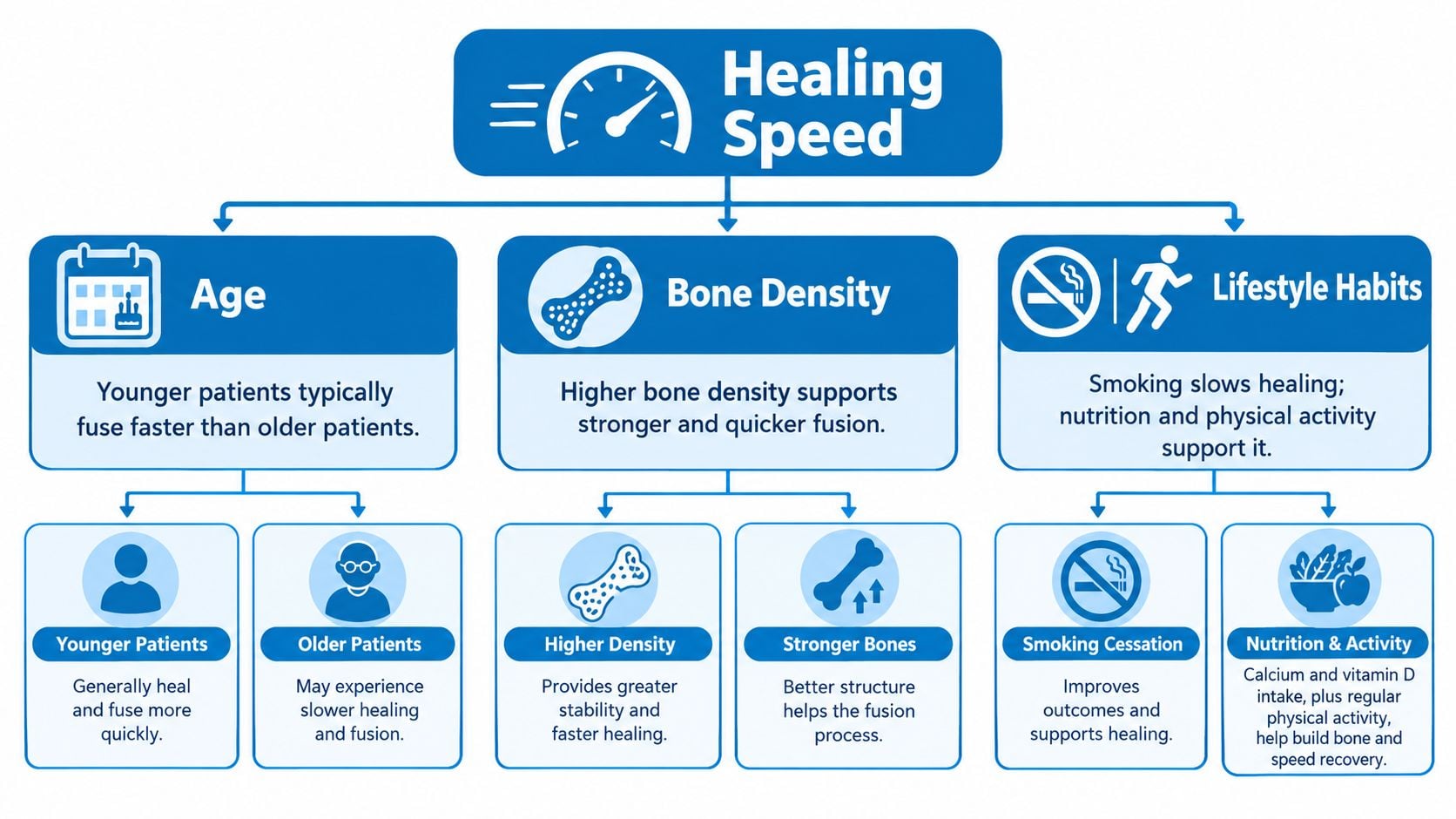
A published recovery range describes a group. It doesn't account for every patient's operation, bone quality, starting condition, or complications. Comparing progress with another patient can therefore create unnecessary alarm or false reassurance.
Longer-term adult outcomes also extend beyond early independence. A multicenter cohort of more than 1,200 adults found meaningful improvements in disability and physical health through two years, with complication and reoperation rates decreasing over the study period, as summarized in the clinical overview of adult scoliosis treatment and recovery.
That clinical overview also identifies procedure extent, age, bone quality, smoking, nutrition, muscle conditioning, and complications as factors that can shift recovery milestones. None should be reduced to a promise that a particular patient will recover quickly.
Factors That Require Individual Planning
Some circumstances cannot be changed through effort. The extent of surgery and the patient's bone quality may call for more cautious progression, additional support, or a different rehabilitation approach.
Understanding spinal instrumentation can help patients distinguish the mechanical support provided during surgery from the healing the body still needs to accomplish. The surgeon should explain how the specific operation affects restrictions.
Useful Areas for Patient Participation
Patients can bring practical questions to the team rather than trying to accelerate recovery independently:
- Smoking. Ask for a cessation plan and clarify the surgical team's requirements.
- Nutrition. Report poor appetite or difficulty maintaining intake, and request individualized guidance.
- Conditioning. Follow prescribed preparation or rehabilitation instead of adding exercises without approval.
- Support needs. Arrange assistance when household or job demands exceed current capacity.
Age or operation extent shouldn't be treated as a personal failure. Conversely, good fitness doesn't override restrictions or eliminate the possibility of setbacks.
A useful comparison: Progress should be measured against the patient's previous function and current care plan, not another person's best day.
Recovery participation means reporting accurately, following instructions, and asking for help early. It doesn't mean proving toughness by tolerating tasks that haven't been cleared.
Warning Signs of Delayed or Complicated Recovery
A patient may be walking farther and managing more at home, then develop a new symptom. That change deserves attention, even when other parts of recovery are going well. A new symptom or worsening trend should be assessed rather than automatically treated as part of healing.
Pain can be part of recovery, but it cannot identify the cause of a setback on its own. Infection, hardware concerns, and slow fusion healing require clinical evaluation, not a diagnosis based on symptoms at home.
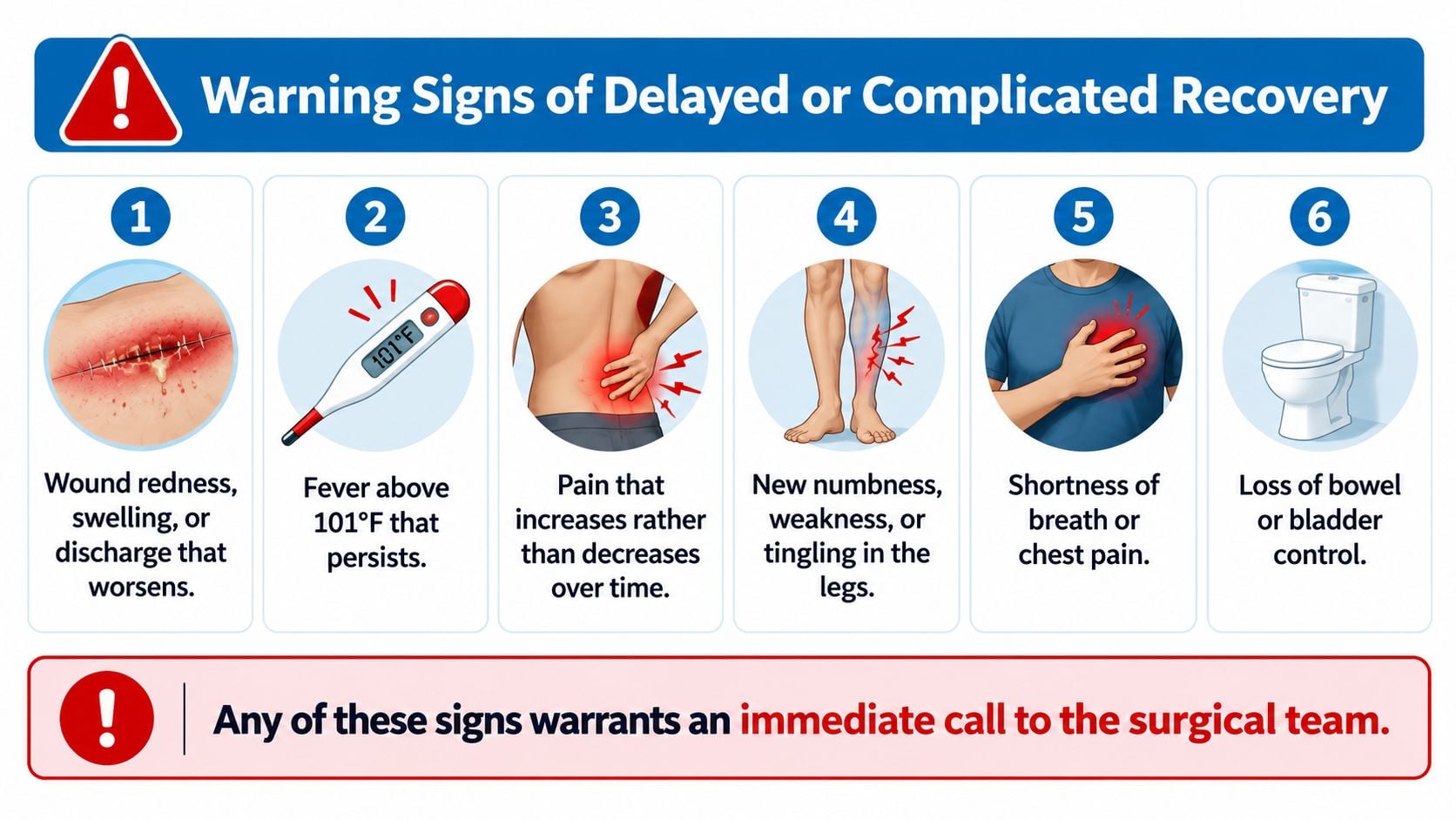
Follow the discharge instructions for the patient-specific fever threshold and contact pathway. If the patient feels unwell or the wound looks concerning, contact the surgical team without waiting to reach a particular temperature.
A wound that becomes redder, more swollen, or starts draining needs review, especially if there is an unusual odor. Report pain that worsens after improving, changes in character, or makes a previously manageable movement difficult. New numbness, tingling, or weakness also calls for prompt clinical advice. So does an unexpected drop in walking ability or independence; don't save that change for a routine appointment.
A description of pain after back surgery can help patients explain what they are experiencing. It does not replace contacting the operating team when symptoms change.
Chest pain, shortness of breath, sudden or progressive weakness, or new loss of bowel or bladder control warrants emergency assessment. If symptoms are severe or developing quickly, use emergency services rather than waiting for an office response.
The clinician can decide whether imaging or other tests are needed. Trying to arrange a specific scan first may delay the assessment that determines what is appropriate.
When contacting the team, a caregiver can describe when the symptom began, whether it is worsening, and any related change in movement or medication use. These details help make the conversation clearer without requiring the caregiver to determine the cause. For concerns that are not emergencies, use the designated contact pathway. Reassurance should follow an assessment, not take its place.
Tracking Your Own Scoliosis Surgery Recovery
A useful recovery record describes what the patient can do, what remains restricted, and what the surgical team has confirmed. A phone note or notebook is sufficient; an elaborate scoring system isn't necessary.
The record should separate functional progress from clinical healing information. This prevents a comfortable day at home from being mistaken for clearance to resume a demanding activity.
A Simple Recovery Record
| Area | What to record | What to discuss |
|---|---|---|
| Walking and transfers | Assistance needed, comfort, and recovery afterward | Whether progression is appropriate |
| School or work | Tasks tolerated and accommodations used | Which duties remain restricted |
| Symptoms | Location, character, changes, and medication effects | Whether the plan needs adjustment |
| Rehabilitation | Prescribed activities and response | What may be added or modified |
| Imaging and restrictions | The clinician's explanation and current permissions | What evidence is needed for the next milestone |
Descriptions should be concrete. “Managed a short outing but needed rest afterward” provides more information than “doing better.” “Comfortable sitting, but unable to manage the commute” helps clinicians address a practical barrier.
Questions for Follow-Up Appointments
At earlier appointments, families can ask about wound care, permitted movement, medication management, and safe independence. As activity increases, questions should become more specific:
- For driving. Has the patient met the team's readiness criteria, and are medications still a concern?
- For school or work. Which accommodations remain necessary, and what tasks are prohibited?
- For exercise. Which movements are permitted, and what symptoms should stop a session?
- For fusion progress. What has imaging confirmed, and how does that affect restrictions?
Appointment timing should follow the operating surgeon's schedule. If function declines or warning symptoms appear, patients shouldn't wait for the next planned review.
The most useful outcome isn't a date labeled “fully healed.” It's a clear, updated plan that helps the patient resume meaningful activities without confusing independence with unrestricted readiness. Adolescents and adults may progress at different rates, but both benefit from specific goals, accurate symptom reporting, and coordinated follow-up.
Interventional Pain Management offers spine surgery, orthopedic evaluation, and pain management services in New Jersey and Staten Island, with treatment plans based on individual clinical needs. Adults seeking help with persistent postoperative pain or questions about function can visit the practice to request an evaluation and bring their surgical records, imaging reports, and current restrictions for review.