

Up to four epidural steroid injections per spinal region in a rolling 12 months is the commonly cited Medicare utilization ceiling, with repeat sessions generally spaced two to four weeks apart and always individualized to documented response. That ceiling answers the coverage question, but it doesn't tell a patient whether another injection is clinically worthwhile, safe, or likely to help.
Table of Contents
- A Common Question After the First Injection Feels Good
- What an Epidural Steroid Injection Actually Does
- The Guidelines That Set the Outer Boundaries
- Clinical Factors That Push the Interval Shorter or Longer
- Why Benefit, Not the Calendar, Should Drive the Next Injection
- Safety Considerations That Shape Every Repeat Decision
- When to Step Back and Reconsider the Plan
- A Practical Decision Framework for Your Next Visit
A Common Question After the First Injection Feels Good
The question about how often can you get epidural steroid injections usually arrives after the first one, not before it. Pain that had been shooting down a leg or arm eases. Walking gets easier, sleep improves, and ordinary movements stop feeling risky. Then the relief starts to fade, or a follow-up visit ends without a firm plan, and the calendar becomes the problem.
Booking another session immediately feels logical. If one injection helped once, another should help again, and waiting can feel like losing ground. That instinct is understandable, but it skips the assessment that makes a repeat procedure useful rather than merely repetitive.
Three Questions Behind One Date
A responsible answer depends on three separate variables. First, the body needs time to show how it handled the corticosteroid, including effects on blood sugar, blood pressure, mood, sleep, and the adrenal system. Second, an insurer may apply utilization rules that limit how many sessions it will pay for and how closely they can be scheduled.
Third, and most important, the next visit needs a defined job. Is the goal to extend a clear functional gain, clarify a diagnosis after a partial response, or chase pain that returned almost immediately? Those situations don't justify the same timing.
A repeat injection should earn its place from the result of the previous one, not from the date when pain becomes frustrating again.
Contradictory online advice often mixes these variables into one number. A coverage limit gets presented as a biological rule, or a minimum safety interval gets treated as a recommended schedule. Separating clinical usefulness, steroid safety, and payment policy makes the decision much clearer.
For a patient whose first injection produced meaningful relief, the useful question isn't only when the next one is allowed. It's whether the pattern, duration, and quality of that relief point toward another injection at all.
What an Epidural Steroid Injection Actually Does
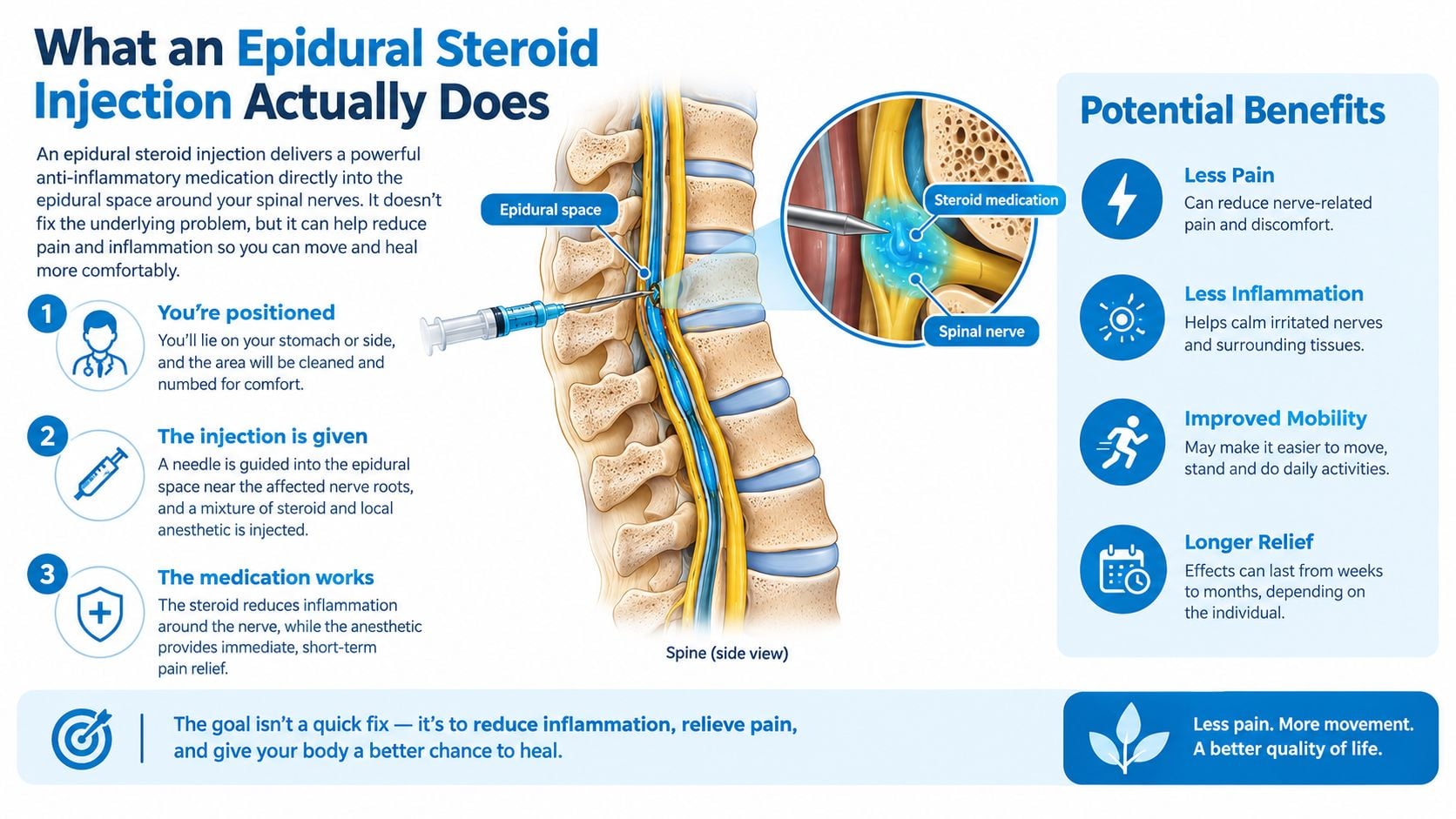
An epidural steroid injection, often shortened to ESI, places a corticosteroid, usually with a local anesthetic, into the epidural space near an irritated spinal nerve root. The target is inflammation around the nerve. The medication isn't intended to repair a disc, widen a narrowed canal, or permanently numb tissue.
Image guidance helps the physician confirm needle placement before medication is delivered. Patients with sciatica and pinched nerve symptoms are often evaluated for this approach when leg pain follows a nerve pattern and imaging supports nerve irritation.
Why Region and Approach Matter
Injections are described by spinal region because anatomy, risk, and counting rules differ. The main regions are:
- Cervical: Treatment in the neck, where the epidural space is narrower and nearby structures require particular caution.
- Thoracic: Treatment in the mid-back, used less commonly than cervical or lumbar procedures.
- Lumbar: Treatment in the lower back, often for radicular leg pain.
- Caudal: Entry through the sacral hiatus at the base of the spine, usually to reach lower lumbar and sacral nerves.
A session is the visit, not each spinal level touched during that visit. That distinction matters when utilization limits are counted by region.
Particulate and Non-Particulate Steroids
Steroid choice also shapes timing. Particulate corticosteroids tend to remain in tissue longer, while non-particulate agents, such as dexamethasone, clear differently and may permit different spacing considerations. Dose, route, and prior steroid exposure from oral or injected medications all enter the calculation.
Understanding those details prevents a common mistake. A patient does not receive a generic shot that can be repeated on demand. Each session adds a specific drug, at a specific dose, into a specific anatomical region, and the next decision should account for all three.
The Guidelines That Set the Outer Boundaries
Guidelines create outer boundaries, but they don't prescribe an ideal schedule for a particular patient. In the United States, a widely used Medicare benchmark allows a maximum of four treatment sessions per spinal region during any rolling 12-month period, according to CMS local coverage determination L39240. The limit applies separately to cervical, thoracic, and lumbar regions and counts sessions rather than levels.
Rolling matters. The count doesn't automatically reset on January 1. A clinic looks backward across the preceding 12 months for that region, so four sessions spread across two calendar years can still fall inside one rolling window.
Spacing Between Sessions
Intervals are generally measured in weeks, not days. A 2024 utilization guideline allows up to three injection sessions for one episode of pain in six months, but no more than four sessions per spinal region in a rolling 12 months when criteria are met, as described in CMS local coverage determination L39015.
That same coverage framework generally doesn't treat routine continuation beyond 12 months as medically reasonable and necessary unless documentation supports exceptional circumstances. Examples include substantial pain-related functional or vocational disability combined with meaningful benefit from prior injections. Private insurers and regional Medicare policies can impose different requirements.
Common Utilization Limits at a Glance
| Rule | Medicare Benchmark | Representative 2025 Commercial Policy |
|---|---|---|
| Annual ceiling by region | Up to four sessions per region in rolling 12 months | No more than four sessions per region in rolling 12 months |
| Episode limit | Governed by documented medical necessity | Up to three sessions for an episode in six months |
| Minimum spacing | Determined through coverage and clinical review | At least 14 days between injections |
| Evidence before repeating | Documented meaningful benefit | At least 50% pain relief lasting two weeks, plus improved function or reduced medication use |
The commercial policy figures in the table come from a 2025 spinal injection policy document. They illustrate how a payer can translate clinical response into authorization language.
Coverage ceiling: Four sessions is a maximum under a benchmark, not a target that every patient should try to use.
Patients reading insurance paperwork should therefore distinguish permission from recommendation. Approval means a payer may cover the service when criteria are met. It doesn't prove that another injection is the safest or most useful next step.
Clinical Factors That Push the Interval Shorter or Longer
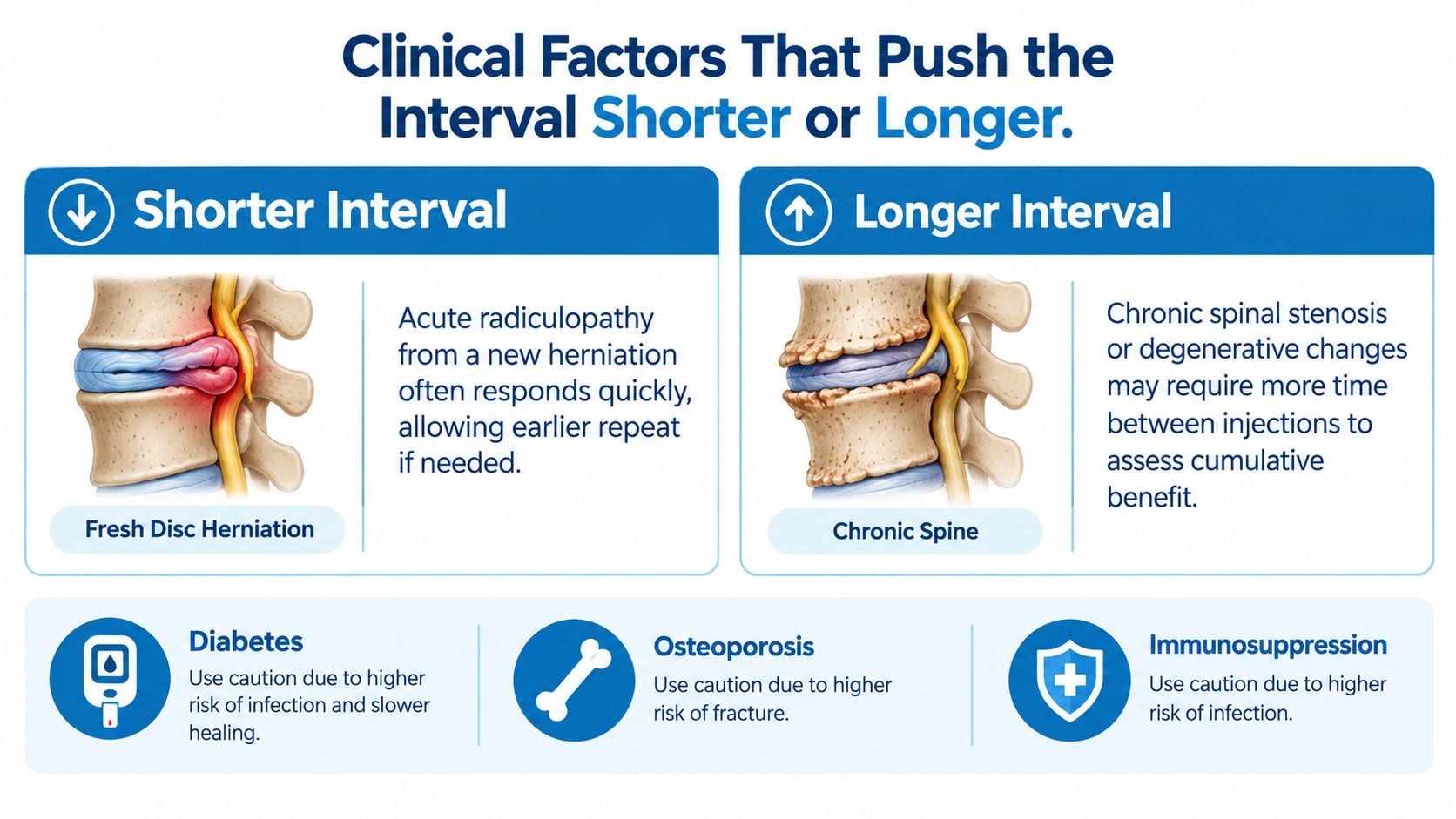
Two patients with the same diagnosis can reasonably follow different schedules. A fresh disc herniation with intense radicular pain presents a different problem from long-standing spinal stenosis. The first may be managed as a short diagnostic and therapeutic episode, while the second often calls for wider spacing tied to how long benefit lasts.
Patients learning about a herniated or bulging disc should also understand that imaging alone doesn't set the interval. Symptom pattern, neurologic examination, prior response, and overall health carry equal weight.
Situations That May Allow Earlier Review
An acute episode can justify earlier reassessment when the first injection produced a clear but incomplete improvement. The physician may need to determine whether a second session can extend function enough to support rehabilitation. Even then, earlier review doesn't mean immediate reinjection, because steroid type and endocrine effects still control safe spacing.
A diagnostic question can also affect timing. If the response pattern helps localize the pain generator, the clinician may evaluate another targeted procedure once the initial result can be interpreted reliably. The decision depends on what new information or functional gain the next session is expected to provide.
Factors That Usually Lengthen the Interval
Several conditions push toward longer spacing, lower dose, or avoidance:
- Diabetes with fragile glucose control: Steroid-related glucose disruption needs monitoring and may change the risk calculation.
- Osteoporosis or elevated fracture risk: Cumulative exposure becomes more consequential when bone health is already compromised.
- Anticoagulation: Medication management around the procedure must be coordinated carefully.
- Infection risk or immune suppression: Active infection or heightened susceptibility can delay treatment.
- Pregnancy: Procedure and imaging choices require individualized obstetric and pain-medicine review.
- Prior steroid reaction: Previous adverse effects may alter drug selection or rule out repetition.
- Systemic steroid use: Injections, oral steroids, and other exposures should be counted together.
Chronic stenosis also changes expectations. A narrow canal doesn't become less narrow because an injection is repeated sooner. When relief is modest or brief, extending the interval while reassessing rehabilitation, medication, and structural options is often more rational than compressing sessions.
The practical task is categorization. Acute radiculopathy, chronic degenerative pain, and medically complex pain don't belong on one timetable, even when the same annual ceiling appears in insurance documents.
Why Benefit, Not the Calendar, Should Drive the Next Injection
Pain returning isn't enough reason to repeat an injection. The previous session must have produced measurable improvement in pain, function, or activity tolerance sufficient to justify more steroid exposure. Without that evidence, scheduling another procedure adds risk while leaving the diagnostic question unanswered.

CMS guidance describes sustained benefit for ongoing treatment as typically at least 50% improvement in pain or objective function, measured with the same scale used at baseline, under CMS local coverage determination L39054. Other expert utilization criteria describe repeat therapeutic injections after approximately 2.5 to 3 months or longer of relief, while remaining within four sessions per year per region.
What Meaningful Benefit Looks Like
A strong response is not limited to a lower number on a pain scale. It may include:
- Walking farther: Greater distance or standing tolerance without the previous leg symptoms.
- Functioning more normally: Easier sitting, bending, dressing, work activity, or sleep.
- Using less medication: Reduced reliance on rescue pain medication because symptoms are better controlled.
- Participating in rehabilitation: Ability to complete therapy that was previously blocked by radicular pain.
- Maintaining the gain: Improvement that lasts long enough to change daily life, not only the ride home after local anesthetic.
Clinicians should compare the same measures over time. A baseline recorded before the first procedure, followed by consistent pain and function scoring, makes the next decision less subjective. Vague recollection months later is a weak basis for another steroid dose.
When the Response Argues Against Repetition
A brief response creates a different conclusion. If pain eased for only a few days, function never improved, or each successive injection helped less than the one before, repeating the same approach may expose the patient to steroid without adequate clinical value. That pattern should prompt reassessment of diagnosis, rehabilitation, medication strategy, or surgical indications.
The best evidence for another injection is durable improvement from the last one, documented in terms a patient can feel and a clinician can measure.
This standard also protects patients from a subtle trap. Temporary relief can feel so welcome that frequency becomes the goal, even while walking distance, strength, work capacity, and medication use remain unchanged. Benefit has to be broader than a short quieter period.
Understanding how often can you get epidural steroid injections therefore requires a record, not a hunch. Dates matter, but response determines whether the next date should exist.
Safety Considerations That Shape Every Repeat Decision
Safety explains why injections aren't spaced like routine maintenance appointments. Epidural medication can have systemic effects, and cumulative corticosteroid exposure rises with every session. The physician has to consider the epidural dose alongside steroids received through oral prescriptions, joint injections, inhalers, or other treatments.
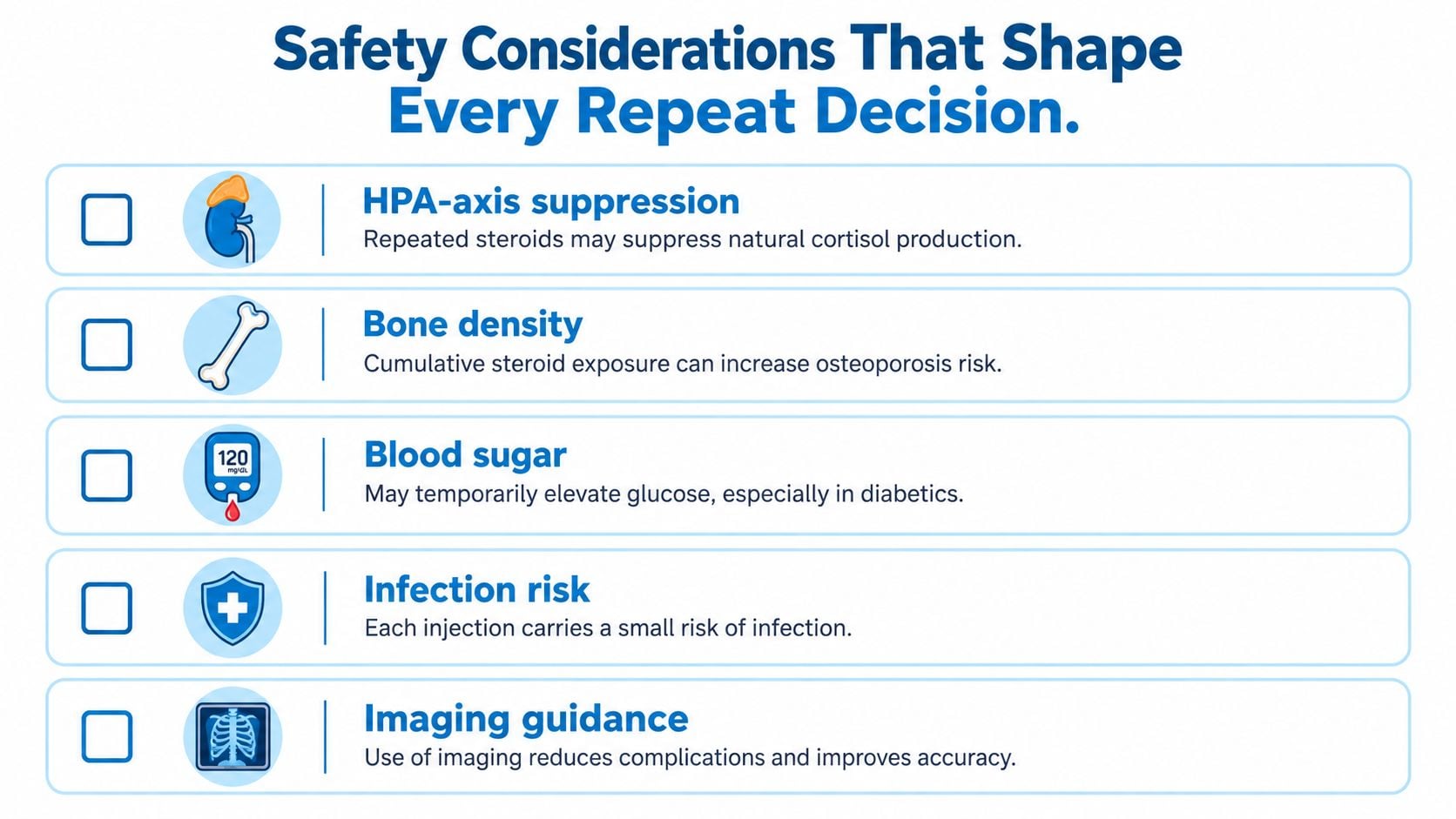
A peer-reviewed safety review reported that particulate steroids should usually be separated by about 3 to 4 weeks because suppression of the hypothalamic-pituitary-adrenal axis can persist, according to the peer-reviewed ESI safety review in PMC. Some expert guidance allows evaluation for a second diagnostic injection after at least two weeks, preferably four to six weeks depending on steroid and dose.
A Risk Screening Checklist Before Repeating
A careful pre-procedure review should cover five areas:
- Endocrine recovery: Prior particulate steroid dose, timing, systemic exposure, and symptoms suggesting adrenal suppression.
- Bone health: Osteoporosis, prior fragility fracture, long-term steroid exposure, and other fracture risks.
- Glucose control: Diabetes history, recent control, monitoring capacity, and medication adjustments after treatment.
- Bleeding and infection risk: Anticoagulants, immune suppression, skin infection, fever, or recent systemic illness.
- Procedure-specific risk: Spinal region, route, image guidance, anatomy, prior surgery, and the lowest effective steroid dose.
Repeated long-term steroid exposure may accelerate bone loss in patients with osteoporosis or high fracture risk. Glucose disruption can be clinically important even when pain relief is satisfactory. Those trade-offs do not automatically prohibit treatment, but they should be explicit rather than discovered after several sessions.
FDA Warnings and Red Flags
FDA labeling warns that serious neurologic events, including some resulting in death, have been reported after epidural corticosteroid administration, and epidural use is not an FDA-approved indication, a point summarized in Hospital for Special Surgery epidural injection guidance. These events are presented as serious safety concerns requiring informed discussion, careful technique, and appropriate patient selection.
Urgent evaluation is needed for vision changes, sudden weakness or numbness, severe headache, dizziness, or seizures after a procedure. Those symptoms aren't reasons to wait for the next routine appointment. New or rapidly worsening neurologic deficits also require prompt assessment rather than automatic reinjection.
More frequent treatment isn't necessarily better, even when pain temporarily falls. Safety review turns the question from simple availability into a defensible balance between expected functional gain and cumulative risk.
When to Step Back and Reconsider the Plan
A routine series shouldn't be assumed. Evidence reviews have found limited data for determining the exact frequency, timing, or degree of improvement that should justify repeating an epidural injection, and no clear evidence supports giving injections as a routine series regardless of response. That uncertainty makes individual reassessment more important, not less.
Stepping back is appropriate when pain returns quickly after every session. It's also appropriate when pain scores improve briefly but walking, strength, work tolerance, and medication use don't change. A mismatch between reported relief and functional recovery suggests the plan isn't solving the main problem.
Signals That the Strategy Needs Review
- No meaningful response: The prior injection produced little pain or functional improvement.
- Diminishing duration: Each session helps for a shorter period than the one before.
- Escalating exposure: Steroid dose is accumulating while benefit stays flat.
- Structural mismatch: Imaging and examination point to compression or instability that an anti-inflammatory injection cannot correct.
- Changing neurology: Weakness, gait difficulty, or other deficits need diagnostic attention.
- Unclear pain generator: Symptoms don't fit the treated nerve level or another source becomes more likely.
The next-step menu depends on the reassessment. Targeted physical therapy may address weakness, movement tolerance, and deconditioning. Advanced imaging or diagnostic blocks may clarify whether facet joints, sacroiliac structures, or a different nerve level are involved.
Learning about the broader types of injections used in pain management can help patients understand why a medial branch block, selective nerve block, or radiofrequency ablation may be considered instead of another epidural. Spinal cord stimulation may enter discussion for selected persistent neuropathic pain patterns. Surgical consultation becomes relevant when structural compression, instability, or progressive neurologic problems require decompression or stabilization.
None of those options should be framed as failure. An injection that stops providing durable value has supplied useful information. Continuing it because sessions remain under an annual ceiling wastes that information and delays a better matched treatment.
The right question at that point isn't how many sessions are left. It's what diagnosis, mechanism, or structural problem the response pattern has revealed.
A Practical Decision Framework for Your Next Visit
A useful appointment can be organized around three questions, answered in order. They connect benefit, safety, and alternatives without reducing the decision to an insurance count.
Three Questions to Answer in Order
- Did the last injection produce durable, meaningful improvement? Review pain, walking, work, sleep, medication use, and rehabilitation participation against the baseline recorded before treatment.
- Has the risk profile changed? Discuss cumulative steroid exposure, diabetes control, bone density, infection risk, anticoagulation, pregnancy, and any adverse effects after the prior session.
- Does another option fit the current problem better? Consider rehabilitation, diagnostic reassessment, a different targeted procedure, neuromodulation, or surgical evaluation when the response pattern supports it.
If the first answer is weak, the remaining questions usually point away from automatic repetition. If benefit was substantial and risks remain acceptable, timing can be individualized around steroid type, duration of relief, and the goal of the next session.
Patients can make that conversation more productive by bringing injection dates, spinal region, medication changes, glucose concerns, and a brief record of what activities improved. A precise history turns how often can you get epidural steroid injections into a clinical plan rather than a calendar negotiation.
Patients in New Jersey and Staten Island who need a clear plan after an epidural steroid injection can review their response, cumulative steroid exposure, and non-injection or surgical alternatives with the multidisciplinary team at Interventional Pain Management. Schedule an evaluation to determine whether another injection is justified, whether the interval should change, or whether reassessment points to a better next step.