
A common spinal stenosis story starts the same way. Someone notices that standing in the kitchen feels harder than it used to. A walk through the grocery store turns into a search for somewhere to sit. The legs may ache, burn, feel heavy, or go numb, and the symptoms often ease when sitting down or leaning forward.
That pattern can feel confusing and unsettling. Many people worry that a diagnosis means the only choices are to “live with it” or have surgery right away. That isn't how care usually works. Spinal stenosis treatment options exist along a spectrum, and each step has a different purpose.
Some treatments aim to calm irritation and improve day-to-day function. Others target inflamed nerves more directly. Surgery becomes part of the conversation when symptoms are severe, progressive, or no longer responding to less invasive care. The important point is that treatment is usually a guided progression, not a single yes-or-no decision.
Table of Contents
- Navigating Your Path Forward from Spinal Stenosis Pain
- What Is Spinal Stenosis and Why Does It Happen
- Conservative Treatments The Foundation of Your Care
- Interventional Procedures for Targeted Pain Relief
- Exploring Your Surgical Treatment Options
- How to Choose the Right Spinal Stenosis Treatment
- Partnering with a Specialist for Your Treatment Journey
Navigating Your Path Forward from Spinal Stenosis Pain
A patient with spinal stenosis often doesn't complain first about the MRI. The complaint is usually about life getting smaller. Walking the dog becomes half the distance. Standing at a child's game becomes a problem. A trip that used to feel simple now requires planning around benches, carts, and frequent breaks.
That loss of freedom can create a lot of fear. People often wonder whether they waited too long, whether they caused the problem, or whether every symptom means permanent damage. In most cases, none of those assumptions helps. What helps is understanding where a person is on the treatment spectrum and what each next step is meant to accomplish.
Spinal stenosis treatment options make more sense when viewed as a progression of care. Early treatment often focuses on reducing strain, improving tolerance for movement, and seeing how the body responds to structured therapy. If that isn't enough, a specialist may move toward targeted procedures to calm nerve irritation. If symptoms continue to limit walking, balance, strength, or function, surgery may become the most effective next step.
Relief starts with a clear goal
The first question usually isn't “What treatment is best in general?” It's “What problem needs solving right now?”
For one person, the priority is standing long enough to cook dinner. For another, it's getting through a workday without leg pain. Someone else may already have weakness or worsening balance, which changes the urgency of treatment.
The right plan starts with the patient's symptoms and function, not just the scan.
Some readers who are hoping to avoid an operation may also want to find non-surgical back relief before considering more invasive care. That can be a useful starting point, especially when symptoms are mild to moderate and daily function is still reasonably preserved.
What Is Spinal Stenosis and Why Does It Happen
Spinal stenosis means there's less room than there should be around the nerves in the spine. A simple way to understand it is to think of a traffic jam for the nerves. When the space narrows, the nerves don't have enough room to move comfortably. That pressure can create pain, tingling, numbness, heaviness, cramping, or weakness.
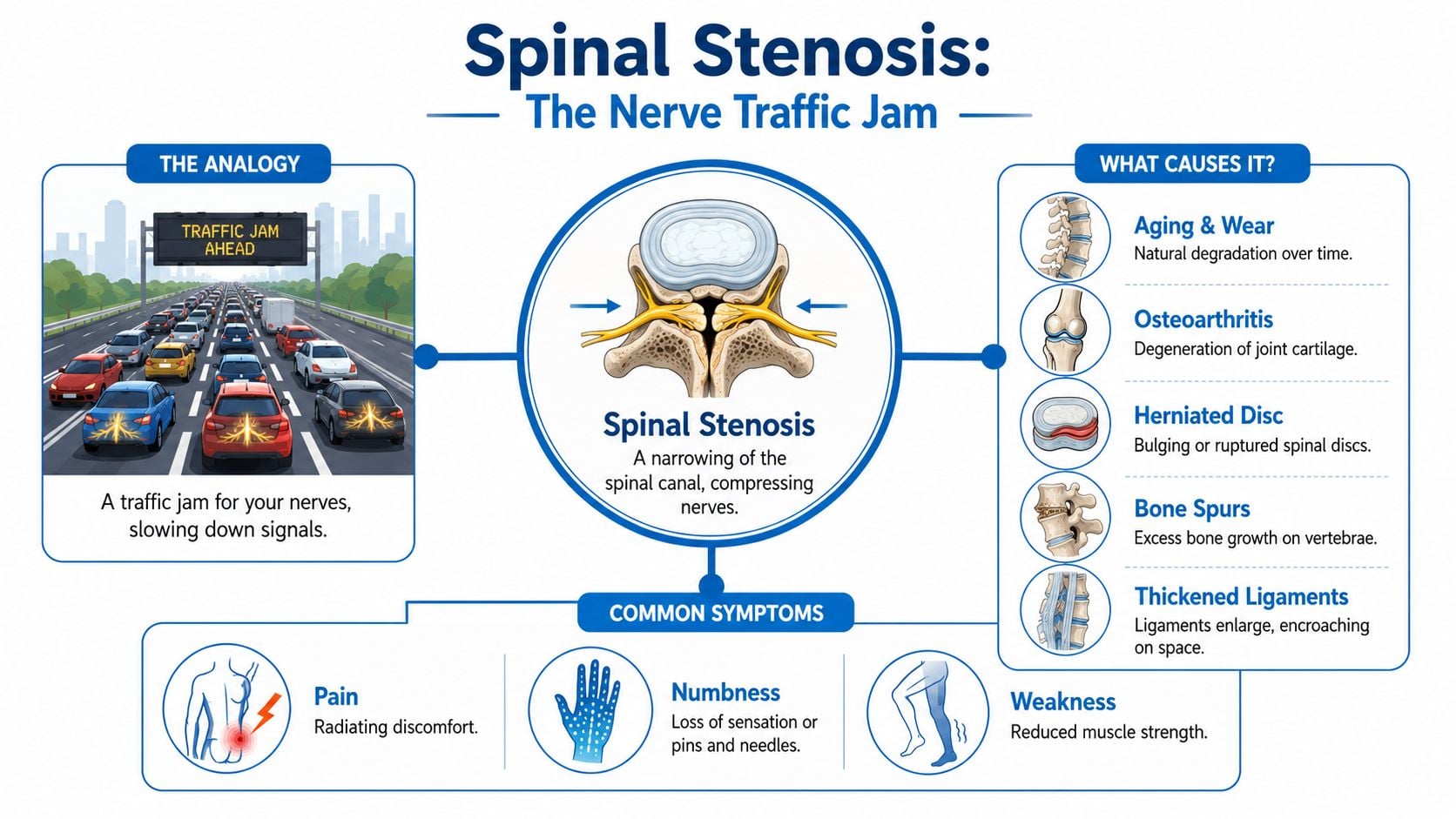
The nerve traffic jam idea
The narrowing usually develops over time. Common contributors include age-related wear, arthritis, thickened ligaments, herniated discs, and bone spurs. Each of those changes can take up space inside a tightly organized area where nerves need room.
The symptoms happen because compressed nerves don't send signals normally. A nerve under pressure may produce pain that shoots into an arm or leg. It may also produce less obvious symptoms, such as leg fatigue when walking or a sense that the feet aren't working quite right.
A person may have imaging that shows narrowing without major symptoms. Another person may have more noticeable limits in walking or standing with only moderate imaging findings. That's one reason treatment decisions depend on both the scan and the actual day-to-day pattern of symptoms.
Lumbar and cervical stenosis feel different
Lumbar spinal stenosis affects the lower back. It often causes pain, tingling, numbness, or heaviness in the buttocks and legs. A very typical pattern is pain with standing or walking that eases with sitting or bending forward. That happens because posture can change how much room the nerves have.
Cervical spinal stenosis affects the neck. It can cause neck pain, arm symptoms, hand clumsiness, weakness, or balance trouble. When the spinal cord is involved, symptoms may go beyond simple pain and include changes in coordination or gait. Those patients often need a more urgent specialist evaluation.
Why the cause matters to treatment
The reason for the narrowing influences which spinal stenosis treatment options fit best.
- Inflammation around a compressed nerve may respond to medication or an injection.
- Mechanical narrowing from bone, ligament, or disc material may continue to cause symptoms despite therapy.
- Instability in the spine can make a purely decompressive approach less appropriate in some surgical cases.
Practical rule: Symptoms tell a specialist how much the stenosis affects function. Imaging helps show why it's happening.
Conservative Treatments The Foundation of Your Care
A common starting point looks like this. A patient can still manage daily life, but standing in the kitchen, walking through a store, or being on their feet for too long brings on leg pain, numbness, or heaviness. In that situation, the first goal is usually not surgery. The first goal is to calm irritated tissues, improve movement, and see how much function returns with lower-risk treatment.
That is why conservative care sits at the front of the spinal stenosis treatment spectrum. It gives the spine and nerves a fair trial of treatment before more invasive options are considered. It also helps clarify the driver of symptoms. Some people improve once inflammation settles and strength returns. Others improve only a little because the narrowing itself remains the main problem.
For many patients, this phase lasts several weeks and often up to about 2 to 3 months before the plan is reassessed, as described in the American Academy of Orthopaedic Surgeons overview of lumbar spinal stenosis. That timeline is not arbitrary. It gives enough time to judge whether symptoms are truly responding, not just fluctuating from one good day to the next.
What conservative care usually includes
Conservative treatment usually works best as a coordinated plan rather than a single fix. Spinal stenosis behaves less like a sore muscle and more like a crowded hallway. If the nerves are being irritated in a tight space, treatment often needs to reduce irritation, improve how the body moves through that space, and build tolerance gradually.
Activity modification is often the first adjustment. This does not mean bed rest. It means temporarily changing the movements or positions that predictably flare symptoms, such as prolonged standing, downhill walking, or extended walking on hard surfaces. Small changes in posture, pacing, and rest breaks can make daily activity more tolerable.
Physical therapy gives structure to that process. A good program often focuses on mobility, core and hip strength, posture, balance, and walking tolerance. For lumbar stenosis, therapy may also use positions that gently flex the spine, since many patients feel better when the lower back is slightly bent rather than extended.
Medication support can reduce pain enough for a patient to participate in therapy and stay active. Depending on the person, that may include anti-inflammatory medication or other pain-relieving options recommended by a clinician. The point is not to mask symptoms and push through them. The point is to lower the noise level so the patient can move more normally.
Home exercise matters just as much as clinic visits. Progress usually comes from repeated, consistent practice. A therapist may see a patient for short blocks of time, but the body changes between appointments.
For readers who want a broader explanation of how rehabilitation fits into spine care, this guide to back and neck pain relief offers a useful overview.
Some patients also benefit from a more structured pain management evaluation, especially if pain is limiting sleep, walking, or participation in therapy.
Why this stage matters, even when it does not solve everything
Patients sometimes worry that choosing conservative care means delaying real treatment. In most cases, it is real treatment. It is also an information-gathering phase.
Here is the practical value. If walking distance improves, recovery after activity gets faster, and symptoms become less disruptive, conservative care may be enough to keep the condition manageable. If symptoms remain stubborn despite a good trial of therapy, medication, and home exercise, that result is useful too. It tells the specialist that the structural narrowing may be playing a larger role.
An evidence review summarized by the American Academy of Family Physicians summary on lumbar spinal stenosis notes that nonoperative treatments may offer short-term symptom relief, but strong evidence for changing long-term progression is limited. Patients often find that statement confusing. It does not mean therapy has no value. It means conservative treatment often helps function and comfort, but it does not physically remove the narrowing.
That distinction matters.
A cane can help someone walk farther. It does not change the shape of the sidewalk. Conservative care works in a similar way. It can improve how a person functions within the limits of the stenosis, and in many cases that improvement is enough. In other cases, it helps define the decision point for the next step.
What success looks like at this stage
Success in conservative care is measured by daily function, not by whether the MRI changes.
Signs that this phase is helping include:
- Walking farther before symptoms start
- Needing fewer stops during errands or household tasks
- Having less intense leg pain, numbness, or heaviness
- Recovering faster after activity
- Feeling more steady and less guarded with movement
Those gains may be modest at first. That is normal.
The key question is whether the patient is trending in the right direction. If the answer is yes, conservative care remains the foundation of treatment. If the answer is no, that becomes a clear decision point along the care spectrum, not a failure.
Interventional Procedures for Targeted Pain Relief
A common moment in the treatment journey looks like this. A patient has done the work with medication, activity changes, and therapy, yet walking still brings on burning leg pain or heaviness too quickly. Surgery may not be the right next step, but staying stuck is not a good plan either. That is where interventional care can help.

These procedures sit in the middle of the care spectrum. Their job is focused. They aim to reduce pain enough to restore function, improve sleep, and create a better window for rehabilitation or clearer decision-making.
How injections fit into the journey
For lumbar spinal stenosis, epidural steroid injections are the most common nonsurgical spine procedure. A review in PMC on epidural injections for lumbar spinal stenosis explains that these injections can reduce inflammation around irritated nerves and provide temporary relief for some patients, though they do not change the underlying narrowing itself.
That difference is important because many patients expect an injection to widen the canal. It does not. The treatment works more like lowering the volume on an irritated nerve inside a crowded space. When that irritation settles down, walking, standing, and therapy may become more tolerable.
Used well, an injection can create a short but meaningful opportunity. A patient who had to stop every few minutes during physical therapy may be able to complete sessions. Another may use that period of relief to build strength, improve endurance, and decide with more confidence whether the next step should still be surgery.
Patients who want a closer look at how this treatment is used can review epidural steroid injections as part of the broader interventional care pathway.
A good injection is judged by what function returns after the procedure.
Other targeted procedures a specialist may discuss
Epidural injections are only one option. The right procedure depends on the pattern of symptoms and the structure that appears to be generating pain.
- Facet-related procedures: If painful arthritic facet joints are part of the problem, a specialist may recommend diagnostic blocks or radiofrequency ablation.
- Selective nerve root injections: If symptoms follow one nerve distribution, a targeted injection can help confirm the source and calm irritation around that nerve.
- Minimally invasive decompression procedures: Some patients who are not ready for open surgery may be candidates for smaller decompressive procedures aimed at relieving pressure in a more limited way.
The North American Spine Society guideline for degenerative lumbar spinal stenosis places these kinds of treatments in the interval between basic conservative care and larger surgical decompression. In practice, that middle step is often useful when the goal is to gain symptom control while refining the diagnosis or testing how much relief changes day-to-day function.
When interventional care is most useful
This phase often makes sense in four situations.
First, conservative care produced partial improvement, but daily life is still too limited. The patient is better than before, just not well enough.
Second, pain is blocking progress. Therapy may be the right idea, but symptoms are too intense to allow steady participation.
Third, the diagnosis needs more precision. A targeted procedure can sometimes help confirm whether the main pain source is a specific nerve, a facet joint, or another structure.
Fourth, surgery is under consideration, but not yet clearly the next move. Some patients need time to weigh options, address other medical issues, or see whether a period of targeted relief changes the picture.
Interventional care works best as part of a step-by-step plan with a clear goal. The procedure itself is only one piece. What matters most is whether it helps the patient walk farther, function better, and understand the next decision along the treatment spectrum.
Exploring Your Surgical Treatment Options
A common turning point sounds like this: walking through the grocery store used to be manageable, but now the legs burn, feel heavy, or grow weak before the end of the second aisle. Sitting down helps. Leaning forward helps. Yet each month, the distance gets shorter. That is often when surgery enters the conversation, not as a first step, but as the next point on the treatment spectrum when symptoms, function, and nerve health no longer match what less invasive care can reasonably improve.
The central goal is simple. Surgery creates more space for the nerves, and in some cases it also stabilizes the spine when extra motion is part of the problem.
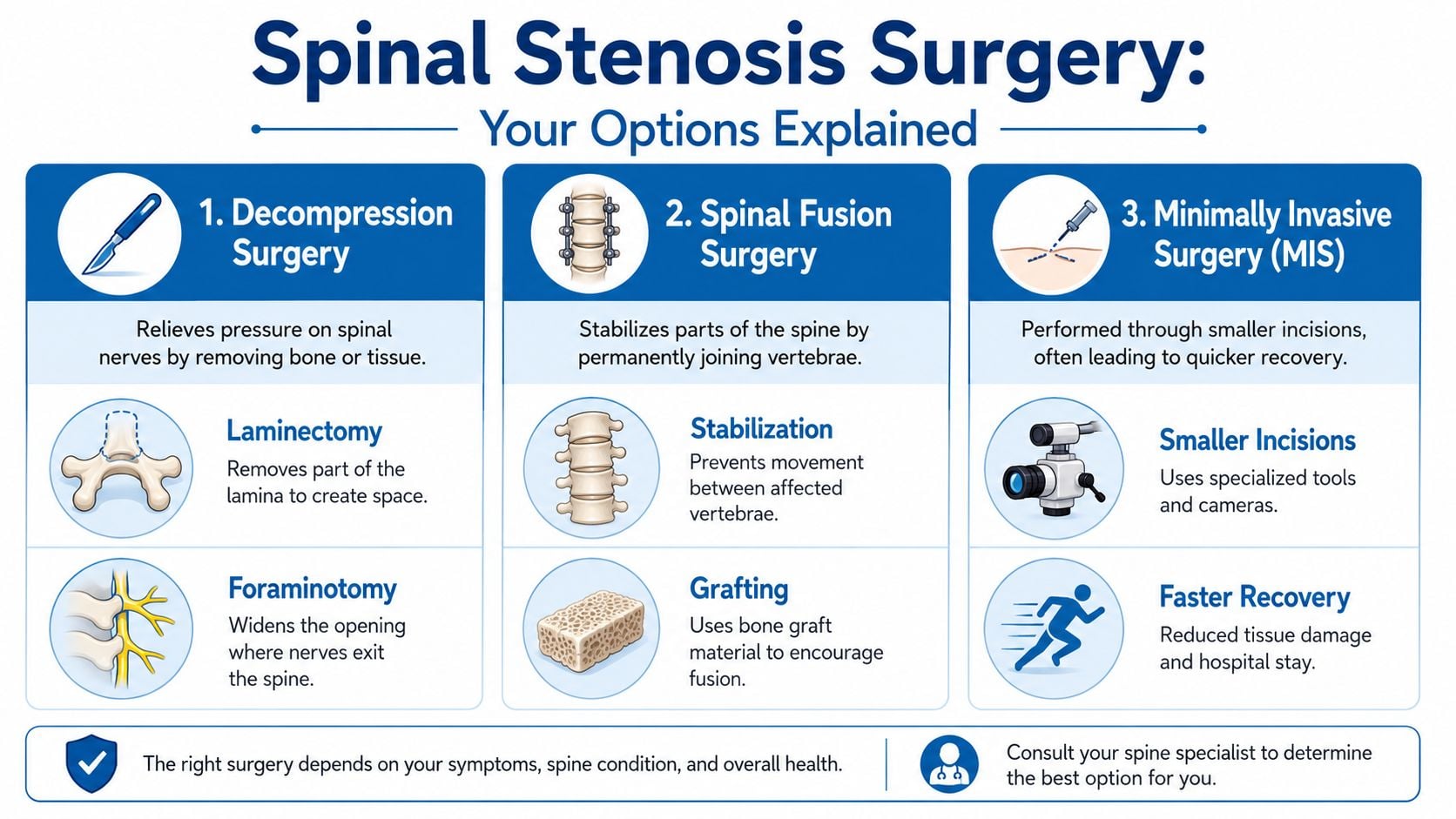
Decompression surgery and its goal
The most common surgical path for spinal stenosis is decompression. A useful way to picture it is a crowded hallway. If the hallway narrows too much, people cannot pass through comfortably. Decompression widens that passage so the nerves have room again.
A laminectomy is one of the best-known decompression procedures. It removes part of the bony roof at the back of the spinal canal to reduce pressure. Other operations may widen the opening where a nerve exits the spine or target a smaller, more localized area of narrowing. The right procedure depends on the exact anatomy causing the symptoms.
The key point is matching the operation to the patient, not to the scan alone. Surgery works best when the imaging findings, physical examination, and symptom pattern all point to the same pain generator.
Published guidance and long-term studies support decompression surgery for carefully selected patients with lumbar spinal stenosis. They show that many patients improve in pain and function after surgery, and long-term follow-up has found better symptom relief for some surgical patients than for those treated nonoperatively. Patients who want a clearer picture of the procedure itself can review laminectomy surgery and recovery information.
When fusion or other advanced procedures enter the picture
Some patients need decompression alone. Others need decompression plus stabilization.
A fusion may be considered when there is spinal instability, such as slippage between vertebrae, or when removing enough bone to free the nerves would leave the segment too loose. In that situation, the surgeon is addressing two problems at once. One is nerve compression. The other is abnormal motion that can continue to trigger pain or place stress on the nerves.
There are also cases where less invasive decompression techniques, interspinous spacer devices, or other procedure-specific approaches may fit the anatomy and the patient's overall health. These options are usually best for selected situations, not as one-size-fits-all substitutes for standard decompression.
Surgery is a group of procedures selected to fit the structure causing the symptoms.
Why the right operation depends on the spine itself
Two patients may both report leg pain with walking and still need very different operations.
One person may have a single narrowed level with no instability. A focused decompression may be enough. Another may have multilevel narrowing, arthritis, and vertebral slippage. That patient may need a broader decompression, sometimes with fusion. A third may have cervical stenosis with signs of spinal cord compression, which changes both timing and surgical planning.
A surgical specialist usually sorts through several questions before recommending a procedure:
- Where is the stenosis located? Lumbar, cervical, and less commonly thoracic stenosis are treated differently.
- How many levels are involved? One compressed level is a different surgical problem than several.
- Is the spine stable? If not, decompression alone may leave pain or nerve irritation unresolved.
- Are there neurologic changes such as weakness, balance trouble, or declining walking tolerance? Those findings carry more weight than pain alone.
- What is the patient's overall health and recovery capacity? The best operation is the one that safely addresses the problem with a realistic recovery plan.
For many patients, the hardest part is not hearing the name of the procedure. It is understanding why that procedure, and why now. A good surgical discussion should answer both. The decision point is not fear versus bravery. It is whether the nerves need more space, whether the spine also needs support, and whether surgery offers the clearest path to better function after reasonable nonoperative care has already had its chance.
How to Choose the Right Spinal Stenosis Treatment
Choosing among spinal stenosis treatment options isn't about finding the “strongest” treatment. It's about matching the treatment to the problem that exists right now. A patient with mild symptoms and stable function doesn't need the same plan as someone with worsening weakness or serious limits in walking.
Specialists usually make that decision by combining four kinds of information. They look at symptoms, physical exam findings, imaging, and the patient's functional goals. A scan alone doesn't choose treatment. Neither does pain alone.
Spinal Stenosis Treatment Options at a Glance
| Treatment Category | Primary Goal | Invasiveness | Typical Recovery | Best For |
|---|---|---|---|---|
| Conservative care | Reduce irritation, improve movement, build tolerance for activity | Low | Often gradual, over weeks to months | Mild to moderate symptoms without urgent neurologic decline |
| Interventional procedures | Calm inflamed nerves and create a window for better function | Minimally invasive | Usually shorter-term recovery focused on resuming activity | Persistent pain limiting therapy or daily life despite initial conservative care |
| Surgical treatment | Create more space for compressed nerves and address structural causes | Higher | Recovery varies by procedure and patient needs | Severe symptoms, progressive deficits, instability, or failure of less invasive care |
What a specialist weighs before recommending a plan
A thoughtful recommendation often comes down to practical questions.
- How limited is walking or standing? A patient who can still function reasonably well may continue with nonoperative care. A patient who can’t get through routine daily tasks may need escalation.
- Are symptoms mostly pain, or is there neurologic change? Numbness, weakness, balance decline, or gait change can shift the plan faster.
- Does the symptom pattern match the imaging? Treatment is strongest when the clinical story and the scan point to the same level and mechanism.
- What has already been tried? A patient who hasn’t had organized conservative care is in a different place than one who has already completed it without meaningful benefit.
- What outcome matters most to the patient? Returning to work, walking farther, sleeping comfortably, and avoiding repeated flare-ups are different targets.
A useful example is the patient whose main issue is leg pain during walking, with imaging that shows lumbar stenosis and no major instability. That person may start with therapy and medication, then move to an injection if progress stalls. Another patient with worsening weakness or clear instability may move toward surgical consultation much sooner.
The best treatment is the one that matches the severity of symptoms, the anatomy on imaging, and the patient’s functional priorities at the same time.
The goal isn’t to rush. The goal is to avoid staying too long at a level of treatment that no longer fits the problem.
Partnering with a Specialist for Your Treatment Journey
A patient may start with occasional leg heaviness while walking and, months later, find that a trip to the grocery store feels like a mile-long obstacle course. That kind of change is why spinal stenosis care works best as an ongoing partnership, not a one-time treatment choice.
A good specialist helps you place your symptoms on the spectrum of care and reassess that position as your condition changes. Early on, the focus may be symptom control, walking tolerance, and preserving daily function with nonsurgical care. If progress stalls, the goal shifts to finding out why. Is inflammation driving the pain, or is the nerve space now tight enough that a procedure or surgical opinion makes more sense?
That stepwise review is not guesswork. It works like following a roadmap with clear checkpoints. Your history, exam, imaging, response to earlier treatment, and personal goals all need to point in the same direction before the plan advances. The North American Spine Society guideline for degenerative lumbar spinal stenosis supports this kind of structured decision-making, where treatment choices are matched to symptoms, function, and imaging rather than chosen in isolation.
Coordination matters because spinal stenosis often sits at the intersection of several questions at once. One clinician may help sort out whether pain is coming from nerve compression, another may perform image-guided procedures, and a spine surgeon may weigh in if nerve pressure, instability, or progressive neurologic loss becomes the main issue. When those perspectives are aligned, patients are less likely to feel rushed toward an invasive option and less likely to spend months repeating treatments that no longer fit the problem.
The right specialist does more than offer a procedure. That clinician helps you understand where you are on the treatment spectrum, what the next reasonable step is, and what result should tell you it is time to stay the course or change direction.
Patients dealing with back, leg, neck, or nerve-related pain can explore care through Interventional Pain Management, where board-certified specialists coordinate non-invasive treatment, image-guided procedures, and surgical evaluation when needed.