
Popular advice makes thoracic outlet syndrome treatment sound cleaner than it is. The usual story says symptoms point to one clear fix, physical therapy first, injections if needed, surgery if nothing else works. In reality, much of that pathway is based on clinical pattern recognition and subtype-specific practice, not on strong randomized proof, and that uncertainty matters when someone is deciding what to do next.
That doesn't make care ineffective. It means thoracic outlet syndrome is one of those conditions where the diagnosis, the subtype, and the treatment goals have to line up before any option has a fair chance of helping. A patient with arm swelling and venous blockage needs a different path than a patient with neck pain, hand numbness, and postural compression, and the certainty level behind each recommendation is not the same.
Table of Contents
- Why Most TOS Treatment Advice Misses the Full Picture
- Understanding the Three Subtypes of Thoracic Outlet Syndrome
- Conservative Management Through Physical Therapy and Medications
- Interventional Pain Procedures as a Bridge to Relief
- Surgical Options and Expected Outcomes for TOS
- Recovery Timelines and What to Expect After Treatment
- Making the Right Treatment Decision for Your Situation
- Accessing Multidisciplinary TOS Care in New Jersey
Why Most TOS Treatment Advice Misses the Full Picture
The biggest mistake in most patient education is treating thoracic outlet syndrome as if every intervention has the same level of proof. A recent Cochrane review found no evidence demonstrating beneficial effects of established operative or non-operative interventions compared with natural progression for pain relief in TOS PMC review. That doesn't mean clinicians are guessing blindly, but it does mean many recommendations rest on experience, anatomy, and observed outcomes rather than definitive trial superiority.
That gap changes how treatment should be framed. For many patients, the question is not “Which therapy is proven to work best?” The better question is “Which approach matches the subtype, symptom pattern, and risk profile well enough to justify a trial?” That is a much more honest way to talk about thoracic outlet syndrome treatment.
Practical rule: If a treatment is presented as a cure, ask what it's actually expected to do, relieve pain, improve function, confirm the diagnosis, or prepare for surgery.
Modern care works best when it's individualized. A multidisciplinary team can sort through overlapping neck, shoulder, nerve, and vascular symptoms, then decide whether the patient needs conservative care, an interventional bridge, or decompression surgery. That's especially important because TOS symptoms can look like other problems and because the same treatment can mean different things in different subtypes.
The honest version of care is not less reassuring. It's more useful. Patients deserve to know where the evidence is solid, where it's mixed, and where clinicians are relying on the most sensible pathway available rather than a perfect trial-backed answer.
Understanding the Three Subtypes of Thoracic Outlet Syndrome
Subtype drives treatment. That is the first thing to get right, because a person with neurogenic TOS does not follow the same pathway as someone with venous TOS or arterial TOS. Contemporary reviews describe neurogenic cases as the large majority of diagnosed TOS, while venous TOS and arterial TOS are much less common Frontiers review.
Why the subtype changes the urgency
Neurogenic disease usually presents with pain, numbness, tingling, heaviness, or weakness in the arm and hand. Venous disease behaves differently, with swelling and color change suggesting true vascular obstruction. Arterial disease is the rarest of the three and can threaten blood flow, so it usually moves faster toward procedural or surgical care.
The epidemiology is messy because diagnostic criteria have varied so much. Published incidence estimates span a wide range, and more recent analyses suggest neurogenic TOS may be uncommon on a population basis Frontiers review. That spread is one reason clinicians lean heavily on pattern recognition and careful exclusion of look-alike conditions.
| TOS Subtypes at a Glance | Prevalence | Key Symptoms | Treatment Urgency |
|---|---|---|---|
| Neurogenic TOS | 80% to 95% of diagnosed cases | Pain, numbness, tingling, heaviness, weakness | Usually begins with conservative care |
| Venous TOS | About 3% to 5% | Swelling, discoloration, venous congestion | Often urgent procedural or surgical care |
| Arterial TOS | About 1% to 2% | Coolness, pallor, reduced blood flow signs | Urgent vascular evaluation and intervention |
What subtype means in the clinic
With neurogenic symptoms, treatment starts with posture change, physical therapy, and symptom control. Vascular cases often need earlier intervention because the problem is not just irritation, it is obstruction. That is why the label matters so much, it determines whether the next step is rehabilitation, an injection, or a vascular procedure.
A patient's symptom pattern should never be forced into a one-size-fits-all plan. The treatment path should follow the structure being compressed, not the other way around.
Conservative Management Through Physical Therapy and Medications
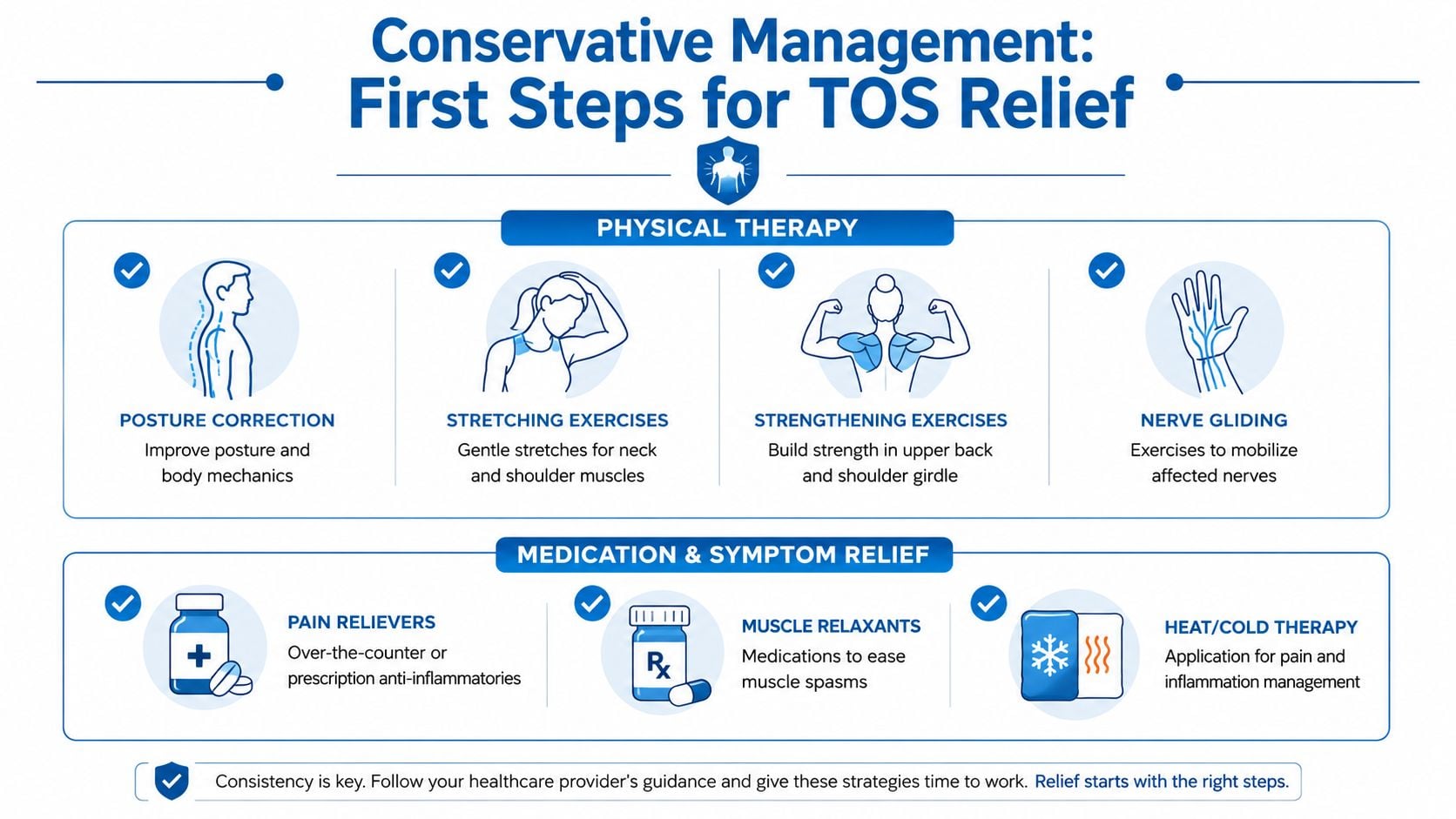
For many neurogenic cases, conservative care is the starting point. The aim is not to repair the thoracic outlet in one move, it is to reduce the forces that create compression, improve shoulder girdle mechanics, and lower symptoms enough for the patient to function better in daily life. The evidence base for this pathway is uneven, so some recommendations rest more on clinical experience and rehab principles than on large randomized trials. Even so, postural education, activity modification, targeted strengthening, mobility work, and breathing retraining remain the standard first steps in evidence-based rehabilitation Niel Asher review.
What a serious PT trial looks like
A useful physical therapy program targets scapular stabilization, deep neck flexor work, pectoralis minor and scalene lengthening, thoracic mobility, and a graded return to overhead or load-bearing tasks. The point is to change the mechanics that narrow the thoracic outlet, not just reduce pain for a few hours.
Manual therapy can help, but it should be treated as support rather than the whole plan. Soft-tissue work, joint mobilization, and rib or clavicle techniques may calm symptoms enough to let the patient stay engaged with exercise and activity retraining. The durable change usually comes from movement retraining and load management, not passive treatment alone.
A real trial of PT also has to be measured against function. If a patient can tolerate more sitting, reaching, lifting, or desk work with fewer flares, that is meaningful progress even before pain disappears.
Where medications fit
Medication has a symptom-control role. NSAIDs, muscle relaxants, and neuropathic pain agents can reduce pain enough to make PT tolerable, but they do not remove the mechanical source of compression. For that reason, medication should be viewed as a helper, not a cure.
Clinical takeaway: If symptoms improve only while medication is active but return with posture, overhead work, or carrying, the underlying mechanical driver is still there.
Activity changes matter just as much as exercises. Desk workers may need screen height and arm support changes. Overhead laborers and athletes often need temporary load reduction, then a gradual rebuild. The most realistic conservative trial is consistent, structured, and long enough to judge whether function is improving, not just whether a flare settled for a day.
Interventional Pain Procedures as a Bridge to Relief
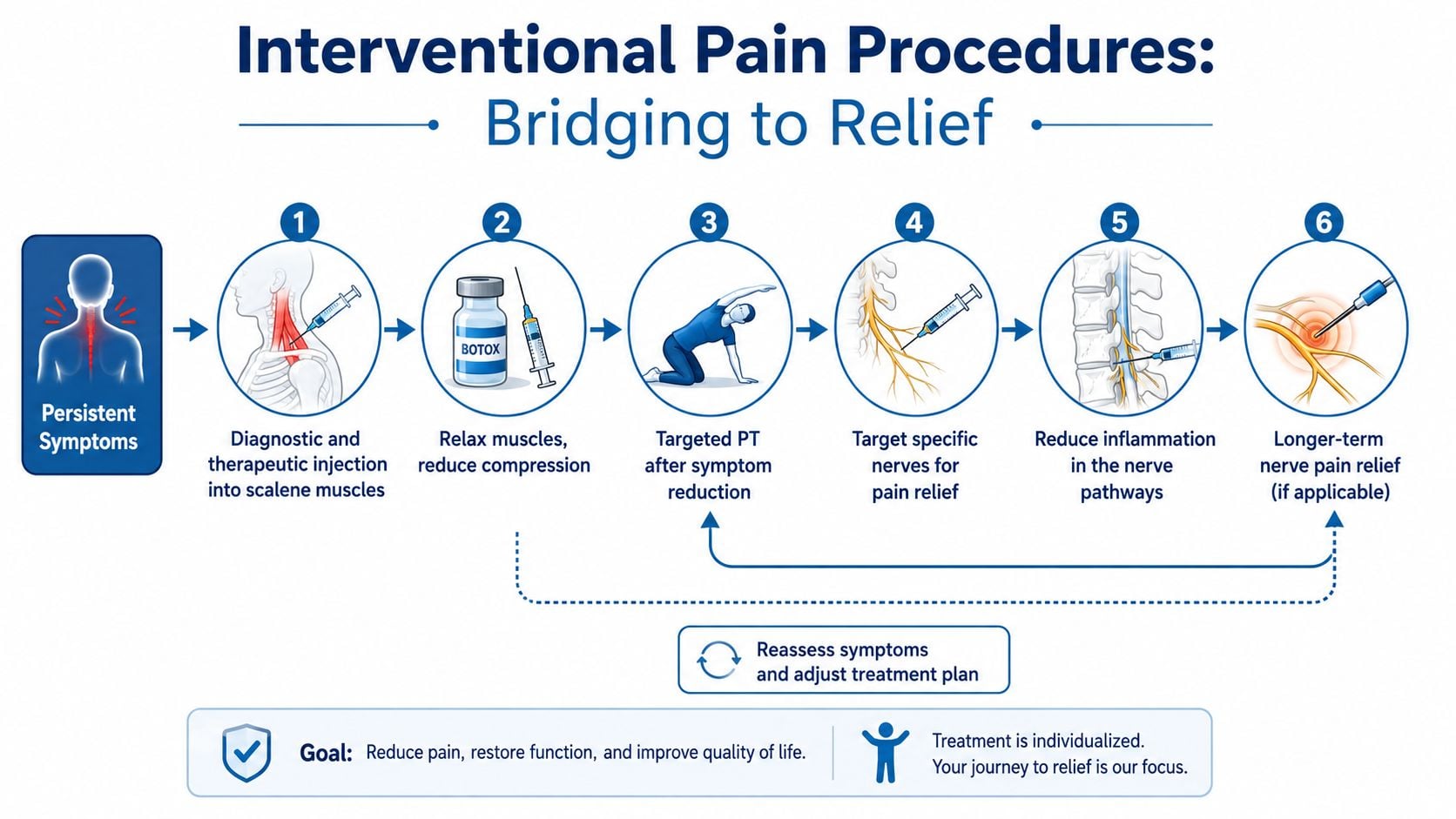
When conservative care is not enough, injections and related procedures can serve two roles. They can reduce pain, and they can help clarify whether decompression surgery is likely to help. For neurogenic TOS, local anesthetic, onabotulinumtoxinA, or steroid injections may be used, and rehab guidance places chemodenervation later in the pathway when symptoms persist after conservative care.
Why blocks matter more than they get credit for
A scalene muscle block is often used as both a therapeutic and diagnostic step. If relaxing the scalene region meaningfully reduces symptoms, that suggests the muscle and the surrounding compression are playing a real role. A similar logic applies to botulinum toxin, which can temporarily reduce muscle tightness and create a better window for function and therapy.
For patients with nerve-dominant pain, a nerve block can be a useful bridge when symptoms are too disruptive for rehab alone. A more detailed discussion of that role is available through the internal resource on nerve block treatment, which fits naturally into this type of stepwise care.
What these procedures can and can't do
These interventions are not permanent fixes. Their value is usually in temporary relief, diagnostic clarification, and treatment selection. That matters because a patient who improves after a targeted injection may be a better surgical candidate than someone who gets no relief at all.
- Scalene block: Helps test whether the compressed area is driving symptoms.
- Botulinum toxin: May reduce muscle spasm and tightness for a limited period.
- Trigger point injections: Can reduce myofascial pain that is adding noise to the clinical picture.
- Targeted nerve procedures: Can calm pain enough to let PT restart with less guarding.
The goal is to create a bridge, not promise a destination. If a procedure helps the patient move, sleep, or complete rehab, it has done its job. If symptoms return quickly, that still gives useful information because it helps the team decide whether the next step should be surgical consultation instead of repeated injections.
Surgical Options and Expected Outcomes for TOS
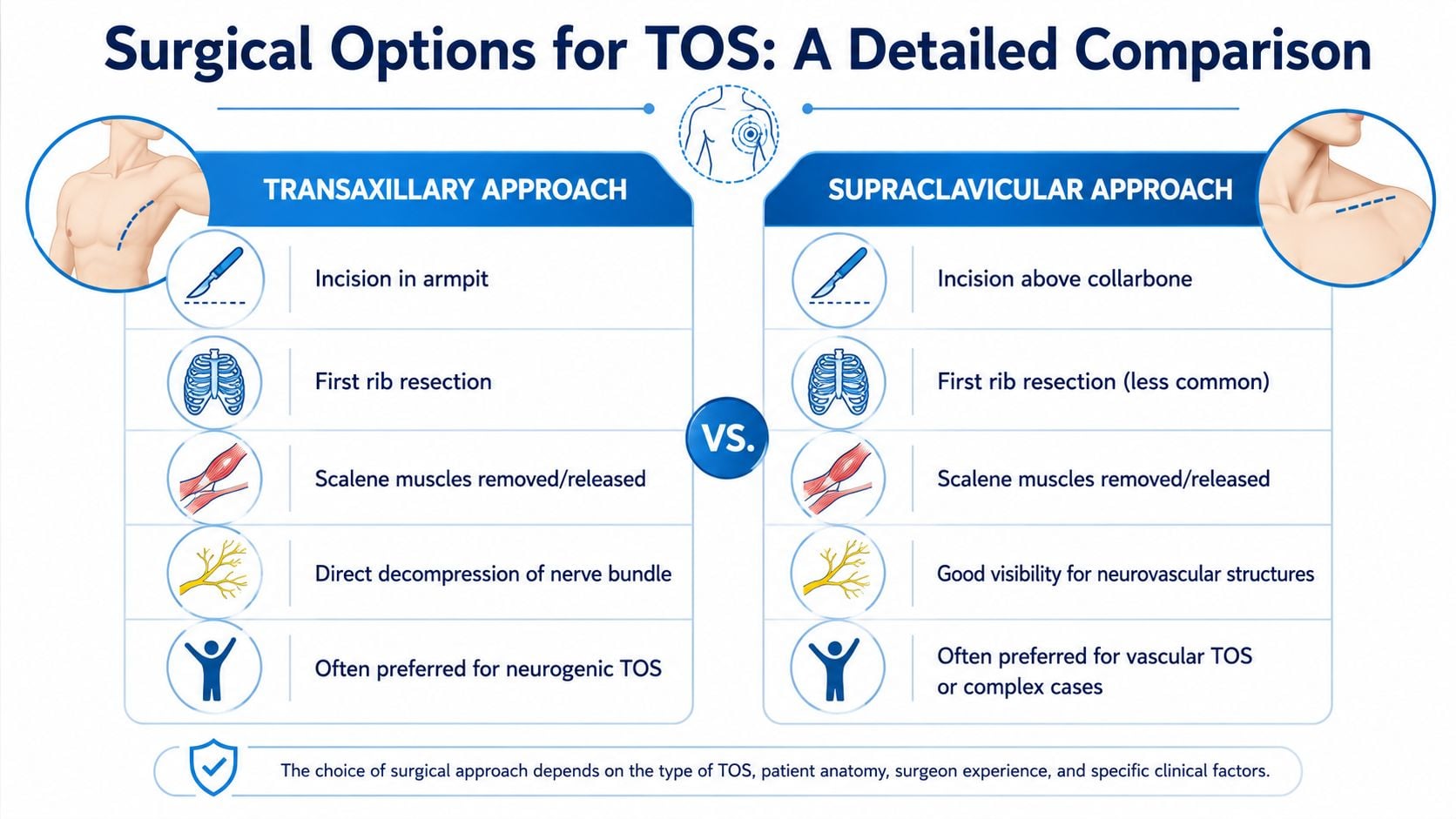
Surgery becomes the right choice when compression is structural, persistent, or vascular. It also belongs earlier in venous TOS and arterial TOS, where restoring flow matters more than extending conservative care that is unlikely to fix the anatomy. For acute venous disease, expert sources describe treatment as urgent thrombolysis, anticoagulation, and surgical decompression ACSM review.
How the main operations compare
A literature review reported 76% success for transaxillary first-rib resection in 2,326 patients, 77% for supraclavicular scalenectomy with first-rib excision in 683 patients, and 85% for supraclavicular scalenectomy without first-rib excision in 674 patients JHS GO review00053-6/fulltext). Complete relief ranged from 53% to 61% across those groups, which shows that even effective operations often improve symptoms rather than erase every complaint JHS GO review. One major center also reported that paraclavicular decompression, external venolysis, and selective venous reconstruction could provide successful and durable treatment for more than 90% of venous TOS patients JHS GO review.
Those numbers matter because they show surgery is not a throwaway option reserved for failure. It is a reasonable treatment path for selected patients, especially when symptoms persist after well-run conservative care or when vascular disease makes earlier intervention the safer course.
What the patient should expect from surgery
Older fears around TOS surgery came from less precise anatomy and weaker patient selection. Outcomes are better when the operation matches the subtype, the compression site, and the patient's actual goals. The decision to operate should therefore be based on more than pain alone, especially when the main question is whether the surgery can address a clear mechanical problem.
The surgical history of this condition also shows why careful selection matters. One U.S. inpatient study found 37,174 hospitalizations over 11 years, averaging 3,314 cases annually, with an overall mortality rate of 1.2% and about 4% 30-day readmission JHS GO review. Those figures remind clinicians that TOS is a real surgical and medical condition, not just a nuisance diagnosis.
Bottom line: Surgery is best viewed as decompression of a clearly defined problem, not as a promise that every symptom will disappear.
Recovery Timelines and What to Expect After Treatment
Recovery is where expectations usually drift away from reality. Patients often expect an injection to work immediately, physical therapy to feel easier within days, and surgery to return life to normal in a couple of weeks. Thoracic outlet syndrome rarely follows that pattern, because the timeline depends on whether the treatment is conservative, interventional, or surgical.
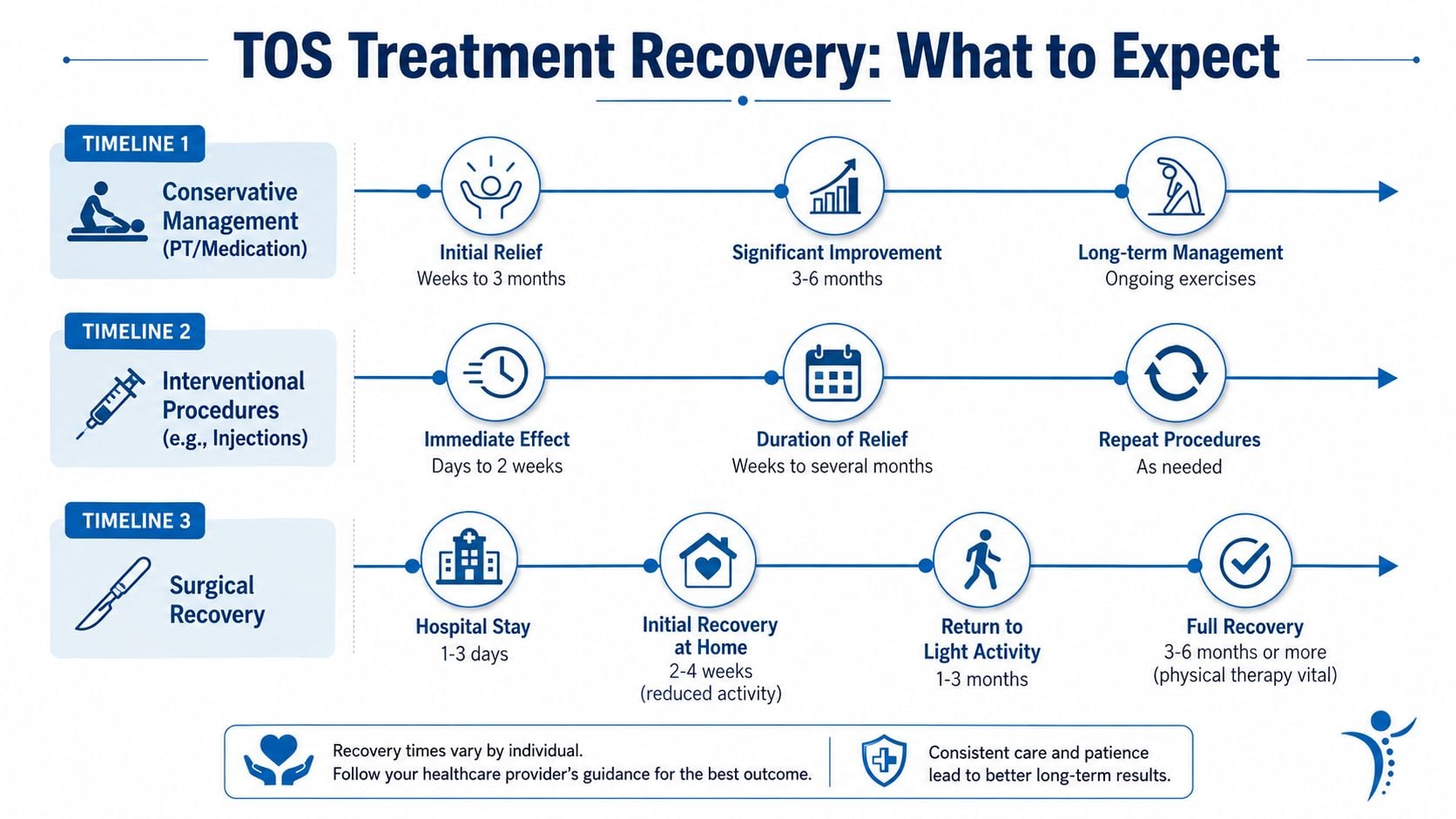
Recovery by treatment path
With conservative management, early relief may take weeks to 3 months, and more meaningful improvement often unfolds over 3 to 6 months. Long-term success depends on continued exercises and movement habits, because this approach is built around gradual retraining rather than a quick symptom switch. That slower pace is part of the trade-off patients need to understand, since the goal is steadier function, not instant correction Niel Asher review.
Interventional procedures often work sooner. Relief may begin within days to 2 weeks, then last weeks to several months, which is why repeat procedures are sometimes considered when the response is clear but temporary. These treatments are best used as a bridge, since they can reduce pain enough to make rehabilitation or treatment decisions easier, but they do not correct the underlying compression on their own Mayo Clinic.
After surgery
For surgical recovery, the early phase often involves a 1 to 3 day hospital stay, followed by 2 to 4 weeks of reduced activity at home. 1 to 3 months is often a more realistic window before light activity starts to feel manageable, with 3 to 6 months or more needed for fuller recovery and the return of function Encinovascular summary. Continued physical therapy remains important during that period because motion, strength, and scar management all affect the final result.
A patient who gets surgery but skips rehabilitation can end up with poor mechanics again. A patient who gets temporary relief from an injection but never addresses the movement pattern that helped create the problem may feel better only while the procedure is active. Recovery only makes sense when the treatment and the follow-through match the actual problem.
Making the Right Treatment Decision for Your Situation
The right choice starts with three questions. What subtype is present, how much is function affected, and has the patient given the conservative pathway a fair trial? Those questions matter more than whether a treatment sounds aggressive or elegant.
A practical decision framework
- Neurogenic symptoms with stable function: Start with conservative care, then reassess after a structured trial.
- Persistent symptoms despite rehab: Consider interventional procedures that can reduce pain and help confirm the pain generator.
- Vascular signs such as swelling, discoloration, or reduced blood flow: Escalate faster, because obstruction changes the risk calculus.
- Work or sport demands that repeatedly recreate the problem: The plan has to fit the exposure, not just the diagnosis.
Special populations need special attention. Overhead athletes often need load management and technique changes, not just generic stretching. Workers with repetitive strain may need a different ergonomic plan than office-based patients. People with cervical spine disease or peripheral entrapment can have overlapping symptoms, so a good workup should separate TOS from look-alike conditions before anyone commits to a procedure.
More detail on the broader care pathway can be found through the internal resource on pain management options, especially when the question is whether symptoms are best handled with rehabilitation, intervention, or surgical referral.
The best decision is rarely the loudest one. It's the one that matches the subtype, the anatomy, and the patient's tolerance for uncertainty.
Accessing Multidisciplinary TOS Care in New Jersey
TOS is a team problem. A useful care plan usually involves pain management, physical therapy, imaging review, and, when needed, surgical input. The most efficient first visit is one where the diagnosis is questioned carefully, the exam is focused, and the next step is chosen for a reason instead of a habit.
For patients across New Jersey and Staten Island, the internal resource on locations can help with practical scheduling and access. In a first consultation, a specialist may review prior imaging, examine posture and shoulder mechanics, and decide whether vascular studies, nerve testing, or a diagnostic block belongs next.
Bring a list of symptoms, the positions that worsen them, any prior therapy notes, and a clear description of what daily tasks are slipping. That helps the team separate pain from compression, and compression from something else entirely.
If thoracic outlet syndrome is still limiting sleep, work, or overhead activity, the next step shouldn't be more guessing. Interventional Pain Management offers a multidisciplinary approach to thoracic outlet syndrome treatment, including diagnostic review, image-guided procedures, and coordinated referral when surgery is the right move. Visit Interventional Pain Management to take the next step with a team that can match your symptoms to a treatment path that fits.