
A patient wakes after joint surgery with a quiet incision and a heavy, unfamiliar limb. The family wants to know how long the relief will last, whether the numbness is normal, and what to do when feeling returns. A nerve block can make the early hours more comfortable, but the numbness is temporary and the limb may be weak while it lasts.
This guide explains what a postoperative nerve block does, how a single injection differs from a catheter, how to prepare for pain as the block fades, and how caregivers can help protect an arm or leg that can't yet feel or move normally. The central trade-off is simple: the same temporary change in sensation that eases pain can also make ordinary movement less safe.
Table of Contents
- Waking Up Comfortable and Wondering What's Next
- What a Nerve Block After Surgery Actually Does
- Single-Injection Blocks and Continuous Catheters Compared
- How Long a Nerve Block Lasts and What Happens as It Wears Off
- Your First Night After the Block
- Living Safely While the Limb Is Still Numb
- Where Nerve Blocks Fit in Your Overall Recovery Plan
- Quick Answers for Common Nerve Block Concerns
Waking Up Comfortable and Wondering What's Next
After surgery, a patient may open their eyes and find that the operated area feels distant or completely asleep. They may be comfortable enough to wonder whether the pain medication has done more than expected. A family member, meanwhile, may be watching the numb hand or leg and trying to judge whether the block is still working as intended.

A nerve block is designed to reduce pain signals from a particular area, not to make the whole body unaware. The relief won't last indefinitely, and as the anesthetic wears off, sensation and pain can return. That change can feel abrupt, especially when the patient has been comfortable for hours.
The practical priority: Treat the block as a temporary bridge. The oral medication plan and safe-movement plan should be ready before the numbness fades.
The next steps are straightforward: understand what the block does, know whether it's a one-time injection or a catheter, follow the prescribed pain-medication schedule before sensation returns, and protect the numb limb from falls, burns, pressure, and accidental strain. Patients and caregivers should also know which changes are expected and when to call the care team.
The hours after surgery are both a pain-control window and a safety window. A patient who feels little pain may still have weakness or poor awareness of limb position. That's why discharge instructions should cover more than comfort: they should explain how to move, when to take prescribed medicines, and what to do if recovery doesn't follow the expected course.
What a Nerve Block After Surgery Actually Does
A peripheral nerve block places local anesthetic near nerves that carry sensation from the surgical area. The medicine reversibly blocks sodium channels, which interrupts the electrical signals that normally carry pain messages toward the brain. A useful analogy is a temporary dimmer switch on selected nerve traffic, rather than a switch that turns off the entire body.
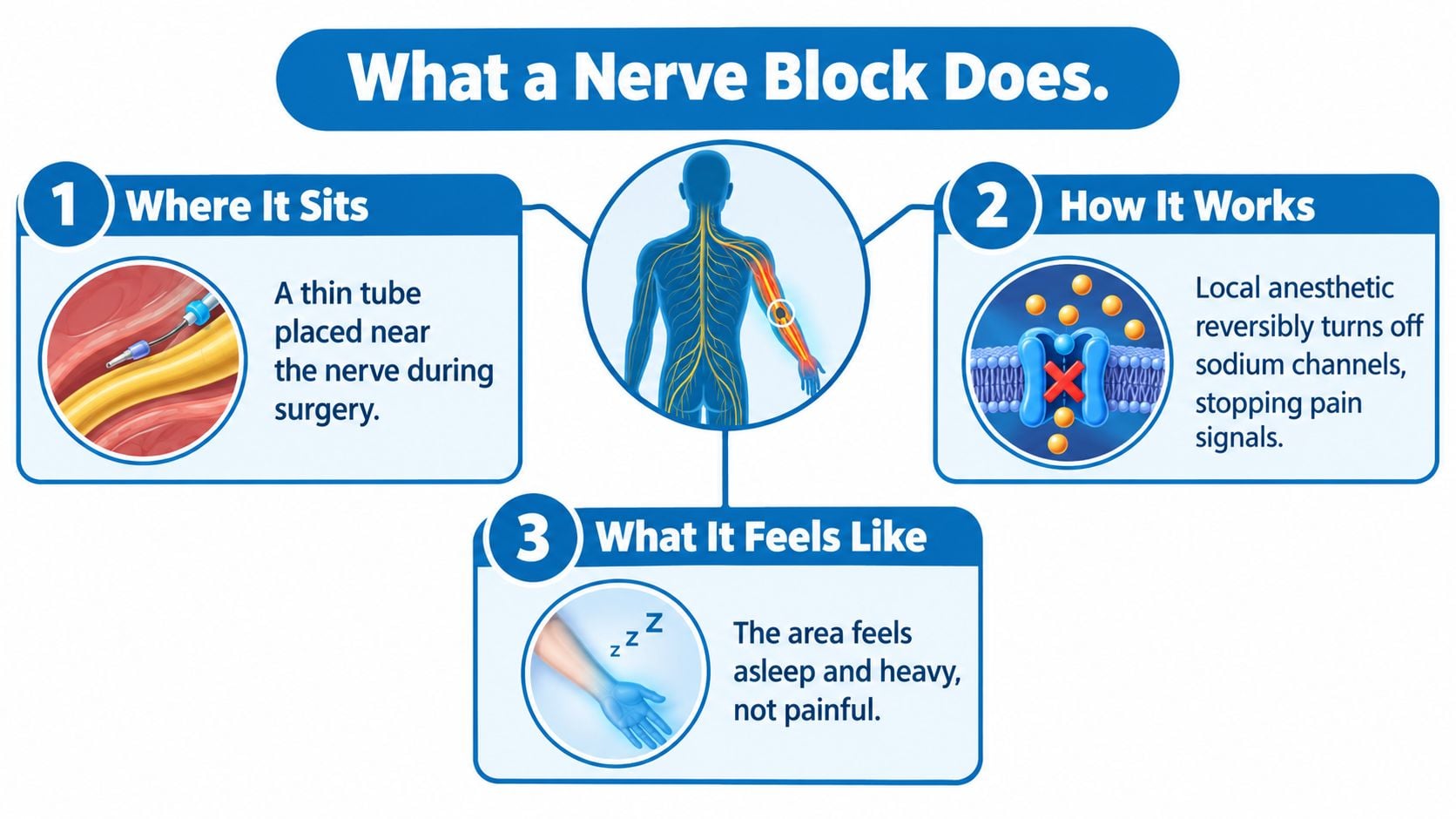
The block is different from general anesthesia, which makes a patient unconscious for surgery. It's also distinct from spinal or epidural anesthesia, which deliver medication around nerves in the spine. A peripheral block targets nerves serving a specific region, such as an arm, shoulder, or leg. For background on a separate pain procedure, see this overview of epidural steroid injections.
The patient may receive a block to supplement general anesthesia or as part of a plan that includes other forms of anesthesia. In either case, the block's main purpose after surgery is regional pain relief. It doesn't repair tissue or make the surgical site heal faster.
Why the limb may feel heavy
A block can affect more than pain sensation. A sensory block reduces feeling, so the skin may seem numb and the limb may feel unfamiliar. A motor block can weaken the muscles, making it harder to move the hand, arm, foot, or leg normally. Some blocks also affect sympathetic nerve activity, which can change warmth or other local sensations.
These effects explain why a numb limb shouldn't be treated as fully functional. A patient might not notice that the hand is resting on a hard edge, or that a foot has shifted into an unsafe position. The care team's instructions about support, movement, and protection matter even when the patient feels comfortable.
The block plan involves two practical decisions: which nerves and delivery method fit the operation, and how pain control will transition as the anesthetic wears off. Patients should ask the anesthesiologist or surgeon what sensations and movement changes to expect, how long the block is expected to last, and whom to contact if the recovery differs from those instructions.
Single-Injection Blocks and Continuous Catheters Compared
A single-injection block is placed near the target nerve and then gradually wears off. A continuous perineural catheter uses a small tube to deliver dilute local anesthetic near the nerve over an extended period. The right choice depends on how long substantial pain is expected to last, along with the patient's mobility goals and ability to manage the device at home.
Most standard local-anesthetic blocks are best matched to operations where clinically significant pain is expected to last approximately 12–24 hours, while a continuous catheter may be considered when pain is expected to continue beyond the first postoperative day. The catheter can extend sensory relief, but it also requires monitoring and careful instructions about removal. A review of continuous perineural catheters and comparative block evidence discusses these considerations and notes the importance of matching block choice to rehabilitation goals.
| Feature | Single-Injection Block | Continuous Catheter |
|---|---|---|
| Delivery | One injection near the target nerve | Ongoing infusion through a catheter near the nerve |
| Duration | Temporary relief that fades as the anesthetic wears off | Can maintain analgesia beyond the effect of the initial injection |
| Practical demands | No catheter to manage after placement | Requires monitoring and clear care and removal instructions |
| Trade-offs | Pain may return as the block resolves | Risks include motor impairment, falls, toxicity, infection, and catheter movement |
| Typical fit | Procedures where substantial pain is expected to be concentrated in the early postoperative period | Procedures where pain is expected to persist beyond the first postoperative day |
Mobility is part of the decision
For leg surgery, a block that reduces pain but significantly weakens the limb may complicate early walking. The cited review of 128 comparative studies reports that motor-sparing saphenous blocks provide satisfactory analgesia after knee surgery and are preferred to femoral blocks in early-mobilization pathways because femoral blockade is associated with falls. The decision should account for the rehabilitation plan, not just pain scores.
A catheter isn't automatically better because it lasts longer. It may be a poor fit if the patient can't follow the monitoring plan or if weakness would interfere with safe transfers. Before discharge, patients and caregivers should understand expected block duration, weight-bearing restrictions, assistive-device use, warning symptoms, and the transition to oral pain medicine.
How Long a Nerve Block Lasts and What Happens as It Wears Off
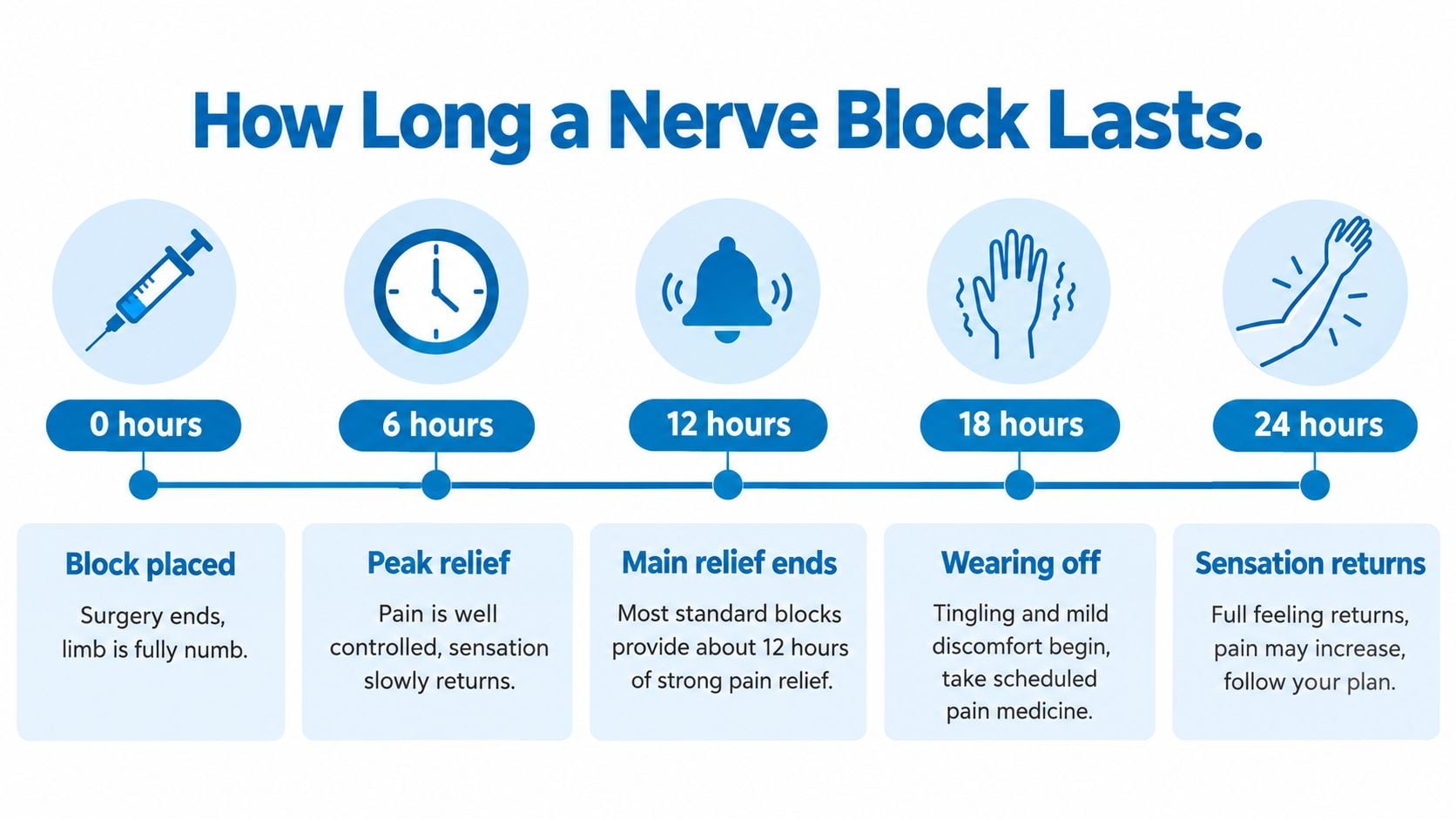
A block's duration varies with the medication and the clinical plan, so the treating team's instructions should take priority over any general timeline. For many standard local-anesthetic blocks, the main relief is best suited to pain expected to remain clinically significant for approximately 12–24 hours. Sensation usually returns gradually, though pain can rise quickly as the anesthetic effect fades.
The changing sensations
Early on, the operated area may feel numb, heavy, or difficult to move. As the block recedes, tingling or patchy sensation may return before the limb feels normal. Some patients notice discomfort emerging at the same time. That transition can be startling after a comfortable recovery-room period, but it doesn't by itself mean the surgery has failed or that a nerve has been injured.
Rebound pain is an abrupt period of intense postoperative pain or hyperalgesia as sensory anesthesia resolves. It's a pharmacologic transition: pain input from the surgical site becomes unmasked as the sodium-channel blockade declines, while inflammation can still be active. A 2025 retrospective cohort of orthopedic-trauma patients found that 41.9% developed rebound pain, defined as a change from pain rated 3 or less to pain rated 7 or more within 24 hours after block resolution (cohort study).
The same study associated rebound pain with younger age, diabetes, moderate-to-severe pain before surgery, bone surgery, and lack of intraoperative dexamethasone or dexmedetomidine. Those factors don't predict an individual patient's experience with certainty, but they support making a clear pain plan rather than waiting to see how the first night unfolds.
A review of arthroscopic rotator-cuff repair describes rebound pain as typically beginning 12–24 hours after the block and often at night, where it may last 2–6 hours. The block should therefore be treated as a bridge to the next part of pain control. Starting scheduled medicines before the expected offset helps make that transition more manageable.
Your First Night After the Block
The most useful instruction is not “take pain medicine before the block wears off.” Patients and caregivers need to know which prescribed medicines to take, when to start them, how to use any rescue medicine, and what symptoms need a call. If the discharge plan doesn't specify these points, ask the surgical or anesthesia team before leaving or contact them for clarification.
A practical first-night sequence
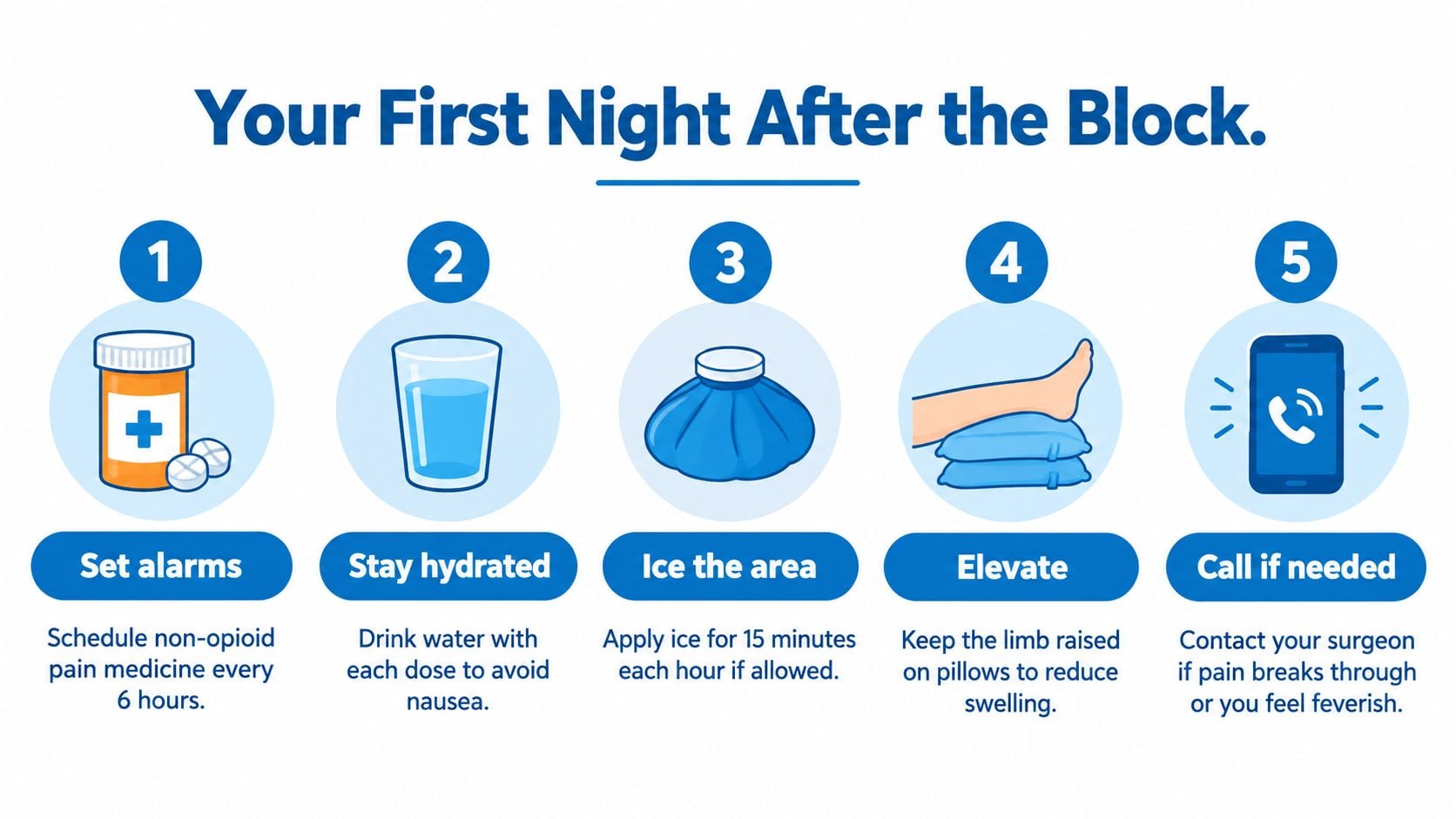
Before the expected fade: Follow the prescribed schedule for acetaminophen and an NSAID if the clinician has approved it. Evidence reviews describe preemptive analgesia 1–2 hours before expected block resolution as a strategy to reduce rebound pain. The timing should be individualized to the patient's instructions and medical history.
While numbness is changing: Keep prescribed rescue medication within reach, but use it only as directed. Don't take extra doses or combine medicines unless the care team has said that's safe. Make a written record of dose times so a tired caregiver doesn't have to rely on memory.
During the night: Keep the affected limb supported in the position recommended at discharge. Don't sleep with it trapped under the body or resting against a hot surface. If pain rises despite the prescribed plan, contact the care team using the instructions provided.
The block doesn't remove the need for a broader recovery plan. For patients recovering from joint procedures, the instructions for joint replacement surgery can help frame the importance of coordinating pain relief with movement and recovery guidance.
Caregiver handoff: Write down the expected block offset, the next scheduled medicine time, the permitted rescue dose, the care-team number, and any movement restrictions. Keep the written plan where the person helping overnight can see it.
Call the surgeon or anesthesiologist for symptoms the discharge instructions identify as urgent, for pain that remains uncontrolled, or for numbness or weakness that lasts longer than the expected window. Fever, a concerning color change, new severe symptoms, or chest symptoms warrant prompt clinical advice; chest symptoms or a medical emergency may require emergency services. Follow the care team's guidance rather than assuming every change is normal rebound pain.
Living Safely While the Limb Is Still Numb
A numb limb can't reliably warn its owner about heat, pressure, sharp objects, or an awkward position. Temporary weakness also changes balance and transfers. A caregiver should help the patient protect the limb until sensation and movement return, following the surgeon's weight-bearing and brace instructions.
If an arm is numb
- Support it as directed. Use the prescribed sling or brace and avoid lifting, pushing, or carrying heavy objects with the affected arm.
- Protect the skin. Check the hand, arm, and pressure points for cuts or marks. Keep the limb away from heating pads, hot water, stoves, sharp tools, and very cold surfaces.
- Plan transfers and sleep. Make sure the arm isn't caught beneath the patient or pressed against a hard edge. A caregiver can help with dressing and other tasks that require safe use of both hands.
If a leg is numb
- Don't walk without the prescribed support. Use the recommended assistive device and follow the weight-bearing instructions. Ask for help with standing, bathroom trips, and car transfers while the leg is weak.
- Make stairs a planned task. If stairs can't be avoided, follow the care team's instructions and have someone assist. Avoid improvising a route when balance or leg control is reduced.
- Protect and position the leg. Use the prescribed brace, check the skin, and support the limb for rest. Don't drive while sensation or control is altered.
Northwestern Medicine's upper-extremity nerve-block guidance advises protecting a numb or heavy limb from heat, cold, sharp surfaces, heavy lifting, and unprotected weight-bearing. Patients should also arrange help at home, especially if stairs, transportation, or living alone could make safe movement difficult. A temporarily paralyzed limb increases fall risk, so a patient who can't move or feel it normally shouldn't test their balance alone.
Where Nerve Blocks Fit in Your Overall Recovery Plan
A nerve block is one part of postoperative pain control, not the whole plan. The transition typically involves prescribed non-opioid medicines such as acetaminophen and, when medically appropriate, an NSAID. The surgical team may also plan other medicines for side effects, supervised activity, and a rescue option if pain breaks through.
A practical recovery plan connects pain relief with movement. The block may make early transfers or physical therapy more tolerable, but the patient still needs to follow restrictions on weight-bearing, braces, and exercise. A leg that's numb or weak isn't ready for unassisted walking because the patient doesn't feel pain.
If an opioid is prescribed, the patient should follow the exact directions and ask how to use it alongside other medicines. Sedation can make falls more likely, particularly when a limb is still weak. Don't take more than prescribed, mix medicines without guidance, or drive while affected by sedating medication or altered sensation.
Discharge instructions should identify who manages pain questions, which symptoms call for urgent advice, and when follow-up is planned. Patients with back or spine procedures can learn more about coordinated care for pain after back surgery. The same principle applies across procedures: the block, oral medicines, and rehabilitation plan should work together, with a clear handoff as numbness fades.
Quick Answers for Common Nerve Block Concerns
How long will the numbness last? It depends on the block and the anesthetic used. Many standard blocks provide their main relief for about 12–24 hours; follow the duration given by the treating team and call if numbness or weakness persists beyond what they expected.
Does a sudden pain spike mean the surgery failed? Not necessarily. Rebound pain can occur as the anesthetic wears off, and the transition alone doesn't prove a surgical problem. Use the prescribed plan and contact the care team if pain is uncontrolled or symptoms are concerning.
Can the patient drive or work while the limb is numb? Don't drive while sensation, movement, or alertness is impaired. Return to work depends on the operation, job demands, medication effects, and the surgeon's instructions.
When should the care team be called? Call for symptoms that worry the patient, pain that isn't controlled as directed, or weakness or numbness lasting beyond the expected period. For chest symptoms or a possible emergency, seek emergency care.
The key action is to begin the prescribed scheduled analgesia before the block fully resolves, not after severe pain has arrived. Keep the medication plan, movement restrictions, and contact instructions visible for the patient and caregiver.
Interventional Pain Management provides nerve blocks and coordinated pain, orthopedic, and spine care suited to individual clinical needs. Patients preparing for surgery or managing pain after a procedure can visit Interventional Pain Management to learn about available services and care options.