
Achilles strain recovery time ranges from 4 to 12 weeks for mild strains, 3 to 6 months for tendinopathy, and 6 to 12 months for ruptures, depending on severity, treatment, and individual factors. The hard part is that a sore heel or calf can feel similar at the start, even when the tissue damage is very different.
A runner feels a sharp tug on stairs, a weekend basketball player limps after a jump stop, or someone notices morning stiffness that keeps coming back. In all three cases, the calendar matters less than the diagnosis, because the wrong label leads to the wrong timeline and the wrong expectations.
Table of Contents
- Understanding What Type of Achilles Strain You Have
- Recovery Timelines by Severity Level
- Progressive Rehabilitation Phases and Milestones
- Why Feeling Better Does Not Mean You Are Ready to Return
- The Imaging Paradox and Recovery Expectations
- Recovery Differences for Athletes and Active Individuals
- When to Seek Advanced Care and Personalized Recovery Guidance
Understanding What Type of Achilles Strain You Have
The first mistake many people make is treating every Achilles injury like the same problem. A mild tendon strain, chronic tendinopathy, and a full rupture can all hurt in the same neighborhood, but they behave differently once loading starts again.
Three injuries, three very different stories
A mild Achilles strain usually means some fibers are irritated or partially damaged, but the tendon is still intact enough to keep working. That kind of injury often improves with load reduction, careful return to walking, and a gradual rebuild.
A tendon with tendinopathy is different. The issue is less about one sudden tear and more about a tendon that has lost capacity over time, so pain hangs around when load rises too quickly. That's why the timeline is often slower and more variable than people expect, even when the injury never fully ruptures.
A rupture is the most serious version. The tendon has failed enough that push-off strength drops sharply, and the path back usually involves many months of rehab and, in some cases, repair. The big error is assuming a rupture should heal on the same schedule as a strain, because it doesn't.
Practical rule: if the person can't confidently push off, rise onto the toes, or trust stairs without a sudden weakness feeling, the injury may be more than a simple strain.
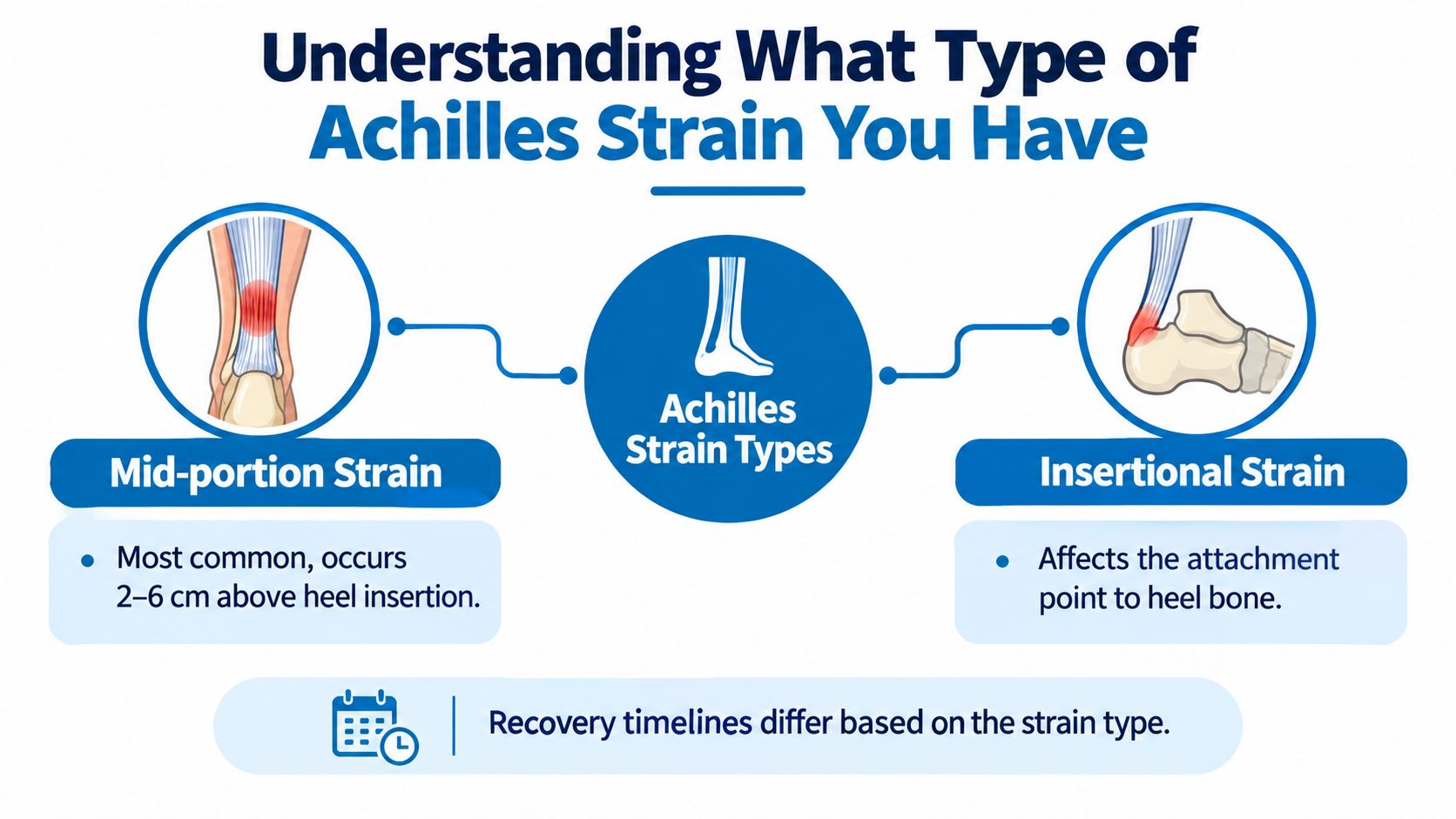
Mid-portion and insertional problems can also be confused because both sit near the heel, but they don't always settle on the same schedule. A person with a brief flare after a training jump may be dealing with a very different tissue problem than someone whose pain has been building for months. For a patient-facing overview of tendon irritation patterns, this Achilles tendinitis resource fits into the bigger picture.
The key point is simple. Recovery time starts with the type of injury, not the date on the calendar.
Recovery Timelines by Severity Level
A useful timeline has to match the type of tissue injury. Broad “Achilles strain recovery time” estimates can mislead readers because a mild strain, tendinopathy, and rupture do not recover on the same clock.
What the evidence supports
A mild non-rupture strain or partial tear usually follows a shorter, load-dependent course when it is identified early. Pain relief is only the first step. The goal is restoring tendon tolerance for walking, then running, then jumping without triggering a setback.
For tendinopathy, recovery usually takes longer. Rehabilitation often moves through symptom control, rebuilding, and sport-specific return over months rather than weeks, and the return-to-sport phase often lasts about 3 to 6 months or longer when symptoms have been chronic or tissue capacity is lower return-to-sport consensus.
A rupture has the longest recovery path. A large systematic review found that 80% of patients returned to play, with an average return time of 6.0 months across 37 studies that reported timing and variability, and study-level averages ranged from 2.95 months to 10.4 months systematic review of Achilles rupture recovery. That average is a population benchmark, not a promise for one person.
Simple translation: a mild strain can settle relatively quickly, tendinopathy usually needs months of progressive loading, and rupture often asks for the longest runway.
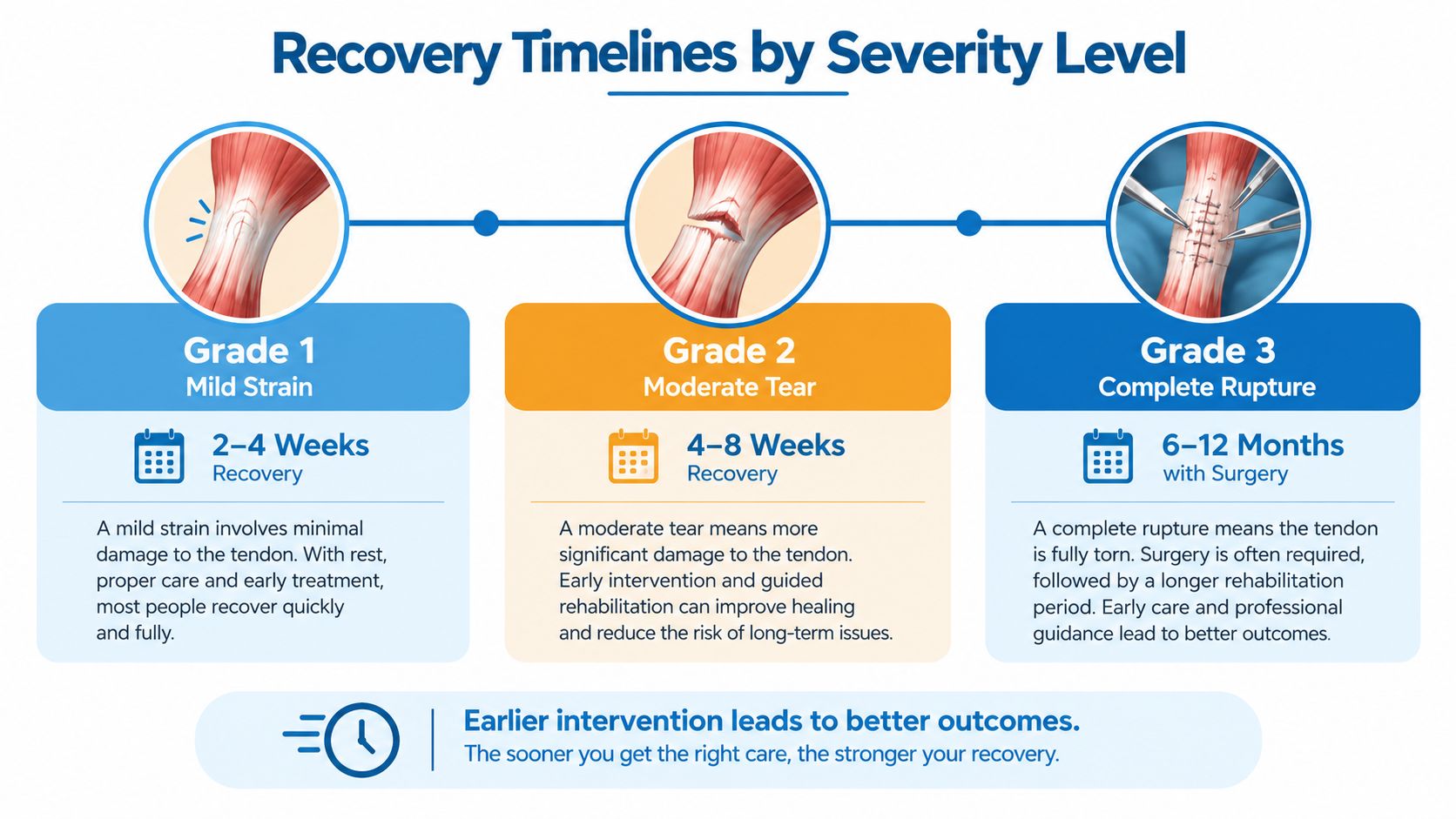
Treat these ranges as ranges. A lighter injury can move faster, while calf weakness, age, treatment choice, and steady rehab progress can stretch the timeline. The same symptom, “it still hurts,” does not mean the same prognosis.
Progressive Rehabilitation Phases and Milestones
Recovery is a sequence of small loading decisions that teach the tendon to handle stress again without getting flooded.
Early protection, then controlled loading
The first job is to calm irritation while keeping the ankle from stiffening up. Once pain settles, rehab moves toward gentle range of motion and then purposeful strengthening, because a tendon adapts to stress, not to rest alone.
One useful rule is to change one variable at a time. Adjust volume, speed, hills, or plyometric demand separately, not all at once. Symptoms should return to baseline by the next morning before the next increase.
| Phase | Main focus | What should improve |
|---|---|---|
| Early phase | Protect tissue and keep walking tolerable | Pain and stiffness should settle |
| Rebuilding phase | Add controlled calf loading | Strength and load tolerance should rise |
| Return phase | Add running, jumping, and sport movements | Confidence and function should track together |
For a useful benchmark, the return-to-sport consensus discussed earlier recommends that activity pain stay no higher than 5/10, with no week-to-week rise in pain or stiffness. That is a guardrail, not a test of toughness.
Useful rule: if a session creates a next-day spike in stiffness, the tendon is telling you that the load jumped too far, too fast.
Pain around the heel can also overlap with other irritation patterns, including tendinitis and bursitis, so the timeline becomes clearer when rehab matches the actual tissue problem. That matters because Achilles strain is not one condition. A mild strain, tendinopathy, and rupture each need a different pace, and the same “feels better” milestone does not mean the same thing for each one.
Why Feeling Better Does Not Mean You Are Ready to Return
Pain often drops before strength comes back. That mismatch is where many recoveries stall, because the ankle feels calmer long before the tendon can tolerate sprinting, jumping, or repeated push-off.
Readiness is bigger than comfort
A person may walk more easily and still have poor calf strength, limited single-leg heel-raise capacity, or obvious asymmetry when hopping. Those gaps matter because everyday comfort and sport readiness are not the same thing.
The more useful markers are functional. Walking should be comfortable, calf strength should be rebuilding, running should start only when load tolerance is stable, and jumping should come much later. If any of those steps is rushed, the tendon gets asked for more than it has rebuilt.
A simple self-check can help keep the picture honest:
- Walking: ordinary walking should be close to normal, without a protective limp.
- Heel raises: the calf should rise and lower with control, not a shaky half-rep.
- Hopping: the injured side should not feel tentative or collapsed compared with the other side.
- Sport movements: cutting, sprinting, and landing should feel repeatable, not like a one-off lucky effort.
The logic is blunt. Feeling better is a welcome sign, but it is not proof of full tissue readiness.
The Imaging Paradox and Recovery Expectations
A scan feels like the quickest way to answer the timeline question. Achilles recovery is messier than that, because imaging and real-world function do not always move together.
Why scans can mislead
Guideline-level evidence cautions against using imaging to predict prognosis or monitor treatment response in Achilles tendinopathy guideline review on imaging and prognosis. Ultrasound or MRI can still look abnormal while walking, strength, and load tolerance are improving. That means a scan may look discouraging even as rehab is working.
The paradox is simple. A normal-looking scan does not guarantee rapid recovery, and an abnormal scan does not mean rehab has failed. Imaging is most helpful when the diagnosis is uncertain, a rupture or larger tear is suspected, or another problem needs to be ruled out.
Recovery is better tracked with function:
- Walking tolerance
- Single-leg heel-raise capacity
- Hopping progression
- Calf symmetry
- Sport-specific workload
The same guideline review notes that 23% to 37% of patients may still have symptoms for at least 10 years, while about 85% of athletes return to sport. Those figures do not promise a single outcome for everyone. They do show why a scan alone gives an incomplete picture.
Persistent pain, worsening pain, sudden weakness, a pop, or trouble pushing off call for prompt clinical assessment. In those cases, the question is not whether the image looks tidy. The question is whether the tendon needs a closer look.
Recovery Differences for Athletes and Active Individuals
An office worker who wants pain-free stairs and a sprinter who needs explosive push-off are recovering toward different targets. That is why “back to activity” and “back to full sport” should not be treated as the same milestone.
Competitive demands raise the bar
A review of surgical-repair studies, sports medicine review, included 24 studies and 947 patients. It reported return-to-sport rates from 65% to 100%, with return times ranging from 3 months to 13.4 months. A separate review of professional athletes from the same source found a 76% return-to-professional-sport rate and a mean return time of 11 months.
That difference is easy to understand. Sport asks the tendon to handle sprinting, cutting, repeated acceleration, and fatigue, not just ordinary walking. Historical sports data from the same review found that among 118 athletes, 96% returned to unrestricted practice and competition after average times of 7 and 9 months, respectively. It also found that 18% did not return to their previous level within the following two seasons, and 8% had rerupture over those two seasons.
| Group | Typical expectation |
|---|---|
| General adult recovery | Basic function often returns sooner |
| Competitive athlete | Full return usually takes longer and is less predictable |
Pain-free walking and competitive push-off are two different thresholds, and athletes have to clear both.
When to Seek Advanced Care and Personalized Recovery Guidance
Some symptoms call for a prompt exam, not another week of self-care. Persistent or worsening pain, sudden weakness, an audible pop at the start of the injury, or inability to push off are all reasons to be evaluated quickly.
What personalized care adds
A clinician can sort out whether the problem is a simple strain, tendinopathy, a partial tear, or a rupture, then match rehab to the actual tissue damage. That matters because the timeline changes with chronicity, age, baseline strength, treatment path, and how well loading has been tolerated.
For patients in New Jersey and Staten Island, Interventional Pain Management's treatments include diagnostic review, imaging coordination when needed, and care pathways that can incorporate rehabilitation planning and targeted procedures for musculoskeletal problems. For Achilles pain specifically, that kind of assessment helps when the diagnosis is uncertain or recovery is not following the expected pattern.
A practical decision rule helps here:
- Home care may fit when pain is mild, walking is improving, and strength is trending up.
- Clinical review is wise when progress stalls, swelling keeps returning, or push-off still feels weak.
- Urgent evaluation is needed when there is a pop, sudden loss of strength, or inability to push off.
Recovery timelines are best used as flexible guides, not rigid promises. The right plan comes from matching the injury type to the load it can handle.