
A practical benchmark for the herniated disc surgery success rate is approximately 80–85% satisfactory outcomes after discectomy. That figure changes with the definition of success: relief from leg pain, relief from back pain, better function, and avoiding another operation are separate outcomes, not one promise. A systematic review of upper-lumbar disc herniation also found that estimates depend on the disc's location and the procedure used.
For someone considering surgery, “successful” might mean being able to sit through a commute without sciatica, walk farther, or return to a usual routine. It doesn't necessarily mean every ache disappears, that recovery follows a fixed schedule, or that the disc can never herniate again. The useful question isn't only how often surgery works. It's what outcome was measured, over what period, and how closely the person's symptoms match the problem surgery is meant to treat.
Table of Contents
- What a Herniated Disc Surgery Success Rate Means
- Comparing Microdiscectomy, Open Discectomy, and Minimally Invasive Options
- How Outcomes Look at 3 Months, 2 Years, and 8 Years
- Patient Factors That Quietly Move the Success Rate Up or Down
- Recurrence, Reoperation, and the Headline They Don't Print
- Where Epidural Injections Fit Before You Reach the Operating Room
- A Realistic Recovery Timeline After Discectomy
- Setting Honest Expectations Before You Decide
What a Herniated Disc Surgery Success Rate Means
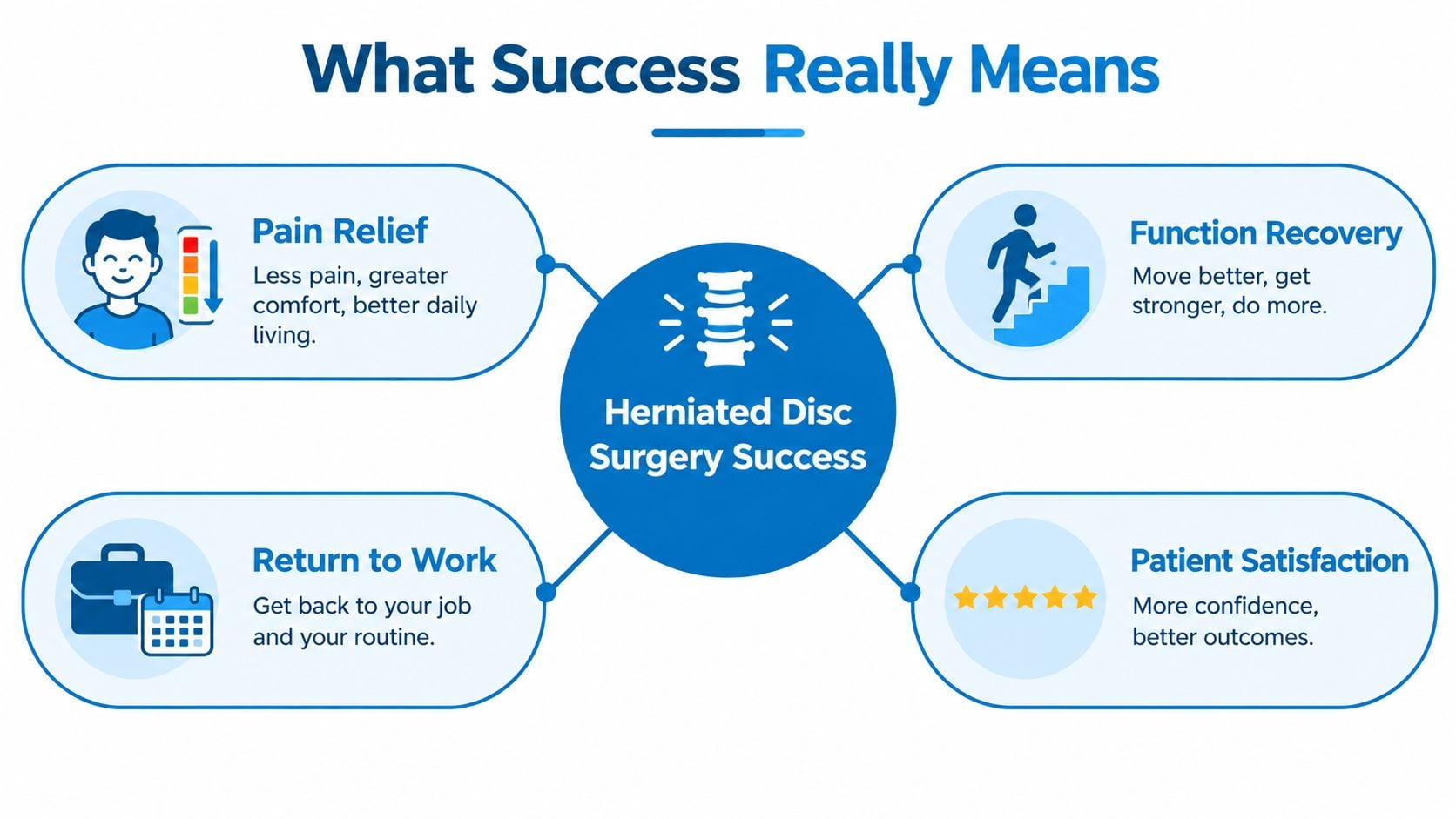
A patient may walk comfortably after surgery yet still have lower-back aching. That outcome can count as successful on one measure and incomplete on another. A satisfactory outcome bundles several experiences into a broad label, much like a report card that combines different subjects into one grade.
Separating those subjects makes the result easier to interpret:
- Leg-pain relief measures improvement in nerve-related pain. Discectomy removes disc material pressing on a nerve, so this symptom closely matches the operation's target.
- Back-pain relief measures a different symptom. It is less predictable because relieving nerve compression may leave other sources of lower-back pain unchanged.
- Function measures daily abilities, such as walking, sleeping, and managing ordinary tasks. Less pain and restored activity do not necessarily progress together.
- Avoiding reoperation measures whether another operation was needed during follow-up. Someone can avoid further surgery while still having pain or limitations.
Each measure needs its own percentage and follow-up period. A combined satisfaction rate cannot supply those separate answers.
The review reporting this benchmark supports the 80–85% benchmark for satisfactory outcomes in upper-lumbar cases. Definitions, disc locations, techniques, and follow-up periods affect how such figures should be interpreted. Early improvement does not establish lasting pain relief or freedom from another operation.
The same precision applies to diagnosis. An MRI shows anatomy; symptoms and examination help establish whether that finding explains the pain. This guide to herniated and bulging discs clarifies the terminology, but a bulge or herniation alone does not prove the cause of symptoms.
A useful question for a consultation: “Which result are we trying to improve, how will we measure it, and when should we assess it?”
Comparing Microdiscectomy, Open Discectomy, and Minimally Invasive Options
These procedures share a basic purpose: remove disc material that's irritating or compressing a nerve. They differ in how the surgeon reaches the affected area. The right route depends on anatomy, the location and shape of the herniation, and the surgeon's assessment, not on whether a procedure is described as "minimally invasive."
A microdiscectomy uses magnification to help the surgeon remove the offending fragment through a limited exposure. Open discectomy provides a more direct view through a larger exposure. Endoscopic and other minimally invasive approaches use specialized instruments and smaller access routes, but a smaller incision alone doesn't prove a better result.
The clearest comparison in the supplied evidence concerns upper-lumbar herniations, a technically distinct group. In that review, satisfactory outcomes were 82% for open lumbar microdiscectomy and 77% for minimally invasive surgery. That difference cautions against assuming a minimally invasive label guarantees a higher success rate. It also shouldn't be generalized automatically to every lumbar level or every patient.
| Approach | Typical indication | Satisfactory outcome | Recovery window |
|---|---|---|---|
| Microdiscectomy | Nerve compression from a disc fragment when the surgeon chooses a magnified approach | No single rate applies across all patients and disc levels | Depends on the procedure, symptoms, and individual healing |
| Open discectomy | Disc removal when direct exposure suits the anatomy or surgical plan | No single general rate is established here | Depends on the procedure, symptoms, and individual healing |
| Minimally invasive or endoscopic discectomy | Selected herniations that can be reached through a limited access route | In the upper-lumbar review, minimally invasive surgery had a 77% satisfactory outcome | Depends on the approach, symptoms, and individual healing |
The same upper-lumbar review reported 82% satisfactory outcomes for open lumbar microdiscectomy. These figures describe that subgroup and shouldn't be read as a head-to-head guarantee for a particular person. Ask the surgeon why the proposed technique fits the MRI and symptoms, what outcome they expect it to improve, and what trade-offs matter in that case.
How Outcomes Look at 3 Months, 2 Years, and 8 Years
Outcomes look different depending on when they're measured. In the Spine Patient Outcomes Research Trial (SPORT), adults with imaging-confirmed lumbar disc herniation and persistent symptoms improved with both surgery and nonoperative care. At 3 months, bodily-pain scores improved by 40.9 points after discectomy and 26.0 points with nonoperative treatment, an estimated advantage of 14.8 points for surgery. Physical-function scores improved by 40.7 points with surgery and 25.3 without. Disability scores also improved more after surgery. The SPORT study reports these measures.
At 2 years, both groups had improved, and the gaps were narrower than the early results. Bodily-pain improvement was 42.6 points with surgery versus 32.4 with nonoperative care. Physical-function improvement was 43.9 versus 31.9 points, while disability improvement was 37.6 versus 24.2 points. The practical reading is that surgery tended to bring faster, larger early gains, while many patients who initially pursued nonsurgical care also improved over time.
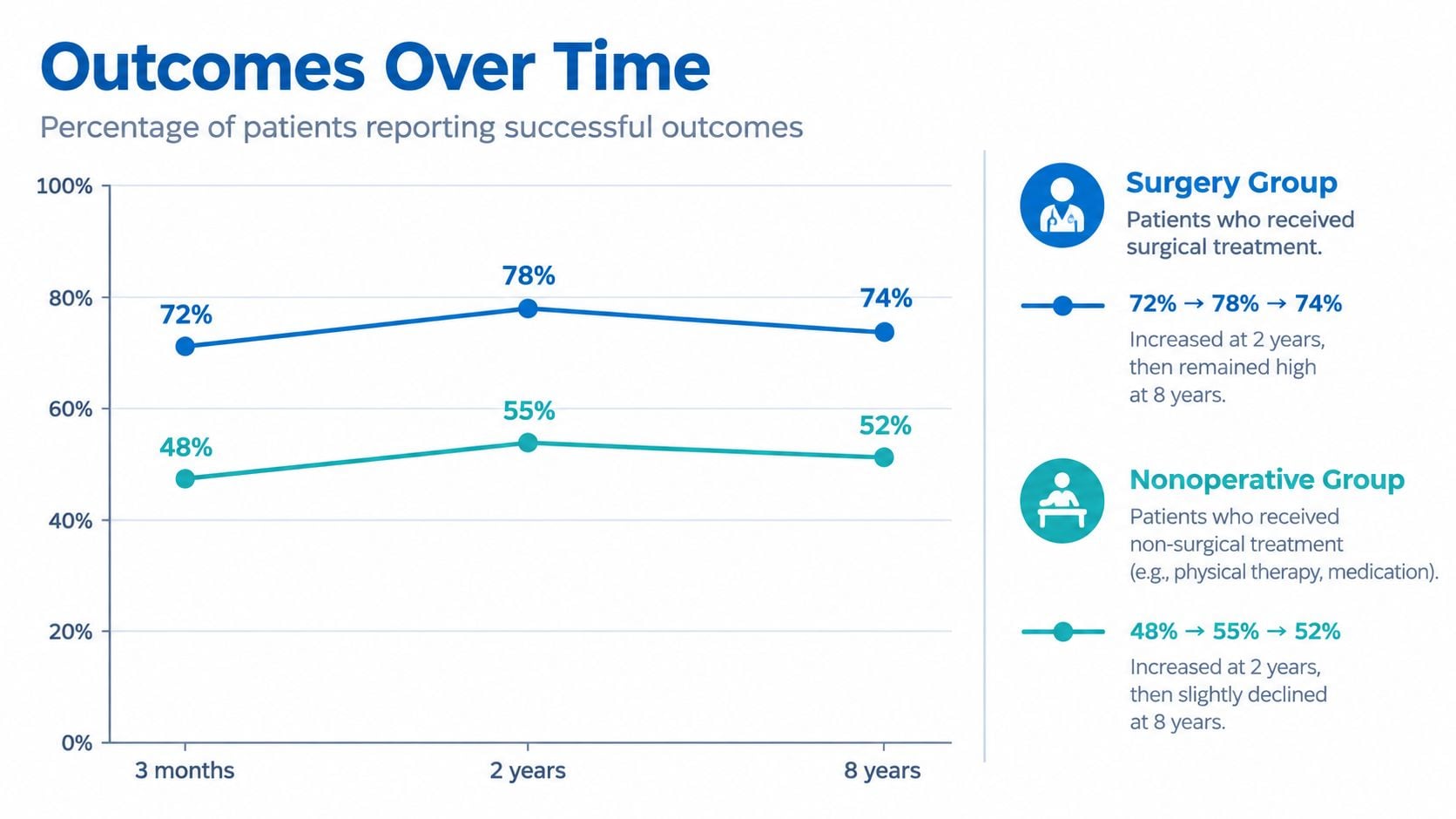
Longer follow-up needs more caution. By 8 years, SPORT outcomes remained favorable to surgery in the measured categories, but the primary intention-to-treat differences weren't statistically significant. Many participants crossed from their assigned treatment to the other, including patients assigned to nonoperative care who later had surgery. That crossover makes a simple comparison of “surgery” versus “no surgery” difficult to interpret. The long-term SPORT follow-up discusses both the durable improvement and this limitation.
The takeaway isn't that one time point is the “real” success rate. Early results help explain the speed of relief; longer follow-up helps assess whether improvement lasts. Neither guarantees an individual patient's course.
Patient Factors That Quietly Move the Success Rate Up or Down
Two patients can have similar MRI findings and different prospects because the scan is only one part of the decision. The strongest case for discectomy is generally one in which the symptoms, examination, and imaging point to the same nerve and level. For example, pain that travels down a particular leg in a consistent pattern, together with examination findings that fit and a matching disc herniation, gives the surgeon a clearer target than an isolated scan abnormality with vague back pain.
The duration and burden of symptoms matter too. SPORT enrolled people with at least six weeks of persistent symptoms and imaging-confirmed lumbar disc herniation. Its results support faster and larger early improvement from surgery in appropriately selected patients, but they don't mean everyone with a herniation should have an operation. A clinician weighs how long symptoms have persisted, whether weakness or sensory changes are present, and how much pain limits daily life.

Smoking and other modifiable health factors belong in the discussion because they can affect surgical planning and recovery. A patient can ask what risks apply personally and what can be improved before surgery. Baseline disability also matters: someone whose leg pain has sharply reduced walking or work has a different functional goal from someone with discomfort that doesn't restrict activity much.
A scan should support the diagnosis, not substitute for one. Ask how the MRI finding matches the pain pattern and physical examination.
A careful assessment should define the intended gain. If the main problem is nerve-root pain, the target may be leg-pain relief and improved movement. If the dominant complaint is nonspecific low-back pain, the surgeon should explain whether the proposed operation is likely to address its cause.
Recurrence, Reoperation, and the Headline They Don't Print
Reoperation rates vary by study, procedure, and follow-up period: The review of long-term discectomy outcomes reports cumulative ranges of approximately 0.6%–7.4% at 1 year, 8.0%–10.5% at 2 years, and 2.4%–13.4% at 5 years. These are results from different studies, not stages of one patient's recovery. They shouldn't be added together. The lower end of the five-year range doesn't mean risk decreases with time.
Success works like a report card with separate grades: leg-pain relief, back-pain relief, function, and avoidance of reoperation each need their own measure and percentage.
Recurrence means a disc herniation has returned; symptomatic recurrence means it is causing symptoms. Some reports describe substantial recurrence after standard discectomy, but recurrence doesn't automatically require surgery. Reoperation counts another operation, which may address recurrent herniation or a different problem.
Long-term surgical follow-up also shows that recurrent herniation accounts for many repeat operations. That belongs alongside satisfactory-outcome measures. A patient may enjoy meaningful pain relief and better walking for months or years, then develop another problem. A later operation doesn't erase the earlier benefit, but it changes the assessment of durability.
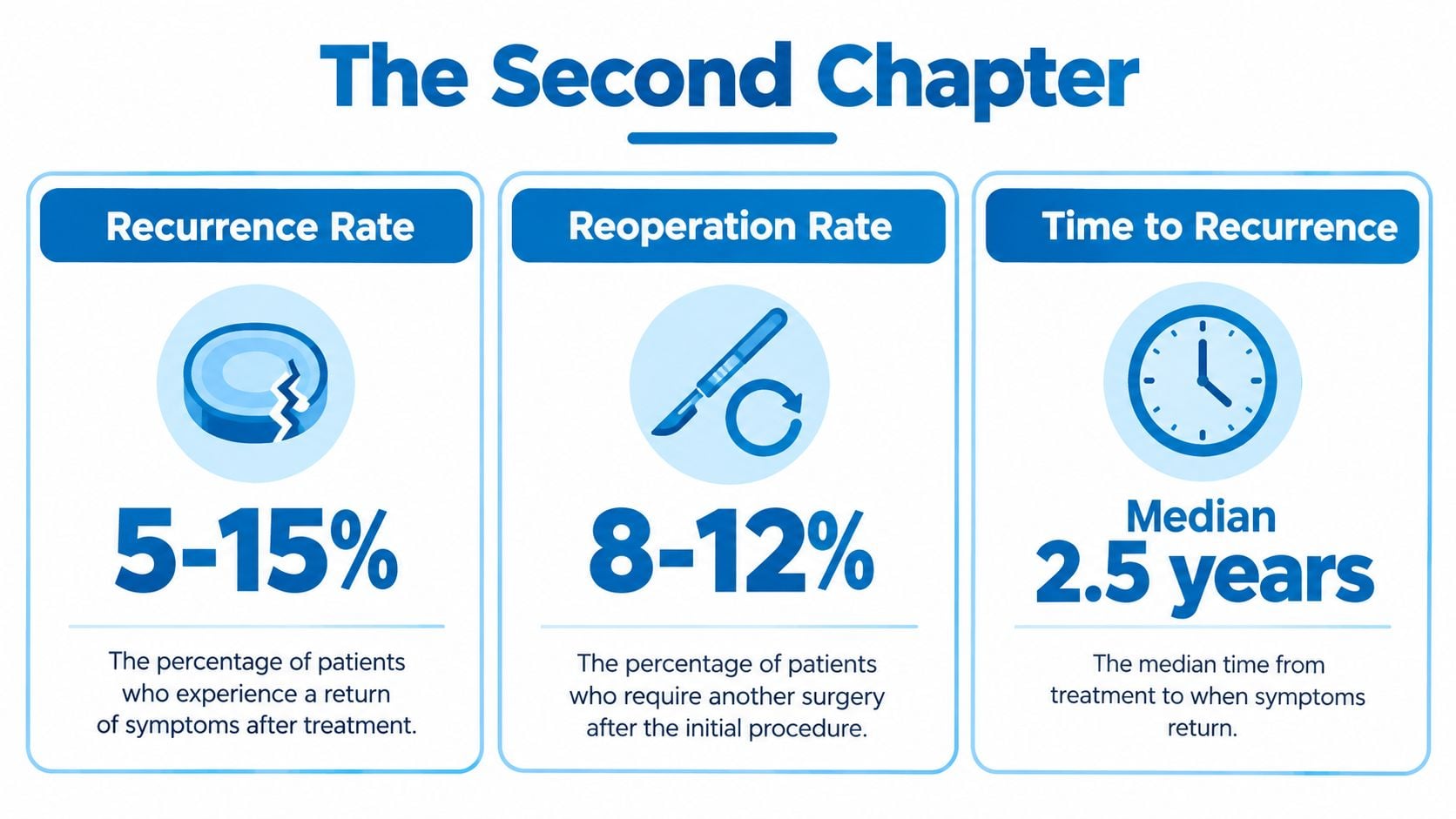
Returning symptoms call for reassessment of the pain pattern, examination, and imaging before deciding on treatment. The cause may be recurrent herniation or another source of pain. Long-term follow-up makes clear why recurrence and repeat surgery belong in an honest discussion of durability.
Where Epidural Injections Fit Before You Reach the Operating Room
An epidural steroid injection can be part of nonsurgical care for nerve-related pain. It may reduce symptoms enough to make daily activity more manageable or give the patient time to decide whether surgery is appropriate. It doesn't remove a disc fragment, and a good response doesn't prove that an operation will never be needed.
SPORT-related data found that patients who received injections were less likely to prefer surgery than those who didn't: 19% versus 56%. Yet the groups showed no difference in primary or secondary outcomes at 4 years. That finding doesn't establish that injections improve long-term surgical results. It suggests that injections may affect how patients approach the decision and its timing. The recurrent-disc review and related SPORT data describe this finding.
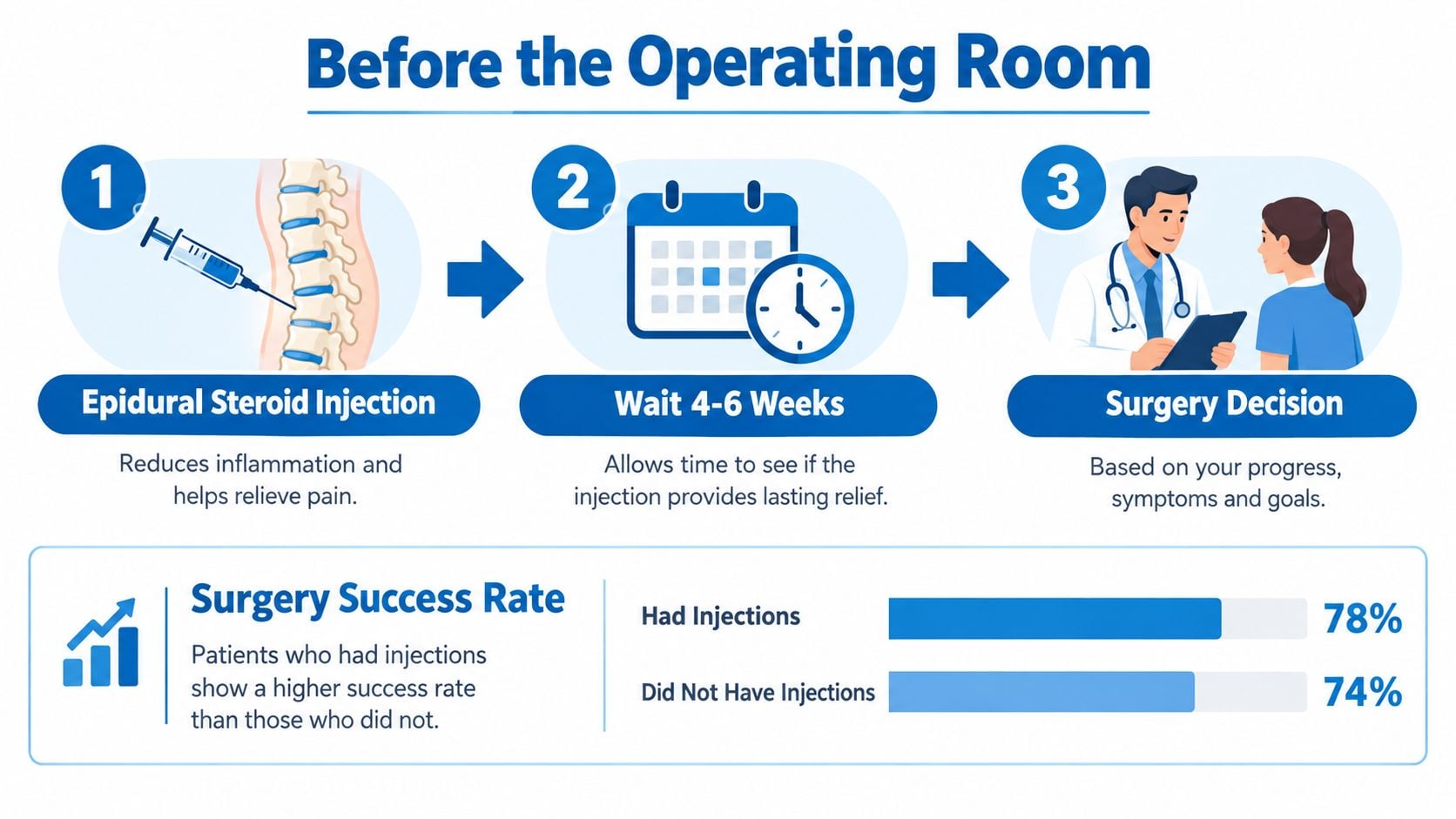
The decision should be based on the whole picture, not on a single injection response. A patient whose symptoms ease may choose to continue nonoperative treatment; someone whose pain remains disabling may want to revisit the options, especially when examination and imaging point to the same nerve. This overview of epidural steroid injections can help patients prepare questions about the procedure and its place in care.
Interventional Pain Management offers epidural steroid injections and other pain procedures alongside diagnostic evaluation and spine care. The relevant question for any clinician is whether the treatment fits the patient's symptoms and goals.
A Realistic Recovery Timeline After Discectomy
Recovery is easier to understand as a gradual return to daily tasks than as a promise that every symptom will vanish on a particular day. In the first part of recovery, a patient may notice leg pain easing while soreness around the incision remains. A clinician's instructions determine when and how much walking and activity are appropriate; recovery varies with the procedure, the patient's health, and the symptoms present before surgery.
As activity increases, the patient may build back toward ordinary tasks at a pace agreed with the surgical team. A desk-based routine and physically demanding work place different demands on the back, so “back to normal” needs a personal definition. If leg pain improves but some lower-back discomfort remains, that doesn't necessarily mean the operation failed: removing pressure from a nerve and resolving every source of back pain aren't the same goal.
A persistent or returning symptom deserves a clear conversation rather than guesswork. The patient should tell the care team where the pain travels, whether numbness or weakness has changed, and which activities remain difficult. This guide to pain after back surgery addresses why pain can persist and why its pattern matters.
Progress can be uneven. A patient may have a better day followed by a more uncomfortable one as activity changes. The useful measure is the overall direction of symptoms and function, checked with the clinical team, not a demand for a perfectly linear recovery.
Setting Honest Expectations Before You Decide
A worthwhile consultation connects the operation to a specific problem and a personal goal. Before deciding, a patient can ask the surgeon to explain how the symptoms, neurological examination, and MRI fit together; what the operation is intended to improve; and what it may not fix. It also helps to discuss health factors that could be addressed before surgery and how the surgeon will assess improvement.
Success needs a definition that matters in daily life. For one person, it may mean less leg pain and longer walks. For another, it may mean improved strength or the ability to resume work. Avoiding another operation is important, but it's only one measure and doesn't describe pain relief or function.
The evidence also has limits. SPORT's treatment crossover complicates a direct comparison between surgery and nonoperative care over the long term. Research on recurrent herniation has uneven reporting across outcomes and surgical approaches, so estimates for revision cases are harder to compare. A careful recommendation should acknowledge that uncertainty rather than turn a population result into a personal guarantee.
Before consenting, make sure the expected benefit, the main risks, and the measure of success are clear. If those answers don't connect to the symptoms that limit daily life, ask for more explanation.
Surgery can relieve nerve compression and often speeds improvement for appropriately selected patients. It can't promise complete freedom from back pain, a fixed recovery course, or no future disc problem. The decision is strongest when the patient and clinician agree on what the procedure is meant to change and how they'll judge the result.
Interventional Pain Management offers diagnostic review, epidural injections, and spine care, with treatment plans built to individual clinical needs. If you're weighing surgery for a herniated disc, visit Interventional Pain Management to learn about its services and arrange a discussion of your options.