
Some readers are finding this article after another rough morning. The back tightens before getting out of bed. The neck starts throbbing halfway through the commute. The leg pain returns after sitting, walking, or trying to sleep. Pills may dull the edge for a few hours. Basic physical therapy may help a little, then stall. Another appointment gets scheduled, but the big question remains the same. Why does the pain keep coming back?
That's often the point when people start asking what Interventional Pain Management really is, and whether it's different from just getting another prescription or being told surgery is the next step. For many adults in New Jersey and New York, especially those juggling work, family, and a long list of failed treatments, the answer matters because chronic pain can turn everyday decisions into exhausting calculations.
Table of Contents
- The Search for Lasting Pain Relief
- Defining Interventional Pain Management
- Common Interventional Pain Management Procedures
- Who Is a Good Candidate for These Treatments
- The Patient Journey From Diagnosis to Treatment
- Expected Outcomes and Potential Risks
- Finding the Right Pain Management Provider
- Frequently Asked Questions About IPM
The Search for Lasting Pain Relief
A common story sounds like this. A person develops back pain after lifting, a long drive, or an old injury that never fully settled down. At first, over the counter medication helps. Then stronger medication gets added. Maybe a few physical therapy visits happen, but the exercises feel too general, or the pain is too sharp to fully participate.
After months of this cycle, frustration sets in because the treatment seems aimed at the feeling of pain, not the reason for it.
That frustration is widespread. In 2023, 24.3% of U.S. adults experienced chronic pain, and 8.5% had high-impact chronic pain that frequently limited life or work activities, according to the National Academies discussion of chronic pain and treatment approaches. Those numbers help explain why so many patients are searching for something more precise than “take this and rest.”
Interventional pain management offers a different path. Instead of treating the whole body in hopes that pain settles down, this specialty looks for the specific structure causing trouble. That might be an irritated spinal nerve, an inflamed joint, or a small branch nerve carrying pain signals from arthritic facet joints.
Pain care works better when the team first identifies the pain generator, then chooses treatment that matches that source.
That's why many specialists describe the process as detective work. The goal isn't limited to muting symptoms. The goal is to trace pain back to its origin and treat it in a focused way that can improve movement, sleep, and daily function.
Some readers also spend time exploring at-home strategies before seeing a specialist. Practical, noninvasive ideas can help frame that early search, and MEDISTIK pain relief insights offer a useful example of how patients often think through relief options before moving to procedural care. When a more targeted evaluation is needed, a dedicated pain management team can help determine whether the pain is coming from a disc, joint, nerve, or another structure entirely.
Defining Interventional Pain Management
A patient may walk into clinic with one simple question: “Why does my back hurt when I stand, but my leg burns when I walk?” Interventional pain management helps answer that question by matching symptoms to a specific structure, then using a targeted procedure to confirm the source and treat it.
Interventional pain management is a medical specialty that uses minimally invasive, image-guided procedures to diagnose and treat pain. Instead of sending treatment through the whole body, the clinician places it near the area most likely responsible for the problem, such as an irritated nerve root, an inflamed joint, or a painful disc.
A useful way to picture it is a GPS compared with a paper map. A paper map shows the whole city, which can help, but it does not point to one exact address. Interventional care aims for the address. It uses the history, exam, and imaging to narrow the search, then uses precise procedures to test whether that spot is the pain generator.
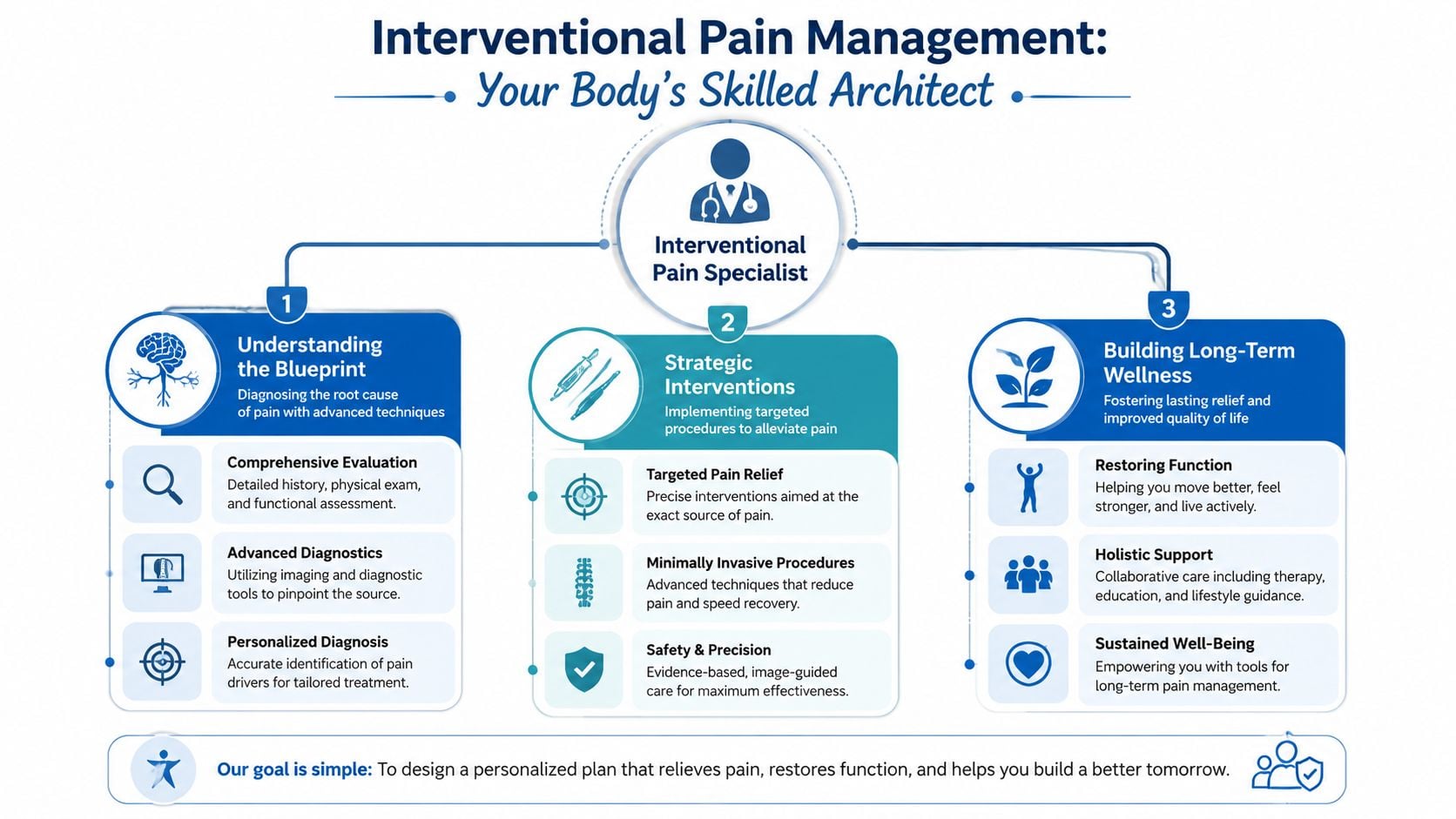
The image guidance matters. Pain specialists commonly use fluoroscopy or ultrasound so the needle can be placed with care and accuracy. The American Society of Regional Anesthesia and Pain Medicine overview of fluoroscopy and ultrasound guidance explains why these tools are used during many pain procedures. Precision is the point.
What makes it interventional
“Interventional” means the specialist actively uses procedures as part of both diagnosis and treatment. In other words, the procedure is not only about relief. It can also answer a medical question.
That usually falls into three categories:
- Diagnostic procedures: A targeted numbing injection can help show whether a certain joint, nerve, or region is actually causing the pain.
- Therapeutic procedures: Medication can be delivered to calm inflammation in one focused area, as happens with image-guided epidural steroid injections for irritated spinal nerves.
- Neuromodulation or signal-changing procedures: Some treatments reduce pain by changing how pain signals are carried or perceived.
This is why patients in NJ and NY often find the process more reassuring after the first visit. The goal is not to collect procedures. The goal is to build a roadmap. First, identify the likely source. Next, confirm it when needed. Then choose the least invasive treatment that fits the diagnosis, function goals, and daily life.
Where it fits in the treatment spectrum
Interventional pain management often sits between basic conservative care and surgery. For many people, it becomes the middle step after home measures, physical therapy, or medication have not provided enough relief, but before anyone decides that an operation is the right move.
| Approach | Main idea | Best understood as |
|---|---|---|
| Medication-based care | Affects the whole body | Broad symptom control |
| Interventional pain management | Targets a specific structure | Precision diagnosis and treatment |
| Surgery | Repairs or changes anatomy more extensively | Structural correction when indicated |
A practical rule helps here. Pain that follows a repeatable pattern, stays in a specific region, or flares with certain movements often deserves a focused evaluation.
So the answer to “what is interventional pain management” is broader than a list of injections. It is a step-by-step method for finding the pain source, testing that theory, and choosing targeted treatment as part of a larger care plan.
Common Interventional Pain Management Procedures
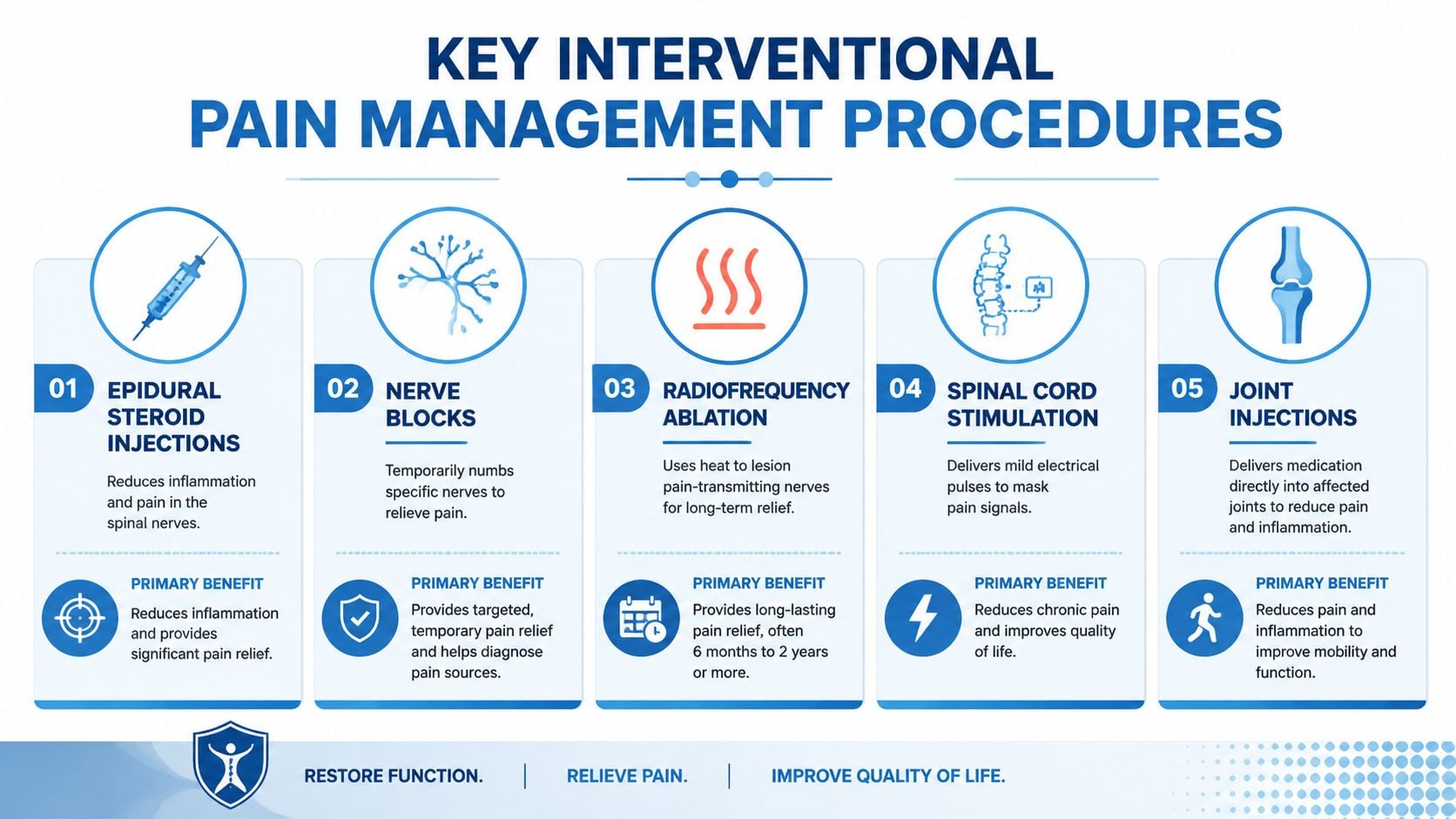
A procedure name can sound intimidating until you know its job. In practice, these treatments usually do one of three things. They calm inflammation around an irritated structure, temporarily numb a nerve to test whether it is the pain source, or reduce how strongly a pain signal travels.
That difference matters because each procedure answers a different question on the patient journey. Is the pain coming from a pinched nerve, a worn joint, or a nerve that has stayed overactive long after the original injury?
Epidural steroid injections
Epidural steroid injections are one of the procedures patients in NJ and NY hear about first, especially for back or neck pain that shoots into an arm or leg. The medication is placed into the epidural space near an inflamed spinal nerve, with the goal of lowering irritation around that nerve.
This works best when the pain pattern fits nerve root inflammation, such as sciatica or cervical radiculopathy. It is more like placing a fire suppressant near the smoke source than giving a general pain shot. Readers who want a condition-specific explanation can review how epidural steroid injections are used in targeted spine care.
Nerve blocks
A nerve block uses numbing medicine, sometimes paired with an anti-inflammatory medication, around a specific nerve or small group of nerves. Relief after the block can provide treatment, but it also gives the specialist useful diagnostic information.
For example, facet joint pain can be hard to identify from imaging alone. A patient may have arthritis on an MRI, but the MRI cannot prove that arthritis is the active pain generator. If numbing the small nerves serving those joints brings short-term relief in the expected pattern, that result supports the diagnosis.
Patients often find this easier to understand when they hear it described as a test drive. If turning off one signal changes the pain in a predictable way, the care team gains confidence about what to treat next.
Radiofrequency ablation
Radiofrequency ablation, or RFA, often comes after successful diagnostic nerve blocks. Instead of injecting medication for short-term relief, RFA uses heat created by a special needle to interrupt pain signals from a targeted nerve.
It is commonly used for pain coming from the facet joints in the neck or back, and in some cases for certain joint-related pain outside the spine. The joint itself may still have arthritis. What changes is the nerve's ability to keep broadcasting pain. A review in the journal Pain Physician describes how radiofrequency techniques are used to treat facet-mediated spinal pain and why careful patient selection matters (radiofrequency neurotomy review).
RFA works like lowering the volume on an alarm that keeps ringing after the danger has passed.
Spinal cord stimulation
Spinal cord stimulation is a more advanced option for chronic nerve-related pain that has not improved enough with simpler treatments. A small device sends electrical signals near the spinal cord to change how pain messages are processed before they reach the brain in the same way.
This treatment is usually considered later in the roadmap, not at the first visit. It may help selected patients with persistent neuropathic pain, including some people with post-surgical pain syndromes, complex regional pain syndrome, or other refractory nerve pain conditions. According to the NCBI overview of spinal cord stimulation in pain care, spinal cord stimulation can provide meaningful pain reduction for appropriately selected patients compared with continued medical management alone.
One detail often reassures patients. A trial is typically performed before permanent implantation, so the patient and physician can see whether it improves daily function in real life.
Joint and targeted injections
Pain does not always start in the spine. The sacroiliac joint, shoulder, hip, and knee can all produce pain patterns that mimic something else. In those cases, an image-guided joint injection may reduce inflammation and help confirm whether that joint is driving the symptoms.
This is one reason interventional pain care is more than a menu of procedures. The same patient with buttock pain could have a lumbar nerve problem, sacroiliac joint pain, or hip disease. The right injection helps sort that out.
A quick comparison can help:
- Epidural steroid injection: Often used for radiating pain from an irritated spinal nerve.
- Nerve block: Helps confirm the pain source and may provide short-term relief.
- Radiofrequency ablation: Used after a successful block when longer relief from that nerve is the goal.
- Spinal cord stimulation: Considered for selected chronic neuropathic pain that has not responded to less invasive options.
- Joint injection: Best suited to pain linked to a specific inflamed or mechanically painful joint.
For many patients, the most reassuring part is knowing there is a sequence. Diagnosis comes first, then a targeted test when needed, then treatment matched to the structure most likely causing the pain.
Who Is a Good Candidate for These Treatments
Not every person with back, neck, or joint pain needs an interventional procedure. The best candidates usually have a pain pattern that points to a specific structure and a treatment history showing that basic measures haven't been enough.
Signs this pathway may fit
A patient may be a reasonable candidate when several of these are true:
- Pain has lasted for months: Chronic pain usually means symptoms have persisted beyond the expected healing window.
- Conservative care hasn't solved the problem: Medication, rest, or general physical therapy may have helped only partially or briefly.
- The pain has a recognizable source: Symptoms, exam findings, and imaging may suggest a nerve root, facet joint, disc, sacroiliac joint, or another clear anatomical target.
- Function matters as much as pain scores: Good candidates usually want to walk farther, sleep better, sit longer, return to work, or care for family more comfortably.
- They want alternatives to bigger interventions: Some people aren't ready for surgery, and some may not be ideal surgical candidates.
Common examples include persistent sciatica, spinal stenosis symptoms, degenerative disc-related pain, post-surgical pain syndromes, and certain neuropathic pain conditions.
When a specialist may pause or redirect care
Interventional care isn't automatically appropriate just because pain is severe. Some patients need a different path first.
That may happen when:
- The pain pattern is too diffuse: Widespread pain without a clear source can make targeted procedures less useful.
- The clinical picture suggests another specialty should lead: Certain structural problems may need surgical review first.
- Expectations don't match reality: If a patient is hoping for a guaranteed cure from one injection, the treatment plan needs recalibration before moving ahead.
- A broader plan is missing: Procedures tend to work best when they support rehabilitation, movement, and overall pain management rather than replacing them.
A careful consultation helps separate “could benefit” from “should proceed now.” That distinction protects patients from both overtreatment and delay.
The Patient Journey From Diagnosis to Treatment
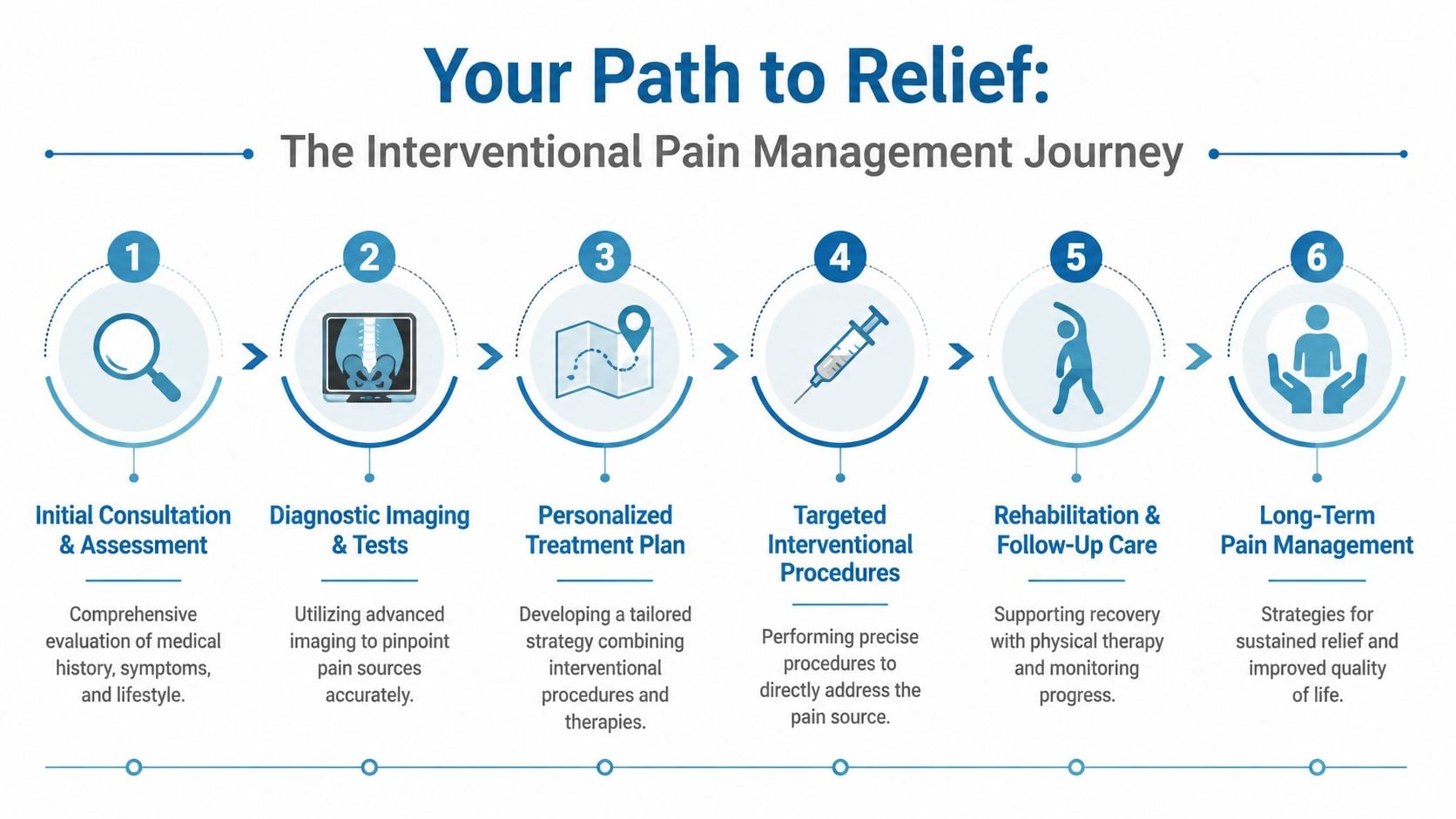
One of the biggest fears patients carry is not knowing what the process will look like. The actual journey is usually more orderly than expected. It moves from evaluation to confirmation, then from targeted treatment to follow-up.
Step one and step two
The first visit usually focuses on details that patients may think are small but matter a great deal. Where does the pain start. Where does it travel. What positions make it worse. Is it burning, stabbing, aching, or electric. Has prior surgery changed the pattern. Imaging is reviewed in that broader context rather than treated as the whole answer.
Sometimes the next step is a diagnostic procedure rather than immediate treatment. That can confuse patients who are expecting a therapeutic injection right away. But a diagnostic block can be one of the most valuable parts of the journey because it helps confirm whether the suspected structure is responsible.
A procedure can be useful even when its first job is diagnosis, not long-term relief.
Step three through step six
Once the likely pain generator is identified, the plan becomes more personalized. In the NJ and NY area, that often matters because patients may be balancing physically demanding jobs, long commutes, prior specialist visits, and pressure to return to normal routines quickly.
A typical roadmap looks like this:
-
Thorough consultation
The specialist reviews symptoms, exam findings, prior treatment, imaging, and functional limits. -
Diagnostic clarification
If needed, a targeted block or other test helps confirm the source. -
Personalized treatment selection
The team matches the procedure to the anatomy and the patient's goals. -
Procedure day
According to the peer-reviewed discussion of image-guided interventional procedures, fluoroscopy is an essential safety and precision tool for spinal interventions, bringing risk to less than 1% in experienced hands. These procedures are typically done in outpatient settings, take less than 60 minutes, and many patients return to normal activities within 24 to 48 hours. -
Recovery and reassessment
The immediate response is tracked, because that information helps determine what comes next. -
Longer-term support
Physical therapy, home exercise, activity changes, and additional care may be added so the result lasts and function improves.
For many patients, the most important part of this roadmap is understanding that interventional pain management isn't a single event. It's a guided sequence of decisions.
Expected Outcomes and Potential Risks
A realistic conversation about outcomes is one of the most important parts of pain care. The goal is usually not perfection. The goal is meaningful improvement. That can mean less pain, better sleep, a longer walking distance, fewer pain flares, or enough relief to participate in rehabilitation again.
What success usually means
Some procedures are aimed at short-term relief. Others are meant to last longer. Some help confirm a diagnosis before the next step. Patients do better when the outcome is defined in functional terms rather than as an all-or-nothing cure.
For advanced neuromodulation, patients should ask what daily life might look like if the treatment works. A thoughtful discussion of spinal cord stimulation options can help frame that decision in practical terms, especially when nerve pain has remained stubborn after other treatments.
In some practices, follow-up also includes digital symptom check-ins and structured monitoring between visits. Broader care systems continue to optimize remote patient monitoring solutions so patients and clinicians can track progress more consistently after procedures and during recovery.
Why honest expectations matter
Interventional procedures can help many people, but they don't help everyone. According to the PMC review on failure patterns and predictors in pain interventions, up to 25% of patients experience no significant pain relief after spinal cord stimulation or radiofrequency ablation, especially when centralized pain syndromes are part of the picture.
That doesn't mean the field is ineffective. It means patient selection matters, and so does timing.
A balanced risk discussion should also include common procedural concerns such as bleeding, infection, temporary soreness, or a treatment that doesn't deliver enough relief. Patients deserve clear language around both possibility and limitation.
Key takeaway: The best interventional plan is one that includes an exit strategy. If a procedure doesn't help enough, the team should already know what alternative comes next.
Finding the Right Pain Management Provider
The provider matters as much as the procedure. A well-chosen treatment can disappoint when the evaluation is rushed, the diagnosis is vague, or the clinic only offers one type of solution for every patient.
Credentials that matter
Patients in New Jersey and Staten Island are often better served by looking for a few specific qualities rather than flashy promises.
A strong checklist includes:
- Board certification and fellowship training: These credentials suggest deeper training in pain diagnosis and image-guided procedures.
- Careful diagnostic habits: The provider should explain why a procedure fits the pain pattern, not just name the procedure.
- Comfort with multiple options: Good care includes knowing when not to inject, when to repeat a test, and when to refer for surgical review.
- Clear communication: The plan should make sense in plain English.
Why a multidisciplinary setting helps
Pain rarely stays neatly inside one medical box. A patient may need interventional care, orthopedic input, physical therapy, and sometimes spine surgery consultation. A multidisciplinary setting helps because those decisions can be coordinated rather than fragmented across disconnected offices.
That's especially useful in the NJ and NY region, where travel time, work schedules, and insurance logistics can add stress to an already draining process.

Patients may also want to ask practical questions early:
| Question | Why it matters |
|---|---|
| Who reviews imaging and performs the procedure | Confirms accountability and expertise |
| Is care coordinated with orthopedic or spine specialists | Helps when pain has more than one possible source |
| Are appointments accessible | Chronic pain is harder to manage when scheduling is chaotic |
| Will the provider discuss both benefits and limits | Honest communication protects decision-making |
Convenience alone shouldn’t choose the doctor, but access does matter. When pain care is hard to reach, patients often delay treatment or drop out before the plan has a real chance to work.
Frequently Asked Questions About IPM
Many patients still have practical concerns even after they understand the basics. Those questions are appropriate, and good answers should be direct.
Are these procedures painful
Most interventional procedures are designed to be tolerable. The area is usually numbed, and the team explains each step as it happens. Patients may feel pressure, temporary soreness, or reproduction of familiar pain during a diagnostic portion, but the goal isn’t to create unnecessary discomfort.
The experience varies by procedure and body region. Anxiety also changes how the visit feels, which is why a calm explanation beforehand can make a major difference.
How long does relief last
There isn’t one universal timeline. Relief depends on the diagnosis, the procedure, the stage of the condition, and whether the patient can build on pain reduction with movement and rehabilitation afterward.
Some injections help for a shorter window. Some ablation procedures may last longer. Neuromodulation can support longer-term management for selected conditions. A specialist should explain success in terms of expected function, not just duration.
Can IPM replace opioids
Sometimes it helps reduce opioid use, but it shouldn’t be sold as a guaranteed opioid-exit plan. According to the AAOPM discussion of interventional pain care and multimodal support, only 30% to 40% of patients achieve sustained opioid reduction without multimodal support, and the HHS Task Force notes that interventional approaches alone are insufficient without integrated behavioral and pharmacologic strategies.
That’s an important reality check. Procedures can create an opening. They can lower pain enough for better sleep, better movement, and more participation in therapy. But many patients still need a broader plan.
A few final questions can help guide the next visit:
- What structure is believed to be causing the pain
- Is the proposed procedure diagnostic, therapeutic, or both
- What would count as success for this specific case
- What happens if the first procedure doesn’t help enough
Good pain care leaves room for hope without making promises it can’t keep.
For patients in New Jersey and Staten Island who want a clearer path from diagnosis to targeted treatment, Interventional Pain Management offers access to board-certified, multidisciplinary care for back, neck, joint, and nerve-related pain. A focused evaluation can help determine whether a minimally invasive procedure, coordinated rehabilitation, or a different specialty referral is the right next step.