
The night before surgery, many patients lie awake wondering what a nerve block before surgery will feel like. Will the injection hurt? Will the arm or leg become completely useless? What happens when the numbness disappears, and will the pain arrive all at once?
A nerve block is a planned way to reduce pain signals from a specific part of the body. It may be used alongside general anesthesia, sedation, or other pain medicines. The most useful way to understand it is as a timeline: preparation before the operation, placement and testing, a period of numbness, and a transition as sensation returns.
Table of Contents
- What Happens Before You Reach the Operating Room
- How a Preoperative Nerve Block Works
- Common Types of Nerve Blocks by Surgical Site
- How the Block Is Placed Step by Step
- What to Expect as the Block Wears Off
- Benefits, Risks, and When a Block May Not Be Appropriate
- Common Misconceptions Worth Clearing Up
- Your Preoperative Checklist and When to Call After
What Happens Before You Reach the Operating Room
A typical surgery day begins in the preoperative holding area. A preoperative nurse checks vital signs, confirms medications and allergies, places an intravenous line, and reviews the surgical plan. The surgeon confirms the operation and its site. The anesthesiologist then discusses the anesthesia options, including whether a nerve block could help with pain during the operation and recovery.
The block is usually discussed before the needle touches the skin. That conversation matters because the plan can affect fasting instructions, medication adjustments, consent, positioning, and the type of monitoring required. The anesthesiologist also needs to know about blood-thinning medicines, bleeding problems, allergies, prior nerve symptoms, and previous experiences with anesthesia.

The planned sequence
After the patient changes into a gown, the care team generally follows this order:
- Nursing assessment: The nurse checks identity, allergies, medications, fasting status, and baseline sensation or movement when relevant.
- Anesthesia consultation: The anesthesiologist explains the proposed block, alternatives, expected benefits, possible risks, and whether sedation or general anesthesia will also be used.
- Consent and preparation: The patient has an opportunity to ask questions and agree to, decline, or discuss changes to the plan.
- Block placement: The patient is positioned so the anesthesiologist can safely reach the target area. Monitoring remains in place.
- Onset and testing: The team waits for numbness or weakness to develop, then checks whether the expected region is covered.
- Transfer to the operating room: Once the plan is confirmed, the patient proceeds to surgery.
A nerve block isn't an emergency decision made after pain becomes severe. It's a preventive part of the anesthetic plan. The anesthesiologist, surgeon, and nurse are coordinating the same objective: make the operation safe and keep pain manageable from the first incision through the early recovery period.
How a Preoperative Nerve Block Works
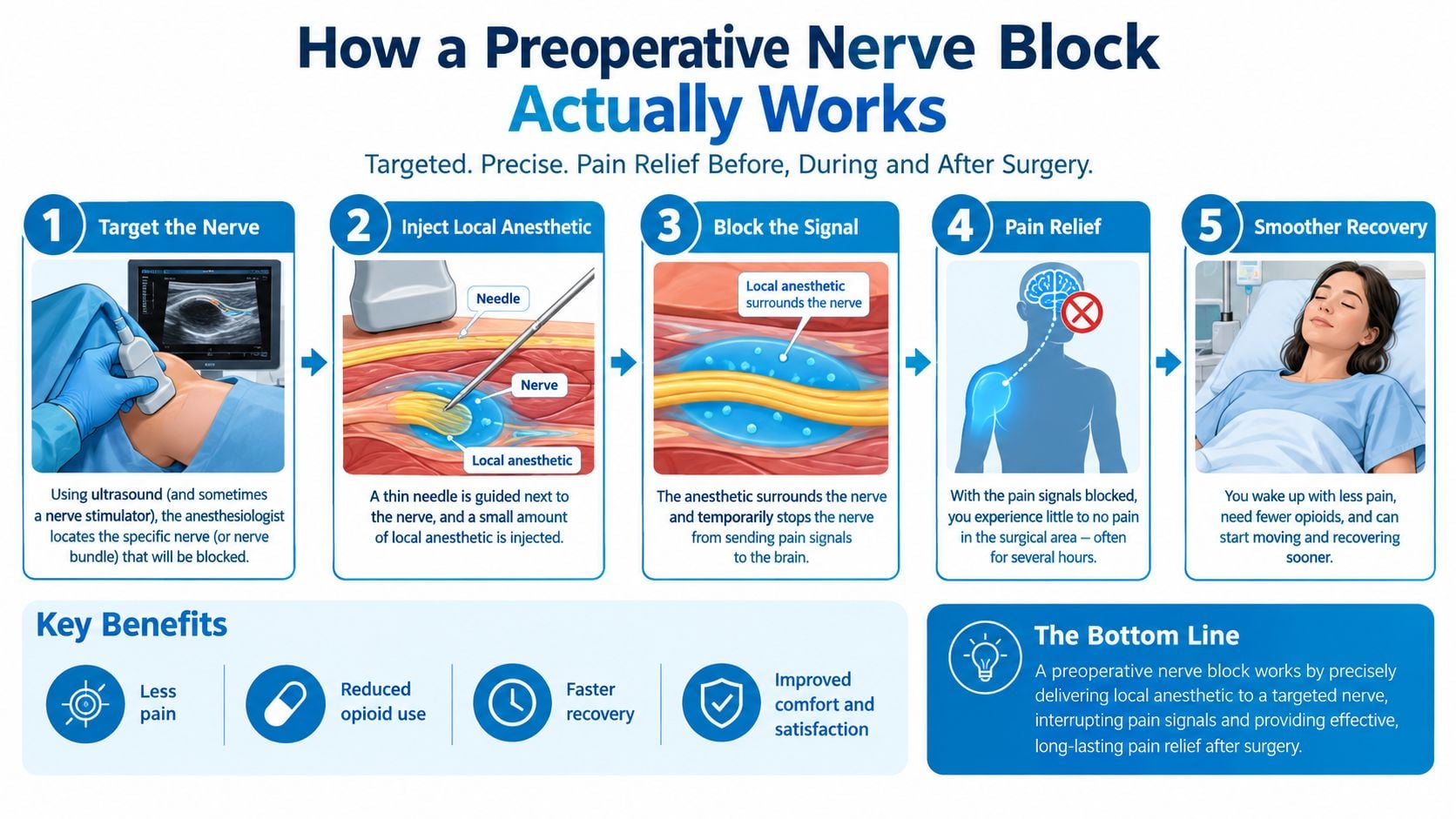
A preoperative nerve block works like dimming one circuit in the body while the rest of the system keeps running. General anesthesia affects awareness more broadly. A nerve block targets the nerves carrying pain signals from the area where surgery will happen, so fewer of those signals reach the spinal cord and brain in the first place.
That is why the block is placed before surgery, not after pain has already built up.
The signal pathway
Nerves carry messages from the skin, muscles, joints, and deeper tissues. When local anesthetic is placed near a selected nerve or group of nerves, those messages slow down or stop for a while. What you feel during that window can include numbness, less pain, warmth, tingling, and sometimes temporary weakness in the arm or leg served by that nerve. For many patients, this is the part that feels strange at first. A heavy, numb limb can be expected, even when the block is working as intended.
There are two common ways this is done. A single-shot block uses one injection of local anesthetic. A continuous block adds a very thin catheter near the nerve so medication can keep flowing for longer under a prescribed plan. How long the effect lasts depends on the nerve being treated, the medication used, the dose, the surgical site, and individual factors.
You may also hear two terms during the discussion. Regional anesthesia means the block can provide much of the anesthesia for a body region, sometimes along with sedation. Preemptive analgesia means the block is given before the operation to reduce pain during and after surgery, even if general anesthesia is also used to keep you unconscious.
Why timing matters
Pain is easier to control when the pathway is quiet before the incision starts. That early timing gives the medication time to settle in and begin working.
The block is also only one part of the plan. Anesthesia teams often combine it with non-opioid medication, local infiltration, other regional techniques, or rescue medication if discomfort breaks through. This layered strategy is called multimodal pain management. The goal is not to promise a pain-free experience. The goal is to reduce pain from several directions, help you need less systemic opioid medication, and make the transition easier when the numbness later begins to fade.
Common Types of Nerve Blocks by Surgical Site
The block choice follows the operation. An anesthesiologist targets the nerves that carry sensation from the surgical area, rather than choosing one universal injection for every patient.
For shoulder surgery, an interscalene block is placed near the side of the neck and commonly numbs the shoulder and upper arm. An axillary block, placed near the armpit, is often used for procedures involving the lower arm, elbow, or parts of the forearm.
Hand and forearm operations may involve individual peripheral nerves. A median nerve block affects sensation on the thumb-side portion of the hand, an ulnar nerve block serves the little-finger side, and a radial nerve block covers sensation across parts of the back of the hand and forearm. These may be used alone or combined, depending on the incision and surgical area.
For abdominal surgery, a transversus abdominis plane block, often called a TAP block, places medication along the abdominal wall to reduce pain from selected abdominal nerves. A paravertebral block, placed near the spine, may be considered for some chest or breast procedures.
Knee operations may use a femoral block, which can provide strong pain relief but may weaken the quadriceps, or an adductor canal block, which aims to preserve more leg strength while treating pain around the knee. Foot and ankle procedures may involve a popliteal block behind the knee or an ankle block near the ankle, depending on the surgical site.
For broader background on injection approaches, patients can review this overview of types of injections used in pain management.
| Surgical area | Typical block | What it numbs |
|---|---|---|
| Shoulder | Interscalene | Shoulder and upper arm |
| Elbow or forearm | Axillary or selected peripheral nerve blocks | Parts of the arm and forearm |
| Hand | Median, ulnar, or radial blocks | Specific regions of the hand |
| Abdomen | TAP block | Portions of the abdominal wall |
| Breast or chest | Paravertebral block | Selected chest and breast regions |
| Knee | Femoral or adductor canal block | Knee region, with different effects on leg strength |
| Foot or ankle | Popliteal or ankle block | Foot, ankle, or portions of the lower leg |
The table shows typical pairings, not fixed rules. The anesthesiologist may choose a different technique because of the incision, positioning, medical history, anticoagulant use, or the need to preserve movement after surgery.
How the Block Is Placed Step by Step
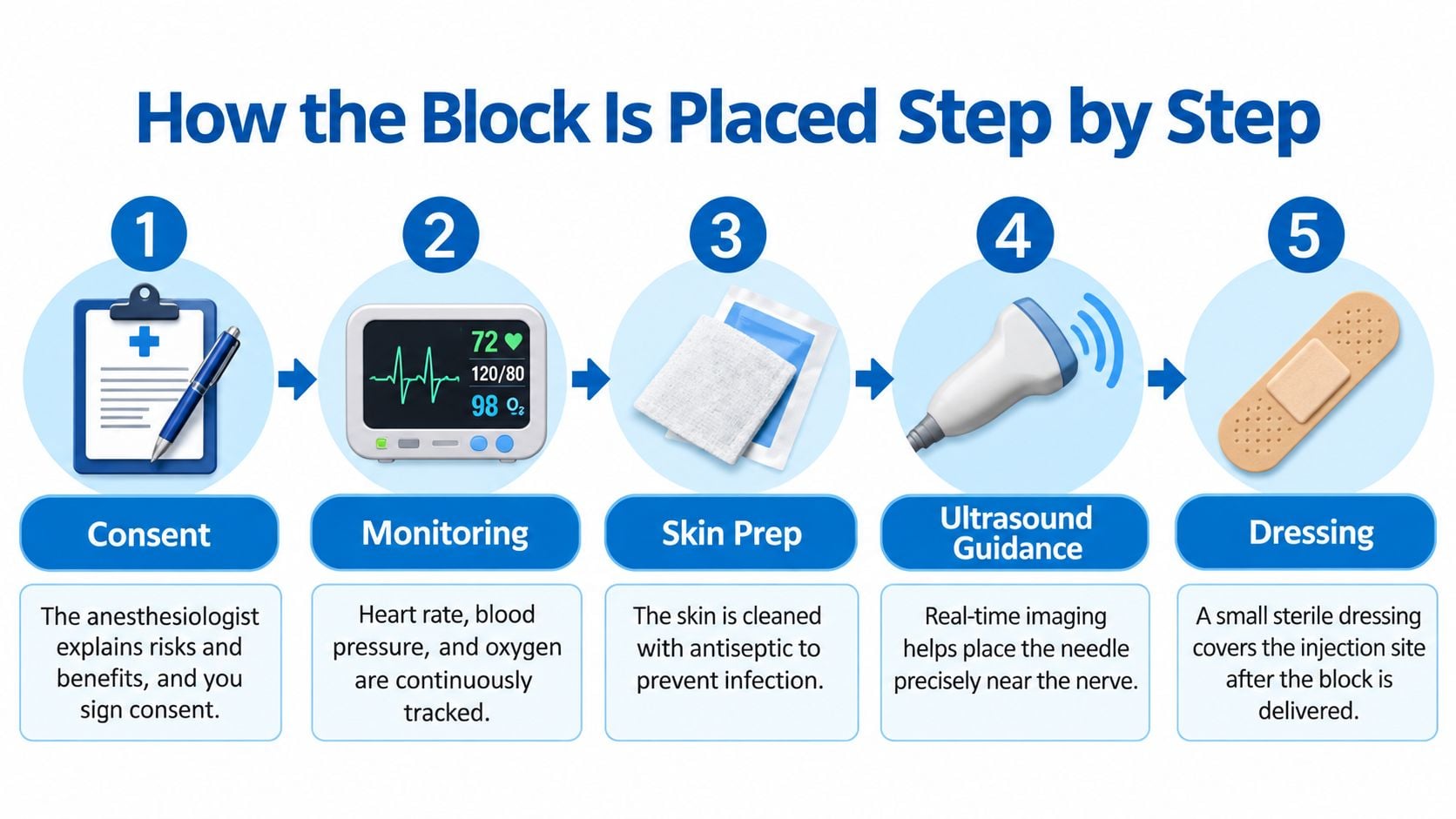
The patient usually remains awake or lightly relaxed during placement. The anesthesiologist first confirms the operation, the intended side, allergies, medications, and consent. The patient is positioned so the target area can be reached without strain, and monitors track heart rate, blood pressure, and oxygen levels.
The skin is cleaned with antiseptic. An ultrasound probe covered for sterile use helps the anesthesiologist identify nerves, nearby blood vessels, muscles, and other structures. The image doesn't make the procedure risk-free, but it helps guide the needle toward the intended location while avoiding important anatomy.
Sensations during placement
A small injection numbs the skin first. Patients commonly notice a brief sting, followed by pressure as the needle advances. Some feel tingling or a quick electrical sensation near the nerve. The anesthesiologist will pause and reposition if the sensation is unexpected or concerning.
The local anesthetic then spreads around the target nerve. A single-shot block is delivered through the needle, which is removed afterward. For a continuous block, a thin catheter remains near the nerve and is secured with a dressing so medication can be infused according to the prescribed plan.
The placement itself is often completed within a short preoperative interval, while the block may take approximately 15 to 30 minutes to develop, depending on the technique and medication. During that time, the patient may feel warmth, heaviness, tingling, or increasing numbness.
Practical rule: The patient should report sharp pain, intense pressure, unusual symptoms, or anxiety during placement. Silence isn't required, and communication helps the anesthesiologist adjust the technique.
Before surgery begins, the team checks sensation and movement in the expected distribution. A patient may be asked to identify touch, move fingers or toes, bend a joint, or describe how the limb feels. These checks help confirm that the block is taking effect and establish a clear baseline for later recovery.
An explanation of image-guided injection care is also available through epidural steroid injection information, although an epidural and a peripheral nerve block are different procedures.
What to Expect as the Block Wears Off
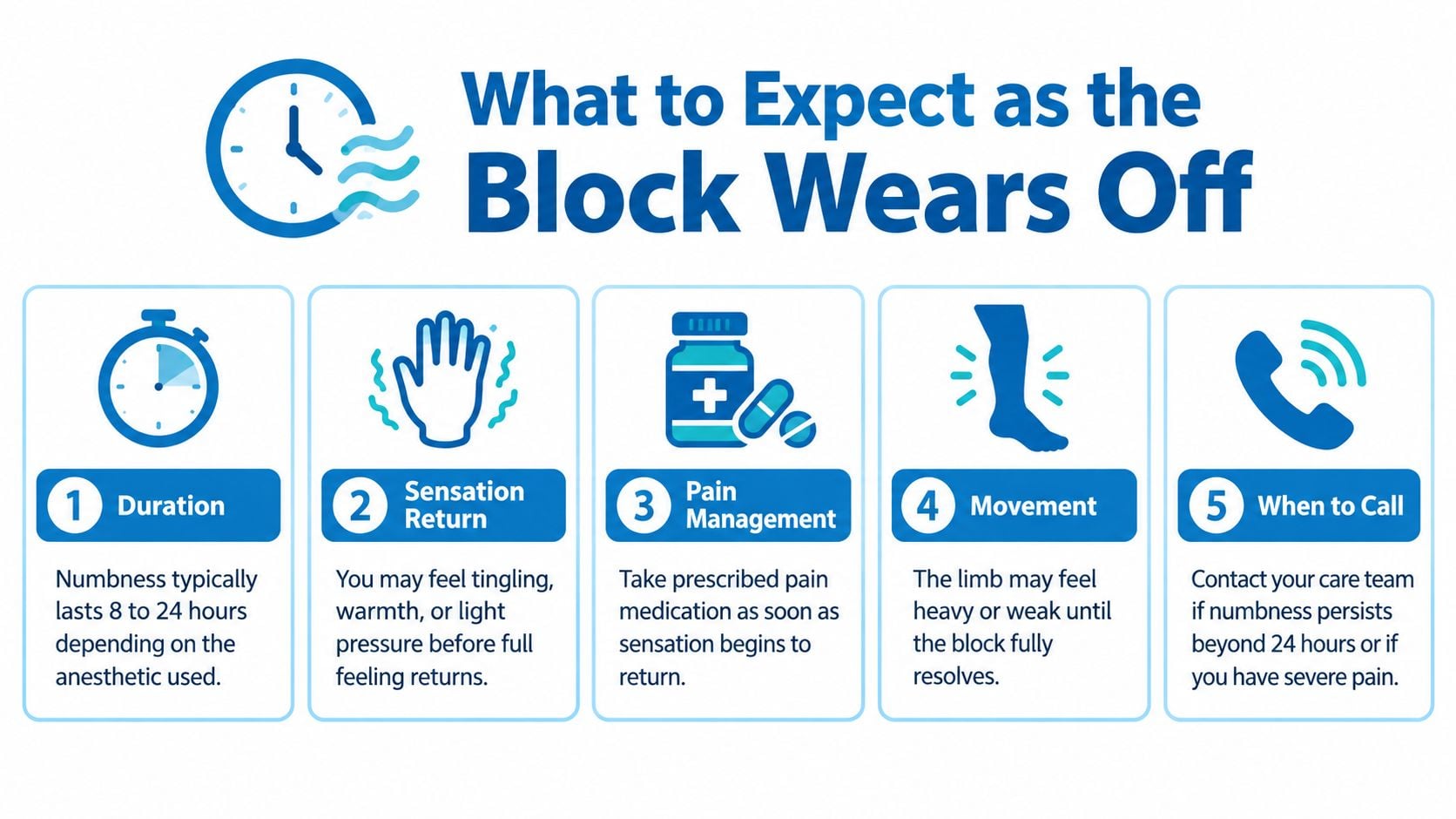
You may go to sleep with a numb arm or leg and wake up surprised by how strange it feels. That change is expected. Depending on the anesthetic and technique, sensation often starts returning within approximately 8 to 24 hours, as described in this review of rebound pain after peripheral nerve blocks. Many patients notice the return in stages: warmth first, then tingling, pins and needles, itching, pressure, and finally pain.
This part of recovery deserves planning before the pain arrives. A nerve block works like a temporary mute button, not an off switch for the surgical injury itself. As the medicine fades, the nerves begin carrying signals again. If that transition happens before your other pain medicine has had time to work, discomfort can rise quickly.
That temporary flare is called rebound pain. Reported incidence varies widely, from approximately 6.67% to 81%, depending on the operation, the block used, and how rebound pain is defined. The practical point is simpler than the numbers. It is common enough that planning for it is standard, not pessimistic.
A good plan during the numb-limb window is straightforward:
- Protect the limb: Keep it away from heaters, hot water, heating pads, sharp edges, and prolonged pressure. A numb foot can rest awkwardly in a blanket. A numb hand can touch something too hot without warning.
- Prevent falls: If the leg feels heavy or weak, use help when walking and follow the movement instructions from your surgical team.
- Follow the medication schedule: Prescribed pain medicine often needs time to start working. If your anesthesiologist or surgeon tells you to begin non-opioid medicine or rescue treatment before full feeling returns, follow that timing rather than waiting for severe pain.
- Watch the dressing: Keep the injection site clean. If you have a catheter or pump, follow the instructions you were given.
- Check circulation and position: Avoid tight wraps, tight clothing, or any position that puts constant pressure on the limb.
Numbness by itself is not automatically a problem. Call your care team if pain becomes severe and stays uncontrolled, or if you notice spreading redness, drainage, fever, symptoms of local-anesthetic toxicity, or weakness that does not improve as the block should be wearing off. Unusual symptoms deserve a phone call, not guesswork.
Benefits, Risks, and When a Block May Not Be Appropriate
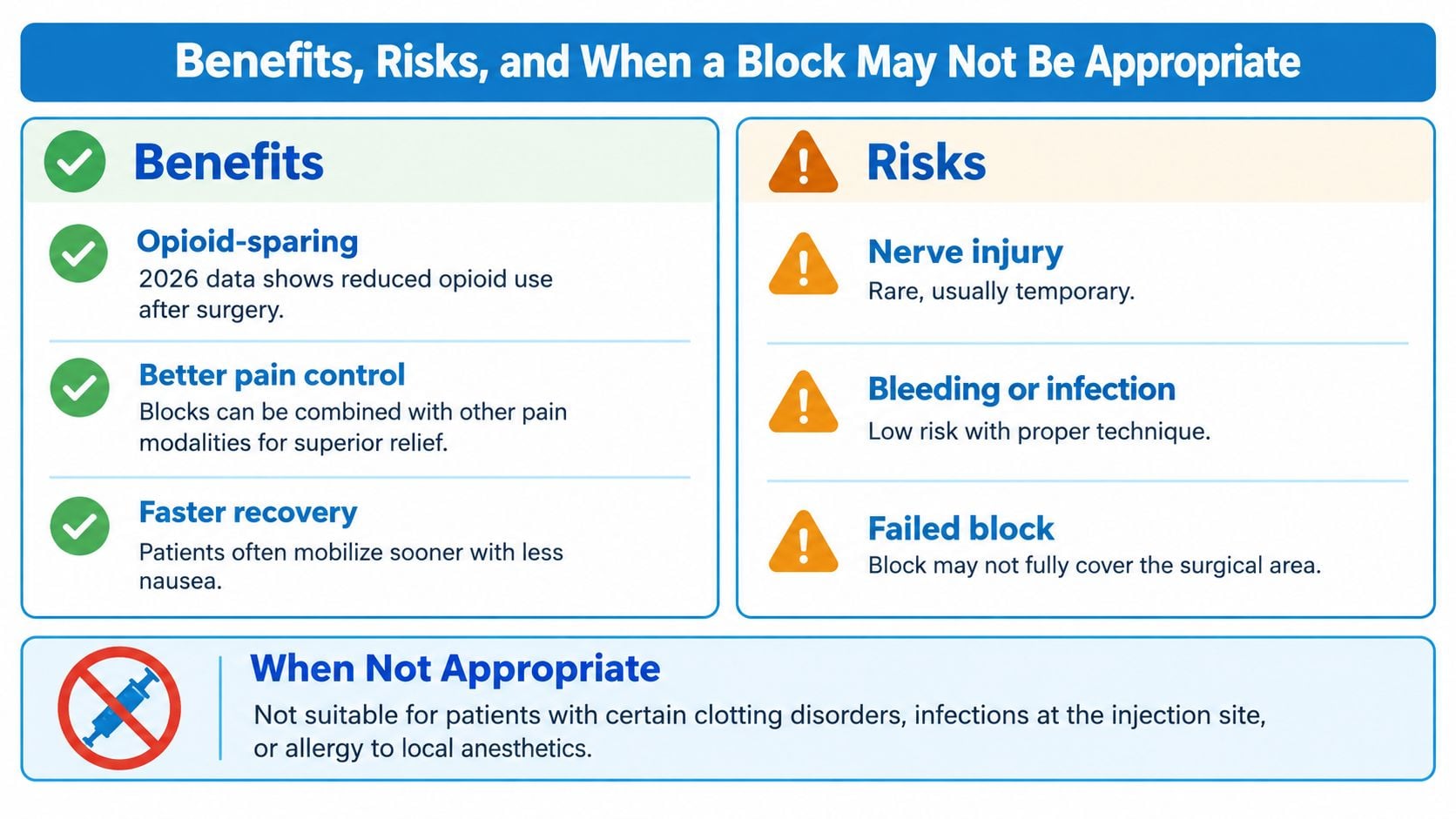
A preoperative nerve block is usually offered for one practical reason. It can lower pain from a specific area and reduce how much whole-body pain medicine you need while the block is working. In a 2026 study of 203 patients, 147 received a continuous preoperative peripheral nerve block and 56 served as controls. Within the first 24 hours after admission, median fentanyl-equivalent opioid use was 50 micrograms with the block compared with 100 micrograms without it, and during the first 24 postoperative hours it was 25 micrograms with the block compared with 95 micrograms without it. Both differences had p < 0.001 (2026 study of continuous preoperative peripheral nerve blocks).
That matters to patients because less opioid often means a simpler early recovery. It may mean less nausea, less grogginess, and easier participation in breathing, therapy, or basic movement, depending on the operation and the rest of the pain plan. After adjustment for age, sex, physical status, fracture type, and time to surgery, receiving a continuous block remained independently associated with 43.8 fewer micrograms of opioid use within 24 hours, with a 95% confidence interval of 28.3 to 59.3 fewer micrograms. The same adjusted analysis supports opioid-sparing use in painful orthopedic and trauma procedures, but one study should not be stretched to fit every surgery, every block, or every patient.
The trade-off is straightforward. A block can improve comfort, but it can also create numbness, heaviness, and temporary weakness in the limb, which may be inconvenient or unsafe if you were expecting normal use right away. That is one reason the decision is not just about placement. It is also about what the hours after surgery will feel like, what help you will have at home, and how you will handle the rebound period as sensation returns.
Serious complications are uncommon, though they are not impossible. A prospective series of 21,278 peripheral nerve blocks identified four cases of radiculopathy, equivalent to 1.9 cases per 10,000 blocks (review of peripheral nerve block safety and history). The safety series cited above also describes a pediatric dataset with a low overall complication rate and reports higher complication rates with central blocks than with peripheral blocks.
Possible problems include infection, bleeding, local-anesthetic systemic toxicity, nerve injury, incomplete pain coverage, and temporary motor weakness. Careful ultrasound use, sterile technique, dose awareness, monitoring, and clear discharge instructions all lower risk.
A block may not be appropriate if you do not want one, if the skin or deeper tissue at the injection site is infected, if a bleeding disorder or blood thinner makes bleeding more concerning, if you have a severe local-anesthetic allergy, or if anatomy makes safe placement difficult. Your anesthesiologist weighs those issues against the expected pain benefit and the surgical plan. If your case is complex or you need longer-term follow-up, additional pain management services may also be part of the discussion.
Common Misconceptions Worth Clearing Up
A nerve block doesn't always replace general anesthesia. Many patients receive a block as a pain-control layer while general anesthesia or sedation is used for the operation itself. The anesthesiologist selects the combination based on the procedure, patient preference, medical history, and expected surgical stimulation.
A block that doesn't cover the expected area isn't a personal failure. Effectiveness depends on the selected nerve, local anesthetic, infusion duration, surgical site, anatomy, and the way pain travels from that region. The anesthesiologist may supplement the block, change the pain plan, or use another technique.
More numbness isn't automatically better. A dense block can hide warning symptoms, create weakness, and increase the risk of falling when a leg is affected. The intended balance is adequate pain control with safe movement and appropriate observation.
An epidural and a peripheral nerve block are both regional techniques, but they aren't interchangeable. An epidural places medication near nerves in the spinal canal, while a peripheral block targets nerves farther from the spine, such as those serving the shoulder, arm, knee, foot, or abdominal wall.
Finally, a successful block doesn't promise zero pain after surgery. It aims to reduce pain during a defined period, support recovery, and limit the need for systemic medication. The patient still needs an agreed plan for incision soreness, movement-related discomfort, and the moment sensation returns.
Your Preoperative Checklist and When to Call After
A short checklist can make the preoperative conversation more productive:
- Bring a medication list: Include prescriptions, over-the-counter medicines, supplements, and blood thinners.
- Describe prior experiences: Mention difficult anesthesia, unusual numbness, nerve symptoms, allergies, or bleeding problems.
- Ask about the target: Find out which block is proposed and what region it should numb.
- Clarify the method: Ask whether the plan involves a single injection or a continuous catheter.
- Plan for the transition: Ask when sensation is expected to return and when prescribed pain medicine should begin.
- Prepare the home setting: Arrange transportation, help with walking if needed, a safe place for the numb limb, scheduled medications, and a charged phone.
After discharge, contact the care team for spreading redness, drainage, fever, severe uncontrolled pain, or numbness or weakness that persists beyond the expected window. New severe headache, chest tightness, ringing in the ears, unusual dizziness, or other symptoms that could suggest local-anesthetic toxicity require prompt medical advice.
A change in limb color, coldness, worsening swelling, or a concerning change in sensation also deserves a call. The safest plan is specific: the patient knows what should happen, when it should happen, and whom to contact if recovery moves outside that pattern.
Interventional Pain Management offers image-guided nerve block injections that use local anesthetic near a nerve to temporarily interrupt pain signals, with treatment selected according to the patient's condition and goals. Patients preparing for surgery or managing persistent spine, joint, or nerve pain can visit Interventional Pain Management to learn about consultation and care options.