

A patient sits in the recovery area after a lumbar epidural steroid injection, relieved that the procedure is over but uncertain about a heavy-feeling leg and soreness in the lower back. Another patient is at home the night before treatment, reading the consent form and wondering whether the frightening complications listed there are likely to happen. Both need the same distinction: temporary procedural effects aren't the same as neurological warning signs.
When evaluating epidural steroid injections for sciatica side effects, the procedure's name alone isn't enough. The needle approach, steroid formulation, medical history, and pattern of symptoms afterward all matter. Good counseling makes those differences clear without dismissing discomfort or suggesting that catastrophic complications are routine.
Table of Contents
- What You Feel in the First Hour After an Epidural Steroid Injection
- How a Lumbar Epidural Steroid Injection Actually Works
- Common Short-Term Side Effects After an Epidural Steroid Injection
- Rare but Serious Risks You Should Know About
- How Injection Technique and Steroid Formulation Change the Risk
- Risk Factors That Make Side Effects More Likely
- Monitoring Yourself After the Injection and Recognizing Red Flags
- When an Epidural Steroid Injection Makes Sense for Sciatica
What You Feel in the First Hour After an Epidural Steroid Injection
In the recovery chair, the most useful question isn't whether something feels different. It's whether the change is mild and improving, or new, substantial, and worsening. Temporary injection-site soreness and brief leg numbness or weakness can occur after lumbar epidural steroid injection, particularly when local anesthetic spreads around nearby nerves.
A heavy leg can be unsettling even when temporary numbing is the explanation. Recovery staff should hear about it before the patient tries to stand or leave. Calling attention to a symptom isn't overreacting, and assuming every new sensation is harmless because an anesthetic was used isn't a safe approach.
Describe the change rather than guessing its cause
A clear description gives the clinician something useful to assess:
- Location: Is the discomfort at the needle site, along the usual sciatica pathway, or somewhere new?
- Function: Does the leg merely feel different, or is standing and moving harder?
- Direction: Is the symptom easing, staying unchanged, or becoming more pronounced?
- Associated symptoms: Are visual changes, a severe headache, or other unexpected symptoms occurring alongside it?
Dizziness and nausea can also occur. A patient who feels lightheaded should tell recovery staff rather than walk unassisted. The immediate priority is safe observation, not proving that the procedure was easy to tolerate.
Recovery-room rule: New symptoms deserve a description and an assessment, not an automatic label of normal.
Before discharge, the patient should have written instructions, a clinic contact number, and an explanation of what warrants emergency care. The accompanying adult should understand those instructions as well. Anxiety is easier to manage when the patient knows what to report and doesn't have to make decisions from memory while uncomfortable.
Early comfort also shouldn't be mistaken for a guarantee of lasting treatment success. Recovery assessment and later evaluation of sciatica relief are different tasks.
How a Lumbar Epidural Steroid Injection Actually Works
A lumbar epidural steroid injection places corticosteroid in the epidural region near irritated spinal nerves. The treatment is directed at the inflammatory component of nerve-related pain. It isn't a procedure that removes a disc fragment or physically enlarges a narrowed passage.
That distinction matters when discussing a herniated or bulging disc. A treatment plan should connect the suspected pain generator with the examination and imaging findings, rather than treating every abnormal-looking disc as a reason for an injection.
Different routes reach the treatment area differently
The names describe the clinician's route, not different brands of the same procedure:
- Interlaminar: The needle approaches the epidural space between adjacent vertebral laminae.
- Transforaminal: The needle approaches through the opening associated with an exiting spinal nerve.
- Caudal: The needle approaches the epidural space from its lower end through the sacral region.
The practical choice concerns where the medication needs to go and which route is appropriate for the patient's anatomy. A clinician considering a focused nerve-root target may discuss a transforaminal approach. A broader distribution goal may lead to discussion of another route, but the approach shouldn't be chosen by a simple rule that ignores imaging or prior procedures.
Placement requires more than reaching a landmark
The safety conversation should include image guidance and contrast confirmation. Imaging helps the clinician evaluate needle position; contrast helps assess the pattern of spread before medication delivery. These are concrete safeguards, not interchangeable with a general assurance that the injection is routine.
Patients don't need to interpret procedural images themselves. They should, however, receive an understandable explanation of the target, planned route, and checks used before steroid injection.
A useful consent discussion identifies where the medication is intended to go and how the clinician checks its placement.
Local anesthetic and corticosteroid also have different roles. Temporary numbing should be distinguished from the anti-inflammatory treatment objective. Otherwise, a patient may interpret early numbness as permanent nerve injury, or early pain relief as proof that the underlying problem has been corrected.
Common Short-Term Side Effects After an Epidural Steroid Injection
The usual short-term effects are transient and self-limited. They include local soreness, a temporary increase in familiar radiating pain, headache, facial flushing, nausea, dizziness, insomnia, fluid retention, mood changes, and brief numbness or weakness. Their clinical significance depends on severity and progression, not merely whether they appear on a side-effect list.
Published minor-event frequencies included local pain in 15.6%, headache in 14.2%, nausea in 8.2%, and tinnitus in 5.5% of participants, with important limitations because reporting varied and some symptoms occurred in both treatment and placebo groups, as summarized in the clinical overview of epidural steroid injection complications. These aren't universal probabilities for every lumbar injection.
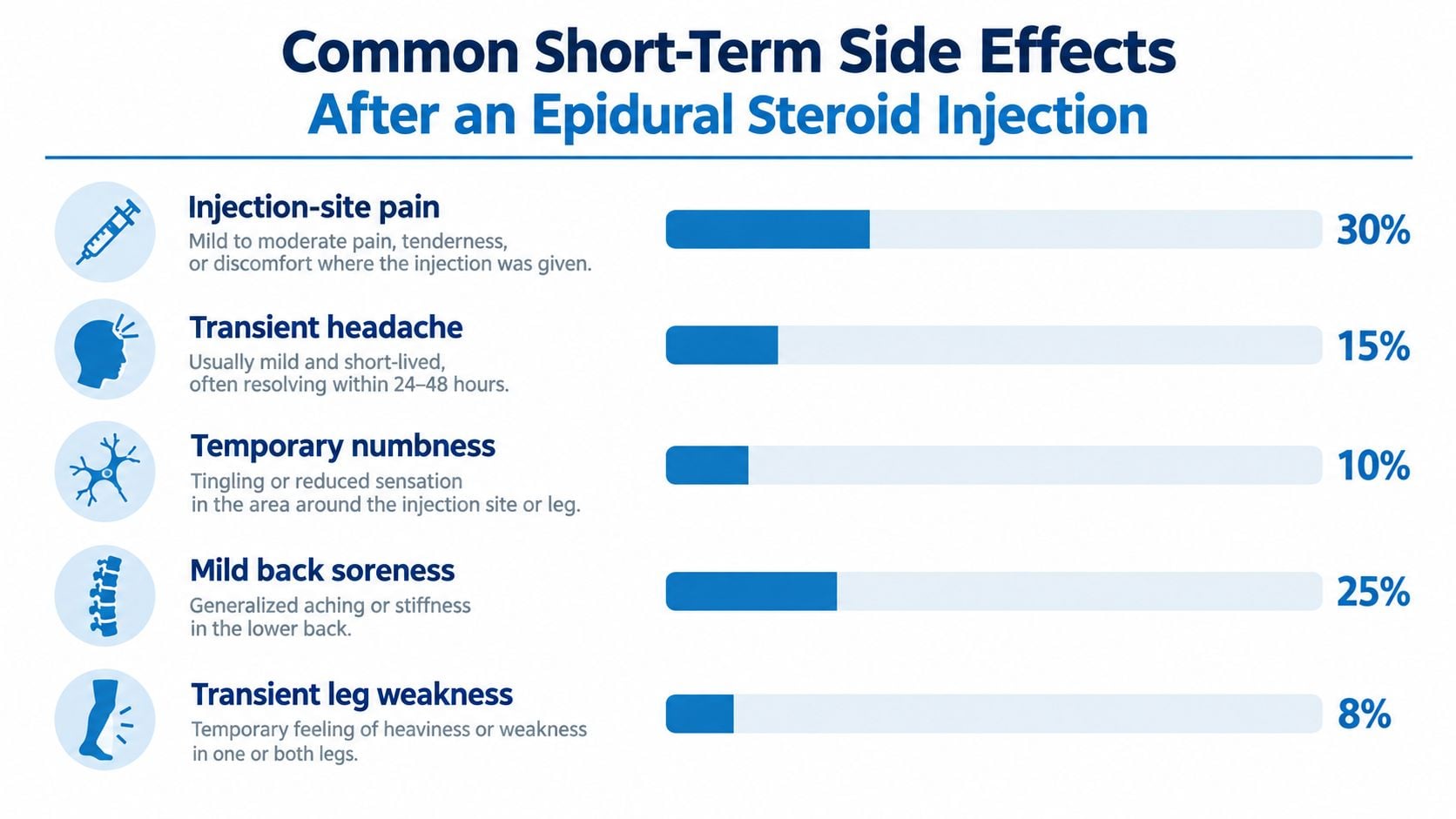
The chart's percentages shouldn't be used as patient-specific risk estimates. The cited figures above are the supported estimates discussed here; other percentages displayed in the illustration aren't established by that evidence.
Discomfort and steroid effects need different responses
Needle-site tenderness and a flare of familiar sciatica are different from sleep disruption or flushing. The former concern the local post-procedure experience; the latter belong to the broader medication side-effect discussion. A patient can experience both without having a major complication.
Brief blood-glucose elevation deserves particular attention in someone with diabetes. A monitoring plan should be agreed on before treatment rather than improvised after an unexpectedly high reading. Medication changes should follow the treating clinician's instructions.
| Symptom pattern | Practical response |
|---|---|
| Mild local soreness that is easing | Follow the written comfort and activity plan |
| Flushing or sleep disturbance without neurological symptoms | Monitor and contact the clinic if troublesome or persistent |
| A glucose reading outside the agreed plan | Contact the clinician responsible for diabetes management |
| Pain that becomes progressively worse or changes character | Request assessment rather than repeatedly assuming a routine flare |
A headache isn't a single diagnosis
A mild headache and a severe headache that changes markedly with position shouldn't receive the same advice. Dural puncture is a recognized procedural complication, so the clinician needs to know the headache's severity, onset, and relationship to sitting or standing.
The same distinction applies to leg symptoms. A fleeting altered sensation differs from persistent sensory loss or declining strength. Persistence, progression, and loss of function change management. Patients shouldn't be asked to endure an unexplained deterioration merely because temporary symptoms can occur after an injection.
Rare but Serious Risks You Should Know About
The consent form includes severe outcomes because they are recognized possibilities, not because they represent the expected recovery. On April 23, 2014, the FDA warned that epidural corticosteroid injections can rarely cause vision loss, stroke, paralysis, and death, following 90 serious neurological adverse-event reports between 1997 and 2014, according to the FDA drug safety communication on epidural corticosteroid injections.
Reported injuries included spinal-cord infarction, paraplegia, quadriplegia, cortical blindness, and stroke. The warning also required changes to injectable corticosteroid labels and stated that the safety and effectiveness of epidural administration hadn't been established. Corticosteroids aren't FDA-approved for epidural administration.

Why the reports don't provide a percentage risk
An adverse-event database doesn't supply the total number of injections performed. It may also miss events, and an individual report doesn't prove causation in every case. Dividing the reported injuries by an assumed number of procedures would produce a misleading estimate.
The defensible conclusion is narrower: catastrophic neurological injury is a recognized, exceptionally uncommon potential complication, but these reports don't establish a precise patient-level probability.
Consent principle: Rare doesn't mean impossible, and a report count isn't an incidence rate.
How a catastrophic vascular injury can occur
A particularly concerning mechanism is inadvertent injection into an artery during a transforaminal procedure. Particulate steroid can aggregate into particles capable of obstructing an arterial branch, interrupting blood supply and causing ischemic injury. This mechanism and the association of catastrophic infarctions with steroid suspensions are described in the clinical discussion of epidural injection vascular complications.
That is different from needle-site tenderness or flushing. It explains why the formulation and safeguards deserve specific discussion instead of a blanket statement that all injections have identical risks.
Bleeding, infection, and significant neural injury are additional uncommon but consequential concerns. Patients don't need to diagnose these complications at home. They need a clear escalation plan when symptoms suggest something more serious than an ordinary recovery effect.
The appropriate trade-off isn't silence versus alarm. It's candid consent that acknowledges severe possibilities, explains the steps taken to reduce risk, and avoids unsupported assurances of zero risk.
How Injection Technique and Steroid Formulation Change the Risk
Approach and formulation are separate decisions. The route describes the needle path; the formulation describes the medication being delivered. Combining them into a single label obscures the part of the risk discussion most relevant to rare vascular injury.
Neurological events have been reported more often with particulate corticosteroids delivered by the transforaminal route. Risk-reduction recommendations include consideration of nonparticulate dexamethasone for an initial lumbar transforaminal injection, as discussed in the review of epidural steroid safety and formulation choices. This is a specific safety consideration, not a claim that another approach or medication makes complications impossible.
Approach and Steroid Choice Comparison
| Variable | Transforaminal | Interlaminar | Caudal | Particulate Steroid | Nonparticulate Dexamethasone |
|---|---|---|---|---|---|
| What the term identifies | Needle route near an exiting nerve | Needle route between laminae | Lower sacral needle route | Steroid suspension category | Nonparticulate steroid choice |
| Key rare-risk discussion | Vascular entry and medication choice | Placement and procedural safeguards | Placement and procedural safeguards | Particle-related embolic mechanism | Alternative considered to address particulate risk |
| Patient question | Why is this route appropriate? | Why is this route appropriate? | Why is this route appropriate? | Why is this formulation being selected? | Is this suitable for the planned injection? |
The table isn't a ranking of overall complication rates. It separates variables that patients can ask about without suggesting that evidence supports a precise numerical comparison among all combinations.
What meaningful safeguards sound like
A useful explanation names the checks: image guidance, assessment of contrast spread, and precautions against vascular injection. An explanation limited to the clinician's confidence or familiarity with the procedure leaves important questions unanswered.
The same specificity should apply when reviewing corticosteroid injection options. If a particulate preparation is proposed, the clinician should explain the reason for that choice and the relevant alternatives. Patients shouldn't have to infer formulation from the general word steroid.
- Ask about the route: Which approach is planned, and what finding supports it?
- Ask about the medication: Is the steroid particulate or nonparticulate?
- Ask about verification: How will needle position and medication spread be assessed?
These questions support shared decision-making. They don't require the patient to select the technique independently or second-guess anatomy that the clinician has reviewed.
Risk Factors That Make Side Effects More Likely
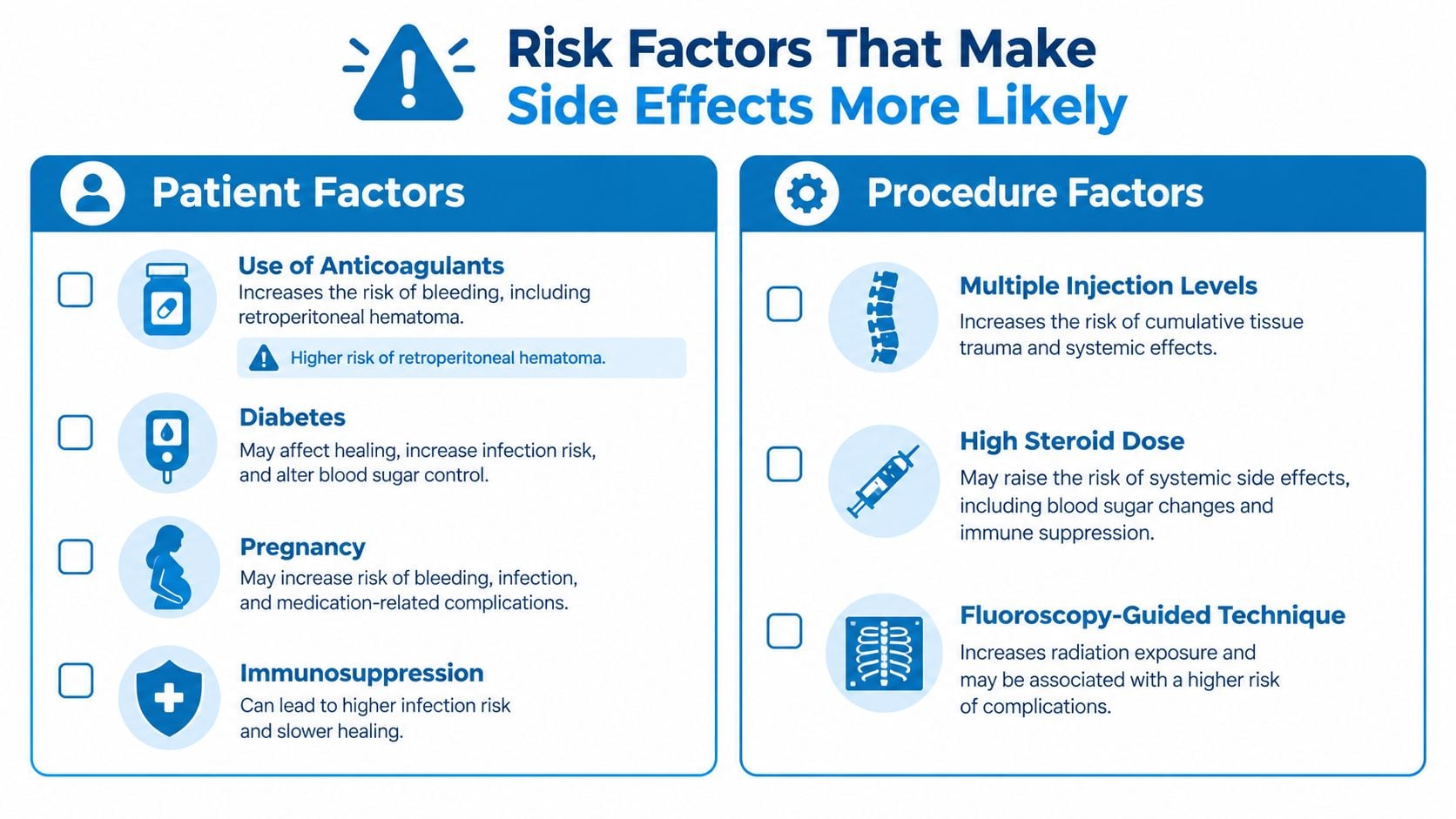
A medication list is part of procedural planning, not administrative paperwork. Anticoagulant therapy deserves explicit review because bleeding-related complications can have serious consequences. Patients should disclose the exact medication and its prescribing clinician rather than describe it only as a blood thinner.
A 2020 Cochrane review reported no minor or major adverse events in the available comparative studies at short-term follow-up, but identified one patient receiving anticoagulant therapy who developed a retroperitoneal hematoma after injection, as reported in the Cochrane review of corticosteroid injections for sciatica. Limited trial observations don't establish zero risk, particularly for rare harms.
Disclosures that help the clinician plan
- Blood-thinning medication: Provide a current list and obtain a coordinated plan. Patients shouldn't stop prescribed anticoagulants independently.
- Diabetes: Discuss recent glucose control and an aftercare monitoring plan.
- Current illness or infection concerns: Report fever, new illness, or treatment for an infection before proceeding.
- Immune-related conditions or treatment: Identify medications and conditions that may affect procedural planning.
- Previous spine surgery: Bring relevant records and imaging so the clinician can review the operative history.
- Pregnancy or possible pregnancy: Disclose it before decisions about imaging and medication.
These are consultation topics, not a validated scoring system. A checklist can't establish that every listed factor increases every complication, or quantify how several factors interact.
Procedure safeguards aren't patient risk factors
The illustration combines health disclosures with procedural considerations. Image guidance is a safeguard, not an adverse condition that patients bring to treatment. Dose, treatment extent, formulation, and route should be discussed as clinical choices rather than interpreted as a simple count of hazards.
The practical objective is an individualized plan: which medications require coordination, whether treatment should proceed, what monitoring is needed, and which instructions differ from routine aftercare. An unexplained standard handout isn't enough when a patient has a relevant medical concern.
Monitoring Yourself After the Injection and Recognizing Red Flags
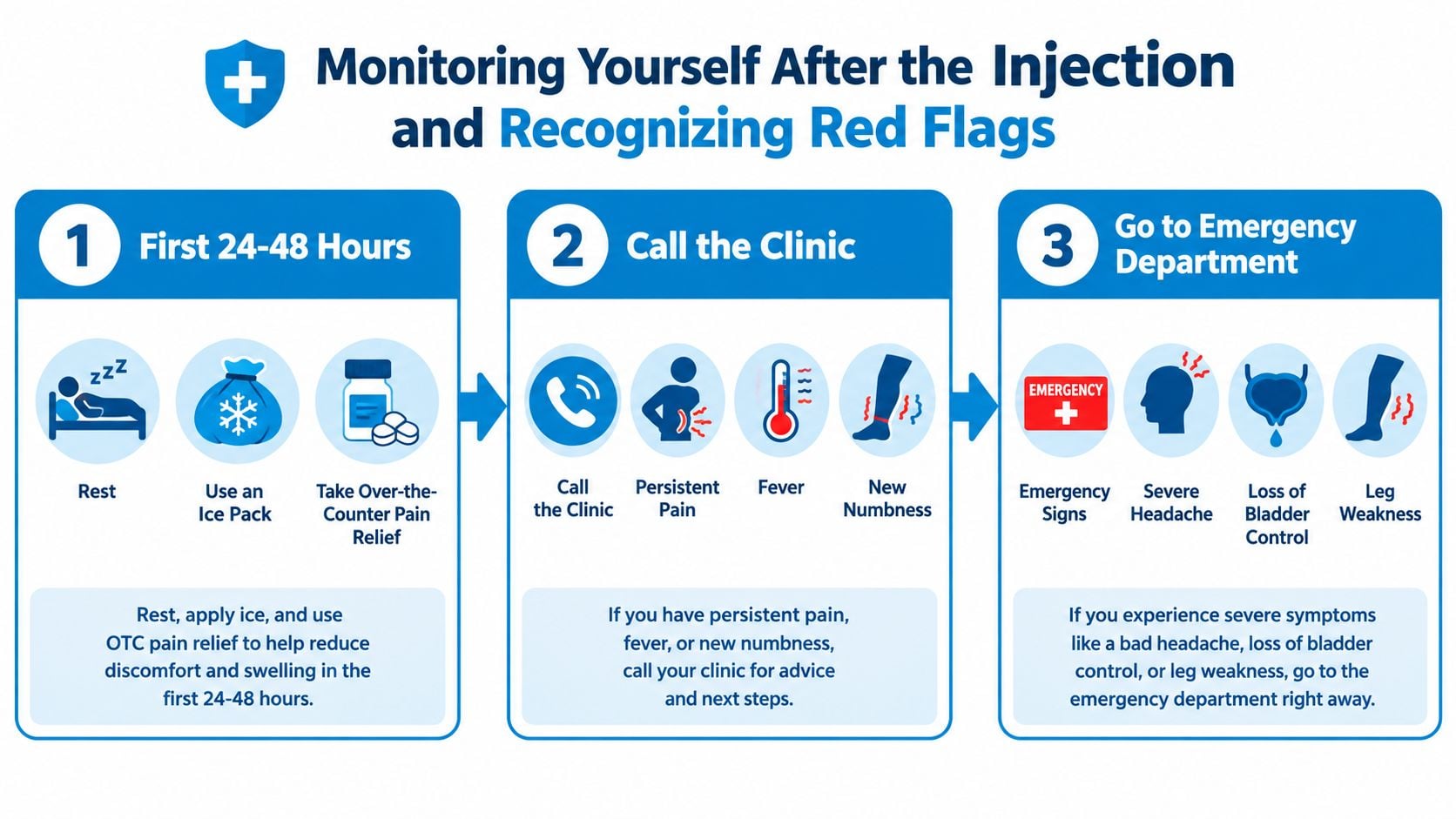
Home monitoring should separate mild symptoms that are improving, symptoms requiring clinic advice, and symptoms requiring emergency assessment. Patients shouldn't move through those categories as mandatory stages. An emergency symptom warrants immediate action, even if the clinic hasn't been contacted first.
The discharge instructions should remain the primary guide for activity, comfort measures, and medication use. Rest, hydration, and any nonprescription pain medicine should follow that plan, especially when other medications or medical conditions complicate otherwise routine advice.
When observation or a clinic call is appropriate
For mild, improving soreness without new neurological symptoms, the patient can follow the agreed aftercare plan. A brief symptom record should describe the location, severity, direction of change, and any effect on walking or ordinary function.
The clinic should hear about persistent discomfort, troublesome medication effects, or uncertainty about recovery instructions. A symptom that isn't improving deserves discussion rather than indefinite watchful waiting.
When urgent assessment takes priority
- Progressive leg weakness or persistent sensory loss: Seek urgent evaluation rather than assume residual anesthetic.
- New bowel or bladder dysfunction: Go to an emergency department.
- Fever after injection: Obtain urgent medical assessment, particularly with worsening back pain or feeling unwell.
- Severe positional headache: Seek urgent evaluation for a possible procedural complication.
- Sudden visual change, seizure, severe headache, or acute neurological symptoms: Obtain emergency care.
For abrupt neurological symptoms, inability to move safely, or a seizure, emergency services should be called. The patient shouldn't drive or wait for a routine callback. The emergency team should be told that an epidural injection was recently performed, along with the timing and medication information if available.
Emergency action depends on the symptom, not on whether serious complications are statistically uncommon.
Follow-up should also address treatment response, not just complications. A reassessment can compare leg pain and function with the pre-procedure baseline. Patients should report new or worsening symptoms whenever they develop rather than assume that leaving the initial recovery period ends the need for vigilance.
When an Epidural Steroid Injection Makes Sense for Sciatica
The decision should begin with a defined clinical problem and a realistic treatment objective. A consultation for sciatica and a pinched nerve should examine whether the leg symptoms, physical findings, and imaging support the same suspected nerve-related source.
An injection is a consideration when radiating leg pain remains disruptive despite an appropriate conservative treatment plan. Isolated mechanical back pain without a clear radicular component calls for a different diagnostic conversation. An imaging abnormality alone shouldn't determine treatment.
Define success before accepting the trade-off
Useful goals are concrete: easier walking, better sleep, or sufficient comfort to participate in rehabilitation. The patient and clinician should also agree on what would count as an inadequate response and how that would change the next decision.
- Treatment rationale: What problem is the injection intended to address?
- Procedure details: What approach, formulation, and placement safeguards are planned?
- Medication coordination: Is there a specific anticoagulation or diabetes plan?
- Follow-up: Who reviews the response, and how are unexpected symptoms reported?
The balanced decision isn't based on fear or reassurance alone. It connects a plausible treatment target with individualized safety planning and a clear recovery plan. Temporary discomfort may be an acceptable trade-off for a meaningful functional goal; an injection without a convincing indication offers a much weaker reason to accept procedural risk.
Patients can visit Interventional Pain Management for evaluation of sciatica and discussion of non-invasive, interventional, and surgical options, including epidural steroid injections when clinically appropriate. Those considering an injection can request a consultation to review their imaging, medication history, technique options, and post-procedure warning signs with the treating physician.