
A lot of patients reach the same point before a spinal cord stimulator procedure. They feel hopeful because chronic pain has worn down sleep, work, movement, and mood. At the same time, they feel stuck on one very practical question. Will the procedure hurt, and what kind of anesthesia will be used?
That concern is completely reasonable. Spinal cord stimulator anesthesia can sound confusing because the process usually happens in stages, and the anesthesia plan often changes between those stages. What feels strange at first usually makes more sense once the purpose of each step is clear.
A spinal cord stimulator can offer meaningful relief for carefully selected patients with chronic neuropathic pain. When implantation happens within two years of the onset of long-term pain, efficacy rates have been reported as high as 75%, with some research indicating 85% in that same window, according to this review of spinal cord stimulator success rates. That's one reason many patients feel both nervous and optimistic on the same day.
Table of Contents
- Your Path to Pain Relief with SCS
- Trial Run vs Final Placement Anesthesia Needs
- Your Anesthesia Options Explained
- Preparing for Your SCS Anesthesia
- Recovery Safety and Potential Risks
- Frequently Asked Questions About SCS Anesthesia
Your Path to Pain Relief with SCS
Many people considering a spinal cord stimulator have already tried several treatments. They may have used medications, physical therapy, injections, or even surgery. By the time spinal cord stimulation comes up, they're often looking for something that feels less like another temporary fix and more like a real strategy.

A spinal cord stimulator works by sending mild electrical signals near the spinal cord to change how pain signals are processed. It's most effective for pain with neuropathic and ischemic components, not for acute nociceptive pain or broad inflammatory pain patterns. For the right patient, that difference matters because the treatment is designed to target nerve-related pain rather than every type of pain.
The process usually feels less intimidating when patients understand that anesthesia isn't an afterthought. It's one of the tools used to improve comfort, safety, and accuracy. In practical terms, the anesthesia plan is built around one question: what does the care team need to accomplish during that specific procedure?
Practical rule: The anesthesia choice follows the procedure's goal. If the team needs patient feedback, the patient stays responsive. If the team needs surgical stillness and comfort, anesthesia is usually deeper.
Some patients benefit from learning about the treatment path before the procedure date arrives. A plain-language overview of spinal cord stimulation can help them understand where the trial fits, what the implant does, and why the planning process is so deliberate.
Why anxiety before anesthesia is common
Most anxiety comes from uncertainty, not from the procedure itself. Patients often wonder whether they'll hear everything, feel everything, or remember everything. They may also worry that “being awake” means being uncomfortable.
In reality, “awake” during an SCS procedure rarely means fully alert in the everyday sense. It usually means calm, monitored, medicated for comfort, and able to answer simple questions if needed. That distinction takes away a lot of fear.
What patients often need to hear early
- The process is staged on purpose. The trial helps show whether the therapy is likely to help before a permanent device is placed.
- Anesthesia is individualized. A patient's pain condition, anatomy, medical history, and procedure type all shape the plan.
- Comfort still matters even when feedback is needed. Light sedation, local numbing medicine, and close monitoring are all part of patient-centered care.
Trial Run vs Final Placement Anesthesia Needs
A spinal cord stimulator trial and a permanent implant may sound like one treatment done twice, but they ask two very different things from your body and from the anesthesia team.
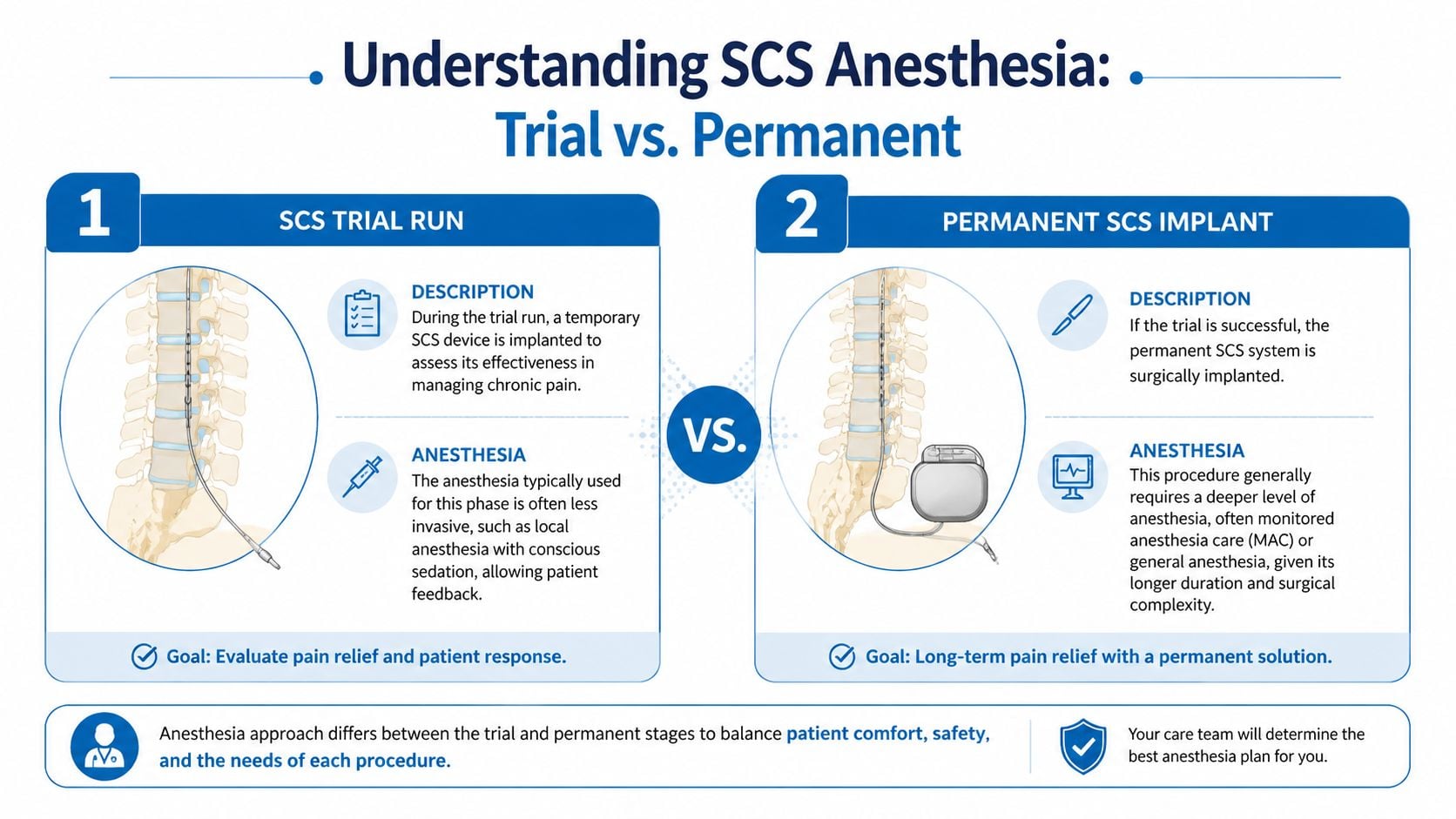
During the trial, we need information from you. During the permanent implant, we usually need stillness, time, and surgical comfort.
Why the trial usually uses lighter anesthesia
The trial is a test period. The goal is not solely to place the lead. The goal is to learn whether the stimulation reaches the right pain area and gives meaningful relief in real life.
That is why the anesthesia plan is usually lighter. The care team may need you to answer simple questions such as where you feel the stimulation or whether it covers the painful region. “Awake” in this setting does not mean unprotected or uncomfortable. It usually means relaxed, closely monitored, numbed where the procedure is being done, and able to communicate when needed.
A common point of confusion is the word “awake.” Patients often hear it and picture being fully alert for everything. In practice, many patients receive local anesthetic plus light sedation, so the experience is often calmer and less intense than they expected. In some cases, the numbing approach works similarly to a targeted nerve block for pain control, reducing discomfort while preserving enough awareness for useful feedback.
If sedation is too deep during the trial, your answers may be delayed, unclear, or absent. The lead can still be inserted, but the most important part of the visit, checking whether the stimulation matches your pain pattern, becomes harder to judge.
Why the permanent implant can use deeper anesthesia
Once the trial shows good benefit, the question changes. We are no longer testing whether the therapy can help. We are placing the system in a way that is safe, accurate, and as comfortable as possible for you.
That change matters.
Permanent implantation can take longer and may involve making an incision for the battery pocket and securing the leads more formally. Some patients also need a paddle lead, which requires a more involved surgical approach. In that setting, movement is less useful and can interfere with careful surgical work.
For that reason, deeper sedation or general anesthesia is often a good fit for permanent placement. The anesthesia plan can focus more on keeping you still, preventing discomfort over a longer procedure, and giving the surgeon stable working conditions. In practical terms, the trial is interactive. The implant is more like a focused repair, where quiet conditions help everything go smoothly.
Patients sometimes notice another layer of difference after the procedure. A trial often feels like a short test with an external system to evaluate. A permanent implant feels more like a true surgery, because it is.
If you later review billing or procedure terminology, One For All's anesthesia CPT guide can help explain how anesthesia services are categorized, though your own treatment plan is based on medical need rather than code language.
The simplest way to remember it
- Trial procedure: lighter anesthesia, because your feedback helps guide placement.
- Permanent implant: deeper anesthesia is often appropriate, because the focus shifts to surgical precision, stillness, and comfort.
The difference is intentional. It reflects what each stage is trying to accomplish for you.
Your Anesthesia Options Explained
Most patients don't need to memorize anesthesia terminology. They do better when they know what each option feels like, why it's chosen, and what the team is watching during the procedure.
Monitored anesthesia care
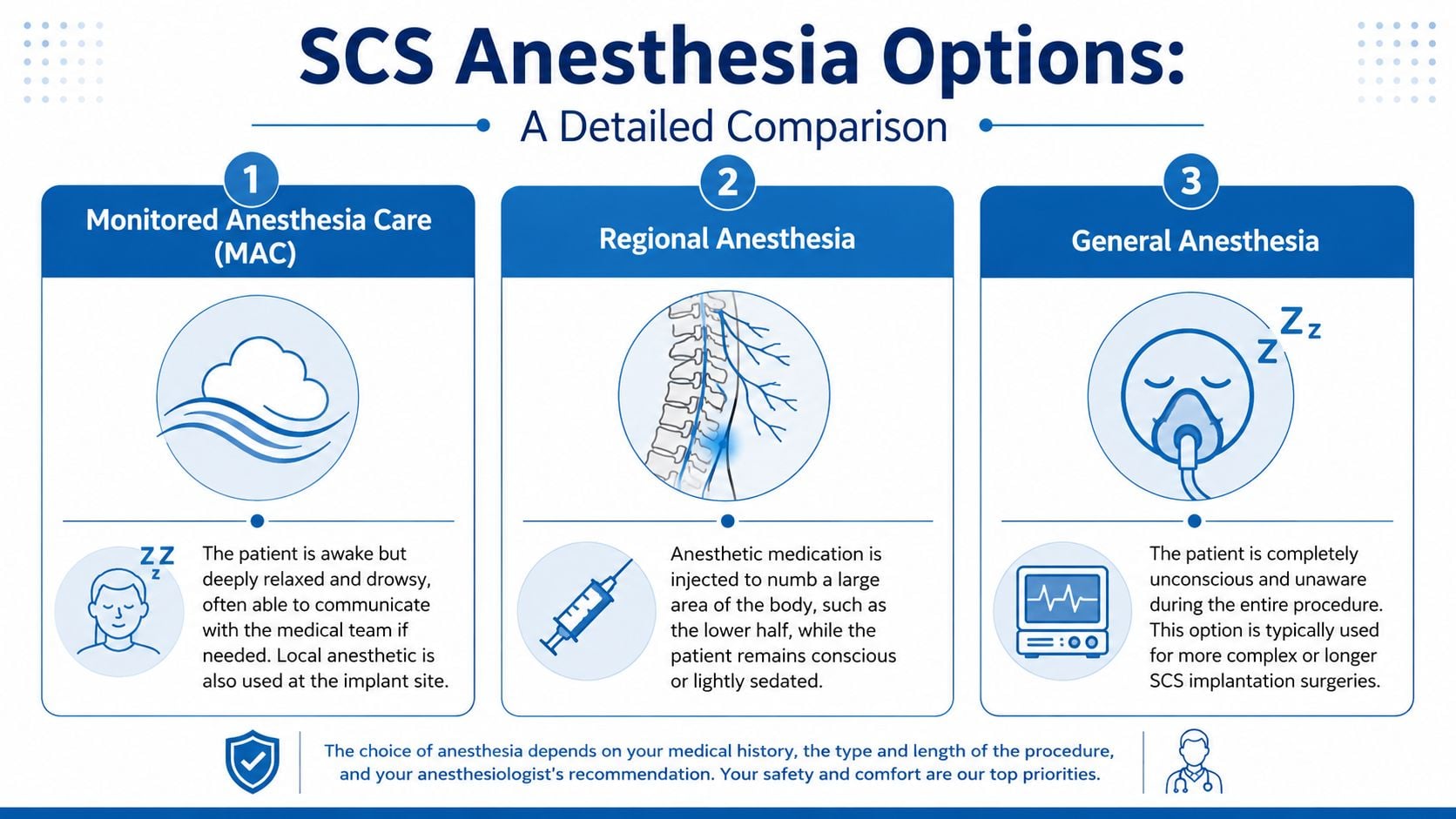
Monitored anesthesia care, often called MAC or “twilight sedation,” is common in procedures where the patient doesn't need to be fully unconscious. During MAC, the patient is usually sleepy, relaxed, and less aware of the environment, but may still be able to respond if spoken to.
For an SCS trial, this can be a very good fit. The patient may drift in and out of light sleep, then briefly wake enough to answer a simple question such as where the stimulation is felt. The skin is also numbed with local anesthetic, which helps limit pain at the insertion site.
Patients often ask whether they'll remember everything. Some do remember parts of the procedure. Some remember very little. Memory can vary based on the medications used and the person's response to them.
General anesthesia
Under general anesthesia, the patient is fully unconscious and unaware during the procedure. This is often more suitable for permanent implantation when the procedure is longer or more surgically involved.
General anesthesia can also make sense when the care team wants complete immobility or when the patient's anxiety, anatomy, or surgical plan makes lighter sedation less practical. During this type of anesthetic, the anesthesia team manages breathing, blood pressure, oxygen levels, heart rhythm, and overall physiologic stability throughout the case.
A patient doesn't choose between MAC and general anesthesia alone. The final plan comes from a discussion between the patient, the anesthesiologist, and the procedural team.
What matters most: the “best” anesthetic is the one that fits the exact procedure, not the one that sounds strongest.
Comparing Anesthesia Options for SCS Procedures
| Feature | Monitored Anesthesia Care (MAC) | General Anesthesia (GA) |
|---|---|---|
| Level of awareness | Usually drowsy but not fully unconscious | Fully unconscious |
| Best fit | Common for SCS trials and some less invasive procedures | Common for many permanent implants |
| Patient feedback possible | Yes, which is useful when lead position depends on patient input | No |
| Comfort approach | Sedation plus local anesthetic at the procedure site | Full anesthetic with complete unconsciousness |
| Typical patient experience | Relaxed, sleepy, sometimes limited memory | Asleep for the entire procedure |
| Recovery right after | Often less grogginess, though this varies | More pronounced early grogginess is common |
Questions patients can bring to the anesthesia visit
Some patients like to prepare a short list before the procedure. Questions that often help include:
- Will feedback be needed during this case? That helps explain why a lighter or deeper anesthetic is planned.
- What side effects are most likely afterward? This gives a more realistic recovery picture.
- How will nausea, anxiety, or pain be prevented? These concerns are common and manageable.
- What medications should be stopped or continued? This is especially important for blood thinners and diabetes medicines.
For patients who want a clearer sense of how anesthesia services are categorized in billing and procedural language, One For All's anesthesia CPT guide is a useful general reference. It won't replace a preoperative conversation, but it can make the terminology less opaque.
Some readers also benefit from understanding where other anesthetic pain techniques fit in the overall range of pain treatments. A plain overview of a nerve block can help distinguish temporary numbing procedures from neuromodulation procedures like SCS.
Preparing for Your SCS Anesthesia
Preparation helps patients feel less helpless on procedure day. It also makes anesthesia safer.
The most important part of preoperative planning is honest, complete communication. The anesthesia team needs an accurate medication list, prior anesthesia history, allergies, major medical conditions, and any implantable devices already in place. Details that may feel small to the patient can matter to the team.
One example is diabetes. According to Medtronic's spinal cord stimulation safety information, diabetic patients undergoing SCS implantation have increased risks of hematoma, epidural hemorrhage, and infection, which is why preoperative glycemic assessment and strict perioperative glucose control matter.
What the care team usually needs to know
- Medication details: Blood thinners, diabetes medications, pain medicines, supplements, and anything taken only occasionally can all affect planning.
- Past reactions to anesthesia: Nausea, prolonged grogginess, difficult IV placement, or airway issues should all be mentioned.
- Device history: Pacemakers, implanted pain devices, or prior spine procedures can change the day-of plan.
- Mobility and baseline pain: This helps the team judge what “normal” looks like for that patient after the procedure.
A simple preparation checklist
The exact instructions come from the treating team, but most preparation falls into a few practical categories.
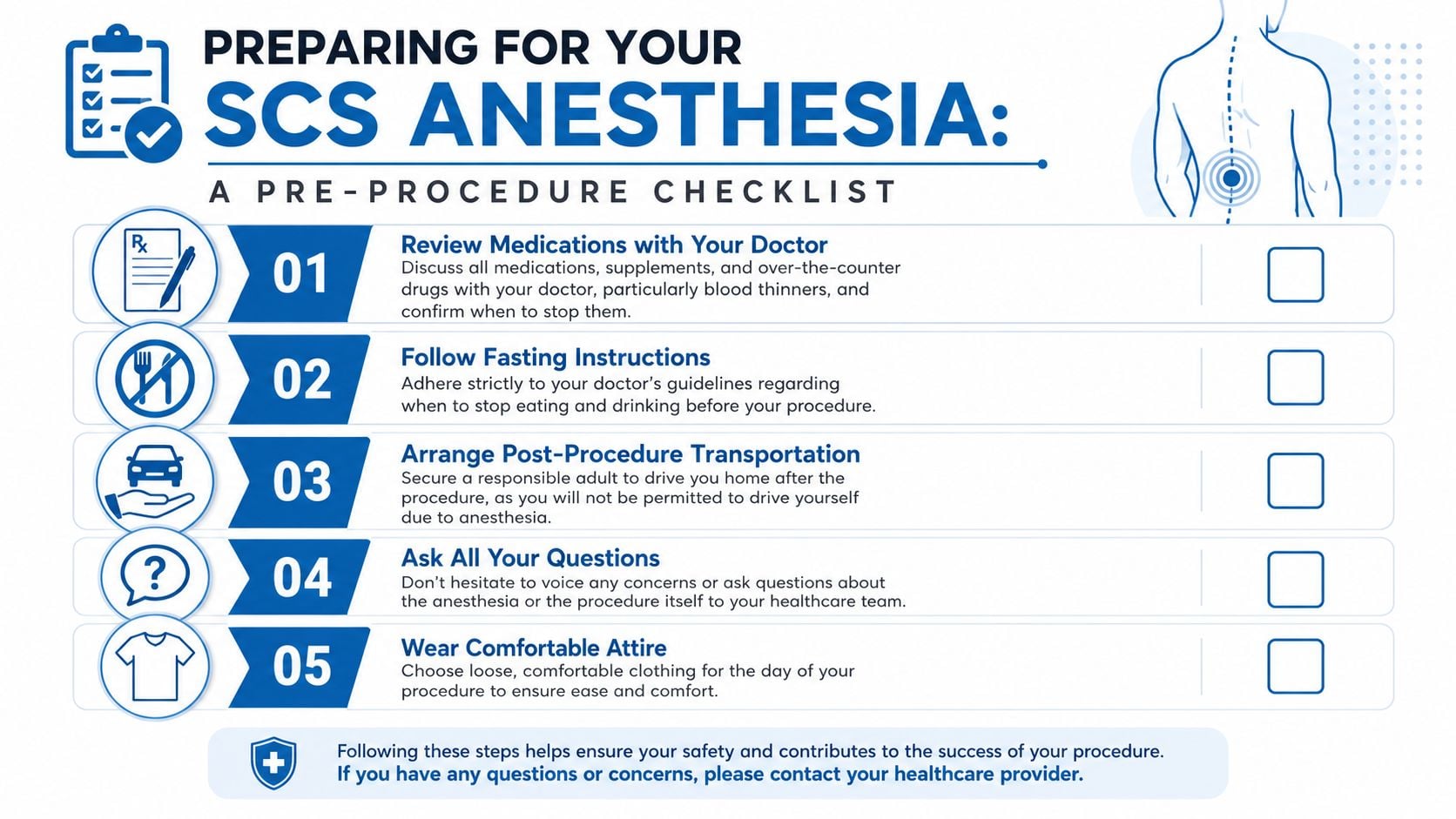
- Follow fasting instructions carefully. Food or liquids too close to anesthesia can create safety problems.
- Review medication timing in advance. Patients shouldn't guess about whether to stop or continue a medicine.
- Arrange a ride home. Sedation and anesthesia can affect judgment and reflexes afterward.
- Wear loose clothing. That makes dressing easier after the procedure, especially if there's soreness near the incision area.
- Ask the question that feels embarrassing. Patients often hold back concerns about pain, awareness, or fear. Those are exactly the questions that should be discussed before the procedure starts.
A smooth anesthesia day usually starts the night before, not in the procedure room.
Patients with devices should also mention any future scans or treatments they expect to need. Some equipment used in medicine can interact with spinal cord stimulators, so advance planning helps avoid problems later.
Recovery Safety and Potential Risks
The recovery period is easier to understand when it's divided into two parts. There is recovery from the anesthetic, and there is recovery from the procedure itself. Those are related, but they're not the same thing.
Recovery from anesthesia versus recovery from the procedure
Anesthesia recovery is usually the shorter part. Patients may feel sleepy, foggy, mildly nauseated, or unsteady for a period after sedation or general anesthesia. Those effects usually improve as the medications wear off.
Procedure recovery often lasts longer. Soreness at the lead entry site or generator pocket can take more time to settle. Activity restrictions may also matter, especially when the goal is to keep the leads from shifting while tissues heal around them.
This distinction matters because some patients worry that normal postoperative soreness means the anesthesia went badly. Usually, it doesn't. It often reflects the procedure itself, not a problem with the anesthetic.
Understanding risk without panic
Spinal cord stimulation is a well-established therapy, but it isn't risk-free. A review cited in this article on anesthesia and complications in spinal cord stimulation found an aggregate complication rate of 36% across 51 studies, with technical complications being the most common at 27%. These are often issues such as lead-related problems that reduce pain coverage rather than catastrophic events.
That distinction is important. “Complication” doesn't always mean a medical emergency. In SCS, many problems are technical and may show up as a loss of target-area coverage or reduced pain relief. Serious complications such as spinal cord injury are described as rare, but they require prompt recognition and management.
A few long-term safety points also deserve attention:
- MRI precautions matter. NICE has mandated that the device be switched off and interrogated before a patient enters an MRI suite, then reactivated after leaving the area.
- SCS is not for acute nociceptive pain. If a patient has a fresh injury or postoperative pain from another cause, standard pain treatment is still needed.
- Device-related planning continues after surgery. Future procedures, imaging, and changes in symptoms should be discussed with the treating team.
Patients with persistent pain after spine surgery often consider SCS as part of a broader treatment plan. For readers trying to understand that underlying condition more clearly, this overview of pain after back surgery may help connect the diagnosis to the role of neuromodulation.
Most patients do best when they treat the stimulator as an ongoing part of their medical history, not as a one-time procedure they can forget.
Frequently Asked Questions About SCS Anesthesia
Will the patient feel pain during the procedure
The goal is to keep the patient comfortable and able to get through the procedure calmly.
During an SCS trial, patients usually feel local numbing medicine, some pressure, and possibly brief tingling or positional discomfort. Sedation helps take the edge off, but the team still needs enough interaction to judge how well the stimulation matches the painful area. For the permanent implant, anesthesia is often deeper, so awareness may be very limited or absent.
Why can't every SCS procedure be done fully asleep
The trial is a test of fit, not just a technical placement. The team needs the patient's feedback to learn whether the stimulation lines up with that person's pain pattern. Without that real-time input, it is harder to tell whether the therapy is likely to help.
Is epidural anesthesia ever used for permanent implantation
Yes. Epidural anesthesia has been used for permanent SCS implantation without interfering with stimulation testing, as noted earlier in the article's linked clinical source. The best anesthetic still depends on the surgical plan, the device location, and the patient's health history.
What if the patient needs surgery later after getting an SCS
This comes up more often than patients expect, especially with childbirth or orthopedic surgery.
Neuraxial anesthesia, such as a spinal or epidural block, is not an absolute contraindication in patients with an SCS, according to recent clinical guidance on neuraxial anesthesia in patients with implanted spinal cord stimulators. The care team may need imaging beforehand to map where the leads run, and fluoroscopy during needle placement can help avoid them.
The first six weeks after implantation need extra caution. Twisting or bending the spine too much during positioning can increase the chance of lead migration.
What should the patient do if anxiety feels overwhelming
Say so as early as possible.
Anxiety is part of the anesthesia plan, just like allergies or prior reactions to medications. The team can adjust how they explain each step, change the sedation plan, and add support so the experience feels more manageable and less frightening.
Patients considering spinal cord stimulator treatment don't have to sort through these decisions alone. Interventional Pain Management provides evaluation and treatment for chronic pain conditions, including spinal cord stimulation, with care from board-certified specialists in pain management, anesthesiology, orthopedics, and spine care. A consultation can help determine whether SCS is appropriate and what anesthesia approach best fits the patient's procedure and medical history.