
You've probably had the same thought many patients have after a long workday, when the legs ache, the veins look more obvious, and the question finally comes up, “Do these need surgery, or is there a gentler way to deal with them?” That confusion is common because non invasive varicose vein treatment gets used as a catch-all phrase, even though some options only calm symptoms while others close the faulty vein. The useful starting point is to separate supportive care from vein-closing treatment, because they are not the same thing.
Table of Contents
- What Non Invasive Varicose Vein Treatment Really Means
- Why Conservative Care Treats Symptoms, Not the Root Cause
- Compression Therapy and Daily Habits That Actually Help
- Medications and Supplements Marketed for Vein Health
- When Conservative Care Is Not Enough and Procedures Become Necessary
- What Evaluation and Treatment Look Like Step by Step
- Common Misconceptions Worth Putting Aside
- Your Next Steps and Questions to Ask at a Consultation
What Non Invasive Varicose Vein Treatment Really Means
The phrase sounds broader than it is
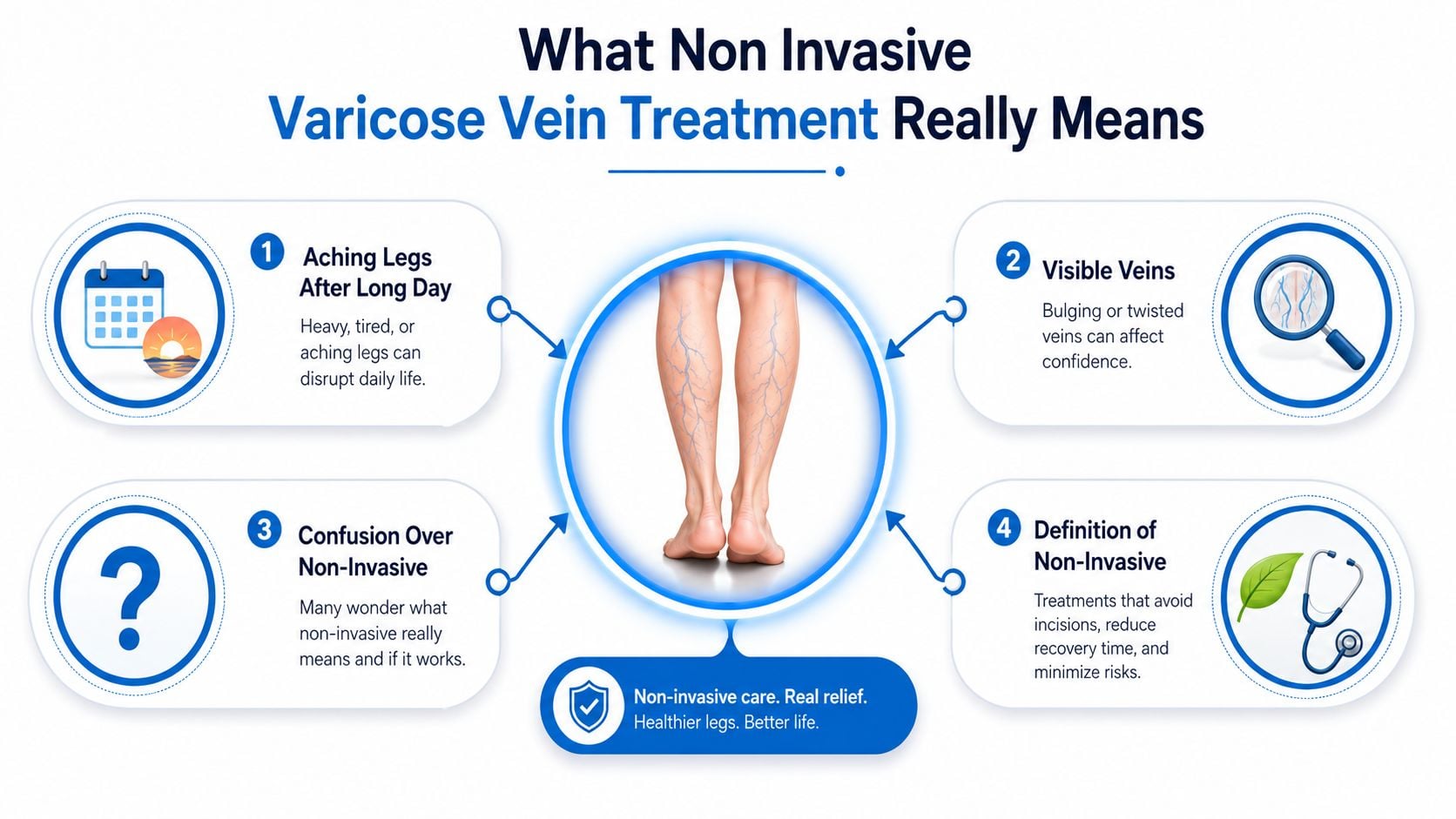
People often hear non invasive varicose vein treatment and assume it means a way to make the veins disappear without any procedure at all. In everyday vein care, that phrase usually refers to compression, leg elevation, exercise, and other measures that don't enter the vein or break the skin to close it. Those steps can ease heaviness, swelling, and aching, but they do not usually seal a refluxing vein.
That distinction matters because many readers are really asking for two different things. One is symptom relief, and the other is a durable fix for the underlying problem. In vein disease, those two goals do not always line up.
A helpful way to think about it is this. If the vein valve is leaking, a stocking can reduce the pressure you feel from the outside, but it does not repair the faulty valve inside. A procedure that closes the vein is a different category altogether.
Patients who want a plain-language overview of visible veins and treatment pathways often start with a clinical explainer such as this varicose and spider vein resource, which helps frame when conservative care makes sense and when a vein study is the better next step. For teams that educate patients at scale, clear healthcare content also matters, which is why healthcare marketing services can be useful for practices trying to explain the difference between symptom relief and definitive treatment without confusion.
What readers are actually signing up for
If the problem is mild, conservative care may be enough to make the day easier. If the problem is driven by truncal saphenous reflux, the care plan usually has to go beyond lifestyle measures to address the faulty conduit itself. That is why the phrase “non invasive” deserves careful reading, because it often describes comfort care rather than a true fix.
Practical rule: if a treatment does not close or remove the refluxing vein, it is usually helping with symptoms, not eliminating the source.
Why Conservative Care Treats Symptoms, Not the Root Cause
The valve problem drives the visible veins
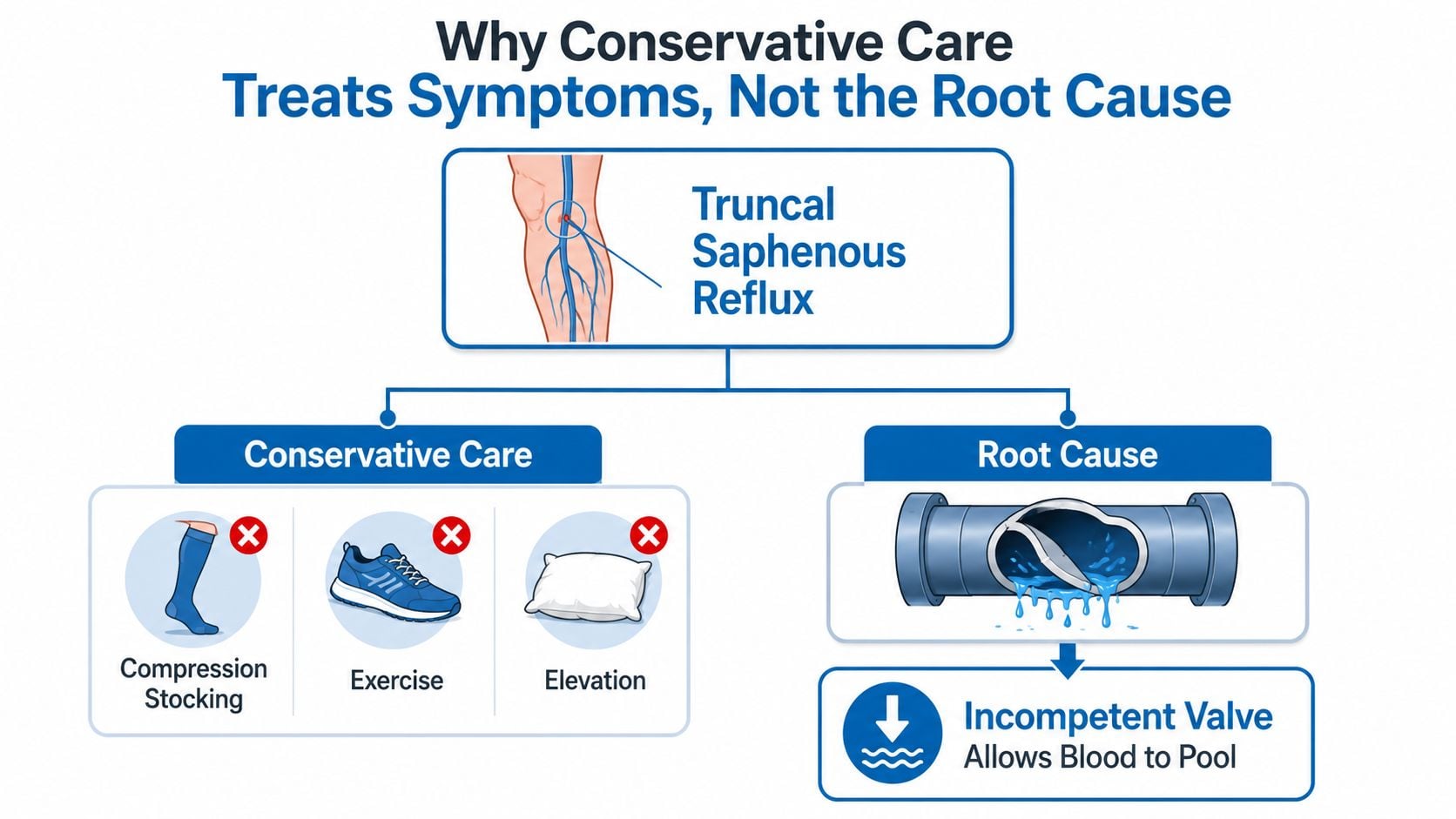
Varicose veins usually start with venous reflux, which means the one-way valves in the leg veins stop holding blood in the correct direction. Once that happens, pressure builds in the vein and gets transmitted into smaller branches, where bulging and twisting become visible over time. A useful image is a leaky pipe with a broken flap, because the issue isn't just the water on the floor, it's the valve that keeps letting it out.
Compression sleeves, stockings, exercise, and elevation all help from the outside. They reduce pooling, assist blood return, and can lower the sense of heaviness by day's end. What they do not do is close the incompetent valve, so the reflux remains in place.
That's why conservative care often works best as support. It can be valuable for people who have mild symptoms, want to avoid procedures for now, or need temporary control while they're deciding on next steps. It's less useful as a definitive answer when reflux has already created more established varicosities.
Why anatomy changes the goal
The anatomy matters because the source vein keeps feeding the visible veins until the reflux is treated. That's why visible improvement from conservative care tends to be limited, even when symptoms do feel better. The biology doesn't change just because the legs are raised for a while.
A more realistic expectation is simple. Conservative care manages the load, while vein-closing procedures change the path the blood is taking. Once that difference is clear, patients usually understand why a non-procedural plan can be worthwhile without pretending it is curative.
Compression Therapy and Daily Habits That Actually Help
Compression is the workhorse of conservative care
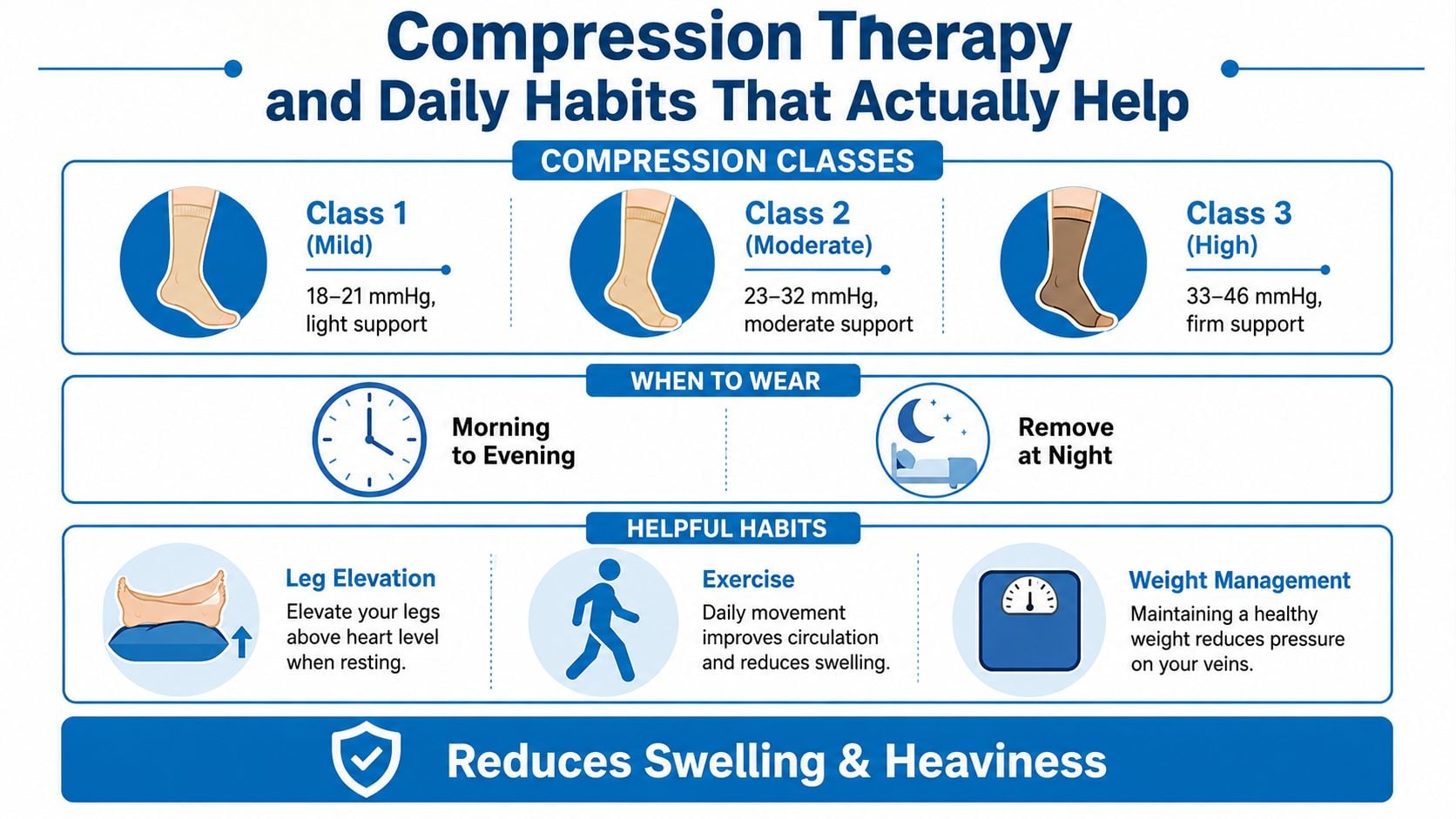
Compression stockings are often the most practical part of non invasive varicose vein treatment. They apply graduated pressure that supports venous return and helps reduce swelling and heaviness, especially after long periods of standing or sitting. Medical-grade stockings come in different pressure levels, so the right fit matters more than the label alone.
The timing matters too. They're usually put on in the morning, before swelling builds, and removed at night. That routine sounds simple, but it's the difference between a stocking that helps and one that just gets abandoned in a drawer.
Most patients do better when compression is treated like footwear, not like a rescue tool. It works best when it's part of the day, not something saved for the worst flare-up.
Habits that fit real life
A nurse on a 12-hour shift, a teacher on their feet all afternoon, and a desk worker who sits too long all face the same problem from different angles, pooled blood in the legs. The solution is rarely dramatic. Short walking breaks, calf muscle movement, periodic leg elevation, and a steady exercise routine all help the body's natural pumping system.
A few day-to-day habits usually matter most:
- Move the calves often: Walking, ankle pumps, and brief stretch breaks help blood return upward.
- Raise legs when resting: A few minutes with the legs above heart level can ease late-day heaviness.
- Protect the skin: Gentle cleansing and moisturizing help reduce dryness and irritation around swollen areas.
- Keep routines realistic: The best habit is the one that can be repeated on workdays, not just on perfect weekends.
Weight management can also reduce pressure on the venous system over time, and it's worth treating that as a long-game strategy rather than an overnight fix. None of these steps closes refluxing veins, but they can make daily life more manageable and can reduce the chance that symptoms get ignored until they're harder to treat.
Medications and Supplements Marketed for Vein Health
Patients also encounter tablets, capsules, and herbal products that promise better circulation or “vein support.” These products are usually discussed as supportive measures, not as substitutes for vein-closing treatment. That's the key filter to use before buying anything.
What these products can do
Some venoactive products may help with aching, swelling, or the sense of leg fatigue in certain patients. The practical appeal is obvious, because they're easy to try and don't require a procedure. That convenience is also why they're easy to overestimate.
The problem is that symptom improvement is not the same as fixing reflux. A supplement can't close an incompetent vein any more than a pain reliever can repair a torn ligament. For people with mild discomfort, that may still be enough to justify a trial.
What they can't do
These products are not a replacement for an ultrasound-guided evaluation when symptoms persist. They also don't erase visible varicosities or stop advanced vein disease from moving forward on its own. If a person keeps needing the same product to stay comfortable, that's usually a sign that the underlying issue hasn't been addressed.
The cleanest way to think about them is this. If someone wants modest support and understands the limits, a supplement may have a role. If someone wants the refluxing vein treated, a tablet won't do that job.
When Conservative Care Is Not Enough and Procedures Become Necessary
Signs that the plan needs to escalate
Conservative care has a ceiling. When symptoms keep returning despite stockings and daily habits, when swelling starts affecting activity, or when the skin begins changing, the conversation usually shifts toward a procedure. Bleeding from a varicosity is another reason not to keep waiting.
At that point, the question is no longer whether to “be more consistent” with home care. It becomes whether the anatomy calls for a treatment that closes the refluxing vein. That is where the difference between non-invasive and minimally invasive matters most.
Side-by-side, the categories are not interchangeable
| Approach | How It Works | Typical Use Case | Recovery |
|---|---|---|---|
| Conservative care | Supports circulation from the outside | Mild symptoms, prevention, temporary relief | No procedure recovery |
| Sclerotherapy | Uses an injected sclerosant to close small veins | Spider veins and smaller varicosities | Usually brief downtime |
| Endovenous laser ablation | Uses heat to close the vein from inside | Deeper incompetent veins | Office-based recovery, usually short |
| Radiofrequency ablation | Uses controlled thermal energy to close refluxing veins | Deeper incompetent veins | Office-based recovery, usually short |
| Mechanochemical ablation | Combines catheter movement with chemical closure | Selected refluxing veins | Office-based recovery, usually short |
| Cyanoacrylate closure | Uses adhesive to seal the vein | Selected refluxing veins | Office-based recovery, usually short |
That table makes one point very clear. Minimally invasive care is still a procedure, but it is not the old open-surgery model people often fear. In large health systems, endovenous procedures have become the dominant pathway in recent years, with endovenous treatment accounting for 60.4% of procedures in 2017 to 2018 versus 14.5% for open surgery and 19.2% for sclerotherapy in one population-based study from England (PMC9260184).
A comparative review also reported occlusion rates of 94.9% for EVLA, 94.4% for RFA, and 92.0% for surgical stripping, with non-thermal methods still achieving 88.7% occlusion (PMC12817718). Those numbers help explain why modern care has shifted toward office-based vein closure instead of open surgery.
Learn more about vein treatment options can be useful for patients trying to match symptom severity with the right level of intervention.
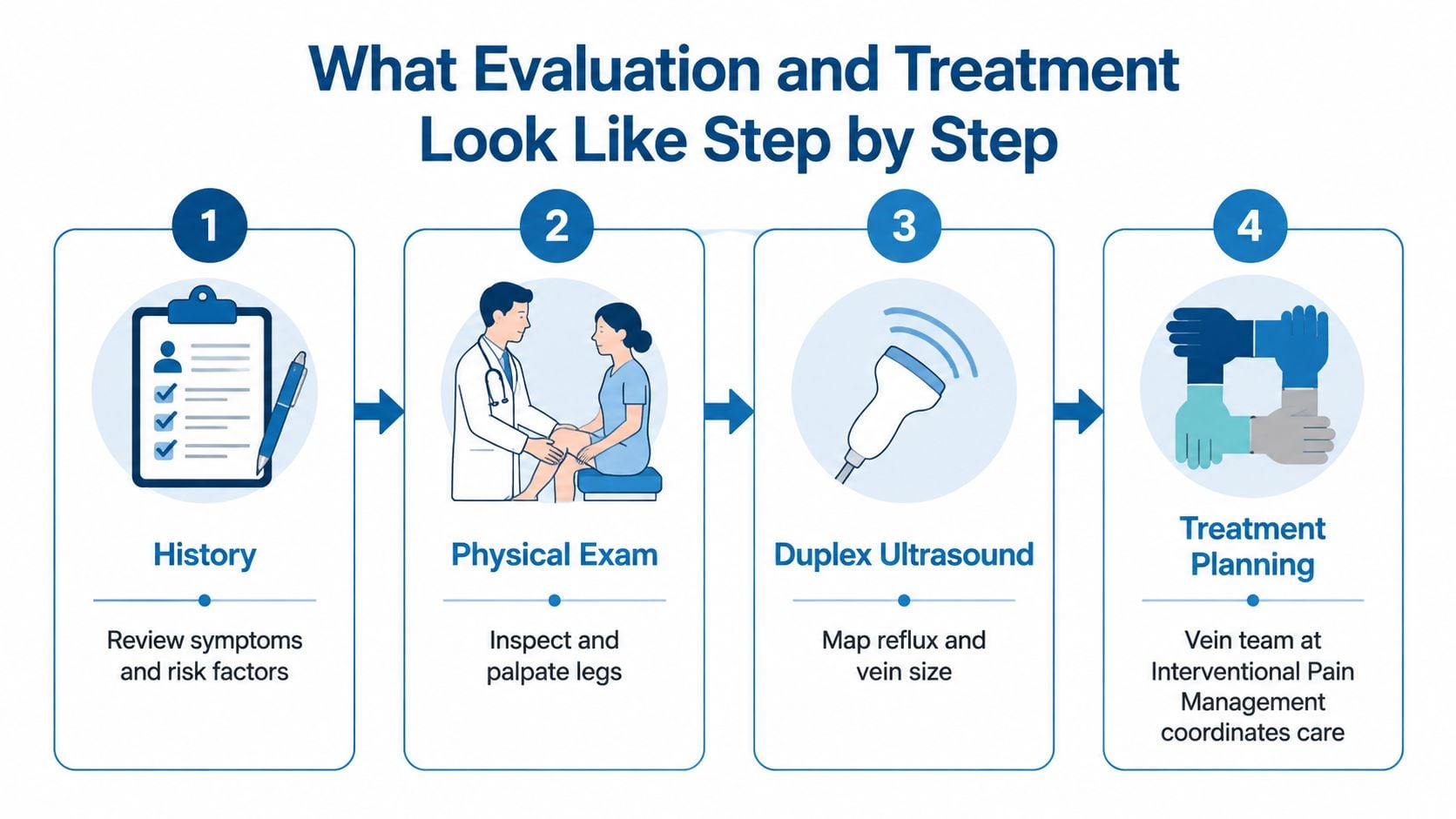
What Evaluation and Treatment Look Like Step by Step
The first visit usually starts with symptoms, not assumptions. A clinician asks where the discomfort is, how long swelling lasts, whether the legs ache more after standing, and whether the skin has changed around the ankles. That history is paired with a physical exam and duplex ultrasound, because visible veins alone don't show the full pattern of reflux.
How the visit usually unfolds
The ultrasound maps which veins are incompetent and how large they are. That matters because treatment choice depends on the source vein, not just on what's visible at the skin. It also helps the team decide whether conservative care is enough or whether a procedure would solve the problem more reliably.
Good vein care starts with mapping, not guessing. The ultrasound tells the clinician which vein is feeding the symptoms and which treatment category fits that anatomy.
At a multi-specialty practice, vein evaluation can be coordinated alongside other musculoskeletal or vascular complaints, which matters for patients who also have back, joint, or mobility issues. Interventional Pain Management serves New Jersey and Staten Island with board-certified physicians across pain management, orthopedics, and spine surgery, and scheduling is available seven days a week through multiple locations. That kind of access can make it easier to address leg symptoms without putting the rest of the care plan on hold.
What procedure day feels like
On procedure day, minimally invasive ablation is usually image-guided and office-based. The catheter is positioned with ultrasound, then treatment is delivered in controlled increments so the vein closes safely along the target segment. Recovery in the first week is often defined by walking, routine movement, and following post-procedure instructions rather than by bed rest.
A useful technical standard in modern vein procedures is maintaining safe distance from the saphenofemoral junction. Published procedural standards describe keeping the catheter tip about 2 cm distal to the junction and then withdrawing it in controlled steps, with one radiofrequency protocol using 20-second cycles and one laser technique withdrawing at 1 cm/min for the first 4 cm, then 3 cm/min (PMC3461787). That kind of precision is one reason office-based vein closure can be both targeted and efficient.
Common Misconceptions Worth Putting Aside
Varicose veins are often dismissed as a cosmetic issue, but that view misses the biology. Visible veins can be the outward sign of a reflux problem that keeps pressurizing the leg veins over time. Untreated disease can progress beyond appearance into swelling, skin changes, and more persistent discomfort.
The most common misunderstandings
Some patients also believe non invasive varicose vein treatment always resolves the veins. It doesn't. Conservative care can improve how the legs feel, but it usually doesn't close the faulty valve or remove the refluxing conduit.
Another misconception is that every procedure means general anesthesia and long downtime. Modern endovenous care is usually office-based and image-guided, which is very different from older open surgical models. The procedure category changed first, then patient expectations followed.
Recurrence also gets misunderstood. A vein coming back in some form doesn't automatically mean treatment failed. Vein disease is shaped by anatomy, time, and the appearance of new reflux pathways, so follow-up and procedure choice matter just as much as the first intervention.
The cleaner expectation is this. Symptoms can be managed conservatively, but durable reflux treatment usually requires closing the vein. Once that's accepted, decisions get easier and a lot less emotional.
Your Next Steps and Questions to Ask at a Consultation
Bring a short list of symptoms, the times they're worst, and any photos of swelling or bulging veins if the appearance changes through the day. Ask whether the problem looks like a case for conservative care, sclerotherapy, or an endovenous procedure, and whether a duplex ultrasound is needed to map the source. It also helps to ask about transportation assistance, insurance navigation, and whether a fee estimate can be provided under the New Jersey Out-of-Network Law if that applies.
The most useful question is simple, “Is this a symptom-control problem, or is it a reflux problem that needs vein closure?” That one question gets to the heart of non invasive varicose vein treatment and keeps the conversation honest.
For scheduling, use the appointment page to request an evaluation and bring the conversation into a clear, structured plan. The goal is not to guess which treatment fits, but to match the vein anatomy with the right level of care.
Interventional Pain Management offers vein evaluation and treatment alongside a broader multi-specialty medical team, which can be helpful when leg symptoms overlap with pain, mobility, or orthopedic concerns. If you're weighing conservative care against a procedure, visit Interventional Pain Management to request an evaluation and get a plan built around your symptoms, ultrasound findings, and daily life.