
You wake up, turn your head, and a sharp bolt runs from your neck into your shoulder or down your arm. Maybe your fingers feel numb by breakfast, maybe holding a phone or coffee mug already feels awkward, and maybe you're wondering whether this is just a stiff neck or something more serious.
A pinched nerve in the neck can feel dramatic because the pain rarely stays put. The problem usually starts where a nerve root exits the cervical spine, then the irritation shows up along the path that nerve serves. For a plain-language overview of that idea, the LifeWorks Integrative Health nerve guide is a useful companion, and if you already know the discomfort is centered in the neck, this neck pain overview can help frame the bigger picture.
Table of Contents
- What a Pinched Nerve in the Neck Actually Feels Like
- How the Cervical Spine Creates Nerve Compression
- Recognizing the Symptoms by Nerve Root Level
- How Specialists Diagnose a Pinched Nerve
- Conservative Care That Actually Works
- Interventional and Surgical Treatment Options
- Red Flags That Require Prompt Evaluation
- Prevention, Daily Habits, and When to Book a Visit
What a Pinched Nerve in the Neck Actually Feels Like
A lot of people describe the first moment the same way. They turn to check a blind spot while driving, look over a shoulder at work, or wake up after a bad night's sleep, and a sharp, electric pain shoots into the arm. Sometimes the neck itself barely hurts compared with the arm, hand, or fingers, which is why the problem gets mistaken for a shoulder strain or “just sleeping wrong.”

A pinched nerve in the neck is really a problem at the nerve root, not the nerve being crushed like a straw. The root gets irritated where it exits the spine, and then the signals it carries can become painful, numb, or weak. A nerve-root problem often travels, while ordinary muscle soreness tends to stay local.
Neck pain and nerve pain don't behave the same way
Pure neck pain can be annoying, but nerve-root pain is usually more patterned. It may trace into the shoulder blade, arm, forearm, or hand, and the path often feels familiar every time it flares. That pattern is one of the biggest clues that the problem is coming from the cervical spine rather than from the shoulder joint alone.
Practical rule: If the symptom moves in a line, tingles, or feels electric, the nerve deserves attention.
That's why a first-time patient often feels confused. The neck may not seem like the main problem at first, yet the irritated nerve root can make the whole arm feel wrong. Once that pattern is recognized, the rest of the decision-making becomes much easier because treatment can be matched to the actual source of pain instead of guessed at.
How the Cervical Spine Creates Nerve Compression
A patient can have neck pain for days and still not know why the arm feels irritated, numb, or weak. The answer usually starts with the cervical spine itself. It is a stack of bones with small side openings where the nerve roots exit on their way toward the shoulder, arm, and hand. Those openings are the foramina, and they do not leave much room for error. A small change in disc shape, bone growth, or joint swelling can crowd the nerve root, much like a garden hose gets restricted when it is pinched as it passes through a narrow opening.
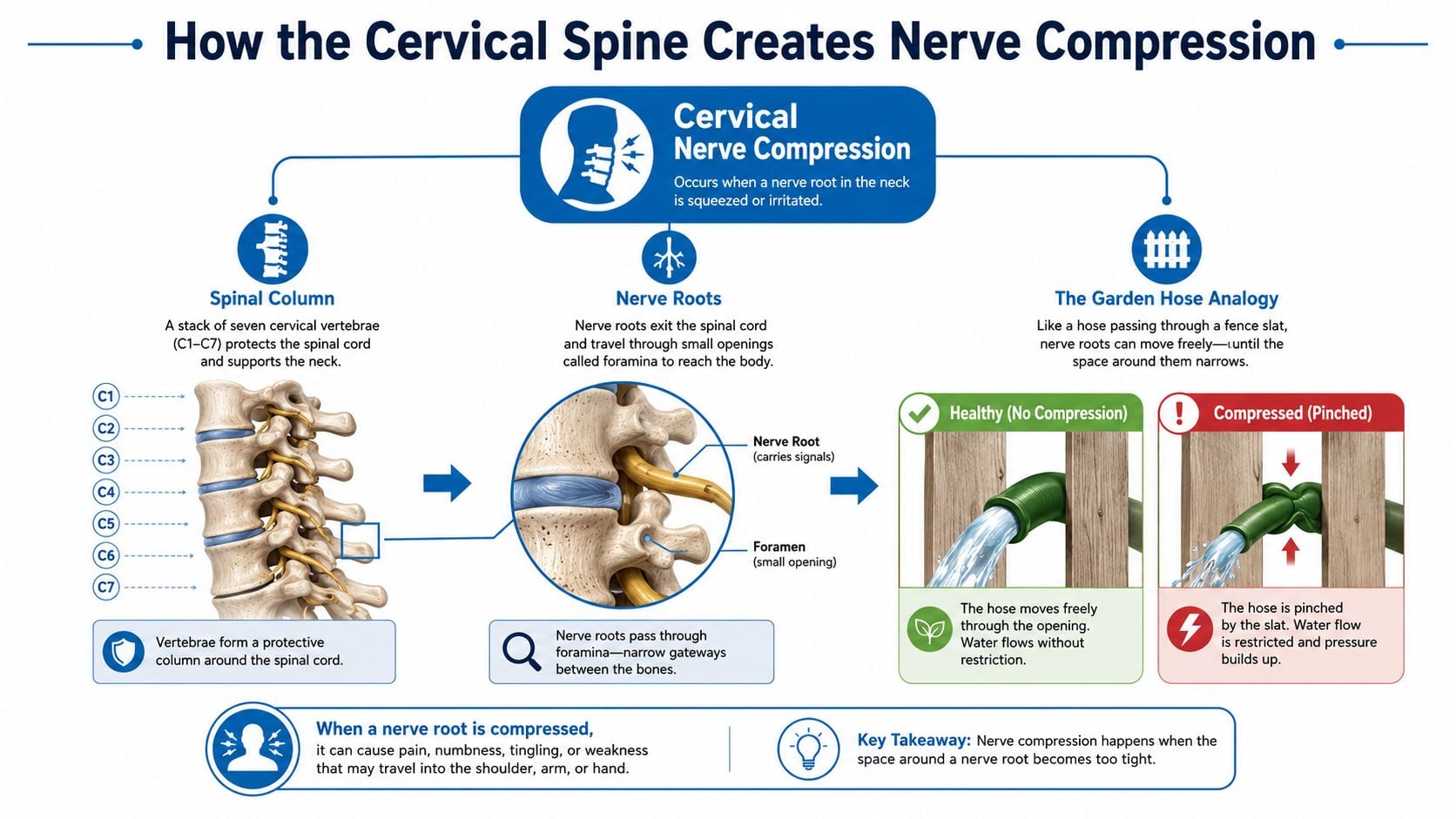
Two mechanical problems account for a lot of cases, and they can look different on imaging while causing the same symptoms. A herniated or bulging disc pushes outward into the nerve's path, and age-related degeneration can narrow the foramen from the opposite side with bone spurs and joint thickening. Both can irritate the nerve root enough to trigger pain, numbness, or weakness. They can also set off inflammation around the nerve, which makes the tissue even more sensitive and explains why some people hurt more than the amount of narrowing would suggest. For a plain-language breakdown of a herniated or bulging disc, see this explanation of disc changes. Cleveland Clinic describes cervical radiculopathy as a combination of mechanical compression plus inflammatory injury at the nerve root (Cleveland Clinic).
Why age matters so much
The anatomy behind the pain changes with age, and that shifts the treatment conversation. In younger and middle-aged adults, the source is more often a herniated disc. In older adults, the more common problem is degenerative foraminal narrowing from spondylosis and bone overgrowth. Two people can receive the same label, yet the structure causing the nerve irritation may be completely different.
A 35-year-old lifter and a 70-year-old retiree can both have a pinched nerve in the neck, but one may have soft disc material crowding the nerve while the other has bone-related narrowing.
That difference matters because imaging is not read as a generic abnormality report. The goal is to match the narrowing to the exact side, level, and symptom pattern the patient feels. When the anatomy and the symptoms line up, the treatment plan can be chosen for the underlying cause of pain, whether the main issue is nerve inflammation, mechanical compression, or more persistent nerve injury.
Recognizing the Symptoms by Nerve Root Level
Pain location is often the best clue to which cervical nerve root is involved. Each root feeds a different strip of skin and a different set of muscles, so numbness in the thumb doesn't point to the same place as numbness in the little finger. The pain may still start at the neck, but the map usually extends into the arm or hand in a recognizable pattern.
Cervical Nerve Root Symptom Map
| Nerve Root | Pain / Numbness Location | Typical Weakness | Reflex Affected |
|---|---|---|---|
| C5 | Shoulder and outer upper arm | Shoulder lift and elbow bend | Biceps |
| C6 | Outer forearm, thumb, and index side | Wrist lift and elbow bend | Brachioradialis |
| C7 | Middle finger and back of the arm | Elbow straightening and wrist flexion | Triceps |
| C8 | Ring finger, little finger, and inner hand | Grip and finger flexion | Finger jerk pattern |
A patient may say, “The neck hurts, but the issue is my hand.” That still fits a radiculopathy pattern, because the nerve root controls sensation and strength far beyond the spine itself. Weakness matters just as much as pain, since trouble lifting the arm, extending the wrist, or gripping objects can mean the nerve is affecting function, not just sensation.
When the pattern feels less straightforward
Symptoms in both hands, the whole arm, or both sides of the body can point to something more complicated than a single pinched root. That doesn't automatically mean danger, but it does mean the pattern needs a more careful look from a specialist rather than a simple assumption. The more precisely a person can describe where the numbness or weakness lives, the more useful that information becomes during the visit.
How Specialists Diagnose a Pinched Nerve
The diagnosis starts with the story, but it doesn't end there. A careful exam checks strength, sensation, and reflexes together, because one normal finding doesn't cancel out the others. The Spurling test, where the head is gently positioned to reproduce arm pain, can help confirm that the cervical nerve root is the source when it brings on the familiar symptoms.
Imaging is ordered when it can change the plan, not just to collect pictures. MRI shows discs, soft tissue, and nerve-root crowding in detail. X-rays are useful for alignment and bony changes, while CT can help when MRI isn't possible or when bony narrowing needs a closer look. These studies answer different questions, so the right test depends on the suspected cause rather than on a one-size-fits-all routine.
A good MRI finding only matters if it matches the side, level, and symptom pattern on exam.
When electrodiagnostic testing adds value
An EMG can help confirm that the problem is coming from a nerve root and not from another common source of arm symptoms, such as a peripheral nerve entrapment. That matters when the numbness pattern is messy, when the weakness doesn't fit the imaging, or when the clinician needs another layer of evidence before moving to a procedure. The test doesn't replace the physical exam, it complements it.
The goal is clarity, not over-testing. A clear MRI by itself doesn't automatically explain pain, because some imaging findings can exist without causing symptoms. The most useful diagnosis comes from lining up the history, exam, and imaging into one consistent picture.
Conservative Care That Actually Works
Many individuals start here, and for good reason. The initial task is to calm the irritated nerve while preventing the neck from stiffening around it. Short-term activity modification helps because the nerve root often reacts poorly to repeated extension, turning, or heavy lifting when inflamed.
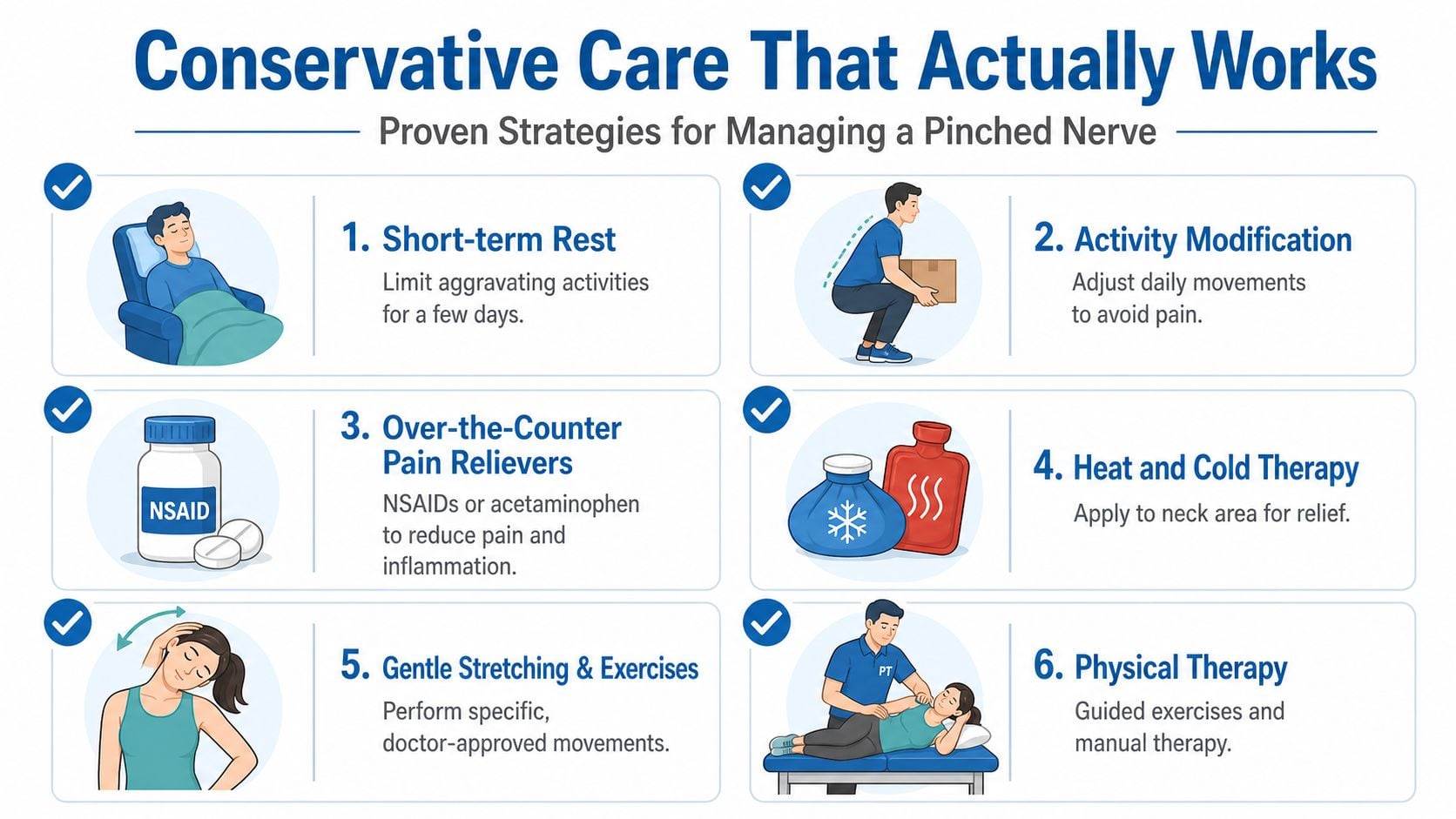
Anti-inflammatory medicine can help reduce swelling around the irritated root, and a short course of prescription medication may be used when the pain is more intense. Physical therapy often focuses on cervical traction, scapular strengthening, and posture correction, because those steps reduce load on the compressed nerve and improve how the neck moves under stress. Ergonomic changes matter too, especially when the workday keeps the head in one position for too long.
What reasonable improvement looks like
A common expectation is that symptoms should begin to settle with conservative care over time, often over six to twelve weeks. That doesn't mean the pain must disappear overnight, but there should usually be a clear trend in the right direction if the plan is working. If pain keeps waking the person up, weakness gets worse, or numbness spreads, the plan needs to be escalated rather than repeated endlessly.
A few tools are helpful, but they're not magic. Cervical collars can reduce motion for a short period in select cases, and home traction may help some people when a clinician has already shown how to use it safely. Used poorly, either one can make a stiff neck feel more guarded, so they work best as part of a guided plan rather than as a guess.
Interventional and Surgical Treatment Options
When conservative care doesn't calm the nerve enough, treatment has to match the dominant problem. If the main issue is inflammation around the root, the next step may be a targeted injection. If the problem is persistent mechanical crowding, the goal may shift toward more durable decompression or, in selected cases, surgery. The value of interventional pain care is that it can sit between “wait and hope” and “operate now,” which is often where the clearest decision-making happens.
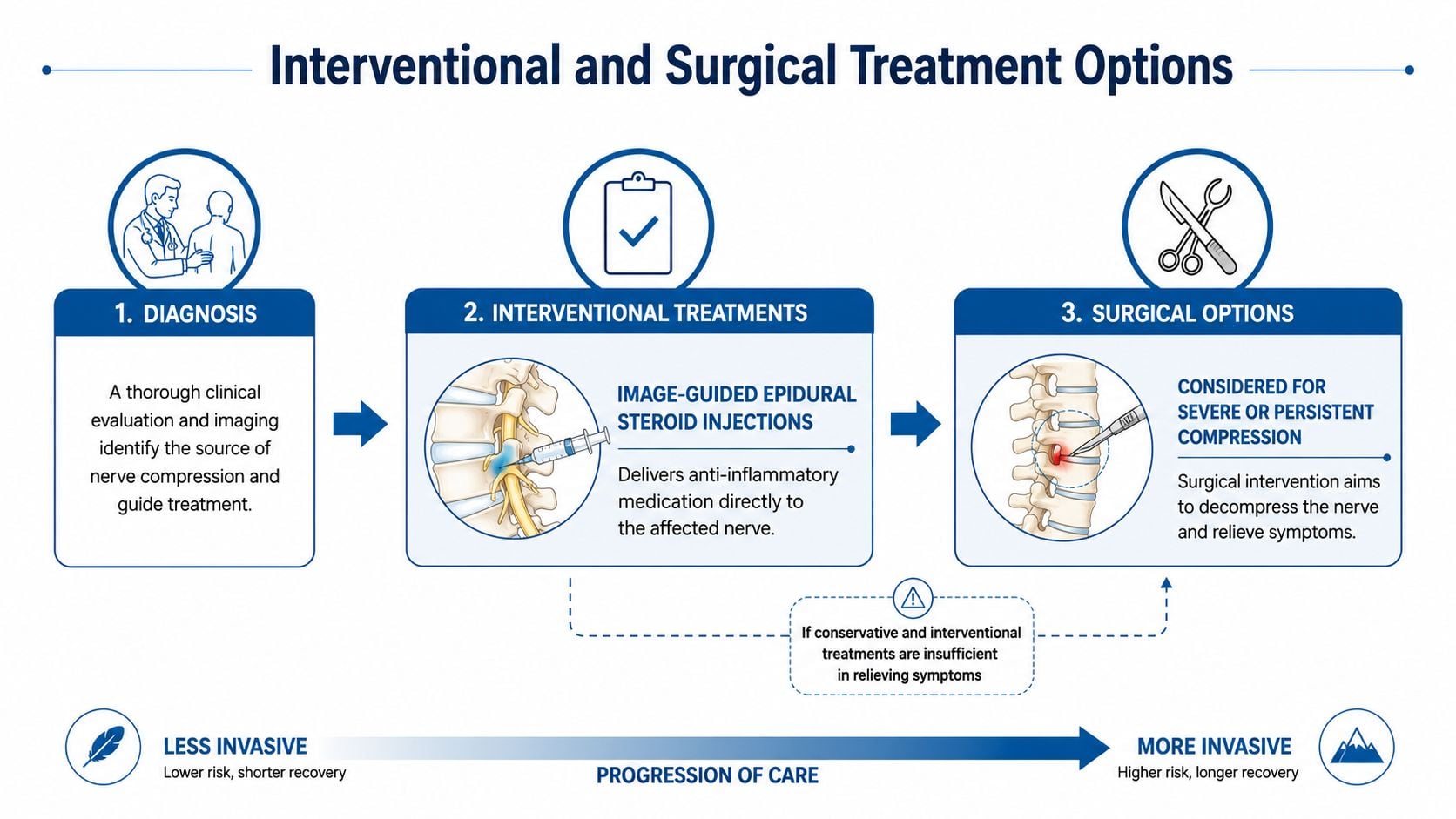
Image-guided epidural steroid injections place anti-inflammatory medicine near the irritated nerve root to reduce swelling and pain. The internal link on epidural steroid injections is useful here because the value of the procedure depends on the medication reaching the right space, not just on receiving a shot in the neck. In plain terms, the treatment tries to quiet the angry tissue around the root so movement hurts less and rehab becomes more possible.
How blocks, ablation, and surgery fit into the ladder
A selective nerve root block can help confirm which nerve is responsible and may also provide relief. Radiofrequency ablation is usually considered for longer-lasting control of certain pain generators, especially when the pain pattern is more chronic and facet-related than a pure acute root issue. Spinal cord stimulation can help some patients with persistent neuropathic pain when other approaches haven't delivered enough improvement.
Surgery comes into the discussion when weakness progresses, function keeps dropping, or the compression is too severe and too persistent for less invasive care. Procedures such as anterior cervical discectomy and fusion or cervical artificial disc replacement aim to remove the source of compression and stabilize or preserve motion depending on the case. The right option depends on anatomy, age, symptoms, and how clearly the compression matches the clinical picture.
Red Flags That Require Prompt Evaluation
Some symptoms mean the problem has moved beyond a routine pinched nerve. Progressive weakness, especially if the arm or hand is getting measurably worse, deserves prompt evaluation. So do numbness that keeps spreading, pain that becomes unmanageable despite treatment, or any sign that the nerve is no longer behaving like a temporary irritation.
The bigger concern is myelopathy, which means the spinal cord itself is being affected rather than just a nerve root. Clumsiness in the hands, trouble buttoning clothes, walking that feels unsteady, or loss of fine motor control are all warning signs that need urgent imaging and specialist review. Bowel or bladder changes are especially serious, because they can signal cord involvement rather than a simple radiculopathy.
What to do with different warning signs
- Call the office today: Worsening arm weakness, increasing numbness, or pain that keeps escalating instead of settling.
- Seek urgent care or the emergency department: New trouble walking, major hand clumsiness, or bowel and bladder changes.
- Do not wait for the next routine visit: Symptoms that suggest the spinal cord may be involved.
A pinched nerve is often treatable, but spinal cord symptoms are a different category. The distinction matters because injections are designed for nerve-root pain, while myelopathy can require faster surgical attention. When the body starts sending those signals, the safest move is prompt evaluation, not another week of guessing.
Prevention, Daily Habits, and When to Book a Visit
Prevention is mostly about reducing repeated strain. A proper workstation setup keeps the monitor at the right height, the chair supportive, and the keyboard positioned so the neck isn't reaching forward all day. Micro-breaks help too, because standing, changing position, and resetting posture give the cervical muscles a chance to stop guarding.
Sleep position matters just as much as desk setup. A pillow that keeps the neck neutral is usually better than one that forces the head into a twist, and regular strengthening of the neck and upper back can help the spine tolerate daily life with less flare-up risk. Stress management belongs on the list too, because people often carry tension in the neck and shoulders without realizing it.
When to stop self-care and book a visit
- Persistent pain: Discomfort that doesn't improve with basic home care.
- Numbness or tingling: Symptoms that keep returning or spreading.
- Weakness: Trouble lifting, gripping, or using the arm normally.
- Recurrent flare-ups: Episodes that keep coming back despite good habits.
For New Jersey and Staten Island residents who want coordinated neck-pain evaluation, Interventional Pain Management offers board-certified, multi-specialty care that can sort out whether the issue is inflammation, compression, or something more complex. If symptoms are lingering or getting worse, visit Interventional Pain Management to take the next step with a team that can match diagnosis, treatment, and referral to the actual problem.