

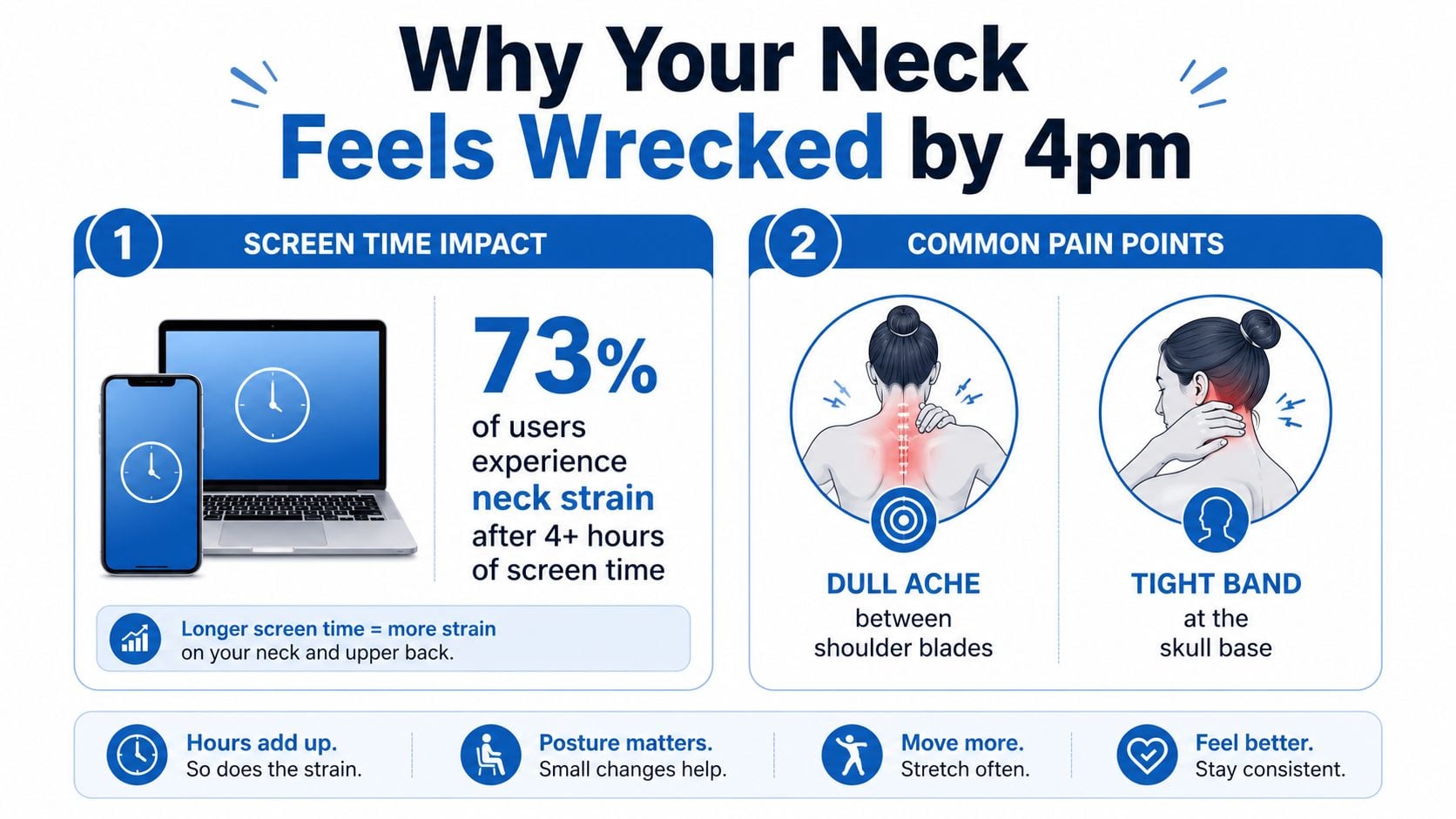
By the time the workday winds down, the neck has usually already sent the message. The laptop screen has been a little low, the phone has spent too long under the chin, and what started as a mild tug has turned into a dull ache between the shoulder blades, a tight band at the base of the skull, or both. That pattern is often forward head syndrome symptoms, and it's more than a posture complaint.
Forward head posture is tied to a symptom cluster that can involve the neck, shoulders, upper back, head, and even the arms and hands. A clinical review notes that neck pain is a major global problem, with overall prevalence in the general population reaching 86.8%, and it lists headaches, neck discomfort, muscle tension, mid-back discomfort, and numbness or tingling in the arms and hands as common associated symptoms (Physio-Pedia on forward head posture). That's why the right question is not just “Does the head sit forward?” It's “Which tissues are being overloaded, and which symptoms mean the problem has moved beyond simple strain?”
A practical way to think about it is this. The head sits on a neck built to carry it in alignment, not to hold it out in front all day like a bowling ball on a stick. That extra load is why symptoms often show up gradually, especially in people who spend long stretches at screens. A helpful overview of workplace setup is what is workplace ergonomics, because the desk environment often decides whether the neck can recover between tasks or keeps getting irritated.
By the end, the reader will know which symptoms can often be managed with posture change and rehab, and which ones should send the person to a specialist.
Table of Contents
- Why Your Neck Feels Wrecked by 4pm
- What Forward Head Syndrome Actually Means
- The Full Forward Head Syndrome Symptom Checklist
- Why Mild Cases Hurt and Severe Cases Quiet Down
- Red Flags That Mean More Than Posture
- How Clinicians Actually Diagnose Forward Head Syndrome
- From Self-Care to Specialist Treatment Options
- Your Forward Head Syndrome Action Plan
Why Your Neck Feels Wrecked by 4pm
The day usually doesn't begin with pain. It starts with a few emails, then a call, then a quick check of messages on a phone held just a little lower than eye level. By late afternoon, the muscles at the base of the skull feel ropey, the neck turns stiff, and the space between the shoulder blades feels like it has been clenched for hours.
That pattern fits forward head syndrome, where the head drifts ahead of the shoulders and the cervical spine has to work overtime to keep everything balanced. The issue is mechanical, not random. When the head sits in front of the body's centerline, the small joints and soft tissues in the neck absorb more strain, and the symptoms tend to build slowly instead of appearing all at once.
Practical rule: Symptoms that show up after long screen sessions often reflect sustained overload, not just “sleeping wrong.”
The timing matters. Many people notice the first warning signs in the second half of the day because that's when accumulated tension finally becomes hard to ignore. A neck that felt “okay enough” in the morning can feel wrecked by the time the body has spent hours looking down, reaching forward, and holding a fixed posture.
This is why the symptom story matters as much as the photo. A person can look only mildly slouched in a mirror and still have a neck that is struggling all day. The reverse happens too, where posture looks dramatic but pain stays low. The rest of the article separates those two realities so the symptoms can be read correctly, not guessed at.

What Forward Head Syndrome Actually Means
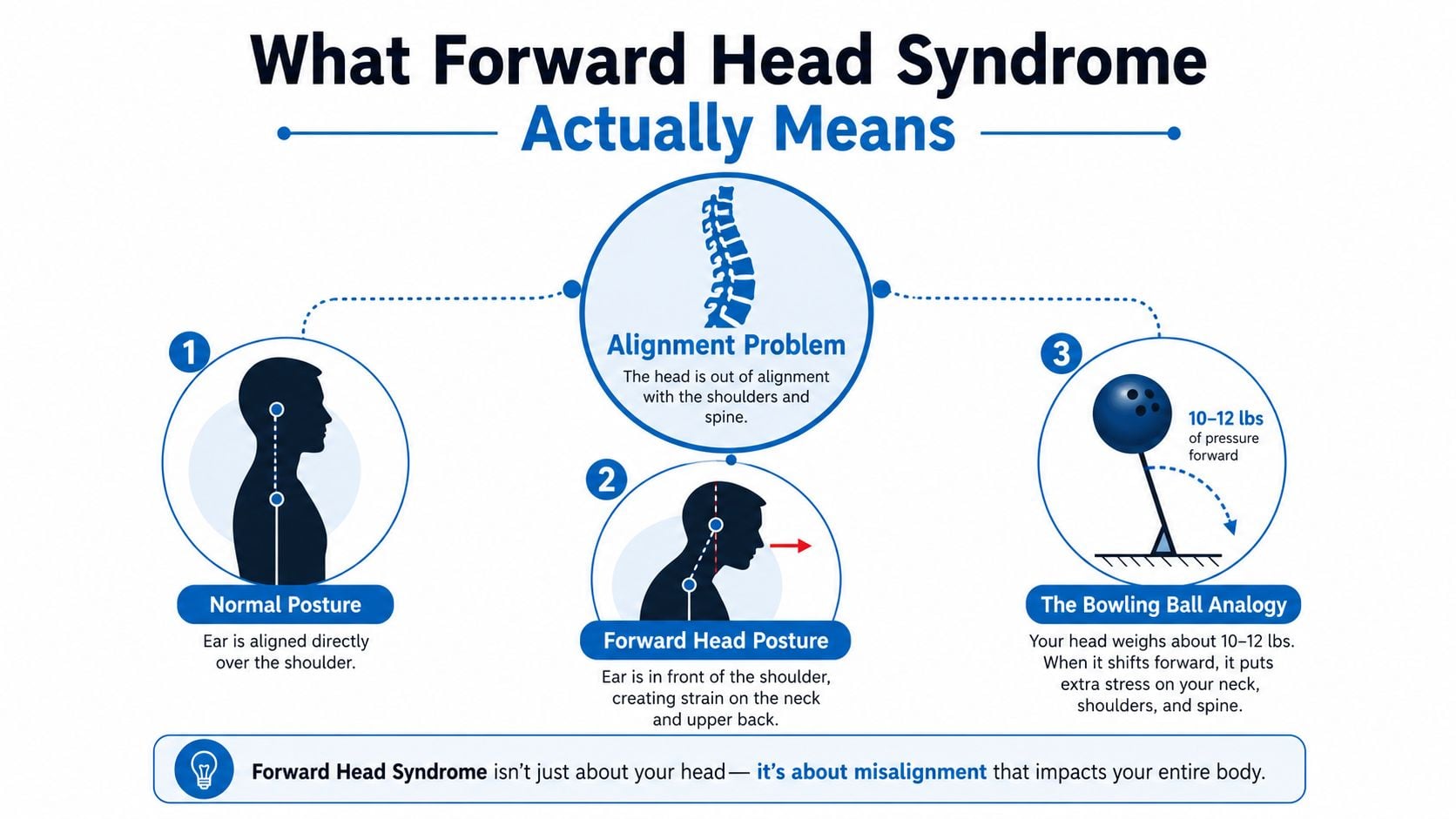
Forward head syndrome is not a single disease. It is a sustained alignment problem. In plain terms, the ear sits ahead of the shoulder instead of stacking over it, and that small shift changes how the neck carries the head all day.
Why the neck starts to feel heavy
The easiest way to picture it is with a bowling ball. An adult head weighs roughly like one, and the cervical spine is built to balance that weight in a stacked position. When the head slides forward, the neck muscles have to create more counterforce just to keep the gaze level. That extra work is why the neck can feel tired, sore, or “compressed” by the end of the day.
The standard clinical yardstick is the craniovertebral angle, often shortened to CVA. A 2025 study on PubMed Central found that 53.8% of patients with forward head posture had cervicogenic headache, and that increased age, decreased CVA, and poor sleep quality were significantly associated with that headache pattern (PubMed Central study). Lower CVA means a more forward head position, so the number gives clinicians a repeatable way to measure alignment instead of relying on a quick glance.
That matters for patients because the body doesn't complain about alignment in the abstract. It complains through muscle strain, joint irritation, and referral pain. The person usually feels the result first, not the posture metric.
The posture picture is useful, but symptoms tell the better story.
For readers who want a patient-friendly comparison of the alignment pattern itself, improve your neck alignment offers a simple way to see how stacked posture differs from a forward head position. The key point is that the issue is not “bad posture” in the moral sense. It is a load problem, and the symptoms flow from that load.
The Full Forward Head Syndrome Symptom Checklist
The symptom pattern makes more sense when it's mapped by region. Head pain, neck soreness, shoulder tightness, and arm symptoms don't mean the same thing, but they often arise from the same mechanical setup.
Head and base of skull symptoms
A common pattern is cervicogenic headache, where pain is referred from the upper cervical joints and muscle attachments into the head. People often describe a pressure at the base of the skull, a tight band around the head, or discomfort that feels like eye strain. That doesn't mean the eyes are the problem. It often means the suboccipital muscles, the small muscles at the top of the neck, are doing too much stabilizing for too long.
Neck symptoms
The cervical extensor overload shows up most clearly in the neck, which can feel stiff, sore, or sharply irritated. Some people describe burning pain or very specific tender points. Reduced range of motion also belongs here. If turning the head to back out of a driveway or looking over a shoulder feels blocked, the cervical tissues are often guarding because they've been overworked.
Shoulders and upper back symptoms
The shoulders often rise to help the neck, and the upper back may carry the consequences. That creates an ache between the shoulder blades, trapezius trigger-point tenderness, and a feeling that the shoulder blades never sit quite right. These are the muscles and fascial lines trying to compensate for the head being forward, which is why the discomfort often lingers after sitting still for a while.
Upper limb symptoms
When symptoms move into the arm or hand, the pattern deserves closer attention. Pins and needles, numbness, or weakness can reflect cervical nerve root irritation rather than ordinary muscle fatigue. A concise clinical overview of the symptom cluster and related exam features is summarized at IMPMC Health neck pain information, especially for readers trying to distinguish simple soreness from a more complicated neck problem.
| Body Region | Common Symptoms | What's Driving It |
|---|---|---|
| Head | Base-of-skull pressure, headache, eye-strain-like discomfort | Referred pain from upper cervical joints and suboccipital muscles |
| Neck | Soreness, burning pain, trigger points, stiffness, reduced motion | Cervical extensor overload and guarding |
| Shoulders and upper back | Interscapular ache, trapezius tenderness, shoulder fatigue | Compensation by scapular and upper back muscles |
| Arm and hand | Pins and needles, numbness, weakness | Possible cervical nerve root irritation |
Why Mild Cases Hurt and Severe Cases Quiet Down
Two people can stand with the same forward head posture and have very different symptoms. That's one of the most confusing parts for patients, because posture photos don't predict pain very well on their own.
The body adapts until it can't
Some necks tolerate the posture for a long time because the deep neck flexors, scapular stabilizers, and upper back muscles are still doing enough to share the load. Others become symptomatic sooner because the balance is already off. Weak deep neck flexors, overactive upper trapezius and levator scapulae muscles, a history of whiplash, poor sleep, and high daily screen time can all make the same posture feel much worse.
The research summary in the verified data points to that variability clearly. The symptom pattern often develops gradually through muscle imbalance and compensation rather than appearing automatically the moment the head moves forward. That's why one person can look “fine” on a phone photo and still feel miserable, while another has a visibly forward posture and very little pain.
Why sleep and stress change the picture
Poor sleep quality matters because irritated tissues recover less well when the body never fully downshifts. Stress matters too, since guarded breathing and braced shoulders can keep the neck muscles switched on for longer than they should be. Over time, that makes the entire system more reactive.
A useful way to think about it is this. Posture is the setup, but sensitivity is the result of how much the tissues have been asked to compensate. That is why symptom severity isn't a simple reflection of how “bad” the posture looks.
What patients often miss: A quiet-looking neck can still be an irritated neck if the day is full of holding, bracing, and screen time.
For readers who want a broader view of muscle-driven neck pain patterns, myofascial pain syndrome helps place trigger-point tenderness and referred ache into context. The practical takeaway is that the same alignment problem can produce mild fatigue in one person and persistent pain in another.
Red Flags That Mean More Than Posture
Not every neck symptom belongs in the posture bucket. Some patterns call for urgent evaluation because they can point to nerve compression, spinal cord involvement, or another condition that needs imaging and specialist care.
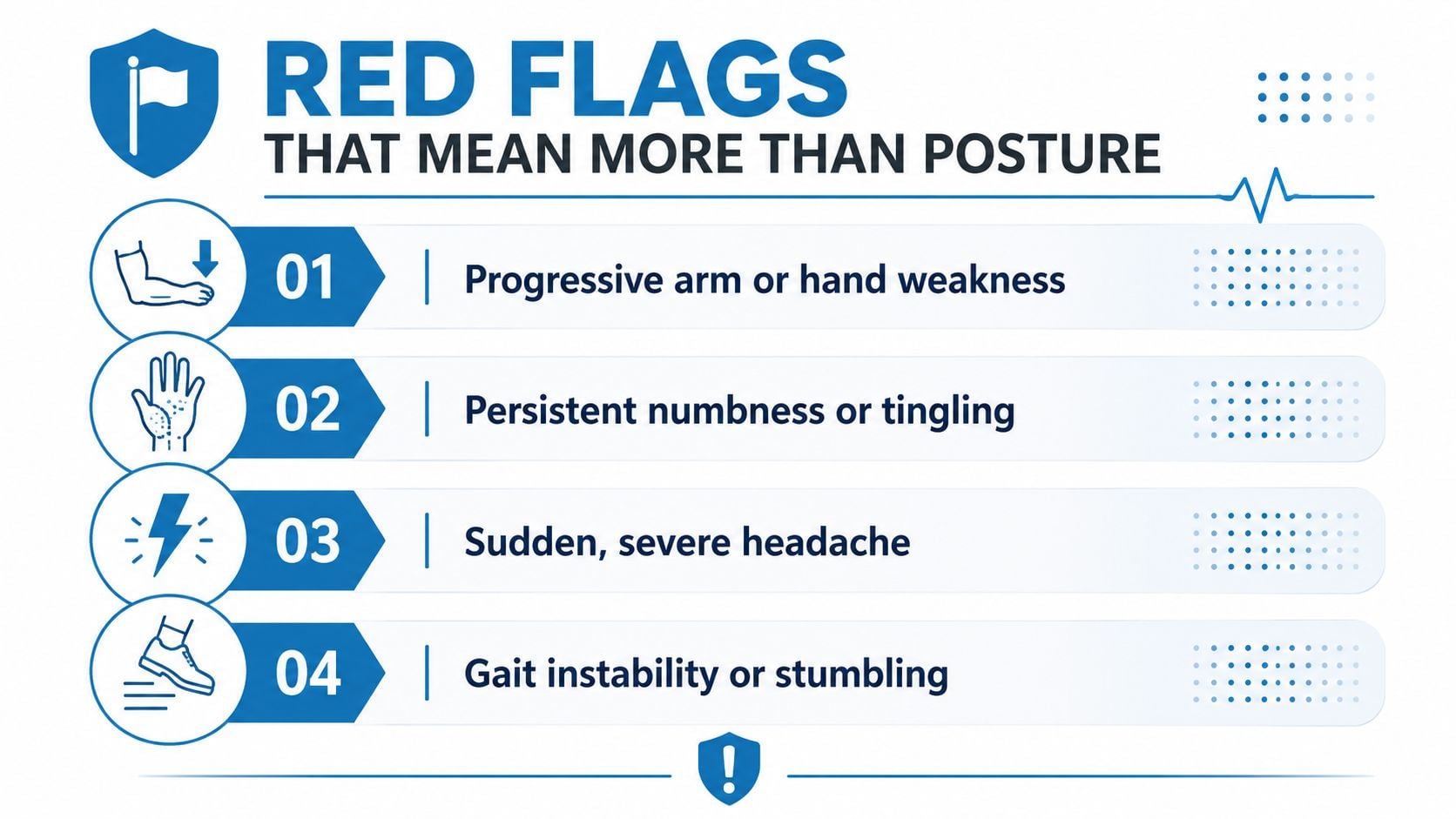
Symptoms that should not be brushed off
- Progressive arm or hand weakness: If grip, lifting, or finger control is getting worse, the issue may be involving a nerve root or spinal cord pathway.
- Persistent numbness or tingling: Ongoing sensory change, especially if it spreads or doesn't settle, can mean more than muscular strain.
- Sudden, severe one-sided headache: A headache that feels different from the usual pattern should not be treated like routine posture pain, especially if it is intense or abrupt.
- Gait instability or stumbling: Trouble walking straight, balance changes, or foot slapping suggests a broader neurologic concern.
Neck pain with fever, after trauma, or with symptoms that wake the person at night also deserves quick medical evaluation. These patterns are not the same as the usual slow-building ache from desk posture. They can reflect disc, facet, nerve, or spinal cord problems that posture correction alone will not fix.
The main rule is simple. If the symptom is changing the way the person uses a hand, walks, or thinks, it's time to stop self-managing and get evaluated. A focused read on headache patterns is available through occipital neuralgia information, which is helpful when head pain is sharp, one-sided, or linked with neck irritation.
How Clinicians Actually Diagnose Forward Head Syndrome
The workup usually starts with a conversation, not a machine. Clinicians ask when the symptoms started, what makes them worse, what helps, how much screen time fills the day, whether sleep is poor, and whether there's been an old injury such as whiplash. That history often reveals the pattern before the exam even begins.
What the physical exam is looking for
The next step is a posture check. Clinicians look at ear-to-shoulder alignment, shoulder rounding, and how the head sits on the neck both standing and sitting. Then they palpate the cervical muscles and upper back for tender trigger points, test neck range of motion, and screen strength, sensation, and reflexes in the arms.
A measured posture exam often includes CVA assessment, because the angle gives a more objective picture of how far forward the head sits. That is useful when the symptoms are vague or the person has adapted to the posture so long that it feels normal.
When imaging gets involved
X-rays, MRI, or nerve studies are not ordered just because the head sits forward. They become relevant when red flags are present, when arm symptoms suggest nerve involvement, or when pain is not responding to reasonable first-line care. Each test has limits. X-rays show alignment and bone structure, MRI shows soft tissues and nerve-related problems more clearly, and nerve studies help when weakness or numbness needs a closer look.
The key point is that diagnosis is mostly clinical. The scan supports the exam, it doesn't replace it.
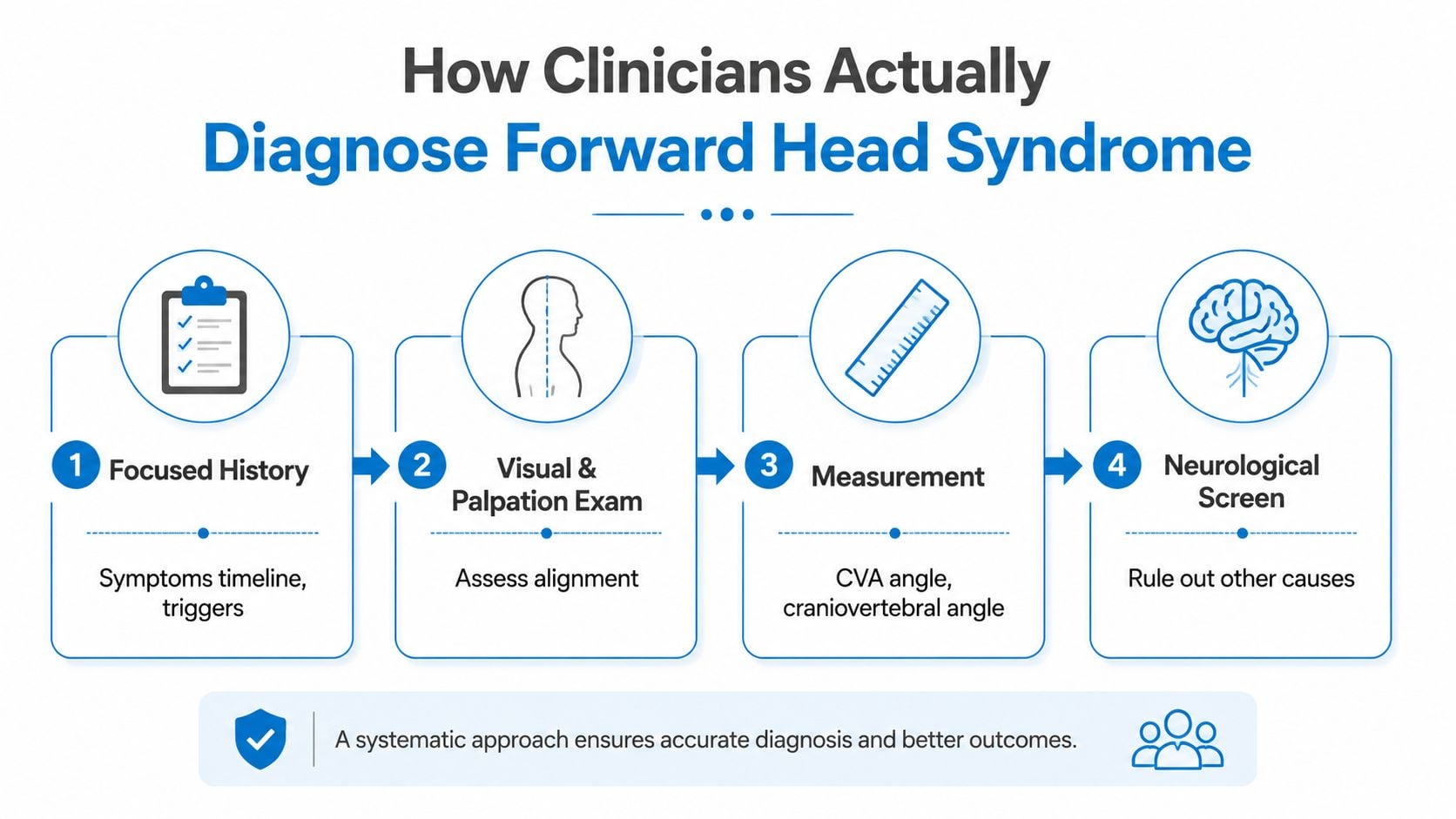
A careful exam is not about proving that posture looks imperfect. It is about finding whether the neck is mechanically overloaded or whether something more serious is going on.
From Self-Care to Specialist Treatment Options
The first layer of care is usually straightforward. Better desk setup, screen height changes, and fewer hours spent with the phone tucked low can reduce the daily load. Targeted chin-tuck retraining, deep neck flexor work, scapular retraction, thoracic mobility, and sleep-position changes are common early tools because they address the parts of the system that have gone quiet or overworked.
What usually belongs first
Ergonomics matters because the neck rarely gets to rest if the workstation keeps pulling the head forward. Exercise matters because posture isn't held by willpower, it's held by muscles that need endurance and coordination. That's why guided physical therapy often helps when self-directed corrections don't stick.
Recent professional guidance also cautions against aggressive cervical foam rolling and over-reliance on generic chin tucks, especially when the wrong tissues are being irritated. The better approach is usually targeted work for the thoracic spine, scapular control, and the deep neck flexors rather than forcing the neck itself to do all the repair.
What comes next when pain keeps hanging on
If symptoms persist, clinicians may add interventional options. Trigger point injections can help when muscle knots dominate the picture. Cervical facet or medial branch blocks can be useful when joint pain is suspected. Epidural steroid injections enter the discussion when nerve-driven symptoms are part of the problem.
Surgical consultation is not the first step for ordinary posture strain, but it becomes relevant when confirmed disc herniation or spinal stenosis is driving weakness, numbness, or disabling pain. In that setting, surgery is one branch of a broader plan, not a failure of care. The right path depends on which tissue is overloaded, which nerve is irritated, and how the symptoms behave over time.
Your Forward Head Syndrome Action Plan
A simple self-check can clarify a lot. Stand with the back against a wall, see whether the head naturally rests back or needs effort to touch the wall, try a gentle chin tuck hold, turn the neck fully left and right, and check for any arm numbness or weakness. Those quick observations don't replace an exam, but they show whether the problem is mostly positional, mechanical, or possibly nerve-related.
If the symptoms are not improving after six to eight weeks of consistent self-care, or if any red flag has shown up, a specialist visit makes sense. Pain that changes hand use, balance, or walking should not be put off.
Recovery is realistic. Many mild-to-moderate cases improve when posture training, ergonomic change, and targeted therapy are matched to the actual tissue that's overloaded. When the problem is more complex, interventional and surgical options exist, which means “bad posture” doesn't have to become the final story.
Interventional Pain Management evaluates neck pain, nerve irritation, and posture-related symptoms with a clinical eye toward the actual pain generator, not just the visible posture. If forward head syndrome symptoms are keeping the neck, shoulders, or arms irritated, visit Interventional Pain Management to learn what a specialist evaluation can clarify and which treatment path fits the findings.