
You've probably had this happen, or seen it happen to someone close to you. The back starts as a nuisance, then becomes the thing that shapes the day, whether that means stiff mornings, a bad drive into work, or the need to sit down after a short walk. Rest helps for a little while, over-the-counter medicine takes the edge off, stretching feels promising for a week, and then the same pain shows up again.
That loop is exactly why facet degenerative disease gets searched so often and understood so poorly. The small joints in the back of the spine can wear down for years, and when they finally start acting up, the pain often feels ordinary enough to be mistaken for muscle strain, a disc problem, or just “getting older.” For people who sit for long hours, a practical place to start is relief from back pain at work, because work posture can keep a painful cycle going even when the pain source hasn't been identified yet. For a broader clinic overview of low back pain care, the low back pain page can also help frame what usually gets checked first.
Table of Contents
- When Back Pain Refuses to Go Away
- What the Facet Joint Actually Does
- Why Almost Every Adult Has Some Facet Wear
- Recognizing the Symptoms and What Else It Could Be
- How Doctors Confirm the Facet Joint as the Pain Source
- Treatment Options From Conservative Care to Surgery
- Prognosis and the NJ and Staten Island Care Pathway
- Frequently Asked Questions From Patients in NJ and Staten Island
When Back Pain Refuses to Go Away
A lot of people arrive at the same frustrating point. They can still work, drive, and take care of family, but every movement seems to come with a quiet warning from the lower back. They've tried rest, a heating pad, a few stretches, and pain medicine from the pharmacy, yet the pain keeps circling back as soon as they return to normal life.
That pattern matters because facet degenerative disease often behaves like this, more stubborn than dramatic. It can feel local, deep, and mechanical, especially when bending backward, twisting, standing, or getting up after sitting too long. It's one of the reasons back pain can drag on without a dramatic injury, and it's also why a person may be told the scan looks “arthritic” without ever being told whether that arthritis is the pain source.
Practical rule: a spine scan can show wear, but wear alone doesn't prove the joint is the one making the pain.
That distinction is where many people get stuck. They know something is wrong, but they don't know whether the pain is coming from a disc, a muscle, a joint, or several structures at once. That uncertainty is real, and it's one reason a structured medical evaluation matters more than guessing based on a single image or a single bad day.
When the pain keeps returning, the question isn't just “what is worn down?” It's “what is generating the pain right now?” That's the thread that runs through every step in this guide, because the best treatment plan depends on identifying the actual pain generator, not just the structure that looks oldest on imaging.
What the Facet Joint Actually Does
Each spinal level has a pair of small joints in the back called the facet joints. A simple way to picture them is as the spine's rear hinges. They guide bending and twisting, help distribute load, and keep the vertebrae from sliding too far or moving in ways they shouldn't.
When those hinges are healthy, the joint surfaces are smooth, the capsule around them is flexible, and the joint moves without much friction. In facet degenerative disease, those parts start changing together. The cartilage thins, the synovial lining can become inflamed, the capsule can thicken and stiffen, and the joint loses some of the smooth motion it was built for. That's why extension and rotation often provoke pain, the movement is asking a worn hinge to do a job it no longer does comfortably.
Why the lower lumbar levels get hit so often
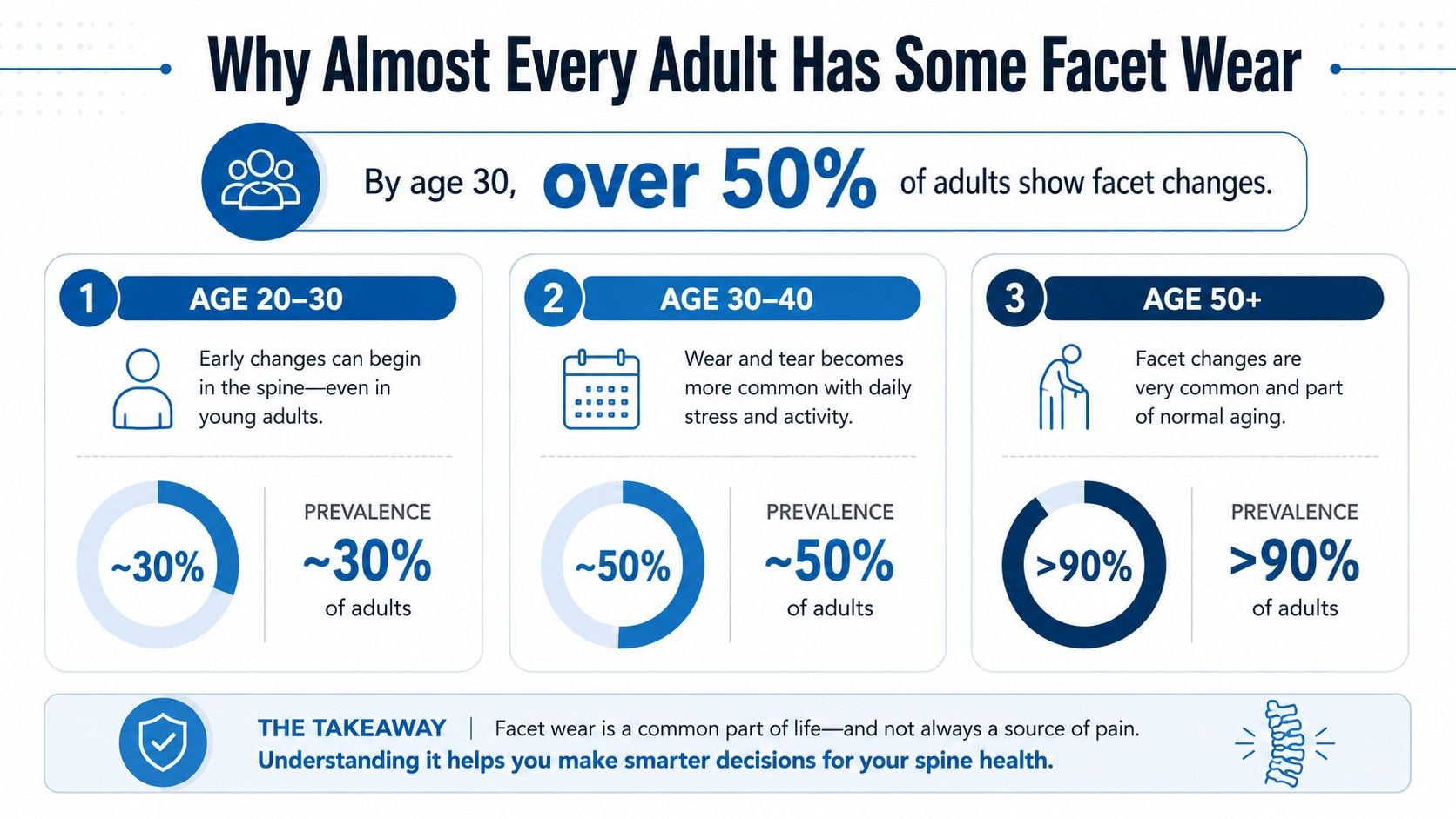
The lower back carries a lot of everyday load, and the L4–L5 level is especially often affected in the landmark study of lumbar facet arthrosis, which found that facet changes were already present in 57% of adults aged 20–29, then rose to 82% at 30–39, 93% at 40–49, 97% at 50–59, and 100% in people older than 60 (PubMed). That pattern is one reason the problem is not just “old age arthritis,” it's a wear process that builds across decades.
The disc and the facet joint also live in the same motion segment, so they often travel together even when one is more painful than the other. A disc can collapse, which changes the load on the facet joints. A facet joint can become arthritic, which changes how the segment moves. That overlap is why a scan can show more than one abnormal structure, yet only one may be the main pain generator.
The hinge analogy helps here. A door can still close when the hinge is rusty, but it won't swing cleanly. The joint is the same way, it may still move, but it moves with friction, stiffness, and pain.
Why Almost Every Adult Has Some Facet Wear
The most important thing to understand about facet degeneration is that it's common, and common doesn't always mean painful. The landmark lumbar study showed that facet arthrosis appears early and becomes nearly universal with age, with the L4–L5 level most commonly involved (PubMed). Another radiologic study in older adults found degenerative disc and facet pathology in greater than 90% of participants regardless of symptoms, and a histologic study showed facet degeneration can be seen as early as 15 years of age (PMC).
That's the key clinical point. Wear is common, pain is not automatic. Many people have imaging findings that look concerning but feel fine, while others have fairly modest-looking changes and a lot of pain. The scan shows structure. The person's story shows whether that structure is causing symptoms.
What those numbers mean in real life
For a worried patient, these prevalence data can feel confusing at first. The instinct is to assume that if something is degenerating, it must be the source of pain. In the spine, that isn't always true. The body can adapt to structural wear for a long time, and pain often starts only when inflammation, instability, joint irritation, or muscle guarding gets layered on top.
That is why imaging abnormalities and pain don't match perfectly. A scan can tell a clinician that a joint has changed, but not whether that joint is the one responsible for the ache that's waking someone up or ruining a work shift. It also explains why chronic low back pain needs a clinical workup that looks at movement, symptoms, and response to treatment, not just the picture on the screen.
A lot of back scans show aging, but aging on a scan is not the same thing as a diagnosis of the pain source.
For patients, the takeaway is reassuring and frustrating at the same time. Reassuring because facet wear is not rare or mysterious. Frustrating because it means the primary challenge is not finding wear, it's deciding whether that wear is the pain generator worth treating.
Recognizing the Symptoms and What Else It Could Be
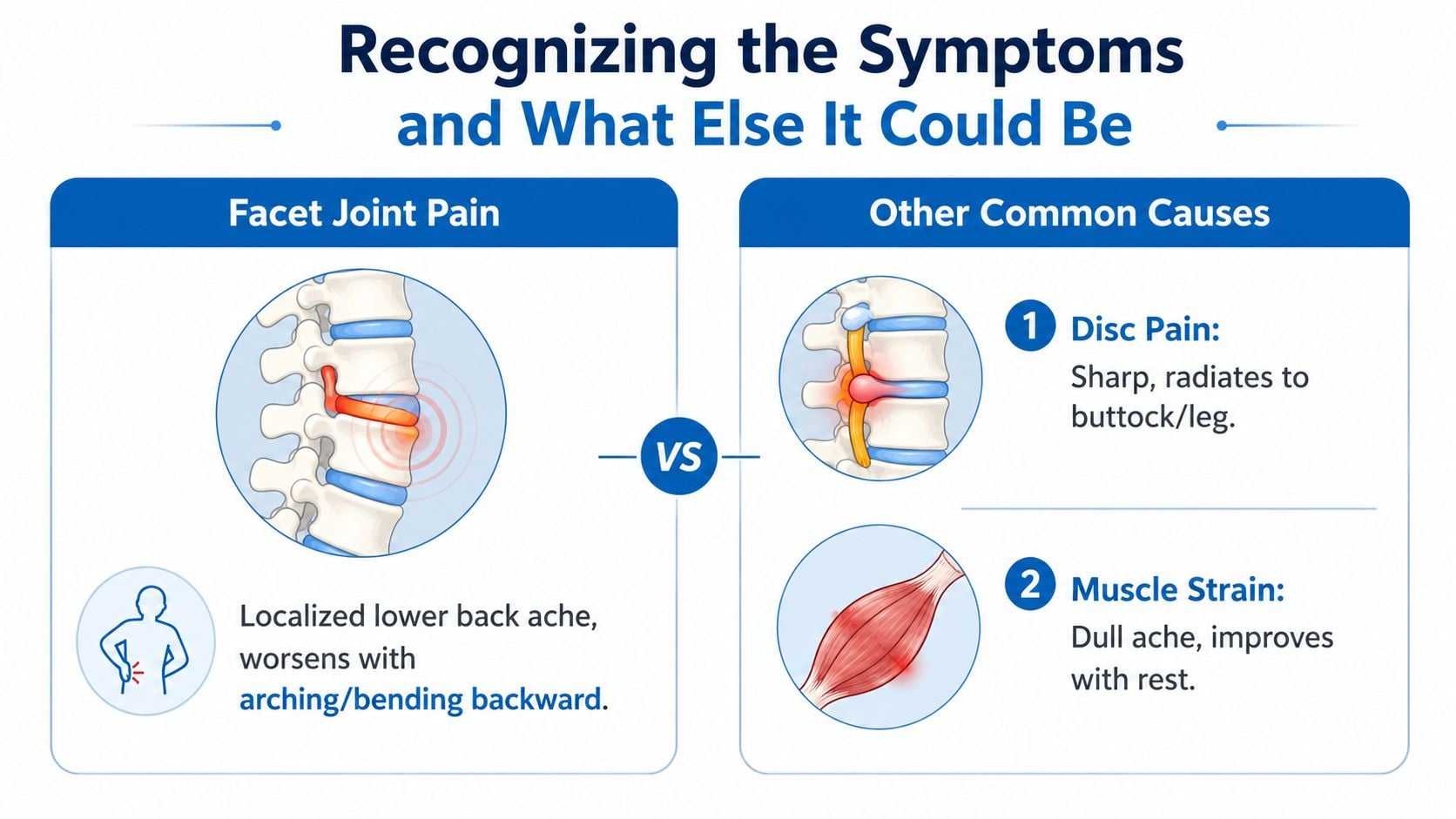
Facet pain usually sounds less like a lightning bolt and more like a persistent, local ache. People often describe stiffness in the lower back, discomfort with arching backward, and pain that comes on with twisting or prolonged standing. Sitting or leaning forward may feel better because those positions unload the back of the spinal segment and reduce pressure on the joint.
The pattern that raises suspicion
A clinician listens for a few details that point toward the facet joint. Is the pain centered in the low back rather than shooting down the leg? Does standing in one place make it worse? Does bending backward or turning to one side reproduce the exact pain? Those clues don't prove the diagnosis, but they make facet involvement more plausible.
Facet pain can also refer into the buttocks, hips, or thighs, which is why people sometimes think they have sciatica when they don't. The pain pattern can overlap with other conditions, but the trigger pattern is often different. Disc-related pain tends to be more flexion-sensitive, nerve-root pain usually travels farther and feels more electric or numb, and myofascial pain often behaves more like a tender muscle band than a joint problem.
What else it could be
A careful differential diagnosis usually includes:
- Degenerative disc disease, especially when sitting or bending forward makes things worse.
- Lumbar spinal stenosis, when walking or standing becomes increasingly limited and leaning forward brings relief.
- Herniated disc, when pain follows a clearer nerve-like pattern with numbness or weakness.
- Sacroiliac joint dysfunction, when pain sits lower near the pelvis and changes with certain transfers or twisting.
- Myofascial pain, when the muscle layers themselves are the dominant source of tenderness.
The point isn't to memorize every label. It's to understand that back pain has several possible generators, and the facet joint is only one of them. A good exam asks which motion aggravates the pain, where the pain travels, and what has already failed to help.
If the pain has been lingering, the next appointment goes better when the patient can say, in plain language, what motion hurts, what eases it, and whether symptoms stop above the knee or seem to travel farther.
How Doctors Confirm the Facet Joint as the Pain Source
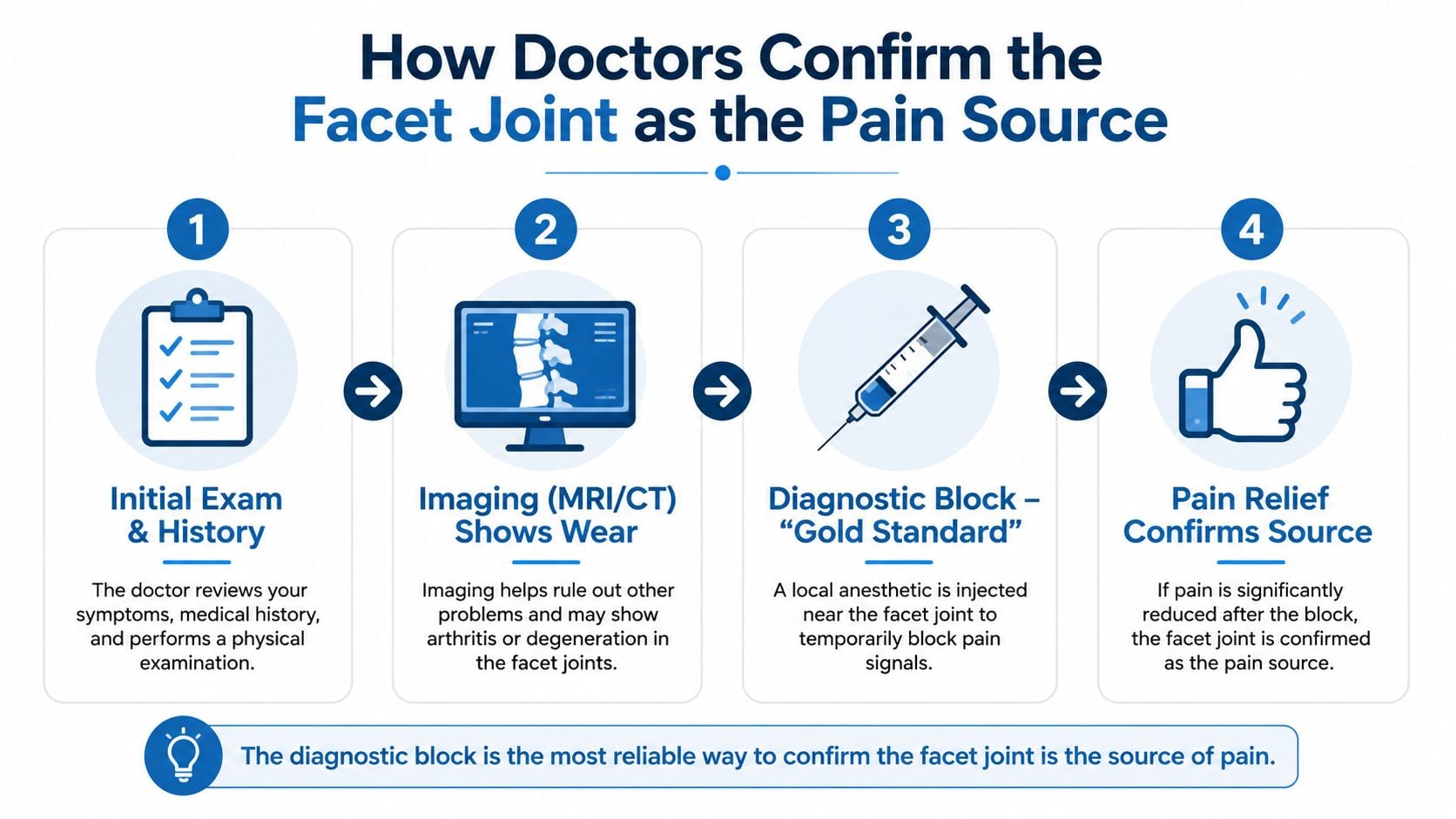
The hard part of diagnosing facet pain is that imaging can't prove pain generation. MRI and CT can show arthritic change, joint narrowing, bone spurs, or degeneration, but the scan can't tell whether a particular facet joint is the one producing the patient's symptoms. That's why the workup starts with a history and exam, then uses imaging as a map, not a verdict.
Why blocks matter more than a scan alone
The literature treats image-guided medial branch blocks or facet injections as the confirmation step before lasting treatment (NCBI Bookshelf). In plain language, a clinician temporarily numbs the small sensory nerves that carry pain from the facet joint. If the pain improves in a clear, time-linked way, that strongly suggests the facet joint is the pain generator.
That is also why patients often feel relief and confusion at the same time. Relief means the right structure may have been found. Confusion comes from the fact that the scan already looked abnormal, so it can seem like the diagnosis should have been obvious. It usually isn't. The diagnosis is a combination of symptoms, exam findings, and a confirmatory block.
A practical way to think about the sequence
- History and exam look for extension- and rotation-provoked pain.
- Imaging shows the structure, but not the pain source.
- Diagnostic block checks whether numbing the facet's nerve supply changes the pain.
- Treatment choice depends on how clearly the block matches the symptom pattern.
That stepwise process is what keeps patients from being treated for the wrong thing. It also explains why a person can have a “bad MRI” and still not need a procedure aimed at the facet joint, or have only moderate-looking degeneration and still be a good candidate for a block.
For patients who are already in the evaluation lane, an internal overview of nerve block evaluation can make the logic of diagnostic injections easier to understand. The point of the block is not to mask pain forever, it's to answer a specific question, is the facet joint really the source?
Treatment Options From Conservative Care to Surgery
Facet treatment works best when every step keeps returning to the same question, is the facet joint really the source of pain, and if so, how much control is needed? That question matters because facet degenerative disease is often a pain-source confirmation problem, not just a label for arthritis on a scan. If the source is still unclear, conservative care usually comes first. If the source is clearer and pain keeps returning, care can move toward targeted procedures.
Comparing the main tiers of care
| Treatment Tier | Typical Use Case | Expected Duration of Benefit | Primary Goal |
|---|---|---|---|
| Conservative care | Early symptoms, uncertain diagnosis, or mild flare | Variable, depends on adherence and biomechanics | Calm inflammation and improve movement |
| Image-guided injections or blocks | Pain source still being confirmed | Temporary | Clarify the pain generator and reduce irritation |
| Radiofrequency ablation | Confirmed facet-mediated pain that keeps returning | Often about 6 to 12 months, sometimes up to 2 years (Rheumatology Advisor) | Interrupt pain signals from the medial branch nerves |
| Surgical evaluation | Refractory pain, instability, or neurologic compromise | Longer-term, depends on procedure and anatomy | Address the structural problem more definitively |
What conservative care is trying to do
First-line care usually means physical therapy, activity modification, weight and biomechanics work, and anti-inflammatory medication when appropriate. These steps do not reverse arthritic change, but they can reduce irritation and help the spine share load more evenly. A useful home-exercise approach can also be guided by Family Caregiving Kit's fitness resources, especially when stiffness and deconditioning are making the back feel older than it is.
Conservative treatment is also useful for another reason. It gives the clinician more information about pattern and response, which helps answer whether the facet joint is really driving the pain or whether another structure is involved.
When procedures enter the picture
If a diagnostic block confirms facet-mediated pain and the discomfort keeps returning, radiofrequency ablation of the medial branch nerves is a common next step. Radiofrequency ablation information helps explain why this procedure can last longer than a simple injection. Expert sources describe the usual relief window as roughly 6 to 12 months, with some patients reporting relief for up to 2 years, because the nerves eventually regenerate (Rheumatology Advisor). That durability is helpful, and it also explains why pain can come back after a period of improvement.
Practical takeaway: repeat pain after radiofrequency ablation usually means the nerve has recovered, not that the original diagnosis was meaningless.
For patients who still have pain after targeted treatment, the next question is whether the problem is only pain or whether there is also instability, compression, or another structural issue. In those cases, surgical evaluation may be appropriate. In the New Jersey and Staten Island setting, a multidisciplinary clinic can bring pain management, orthopedics, and spine surgery into one pathway, which matters when insurance approval, transportation, and prior treatment history all shape what happens next. Interventional Pain Management is one example of that kind of evaluation and treatment model, with board-certified physicians across pain, orthopedics, and spine care.
Prognosis and the NJ and Staten Island Care Pathway
Most patients with facet-related pain do better when the pain generator is identified early and the treatment matches the diagnosis. Some improve with conservative care and movement changes. Others need repeat procedures over time, especially when the joint keeps sending pain through regenerating nerves. A smaller group ends up needing a surgical opinion because the problem is no longer just pain, it's pain plus structural compromise.
When to escalate care
A specialist visit makes sense when pain has lasted beyond a few weeks without a clear improvement trend, when symptoms keep returning after injections, or when the pain starts limiting daily function in a meaningful way. Numbness, weakness, balance problems, or bowel and bladder changes deserve prompt reassessment because those features raise the stakes beyond a simple arthritis workup.
For people in New Jersey and Staten Island, the practical value of a multidisciplinary clinic is that the path doesn't have to be scattered across different offices. A patient can be evaluated by pain management, orthopedics, and spine surgery within one system, which helps when the key question is still, is this really the facet joint, or is something else driving the pain? That kind of coordination matters when insurance, transportation, and prior treatment history all affect what happens next.
What the first call usually needs to cover
Patients do best when they ask for a plan that includes diagnostic review, benefit navigation, and a clear explanation of next steps. Clinics serving the area may also offer seven-day scheduling, transportation assistance, and fee estimates, including compliance with the New Jersey Out-of-Network Law when applicable. For workers' compensation or motor vehicle accident cases, the administrative side often matters almost as much as the medical side, because the evaluation has to be documented clearly from the start.

A well-run pathway doesn't promise instant answers. It gives patients a structured way to move from uncertainty to confirmation, then from confirmation to a treatment plan that matches the actual pain source.
Frequently Asked Questions From Patients in NJ and Staten Island
A patient may hear that the facet joints are “degenerating” and assume that alone explains the back pain. In practice, the harder question is usually whether the facet joint is the pain source, because worn joints can exist without causing the symptoms that brought the patient in.
How often does radiofrequency ablation need to be repeated? Relief often lasts about 6 to 12 months, and some patients report benefit for up to 2 years before the nerves grow back. The useful next question is whether the pain pattern still looks facet-mediated before another procedure is planned. Rheumatology Advisor
Does facet degeneration ever fully reverse? Structural wear usually does not reverse once it is established, but symptoms can stabilize or improve when inflammation, movement patterns, and load sharing are addressed. The key issue is not whether the joint looks new again, it is whether the pain can be controlled enough for normal function.
When should a surgical consult be requested? If pain keeps returning after appropriate conservative and interventional care, or if weakness, balance trouble, or bladder or bowel changes appear, a surgical opinion should be requested sooner rather than later. That does not mean surgery is certain, it means the anatomy needs a more complete review.
How do workers' compensation and motor vehicle accident cases fit into the pathway? Those cases usually need careful documentation of symptoms, imaging, and treatment response, so the most efficient first step is a multidisciplinary evaluation that can coordinate the medical and insurance pieces together. Patients should also ask about transportation support and a benefits review before the first visit.
Why can two doctors give different answers about the same back pain? Because the pain generator is not always obvious from the scan alone. One clinician may see facet wear and call it the problem, while another may suspect the discs, muscles, sacroiliac joint, or nerve irritation. That is why the workup should keep returning to the same practical question, is the facet joint really the source.
What should patients in NJ and Staten Island ask at the first visit? They should ask how the diagnosis will be confirmed, which specialists will review the case, and what happens if the first treatment does not match the pain pattern. A clear answer should also cover insurance approval, out-of-network concerns if they apply, and whether the clinic can coordinate follow-up without sending the patient from office to office.
A well-run pathway does not promise instant answers. It gives patients a structured way to move from uncertainty to confirmation, then from confirmation to a treatment plan that matches the actual pain source.
If chronic back pain has started shaping the day, Interventional Pain Management can help sort out whether the facet joint is the pain source and build a treatment plan around that answer. Their team works across pain management, orthopedics, and spine care, which makes it easier to move from diagnostic blocks to a clear next step. To get started, visit Interventional Pain Management and ask for an evaluation that matches your symptoms, imaging, and insurance situation.