
You're exhausted, and the pattern feels unfair. The hips may have felt tolerable all day, then the moment the lights go out, every turn in bed seems to make the ache sharper. That night-after-night swing is exactly why the best sleeping position for hip pain isn't a single pose, it's a setup that reduces pressure, keeps the pelvis level, and stops the painful side from getting crushed for hours.
The useful part is that most sleep pain follows a mechanical pattern. If the hip is compressed, rotated, or forced to sag into the mattress, it tends to complain later in the night, even when the first hour felt fine. That's why the fix usually starts with alignment, not medication.
Table of Contents
- Why Hip Pain Worsens at Night
- Recommended Sleeping Positions Step by Step
- Choosing the Right Position for Your Symptoms
- Mattress and Pillow Adjustments That Actually Help
- Modifications for Common Hip Conditions
- Red Flags and When to Stop Self-Managing
- Frequently Asked Questions About Hip Pain and Sleep
Why Hip Pain Worsens at Night
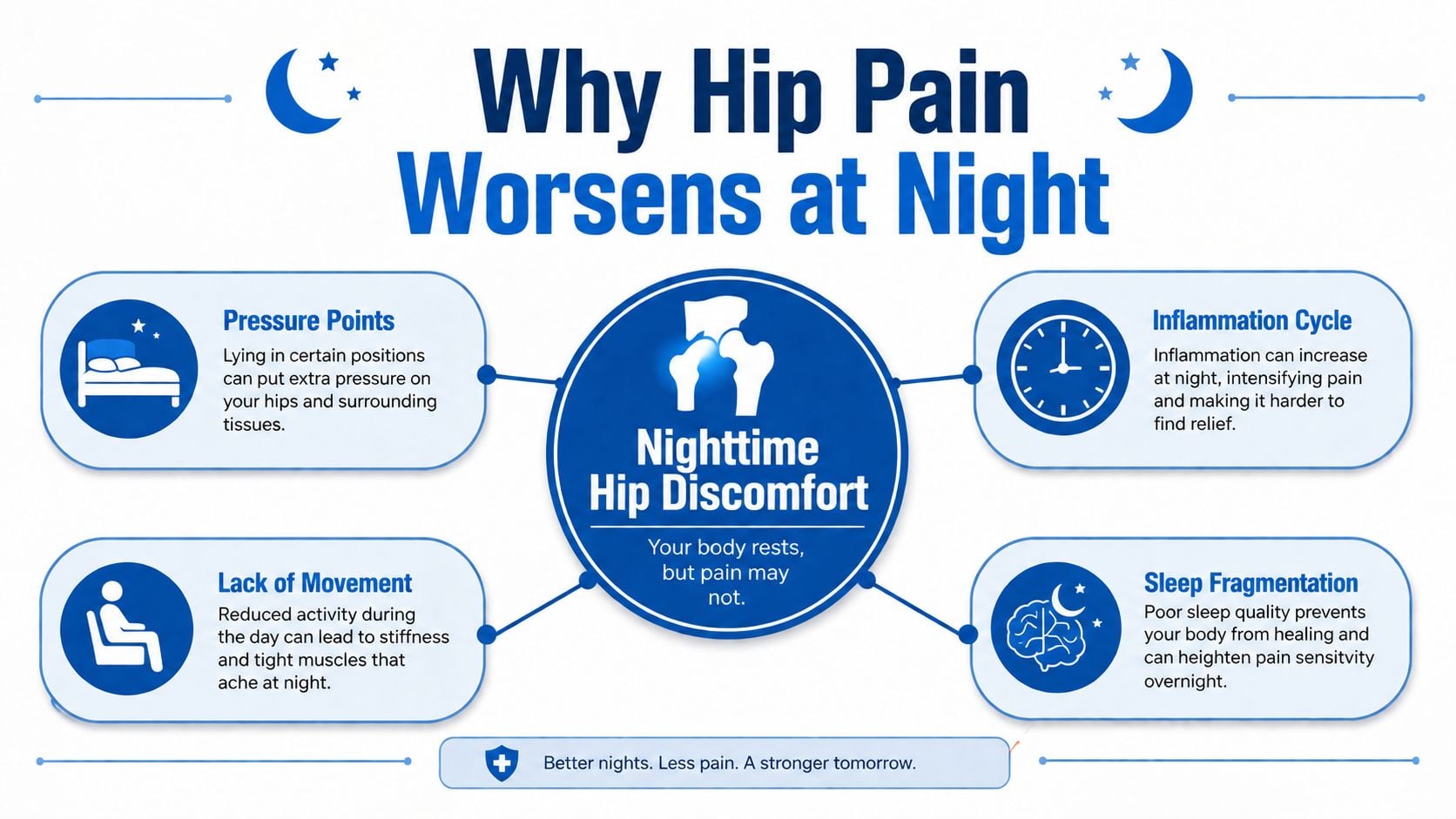
A patient can spend the whole evening moving around with only a dull ache, then lie down and suddenly feel every joint line and pressure point. That isn't random. At night, the body stays still long enough for direct compression, pelvic rotation, and a slow accumulation of irritation to show up more clearly than they do during the day.
The mechanics that make bedtime harder
When someone lies on the painful side, the lateral hip takes direct pressure for hours, which can aggravate the outer hip and the tissues around it. When someone side-sleeps without enough pillow support, the top leg tends to drop forward, the pelvis rotates, and the hip drifts out of neutral alignment. That small twist is enough to keep the joint and surrounding tendons under strain.
Practical rule: if a position feels fine at first but gets worse after the body has been still for a while, the setup is probably loading the hip instead of resting it.
The top mattresses for spine alignment article from Woodstock Furniture & Mattress Outlet is worth a look if the problem seems to involve both the back and the hips, because a mattress that lets the pelvis sink unevenly can make alignment harder to hold. The same thing happens when the surface is too soft or when pillows don't keep the legs stacked.
Recommended Sleeping Positions Step by Step
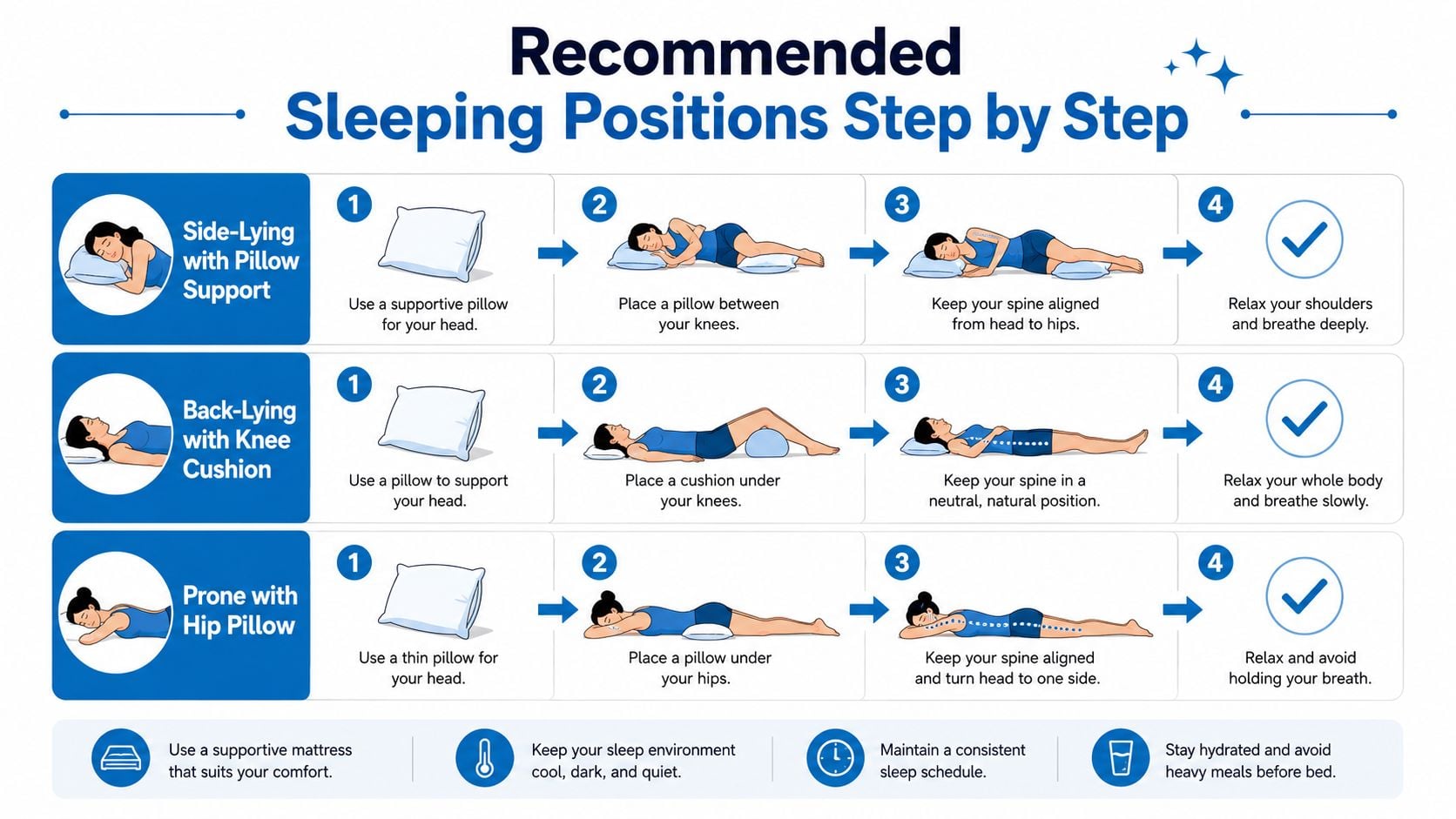
The safest starting point is usually the position that reduces pressure and keeps the pelvis level. For many people, that means either back sleeping with knee support or side sleeping with a firm pillow between the knees and ankles. Those setups work because they stop the upper leg from pulling the hip forward and they keep the femur closer to neutral.
Build the position, don't just try it
Back sleeping is the cleanest first test. Place a pillow under the knees so the low back can settle and the hip flexors don't stay on stretch all night. If the knees feel too high, adjust the pillow thickness until the pelvis feels supported but not pushed upward.
Side sleeping needs more precision. Lie on the non-painful side, place a firm pillow between the knees, and if the knees still drift, extend the support down toward the ankles. That extra length matters because a pillow only between the knees sometimes leaves the upper leg free to rotate forward.
A semi-side-lying setup can help when outer hip pain is stubborn. Rotate slightly forward, keep a cushion supporting the top leg, and avoid letting the painful hip bear full bodyweight. The goal is not a perfect pose, it's a position that stops the hip from being compressed and twisted at the same time.
If a position still reproduces lateral hip pain after a few nights, it isn't unloading the joint enough and should be changed.
Choosing the Right Position for Your Symptoms
Hip pain isn't one problem, so the starting position shouldn't be one-size-fits-all. The first clue is where the pain shows up. Outer hip pain usually reacts badly to direct pressure, while deeper joint pain often hates being held in a position that lets the pelvis tilt or the hip flex too long.
Match the position to the pain pattern
For pain on the outside of the hip, the first choice is usually back sleeping or side sleeping on the non-painful side with the painful leg supported on top. For pain that feels deeper in the joint or groin, back sleeping often gives the cleanest rest because it removes the side pressure that can keep the hip irritated overnight. For front-of-hip discomfort, a slightly supported, less extended setup is often easier than lying flat and letting the front of the joint stay stretched.
The simplest way to sort the pattern is to ask what makes it worse in bed, lying directly on it, keeping the legs straight, or letting the top leg fall forward. That answer usually points to the right starting setup faster than guessing from pillow ads or generic posture advice.
| Symptom Pattern | Best Starting Position | Key Setup Detail |
|---|---|---|
| Outer hip pain that flares on contact | Side-lying on the non-painful side | Keep a firm pillow between the knees and ankles |
| Deep groin or joint pain | Back sleeping | Use a pillow under the knees to reduce pull through the hip |
| Front-of-hip tightness | Slightly supported back or semi-reclined setup | Avoid full extension if it increases discomfort |
| Pain that worsens when the top leg drifts forward | Side-lying with alignment support | Use enough pillow thickness to keep the pelvis stacked |
A useful internal reference for the arthritis side of the problem is the hip osteoarthritis overview, especially when stiffness and night pain seem to move together.
Mattress and Pillow Adjustments That Actually Help
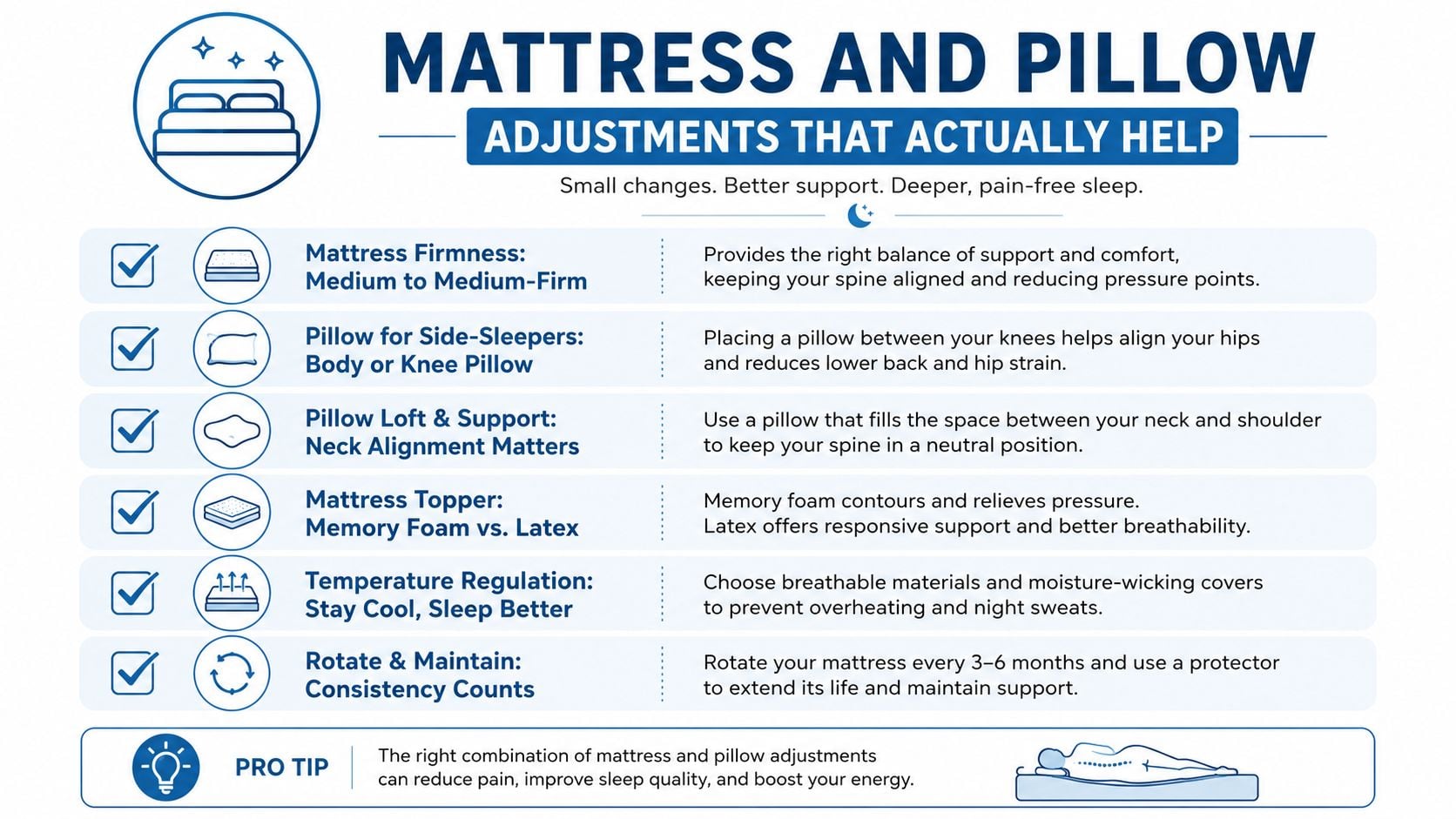
Positioning matters, but the mattress decides whether that position holds up for six hours or collapses after one. A medium-firm surface is often the practical middle ground because it supports the pelvis without letting the hip sink far enough to twist the spine. When a mattress is too soft, the painful side can drop lower than the rest of the body, and the result is more rotation, not less.
What to look for in the bed itself
A mattress topper can be useful when the current bed is close, but not quite right. If the surface is too firm and pressure builds at the outer hip, a topper may take the edge off. If the bed is too soft, a topper usually makes the problem worse unless it adds enough support to prevent sinking.
The same logic applies to pillows. A standard knee pillow works if the legs stay stacked, but a body pillow often does better for restless side sleepers because it supports the whole top leg and gives the pelvis less room to roll. A firm pillow between the knees and ankles is better than a thin one that collapses by the middle of the night.
For anyone comparing surfaces while shopping, the Norwich mattress for back pain resource from Gorins Furniture & Mattress is a reasonable place to think about the back-hip trade-off, since many people with hip pain also notice that poor lumbar support changes hip position in bed.
Useful test: if the hip hurts less when the mattress is firmer or when the knees are better supported, the issue is probably alignment and load sharing, not just soreness.
A practical trial helps more than guesswork. Start with the current mattress, then change only one variable at a time, pillow thickness, pillow firmness, or side versus back sleeping. If the pain improves when the pelvis stays level, the setup is doing real work.
The overlap between hip pain and soft tissue irritation is discussed further in the tendinitis and bursitis guide, especially when outer hip tenderness is part of the story.
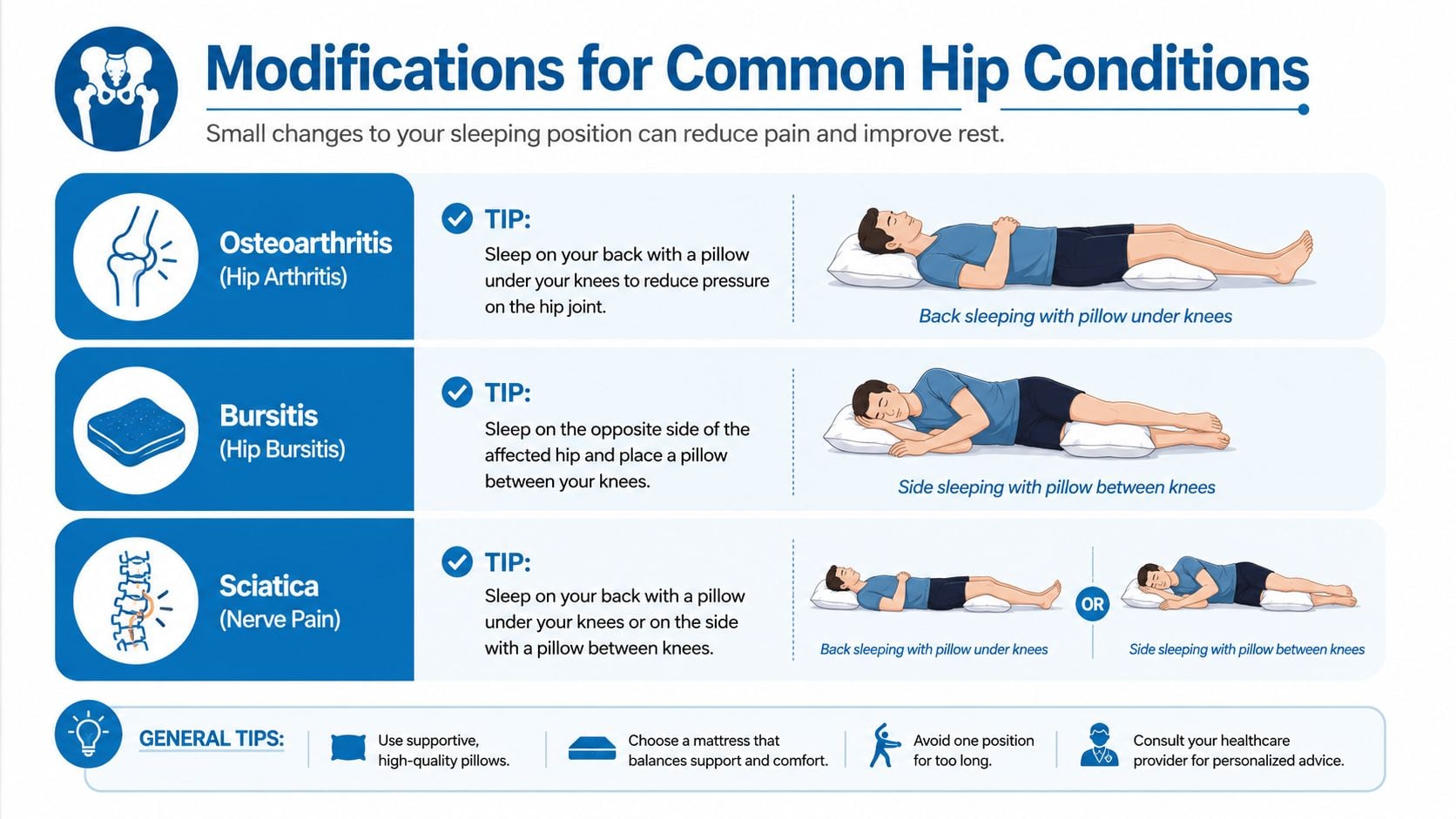
Modifications for Common Hip Conditions
The same sleep position won't serve every diagnosis. Greater trochanteric pain syndrome usually hates direct lateral pressure, while hip osteoarthritis often complains more when the joint feels stiff and unsupported. Gluteal tendinopathy and bursitis can both react to compression and to letting the top leg drift inward.
Condition-specific tweaks
For greater trochanteric pain syndrome, the big rule is simple, don't lie on the painful side. Side-sleep on the other side with the affected leg on top, and keep enough pillow support to stop the top thigh from falling forward. For more stubborn lateral pain, a semi-side-lying angle can reduce load over the outer hip.
For hip osteoarthritis, a slightly more forgiving surface sometimes helps because it spreads pressure better across the body. The joint still needs alignment, though, so a pillow under the knees or between the knees remains important. For gluteal tendinopathy, the key is preventing adduction and internal rotation, since those positions tend to tighten the very tissues that are already irritated.
For pain that seems to originate from the low back or sacroiliac region, the hip may only be the messenger. In that situation, the sacroiliac joint dysfunction overview can help distinguish a pelvis-driven pattern from a true hip-driven one, because sleep setups often need to protect both areas at once.
Red Flags and When to Stop Self-Managing
A pillow strategy is useful only when the pain is mainly mechanical. If the hip keeps waking the person every night despite several position changes, the problem may be more than sleep posture. The same is true when numbness, tingling, swelling, fever, or recent trauma enters the picture.
When the pattern stops looking like a simple sleep problem
Persistent night pain that doesn't improve after a reasonable trial of positioning deserves evaluation. So does reduced range of motion that keeps getting worse, because stiffness that doesn't ease with movement can point to a structural issue rather than a positional one. Pain after a fall, a direct hit, or another clear injury also needs a closer look.
Interventional pain care can play a role when conservative measures aren't enough. That may include image-guided injections, nerve blocks, or other targeted options chosen after an exam and imaging review. Orthopedic evaluation matters when the joint itself looks like the driver, especially if the problem is advancing despite good positioning.
If the hip still hurts after the body has been positioned correctly for several nights, the symptom is telling the truth, the setup isn't enough.
The point isn't to scare people into overreacting. It's to keep them from spending months trying to out-pillow a problem that needs a real diagnosis.

Frequently Asked Questions About Hip Pain and Sleep
A softer mattress can help some people, but only when the problem is pressure on the outer hip and the surface still supports alignment. If the mattress is so soft that the pelvis sinks and the hip rotates, the pain usually gets worse, not better. The right test is not “soft versus firm” in the abstract, it's whether the position stays level through the night.
If someone keeps rolling onto the painful hip, the fix is usually not more forceful willpower. A body pillow, a pillow behind the back, or a thicker knee-and-ankle setup can make it harder to roll into the bad position without waking fully. If that still fails, the setup is too easy to collapse.
A new position should usually be trialed for several nights before it's judged. One bad night doesn't prove much, but a repeated pattern does. If the same setup keeps reproducing the same pain, the hip is giving a clear answer.
Night pain can occasionally signal something serious, especially when it's paired with fever, swelling, trauma, or neurologic symptoms. A stress fracture, infection, or another structural problem can't be sorted out safely by guessing from sleep position alone. That's the point where a clinical evaluation matters more than another pillow.
For people who want a direct next step, a targeted evaluation can separate hip joint pain from bursitis, spine referral, or sacroiliac pain, then match treatment to the actual driver instead of the bedroom guesswork. A proper diagnosis saves time, and it usually saves sleep too.
A good sleep position should calm the hip, not demand a nightly battle. If the pain keeps returning, or if the setup only helps for part of the night, schedule a clinical evaluation with Interventional Pain Management to get a more precise answer and a treatment plan that fits the underlying cause.