
A straight neck on an X-ray does not automatically mean it's the cause of pain. That assumption drives a lot of unnecessary worry, because many people with no neck symptoms still show a lordotic cervical curve on imaging, and the difference between a meaningful problem and an incidental finding depends on the full clinical picture, not the curve angle alone. The smarter question is not, “Is the curve normal?” It's, “What else is going on?”
Table of Contents
- Understanding Loss of Normal Cervical Lordosis
- Common Causes Behind a Straightening Neck Curve
- Symptoms and Red Flags You Should Not Ignore
- How Specialists Diagnose the Problem
- Evidence-Based Treatment Options From Conservative to Surgical
- Self-Care Strategies and When to Skip Them
- Getting Expert Care in New Jersey and Staten Island
Understanding Loss of Normal Cervical Lordosis
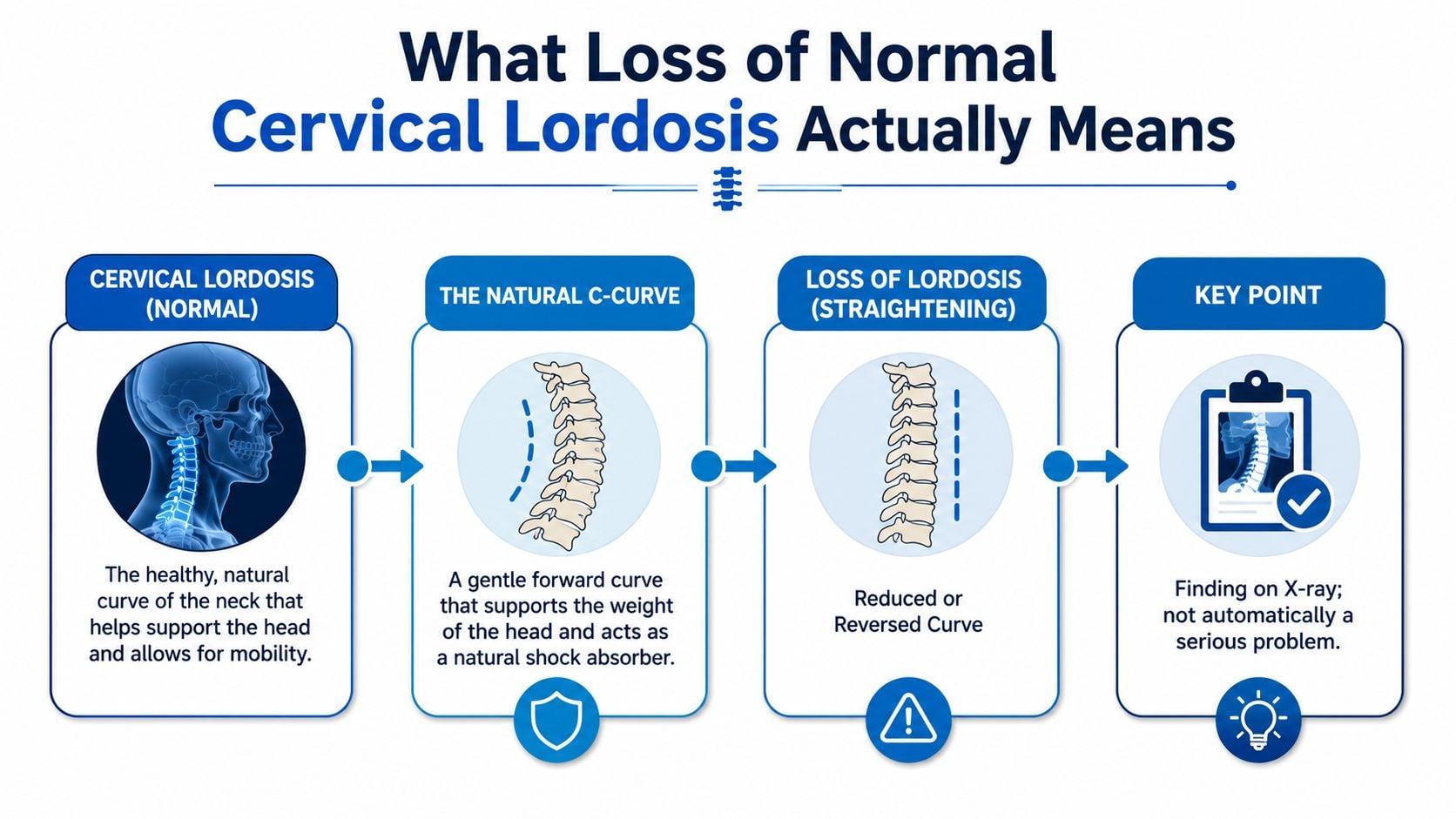
Loss of normal cervical lordosis means the neck's usual gentle forward curve looks flatter than expected, or sometimes even reversed, on imaging. Normal adult cervical alignment is often described as 30° to 40° of lordosis, but that range is a reference point, not a diagnosis by itself, and it can vary across people and populations Cleveland Clinic. In practical terms, the finding says the neck is not holding its usual C-shaped posture.
The finding is not the same as a disease
That distinction matters because a straightened neck curve can show up in people who feel fine. A 2016 meta-analysis found that many asymptomatic adults still had a lordotic cervical curve, and the average C2–C7 lordosis was described in the same review using different measurement methods. The review also found no significant difference in cervical curvature between symptomatic and asymptomatic people, which is why imaging alone cannot prove the pain source.
Practical rule: the x-ray describes alignment, but the patient describes the problem.
The curve also is not one-size-fits-all. That same review noted that lordotic curvature was significantly higher in men than in women, which means “normal” alignment is not identical for every body. A report that says “loss of cervical lordosis” should be read as one piece of a larger puzzle, not a final answer.
Why the wording can sound scarier than it is
Radiology language often sounds more alarming than the underlying finding. “Straightening,” “reversal,” and “loss” can sound like damage has been proven, but the report may be describing posture at the moment of the image. Muscle tension, positioning, and underlying wear can all influence what the neck looks like on film.
That is why clinical correlation matters. If the exam is normal, pain is mild, and there are no structural red flags, the alignment change may be more of a descriptor than a diagnosis. For people comparing notes with a clinician, an overview of neck pain evaluation can help frame the conversation around symptoms, function, and imaging together.
Common Causes Behind a Straightening Neck Curve
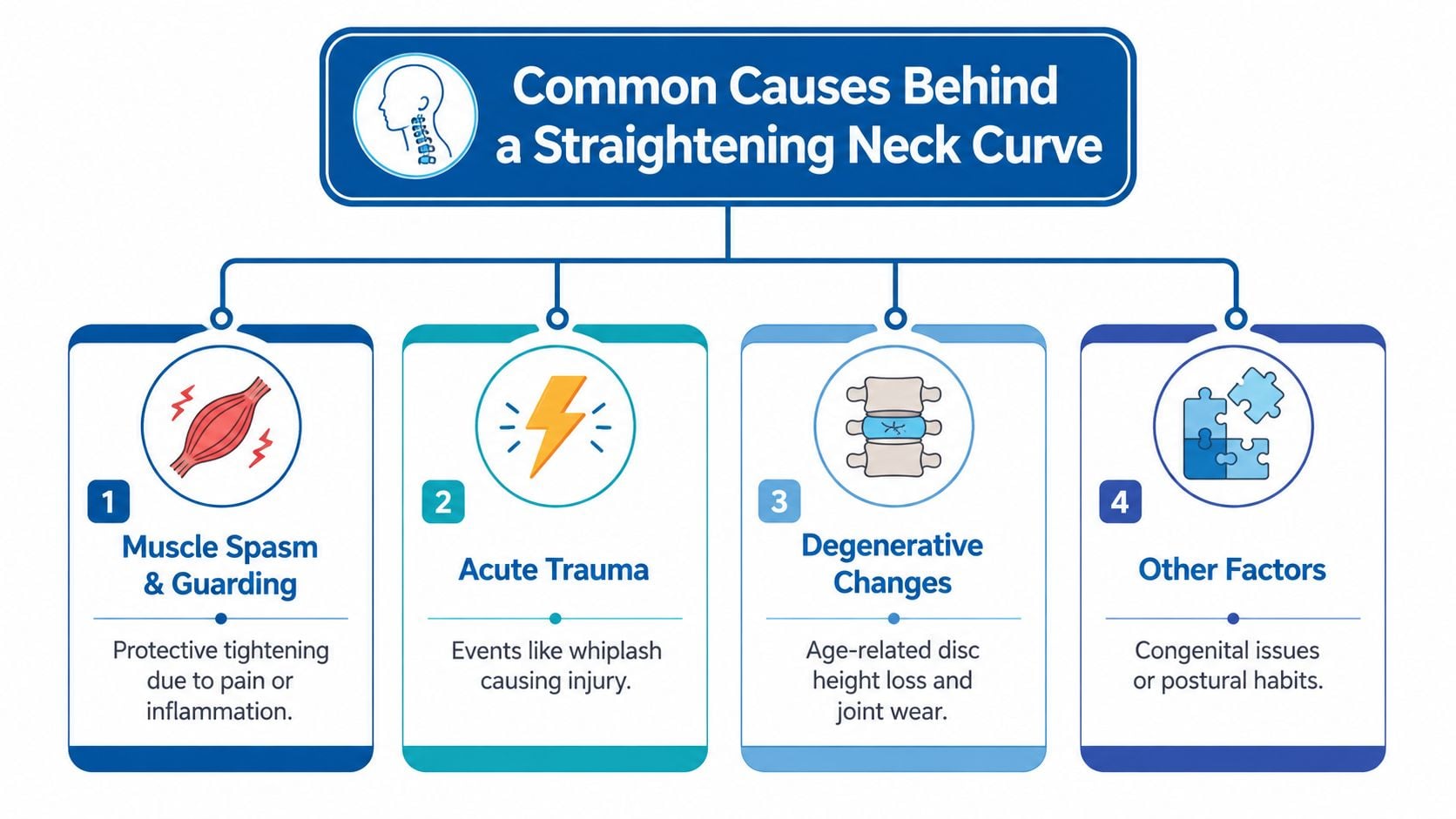
A straightened cervical curve usually reflects mechanics, not a single mysterious disease. In a large radiologic study published in 2021, age, sex, disc height loss, and T1 slope were each independently associated with lower cervical lordosis, which shows that alignment shifts with anatomy and degeneration rather than one isolated cause study. That matters because a straight neck on X-ray is often a description of what the spine was doing at the moment the image was taken.
Muscle guarding and acute injury can flatten the curve
After pain or injury, neck muscles often tighten protectively. That guarding can pull the cervical spine into a straighter position, especially after whiplash or another sudden strain. In those cases, the altered curve may be temporary, because the body is bracing around a painful structure rather than reshaping the spine itself.
Acute trauma can work the same way. The neck may lose its usual curve because surrounding tissues are inflamed, sensitive, and less willing to move normally. The image looks dramatic, but the posture change may be part of the short-term injury response.
Degeneration changes the height and balance of the spine
Disc height loss matters because the discs help preserve the neck's normal arc. When those discs thin, the front and back of the cervical spine don't stack the same way, and the curve can flatten. That is why disc wear and other degenerative changes often appear together with lordosis loss.
This finding becomes more clinically relevant when the flattening appears alongside disc degeneration, facet wear, or foraminal narrowing. That pattern points to a structural process, not just posture. A patient with chronic neck stiffness and degenerative change may need a different plan than someone whose X-ray was taken during an acute muscle spasm.
Posture can contribute, but it isn't the whole story
Prolonged desk work and device use can reinforce forward head posture, which increases load on the neck. Over time, that can train the surrounding muscles to hold the head differently and make the cervical curve look straighter. Even so, posture is usually one piece of a larger mechanical picture, not the sole explanation.
Biomechanics around the thoracic inlet also matter. The 2021 radiologic study linked T1 slope with lower cervical lordosis study, which reinforces a simple point, the neck does not work in isolation. A flatter curve can reflect age, degeneration, posture, prior injury, or a blend of all four.
Symptoms and Red Flags You Should Not Ignore
The most common symptoms tied to a straightened neck curve are familiar ones, stiffness, restricted turning, muscular fatigue, and aching pain. Those complaints often overlap with degenerative change, muscle tension, and irritated joints, so they don't point to lordosis loss alone as the pain generator. In other words, the symptom pattern matters more than the curve label.
Common discomfort does not always mean danger
Neck stiffness after a long workday, soreness with rotation, or a tight band across the shoulders usually fits a mechanical pattern. Those symptoms can be real and frustrating, but they don't automatically mean a serious spinal lesion. The neck may just be reacting to load, inflammation, or wear.
The Cleveland Clinic summary notes that cervical sagittal alignment in a 700+ volunteer study was not associated with neck symptoms, while degenerative changes correlated with neck-pain severity in females Cleveland Clinic. That doesn't mean alignment never matters. It means the image alone often isn't the main explanation for discomfort.
Red flags point beyond posture
Some symptoms deserve faster evaluation because they suggest nerve or spinal cord involvement. These include progressive numbness or weakness in the arms or hands, balance changes, gait disturbance, loss of fine motor dexterity, and bowel or bladder changes. Those findings can indicate cervical myelopathy or significant nerve compression, which goes well beyond a simple postural issue.
If the hands feel clumsy, the legs feel unsteady, or bladder control changes, the concern shifts from comfort to spinal cord safety.
A useful way to sort symptoms is to ask whether they are stable or progressive. Stable soreness often fits conservative care. Worsening neurologic signs need a specialist exam, because the main risk is missing a structural problem that needs prompt action.
When routine follow-up is reasonable
If symptoms are limited to stiffness, aching, and reduced range of motion, a scheduled visit is usually reasonable. If those symptoms come with arm numbness, weakness, or changes in walking, the situation deserves more urgency. A flat cervical curve can coexist with degenerative disc disease or spondylosis, but the red flags are what change the level of concern.
How Specialists Diagnose the Problem
A specialist does not stop at the report that says the curve looks straight. The workup starts with range of motion, neurologic testing, reflexes, strength, posture, and symptom behavior, because those findings help show whether the alignment change is just an incidental description or part of the pain pattern. Imaging is then matched to the exam, because the image alone rarely explains everything.
A straightened curve on X-ray can reflect a neck that is tensing up to protect itself. It can also show up in people who feel fine. That is why the finding is best treated like one clue in a larger puzzle, not a diagnosis by itself.
The exam usually answers what the image cannot
A flat curve on X-ray may be a snapshot of a guarded neck, while MRI can show whether discs, nerves, or the spinal cord are involved. CT gives a clearer look at bone detail and structural change. Each test answers a different question, so no single measurement tells the whole story.
That matters because the visible curve may only be the part that is easiest to spot. Specialists look for disc degeneration, foraminal narrowing, cord signal change, ligament injury, and instability when symptoms suggest more than strain. These findings carry more weight than the angle on its own, and they are especially relevant when a patient has features that fit cervical spine degeneration, as outlined in this overview of degenerative disc disease.
Biomechanics help explain the discomfort
When the cervical spine straightens, load sharing changes. Compressive and shear forces are not distributed as efficiently through the discs, facets, and soft tissues, so the neck may feel tighter and fatigue more quickly. That mechanical shift can also increase muscle guarding, which feeds the cycle of stiffness.
A useful rule is simple, treat the patient's function, not the picture on the report.
For some patients, a straightened curve is part of a broader pattern of irritation, muscle spasm, or natural relief for chronic tech neck may be discussed when symptoms come from posture-related strain. The point of specialist evaluation is not to chase every imaging abnormality. It is to identify which abnormality fits the pain, weakness, or loss of function.
Evidence-Based Treatment Options From Conservative to Surgical
Treatment works best when it matches the cause, not just the curve. For many people, the first step is conservative care aimed at reducing pain, improving motion, and calming muscle guarding. For others, the priority is finding out whether nerve compression or instability is present, because those cases need a different path.
Treatment tiers for cervical lordosis changes
| Treatment Tier | Typical Patient Profile | Common Interventions | Expected Timeline |
|---|---|---|---|
| Conservative care | Mild pain, stiffness, posture-related symptoms, no neurologic red flags | Physical therapy, ergonomic changes, activity modification, targeted exercise | Often the first step, with changes assessed over weeks |
| Interventional care | Pain persists despite basic care, symptoms are more focal, muscle or nerve pain is suspected | Epidural steroid injections, nerve blocks, trigger point injections | Used when symptoms need more focused relief |
| Surgical care | Progressive neurologic symptoms, significant structural disease, instability, severe deformity, or pain that doesn't settle with nonoperative care | Decompression or fusion procedures when appropriate | Considered when structural goals outweigh conservative options |
Conservative care is the usual starting point
Physical therapy, stabilization work, and ergonomic correction often make the most sense when symptoms are mechanical and neurologic signs are absent. The point is to reduce guarding, improve movement quality, and make daily loading less irritating. A good therapist usually focuses on control, not aggressive force.
For readers looking for natural relief for chronic tech neck, the most useful advice is usually a mix of posture correction, movement breaks, and symptom-aware exercise rather than one single fix, and that approach is echoed in practical guidance on neck strain. Those strategies can support comfort, but they don't replace evaluation when red flags are present.
Surgery is uncommon and indication-driven
Surgery is not the default answer for a straight neck curve. It's generally reserved for progressive neurologic symptoms, severe myelopathy, significant structural instability, severe kyphotic deformity, or pain that hasn't improved after a reasonable conservative trial. For patients considering that step, an overview of anterior cervical discectomy can help clarify why decompression is used when nerves or the spinal cord are being squeezed.
The best treatment plan is the one that matches the actual problem, not the anxiety created by the report.
Self-Care Strategies and When to Skip Them
Self-care helps most when the neck curve issue is mostly postural or linked to mild degeneration. The goal isn't to “force” the curve back into place. It's to lower irritation, reduce guarding, and make the neck less overloaded during ordinary life.
Small changes often matter more than dramatic ones
A workstation should let the head stay over the shoulders without constant forward drift. The screen belongs near eye level, the keyboard should keep the shoulders relaxed, and the chair should support an upright pelvis so the neck isn't compensating all day. Frequent short breaks usually beat one long stretching session.
Sleep positioning also matters. A supportive pillow that keeps the neck neutral can reduce overnight strain, especially for people who wake up stiff. For readers wanting to browse expert tips for neck stiffness, the useful takeaway is that sleep support should reduce strain, not force the neck into an exaggerated position.
Good self-care has limits
Gentle mobility work, posture awareness, and cervical stabilization exercises can be reasonable when symptoms are stable and there are no neurologic warning signs. But self-care should be skipped if numbness, weakness, gait trouble, or bladder changes appear. Those symptoms need a clinician, not just a home routine.
Consider this straightforward analogy:
- Use self-care when: the issue is stiffness, mild aching, or desk-related strain without red flags.
- Stop self-care and seek evaluation when: pain worsens despite basics, arm symptoms appear, or balance and hand function change.
A realistic expectation is important. Self-care can reduce symptoms and improve tolerance, but it usually won't erase a structural alignment change. A flatter curve can improve function without ever looking “perfect” on imaging, and that's still a good outcome.
Getting Expert Care in New Jersey and Staten Island
A good spine visit starts with a long conversation, not a quick glance at the X-ray. At a multidisciplinary center, the first appointment usually brings together the symptom history, physical exam, and available imaging so the clinician can sort out whether the straightened curve is incidental, mechanical, or part of something more serious. That is especially helpful when neck pain overlaps with arm symptoms, headaches, or long-standing degeneration.
Patients often benefit from a team that can move from non-invasive care to procedures or surgery without sending them to multiple disconnected offices. Board-certified, fellowship-trained physicians in pain management, orthopedics, and spine surgery can review the same case through different lenses, which helps avoid both over-treatment and under-treatment. Support with insurance navigation and transportation can also make follow-through easier.
Before a visit, it helps to bring prior imaging reports, a medication list, and a short symptom timeline that notes what makes the pain better or worse. That gives the specialist enough context to connect the curve finding with the actual clinical problem and recommend the next step based on function, not fear.
If neck pain, arm numbness, weakness, or gait changes are interfering with daily life, schedule a consultation with Interventional Pain Management at Interventional Pain Management. A focused evaluation can clarify whether the straightened curve is incidental or part of a problem that needs targeted treatment.