
Chronic pain changes the shape of a day. A person can get through physical therapy, injections, medications, and even spine surgery, then still wake up with the same leg pain, the same back pain, and the same question, what now? For people in New Jersey and Staten Island facing that exact point, spinal cord stimulators often enter the conversation not as a miracle, but as a serious next step worth understanding carefully.
This guide keeps that decision grounded. It follows the path from pain that outlasts every other treatment, through how the device works, to the trial, implant, long-term follow-up, and the trade-offs that mainstream articles often soften or skip. It also stays honest about where the evidence is strong, where it's mixed, and why the right candidate matters more than the headline.
Table of Contents
- When Pain Outlasts Every Other Treatment
- How Spinal Cord Stimulators Actually Work
- A Short History of How the Technology Evolved
- Who Is a Good Candidate
- The Trial, the Implant, and the Months After
- The Honest Risks Most Articles Skip
- Spinal Cord Stimulators Against the Other Options
- How to Access This Care in New Jersey and Staten Island
When Pain Outlasts Every Other Treatment
A familiar story plays out in pain clinics. Someone has already done the “right” things, physical therapy, injections, medications, maybe even surgery. The scan may show a repaired spine, but the body still reports pain, often in the leg, foot, or low back, and the number on the pain scale barely budges.
That's the moment when spinal cord stimulation becomes a question instead of a slogan. It's not a verdict that everything else failed, and it isn't a promise that pain disappears. It's a structured way to ask whether changing pain signaling might restore enough function to make daily life more manageable.
The question behind the device
For many patients, the primary issue isn't only pain intensity. It's sleep interrupted by burning or shooting pain, sitting tolerance that collapses halfway through a commute, or walking that stops after a short block because the leg pain wins. Those are the situations where a therapy needs to be judged by function as much as by sensation.
A thoughtful patient usually wants a straight answer. Is this a logical next step, or a leap of faith? The honest answer is that spinal cord stimulators make the most sense when the pain pattern is neuropathic, the problem has persisted despite conservative care, and the goal is better day-to-day function rather than a fantasy of a perfect spine.
Practical rule: if the pain story is still changing, the device conversation is usually premature. If the pain pattern is stable, clearly nerve-like, and has outlasted standard treatment, the discussion becomes much more serious.
That's also why a multidisciplinary mindset matters. A device can be one tool in a larger plan, not a substitute for diagnosis, movement, medication review, or follow-up. Patients who do best usually understand that the stimulator is part of a care pathway, not the whole pathway.
How Spinal Cord Stimulators Actually Work
Think of the spinal cord like a busy highway and pain like traffic moving toward the brain. Spinal cord stimulators don't fix the road itself. They change the signal flow, so pain messages have a harder time dominating the conversation.
The implanted system has two main parts that patients usually notice in practice. Thin epidural leads are placed in the posterior one-third of the spinal canal, often around T8 to T10 when the target is trunk or lower-extremity pain, and a small implantable pulse generator sits under the skin and sends the stimulation program. Patients then use a handheld controller to adjust settings within the ranges the clinic sets.
What the different waveforms mean
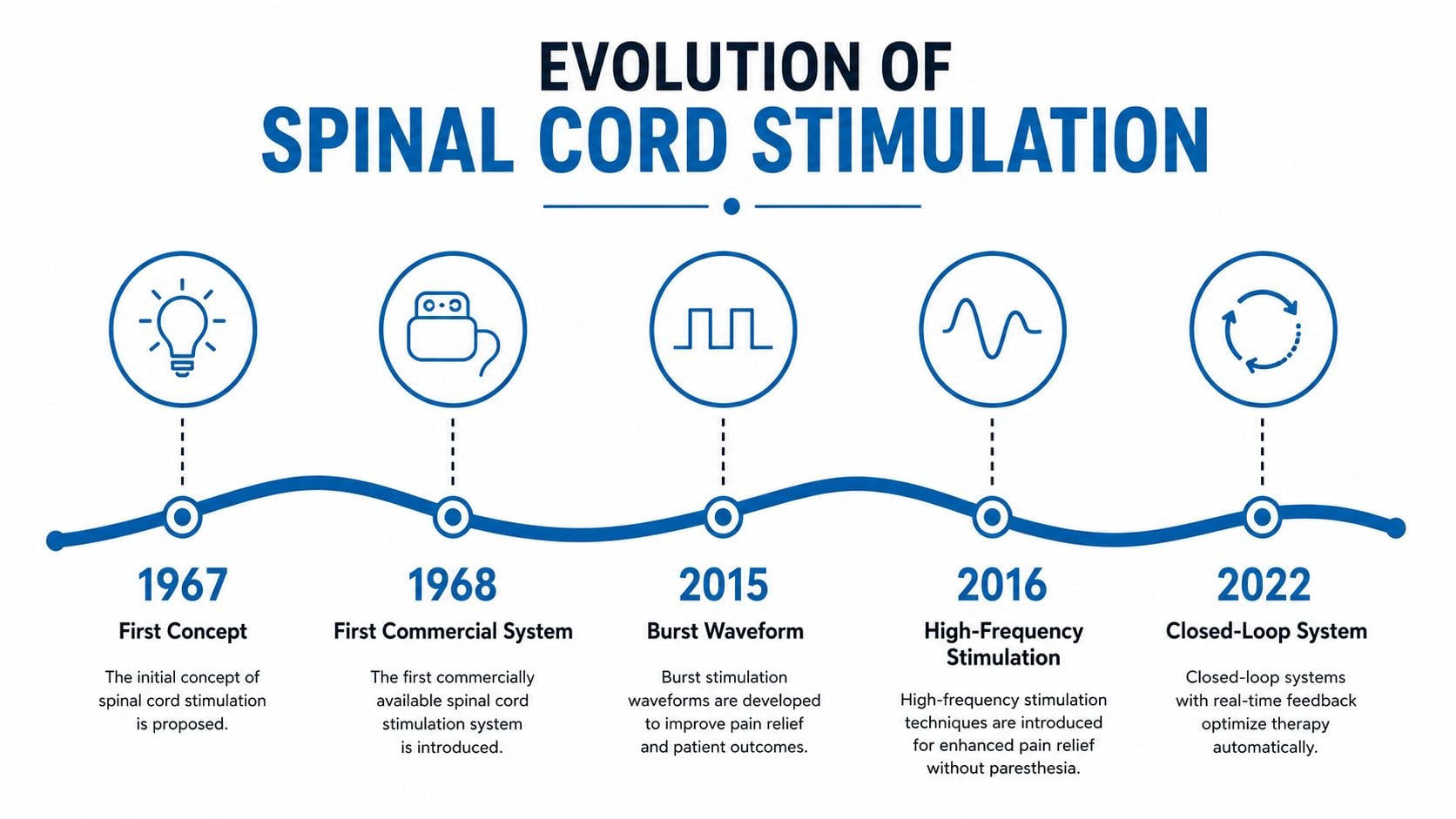
Older “tonic” stimulation often produced a tingling sensation called paresthesia. Newer programming approaches were designed to change that experience, either by making stimulation less noticeable or by shaping it differently. Burst, high-frequency, and closed-loop systems are part of that evolution, and each was developed to solve a practical problem patients and clinicians were running into.
That's why newer doesn't automatically mean better for every person. Some patients care most about comfort. Others care about battery support, MRI compatibility, or how easy the system is to program. A good clinic matches the waveform and hardware to the pain pattern and the patient's life.
If future imaging matters, MRI-compatible systems are a major planning issue, because chronic pain rarely lives in a vacuum. New symptoms, falls, or unrelated medical problems can still send a patient to imaging years later, so the device choice has to look beyond the first successful trial.
What the timeline shows
The first therapeutic use was in 1967, the first commercial system arrived in 1968, and later milestones included burst and high-frequency approvals in 2015 and 2016, followed by closed-loop approval in 2022. That long arc matters because it shows a therapy that has matured without standing still.
A Short History of How the Technology Evolved
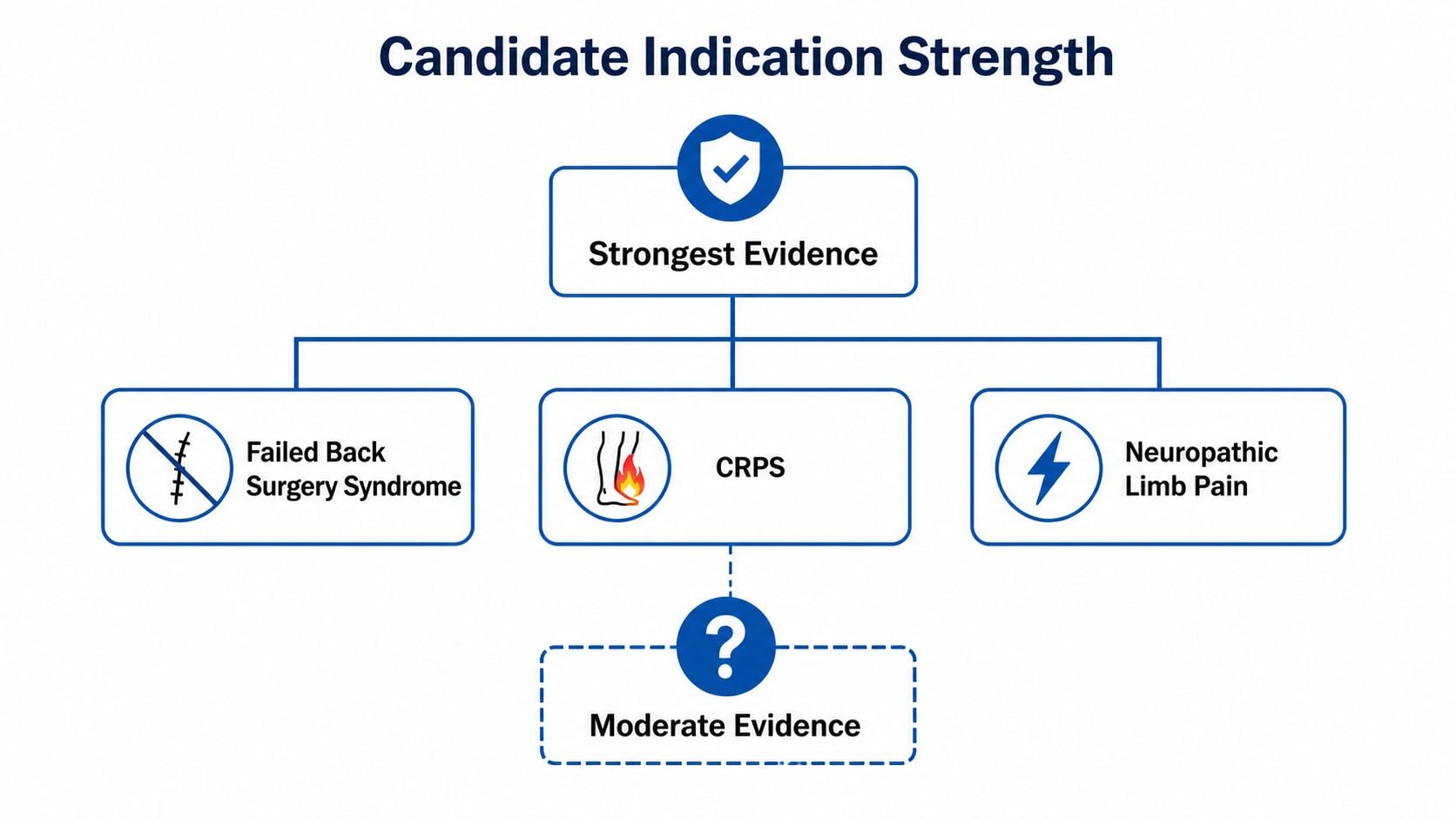
The history of spinal cord stimulators is useful because it explains why the field still feels active, not settled. The first therapeutic use in 1967 and the first commercial system in 1968 marked the move from experimental neurosurgery into clinical pain care. Later approvals, including burst and high-frequency stimulation in 2015 and 2016, and closed-loop systems in 2022, show how engineers kept trying to solve the same basic problems in different ways.
Those problems were practical. Early systems could be effective but uncomfortable, or hard to tune, or limited in how they delivered stimulation. Later generations aimed to reduce unwanted sensations, improve personalization, and make the therapy easier to live with over time.
Why each generation mattered
A historical timeline is more than trivia when a patient is deciding whether to proceed. It signals that the device family is mature enough to have long clinical experience, but still evolving enough that programming, hardware choice, and support pathways matter. It also means two people can both say “I had an SCS” and have very different experiences depending on the generation and settings.
That's the point where the evidence and the engineering stop being abstract. A newer platform may give a clinic more options, but it doesn't override the basic question of whether the person in front of the doctor is a fit for the therapy. Technology can broaden the menu, but it can't create a good indication out of a poor one.
Bottom line: maturity and innovation can coexist. A device can be established in practice and still be actively changing under the hood.
The strongest takeaway is simple. Spinal cord stimulators are no longer experimental, but they're not static either. That matters for long-term support, future programming, and the expectations a patient should bring into the consultation.
Who Is a Good Candidate
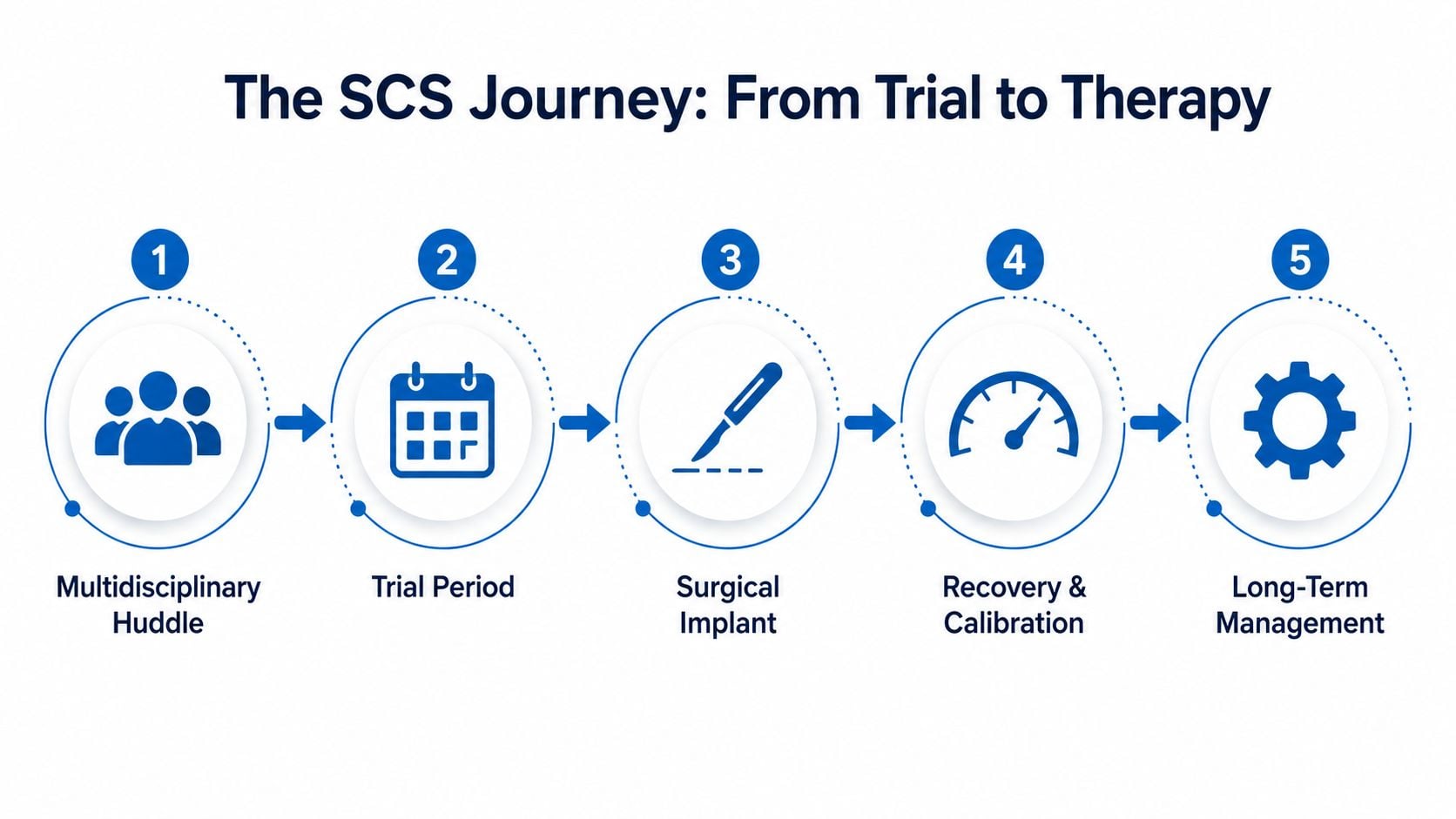
The strongest candidates usually have neuropathic pain that behaves like nerve pain, not generic soreness. Failed back surgery syndrome, complex regional pain syndrome, and other refractory neuropathic pain states are classic examples. FDA-reviewed systems are indicated for chronic intractable trunk and/or limb pain, including failed back surgery syndrome and intractable low back and leg pain FDA reviewed indication summary.
That does not mean the device fits every person with back pain. It means the pain generator has to resemble the type this therapy was built for. A patient whose pain is mostly mechanical, poorly characterized, or still being explained by a new structural problem usually needs a different plan first.
What clinics are checking before a trial
Before a trial, a careful team usually wants to know three things. First, whether the pain pattern matches a neuropathic diagnosis. Second, whether conservative care has really been exhausted. Third, whether the patient has realistic goals, because relief without function may not justify implantation.
Clinical note: a “good candidate” is not the person who wants the device most urgently. It is the person whose pain pattern, imaging, and life goals line up with what the therapy can actually do.
That is also why imaging review, medication review, and sometimes psychological screening happen before anyone reaches for a needle. A “no” at this stage usually means the team is protecting the patient from a procedure that is unlikely to help enough. For people with complex regional pain syndrome, a deeper overview is available in this CRPS resource, because that diagnosis needs its own careful framing.
The Trial, the Implant, and the Months After
The process works best when it feels like one connected pathway, not a pile of separate appointments. A typical patient first gets a multidisciplinary review, including imaging and a pain history, then moves to the trial period, then, if the trial is convincing, to the permanent implant and the adjustment visits that follow.
The trial is where the decision gets real. Temporary leads are placed and the patient lives with the system in ordinary life, walking, sitting, sleeping, and tracking what changes. A trial is usually considered successful when it produces at least 50% pain reduction and/or 50% functional improvement trial success criterion.
What a good trial feels like
A strong trial often feels less dramatic than people expect. It may not erase pain. Instead, it may make the pain quieter, more predictable, or less disruptive when standing, traveling, or trying to sleep. That difference matters because function is usually the primary target.
A marginal trial can be trickier. A patient may technically cross the threshold, but only in a narrow window that doesn't change daily life in a meaningful way. In those cases, careful clinicians sometimes advise against proceeding, because permanent implantation adds maintenance, follow-up, and hardware burden that a weak trial may never justify.
After implantation, the work isn't over. Programming visits, wound checks, and gradual return to activity are part of the course, and the experience can feel especially demanding for caregivers and clinic staff who manage complex follow-up. For teams trying to boost nurse resilience with these tips, the lesson is the same, structured systems make long follow-up more manageable for everyone involved.
Practical rule: the trial answers a narrower question than most patients think. It doesn't ask whether pain is gone forever. It asks whether this therapy changes enough daily function to justify permanent hardware.
The Honest Risks Most Articles Skip
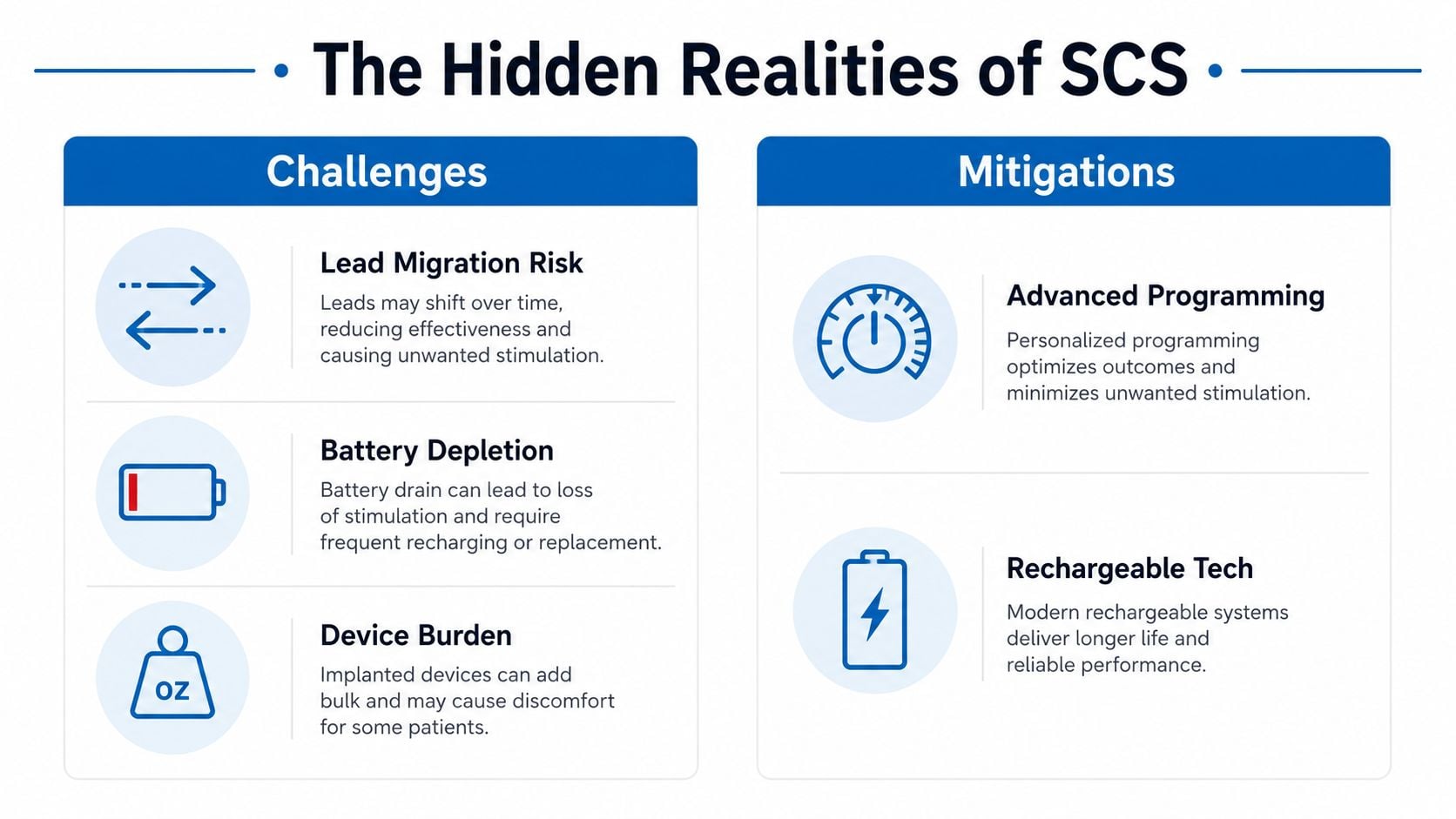
Mainstream articles often stop at “the device sends electrical pulses.” They tend to soften the harder questions, such as what happens when the lead moves, the battery needs attention, the patient wants an MRI, or the implant site gets irritated. Those issues are part of real-world care, not rare footnotes.
The evidence debate matters too. A 2023 Cochrane review found that nearly all SCS trials were short-term, the benefits of active SCS were small and uncertain, and the one high-quality placebo-controlled study followed for up to six months found no benefit evidence review summary. That doesn't erase all clinical use, but it does mean patients should be cautious about broad claims.
Why the long view is different from the brochure
Real-world follow-up changes the story. Independent reporting cited more than 2,000 adverse-event reports to Australia's TGA since 2012, and a newer cohort study reported sustained pain and quality-of-life improvements through 24 months when SCS is delivered in a structured pathway real-world safety and follow-up data. Both can be true at once. A therapy can help selected patients and still carry meaningful maintenance and safety issues.
That is why the right question is not “Does it work?” in the abstract. The better question is, for whom does it work enough to justify the long-term device burden? Lead migration, reprogramming needs, battery replacement, and revision surgery are part of the decision, even when the initial result is encouraging.
The honest takeaway is measured. Spinal cord stimulators can help, but they reward careful selection and disciplined follow-up. Patients should expect a device that needs management, not a one-time fix.
Spinal Cord Stimulators Against the Other Options
Patients rarely choose between a stimulator and nothing. They're usually choosing among continued conservative care, repeat injections, repeat surgery, and long-term medication-based management. The right comparison is about trade-offs, not hype.
| Option | Reversibility | Typical Recovery | Durability of Relief | Key Trade-Off |
|---|---|---|---|---|
| Spinal Cord Stimulator | Generally reversible hardware, but still an implant | Procedure plus follow-up visits | Can be meaningful in selected patients, but depends on indication and pathway | Adds device maintenance, programming, and revision risk |
| Epidural Steroid Injections | Reversible | Usually brief | Often temporary | Less invasive, but may not hold for persistent neuropathic pain |
| Physical Therapy and Rehab | Fully reversible | No surgical recovery | Varies with diagnosis and adherence | Best when movement, conditioning, and pain biology are still modifiable |
| Repeat Spine Surgery | Not easily reversible | Longer surgical recovery | Can help when a clear structural problem remains | Higher procedural commitment, especially after prior surgery |
The table doesn't declare a winner because there isn't one for every patient. A stimulator sits higher on the invasiveness ladder than injections or rehab, but it's still a different kind of commitment than another fusion or decompression. It's often chosen when the pain is neuropathic and surgery hasn't solved the problem.
For patients considering repeated injection care, a focused discussion of epidural steroid injections can help clarify where that option fits before moving to an implant. That matters because a patient shouldn't jump to hardware just because an easier step didn't last.
One practical way to think about the choice is this, medication changes what's in the bloodstream, surgery changes anatomy, and stimulation changes signal handling. Each path has a different risk profile and a different follow-up burden. The right one is the one that matches the pain mechanism, not the one with the loudest marketing.
How to Access This Care in New Jersey and Staten Island
A productive consultation starts before the appointment. Bring prior imaging, operative notes, a list of failed treatments, and a short pain diary that shows what hurts, when it hurts, and what activities are being lost. That makes it easier for a pain specialist to decide whether the pain pattern fits a trial.
It also helps to choose a clinic by process, not by adjectives. Look for board-certified physicians, fellowship training, on-site coordination between pain, orthopedics, and spine surgery when needed, and a clear trial-to-implant pathway. In the New Jersey and Staten Island area, Interventional Pain Management offers multidisciplinary evaluation and treatment across multiple locations, including its Staten Island office information, along with support for workers' compensation, motor vehicle accident cases, transportation assistance, and fee estimates under the New Jersey Out-of-Network Law.
Questions worth asking before consent
- How is candidacy decided? Ask whether imaging, exam findings, and pain history are reviewed together before a trial.
- What does success mean here? Ask whether the team uses pain relief, function, or both when judging the trial.
- Who handles programming and long-term follow-up? Ask who adjusts settings if pain shifts over time.
- What risks should be expected over years? Ask about reprogramming, MRI planning, and revision pathways.
- What happens if the trial is only borderline helpful? Ask whether the team is willing to say no.
The best clinics don't oversell the device, and they don't rush the trial. They explain where spinal cord stimulators fit, where they don't, and what life looks like after implantation if the therapy is a match.
If chronic pain has kept you stuck between temporary fixes and bigger decisions, schedule a consultation with Interventional Pain Management to review your imaging, prior treatments, and candidacy for spinal cord stimulation in New Jersey or Staten Island.