
Basal joint replacement is an option for carefully selected patients with symptomatic Eaton-Littler stage II or III thumb-base arthritis who want to preserve motion, but it isn't automatically better than trapeziectomy. Patients also need counseling about early complications and the possibility of revision.
A New Jersey or Staten Island resident may notice the problem first while opening a pickle jar, turning a key, gripping a tool, or pushing up from a chair. The thumb still moves, but pain at its base makes ordinary tasks slower and less reliable. A diagnosis of thumb carpometacarpal, or CMC, arthritis often leads to a more complicated question than “Which operation is newest?” The useful question is, which patient is most likely to benefit from preserving the joint with an implant, and which patient is better served by nonoperative care or trapeziectomy?
Table of Contents
- What Basal Joint Replacement Means for Thumb Arthritis Patients
- What the Evidence Shows About Outcomes and Implant Survival
- Basal Joint Replacement vs Trapeziectomy and Conservative Care
- Surgery, Recovery, and Realistic Return to Work and Daily Activities
- How to Choose a Surgeon and Clinic in New Jersey and Staten Island
- Common Questions About Basal Joint Replacement for NJ Patients
What Basal Joint Replacement Means for Thumb Arthritis Patients
The basal joint is the saddle-shaped joint where the thumb meets the wrist. It lets the thumb sweep across the palm, supporting pinching, twisting, writing, and grasping. As cartilage wears away, those movements may become painful and less forceful. X-rays show CMC degeneration in approximately 25% of women and 8% of men, although imaging changes do not always cause symptoms (epidemiologic and registry review).

An X-ray is only one part of the decision. In one review, 28% of women with isolated CMC degeneration acknowledged pain, compared with 55% of patients who had both CMC and scaphotrapezial arthritis (reviewed findings on symptomatic disease). The examination, hand function, symptom pattern, and effect on work or home activities matter just as much. A patient in New Jersey or Staten Island may have arthritis on imaging but need no operation if daily function remains acceptable.
How the operation changes the joint
Basal joint replacement, also called thumb CMC total joint arthroplasty, replaces the worn joint surfaces with an artificial joint. A typical implant includes a stem or head placed in the thumb metacarpal and a cup secured in the trapezium. Some designs include a mobile bearing to support stability.
The difference from trapeziectomy can be understood through a worn hinge. Trapeziectomy removes the damaged contact surface and supports the thumb through a different reconstruction. Replacement rebuilds the contact surface with an implant, with the goal of maintaining thumb length and useful motion. That design may appeal to someone who values movement and pinch precision, but it also introduces implant-specific risks, including loosening, wear, instability, or revision surgery.
Patients can review an overview of osteoarthritis and its nonoperative treatment options. Splinting, activity changes, hand therapy, appropriate medication, and injections may help before surgery, especially when pain is manageable and function remains adequate.
Who may benefit most
The strongest candidate is usually an adult with persistent, symptomatic stage II or III disease, adequate bone quality, useful surrounding-joint function, and a clear reason to preserve motion. Pinch-intensive work, valued thumb length, and the need for a motion-preserving reconstruction may support that choice.
Age by itself does not settle the question. A younger, physically active patient may place greater demands on an implant. An older patient may place more value on a procedure intended to avoid prosthetic wear. Metacarpophalangeal-joint hyperextension, deformity, instability, bone loss, and the surgeon's experience with the selected implant also affect the recommendation.
For patients seeking care in New Jersey or Staten Island, access to a surgeon who regularly performs both replacement and trapeziectomy matters. The useful question is not whether replacement is newer. It is which patient is most likely to gain meaningful function while accepting the possibility of implant-related revision.
Practical rule: Begin the discussion with work, hobbies, pinch demands, bone quality, and willingness to accept revision risk, rather than with an implant's marketing description.
What the Evidence Shows About Outcomes and Implant Survival
A patient may hear that a basal joint replacement has a high survival rate and reasonably ask, “Will it give me a stronger, more useful thumb?” Those are related questions, not identical ones. The evidence examines implant survival, complications, reoperation, pain, strength, motion, and what can be done if the reconstruction fails. Together, these findings help identify which patients may benefit most, rather than proving that replacement is the best operation for everyone.
What registry follow-up can and cannot tell patients
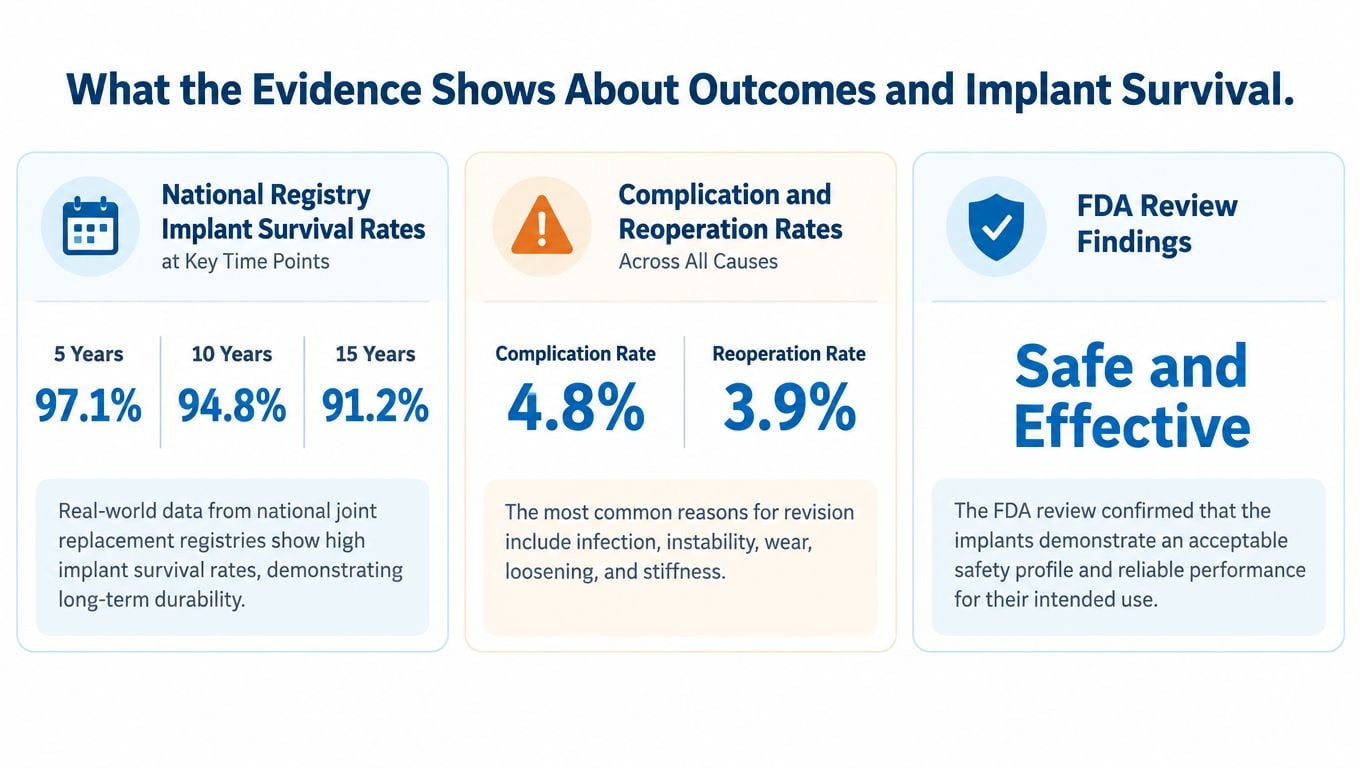
A Norwegian national registry tracked 479 primary thumb CMC replacements performed between 1994 and 2011. Overall implant survival was 91% at five years and 90% at ten years. At five years, survival among implant brands ranged from 90% to 94% (Norwegian registry study). The registry found no meaningful effect of patient sex, age, or diagnosis on revision risk.
This kind of registry is useful because it reflects treatment across a national healthcare system, not only results from carefully selected patients at one specialist center. It also places the numbers in context. Newer metal total prostheses did not outperform older silicone and monoblock designs in that registry, and the authors did not consider the evidence strong enough to support widespread implementation at that time.
Survival answers one question: whether the implant remains in place. It does not tell us whether every patient has less pain, greater pinch strength, or a more useful thumb than a patient treated with trapeziectomy. A replacement preserves a moving joint, but loosening, subsidence, instability, wear, or changes in the surrounding bone can cause symptoms and lead to revision. Trapeziectomy has its own recovery demands, while avoiding a retained artificial joint.
Complications and reoperation remain part of the decision
A multicenter study of 381 thumb CMC replacement procedures reported a 2.9% failure rate. Failed cases were treated with salvage trapeziectomy, with or without ligament reconstruction or suspensionplasty. The investigators classified approximately 6% of operations as having major complications and reported minor adverse events in 25.4% of cases. Temporary superficial radial-nerve irritation and De Quervain tendinopathy were among the minor problems, and 95% of all complications occurred within six months (multicenter outcomes study and systematic review).
A separate comparison within the evidence base recorded reoperation in 9 of 198 patients, or 5%, after total joint arthroplasty, compared with 6 of 208 patients, or 3%, after trapeziectomy. These findings do not select an operation for every patient. They clarify the trade-off: a person choosing replacement accepts the possibility of implant-related problems and later conversion to trapeziectomy.
What the FDA review adds
The FDA's 2025 review of the TOUCH CMC 1 prosthesis included 149 trial participants, more than 1,000 international patients, 16 published studies from eight countries, and two post-market follow-up reports (FDA review of the TOUCH CMC 1 prosthesis). The review reported a mean 2.5-kilogram increase in key-pinch strength and a 0.9-point mean improvement in the Kapandji thumb-opposition index. It also identified device-specific adverse events requiring mitigation.
These are group averages, not a forecast for one person. FDA review can establish that a device meets the requirements evaluated for a defined indication. It cannot decide whether replacement suits a particular worker, caregiver, athlete, or patient with poor bone stock.
A 2025 systematic review found improvements in pain, strength, range of motion, and satisfaction, with an overall complication incidence of 13% and dislocation risk of 0.6%. The authors judged the evidence low quality, found follow-up too limited to establish long-term implant survival, and did not demonstrate superiority over trapeziectomy (2025 systematic review of basal joint replacement).
The practical conclusion is measured. Replacement can provide motion-preserving reconstruction and favorable short- to medium-term results. Registry survival and early functional improvement do not remove implant-specific risks. For a New Jersey or Staten Island patient, the most informative consultation compares those risks with work demands, pinch goals, bone quality, and the surgeon's ability to perform both replacement and salvage procedures.
Basal Joint Replacement vs Trapeziectomy and Conservative Care
A patient who can still write, open containers, or work with manageable pain may not need surgery yet. A patient who has persistent pain despite support and activity changes faces a different decision. The useful comparison is not merely which procedure is newer or faster. It is which option best matches the thumb's condition, the patient's goals, and the risks they are willing to accept.
A practical decision framework
Conservative care suits patients whose pain is intermittent, whose daily function remains acceptable, or whose imaging does not explain their symptoms well. A thumb orthosis, hand therapy, activity modification, appropriate medication, and an injection can reduce symptoms or help confirm how much pain comes from the CMC joint. Information about corticosteroid injections explains one nonoperative option. An injection may calm inflammation, but it does not restore advanced cartilage loss.
Trapeziectomy-based surgery removes the painful arthritic contact surface and reconstructs the thumb base without leaving an artificial CMC joint. It remains a reasonable choice when pain limits work or daily activities despite nonoperative care. Patients may prefer it because it avoids prosthetic loosening, wear, migration, and instability. It can also serve as a salvage option if a replacement later fails.
Replacement is intended for a narrower patient group. The reviewed device is indicated for symptomatic Eaton-Littler stage II or III osteoarthritis, as described in the FDA indication and evidence review. That indication does not cover every cause of thumb-base pain. Rheumatoid arthritis and post-traumatic CMC arthritis may require a different assessment because inflammatory disease, altered bone, or prior injury can change fixation, stability, and expected results.
The patient must also accept surveillance and the possibility of another operation. Preserving a moving joint may preserve useful motion, but it also leaves implant-specific uncertainty that trapeziectomy avoids.
Thumb base procedure comparison
| Procedure | Motion Preservation | Revision Risk | Best-Fit Patient Profile |
|---|---|---|---|
| Basal joint replacement | Uses an implant to preserve useful CMC motion | Includes loosening, instability, wear, migration, and possible conversion to trapeziectomy | Carefully screened patient with symptomatic stage II or III disease who values motion, thumb length, or pinch function and accepts prosthetic risk |
| Trapeziectomy-based surgery | Preserves functional thumb movement through reconstruction without an artificial CMC joint | Avoids implant revision, although persistent symptoms or instability may require further treatment | Patient seeking an established nonprosthetic reconstruction or wishing to avoid implant-related failure |
| Conservative care | Preserves existing motion without changing the joint | Avoids surgical revision while symptoms remain manageable | Patient with tolerable symptoms, acceptable function, or a reason to postpone surgery |
Factors that change the recommendation
Bone quality matters because an implant's cup and stem need dependable fixation. The surgeon also evaluates metacarpophalangeal-joint hyperextension, neighboring-joint arthritis, deformity, ligament stability, and the patient's ability to follow protected rehabilitation.
Work demands deserve specific discussion. Repetitive heavy gripping places different demands on a reconstruction than writing or light household use. Age contributes to the decision, but it does not decide it. The central question is whether the expected benefit in motion or pinch function justifies accepting an implant that may eventually need revision.
For patients in New Jersey or Staten Island, access is part of the choice. Ask where follow-up visits, hand therapy, imaging, and treatment of a complication would occur. The surgeon should also be prepared to perform trapeziectomy or another salvage procedure if replacement is unsuitable later.
Replacement makes the most sense when motion preservation is a meaningful priority, the arthritis fits the device's indication, and the patient accepts prosthetic uncertainty.
Surgery, Recovery, and Realistic Return to Work and Daily Activities
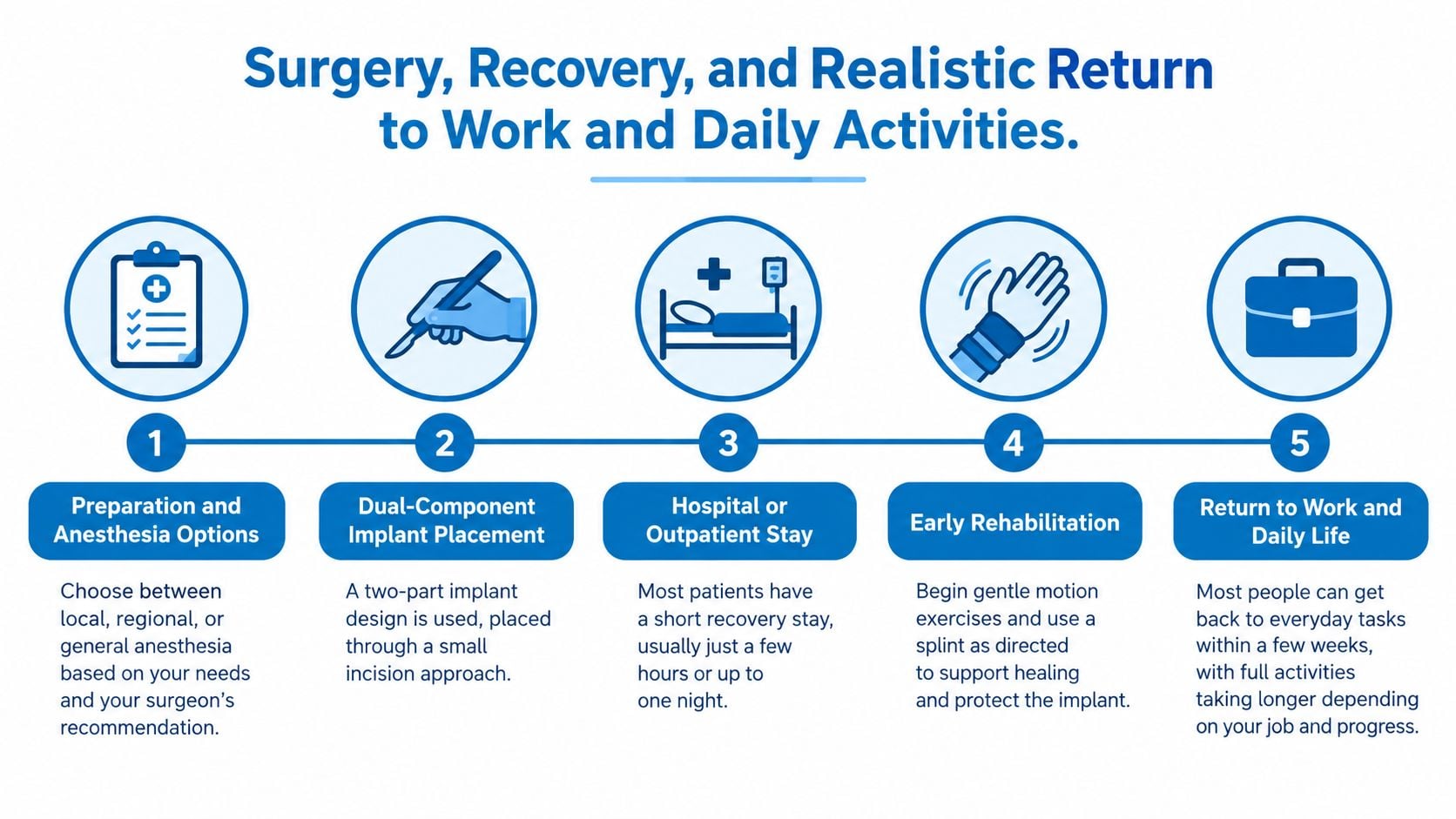
Basal joint replacement uses a dual-component implant, usually with a metacarpal stem or head and a cup fixed in the trapezium. Dual-mobility designs add a mobile bearing intended to increase jump distance and reduce instability. The surgeon reaches the joint through a focused incision, prepares the bone surfaces, places the components, and checks stability and movement before closing.
Anesthesia may be local, regional, or general, depending on the patient's health, the surgical plan, and the facility. Many procedures are arranged in an outpatient setting, but the exact setting and observation plan vary. The operation itself is only one part of the treatment. Protection, hand therapy, and gradual loading determine whether the thumb develops useful strength and control.
Recovery should be planned around tasks
Aftercare guidance states that recovery can be slow, with three to six months commonly needed before normal heavy activity, and that return to work depends substantially on job demands (aftercare guidance for CMC arthroplasty). That range is more useful than a single promise because “return to work” can mean answering emails, lifting patients, using power tools, or carrying materials.
A practical planning conversation separates pain and wound recovery from strength and endurance:
- Desk work: Keyboarding, writing, and short administrative tasks may become possible before the thumb can tolerate forceful pinching. The work plan may need reduced hours, voice input, or limits on sustained typing.
- Light household tasks: Eating, dressing, and handling light objects can return progressively, but jar opening, wringing cloths, and forceful twisting place greater demand on the healing thumb.
- Driving: Driving requires a secure grip, rapid steering corrections, and the ability to respond safely. The patient should wait until pain, splinting, medication effects, and control no longer interfere with safe vehicle operation.
- Heavy manual labor: Construction, landscaping, warehouse work, and repetitive tool use usually require a longer staged return because they combine force, vibration, and endurance. Normal heavy activity commonly takes three to six months to resume, according to the cited aftercare guidance.
- Sport and childcare: Racket sports, lifting a child, and repeated gripping should be discussed as specific tasks rather than assigned a generic clearance date. The question is whether the thumb can tolerate the required force without pain, instability, or loss of control.
What rehabilitation is trying to restore
A patient may have a healed incision while still lacking pinch strength, dexterity, endurance, or confidence. Hand therapy helps coordinate protection with progressive motion and strengthening. Too little movement can promote stiffness, while too much force too early can threaten fixation or provoke swelling.
Persistent pain deserves evaluation rather than automatic reassurance. The clinician may assess implant position, loosening, cup migration, instability, polyethylene wear, trapezial bone loss, nerve irritation, tendon problems, or another source of pain. If the implant fails, treatment can include revision or conversion to trapeziectomy, sometimes with ligament reconstruction or suspensionplasty.
Patients should ask for a written work and activity plan that addresses their actual job. A desk employee, emergency clinician, tradesperson, caregiver, and tennis player don't share the same recovery target, even when they undergo the same operation.
How to Choose a Surgeon and Clinic in New Jersey and Staten Island
A thoughtful consultation should answer two separate questions. First, is surgery appropriate for the thumb? Second, if it is, which reconstruction matches the patient's anatomy, work, activities, and tolerance for revision?
Patients can begin with a board-certified orthopedic or hand surgeon who evaluates the entire thumb, not only the X-ray. The surgeon should explain why the disease fits the device indication, what features might favor trapeziectomy, and how complications are handled. Experience with the selected implant matters because replacement requires patient selection, component positioning, and follow-up.
Questions worth asking before scheduling
- Patient selection: How does the surgeon determine whether the arthritis is stage II or III, and what findings would rule out replacement?
- Procedure choice: Why is replacement being recommended instead of conservative treatment or trapeziectomy for this particular hand?
- Implant risks: How are loosening, instability, wear, migration, and persistent pain monitored?
- Revision planning: If the implant fails, can the surgeon perform or coordinate conversion to trapeziectomy?
- Rehabilitation: Which hand therapist participates in recovery, and how will work restrictions be adjusted?
- Access and cost: Does the clinic provide insurance and workers' compensation assistance, and can it supply a written fee estimate?
A multidisciplinary clinic can be useful when the diagnosis is uncertain or when pain overlaps with cervical nerve symptoms, carpal tunnel syndrome, tendon disease, or other musculoskeletal problems. Board-certified physicians across orthopedics, pain management, anesthesiology, and spine care can help coordinate evaluation when more than one condition may be affecting hand function.
For patients near Staten Island, Staten Island office information can help with location and access questions. The publisher describes multiple offices across New Jersey and Staten Island, seven-days-a-week availability, individualized treatment planning, insurance and workers' compensation support, and compliance with New Jersey's Out-of-Network Law, with fee estimates available upon request.
Patients should bring hand and wrist imaging, a list of previous treatments, injection dates if applicable, medication information, and a short description of work duties. A list of difficult tasks, such as opening containers, lifting equipment, turning tools, or caring for a child, gives the surgeon a functional target that an X-ray cannot provide.

Common Questions About Basal Joint Replacement for NJ Patients
Is basal joint replacement covered by insurance in New Jersey?
Coverage depends on the patient's plan, medical-necessity requirements, implant, facility, and surgeon participation. Before scheduling, ask the office to verify benefits and provide an estimate of your expected responsibility. Patients considering out-of-network care in New Jersey can also request fee information under the state's Out-of-Network Law.
How long do replacement results last compared with trapeziectomy?
The available registry evidence reported 90% implant survival at ten years (Norwegian long-term registry evidence). That figure describes whether the implant remained in place. It does not show how much pain relief, grip strength, or daily function each patient had, and no long-term head-to-head evidence establishes that replacement outlasts trapeziectomy.
If an implant fails, revision may involve removing the components and addressing bone or soft-tissue changes before choosing another reconstruction. The procedure depends on the cause of failure, your bone quality, symptoms, and activity needs. Ask the surgeon what revision options would be available for your anatomy.
Which symptoms require urgent follow-up after surgery?
Contact the surgical team promptly for increasing redness, drainage, fever, rapidly worsening swelling, new numbness or weakness, a displaced thumb, sudden loss of motion, or severe pain after an injury. These symptoms can indicate infection, nerve problems, dislocation, or fixation failure.
NJ and Staten Island patients should bring imaging, treatment history, insurance details, work requirements, and activity goals. The team can then discuss whether continued nonsurgical care, trapeziectomy, or replacement best fits the patient's anatomy and priorities.
Interventional Pain Management provides evaluations across New Jersey and Staten Island. Visit Interventional Pain Management to request an evaluation.