
Approximately one in four patients experiences at least one adverse event with spinal cord stimulation, and most problems are gradual loss of benefit or device-related changes rather than sudden emergencies. Serious complications affect a smaller minority, but certain symptoms require urgent medical assessment.
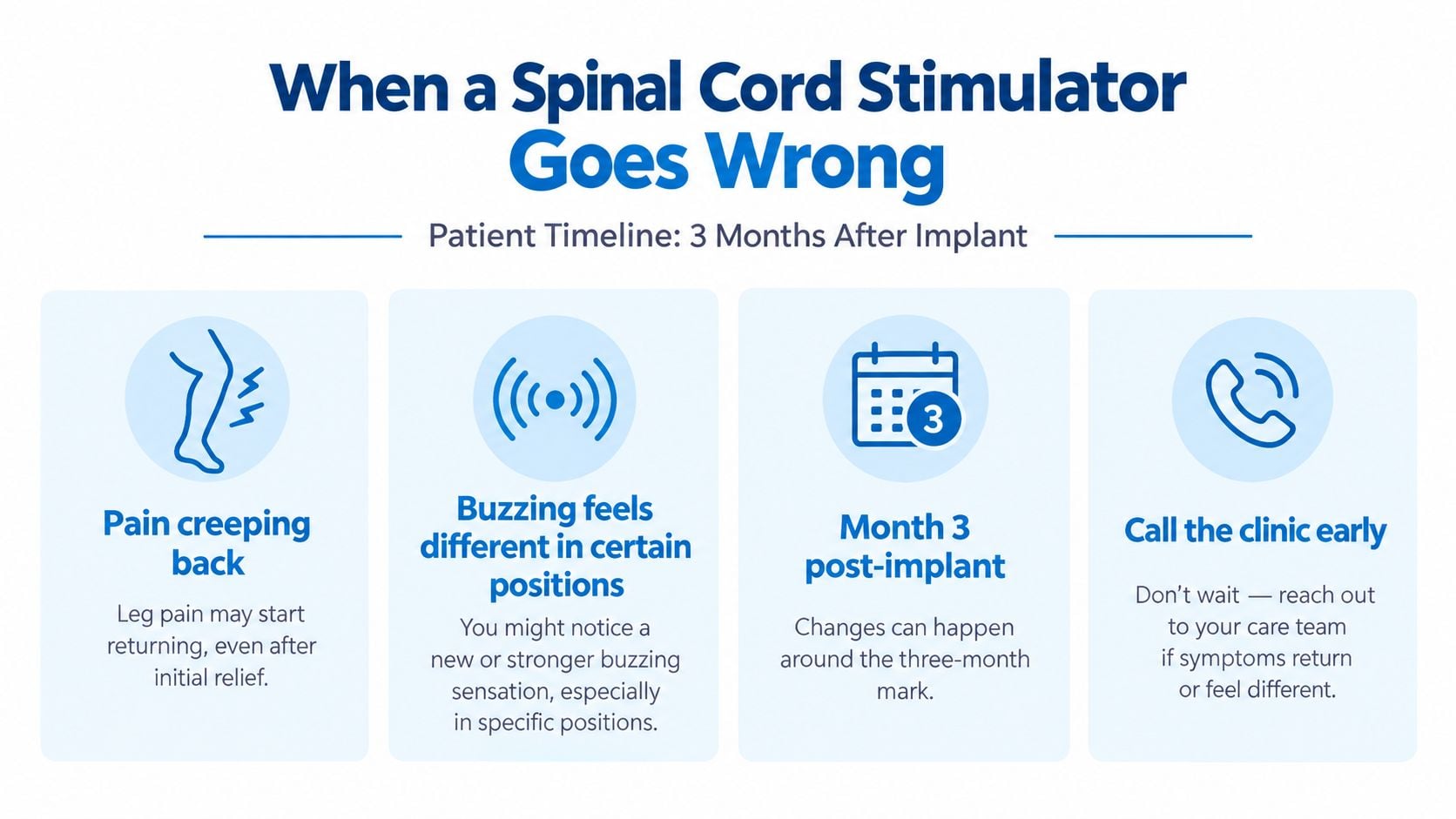
A patient three months after implantation may notice that familiar leg pain has slowly returned. The stimulation feels different when she sits, stands, or turns in bed, and the generator pocket remains mildly tender. Nothing looks dramatically wrong, yet she wonders whether the device is healing normally, losing coverage, or failing.
That uncertainty is common. A spinal cord stimulator gone wrong isn't always a catastrophic surgical event. More often, the problem is a slow decline in relief, altered stimulation, lead movement, battery or connector trouble, wound irritation, or an infection that needs prompt treatment. The practical question is not just whether the device has “failed.” It is what changed, how quickly it changed, and whether any warning signs suggest danger.
A large systematic review and meta-analysis included 33 studies involving 3,445 patients and recorded 1,119 adverse events. At the patient level, 24% experienced at least one adverse event, while 3% experienced at least one serious adverse event in the pooled evidence. Those figures don't mean that every change signals permanent harm. They do support calling the implanting team early instead of adjusting medications on your own or waiting through a worsening pattern.
Practical rule: A change in coverage deserves a clinical explanation, but a neurological deficit, spreading infection, or systemic illness deserves urgent assessment.
Table of Contents
- When a Spinal Cord Stimulator Goes Wrong
- How Spinal Cord Stimulation Works and Why It Can Fail
- The Most Common Ways Spinal Cord Stimulation Goes Wrong
- Warning Signs That Need an Urgent Call to Your Provider
- Revision, Reprogramming, and Removal Decisions in Real Practice
- Patient Factors That Influence Outcomes and What You Can Actually Do
- What to Do Next When You Suspect Something Is Off
When a Spinal Cord Stimulator Goes Wrong
The first question is what changed
A patient may report several problems at once, but each pattern points toward a different evaluation.
- Pain creeping back: The original pain generator may have changed, coverage may no longer reach the painful area, or a new pain pattern may have developed.
- Buzzing that varies with position: Posture-dependent stimulation can reflect lead movement, a connection problem, or settings that need adjustment.
- Pocket tenderness: Mild soreness can occur during recovery. Increasing warmth, redness, drainage, swelling, or fever requires prompt assessment for infection.
The pattern matters more than one uncomfortable day. Gradual pain returning without weakness or wound changes generally calls for device interrogation, programming review, and reassessment of the diagnosis. A sudden painful shock, abrupt loss of coverage, or new neurological symptom warrants faster contact with the implanting team.
Adverse events aren't all surgical disasters
A large systematic review and meta-analysis found a pooled burden of 0.35 adverse events per patient, equivalent to 34.5 events per 100 patient-years in the reported analysis. Device-related problems featured prominently. Lead migration occurred at 7.05 events per 100 patient-years, compared with 2.82 events per 100 patient-years for infection. Revision procedures occurred at 6.31 per 100 patient-years, while explantation occurred at 2.93 per 100 patient-years from the same pooled analysis.
Study results varied with patient selection, implantation technique, device type, follow-up duration, and definitions of complications. The practical point is that inadequate relief can develop without a catastrophic neurological injury. A stimulator may need programming, investigation, revision, or removal, depending on the cause and the patient's goals.
Why an early call helps
The implanting team can compare current symptoms with the original pain map, review recent activity or falls, interrogate the generator, and decide whether imaging is appropriate. That assessment is more useful than repeatedly increasing medication or assuming that every problem requires removal.
Record when the change began, whether posture affects it, which areas still receive coverage, and whether the surgical sites look different. For an individual patient, population rates matter less than the direction of change. A stable symptom can be monitored with guidance, while a progressing symptom needs a call within days, not months. New weakness, spreading redness, drainage, fever, or systemic illness should be assessed urgently.
How Spinal Cord Stimulation Works and Why It Can Fail
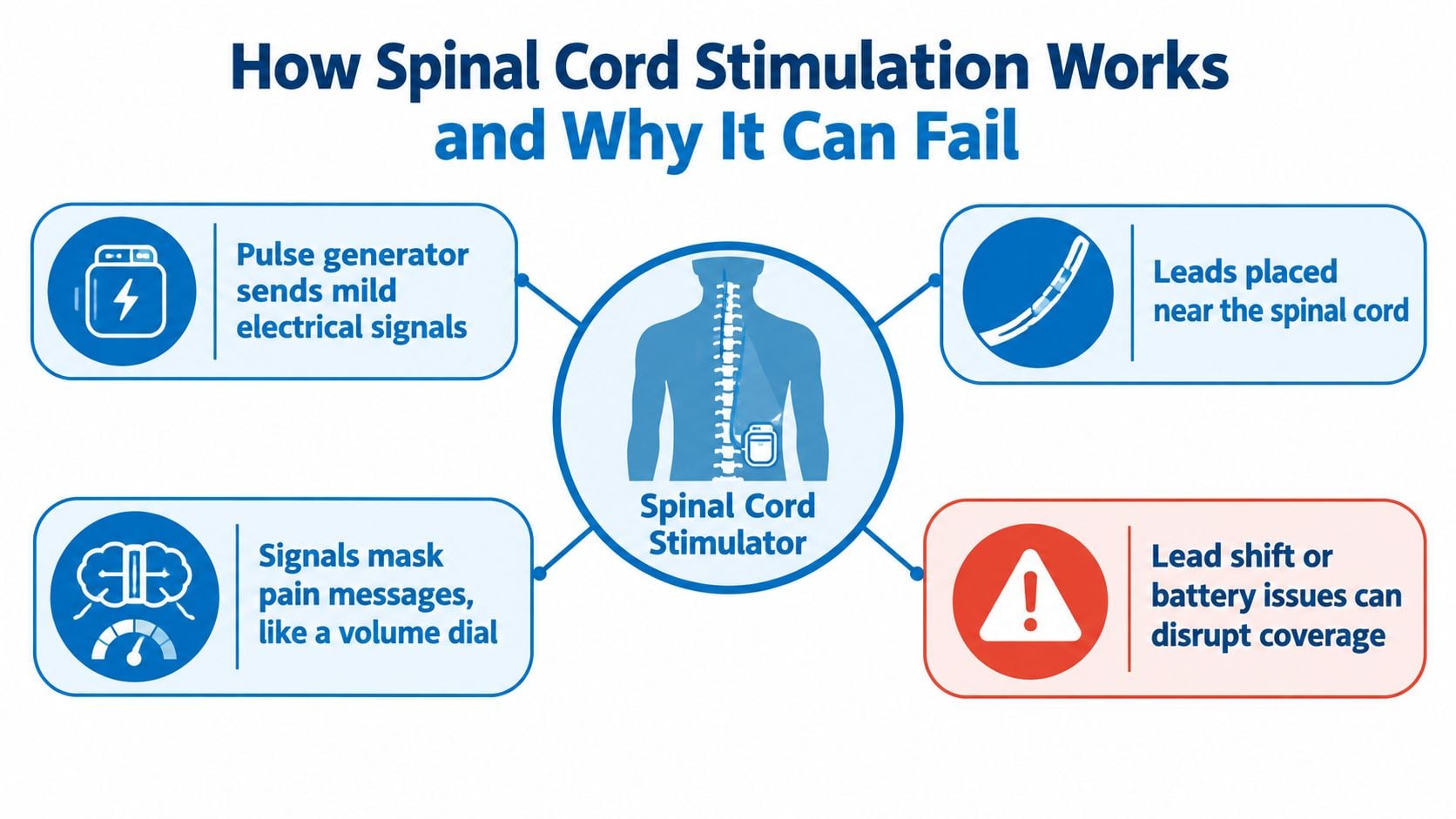
A spinal cord stimulator works like a carefully positioned volume dial for pain messages. Thin leads sit near the spinal cord and deliver controlled electrical pulses, while a pulse generator under the skin supplies power. The patient uses a remote to select or adjust programs, but the device doesn't repair every source of pain. It changes how selected pain signals are processed and perceived.
The system has three practical parts:
- Leads: Flexible electrodes are placed in a planned position near the spinal cord. Their location determines which body regions receive coverage.
- Pulse generator: The implanted battery and electronics create the electrical pulses and store the programmed settings.
- Controller: The external remote allows the patient to use prescribed programs and adjust permitted settings.
A useful analogy is a speaker aimed at one room. If the speaker shifts, the sound may become faint in the intended room and louder somewhere else. If the cable breaks, the speaker may stop working. If the room's needs change, the same volume setting may no longer solve the problem. Lead migration, conductor fracture, connector trouble, battery depletion, changing pain anatomy, and altered nerve sensitivity fit that model.
More background on the treatment, including how clinicians use it for chronic neuropathic and postsurgical pain, is available in this overview of spinal cord stimulation.
Why placement and biology both matter
The leads need stable contact with the intended area. Mechanical stress, a fall, scar tissue, or movement at the anchoring site can alter performance. An abnormal impedance reading can point toward a conductor or connection problem, while a normal interrogation doesn't eliminate the possibility that the pain diagnosis or coverage target has changed.
The body also matters. Surgical wounds heal, tissues remodel, and the generator pocket can remain uncomfortable. Infection, bleeding, dural puncture, or an epidural complication can affect recovery, although the most appropriate response depends on the symptoms and examination.
A device can therefore be functioning exactly as designed while the patient experiences less relief. That distinction is important. The device's electrical output, the lead position, the pain map, and the patient's functional goals all need review before anyone labels the treatment a failure.
The Most Common Ways Spinal Cord Stimulation Goes Wrong
A useful clinical classification has three groups: hardware problems, biological complications, and loss of therapeutic benefit. They overlap, but separating them prevents a slow decline in relief from being treated like an emergency and prevents an urgent wound problem from being dismissed as routine programming trouble.
Hardware and mechanical problems
Lead migration is one of the most important device-related issues. The patient may notice that stimulation no longer reaches the original painful region, that coverage changes with posture, or that an unpleasant sensation replaces useful relief. Lead fracture or connector failure can produce intermittent stimulation, high impedance, sudden loss of efficacy, or uncomfortable electrical sensations. Mechanical problems may require revision, replacement, or removal, but device interrogation and imaging help determine which option is appropriate.
Battery depletion is different. It tends to create a predictable reduction in available therapy rather than a new neurological deficit. Patients should bring the remote and charging information to appointments, because the clinical team needs to know whether the generator is communicating and whether the available programs behave as expected.
Infection and other biological complications
Infection can begin with localized generator-pocket pain, redness, drainage, wound separation, or fever. A deep infection may require removal of the implanted system and treatment directed by the clinical team. A large review cited an overall infection rate of approximately 2.45% across 2,737 implants, while broader studies reported ranges of roughly 2% to 10% in a clinical complications review.
Rare complications include dural puncture, epidural infection, hematoma, and neurological injury. Their rarity shouldn't encourage delay when weakness, bowel or bladder dysfunction, rapidly worsening sensory loss, severe headache after implantation, or systemic toxicity appears.
Gradual loss of relief
The most overlooked failure pattern is a device that no longer helps enough. The generator may communicate normally, the wound may look healed, and imaging may show no obvious mechanical problem. Yet pain returns because the underlying condition progresses, the pain pattern changes, the target was incomplete, tolerance develops, psychological distress affects treatment experience, or the original diagnosis no longer explains the dominant symptoms.
A stimulator that has lost usefulness isn't automatically a broken stimulator. The care team must reassess both the hardware and the pain.
The pooled evidence shows why patients should plan for follow-up rather than expect permanent, unchanging coverage. Historical reviews also describe recognized issues such as infection, lead migration, painful stimulation, battery depletion, and revision surgery throughout the technology's development in this regulatory and clinical history. Modern systems and techniques may reduce some technical problems, but they haven't eliminated the need for troubleshooting.
Warning Signs That Need an Urgent Call to Your Provider
The safest triage question is whether the symptom suggests neurological compromise, infection, bleeding, or rapid deterioration. Patients shouldn't try to diagnose the cause at home. They should use the symptom pattern to choose the right level of response.
Seek emergency assessment for neurological or systemic red flags
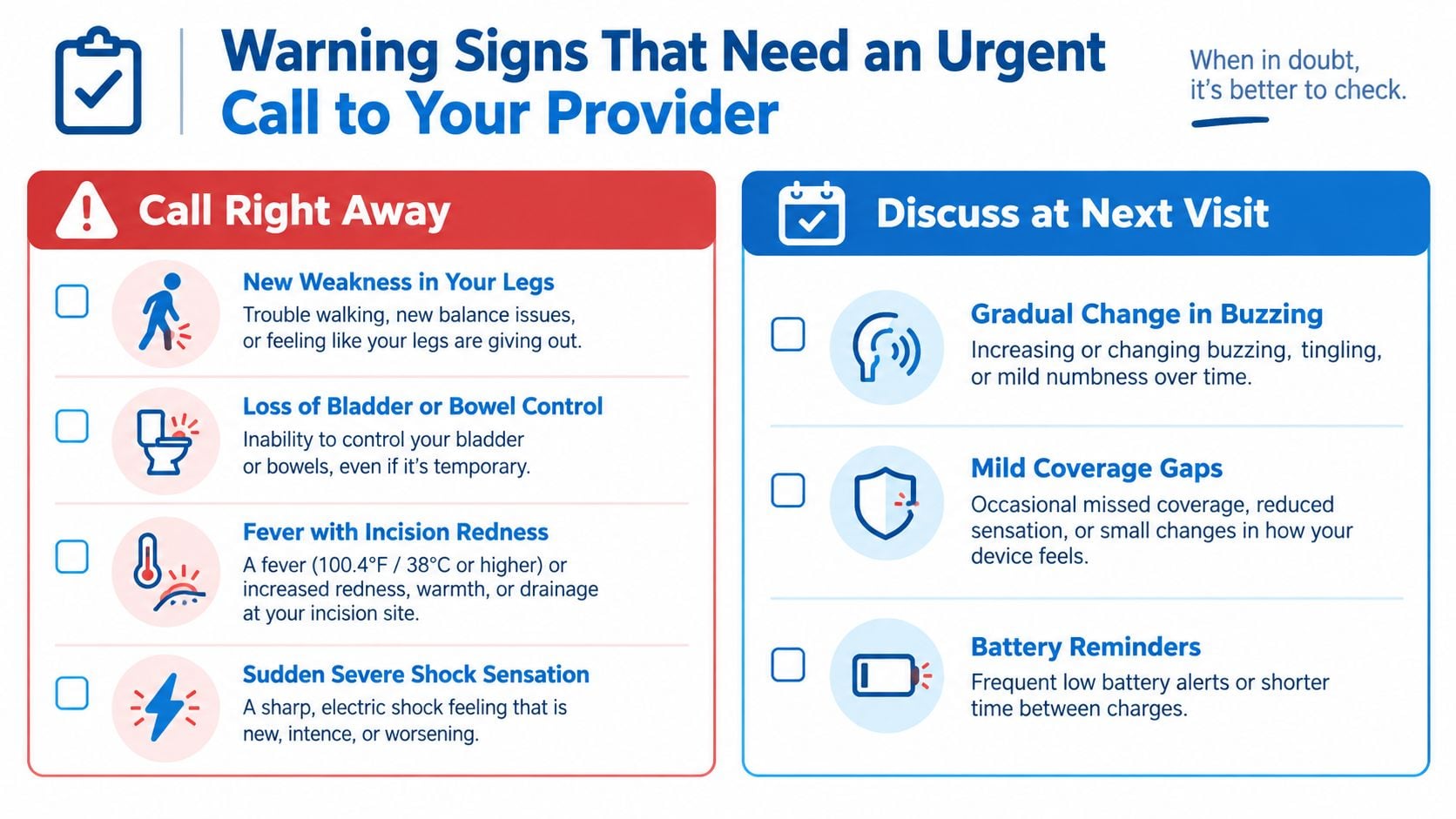
New or worsening leg weakness, loss of coordination, rapidly progressive numbness, or loss of bladder or bowel control needs emergency evaluation. These symptoms can signal a serious spinal or neurological problem and shouldn't be attributed to ordinary stimulation changes.
A severe headache after implantation also warrants prompt assessment, particularly if it began after a procedure and is accompanied by other concerning symptoms. Fever with worsening back pain, generator-pocket pain, redness, warmth, drainage, wound separation, or systemic illness can indicate infection. Signs of sepsis require emergency care.
Sudden severe shocks or stimulation that becomes distinctly painful should prompt immediate contact with the implanting team. If the sensation is accompanied by weakness, numbness, or a rapidly changing neurological state, emergency evaluation is more appropriate than waiting for a programming visit.
Contact the provider promptly for device changes
Some problems aren't emergencies but still deserve a call rather than weeks of observation:
- Coverage gaps: Pain returns in an area that was previously controlled.
- Posture-dependent stimulation: Buzzing changes when sitting, standing, bending, or lying down.
- New tingling: Stimulation spreads into an unpleasant or unexpected region.
- Generator discomfort: Pocket soreness persists, increases, or interferes with sitting or sleeping.
- Intermittent therapy: Relief switches on and off or the remote reports an unusual device status.
The provider will usually review the symptom timeline, examine the wounds and neurological function, interrogate the system, and decide whether imaging or laboratory evaluation is needed. Reprogramming may be reasonable when the problem is coverage, but reprogramming shouldn't substitute for an infection or neurological assessment.
What can wait for a planned visit
A stable, mild change in buzzing without pain, weakness, wound changes, or systemic symptoms can often be discussed at the next scheduled appointment. So can a gradual reduction in benefit when the patient remains medically stable. The timing still matters. A routine issue that is steadily worsening should become a prompt call.
Revision, Reprogramming, and Removal Decisions in Real Practice
A stimulator may still communicate normally while its benefit gradually fades. That pattern is more common than a catastrophic surgical complication. The next decision depends on system function, lead position, the current pain generator, and whether the patient still wants to pursue neuromodulation.
Reprogramming can be the least invasive answer
Consider a patient whose original leg coverage has weakened while device interrogation remains reassuring. The clinician can review the pain map, test alternative programs, and adjust stimulation toward the intended region without creating unpleasant sensations. Reprogramming is most useful when the lead remains stable and the main problem is a changed coverage pattern or programming issue.
Programming cannot correct every increase in pain. A new pain generator may have developed after implantation, or the original diagnosis may no longer explain the patient's symptoms. Physical examination, imaging, medication review, and reassessment of the broader pain condition may provide more useful answers than treating each flare as an electrical fault.
Revision addresses a confirmed mechanical problem
Imaging and interrogation may identify lead migration, a fracture, or a connector problem. Revision can restore intended system function in those cases, but it is another procedure with recovery time and procedural risk. The mechanical finding should connect to a meaningful treatment goal. A small imaging change alone does not justify revision when coverage and daily function remain acceptable.
Persistent pain after back surgery can involve several overlapping pain generators. A separate evaluation of pain after back surgery may clarify whether stimulation is underperforming or whether the underlying condition needs a different treatment strategy.
When Removal Becomes the Right Choice
Removal may be appropriate for deep infection, persistent hardware problems, intolerable pocket symptoms, or sustained lack of meaningful benefit after reassessment. A 2025 systematic review of 13,026 implanted patients found that 1,882 underwent explantation, or 9.82%. Inadequate pain relief accounted for 38% of removals, compared with 15% for lead failure and 14% for infection in the review of explantation.
The same review reported explantation rates ranging from 1.8% to 38% across studies, with many removals occurring within the first one to two years. Those findings support careful counseling before implantation and during follow-up. Some patients return close to their previous pain baseline after removal, while others continue to experience improvement. The review does not establish one outcome for every explantation.
Before scheduling removal, discuss pain management afterward, whether revision remains reasonable, what the diagnostic workup shows, and how current function compares with the original treatment goals. The decision should reflect the patient's symptoms, risks, expectations, and priorities.
Patient Factors That Influence Outcomes and What You Can Actually Do
Patients often ask whether they caused the problem. The answer requires honesty without blame. A 2025 institutional study of 505 stimulation trials reported a 14.1% overall explantation rate and identified tobacco use, depression, chronic opioid use, and post-implant falls as statistically significant predictors of explantation in the reported study.
An association doesn't prove that one factor caused a particular patient's outcome. Smoking may impair wound healing, depression can affect pain perception and satisfaction, chronic opioid use may identify a more complex pain phenotype, and a fall may mechanically stress the leads. None of those explanations means that a patient is responsible for a failed treatment.
Practical risk reduction
Several actions can improve detection and support recovery, even though they can't guarantee success:
- Prevent falls: Remove trip hazards, use prescribed mobility support, and follow activity restrictions while the leads and incisions heal.
- Protect the wound: Watch for increasing redness, warmth, drainage, separation, swelling, or worsening tenderness, and report changes promptly.
- Review tobacco use: Discuss cessation support with the medical team, especially around implantation or revision.
- Screen emotional health: Depression, anxiety, sleep disruption, and distress deserve treatment as part of pain care, not judgment.
- Review medications: Ask whether chronic opioid therapy, sedating drugs, or other medicines should be adjusted as the device plan changes.
- Track symptoms: Record pain location, stimulation quality, posture triggers, activity, falls, wound changes, and device messages.
The most useful prevention plan is individualized. A patient with repeated falls needs a different intervention from a patient with depression and severe sleep disruption, and neither should be told that behavior alone determines the outcome.
What to Do Next When You Suspect Something Is Off
A patient who suspects a problem should start with a short, organized record rather than trying to troubleshoot the implant independently. Write down when the change began, what the original device relief felt like, which body areas are now uncovered, whether posture changes stimulation, and whether a fall, strenuous activity, wound change, or medication change preceded the symptoms.
If there are no emergency red flags, contact the implanting pain team. The appointment may include a wound and neurological examination, device interrogation, review of impedance and battery status, imaging to evaluate lead position, and reassessment of the pain diagnosis. An epidural procedure, such as epidural steroid injections, may be discussed only if the clinical findings support treating a separate source of nerve irritation. It isn't a substitute for evaluating an implanted device complication.
Questions worth taking to the appointment
- What changed: Does the pattern suggest lead movement, programming trouble, infection, or a different pain generator?
- What has been checked: Were the wounds, neurological findings, impedance, battery, and lead position evaluated?
- What can be tried first: Is reprogramming reasonable, and what result would justify moving to revision?
- What would removal involve: How would pain be managed afterward, and is reimplantation even appropriate?
- What needs urgent attention: Which symptoms should prompt an emergency visit rather than another office call?
Not every suboptimal result requires explantation, and not every removal returns a patient to baseline. A stable coverage gap may be manageable, while rapidly progressive weakness or infection cannot wait. Patients in New Jersey and Staten Island who suspect a complication should arrange an in-person assessment with a clinician familiar with their case rather than rely on home adjustments or internet searches.

This article provides general information, not an individual diagnosis. New weakness, bowel or bladder changes, rapidly progressive numbness, severe post-procedure headache, fever with wound changes, or signs of sepsis require urgent medical evaluation.
Interventional Pain Management evaluates changing stimulation coverage, suspected lead or hardware problems, infection concerns, and persistent pain after implantation through in-person examination and diagnostic review. Patients in New Jersey and Staten Island can visit Interventional Pain Management to request an evaluation and discuss reprogramming, revision, removal, or other treatment options suited to the clinical findings.