

Carpal tunnel release is generally a low-risk operation, but real complications can include temporary nerve irritation, pillar or scar pain, wound problems, and, rarely, permanent nerve injury or incomplete release. Recent reviews place overall complications at roughly 6% to 9%, although the exact profile depends on the technique, the patient, and the surgeon's experience.
A person in New Jersey or Staten Island may reach this decision after months of waking with numb fingers, dropping objects, or shaking the hand to restore sensation. A nerve study may confirm compression, a wrist splint may no longer control symptoms, and the next appointment may focus on whether surgery is necessary and which approach makes sense.
That conversation shouldn't be reduced to “safe” versus “dangerous.” Carpal tunnel release makes more room for the median nerve by dividing the ligament that compresses it. The important questions are which problems are expected during healing, which represent a true complication, and which risks matter most for the individual patient.
Table of Contents
- What Carpal Tunnel Surgery Risks Mean
- Major Complications After Carpal Tunnel Release
- Open Versus Endoscopic Carpal Tunnel Release
- Why Less Invasive Does Not Always Mean Safer
- Recovery Scenarios and Warning Signs After Surgery
- How to Choose the Right Surgical Approach
- Non-Surgical Alternatives and Next Steps
What Carpal Tunnel Surgery Risks Mean
A patient often comes in worried about the wrong outcome. They may picture permanent numbness or a hand that never works properly again, when the more common question after surgery is whether the first few weeks of pain, stiffness, tenderness, or tingling fall within the expected healing range.
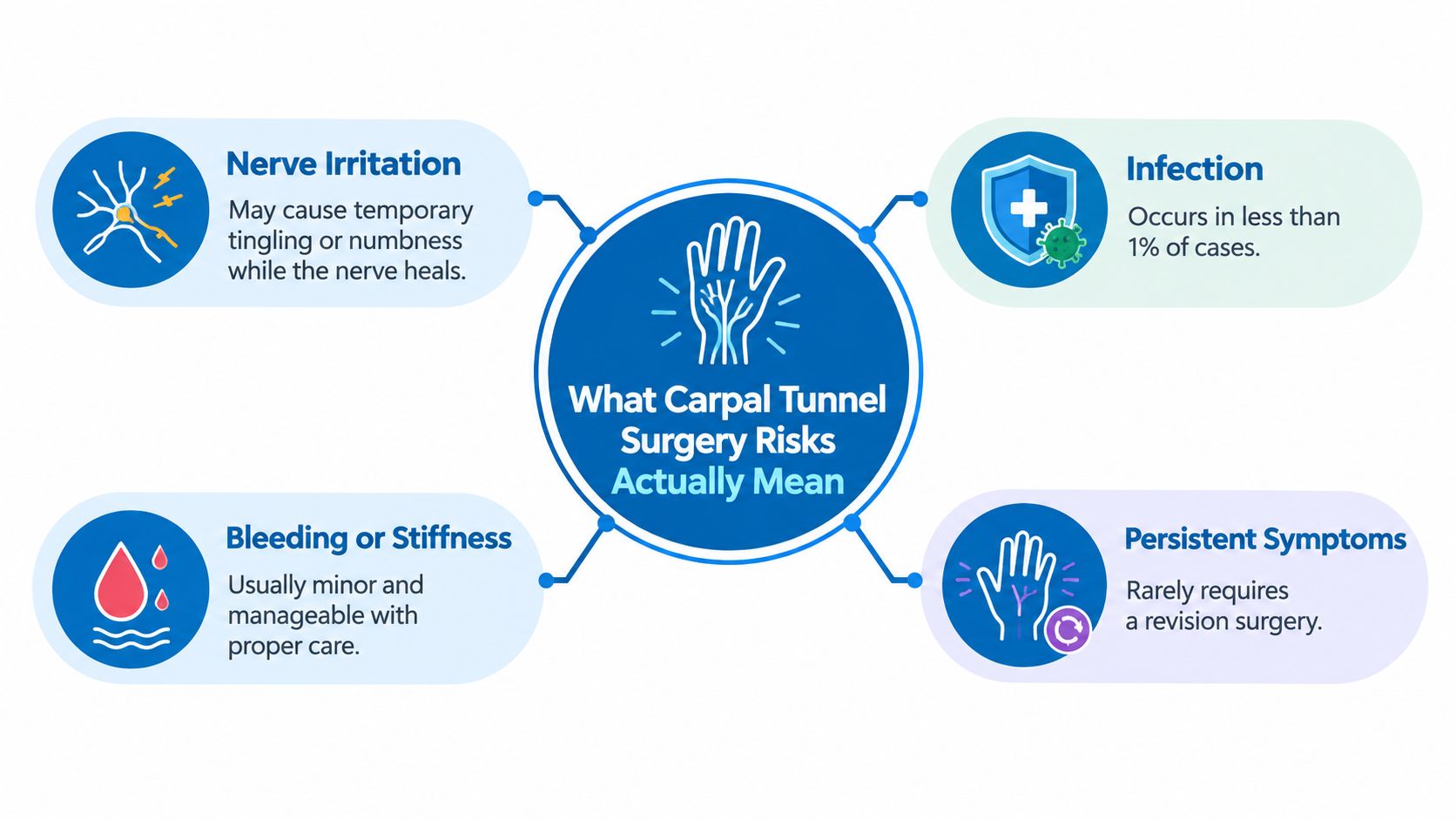
That distinction matters more than the word “risk.” In practice, I separate expected postoperative symptoms from true complications. The first group includes palm soreness, scar sensitivity, stiffness, and temporary nerve irritability while the tissues settle and the median nerve adjusts after decompression. The second group includes problems that worsen instead of improve, interfere with hand function beyond the usual recovery window, or raise concern for infection, bleeding, or a meaningful nerve injury.
A 2023 review of mini-open carpal tunnel release reported that 8.9% of patients experienced a postoperative complication during a median 12-month follow-up, with a 95% confidence interval of 4.0% to 13.8%. That number is useful as a benchmark, not a promise for any one person, because the included studies varied and individual surgical risk does not come from the incision alone (systematic review of mini-open release complications).
A practical risk framework
The most useful consultation sorts carpal tunnel surgery risks into four buckets:
- Local tissue symptoms: Pillar pain, scar tenderness, palm discomfort, and temporary weakness near the incision or released ligament.
- Neurologic symptoms: Tingling or altered sensation that may settle with time, versus a less common but more serious nerve injury.
- Wound and bleeding problems: Irritation, delayed healing, superficial infection, or excess bleeding that need monitoring and sometimes treatment.
- Persistent or recurrent symptoms: Ongoing numbness or hand symptoms caused by longstanding nerve compression, incomplete release, or another diagnosis contributing to the picture.
This is why two patients with the same diagnosis can face different odds. A person with prolonged compression, thenar muscle wasting, diabetes, smoking exposure, anticoagulant use, prior wrist surgery, or unusual anatomy may recover differently from someone with recent, uncomplicated carpal tunnel syndrome. Surgeon experience also changes the risk profile in ways patients should discuss directly.
Low risk does not mean no risk, and it does not guarantee a fast or symptom-free recovery.
Practical rule: A useful risk discussion explains what is likely to hurt, what should improve gradually, and which changes should prompt a call to the surgical team.
Major Complications After Carpal Tunnel Release
After carpal tunnel release, the word “complication” can describe problems that are inconvenient, problems that need treatment, and a smaller group that can change long-term hand function. Those should not be lumped together in one undifferentiated risk list. A sore scar and a true nerve injury do not carry the same weight, and patients should ask which issues are expected to settle, which are treatable if they happen, and which are rare but more serious.
In the mini-open review cited earlier, 133 total complications were reported. The largest categories were 44 cases of pillar pain, 35 cases of scar tenderness or sensitivity, and 10 cases of temporary nerve irritation. Superficial wound infection, delayed wound healing, and excessive bleeding each accounted for 7 cases, and the review reported no median nerve transections or deep wound infections in the included studies.
More common does not always mean more dangerous
Pillar pain usually affects the padded areas at the base of the palm. Patients notice it when pushing up from a chair, gripping a steering wheel, carrying bags, or using tools at work. Scar sensitivity can make direct pressure unpleasant even when the release itself was technically successful. These are real postoperative problems, but they usually differ from a structural injury to the nerve.
Temporary tingling sits in a different category. A nerve that has been compressed for months can stay irritable after the pressure is relieved, especially early in recovery. That does not automatically mean something went wrong in the operating room. What matters is the pattern over time, whether the numbness is improving or spreading, and whether there is associated weakness, loss of pinch strength, or loss of coordination.
Problems that deserve prompt evaluation
Serious complications are uncommon, but they need to be discussed plainly. A neurovascular complication rate of approximately 0.2% to 0.5% has been reported for carpal tunnel decompression overall (comparative evidence review). In practice, patients should call promptly for worsening pain instead of gradual soreness, spreading redness, fever, drainage, uncontrolled bleeding, new weakness, or rapidly increasing pressure under the dressing.
Persistent or recurrent numbness also deserves a closer look. Sometimes the issue is incomplete release. Sometimes it is severe preoperative nerve damage, another compression site, or a diagnosis that was never purely carpal tunnel in the first place. That is why surgeon judgment and the preoperative workup matter as much as the incision itself.
Ask the surgical team to separate the two lists clearly: which symptoms are expected this week, and which symptoms mean the office should be called the same day.
Open Versus Endoscopic Carpal Tunnel Release
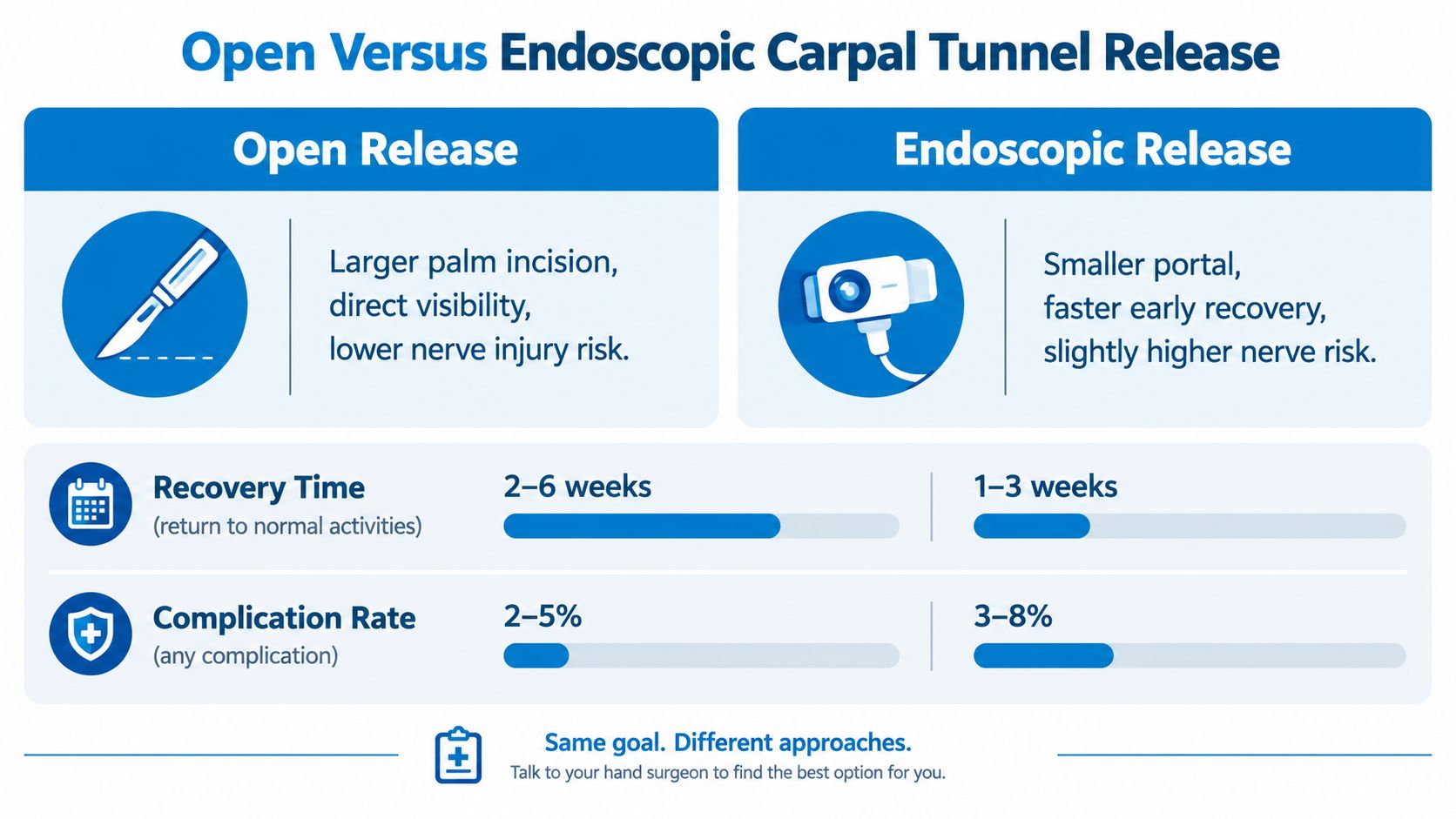
Across 4,367 endoscopic procedures and 4,107 open procedures in a 2024 systematic review, the overall complication burden was broadly similar, but the type of complication shifts between techniques. One cited meta-analysis in that review reported an overall complication rate of 5.8%. For patients deciding between the two, that distinction matters more than the size of the incision.
Open release gives the surgeon direct exposure. Endoscopic release uses smaller access points and may reduce irritation in the palm and around the incision. In practice, that can mean less scar tenderness, less pillar pain, and fewer wound-related complaints early on. The trade-off is different rather than absolute. Some analyses have reported more temporary nerve irritation with endoscopic methods, while open surgery more often brings incision-related discomfort and sensitivity.
What the comparison means in practice
| Consideration | Open release | Endoscopic release |
|---|---|---|
| Incision-related symptoms | More direct palm or wrist incision discomfort may occur | Smaller access points may reduce early scar sensitivity |
| Visualization | Direct visualization of the surgical field | Camera-guided view through limited access |
| Nerve risk | Permanent injury remains uncommon | Temporary nerve irritation or injury has been reported more often |
| Recovery trade-off | May involve more wound or pillar discomfort | May support faster early functional recovery |
| Repeat procedure | Depends on diagnosis and completeness of release | Repeat surgery has been reported more frequently in some evidence |
These are tendencies, not guarantees.
I usually frame the choice around anatomy, job demands, symptom pattern, and surgeon experience with the specific technique. An open approach often makes sense when direct visualization is important, the anatomy is less straightforward, symptoms have returned after prior surgery, or there is concern about getting a complete release the first time. Endoscopic release can be a good fit when early palm comfort and faster hand use matter, especially for someone whose work puts pressure on the heel of the hand, provided the surgeon performs that approach regularly and can do a full decompression safely.
Patients who want to learn more about endoscopic surgery services should ask a practical question at consultation. How often does the surgeon use this approach in patients like me, and what problems do they see most often? That answer is usually more useful than focusing on incision length alone.
Why Less Invasive Does Not Always Mean Safer
A smaller incision changes the surgical pathway. It doesn't remove the need for precise anatomy, complete ligament release, and careful protection of the median nerve and recurrent motor branch.
Endoscopic release can reduce trauma to the palm and may improve early hand use. The surgeon works through limited access, however, with an instrument trajectory that can make certain structures more dependent on technique and experience. A systematic review reported an odds ratio of 4.84 for transient nerve injury when endoscopic and open surgery were compared, while permanent nerve injury didn't differ significantly between the methods (randomized-trial evidence on endoscopic and open release).

The risk of an incomplete release
Persistent symptoms after surgery don't always mean the nerve was permanently injured. The transverse carpal ligament may not be fully divided, or another source of numbness may coexist. Cervical nerve compression, peripheral neuropathy, tendon problems, and arthritis can complicate the symptom picture.
The surgeon should match the approach to the anatomy and the clinical problem. Severe electrodiagnostic abnormalities, prior surgery, recurrent symptoms, scar tissue, and unusual nerve positioning can alter the balance. A technique that appears appealing in a routine case may not be the best choice for revision surgery or complex anatomy.
Newer techniques still need careful evaluation
Ultrasound-guided and ultra-minimally invasive procedures are receiving attention because they may limit tissue disruption. A 2025 network meta-analysis found differences in adverse-event rates among techniques, but it didn't establish that every patient benefits from the newest approach (network meta-analysis of carpal tunnel release techniques). Long-term evidence for emerging methods remains more limited than many patients assume.
A smaller incision can reduce one kind of trauma while increasing the importance of visualization, instrument control, and operator experience.
Before choosing a method, patients should ask how often the surgeon performs that specific technique, how incomplete release is handled, and what the surgeon considers the most relevant risk for that individual hand.
Recovery Scenarios and Warning Signs After Surgery
Recovery rarely follows a single script. One patient may notice that nighttime tingling improves quickly but still have palm soreness with gripping. Another may have persistent numbness because the median nerve sustained substantial damage before decompression. Neither pattern can be interpreted accurately without the preoperative examination and nerve testing.
A common recovery scenario involves pillar pain, scar sensitivity, grip weakness, or fluctuating tingling that gradually settles. These symptoms can interfere with driving, lifting, keyboard use, or household tasks, but they may represent healing rather than a failed procedure. Recovery can range from days to several months, and prolonged nerve compression can make sensory improvement slower (evidence synthesis on recovery and complications).
Three patterns that should be distinguished
Expected healing discomfort: The palm remains sore around the operative area, but the trend is slowly improving. Pressure on the scar is uncomfortable, while there is no fever, drainage, or progressive weakness.
Delayed nerve recovery: Numbness remains even though the wound looks healthy and hand strength is stable. The nerve may need time to recover, and preexisting damage may limit how much sensation returns.
A warning pattern: Pain increases rather than eases, redness spreads, drainage appears, fever develops, or new weakness affects finger movement. These symptoms call for prompt communication with the surgical team.
Persistent numbness deserves an especially careful explanation. Surgery removes compression, but it can't guarantee that a chronically injured nerve will regain normal sensation. Conversely, worsening neurologic function after surgery shouldn't be dismissed as ordinary recovery.
Questions that make recovery safer
Before leaving the consultation, the patient should receive specific guidance about dressing care, permitted hand use, driving, work restrictions, therapy, and the follow-up plan. The surgeon should also explain what to do if the bandage feels increasingly tight or finger movement becomes difficult.
Practical rule: Improvement may be gradual, but worsening pain, drainage, fever, spreading redness, or new weakness should trigger a call rather than watchful waiting.
A written timeline helps patients judge trends instead of reacting to every fluctuation. It also gives the surgical team a clearer description of when symptoms changed and whether the problem is local wound healing, nerve recovery, or something more urgent.
How to Choose the Right Surgical Approach
The right approach is the one that provides complete decompression with an acceptable risk profile for the patient's anatomy, nerve condition, work demands, and medical history. Open versus endoscopic surgery matters, but it usually matters less than assuming one technique is universally safer.
A consultation should begin with the diagnosis. The clinician should confirm that symptoms fit median-nerve compression and consider electrodiagnostic severity, weakness, muscle wasting, neck symptoms, diabetes, smoking, anticoagulant use, prior operations, and the duration of numbness. These factors can change both the urgency of treatment and the expected recovery.
Questions worth taking to the appointment
- Which complication is most relevant here? The answer should relate to the patient's examination and medical history, not a generic consent form.
- How often does the surgeon use each approach? Experience with the specific technique matters.
- How is complete release confirmed? Patients should understand how the surgeon reduces the chance of persistent compression.
- What happens if symptoms continue? The plan may include repeat examination, nerve testing, imaging, therapy, or evaluation for another source.
- What should work and driving restrictions look like? Recovery planning should reflect the patient's job and hand demands.
- Which symptoms require urgent contact? Wound and neurologic warning signs should be stated plainly.
The surgeon's experience deserves direct discussion because endoscopic release has a narrower working space, while open release may create more incision-related discomfort. Neither approach eliminates complications. The practical choice balances the likely benefits against the specific downside most relevant to the patient.
Shared decision-making also means discussing whether surgery is necessary now. A patient with progressive weakness or severe nerve compression may face a different risk from delaying decompression than someone with mild, intermittent symptoms. A patient with manageable symptoms may reasonably explore splinting, activity modification, rehabilitation, or injection before committing to an operation.
Non-Surgical Alternatives and Next Steps
Surgery isn't the only route for every patient with carpal tunnel symptoms. A stepwise plan may include nighttime wrist splinting, activity modification, ergonomic changes, hand therapy, and treatment of contributing medical conditions. A corticosteroid injection can provide temporary symptom relief for selected patients and may help clarify whether the wrist is the main pain source. Information about this option is available through corticosteroid injections.
The next appointment should answer four practical questions:
- Is the median nerve definitely compressed? The examination and, when appropriate, electrodiagnostic testing should support the diagnosis.
- What is the severity and timeline? Progressive weakness or long-standing sensory loss may change the urgency.
- What has already been tried? The response to splinting, therapy, ergonomic changes, and injections helps guide the next step.
- Which approach fits the patient? Technique, anatomy, medical history, work, and surgeon experience all belong in the decision.
For patients in New Jersey and Staten Island, Interventional Pain Management offers evaluation and treatment planning across conservative, interventional, and surgical options through physicians in pain management, orthopedics, and spine care. The purpose of consultation is to match treatment to the diagnosis rather than treat the incision as the main decision.
Patients considering carpal tunnel release can schedule an evaluation with Interventional Pain Management to review symptoms, prior treatment, nerve findings, and approach-specific risks. The clinical team can help clarify whether continued non-surgical care or surgical decompression fits the patient's goals and recovery needs.