
A meniscus tear cortisone shot provides temporary symptom relief rather than structural healing. In a retrospective study, average pain relief lasted 5.68 weeks, although individual responses varied substantially.
That distinction matters when a knee hurts along the joint line, swells after activity, or catches during a turn. A shot may quiet the inflammation enough to walk more comfortably or participate in rehabilitation, but it doesn't stitch the meniscus back together. It also isn't always a harmless bridge to surgery, particularly when arthroscopy or meniscus repair may be under consideration.
The practical question isn't just whether cortisone works. It's whether temporary relief fits the type of tear, the condition of the joint, the person's medical risks, and the orthopedic timeline.
Table of Contents
- Understanding What a Cortisone Shot Actually Does
- How Long Pain Relief Typically Lasts
- Weighing Short-Term Benefits Against Joint Risks
- Injection Timing and Surgical Planning Considerations
- Combining Injections with Physical Therapy and Rehabilitation
- Determining Whether You Are a Good Candidate
- Making an Informed Decision About Your Knee Treatment
Understanding What a Cortisone Shot Actually Does
A patient with a painful degenerative tear may arrive unable to bend the knee without swelling. Another may have twisted the knee during sport and developed a traumatic tear with catching or instability. Both may describe “meniscus pain,” but the source of the symptoms and the appropriate role of an injection can be very different.
A corticosteroid injection acts mainly on inflammation in the joint lining, called the synovium. By calming inflammatory activity, it can reduce pain and swelling around an irritated knee. It doesn't regenerate torn fibrocartilage, reconnect separated tissue, or prove that the meniscus has healed.
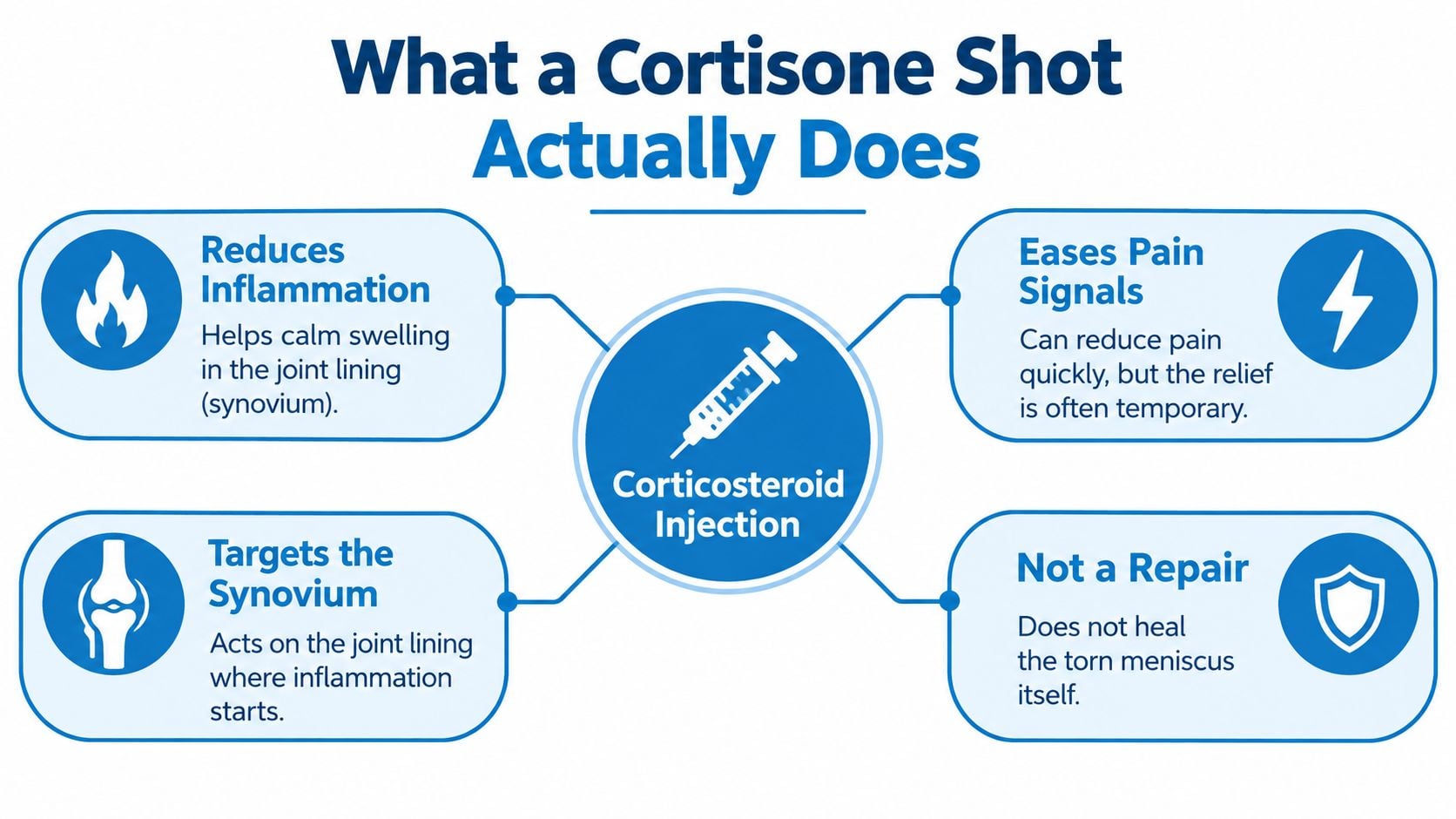
The pain source matters
With chronic degenerative fraying, pain may come from a mixture of meniscal irritation, synovial inflammation, and coexisting osteoarthritis. A cortisone shot may settle that inflammatory component, especially when swelling is interfering with exercise.
An acute traumatic tear can behave differently. A displaced fragment, true mechanical locking, or a tear that may be repairable requires an orthopedic assessment rather than relying on symptom suppression. Less pain after an injection doesn't make a mechanically unstable fragment safe.
Practical rule: Use pain relief as an opportunity to restore movement and strength, not as evidence that the torn tissue has been repaired.
Image guidance may help the clinician place medication accurately and assess fluid or inflammation around the joint. Patients can learn more about the clinical role of corticosteroid injections, including why the treatment should be matched to the diagnosis rather than offered as a routine response to an MRI finding.
How Long Pain Relief Typically Lasts
The most useful evidence for a meniscus-targeted injection comes with an important limitation. A 2019 retrospective study of 135 patients with meniscal tears or degenerative meniscal fraying examined ultrasound-guided corticosteroid injections directed at the meniscus. Patients received either 20 mg or 40 mg of triamcinolone, and average pain relief lasted 5.68 weeks, with a standard deviation of 5.28 weeks (the full study report).
That spread tells patients something clinically important: an average isn't a promise. Some people may experience a shorter response, while others may have a longer period of improved comfort. The study also found a 2.14-point decrease in visual analog scale pain, with P < 0.0001, but the absence of a control group means the results show short-term improvement rather than proof that the injection outperforms physical therapy or heals the meniscus.
What a useful response looks like
A useful response isn't just a lower pain score at rest. It may mean the knee tolerates controlled strengthening, range-of-motion work, and ordinary walking with less guarding. The response becomes clinically valuable when it helps a patient perform rehabilitation that was previously blocked by pain or swelling.
A response that fades quickly, fails to improve function, or requires repeated injections deserves reassessment. The original study used retrospective medical-record data, and its authors identified the need for prospective comparisons between meniscus-targeted injections and standard intra-articular injections. That limits how confidently clinicians can apply the findings to every kind of tear.
What the injection cannot establish
Pain reduction doesn't show that a tear has closed, that a displaced fragment has become stable, or that surgery will no longer be needed. It only shows that one contributor to the symptoms, often inflammation, has become quieter.
For that reason, follow-up should track function, swelling, range of motion, mechanical symptoms, and rehabilitation progress. A patient who feels better but still has locking or recurrent effusion shouldn't interpret the temporary improvement as clearance for unrestricted twisting, pivoting, or impact activity.
Weighing Short-Term Benefits Against Joint Risks
The appeal of a cortisone shot is straightforward. It can reduce pain and improve function in the short term, which may help someone move more normally or begin exercises that were too uncomfortable before. The concern is that repeated exposure introduces a separate question about the long-term condition of the joint.
A randomized trial summarized in a Cochrane review of intra-articular corticosteroids compared 40 mg of triamcinolone every three months for two years with saline. MRI-measured cartilage loss was approximately 0.21 mm with triamcinolone versus 0.10 mm with saline, while the steroid group had no sustained symptomatic advantage over placebo.
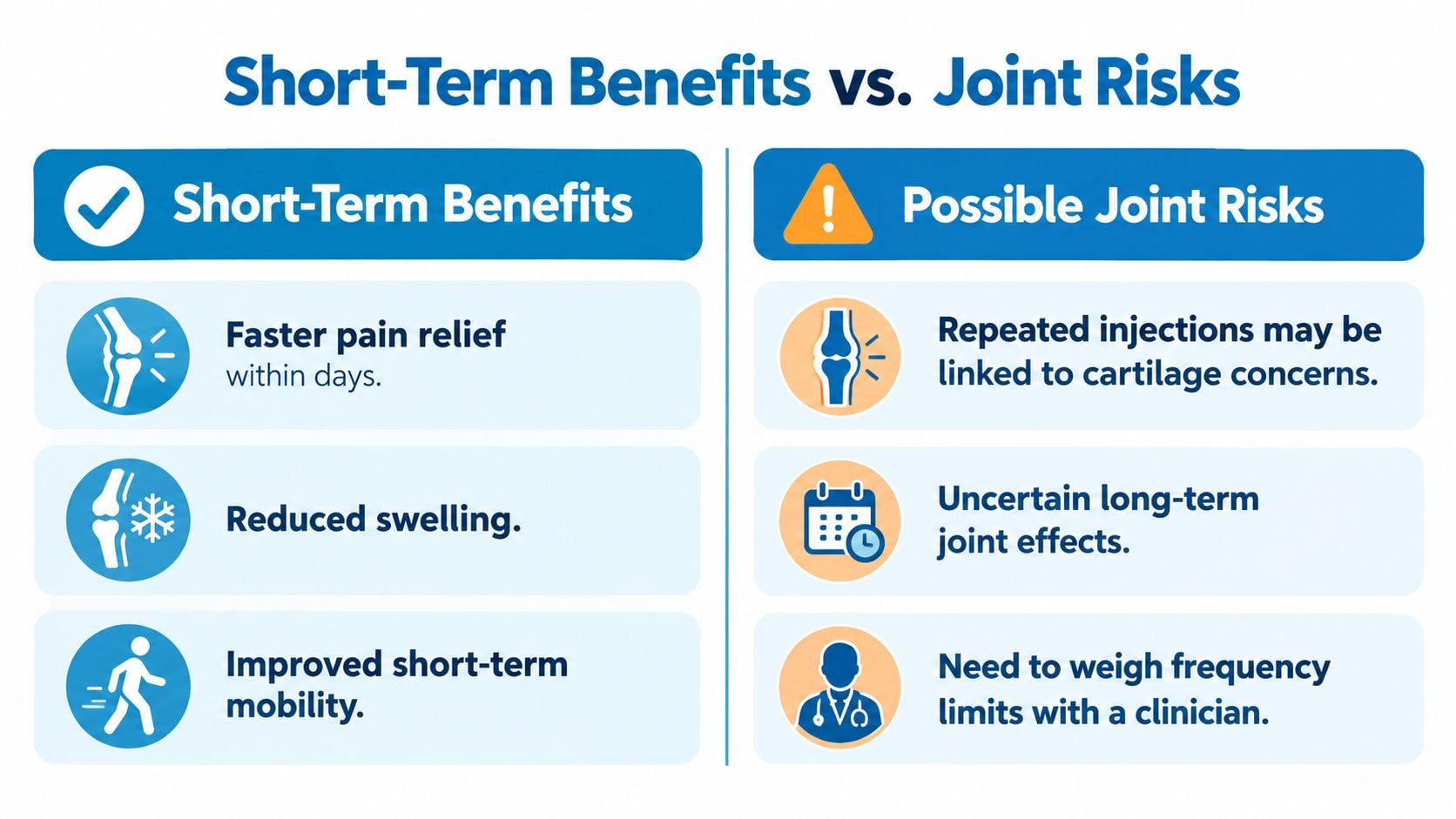
Relief and risk belong in the same conversation
The same review found short-term benefits versus placebo for pain and function, with standardized mean differences of -0.40 for pain and -0.33 for function. It also emphasized uncertainty about long-term structural effects. These findings don't mean a single injection will damage every knee, but they do argue against treating serial injections as an automatic maintenance plan.
The decision changes when the knee has substantial osteoarthritis, recurrent swelling, glucose-management concerns, infection risk, or a possible operation ahead. The clinician needs to know the diagnosis, previous injection response, duration of relief, and whether the patient gained meaningful functional benefit.
Patients should also understand the distinction between symptom control and joint protection. A medication can reduce pain without preserving cartilage, and pain reduction can sometimes encourage activity beyond what the underlying knee can tolerate.
A conservative exposure strategy
A reasonable approach includes:
- Use the lowest effective exposure: Avoid scheduling repeat injections just because a calendar interval has passed.
- Measure the response: Record how long relief lasts and whether walking, stairs, sleep, and rehabilitation genuinely improve.
- Review joint factors: Discuss effusion, osteoarthritis, glucose risk, infection risk, and alternatives before another injection.
- Protect the surgical pathway: Don't inject near planned arthroscopy unless the treating surgeon has reviewed the timing.
Patients with osteoarthritis may also benefit from a broader assessment of noninjection care. Information about osteoarthritis treatment can help place a steroid decision within the overall condition of the knee rather than treating the meniscus finding in isolation.
Injection Timing and Surgical Planning Considerations
A cortisone shot can seem like a sensible way to get through the weeks before surgery. That assumption can be wrong. If arthroscopy or meniscus repair is being considered, the injection should be discussed with the orthopedic surgeon before it is administered.
A recent peer-reviewed report found that corticosteroid administration before or after knee arthroscopy has been associated with increased risks of infection and reoperation (the report on perioperative corticosteroid use). Injections given during arthroscopy have also been studied for immediate postoperative pain, but that doesn't make unscheduled preoperative treatment appropriate for every patient.
Why there isn't one universal waiting period
The safe interval depends on several clinical details:
- The planned operation: Meniscus repair, partial meniscectomy, and other procedures may carry different considerations.
- The injection location: A targeted perimeniscal injection and an intra-articular injection aren't identical exposures.
- The patient's health: Diabetes, immune suppression, skin problems, and prior infection can alter the risk calculation.
- The surgeon's protocol: The operating team must decide whether the injection changes the planned date or perioperative plan.
A universal waiting period presented without context can create false reassurance. The important action is coordination, not memorizing a number.
When a shot may be poorly timed
A patient with true locking, a suspected displaced tear, or a clear surgical consultation already scheduled should tell the orthopedic office about any proposed injection. The surgeon may prefer examination and imaging first, or may recommend a different treatment while the operative plan is clarified.
A short period of comfort isn't worth compromising a carefully timed surgical pathway.
The same caution applies when pain management and orthopedic care are provided by separate teams. The patient should authorize direct communication, provide the injection date and medication details, and ask whether the shot affects arthroscopy timing. Reduced pain can be helpful, but it shouldn't delay evaluation of a knee that remains mechanically blocked.
Combining Injections with Physical Therapy and Rehabilitation
The most productive role for an injection is often as a temporary opening for rehabilitation. When pain prevents a patient from bending the knee, activating the quadriceps, or walking with a normal pattern, reducing inflammation may make structured therapy possible. The injection still isn't the rehabilitation itself.
Longer-term observational evidence supports this combined approach for selected degenerative medial meniscus tears. A 2024 retrospective case series initially reviewed 671 symptomatic patients and included 481 who met the study criteria. Patients received intra- and perimeniscal corticosteroid injections plus structured physiotherapy; at five years, 83% remained free from surgery on the affected knee, while 52% remained free from a second injection (the published case series).
What the observational findings mean
At a mean follow-up of 4 ± 2 years, reported WOMAC improvements were 5.2 ± 4.9 points for pain, 2.0 ± 2.0 for stiffness, 7.3 ± 7.4 for function, and 12.4 ± 12.7 for the global score. Results were worse when effusion was present before injection or when osteoarthritis was advanced, factors statistically associated with poorer outcomes at P < 0.003 and P < 0.0004, respectively.
Those results are encouraging but not proof that cortisone alone prevents surgery. The study was a Level IV retrospective case series without randomization, so patient selection, rehabilitation participation, and other factors may have influenced the outcomes.
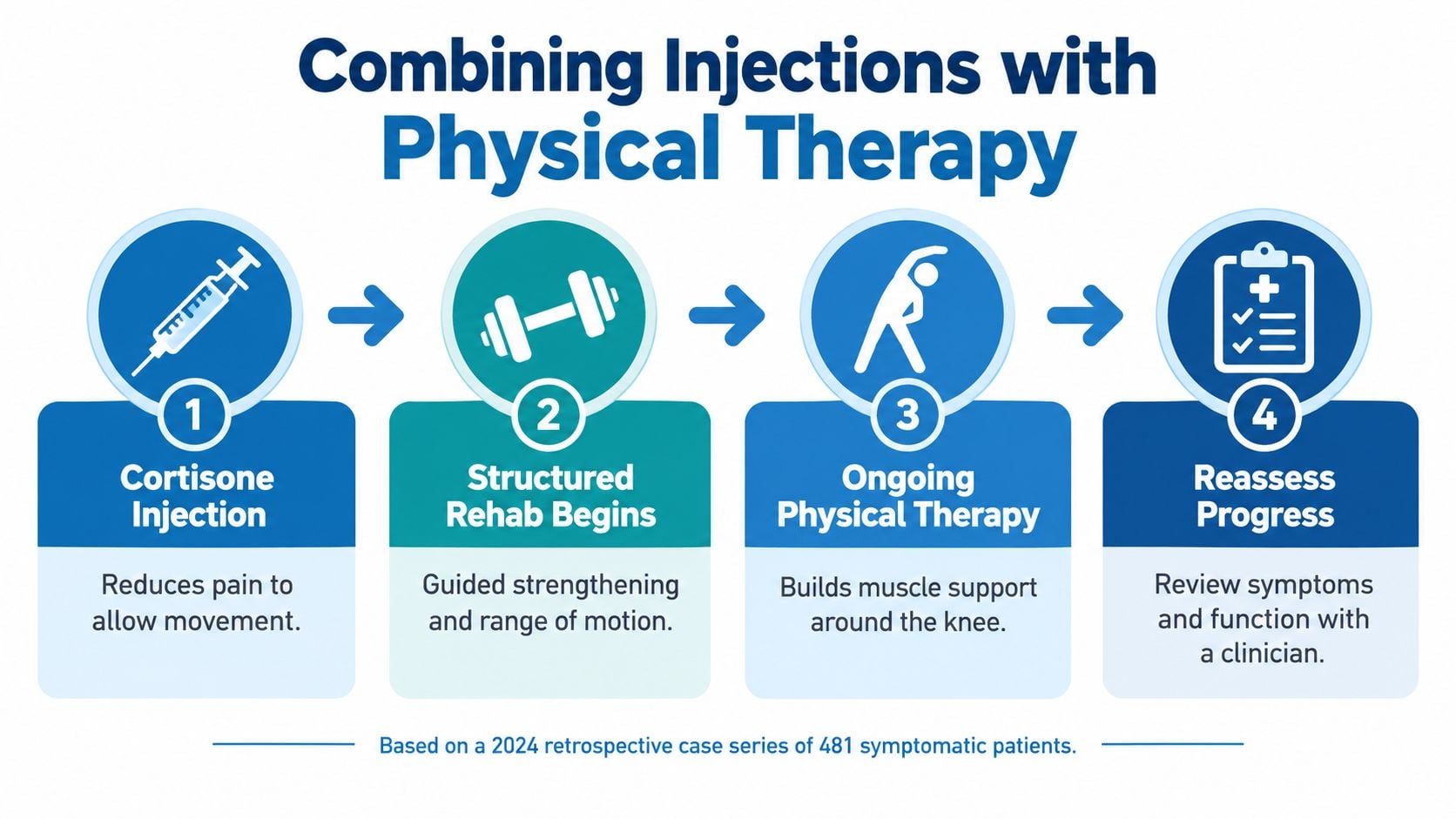
A practical rehabilitation pathway
The sequence should be deliberate:
- Set the target: Identify whether the immediate barrier is pain, swelling, limited motion, or fear of loading.
- Begin guided work: Once symptoms permit, therapy can address range of motion, quadriceps and hamstring strength, hip control, and movement patterns.
- Progress gradually: The patient should increase load according to function and swelling, not solely because the injection reduced pain.
- Reassess candidly: Persistent locking, recurrent effusion, or declining function calls for diagnostic review rather than another automatic shot.
Patients looking for information about torn meniscus care should keep the central principle in view. Rehabilitation builds capacity around the knee; an injection may only make that work tolerable.
Determining Whether You Are a Good Candidate
Candidacy starts with diagnosis, not the MRI phrase “meniscus tear.” The clinician needs to compare the scan with the pain location, examination findings, swelling pattern, range of motion, and mechanical symptoms. A tear can coexist with another pain generator, including osteoarthritis or irritation elsewhere in the knee.
A focused screening process
First, clarify the tear pattern and clinical setting. Chronic degenerative fraying may be approached differently from an acute traumatic tear. A locked knee, a suspected displaced fragment, or symptoms suggesting instability should prompt orthopedic review before injection.
Next, examine the inflammatory component. Effusion and synovial irritation may make a corticosteroid more relevant, while a quiet knee with persistent mechanical symptoms may need a different plan. In the longer-term case series, pre-injection effusion was associated with poorer outcomes, so swelling shouldn't be treated as a minor detail.
Then review medical risks. The clinician should ask about active or recent infection, skin problems near the injection site, diabetes and glucose control, immune suppression, anticoagulant use, prior reactions, and recent injections. These factors may change whether injection is appropriate or how it should be delivered.
Finally, map the orthopedic timeline. If surgery is possible, the orthopedic surgeon should know before the injection. This is especially important when the patient has a planned arthroscopy, a repair consultation, or symptoms that may require a procedure.
Questions worth bringing to the appointment
- What is causing the pain: Is inflammation the main target, or do symptoms suggest mechanical obstruction?
- What is the expected benefit: How will success be measured in walking, sleep, stairs, or therapy?
- What happens after relief: Which exercises or activity changes should begin, and when?
- What could change the plan: Which symptoms require prompt reassessment?
- How does timing affect surgery: Does the proposed injection alter the orthopedic schedule?
A good candidate isn't defined by a scan alone. Suitability depends on a realistic symptom target, acceptable medical risk, and a plan that uses temporary relief constructively.
Making an Informed Decision About Your Knee Treatment
A cortisone shot can be reasonable when inflammation and pain are blocking rehabilitation, especially if the knee isn't showing signs that demand immediate surgical attention. It becomes less attractive when relief would only postpone a necessary evaluation, when injections are being repeated without durable functional benefit, or when surgery may be scheduled soon.
The most useful decision is therefore a coordinated one. The patient, injection clinician, physical therapist, and orthopedic surgeon should agree on the diagnosis, the purpose of the injection, the rehabilitation plan, and the follow-up threshold.

A concise appointment checklist
- Bring the timeline: Explain when symptoms began, whether there was a twist, and how swelling or locking behaves.
- Bring treatment history: Include prior injections, the duration of relief, therapy participation, and relevant imaging.
- Ask about surgery: Confirm whether an injection could affect a planned arthroscopy or repair.
- Define success: Agree on functional goals, not just a temporary reduction in pain.
- Plan the next step: Know when to reassess and what symptoms should trigger earlier review.
The balanced view is simple. A meniscus tear cortisone shot may calm symptoms, but it doesn't repair the meniscus. Used selectively and paired with rehabilitation, it can create useful breathing room. Used repeatedly or without surgical coordination, it may provide short-term comfort while complicating the larger treatment plan.
Interventional Pain Management offers evaluation and image-guided corticosteroid injections for selected joint pain conditions, with treatment planning that can account for rehabilitation needs and orthopedic coordination. Patients with meniscus-related knee pain can visit Interventional Pain Management to discuss whether an injection fits their diagnosis, medical history, and surgical timeline.