
Two days after lumbar fusion, a patient may still need help standing, feel groggy from medication, and wonder whether the soreness is normal. A difficult morning can feel like evidence that something has gone wrong, while a better afternoon can create pressure to do too much. Both reactions are common sources of anxiety.
The phrase spinal fusion surgery recovery time can be misleading because recovery doesn't end on one predictable day. Healing unfolds in stages, and the safest plan follows the patient's symptoms, job demands, imaging, and surgeon's restrictions rather than a calendar alone.
Table of Contents
- What Recovery After Spinal Fusion Means
- The First Two Weeks After Surgery
- Weeks Two to Six and the Return to Daily Life
- Three to Six Months When the Bone Heals
- Six to Twelve Months and Long-Term Remodeling
- Factors That Change Your Recovery Timeline
- Red Flags and When to Call the Surgeon
- Your Recovery Plan and Common Questions
What Recovery After Spinal Fusion Means
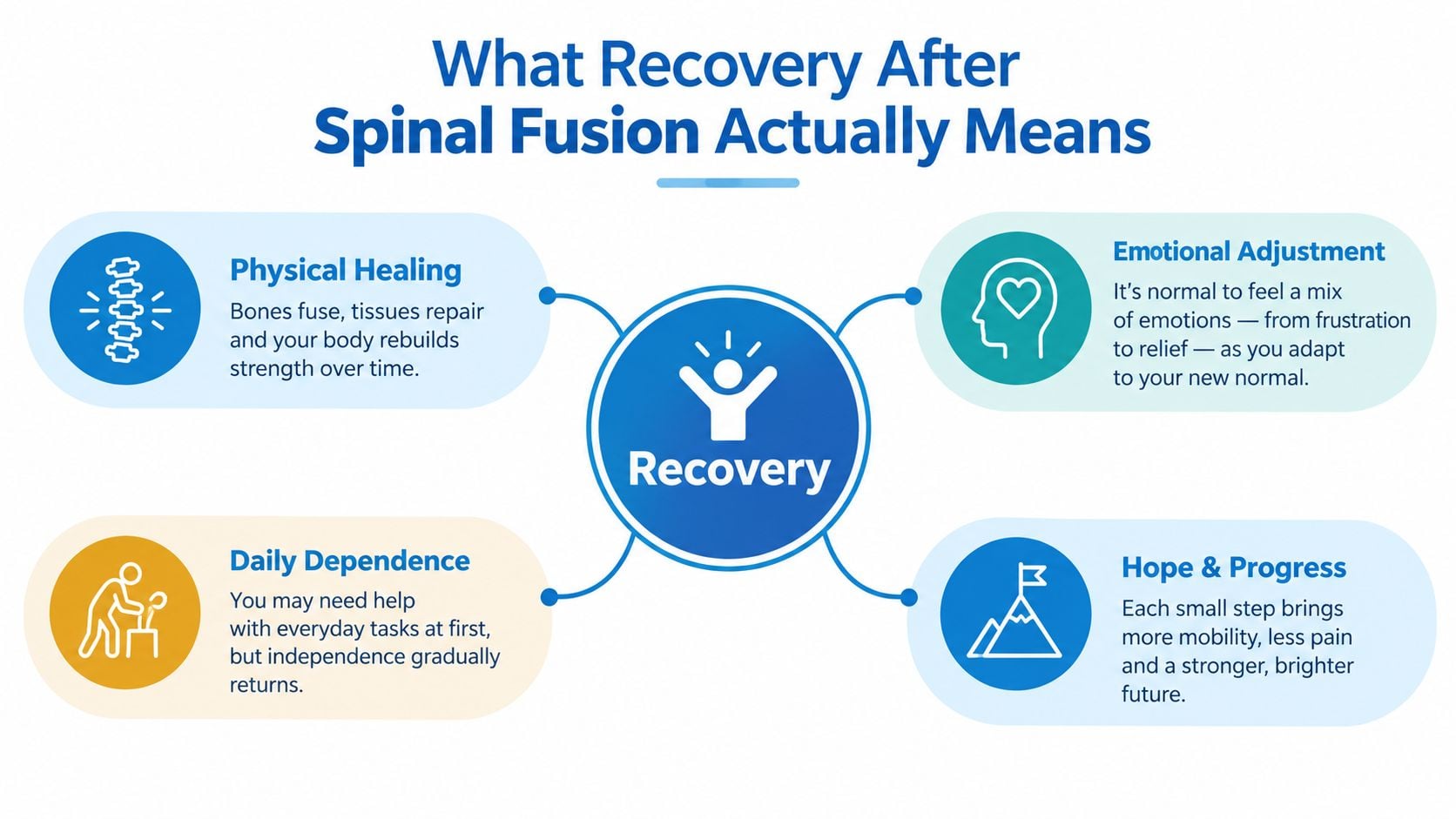
A person with a desk job may be able to sit through part of a workday before the spine has finished fusing. Someone who lifts, bends, drives, or stays on their feet may need more time, even if both patients report less pain. Recovery after fusion follows two overlapping tracks, and those tracks do not always advance at the same speed.
Functional recovery describes what you can safely do. It includes walking, sleeping, bathing, dressing, driving, household tasks, exercise, and returning to work. Your job duties matter here. Typing and brief sitting place different demands on the back than carrying materials, climbing, or repeated bending.
Radiographic healing describes what the bone graft and vertebrae are doing as they gradually join into a stable fusion. Muscles, nerves, and other soft tissues can remain stiff or tired after daily function improves. The reverse can also happen: an image may look encouraging while movement still feels limited.
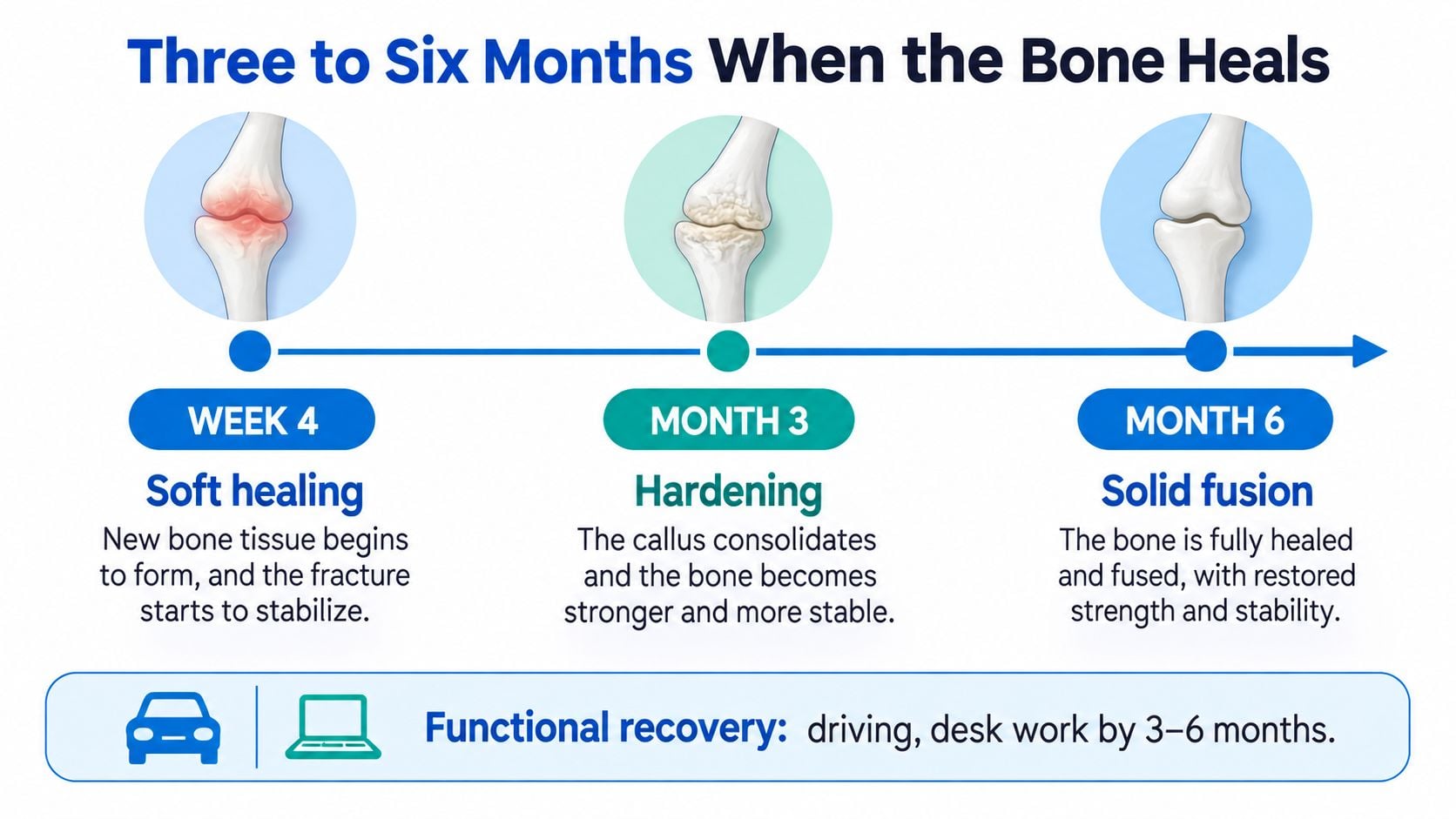
Clinical guidance on spinal fusion recovery notes that many patients with sedentary jobs may return to work in about 4 to 6 weeks. Bone healing generally takes at least 3 to 4 months and may continue for 12 months or longer. A better pain day shows functional progress, not necessarily a completed fusion.
Two questions for every milestone
At each follow-up, ask two separate questions:
- What can the patient safely do now? Consider walking, sitting, bathing, driving, working, and exercising in relation to actual daily and job demands.
- What is the fusion doing now? Examination and imaging help assess bone progress and guide changes to restrictions.
Information about spinal instrumentation and its role in fusion may mention screws, rods, or other stabilizing implants. These devices can support alignment while the bone heals. They do not mean the fusion is finished.
Practical rule: Treat each milestone as permission to progress carefully, not as a deadline to push through pain.
The timeline uses broad ranges because age, surgical approach, number of levels, medical conditions, and job demands all influence recovery. Office work and construction work require different return-to-work plans. Steady improvement within the surgeon's limits matters more than matching an average.
The First Two Weeks After Surgery
The first two weeks are about protection, basic mobility, and symptom control. In the hospital, the care team checks strength, sensation, blood pressure, pain control, the incision, and the ability to move safely. Physical therapy commonly helps the patient sit up, stand, and take the first supervised walk.
Pain often changes rather than disappears. Incisional soreness, muscle tightness, fatigue, and difficulty finding a comfortable position can all occur early. Oral medication usually replaces intravenous medication as the patient can drink, eat, move, and manage symptoms with a home plan.
The first days at home
Discharge generally depends on practical function rather than a particular day. The patient needs a manageable pain plan, safe mobility, adequate food and fluids, and a clear way to contact the surgical team. A family member or other support person may help with meals, bathing, medication organization, and transportation.
At home, the incision should be kept according to the surgeon's dressing and shower instructions. A small amount of expected tenderness differs from spreading redness, warmth, increasing swelling, foul drainage, or pain that escalates instead of easing. Those changes deserve a call rather than self-treatment.
Getting out of bed often feels safer with a log-roll technique. The patient turns onto the side, keeps the shoulders and hips moving together, lowers the legs, and pushes up with the arms. This reduces unnecessary bending and twisting through the healing area.
Movement without overloading the spine
Short, frequent walks are usually more useful than one ambitious walk. Rest breaks are part of the plan, not a sign of failure. The patient should follow the surgeon's lifting, bending, twisting, brace, and stair instructions, since restrictions differ by procedure.
The emotional pattern can be uneven. Early relief may fade as medication decreases and stiffness becomes more noticeable. A low mood or a sense of dependence can appear during the first weeks, but a worsening emotional state should also be discussed with the clinical team.
Progress at this stage may look modest: standing more easily, using fewer doses of strong pain medicine, or walking from one room to another without assistance. Those small changes are functional milestones even though the bone is still in an early healing phase.
Weeks Two to Six and the Return to Daily Life
At week three, a patient may walk around the house, prepare a simple meal, or sit at a desk for a short period, then feel exhausted afterward. That pattern reflects functional recovery, which measures what the body can do today. Radiographic healing follows a slower track. The fusion is still developing even when pain has eased and daily movement feels more manageable.
Judge each activity by its after-effect. A lasting increase in pain or fatigue means the task was too much, even if it was completed once. Work plans should match the job: desk workers may need shorter days and frequent position changes, while jobs involving lifting, driving, prolonged standing, or repeated bending require separate clearance.
A return to desk work may be possible around 4 to 6 weeks for many patients. Older adults and people recovering from more extensive surgery may need longer, according to clinical recovery guidance for spinal fusion. A supportive workstation, scheduled walking breaks, and gradual hours can make the difference between tolerating a shift and spending the evening recovering from it.
Driving involves more than sitting comfortably. The patient needs surgeon clearance, no medication-related impairment, and enough strength and mobility to turn toward traffic, move between pedals, and brake suddenly without hesitation. Pain, medication, surgical approach, and leg strength all affect the timing.
Expected activity compared with safe progression
| Activity | Typical patient expectation | Realistic surgeon-approved milestone |
|---|---|---|
| Driving | Returning once sitting feels comfortable | Driving after clearance, safe emergency movements, and no impairing medication |
| Desk work | Completing a full day immediately | Beginning with short or partial days and changing position often |
| Household chores | Resuming cleaning and laundry | Managing light tasks while avoiding bending, lifting, and twisting |
| Walking | Covering a long distance in one outing | Adding short walks gradually, with recovery time afterward |
| Pain medicine | Stopping all medication quickly | Tapering according to symptoms and the prescribing plan |
| Exercise | Rebuilding strength independently | Starting with approved walking or therapy exercises |
A hospital-based review of return-to-work and driving milestones reported that more than 85% of minimally invasive TLIF patients returned to work between 2 and 4 weeks, while more than 90% of minimally invasive lumbar laminectomy patients did so in the same period. The review also notes that full recovery can take up to 6 months. Early work capacity therefore shows functional progress, while imaging may still show an immature fusion.
Sleep may improve with a pillow between the knees when side-lying or beneath the knees when lying on the back, if the surgical team approves. Sexual activity can often resume when pain and movement allow. Positions involving forceful bending, twisting, or back extension should wait for individualized clearance. Outpatient therapy may begin during this phase, with exercises adjusted to the procedure and current restrictions.
Three to Six Months When the Bone Heals
At this stage, you may feel ready to do far more than your scan can confirm. Bone healing works like a structure that sets in layers: early tissue is vulnerable, later tissue becomes more organized, and the fusion gains strength gradually. Better walking or work tolerance therefore does not automatically mean that heavy lifting, impact, or repeated twisting is safe.
Postoperative fusion guidance on bone healing describes fusion healing as taking at least 3 to 4 months, with remodeling continuing for at least a year. The bone graft gradually joins the vertebrae into a stable fusion, and the healing process depends on how the graft incorporates. This overview of bone grafting explains the material's role in supporting that process. Functional recovery can stay ahead of radiographic confirmation, so you may feel capable while imaging still shows an immature fusion and your surgeon limits certain loads.
What usually changes
Physical therapy may progress from basic mobility to posture, trunk control, hip strength, walking endurance, and controlled movements used in daily life. The therapy goal is to help the hips, legs, and surrounding muscles share the workload so the healing construct is not strained. A person preparing for desk work may practice supported sitting and position changes, while someone returning to patient care, warehouse work, or construction may need carefully graded lifting, reaching, and carrying.
Approved low-impact activity, such as stationary cycling or swimming, may become appropriate after the incision has healed and the surgeon or therapist agrees. Resistance work can begin with selected movements and light loads. Running, contact sports, heavy deadlifts, and forceful twisting generally remain restricted until imaging, strength, and movement quality support clearance.
The distinction between comfort and capacity matters. You may tolerate a walk yet struggle with prolonged sitting, or manage stairs but fatigue during repeated lifting. Therapy should gradually reproduce the demands of your actual job and home routine. One successful activity does not establish readiness for every task.
Work demands still set the pace
Desk duties often return sooner because they place less repetitive load on the spine. Manual work requires assessment of lifting, carrying, climbing, awkward positions, vibration, and recovery between shifts. The surgeon may combine examination findings, imaging, therapist feedback, and a staged duty plan before approving heavier tasks.
Pain medicine may decrease as walking and sleep improve. Follow the prescribing clinician's instructions for every change. Mild soreness after therapy can occur, while pain that keeps increasing deserves review.
Six to Twelve Months and Long-Term Remodeling
The later recovery phase can be confusing because daily life may feel almost normal while the fusion continues to mature. Long-term postoperative guidance on fusion recovery notes that healing may continue for 12 to 18 months, and that return-to-work timing varies sharply by job demands and surgical approach.
A patient with a sedentary role may already be working normally, while a patient whose job involves lifting, transfers, climbing, or prolonged vibration may still need a staged return. Heavy labor can require 3 to 6 months or longer, depending on the operation and clinical progress. Clearance should reflect the actual task, not just the job title.
Activity decisions should be comparative
| Activity | Earliest clearance | Typical clearance | Key precondition |
|---|---|---|---|
| Low-impact exercise | After basic walking is comfortable | During the later recovery period | Healed incision, stable symptoms, and clinical approval |
| Recreational sport | After strength and movement return | When imaging and examination support it | Sport-specific progression without pain escalation |
| Golf or tennis | Later than ordinary walking | Only after rotational demands are assessed | Adequate trunk and hip control with surgeon clearance |
| Running | Later than low-impact exercise | After impact tolerance is tested gradually | Solid healing, strength, and symptom stability |
| Heavy manual work | After light duties are tolerated | Often several months or longer | Safe lifting mechanics and staged workload |
Some patients notice a plateau after earlier progress. Deconditioning, altered movement patterns, or strain in nearby spinal segments can contribute, but new or worsening symptoms shouldn't be self-diagnosed. A surgeon can distinguish ordinary muscular fatigue from a problem requiring examination or imaging.
Hardware is generally intended to remain in place. Removal isn't automatically part of recovery and is considered only when a treating surgeon identifies a specific reason, such as a symptomatic implant or another clinical concern.
The most useful long-term target is reliable function, not the absence of every sensation. Occasional stiffness after prolonged activity may coexist with a successful recovery. Persistent weakness, returning nerve pain, or declining function calls for reassessment.
Factors That Change Your Recovery Timeline
No single calendar fits every patient. The surgical approach, number of fused levels, bone quality, age, general health, nicotine exposure, and physical workload can all change the path.
Factors a patient can't fully control
A more extensive operation usually creates more tissue recovery demands than a smaller procedure. A multi-level fusion may require more gradual progression than a single-level fusion. Age and bone quality also influence how confidently a surgeon advances activity and interprets imaging.
Diabetes, osteoporosis, prior smoking, and other medical conditions may affect the healing plan. These factors don't determine the outcome by themselves, but they can lead to closer monitoring, additional testing, or slower increases in load.
The job itself matters just as much. A remote worker who can alternate sitting and standing has different mechanical demands from a nurse who transfers patients, a warehouse worker who carries loads, or a construction worker who repeatedly bends and twists.
Factors that can be improved
Nicotine cessation is one of the most important preparation steps because nicotine exposure can interfere with bone healing. Nutrition, sleep, blood-sugar management, and treatment of low bone density also deserve attention before and after surgery.
A practical preparation list includes:
- Medication review: The surgical team should know about prescription drugs, supplements, and medicines that may affect bleeding or bone health.
- Nutrition support: Adequate protein and a balanced diet help the body meet the demands of tissue repair. Deficiencies should be assessed rather than treated blindly.
- Condition management: Diabetes, osteoporosis, and other chronic conditions should be as controlled as the treating clinicians recommend.
- Activity planning: The home should be arranged so that essential items are reachable without repeated bending, climbing, or lifting.
- Therapy adherence: Approved walking and rehabilitation exercises should be consistent, but pain spikes shouldn't be treated as a challenge to overcome.
Recovery slows when a patient repeatedly exceeds restrictions, skips follow-up, or returns to a demanding job before the spine is ready.
That doesn't mean delayed progress is always caused by poor adherence. Biology, complications, surgical complexity, and pre-existing conditions can all play a role. The most useful response is an honest review with the surgeon, not blame.
Red Flags and When to Call the Surgeon
Some soreness, fatigue, stiffness, and changing pain are expected after fusion. The pattern should generally become more manageable over time. A symptom that is new, rapidly worsening, or associated with weakness or loss of function deserves prompt attention.
Possible infection or clot
The surgical office should be contacted promptly for an incision that becomes increasingly red, hot, swollen, painful, or draining. Fever, cloudy or foul-smelling drainage, or pain that escalates instead of improving also warrants a call.
Sudden calf swelling, calf pain, chest pain, or shortness of breath requires urgent medical assessment. Those symptoms shouldn't wait for a routine follow-up.
Possible nerve or structural problem
New leg weakness, loss of sensation, difficulty walking, or loss of bladder or bowel control requires immediate contact with the surgical team or emergency services, depending on severity. New clicking or popping accompanied by pain, deformity, or declining function also shouldn't be watched at home.
A returning shooting leg pain after a period of improvement may have several explanations. The appropriate response is to contact the surgeon, especially when it appears with weakness or worsening numbness. Guidance about pain after back surgery can help a patient understand why persistent or changing pain deserves clinical review.
Most postoperative questions don't lead to a major complication. Calling early still protects the recovery because the team can decide whether reassurance, an examination, wound care, medication adjustment, or urgent testing is needed.
Your Recovery Plan and Common Questions
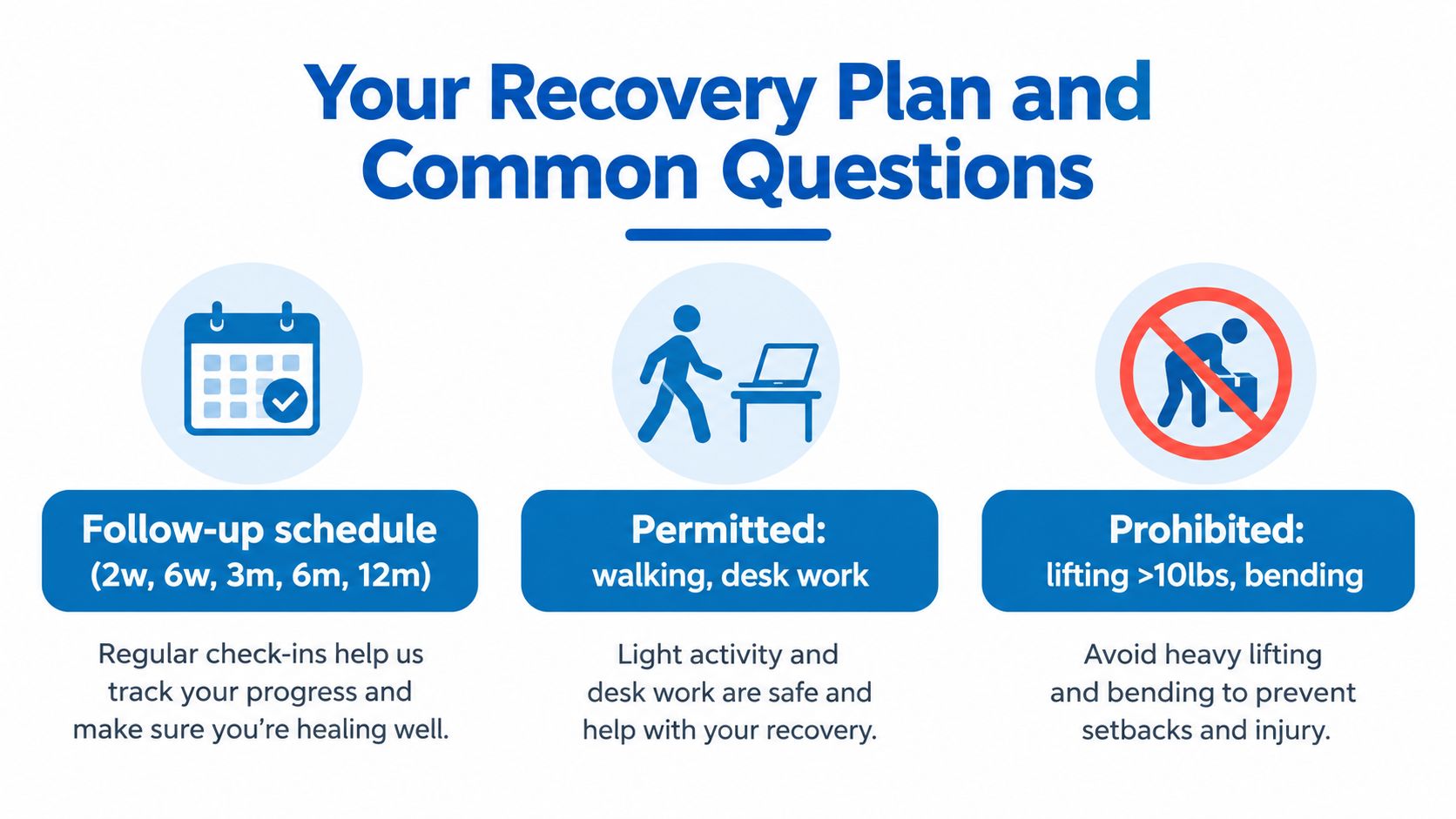
A useful appointment checklist keeps recovery specific:
- Follow-up schedule: The patient should confirm when clinical examinations and imaging are expected.
- Activity limits: The surgeon should identify permitted movements, prohibited loads, driving requirements, and work restrictions.
- Therapy plan: The patient should ask when outpatient rehabilitation begins and which exercises are appropriate.
- Medication taper: Strong pain medicine should be reduced only according to the prescribing plan.
- Nicotine plan: Any nicotine use should be disclosed and cessation support arranged.
Questions patients often forget
When can the patient shower? The answer depends on the dressing, incision, and surgeon's instructions. Bathing or soaking usually requires separate clearance.
When can the patient sleep on the side? Side-lying may be comfortable with support between the knees, but the incision and movement restrictions determine when it is appropriate.
When can sexual activity resume? It should wait until pain is controlled and movements can remain within the approved range, without forceful bending, twisting, or extension.
When can the patient fly? The surgical team should assess wound status, mobility, medication needs, and the ability to move safely during travel.
When can a patient lift a toddler? Childcare often requires repeated lifting and twisting, so clearance should be based on the actual task rather than a general return-to-work date.
Will hardware need removal? Usually not, unless the surgeon identifies a specific clinical reason.
A written symptom log can capture pain changes, walking tolerance, medication effects, sleep, and questions between visits. Recovery works best as an active collaboration between the patient, surgeon, therapists, and support network.
Interventional Pain Management evaluates spine and postoperative pain through coordinated pain management, orthopedic, and spine care, with treatment plans matched to clinical findings and functional demands. Patients in New Jersey and Staten Island can visit Interventional Pain Management to discuss recovery concerns, persistent symptoms, rehabilitation needs, or the next appropriate step.