
Initial healing after wrist surgery takes about 6 weeks, but most patients continue improving for 3 to 12 months, depending on the procedure. The wrist may be safe for carefully chosen daily tasks before it has regained normal movement, endurance, or strength.
A patient often reaches the first follow-up appointment with a protected wrist, swollen fingers, and a long list of questions. The numbness has faded, sleep may be uncomfortable, and the cast or splint can make ordinary tasks feel surprisingly difficult. The most common question is simple: when will the wrist feel normal again?
The answer depends on what “recovered” means. Bone healing, comfortable movement, grip strength, and the ability to perform demanding work don't return on the same day. NHS guidance for surgically treated distal radius fractures describes about 6 weeks for initial bone healing, followed by another 6 weeks for the bone to become almost as strong as before. Full normal hand use can sometimes take 6 to 12 months. NHS guidance on fractured wrist recovery after surgery
Practical rule: A cast coming off means the wrist is ready for a new stage of rehabilitation. It doesn't mean the entire recovery is finished.
For patients arranging support with washing, dressing, meals, medication, or safe movement at home, a practical guide to post-operative care at home Dubai can help families plan the early period. The central message remains steady: wrist operation recovery time is a phased journey, not a single appointment or date.
Table of Contents
- What to Expect During Your Wrist Surgery Recovery
- The Three Phases of Wrist Healing
- Recovery Timelines by Wrist Procedure Type
- Week-by-Week Recovery Milestones
- Why Function Lags Behind Bone Healing
- Factors That Speed Up or Slow Down Recovery
- Returning to Work and Sports After Wrist Surgery
- When to Consult Interventional Pain Management Specialists
What to Expect During Your Wrist Surgery Recovery
A patient with surgery on the dominant wrist may expect pain to settle as soon as the repair is complete. Instead, the fingers can move slowly, the hand may remain swollen, and the surgeon's restrictions can feel stricter than expected. It is natural to wonder whether recovery is unusually slow.
That concern deserves a clear explanation. Early recovery often feels uneven because swelling, poor sleep, medication effects, stiffness, and anxiety can change from day to day. A good morning does not show that the wrist is ready for lifting. A difficult afternoon does not automatically signal a problem.
Recovery has separate milestones
Biological healing comes first. The bone, repaired tissue, and incision need protection while they recover. Functional mobility develops through gradually guided movement of the wrist and forearm. Strength, coordination, endurance, and confidence usually return later, like separate parts of the same repair gradually becoming usable again.
For distal radius surgery, patient guidance describes about 6 weeks for initial bone healing, followed by another 6 weeks for the bone to become almost as strong as before. Full normal hand use may take 6 to 12 months for some patients. The staged NHS recovery guidance helps clarify why removing a splint marks one checkpoint rather than the end of recovery.
The operation itself also shapes the timetable. A minimally invasive procedure may permit earlier everyday use than fracture fixation. Repairs involving the joint surface or several structures may need longer protection. The therapist also considers work demands, hobbies, hand dominance, pain response, and how safely the patient can follow restrictions.
Small, consistent choices support progress. Keep follow-up appointments, protect the surgical site, move the fingers when instructed, and ask before changing exercises. For families arranging help with washing, dressing, meals, medication, or safe movement at home, this guide to post-operative care at home Dubai can help with planning.
Early activity can limit stiffness, provided it is the right activity at the right stage.
The Three Phases of Wrist Healing
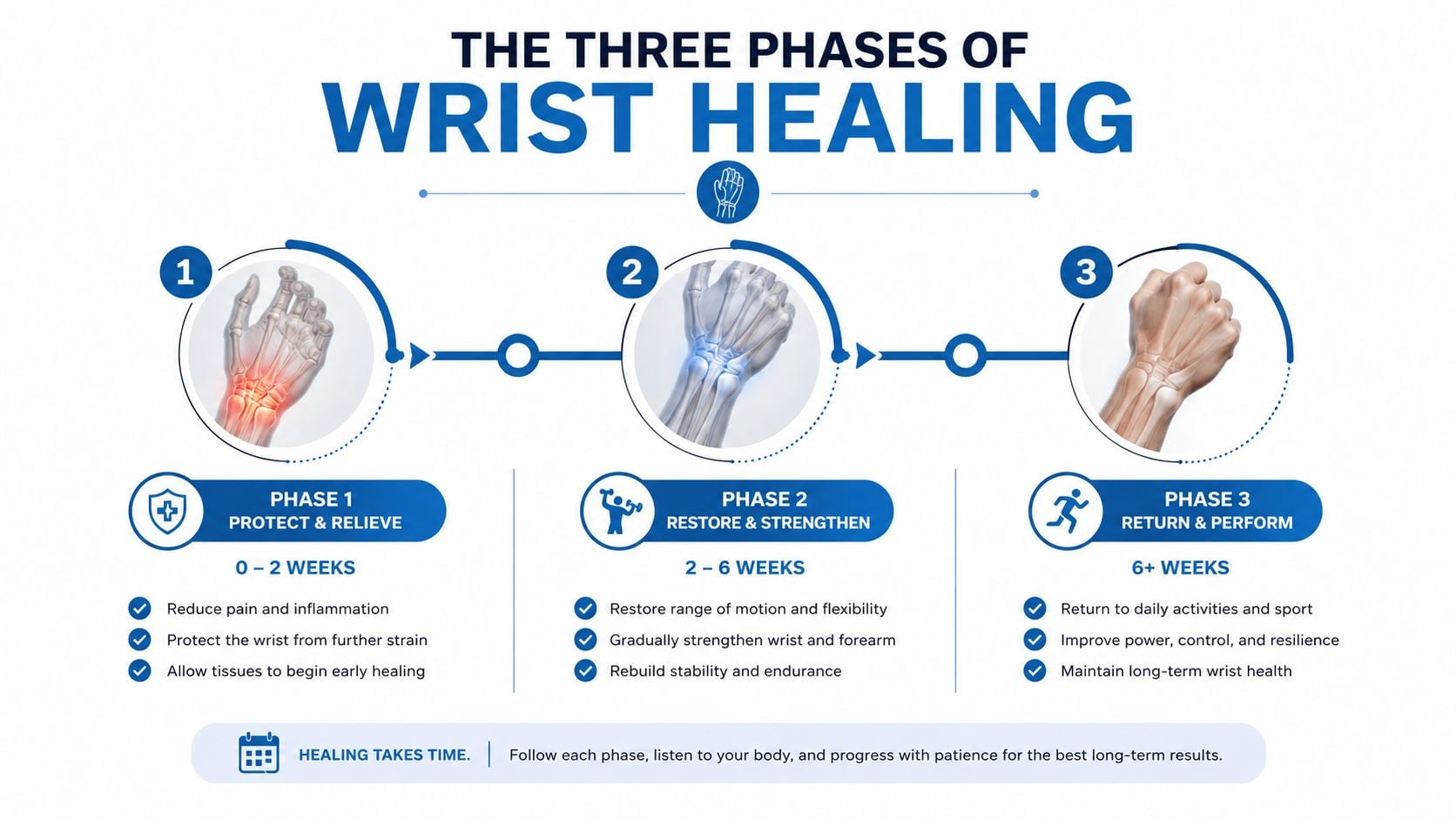
Wrist recovery follows several tracks at once. The wound may close before the bone or repaired tissue can tolerate force, and strength may remain limited after movement improves. Understanding these phases helps set expectations: biological healing, useful mobility, and full performance return on different timelines.
Phase one protects the repair
From surgery through approximately 6 weeks, the priority is protecting the repair while early healing begins. The incision settles, swelling gradually reduces, and the bone or repaired tissue starts developing stability. Finger and elbow movement may be encouraged, while lifting, forceful gripping, and loading through the wrist remain restricted.
Some hospital guidance recommends elevation during the first 72 hours and early finger motion. The wrist itself still needs protection. Royal Cornwall Hospitals' wrist fracture guidance shows why keeping the fingers active does not mean placing stress on the healing wrist.
Pain and swelling can fluctuate during this phase. A better day does not necessarily mean the repair is ready for heavier use. Follow the surgeon's restrictions, because the outside appearance of the wound cannot show how secure the deeper tissues are.
Phase two restores controlled movement
Between 6 and 12 weeks, the clinician may allow more wrist motion and introduce carefully graded strengthening. The fracture is becoming more secure, although injuries involving the joint surface may still require avoiding weight bearing until week 10 to 12, as described in rehabilitation guidance.
Therapy may address wrist flexion and extension, forearm rotation, tendon glide, swelling control, scar mobility, and practical tasks. The goal is steady movement without provoking a flare-up. Progress resembles reopening a stiff hinge gradually, rather than forcing it fully open at once.
For broader background on fracture care, this fracture treatment resource provides additional context. Wound recovery also follows stages, and the Hyperbaric business solutions wound guide helps explain why surface closure and deeper tissue recovery may not occur together.
Phase three rebuilds performance
From about 3 months through a full year, rehabilitation shifts toward strength, dexterity, endurance, and demanding function. Range of motion may continue improving, while grip strength and tolerance for sustained work take longer to return. Repeated, appropriate use helps the wrist adapt to real-life demands during this remodeling phase.
Recovery Timelines by Wrist Procedure Type
A patient may be able to use the fingers comfortably while the wrist still needs protection. That difference explains why wrist operation recovery time varies by procedure and why biological healing, movement, and strength should be judged separately.
A wrist arthroscopy uses small incisions and may follow a shorter early course than surgery for a complex fracture. Carpal tunnel release follows the incision's healing and the nerve's response. A fusion changes the goal altogether. Because the joint is intentionally made rigid, “full recovery” means reduced pain and dependable hand use, not restored wrist bending.
Published guidance describes wrist arthroscopy recovery as usually about 6 weeks, while distal radius fracture protocols may allow about 3 months for complete healing. Another postoperative source notes that a splint may stop after 6 weeks, while full recovery can take up to a year. These time points are guideposts, not automatic permission to increase activity. A procedure-focused overview of wrist surgery recovery
Comparison table
| Procedure | Initial Healing | Return to Daily Activities | Full Recovery |
|---|---|---|---|
| Wrist arthroscopy | Often a shorter early course, commonly described around 6 weeks | Light use may return as symptoms settle and the surgeon permits | Depends on the condition treated and may extend beyond early healing |
| Carpal tunnel release | The incision and nerve symptoms recover on separate patterns | Gentle daily use usually progresses with wound comfort and nerve response | Tingling, sensation, and grip may continue changing after the incision settles |
| Distal radius fracture fixation | Initial bone healing commonly takes about 6 weeks | Normal activities often build through the 8 to 12 week window | Strength and hand use may continue improving for 6 to 12 months |
| TFCC repair | The repaired soft tissue and forearm rotation require protection | Activities return gradually under a procedure-specific protocol | Recovery depends on tissue healing, motion, and loading demands |
| Wrist fusion | The wrist joint requires a longer protected healing period | Daily tasks return through adaptation rather than restored wrist bending | The fused joint no longer provides normal wrist motion, although function may improve |
For nerve-compression surgery, this carpal tunnel syndrome treatment information explains why symptom improvement may follow its own pattern. The operating clinician remains the right source for an individualized schedule. Procedure details, fixation stability, imaging, and work demands can change each milestone, so use the table for orientation rather than as permission to advance activity.
Week-by-Week Recovery Milestones
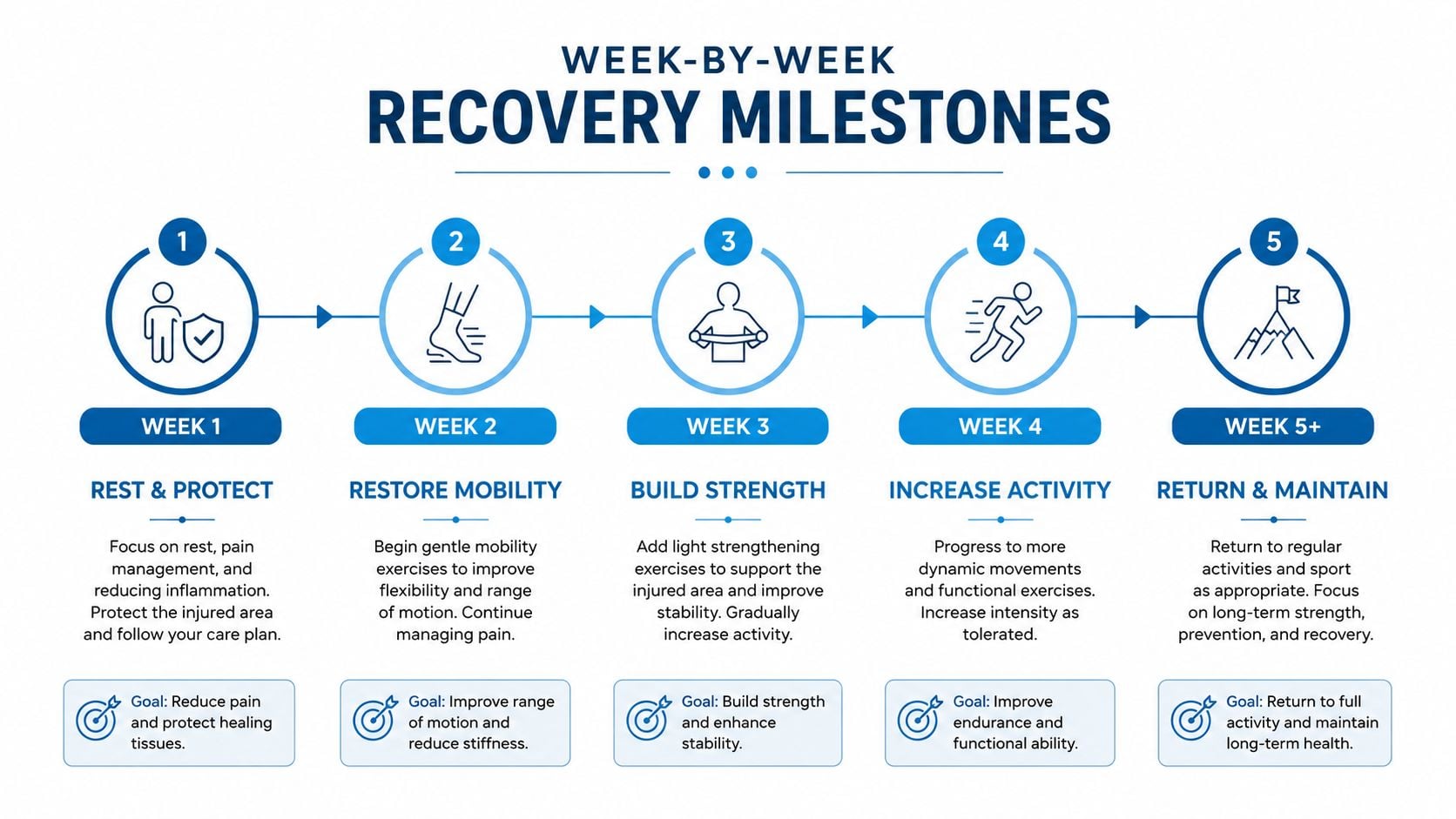
A wrist can feel better before it is ready for normal loading. You may move your fingers comfortably, then notice swelling after therapy or a busier day. Recovery often advances in steps rather than a straight line. This roadmap applies most closely to distal radius fracture surgery, while the operating team may adjust it for the procedure, fixation, and healing response.
The early checkpoints
At the first postoperative visit, the team checks the incision, swelling, sensation, finger movement, and splint or dressing. You should leave knowing which movements are encouraged, which positions need protection, and which loads remain prohibited.
During weeks 1 and 2, priorities usually include moving the fingers, elevating the hand, protecting the wound, and controlling pain. Stitch or dressing decisions depend on the incision and the surgeon's protocol. Good finger movement does not mean the wrist is ready to move freely or bear weight.
During weeks 2 to 6, some patients change to a removable brace and begin guided hand therapy. Gentle wrist motion may start once the repair has enough protection. Lifting restrictions still apply. Reduced pain shows improving comfort, not necessarily enough bone stability for forceful use.
Later milestones
Around week 6, many patients have about 50% of normal wrist motion. Motion often improves most between 2 weeks and 3 months, so this checkpoint marks continued rehabilitation rather than the end of recovery. Clinical findings on motion and grip recovery after volar plate fixation help explain why biological healing, mobility, and strength return on different schedules.
From weeks 6 to 12, therapy commonly shifts from gaining movement toward rebuilding strength and practicing useful tasks. Depending on your goals, assessment may include opening a container, typing, dressing, carrying a light object, or rotating the forearm.
At 3 months, many patients have regained much of their hand and wrist motion and strength, yet demanding work can still reveal fatigue or weakness. By 12 months, grip strength may be close to normal, although pain and function may not be completely normal for everyone. The safer guide is movement quality and task tolerance, not the calendar alone.
Why Function Lags Behind Bone Healing
A follow-up scan may show that the repaired bone is becoming stable, while everyday tasks still feel surprisingly difficult. Bone union answers whether the structure is healing. It does not show whether the wrist can rotate a key, support a pan, grip a tool, type through a work period, or tolerate repeated force.
A house offers a useful comparison. The frame can be secure while the flooring, fixtures, wiring, and finishing work remain incomplete. In the wrist, swelling, scar tissue, tendon glide, joint stiffness, muscle weakness, altered sensation, and reduced coordination may continue after the bone has united.
Movement returns before endurance
A published postoperative series found that wrist motion improved most between 2 weeks and 3 months, with additional gains continuing to 12 months. Grip strength was expected to approach normal by one year, although pain and function were still not fully normal for every patient then. The postoperative range-of-motion and grip-strength findings explain why bone healing is only one milestone in recovery.
This delay can feel discouraging. You may hear that the fracture is healing and still struggle to fasten clothing or hold a kettle. That experience usually signals entry into the longer phase of rebuilding practical capacity, rather than a surgical failure.
Therapy has a specific purpose
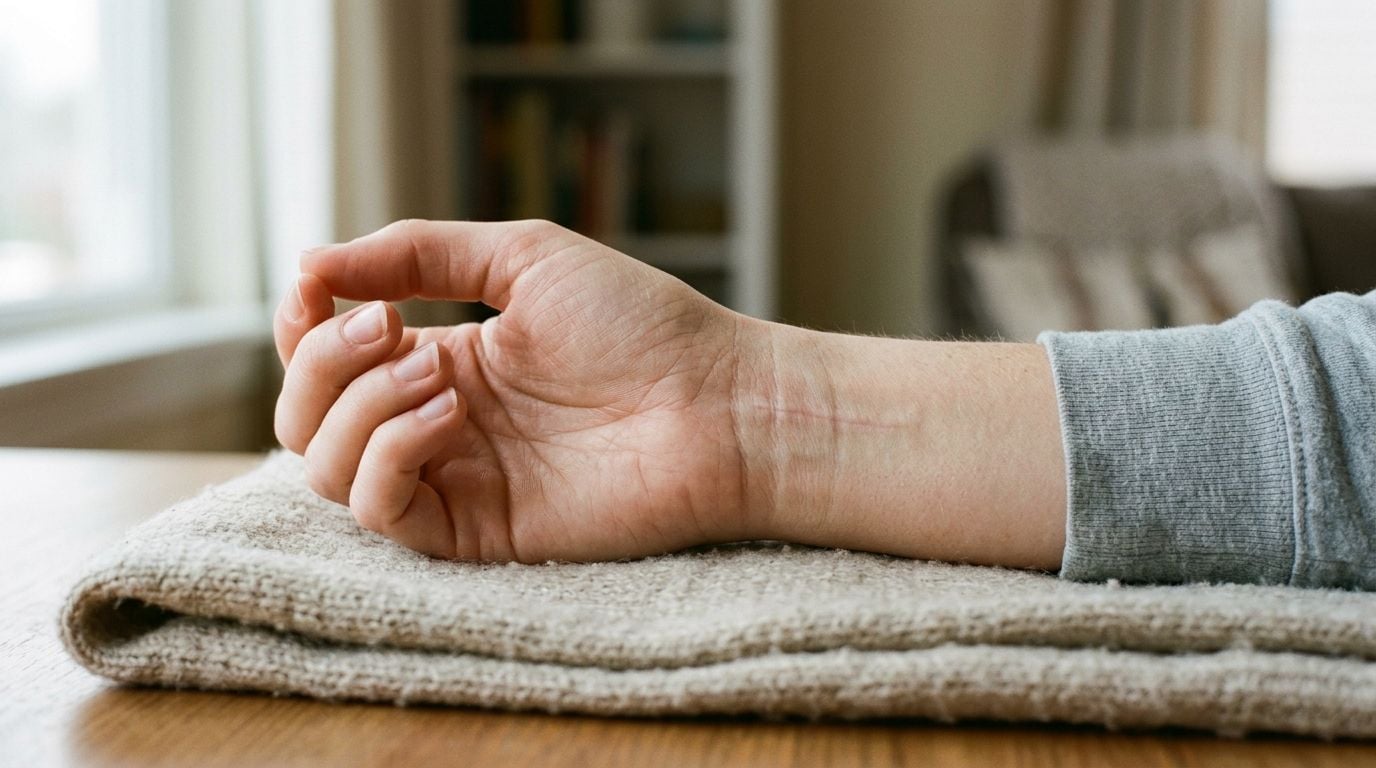
Hand therapy helps restore abilities that bone healing cannot rebuild by itself. Your therapist may address swelling, scar mobility, joint motion, tendon movement, grip, dexterity, and control during specific tasks. Progress must stay gradual. Too much loading can increase pain and swelling, while too little movement can reinforce stiffness.
The wrist can be biologically healed and functionally unfinished.
Use task tolerance as a practical checkpoint. Can the wrist perform the required activity repeatedly, safely, and without a prolonged reaction afterward? That answer often gives a clearer picture of recovery than the scan or calendar alone. Recovery is a phased journey: stability develops first, mobility follows, and endurance and strength take longer to rebuild.
Factors That Speed Up or Slow Down Recovery
Wrist recovery rarely follows a single timetable. The fracture pattern, joint involvement, fixation method, tissue damage, bone quality, general health, and the operation itself can change how quickly biological healing progresses. Protection, follow-up care, smoking status, and participation in prescribed therapy are factors you can influence.
Actions that support steady progress
- Control swelling: Keep the hand raised and use ice as directed. Less swelling can make finger movement and therapy more comfortable.
- Move permitted joints: Early movement of the fingers and elbow helps preserve mobility while the wrist remains protected.
- Respect loading restrictions: A wrist may feel comfortable before the repair is ready for force. Increase lifting and weight bearing only after clinical clearance.
- Attend therapy: A hand therapist can adjust exercises as stiffness, pain, scar sensitivity, or weakness changes.
- Support general health: Balanced nutrition, adequate hydration, smoking cessation, and good management of conditions such as diabetes support healing.
- Protect the incision: Follow wound-care instructions and report increasing redness, drainage, or fever so problems can be assessed early.
These measures support the biological phase of recovery, but they do not make strength return immediately. Healing is more like rebuilding a bridge: the structure must first become stable, then movement and load can be added in stages.
Symptoms that need assessment
Mild soreness, stiffness, and swelling can occur during rehabilitation, particularly after a new exercise. Symptoms that steadily worsen need clinical review. Increasing numbness, unusual changes in color or temperature, severe disproportionate pain, loss of finger movement, or possible infection should not be treated as ordinary healing.
Complex regional pain syndrome, nerve irritation, tendon problems, and persistent stiffness each require individualized assessment. Do not change medication, begin weight bearing, or push through increasing pain without speaking with the surgical or therapy team.
A useful plan follows two tracks. One records expected milestones. The other records warning signs and identifies who to contact if recovery changes.
Returning to Work and Sports After Wrist Surgery
A keyboard-based job and a construction job may follow very different recovery paths. Someone who types, answers calls, or reads documents may return to modified duties while the wrist remains weak. Someone who uses tools, lifts materials, pushes equipment, or repeatedly twists the forearm needs the wrist to handle force safely.
Light desk or computer work may resume within days to 2 to 3 weeks after distal radius surgery, if pain, swelling, wound care, and comfort permit. Manual labor commonly requires at least 6 weeks, and often 3 months or longer, because the wrist must tolerate lifting and loading rather than resting on a desk. Task-based recovery guidance after distal radius fracture surgery
Return by demand, not by job title
A staged work return could start with shorter computer sessions, voice input, or tasks requiring a lighter grip. A manual worker may need temporary limits on lifting, pushing, pulling, climbing, vibration, and repeated rotation. The surgeon, therapist, employer, and patient can turn examination findings and daily function into specific duties.
Sports follow the same principle. Cycling places weight through the handlebars. Swimming requires repeated wrist and shoulder coordination. Contact sports expose the repair to impact, while weightlifting and racquet activities require grip, rotation, and load tolerance. Begin with a controlled version of the activity, then increase duration, speed, or resistance only when symptoms remain settled.
Fear of reinjury is common and deserves a practical plan. Written steps can make progress easier to judge, but the treating team should clear each stage because the fracture pattern, repair, and imaging determine what the wrist can safely tolerate. Biological healing, mobility, and full strength do not return together, so a safe return may come before the wrist feels completely normal.
When to Consult Interventional Pain Management Specialists
A wrist that is healing may still feel stiff or weak, but discomfort should generally become easier to manage over time. Contact the surgical team promptly if pain or swelling increases, numbness worsens, finger movement becomes impossible, drainage appears, redness spreads, fever develops, or the hand becomes unusually cold or discolored. These signs can point to infection, circulation problems, nerve issues, or another complication that needs timely review.
Persistent pain does not always signal an emergency. It can come from stiffness, tendon irritation, nerve compression, hardware sensitivity, changed movement patterns, or a problem higher in the arm. An examination helps separate expected rehabilitation discomfort from a condition that needs additional treatment. The clinician may review the operation details, imaging, hand movement, sensation, swelling, and how symptoms change during daily tasks.
When a broader evaluation helps
Interventional Pain Management and Ortho-Spine Center serves patients in New Jersey and Staten Island through pain management, orthopedics, anesthesiology, and spine surgery. A multidisciplinary assessment may help when wrist pain remains prolonged or complex, symptoms do not follow a straightforward healing pattern, or standard rehabilitation has not restored practical function.
Treatment depends on the suspected source. A nerve-related pattern may lead to discussion of a nerve block evaluation. Pain coming from another region may require a different diagnostic pathway. The practice also provides orthopedic evaluation, carpal tunnel assessment, joint care, and interventional procedures such as injections. These services do not replace urgent postoperative assessment when infection, circulation changes, or loss of movement is suspected.
Preparing for the appointment
Bring the operation report, imaging, medication list, therapy notes, and a brief record of symptom changes. Note where the pain occurs, whether gripping or rotation triggers it, where numbness travels, whether sleep is affected, how swelling changes, and which tasks remain impossible. Specific examples give the clinician a clearer picture than a pain rating alone.
The appointment should clarify the suspected pain source and the next step. That may include continued therapy, additional imaging, medication review, orthopedic follow-up, or an interventional procedure. Early communication gives the care team more time to protect function while biological healing, mobility, and strength continue on their separate timelines.
Interventional Pain Management evaluates persistent musculoskeletal and nerve-related pain through coordinated pain management and orthopedic care. Patients with severe, limiting, or difficult-to-explain wrist pain can visit Interventional Pain Management to request an evaluation and discuss an appropriate next step.