

A spinal cord stimulator placement usually starts with temporary percutaneous epidural leads under fluoroscopy, followed by permanent leads and a pulse generator when the trial succeeds; overall complications average 21.1%, with lead migration at 5.6% and infection at 3.8%. The process is deliberately staged so patients and clinicians can evaluate pain coverage before committing to a permanent system.
A patient may reach this decision after months or years of back, leg, neck, or nerve pain that hasn't settled with medication, physical therapy, injections, or surgery. The pain may feel burning, electric, shooting, or numb, and even ordinary activities such as standing, sleeping, or walking can become carefully planned events. Spinal cord stimulation doesn't repair every source of pain, but it can change how pain signals are processed and help selected patients regain function.
Understanding the journey matters as much as understanding the device. Placement involves evaluation, a temporary trial, a decision about permanent implantation, recovery precautions, programming, and long-term follow-up. Each stage gives the care team information that can improve the next decision.
Table of Contents
- Understanding Spinal Cord Stimulation Therapy
- The Two-Stage Placement Process Explained
- Trial Versus Permanent Implantation Pathways
- Understanding Risks and Complication Rates
- Protecting Your Leads and Optimizing Outcomes
- Making the Decision With Your Pain Management Team
Understanding Spinal Cord Stimulation Therapy
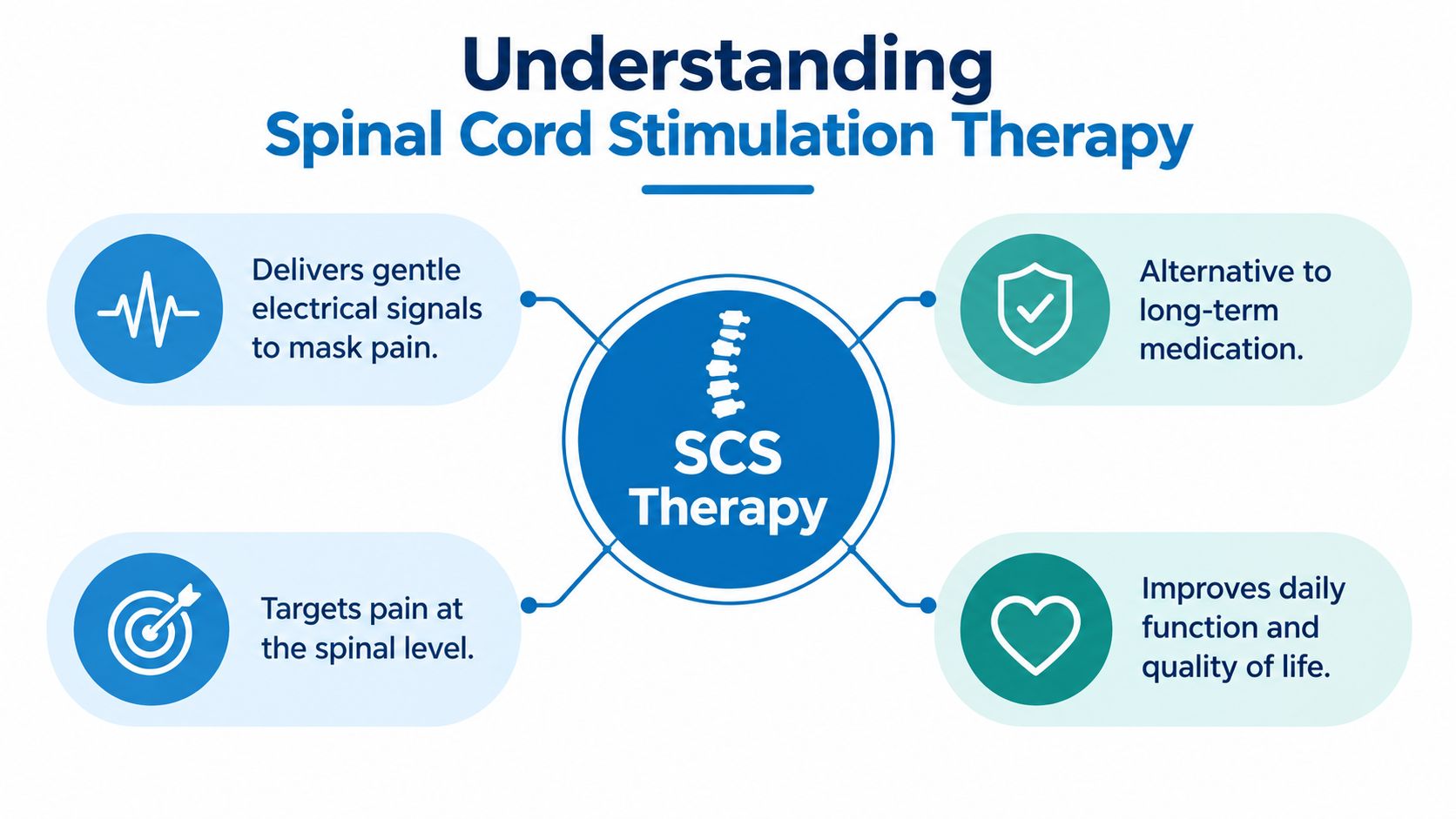
A patient with persistent nerve pain may describe the experience as a faulty alarm system. The original injury or surgery happened months or years earlier, yet the nervous system continues sending danger signals even after the tissues have healed. Medication can quiet those signals throughout the body, while an operation may correct a structural problem. A spinal cord stimulator takes a different approach by delivering carefully controlled electrical signals near the spinal cord.
How neuromodulation changes pain processing
The spinal cord acts as a communication pathway between the body and brain. Leads placed in the epidural space deliver stimulation near neural structures involved in pain signaling. A useful analogy is a gate controller. Instead of removing the source of every painful sensation, stimulation can interfere with how strongly pain messages travel upward, making those messages less dominant in the brain's interpretation.
Modern systems can be programmed and adjusted as symptoms change. Some patients notice a masking sensation, while others experience pain reduction without a noticeable sensation. The goal isn't only to create an electrical feeling. The goal is to improve meaningful activities, such as walking, sleeping, working, or participating in rehabilitation.
Spinal cord stimulation is especially relevant to neuropathic pain, which can arise from irritated or injured nerves. It may also be considered for persistent pain after spine surgery, certain forms of limb pain, and other chronic pain patterns when a careful evaluation supports the treatment. It isn't an automatic substitute for diagnosing compression, instability, infection, cancer, or other conditions that may require a different intervention.
Why the therapy has a long clinical history
Spinal cord stimulation has developed over nearly six decades. In 1967, Norman Shealy, Thomas Mortimer, and James Reswick reported treating pain in a patient with terminal cancer using a surgically placed electrode over the spinal cord's dorsal columns. Commercial devices became available in 1968, and the U.S. Federal Medical Device Act of 1976 gave the Food and Drug Administration authority to regulate medical devices. The FDA established implanted spinal cord stimulators for pain relief as Class II devices between 1978 and 1979, while fully implantable pulse-generator systems received approval between 1981 and 1984. These milestones are documented in the history of spinal cord stimulation and device regulation00112-0/fulltext).
That history explains why contemporary spinal cord stimulator placement is more than inserting a small battery and wires. Patient selection, imaging, sterile technique, stimulation testing, lead fixation, programming, and long-term device surveillance all matter. A detailed overview of treatment considerations is available through spinal cord stimulation care.
The Two-Stage Placement Process Explained
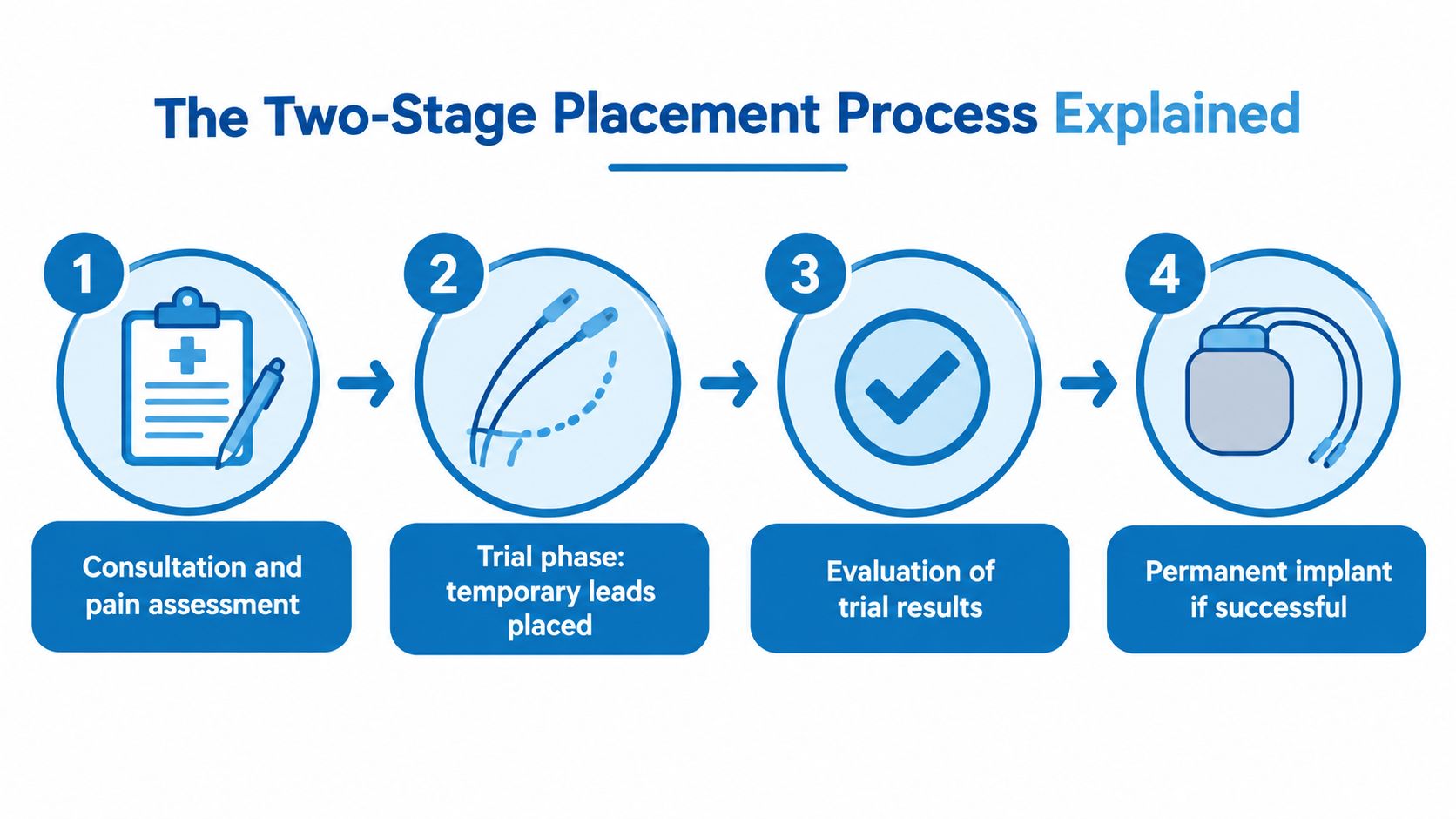
The standard pathway resembles testing a signal before installing permanent equipment. A clinician first identifies the pain pattern and a likely neural target, then uses a temporary system to determine whether stimulation provides useful coverage. If the trial is successful, permanent leads and a pulse generator can be placed.
Stage one involves a temporary trial
Before the procedure, the pain specialist reviews symptoms, previous treatments, medical history, medications, imaging, physical findings, and functional goals. The team also considers whether untreated structural disease, uncontrolled medical problems, bleeding risk, infection risk, or psychological factors could affect safety or the interpretation of the trial.
During the trial, a clinician generally advances one or more percutaneous leads through a Tuohy needle into the posterior epidural space. Continuous fluoroscopy helps guide the needle and lead. The leads sit between the dura and the vertebral canal, near the dorsal columns but outside the fluid-filled intrathecal space. The lead is advanced toward the vertebral level that best corresponds to the pain distribution.
A lower-extremity or axial pain pattern often directs attention toward the midthoracic region, approximately T8 to T10, although the final position must be individualized and confirmed with imaging and stimulation testing. The body's anatomy, prior surgery, scar tissue, stenosis, and the exact pain map can all affect the ideal location.
The external generator connects to the temporary lead. During testing, the clinician adjusts stimulation while the patient describes whether the painful area is being covered. This resembles tuning a radio. A signal that is close to the correct frequency may still sound unclear, and a lead that is close to the desired neural territory may still require repositioning or programming changes.
Stage two creates the permanent system
A successful trial doesn't mean every symptom disappears. The team usually looks for meaningful improvement in pain and function, along with a result that the patient considers worthwhile. If the trial provides inadequate or poorly distributed coverage, the result becomes useful information rather than a personal failure. The clinician may reassess the diagnosis, lead position, programming options, or another treatment pathway.
Permanent implantation places the leads in a selected epidural position and connects them to an implantable pulse generator under the skin. The generator may be positioned in an area that accommodates the patient's body shape, comfort, daily movements, and charging or device-access needs. The leads and extension pathway are secured to reduce tension during healing, and final lead position is documented with imaging.
Recovery instructions vary with the technique and medical history. Patients commonly need to protect the incisions, avoid unnecessary strain, attend programming visits, and report changes promptly. Guidance on showering, driving, lifting, bending, twisting, and returning to work should come directly from the treating team rather than from a generic timetable. The spinal instrumentation service addresses a different category of spine care, but the same principle applies: the procedure must be matched to the patient's anatomy and clinical problem.
Trial Versus Permanent Implantation Pathways
The temporary trial and permanent implant answer different questions. The trial asks, “Does stimulation provide useful coverage for this patient's pain?” Permanent implantation asks, “Is the expected benefit sufficient to justify living with an implanted system and its ongoing care?”
| Pathway | Main purpose | What the patient and clinician evaluate |
|---|---|---|
| Temporary percutaneous trial | Test whether stimulation helps | Pain coverage, functional change, comfort, lead position, and ability to manage the external generator |
| Permanent implantation | Provide ongoing therapy | Durable lead placement, generator location, programming options, wound healing, and long-term maintenance |
| Reassessment after an inconclusive trial | Avoid an unnecessary implant | Diagnosis, pain distribution, technical positioning, expectations, and alternative treatments |
| Selected permanent trial | Address circumstances in which a conventional trial may be unreliable or unsafe | Whether a more definitive test is appropriate despite additional procedural considerations |
Percutaneous trial leads are less invasive than an open surgical approach. Evidence from a systematic review and meta-analysis found that percutaneous implantation was associated with fewer medical-related surgical reinterventions and fewer infection-related explants than open implantation, although the choice still depends on anatomy, lead design, prior surgery, and the intended treatment target. The comparative evidence on percutaneous and open implantation supports a discussion of technique rather than a universal rule.
Open placement may be considered when a paddle lead or a more surgically secured lead is clinically appropriate. Prior operations, epidural scarring, narrowed anatomy, difficult access, or a need for a particular lead design can change the balance between approaches. The relevant question isn't which method sounds simpler. It's which method offers a reasonable combination of safety, access, coverage, and durability for the individual patient.
When a standard trial isn't reliable
Most patients follow the temporary percutaneous trial pathway, but selected patients may need a different strategy. Difficult anatomy, extensive epidural scarring, bleeding concerns, or concern about temporary lead movement can make a conventional trial harder to interpret.
A 2025 study of 27 patients receiving permanent trials reported that 24 patients, or 88.8%, proceeded to permanent implantation, and 16 of those 24 patients, or 66.7%, achieved at least 50% pain reduction at three months. The study involved selected, higher-risk cases and included paddle, percutaneous, and dorsal-root-ganglion trials. Its small size means the findings don't prove permanent trials are superior for routine care, but they do show why a single pathway may not fit every patient. The study of permanent trial strategies also reported complications including intracranial hemorrhage, lead fractures, migration, and cerebrospinal-fluid leakage.
Decision principle: A trial result should be judged by meaningful function and sustained benefit, not by a promise that all pain will disappear.
Understanding Risks and Complication Rates
Spinal cord stimulator placement is a medical procedure with measurable risks. The most important complications involve the device, the surgical site, or the patient's response to implantation. Discussing those risks can feel unsettling, but accurate expectations help patients recognize problems early and decide whether the likely benefit justifies the intervention.
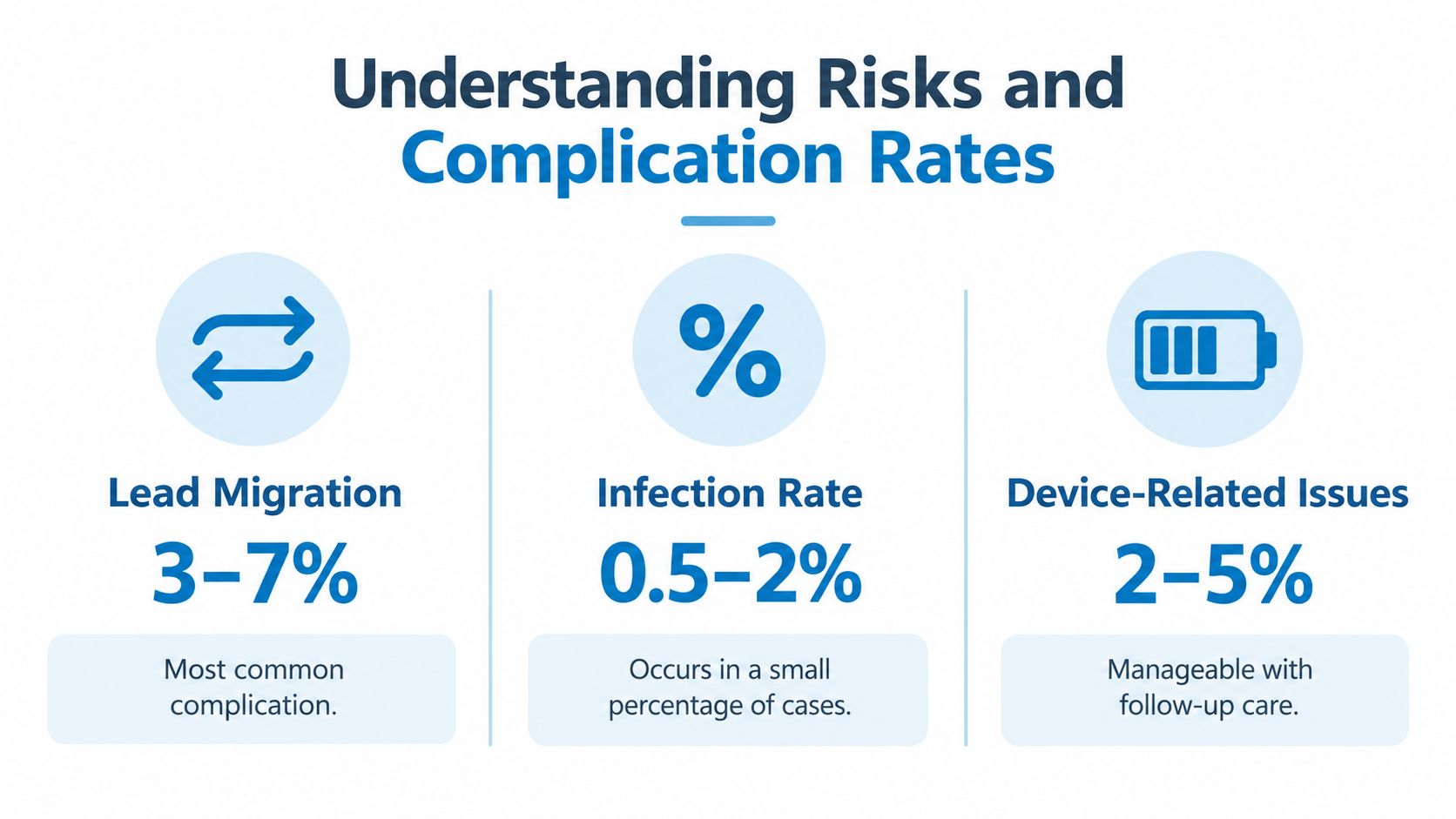
A 2021 systematic review and meta-analysis reported an overall average complication rate of 21.1%, with a 95% confidence interval of 14.9% to 27.2%. Equipment-related complications accounted for 12.1%, medical complications for 6.3%, and technical complications for 1.1%. These figures combine different patient groups, lead types, techniques, and follow-up periods, so they aren't a personal prediction for every patient.
Lead migration can change pain coverage
Lead migration means that a lead shifts from its intended position in the epidural space. Because stimulation depends on proximity to specific neural structures, even a modest change can reduce coverage, create coverage in an unwanted area, or lower the treatment's effectiveness. Migration may occur during the temporary trial or after permanent implantation, and those situations don't carry the same implications.
The same analysis reported lead migration in 5.6% of cases and infection in 3.8%. Earlier pooled evidence reported lead migration or misplacement in 12.2% of cases, including 12% for percutaneous systems and 14% for surgically implanted systems. The variation illustrates why one percentage shouldn't be treated as a universal personal risk.
A broader review of 68 studies involving more than 2,700 patients reported migration in 13.2%, making it the most frequent technical failure, compared with lead breakage at 9.1%. Contemporary retrospective series have reported percutaneous migration requiring revision in approximately 2% to 9% in some settings, suggesting that anchoring, technique, and lead design can influence outcomes. The review of lead migration and technical failure also emphasizes the limitations of comparing older systems and small cohorts with newer implantation practices.
Other complications require surveillance
Infection can affect the incision, lead pathway, or generator pocket. It may require antibiotics, drainage, device removal, or later reimplantation. Patients should report increasing redness, drainage, fever, worsening swelling, or escalating pain around the surgical site rather than waiting for a scheduled visit.
Generator-site pain is another recognized issue. Earlier pooled evidence reported generator-site pain in 9% overall, including 7% after percutaneous placement and 12% after surgical placement, while wound-related complications occurred in 5%. As with other rates, these figures depend on the population and definitions used in the underlying research.
Loss of efficacy may develop even when the device remains intact. Pain can change, the nervous system can adapt, leads can move, or programming may no longer provide the same coverage. A 2025 systematic review of 13,026 permanent implants identified loss of efficacy as the most common reason for explantation, with migration or lead failure, infection, generator-site pain, and charging or hardware problems also recurring contributors. The systematic review of explantation reasons supports realistic counseling: implantation isn't necessarily a lifetime commitment.
Protecting Your Leads and Optimizing Outcomes
Lead protection begins before the procedure. Patients can ask the clinician to explain the intended lead level, how the lead will be secured, which movements could place traction on the system, and how coverage will be tested. A clear plan makes restrictions easier to follow because patients understand what those restrictions are protecting.
During early healing, the lead and extension pathway need time to stabilize. The treating team may limit bending, twisting, stretching, lifting, strenuous exercise, or other movements that pull across the back and generator pocket. Restrictions differ according to the procedure and patient, so the surgeon's instructions should take priority over advice from friends, online forums, or general recovery checklists.

Small changes in coverage deserve attention
A patient may notice that stimulation no longer reaches the area that previously responded. Pain can return in a familiar distribution, appear outside the treatment area, or change when the patient moves. That doesn't automatically mean the lead has migrated. Programming may correct some coverage changes, while imaging and examination may be needed to identify a mechanical problem.
The practical response is to document the change. Patients can record when coverage changed, which activities provoke symptoms, whether the generator turns on normally, and whether the original pain or a new sensation has appeared. The clinician may then compare current symptoms with prior programming notes and imaging.
Practical rule: A sudden or meaningful loss of coverage should prompt a call to the implanting team, not repeated self-adjustment of the device or a return to strenuous activity.
Questions that improve lead protection
Patients can prepare for a more useful conversation by asking:
- Position: Where will the lead sit, and how will imaging confirm its final location?
- Fixation: What anchoring and strain-relief methods will protect the lead during healing?
- Activity: Which movements, exercises, work tasks, and sleep positions should be avoided temporarily?
- Coverage: How will the team distinguish a programming issue from possible lead migration?
- Escalation: When would imaging, reprogramming, or revision be considered?
- Medical care: What should other clinicians know before MRI, surgery, emergency treatment, or diagnostic procedures?
Technical choices can also matter. A recent cervical study associated more rostral lead positioning, 16-contact leads, and a superior C7 to T1 entry point with less migration, but the study involved a very small investigational upper-limb application. Those findings shouldn't be applied automatically to routine chronic-pain care. They do support a broader discussion about lead design, entry point, anatomy, and the difference between trial-lead movement and permanent-system migration.
The review of lead migration noted that most movement in the cited cervical trial participants occurred early, with measured rostrocaudal changes of 29.7 millimeters, 41.9 millimeters, 1.9 millimeters, and 16.6 millimeters. Those observations come from a small, specialized study, not a universal forecast. They reinforce the value of early precautions and prompt reporting when coverage changes.
Making the Decision With Your Pain Management Team
A strong decision starts with the pain pattern rather than the device. The clinical team needs to determine whether symptoms suggest a pain mechanism that stimulation may address, whether a structural problem needs treatment first, and whether the patient can participate in trial evaluation, recovery restrictions, programming, and follow-up.
A consultation should also define success in practical terms. Reduced pain may matter, but so may standing long enough to prepare a meal, sleeping with fewer interruptions, walking farther, returning to a valued activity, or participating more fully in rehabilitation. A trial that changes a meaningful daily task may be worthwhile even when discomfort remains.
Questions to bring to the consultation
- Suitability: What features of the pain make spinal cord stimulation reasonable, and what findings would point toward another treatment?
- Alternatives: Which medications, injections, rehabilitation strategies, behavioral approaches, or surgical options should be considered before implantation?
- Technique: Would a percutaneous or surgically placed lead be more appropriate, and why?
- Trial interpretation: What level of pain or functional improvement would count as a successful trial?
- Risk profile: How do prior surgery, scar tissue, bleeding risk, infection risk, and other health conditions affect the plan?
- Long-term care: Who handles programming, charging concerns, wound checks, imaging questions, and possible revisions?
- Future procedures: What information should be carried in the patient's device records before MRI or another operation?
The permanent system should be viewed as one part of a broader pain management program. Programming appointments can refine stimulation as the patient's symptoms and activity change, while physical rehabilitation and condition-specific care may help convert pain reduction into better movement and function.
A realistic view of long-term treatment
Spinal cord stimulation isn't guaranteed to work indefinitely. Explantation may become necessary because of inadequate benefit, infection, hardware failure, generator-site pain, charging problems, or the need for another medical procedure. Discussing those possibilities before implantation doesn't undermine hope. It gives the patient a clearer understanding of the commitment and a plan for responding if the device stops meeting its purpose.
Interventional Pain Management offers evaluation and treatment for chronic back, neck, joint, and nerve-related conditions, including image-guided procedures and spinal cord stimulation with individualized follow-up. Patients considering placement can bring their pain history, prior imaging, treatment list, functional goals, and questions about trial design to a consultation so the team can assess whether the pathway fits their medical needs.
Patients in New Jersey and Staten Island can schedule an evaluation with Interventional Pain Management to discuss spinal cord stimulator placement, alternatives, trial planning, recovery precautions, and long-term programming. A focused consultation can turn an uncertain treatment decision into a practical plan based on symptoms, anatomy, goals, and safety.