
By late afternoon, many people in New Jersey and Staten Island notice the same pattern. One leg feels heavy. The calf aches after standing. A sock leaves a deep mark at the ankle. By evening, the discomfort is easy to dismiss as overwork, age, or “just being on the feet too long.”
Then it starts happening every day.
That's the point where leg pain deserves a closer look. Vein-related leg pain can be subtle at first, and many patients assume visible veins are only a cosmetic issue. In reality, painful varicose veins often reflect a circulation problem that can be diagnosed and treated. For patients who also carry extra joint stress from weight, supportive lifestyle tools such as medical weight loss for joint pain relief can be helpful alongside a vein evaluation, especially when several sources of leg discomfort may be overlapping.
Table of Contents
- When Leg Pain Signals More Than a Pulled Muscle
- Understanding Varicose Veins and Venous Insufficiency
- Modern Minimally Invasive Vein Treatments
- Traditional Vein Surgery Ligation and Stripping
- Your Treatment Journey From Consultation to Recovery
- Finding Expert Vein Care in New Jersey and Staten Island
- Frequently Asked Questions About Vein Treatment
When Leg Pain Signals More Than a Pulled Muscle
A common story starts with a person who spends long hours at work, drives home over the bridge, and notices throbbing in the lower leg while changing clothes. At first, rest helps. Then the same aching returns the next day, along with swelling near the ankle and a feeling of heaviness that makes stairs more irritating than painful.
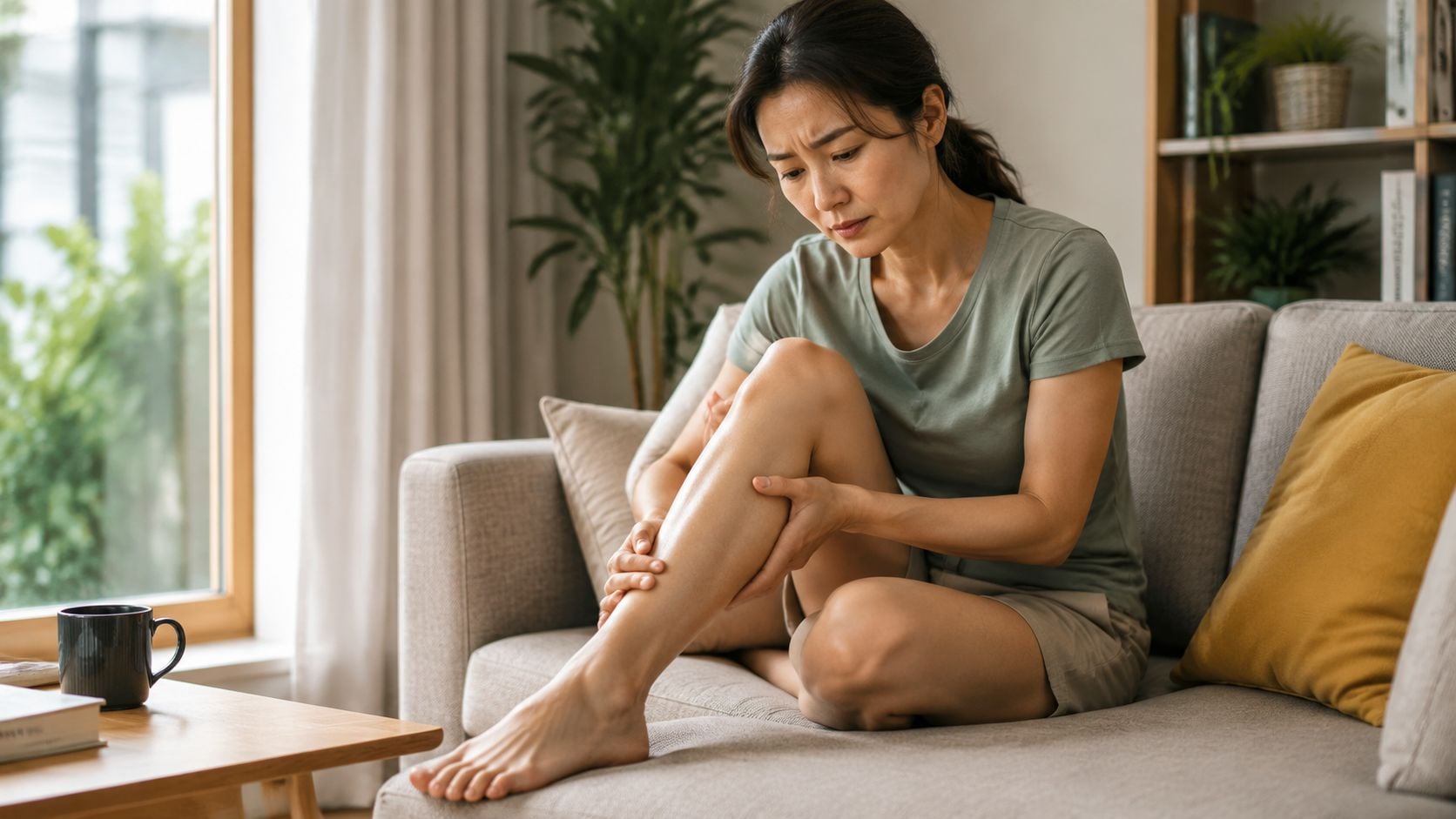
That pattern doesn't always come from a pulled muscle. Sometimes the issue is venous insufficiency, which means the leg veins aren't moving blood back toward the heart efficiently. Pressure builds in the vein, fluid can collect in the lower leg, and the result may feel like soreness, tightness, burning, or fatigue rather than “pain” in the dramatic sense people expect.
Leg pain is common enough that many patients normalize it. In the United States, 36.5% of adults experienced lower limb pain in the past three months in 2019, and chronic pain costs the country up to $635 billion annually in health care expenses and lost productivity, according to Frontiers in Public Health. Those numbers matter because they remind patients that persistent leg symptoms aren't unusual, and they also aren't something to ignore.
Clues that point beyond simple muscle fatigue
- Symptoms worsen later in the day: Vein-related discomfort often builds after standing or sitting for long periods.
- Heaviness comes with swelling: A tired muscle can ache, but ankle swelling and a tight lower leg raise more concern for circulation issues.
- Visible veins aren't the whole story: Some patients have significant symptoms before they notice bulging veins.
- Rest helps, then stops helping enough: Temporary relief after elevation is common early on.
Persistent aching with heaviness and swelling is often the moment when a cosmetic concern becomes a medical one.
For many patients, the hardest part isn't the treatment. It's recognizing that the daily ache has a name, a cause, and a realistic path toward relief.
Understanding Varicose Veins and Venous Insufficiency
Varicose veins make more sense once the veins are viewed like a plumbing system with one-way gates. Blood in the legs has to travel upward against gravity. To do that, veins rely on tiny valves that should open to let blood move up and close to keep it from slipping backward.
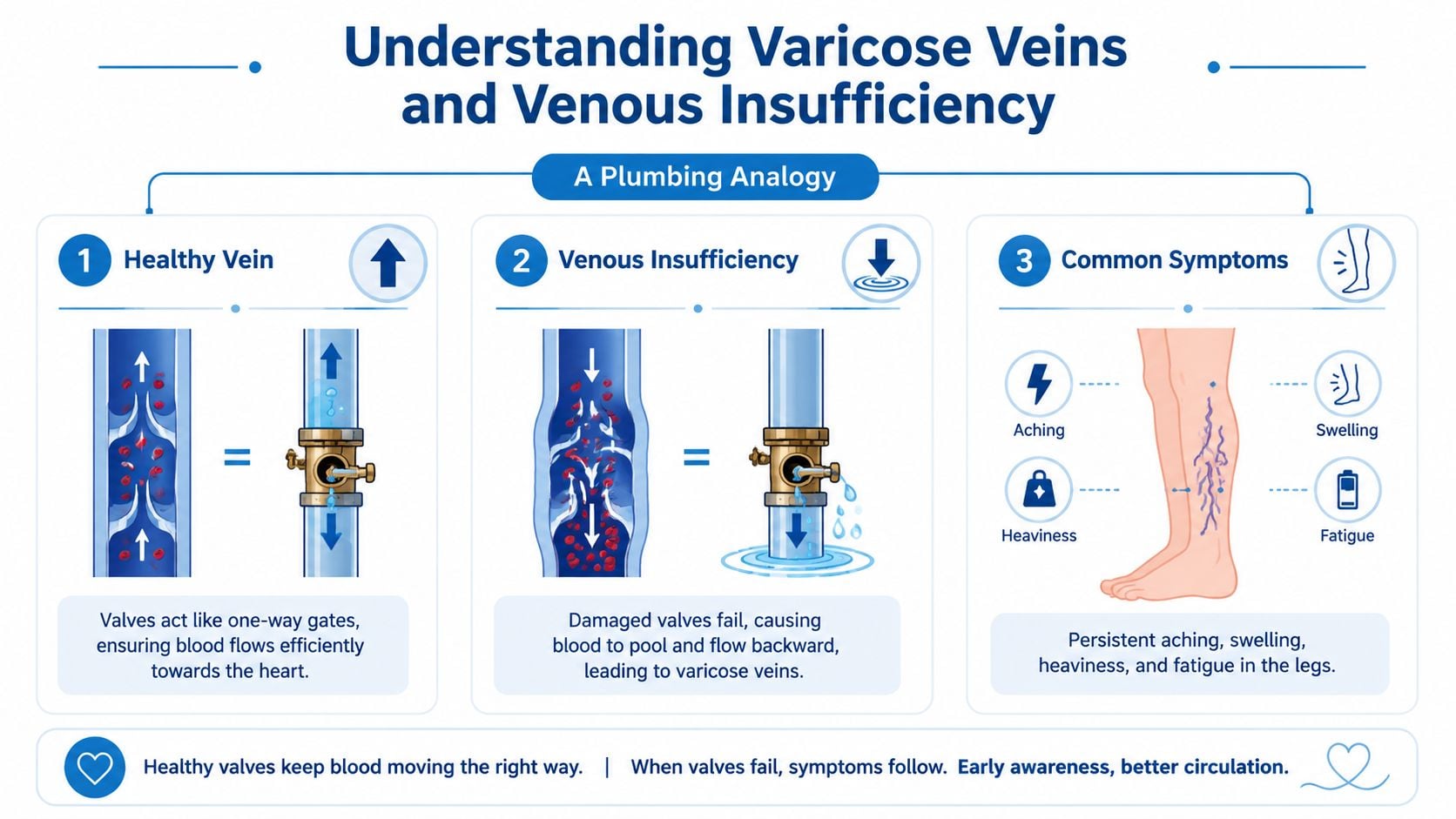
When those valves weaken, blood falls back down and pools in the leg. That problem is called venous insufficiency. Over time, the extra pressure stretches the vein wall, and the stretched vein becomes more visible, twisted, and uncomfortable. Patients who want a basic overview of compression options during this process often benefit from a practical gradient support stockings guide, since compression is commonly part of both symptom management and recovery planning.
What's actually going wrong in the vein
A varicose vein is a larger, bulging surface vein caused by abnormal pressure and faulty valve function. A spider vein is smaller and closer to the skin surface. Spider veins may be more of a cosmetic concern, while varicose veins are more likely to cause aching, throbbing, swelling, or skin irritation.
A proper vein workup looks deeper than what appears on the skin. Patients exploring varicose veins and spider veins treatment options often learn that the visible vein is only part of the story. The underlying source may be a larger vein feeding pressure into smaller surface branches.
Symptoms people often miss
Many patients expect varicose veins to be obvious. Sometimes they are. Sometimes the first complaint is that one leg feels “off.”
Common symptoms include:
- Aching or throbbing: Often worse after long periods of standing
- Leg heaviness: A dragging, fatigued sensation by midday or evening
- Cramping or restlessness: Especially at night
- Swelling: Usually around the ankle or lower calf
- Skin changes: Itching, discoloration, dryness, or tenderness over time
Practical rule: If discomfort tracks with standing, improves with elevation, and comes with visible veins or swelling, vein disease belongs on the list of possible causes.
Not every active person with leg pain has a vein problem. Some patients have orthopedic, nerve, or even vascular conditions that mimic common overuse injuries. A review in Current Physical Medicine and Rehabilitation Reports notes that leg pain content often misses the gap between routine musculoskeletal pain and less obvious vascular causes, leaving active adults unaware that they may need specialized vascular or orthopedic evaluation. That's one reason diagnosis matters more than guessing.
Modern Minimally Invasive Vein Treatments
Most patients are relieved to learn that vein treatment usually doesn't mean a hospital stay or a large incision. Modern care often centers on office-based procedures designed to close or remove malfunctioning veins while allowing blood to reroute through healthier veins nearby.
A specialist chooses the method based on vein size, anatomy, symptoms, and ultrasound findings. Patients reviewing broad vein treatment options often see several names listed together, but these treatments become easier to understand when grouped by how they work.
Heat-based closure from inside the vein
Endovenous laser ablation and radiofrequency ablation work on the same principle. A clinician places a thin catheter into the diseased vein using ultrasound guidance, numbs the area with local anesthetic, and applies heat inside the vein. The heat seals the vein shut.
This option is often a strong fit for larger superficial veins that are clearly refluxing on ultrasound.
Patients usually want answers to three practical questions:
| Treatment | How It Works | Best For | Anesthesia | Recovery Time |
|---|---|---|---|---|
| Endovenous laser ablation | Uses heat inside the vein to close it | Larger refluxing veins | Local anesthesia | Usually a quick return to walking and routine light activity |
| Radiofrequency ablation | Uses controlled thermal energy to seal the vein | Larger straight segments of abnormal vein | Local anesthesia | Usually a quick return to walking and routine light activity |
| Sclerotherapy | Injects a special solution that irritates and closes the vein | Smaller varicose veins and spider veins | Usually little or no local anesthesia beyond needle discomfort | Often minimal downtime |
| Ambulatory phlebectomy | Removes bulging surface veins through tiny skin openings | Rope-like surface veins that are easy to access | Local anesthesia | Walking the same day is common, with short-term soreness or bruising |
For many patients, the experience is more straightforward than expected. The leg is numbed, the procedure is done through a small access point, and walking afterward is encouraged.
Chemical closure for smaller problem veins
Sclerotherapy closes a vein with a medical solution injected directly into it. The solution irritates the inside of the vessel, the vein collapses, and the body gradually clears it.
This approach is commonly used for smaller varicose veins and spider veins. It can also be used as a finishing treatment after a larger underlying vein has already been treated.
A few points often reduce anxiety:
- Needle-based, not incision-based: There's no surgical cut for standard sclerotherapy.
- Best for visible surface veins: It's especially useful when the main complaint is residual branch veins.
- Gradual improvement: The vein doesn't vanish instantly. The body needs time to reabsorb it.
Some of the best results come from combining treatments, not forcing one procedure to solve every vein problem.
Tiny-incision removal for bulging surface veins
Ambulatory phlebectomy is exactly what many patients hope exists when they look at a large, raised surface vein and ask whether it can be removed. Through very small skin openings, the clinician extracts the bulging vein segments.
It's often a good choice when a vein is too prominent to respond well to injection alone, or when the source vein has already been closed and the remaining branches still protrude.
Patients tend to like this option for a simple reason. The rope-like vein is physically removed rather than left in place to shrink over time. Bruising and tenderness can occur during healing, but the procedure is still far less disruptive than traditional surgery.
Traditional Vein Surgery Ligation and Stripping
Minimally invasive treatment has changed vein care, but traditional surgery still has a place. Ligation and stripping may be considered when veins are especially large, unusually twisted, or not well suited to catheter-based treatment.
When surgery is still the right tool
In ligation, the problematic vein is tied off. In stripping, part or all of the vein is removed through surgical access points. The idea is similar to newer treatments in one important way. The goal is to eliminate the faulty vein from circulation so healthier veins can carry blood more effectively.
This isn't the first option for many patients today, but it isn't obsolete either. It's one tool among several. A careful specialist recommends it only when the anatomy and clinical picture make it the better match.
Situations that may push the discussion toward surgery include:
- Very tortuous veins: A catheter may not pass cleanly through a severely twisted vein.
- Complex anatomy: Some veins don't fit standard office-based closure techniques.
- Combined surgical planning: A patient may already be undergoing related care where a surgical approach makes sense.
How recovery differs
Compared with office-based procedures, ligation and stripping is more invasive. Recovery may involve more bruising, more soreness, and a longer return to full comfort. Some patients need more downtime from strenuous activity.
That contrast matters because many patients worry that “vein treatment” automatically means surgery. In many cases, it doesn't. When surgery is recommended, patients should hear a clear explanation of why that method fits their anatomy better than a less invasive alternative.
Your Treatment Journey From Consultation to Recovery
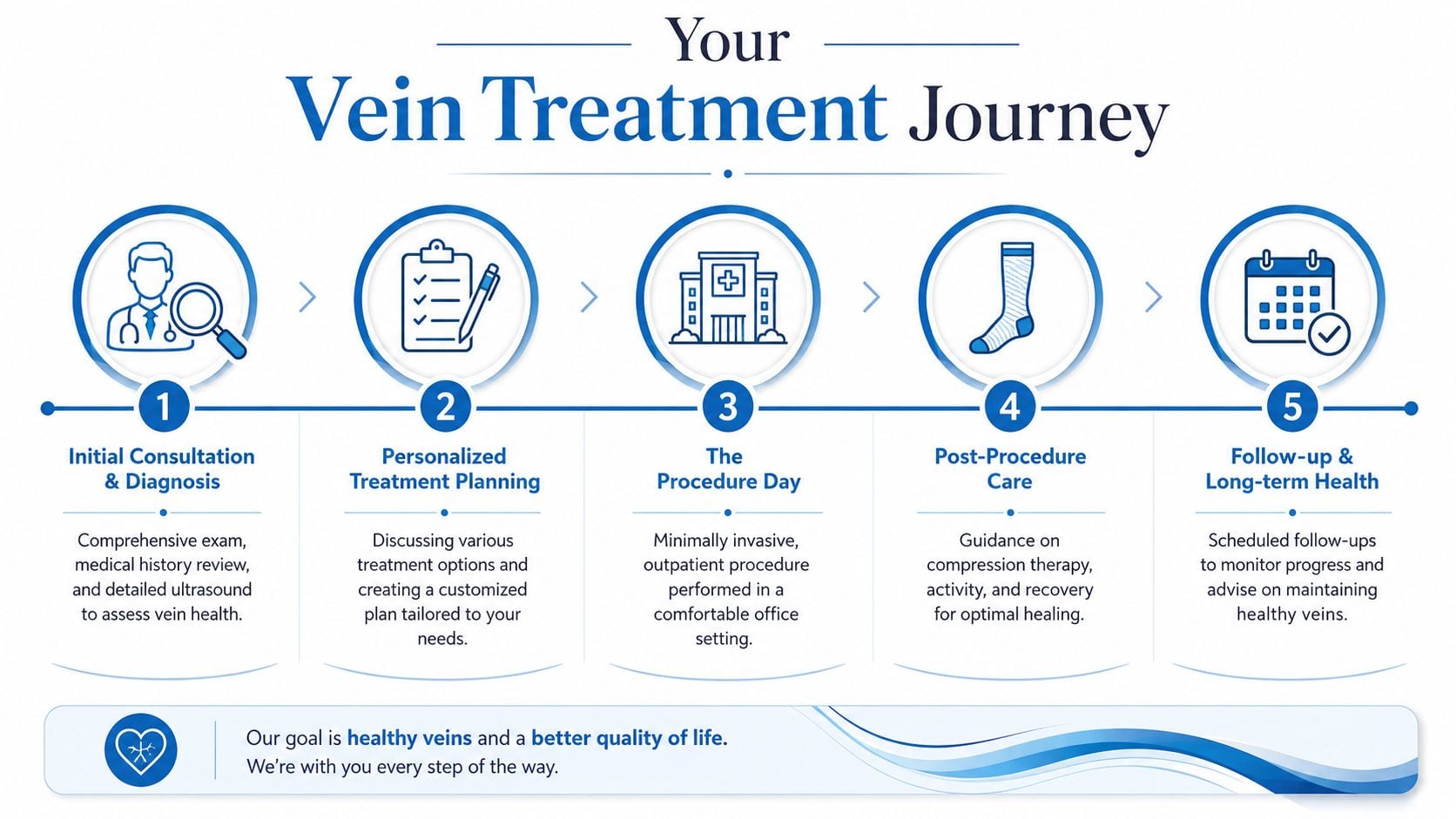
Most anxiety about vein treatment comes from uncertainty. Patients don't always worry about the medical terms. They worry about practical questions. What happens at the first visit. Will the procedure hurt. How soon can normal activity resume.
Step one getting the diagnosis right
The first visit usually starts with a conversation, not a procedure. The clinician asks when the pain started, whether swelling changes through the day, what the skin looks like, and whether symptoms worsen with standing, exercise, or sitting.
Then comes the key test for many vein patients: an ultrasound exam. This shows blood flow direction and valve function. It helps answer whether the visible vein is the true source of symptoms or just a surface sign of a deeper reflux problem.
That diagnostic step also protects patients from the wrong treatment. Lower back pain is the single leading cause of disability worldwide, and it frequently shows up as leg pain through radiculopathy or sciatica when nerve roots are compressed, according to the Global Burden of Disease study review on PubMed. In other words, not all leg pain comes from veins. Some patients need spine, orthopedic, or pain evaluation before anyone should label the problem as venous.
Step two planning and procedure day
Once the diagnosis is clear, the treatment plan becomes much easier to follow. Patients are usually told:
- Which vein is causing symptoms
- Why a specific procedure fits best
- Whether compression stockings are needed before or after treatment
- What medications or skin products to avoid right before the visit
- How transportation and timing should be handled
On procedure day, most minimally invasive vein treatments are outpatient. The leg is cleaned, mapped, and numbed. Ultrasound guides the clinician during the procedure, which helps target the right vein and avoid unnecessary treatment.
Patients often find the day less dramatic than expected:
- Check-in and marking: The vein pattern may be marked while the patient is standing.
- Local numbing: The area is anesthetized so discomfort stays manageable.
- Treatment: The catheter, injection, or tiny-incision technique is performed.
- Compression and walking: A bandage or stocking is placed, and light walking is usually encouraged soon after.
The best procedure is the one that matches the diagnosis, not the one with the most familiar name.
Step three recovery and follow-up
Recovery is usually simple, but it still requires attention. Patients often do best when they follow a short list rather than trying to guess what's normal.
A typical recovery plan may include:
- Wear compression as directed: This supports healing and helps control swelling.
- Walk regularly: Short walks promote circulation.
- Avoid prolonged stillness: Long stretches of sitting or standing can increase discomfort.
- Expect bruising or tightness: Mild tenderness, pulling, or firmness along the treated area can happen during healing.
- Keep follow-up visits: Ultrasound follow-up confirms the treated vein has closed as intended.
For New Jersey and Staten Island patients, this step matters even more when leg pain overlaps with back pain, knee arthritis, or sports injury history. A multi-specialty pathway can shorten the time between “something feels wrong” and “this is the exact reason.”
Finding Expert Vein Care in New Jersey and Staten Island
Local patients often start with one simple question. Who should evaluate leg pain when it might be veins, but might also be something else. That's an important question because the right answer isn't just “who treats veins.” It's “who can sort out veins from the many other causes of leg symptoms.”
What local patients should look for
A strong vein evaluation should include several basics:
- Board-certified physicians: Credentials matter when symptoms may cross vein, pain, spine, and orthopedic lines.
- Ultrasound-based diagnosis: A visual exam alone isn't enough for meaningful treatment planning.
- More than one treatment option: A practice should be able to explain why one procedure fits better than another.
- Clear recovery guidance: Patients need specifics on compression, activity, work, and follow-up.
- Access close to home: Convenience matters when appointments, imaging, and follow-up visits are part of care.
Patients in the region often prefer care that doesn't force them to bounce between separate offices for diagnosis, imaging, procedure planning, and related specialty referrals.
Why a multi-specialty pathway matters
Leg pain can come from veins, but it can also involve the spine, joints, nerves, or sports-related strain. In a multi-specialty setting, those possibilities can be sorted more efficiently. That's especially useful for patients who have swelling plus sciatica, visible veins plus knee pain, or symptoms that haven't responded to basic conservative care.
For Staten Island residents who want nearby access within a broader regional network, the Staten Island office location gives patients a practical starting point. For many local families, the most reassuring part of care isn't just the procedure itself. It's knowing there's a connected path if the diagnosis turns out to involve more than one problem.
Frequently Asked Questions About Vein Treatment
Will varicose veins come back after treatment
The treated vein usually doesn't return in the same way once it's successfully closed or removed. What can happen is that a patient develops new vein problems over time, especially if there's an underlying tendency toward venous insufficiency. Follow-up, compression when advised, activity, and weight management can all support longer-term vein health.
Is vein treatment covered by insurance
Coverage often depends on whether the treatment is considered medically necessary rather than cosmetic. Pain, swelling, skin changes, failure of conservative care, and ultrasound findings can all matter. The only way to know the likely coverage path is to have the symptoms documented and the veins evaluated properly.
What if a patient wants to avoid a procedure
Conservative care can help manage symptoms. That may include compression stockings, leg elevation, walking, avoiding long periods of sitting or standing, and addressing other contributors to leg strain. Those steps can be worthwhile, but they usually manage the effects of venous insufficiency rather than correcting the faulty vein itself.
Patients in New Jersey and Staten Island who are dealing with persistent leg pain, heaviness, swelling, or visible varicose veins can take the next step with Interventional Pain Management. The practice brings together board-certified physicians across pain management, orthopedics, spine, and vein care, which helps patients get a clearer diagnosis and a treatment plan that fits the actual cause of their symptoms.