

A common reader for this topic has already done the usual things. They rested the arm. They changed how they lift groceries. They tried anti-inflammatory medicine, a brace, and therapy exercises. Yet the outside of the elbow still flares when they shake hands, pour coffee, type for too long, or lift a pan from the stove.
That pattern is frustrating because tennis elbow often sounds minor, but stubborn cases can disrupt work, sleep, exercise, and ordinary chores. For some people, Elbow Embolization enters the conversation only after months of failed conservative care. It can sound unfamiliar, even a little intimidating, because it treats elbow pain through the blood vessels rather than through a cast, injection, or open surgery.
This guide is built for that exact moment of uncertainty. It explains what tennis elbow is, how doctors confirm the diagnosis, where Elbow Embolization fits among other options, what happens during the procedure, what the evidence shows, and where the evidence still has an important gap.
Table of Contents
- Introduction to Elbow Embolization and Tennis Elbow Relief
- Understanding Lateral Epicondylitis and Diagnosis
- Comparing Treatment Options for Tennis Elbow
- Procedure Steps and Mechanism of Elbow Embolization
- Risks Benefits and Outcomes of Embolization
- Decision Making for Treatment and Provider Selection
- Practice Locations Scheduling and Insurance Navigation
- Conclusion and Next Steps
Introduction to Elbow Embolization and Tennis Elbow Relief
A typical patient story goes like this. The pain started as an annoyance on the outside of the elbow after repetitive gripping, lifting, racket sports, tools, or computer work. Then the pain stopped acting small. It began showing up during simple tasks, and the person who expected it to settle down found that it kept returning.
That's where Elbow Embolization has gained attention. It's a minimally invasive, image-guided procedure used for chronic tennis elbow, also called lateral epicondylitis, especially when standard treatment hasn't provided lasting relief. Instead of cutting through tissue, the procedure targets the abnormal small blood vessels linked to chronic tendon irritation.
One reason patients ask about it is that the treatment aims at a specific pain mechanism rather than merely numbing symptoms for a short period. Another reason is practical. It's generally performed as an outpatient procedure, and recovery is usually much lighter than recovery from open surgery.
Practical rule: Elbow Embolization usually becomes relevant when elbow pain has stayed stubborn despite a reasonable trial of conservative care and the diagnosis is clear.
Not every sore elbow is a candidate. The right starting point is understanding exactly what tennis elbow is, and what it isn't.
Understanding Lateral Epicondylitis and Diagnosis
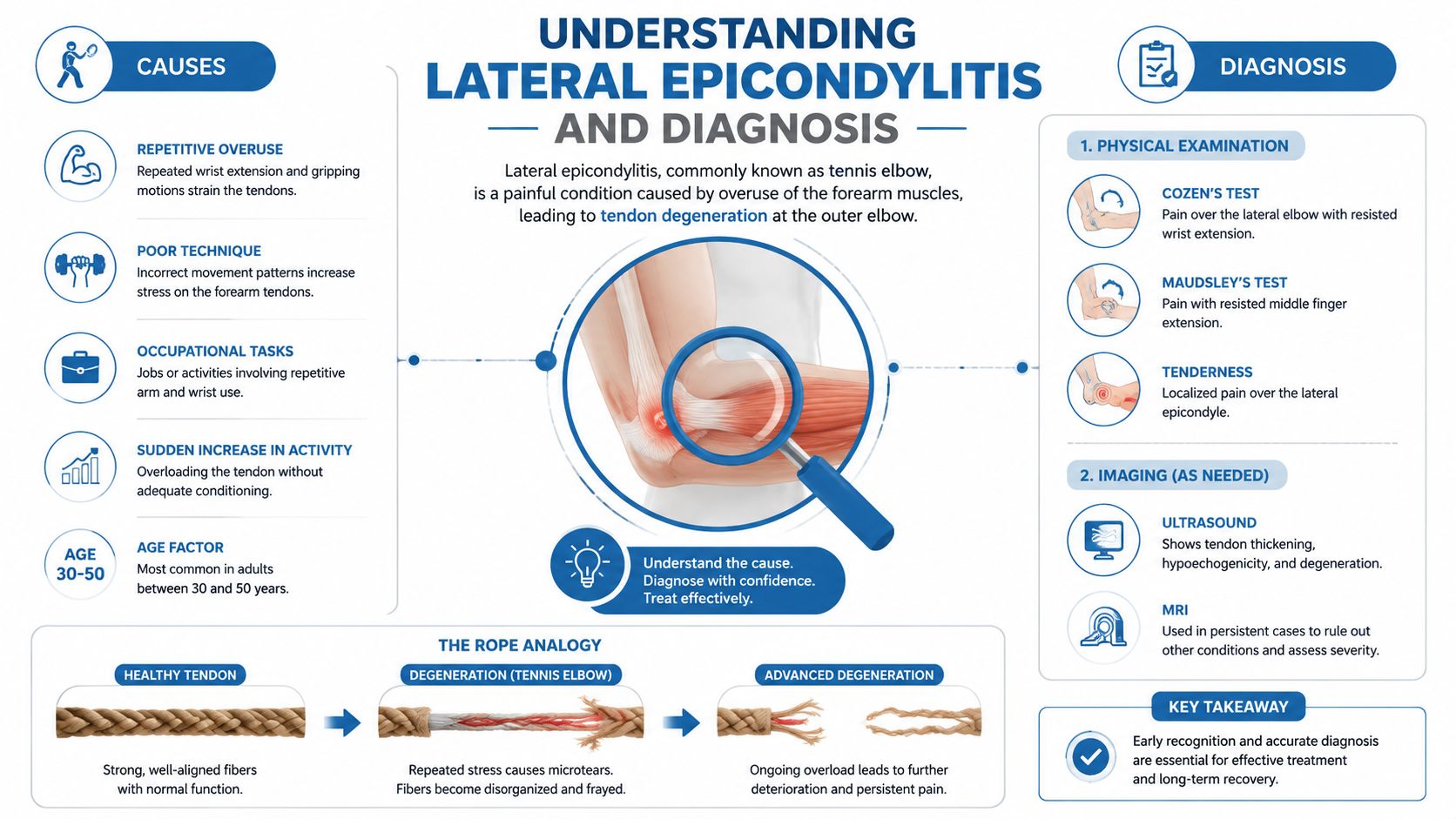
Tennis elbow sounds like a sports injury, but many patients with this condition have never picked up a racket. The problem usually sits where the forearm extensor tendons attach to the bony bump on the outside of the elbow.
A useful analogy is a rope that has been rubbed over the same edge for too long. At first, the rope looks intact. Then the fibers begin to fray. The tendon can behave in a similar way. Repeated strain can leave the tissue irritated and structurally worn rather than “inflamed” in the everyday sense.
What usually causes the pain
The tender area is often the lateral epicondyle. Pain can spread into the forearm. Gripping, twisting, lifting with the palm down, or extending the wrist against resistance often makes it worse.
Patients often get confused by the term “inflammation.” In chronic cases, the issue is more complex than swelling alone. Abnormal tiny blood vessels can develop around the diseased tendon, and those vessels are associated with ongoing pain signaling. That matters because some treatments only calm symptoms, while others try to interrupt that cycle.
For readers comparing related tendon conditions, this overview of tendinitis and bursitis helps clarify how tendon pain differs from other common causes of joint discomfort.
How clinicians confirm the diagnosis
Diagnosis usually begins with a history and focused physical exam, not a fancy test. A clinician often presses on the outer elbow, checks grip, and uses resisted wrist or middle-finger extension to see whether that familiar pain appears.
A simple way to think about the exam is this:
- Location matters: Pain right over the outer elbow points toward lateral epicondylitis.
- Motion matters: Pain that increases with gripping or wrist extension supports the diagnosis.
- Pattern matters: Pain tied to repeated hand and forearm use is more typical than pain that appears randomly.
What has to be ruled out
Not all outer elbow pain is tennis elbow. A clinician may also consider nerve irritation, arthritis, neck-related pain, or other tendon problems. Imaging can help when the picture isn't straightforward or when symptoms have dragged on.
If the diagnosis is fuzzy, treatment decisions get fuzzy too. A precise diagnosis matters more than moving quickly to the newest procedure.
That careful distinction is one reason treatment should be matched to the actual pain generator, not just the body part.
Comparing Treatment Options for Tennis Elbow
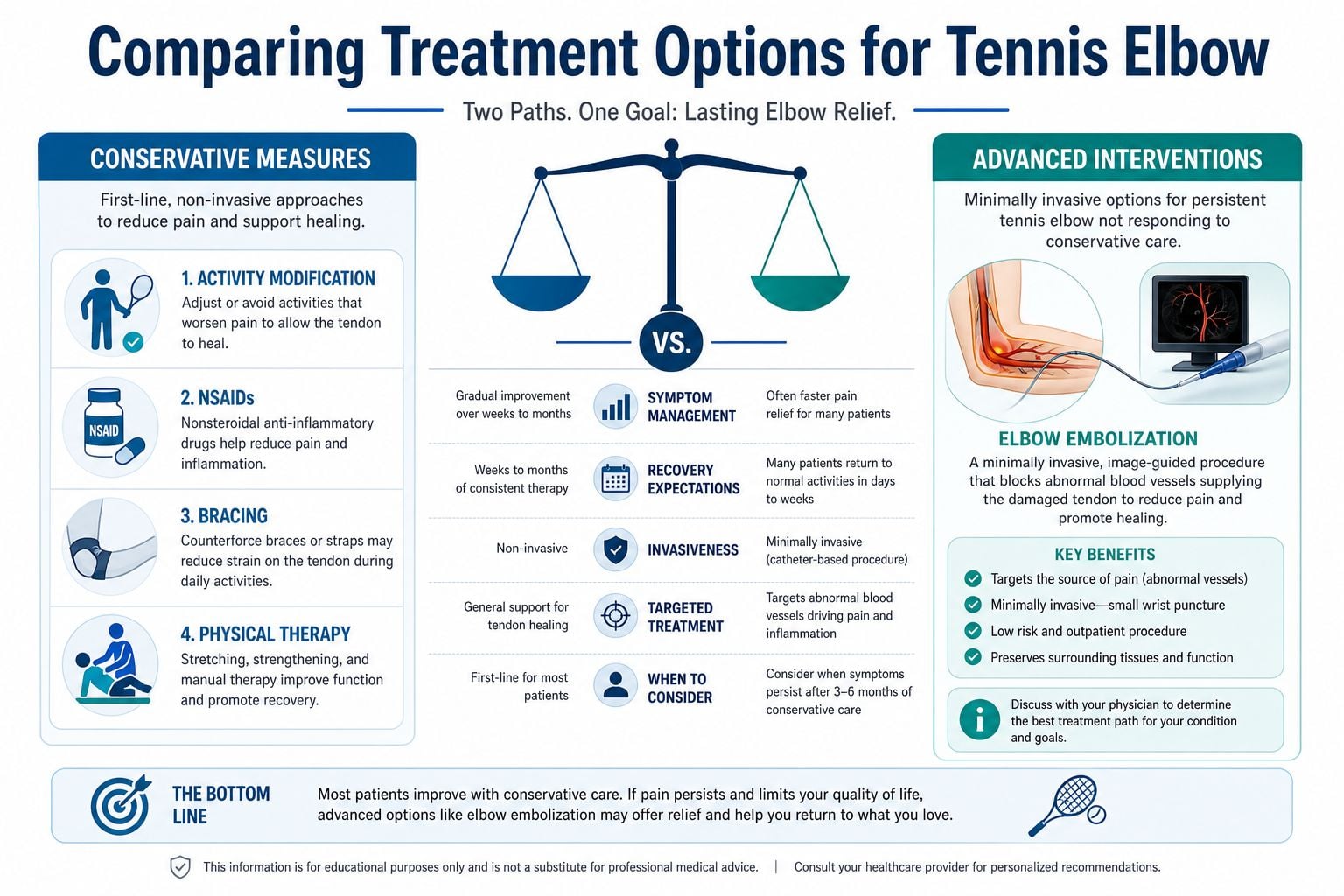
Most patients don't jump straight to a procedure. Care usually moves in layers, from lower-intensity options to more targeted interventions when the elbow doesn't recover.
Where each option fits
Conservative care often includes activity modification, anti-inflammatory medication, bracing, and physical therapy. These approaches make sense early because many people improve without a procedure.
Injection-based treatment sits in the middle. Some patients are offered steroid injections for short-term symptom control. Anyone weighing that route can review a practical summary of corticosteroid injections before deciding how that option compares with longer-acting strategies.
Elbow Embolization is generally considered when symptoms remain chronic and function stays limited despite conservative treatment. Surgery is usually reserved for cases that remain refractory or that involve a different structural problem requiring operative repair.
Side by side comparison
| Treatment path | Main goal | Typical trade-off |
|---|---|---|
| Conservative care | Reduce strain and allow healing | Can take time, and some chronic cases don't fully settle |
| Injection-based care | Calm pain to improve function | Relief may be temporary depending on the patient and diagnosis |
| Elbow Embolization | Target abnormal neovascularity linked to chronic pain | Requires a vascular procedure and careful patient selection |
| Surgery | Address persistent structural disease directly | More invasive recovery |
For patients who haven't improved with conservative care, clinical benchmarks for embolization report significant pain reduction and functional improvement in 80–90% of patients, with average grip strength increases of 15–25% and range of motion gains of 10–15 degrees within 4–12 weeks according to clinical benchmarks for elbow embolization.
How escalation should work
Escalation shouldn't be based on frustration alone. It should be based on diagnosis, duration, function, and goals.
- Mild symptoms: Conservative treatment often remains the most sensible starting point.
- Persistent symptoms: Targeted procedures become more reasonable when pain blocks work, exercise, or sleep.
- Mechanical or structural concerns: Surgery may fit better when the pathology goes beyond chronic tendinopathy.
A desk worker who can't type comfortably, a mechanic who can't grip tools, and a recreational athlete who can't lift without pain may all have the same diagnosis, but they may choose different treatment intensities based on daily demands.
Procedure Steps and Mechanism of Elbow Embolization
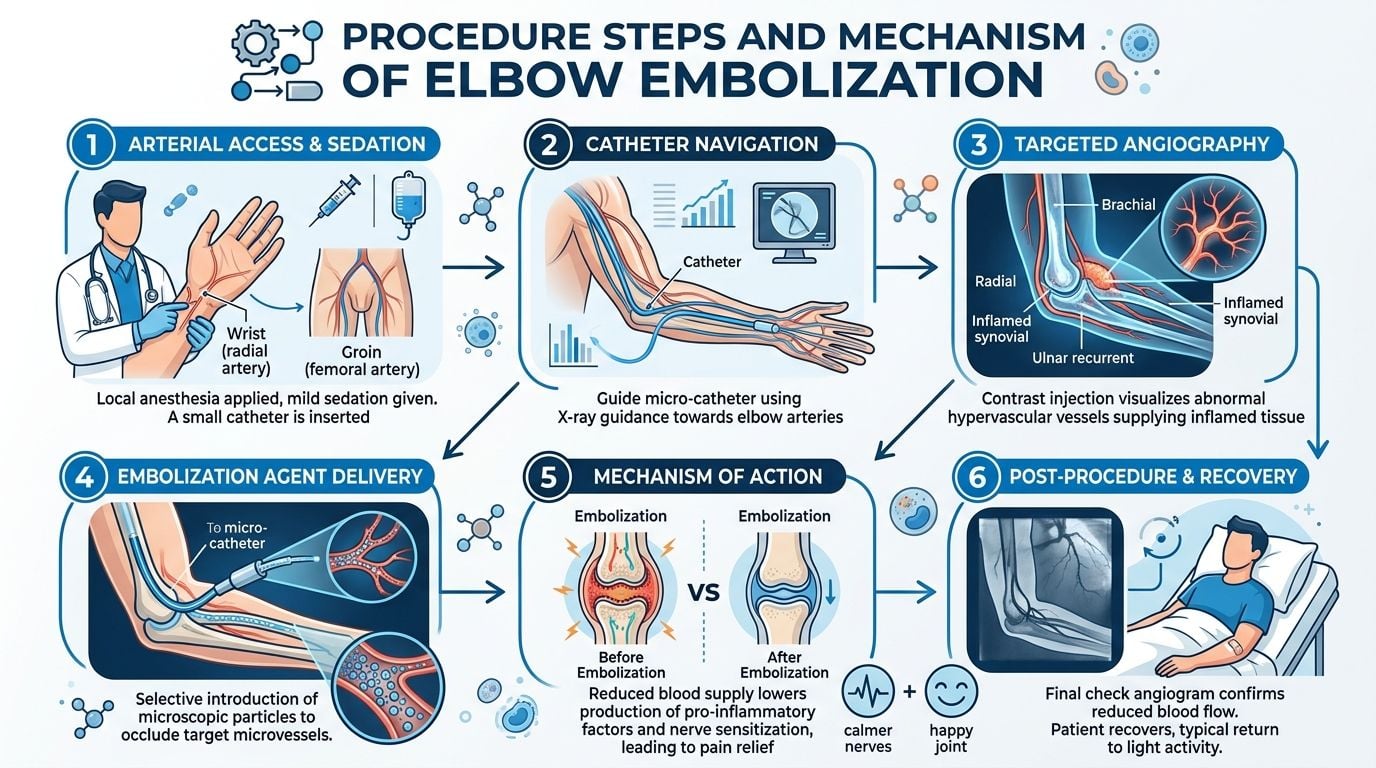
Many patients understand injections and surgery. A catheter procedure for elbow pain feels less intuitive. The easiest mental model is to picture a road map. The physician enters a blood vessel through a tiny access point, travels through the vascular system under imaging guidance, finds the abnormal small vessels feeding the painful area, and blocks that abnormal flow selectively.
What happens on procedure day
The procedure is performed under local anesthesia with mild sedation. Access is typically obtained through a very small puncture in the wrist or groin. From there, imaging helps guide the catheter to the vessels supplying the abnormal area around the tendon.
According to a procedural overview of elbow artery embolization technique and recovery, Elbow Embolization uses 2–4 mL of microscopic embolic agents under fluoroscopic and ultrasound guidance to selectively occlude neo-vascularized arteries. That same source notes same-day discharge with return to light activities within 1–2 days.
A simplified sequence looks like this:
- Preparation: The patient checks in, the team reviews imaging and consent, and the access site is cleaned and numbed.
- Access: A tiny puncture is made at the wrist or groin.
- Navigation: The catheter is directed through the arteries under live imaging.
- Targeting: The physician identifies the abnormal vessels associated with the painful tendon.
- Embolization: Microscopic particles are delivered to reduce abnormal blood flow.
- Recovery: The catheter is removed, pressure is applied, and the patient goes home the same day in most cases.
Why reducing blood flow can help
This point often trips people up. The goal isn't to “starve” the elbow. The goal is to selectively shut down the abnormal new vessels linked to chronic tendon irritation while preserving healthy surrounding circulation.
A useful analogy is a sprinkler system with one broken zone that keeps flooding the same patch of ground. The treatment doesn't shut off water to the whole property. It turns down the pathologic overwatering in one area so the ground can recover.
The pain relief often isn't immediate. The vessel treatment changes the environment around the tendon, then the tendon and surrounding tissue settle gradually over the following weeks.
What recovery feels like
Most patients go home the same day. Light activity usually returns quickly, while the elbow itself may improve more gradually than patients expect. That's normal for a tendon-based problem. The biological response takes time.
Patients should ask the treating physician what restrictions apply after the procedure, when symptoms should begin to change, and what follow-up is planned if progress is slower than expected.
Risks Benefits and Outcomes of Embolization
Elbow Embolization gets attention for a simple reason. In the right patient, it can improve pain and function without open surgery. But balanced education matters. Patients deserve the upside and the limits.
What the evidence supports
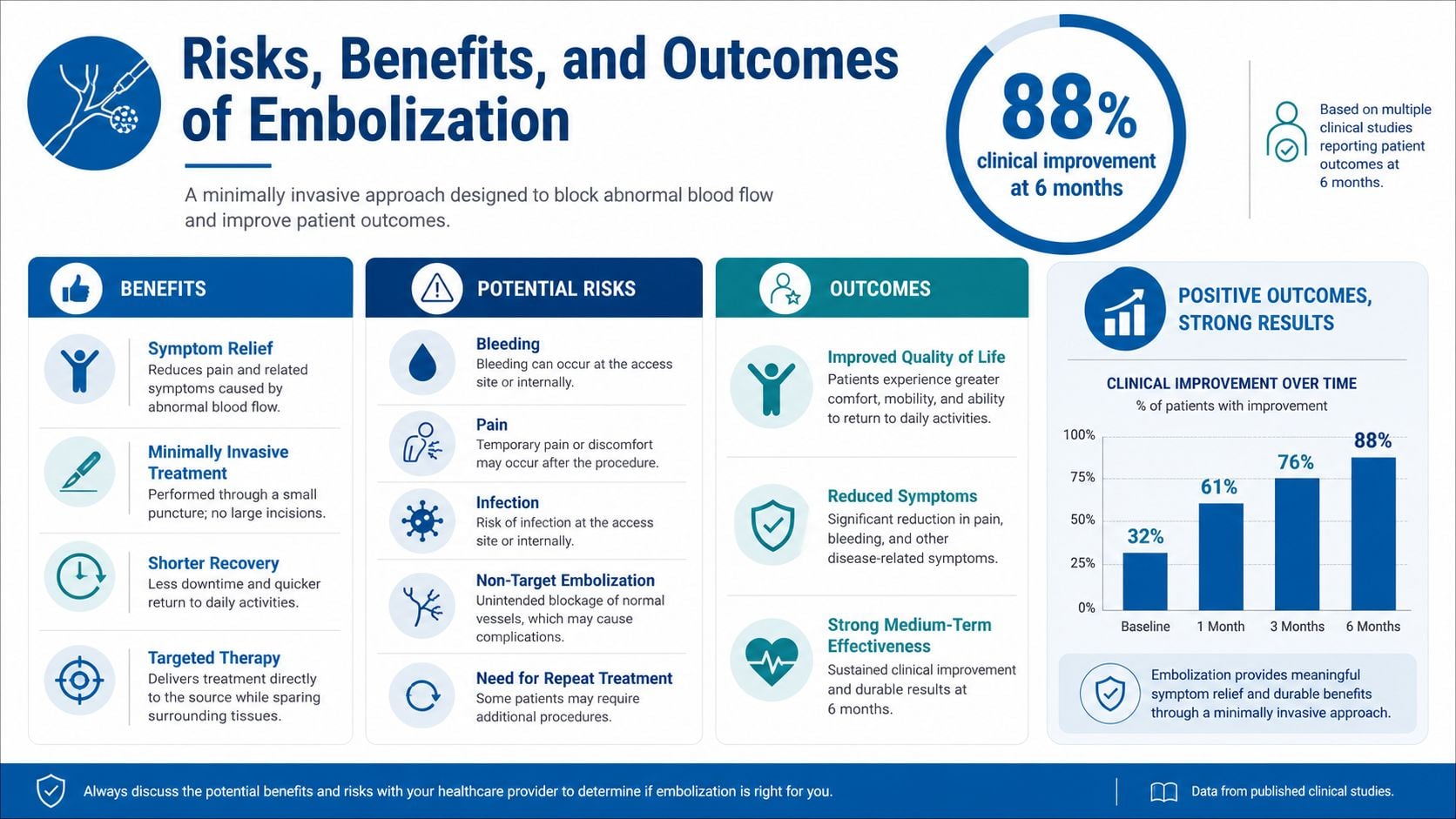
The strongest numeric data available here are encouraging. A study summarized in PubMed on transcatheter arterial embolization for chronic tennis elbow reported 88% clinical improvement at six months in patients with difficult-to-cure lateral epicondylitis.
That same source reported a drop in average VAS pain score from 7.5 to 0.1 at 44 months, which equals a 98.7% reduction in pain intensity. It also reported Quick-DASH scores improving from 61.3 at baseline to 6.9 at six months, suggesting a return toward near-normal arm function.
The procedure also showed 100% technical success in identifying and embolizing abnormal vessels in treated patients in that evidence set. No major adverse events such as bone marrow necrosis, cartilage loss, or limb ischemia were observed, even at follow-up out to 24 months in the reported data. MRI findings at two years also showed structural improvement in tendinosis and tear scores compared with baseline.
What those numbers mean in plain language
A pain score change matters only if the patient can feel it in daily life. In practical terms, this kind of improvement can mean less pain with gripping, fewer pain spikes during work tasks, and a larger margin for ordinary activity.
Functional scoring matters for a similar reason. A patient usually doesn't care about a questionnaire number in itself. The patient cares about fastening a seatbelt, carrying a grocery bag, lifting a skillet, or returning to sport without guarding the arm.
Better imaging findings are helpful, but patients live in function. The meaningful question is whether daily tasks become easier and stay easier.
What side effects and risks look like
No procedure is risk free. The same evidence set reported minor adverse events in 18.9% of patients (27 of 143), and those events resolved spontaneously. Commercial clinical summaries describe serious complications as uncommon, with more typical issues being transient bruising, mild skin discoloration, or minor access-site discomfort.
A patient should still ask specifically about risks related to the access site, non-target embolization, expected soreness, and when to call after the procedure.
Where caution still belongs
Good early and mid-term outcomes don't answer every question. Most of the available evidence is not the same as large randomized head-to-head trials against surgery or other advanced options. That distinction matters because strong symptom improvement can coexist with unanswered comparative questions.
A balanced interpretation looks like this:
- The mechanism makes sense: The treatment targets abnormal neovascularity associated with chronic tendon pain.
- The clinical results are promising: Pain and function can improve substantially in appropriately selected patients.
- The safety profile appears favorable in current reports: Serious complications have not been prominent in the cited data.
- The evidence still has limits: Patients should ask what remains uncertain, especially regarding durability and comparisons to other treatments.
For many readers, that final point becomes the most important part of the decision.
Decision Making for Treatment and Provider Selection
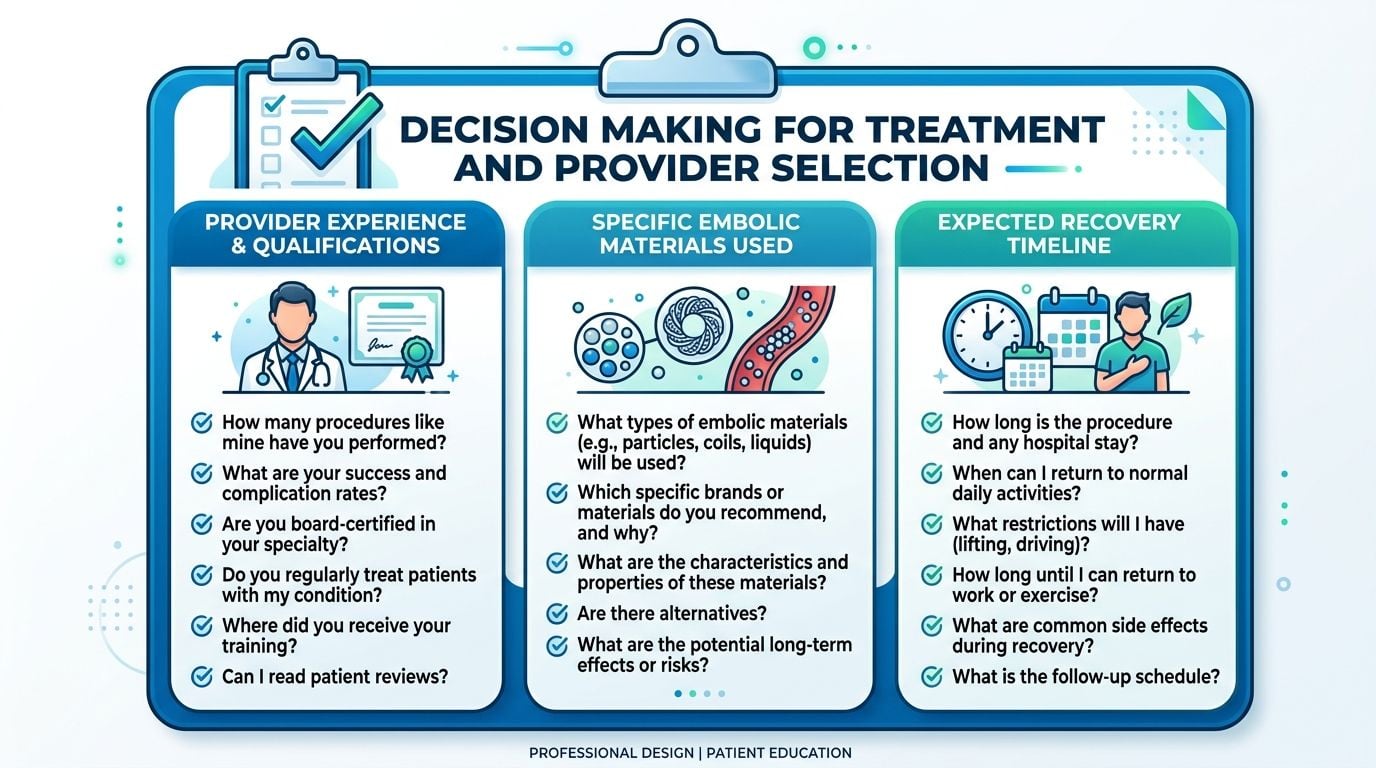
A patient considering Elbow Embolization shouldn't ask only, “Can this help?” The better question is, “Is this the right treatment for this diagnosis, at this stage, with this level of evidence, from this particular provider?”
The key evidence gap patients should discuss
One of the most overlooked facts in commercial discussions is the durability gap. A review in PubMed discussing the lack of randomized durability data beyond one year notes that existing studies lack randomized data on outcomes beyond one year, leaving a critical evidence gap for patients who want to know whether Elbow Embolization is a definitive long-term alternative to surgery.
That doesn't mean the procedure doesn't work. It means the conversation should stay honest. Early results can be favorable while long-range comparative certainty remains incomplete.
Questions worth bringing to the consultation
A productive visit often comes down to the quality of the questions. Patients can ask:
- Diagnosis clarity: What findings make the clinician confident this is lateral epicondylitis and not nerve entrapment, arthritis, or referred pain?
- Why this treatment: Why is Elbow Embolization a better fit than more therapy, an injection, or surgery in this case?
- Technical approach: Which access site is planned, what embolic material is used, and how is non-target embolization avoided?
- Recovery expectations: When should pain begin to change, what restrictions apply, and what would count as a normal versus abnormal recovery?
- Follow-up plan: How is progress tracked if symptoms improve slowly or only partially?
How to judge the provider, not just the procedure
A polished website isn't enough. Patients should look for a team that explains the diagnosis clearly, discusses alternatives without pressure, and outlines follow-up in plain language.
A useful check is whether the physician welcomes questions about uncertainty. Confidence is good. Overconfidence is not.
For readers reviewing physician backgrounds, the care team directory offers one example of how to verify training and specialty alignment when evaluating a practice.
A strong consultation should leave the patient more informed, not more rushed.
Matching the choice to personal goals
Not every patient wants the same outcome. One person wants to return to golf. Another wants to work a full shift without flaring the elbow. Another wants to avoid surgery if possible.
That's why the “best” treatment is rarely abstract. It depends on the person's pain severity, job demands, tolerance for uncertainty, and comfort with procedural versus surgical care. Elbow Embolization is often most appealing to patients who want a minimally invasive option and understand both the promise and the evidence limits.
Practice Locations Scheduling and Insurance Navigation
Once a patient decides to seek an evaluation, the practical steps matter almost as much as the clinical ones. The most efficient approach is to gather prior elbow imaging, a list of past treatments, current medications, and any therapy notes before calling for an appointment.
For patients in New Jersey and Staten Island, practices with multiple office locations and seven-day scheduling can make the process easier, especially for those balancing work, family, or travel constraints. It also helps to ask whether the office offers insurance benefit verification, authorization support, transportation guidance, and fee estimates when needed.
Insurance review for a vascular procedure may require documentation showing failed conservative care and a clear medical rationale. When insurers request extra support, it helps to understand what is a medical necessity letter, since that document can explain why a specific treatment is being requested and why more routine options may not be appropriate.
A short prep list can save time:
- Bring records: Prior imaging reports, therapy history, and medication lists help avoid repeat steps.
- Ask about authorization: Find out who submits paperwork and what documents the insurer may request.
- Clarify network status: Patients should ask about in-network versus out-of-network billing and request estimates when available.
- Confirm logistics: Office location, procedure-day instructions, and follow-up scheduling should be clear before booking.
Conclusion and Next Steps
Chronic tennis elbow can feel deceptively small and debilitating at the same time. Elbow Embolization offers a targeted, minimally invasive option for selected patients whose pain hasn't improved with standard care. Its appeal comes from a clear mechanism, outpatient treatment, and encouraging reported outcomes.
The decision still deserves careful thought. A precise diagnosis matters. The treatment should fit the patient's daily demands and goals. And the long-term durability gap beyond one year should be discussed openly.
The next practical steps are simple. Gather records, confirm the diagnosis, ask focused questions, and review insurance requirements before committing to treatment.
For patients ready to discuss chronic elbow pain, Interventional Pain Management provides multidisciplinary evaluation across New Jersey and Staten Island, with board-certified specialists, seven-day scheduling, and support for imaging review, treatment planning, and insurance navigation.