
Many people can return to work about 3–6 weeks after anterior cervical discectomy and fusion, while broader regular activities often take 3–4 months, and the bone fusion itself may take 6–12 months to solidify. Physical labor, multilevel surgery, neurologic symptoms, and complications can extend every stage.
A New Jersey patient may leave the surgical center feeling relieved, then face an immediate practical question from an employer: “When can work resume?” The honest answer depends on what “work” involves. Sitting at a computer, driving, lifting patients, reaching overhead, operating machinery, and carrying materials place very different demands on a healing neck.
Cervical discectomy recovery time isn't one finish line. It has several overlapping tracks: symptom relief, wound healing, safe movement, work capacity, rehabilitation, and, after fusion, biological bone healing. Understanding those tracks helps patients plan without mistaking an early improvement for complete recovery.
Table of Contents
- Your Surgical Recovery Timeline, Stage by Stage
- What to Expect in the First Week After Surgery
- ACDF Versus Cervical Disc Replacement Recovery Paths
- Navigating Return to Work and Daily Activities
- Pain Management and Rehabilitation Milestones
- Understanding Bone Fusion and Biological Healing
- Your Personalized Recovery Roadmap
- Moving Forward with Confidence
Your Surgical Recovery Timeline, Stage by Stage
A northern New Jersey patient may wake up after surgery relieved that the arm pain has shifted, then quickly run into a harder question: what can the neck safely do today, and what still needs time? An employer may want a return date. Family members may ask about chores. The discharge sheet may list restrictions, but turning those rules into everyday decisions can feel confusing.
Recovery happens in layers. Early improvement does not mean every task is ready. You may be walking, eating, and managing basic self-care while your neck still needs protection from lifting, sudden motion, vibration, long drives, or hours in one position. After ACDF, the skin incision can look settled while the deeper fusion is still developing. This overview of anterior cervical discectomy surgery can clarify the procedure itself, but your surgeon's instructions still set the plan for your body and your job demands.
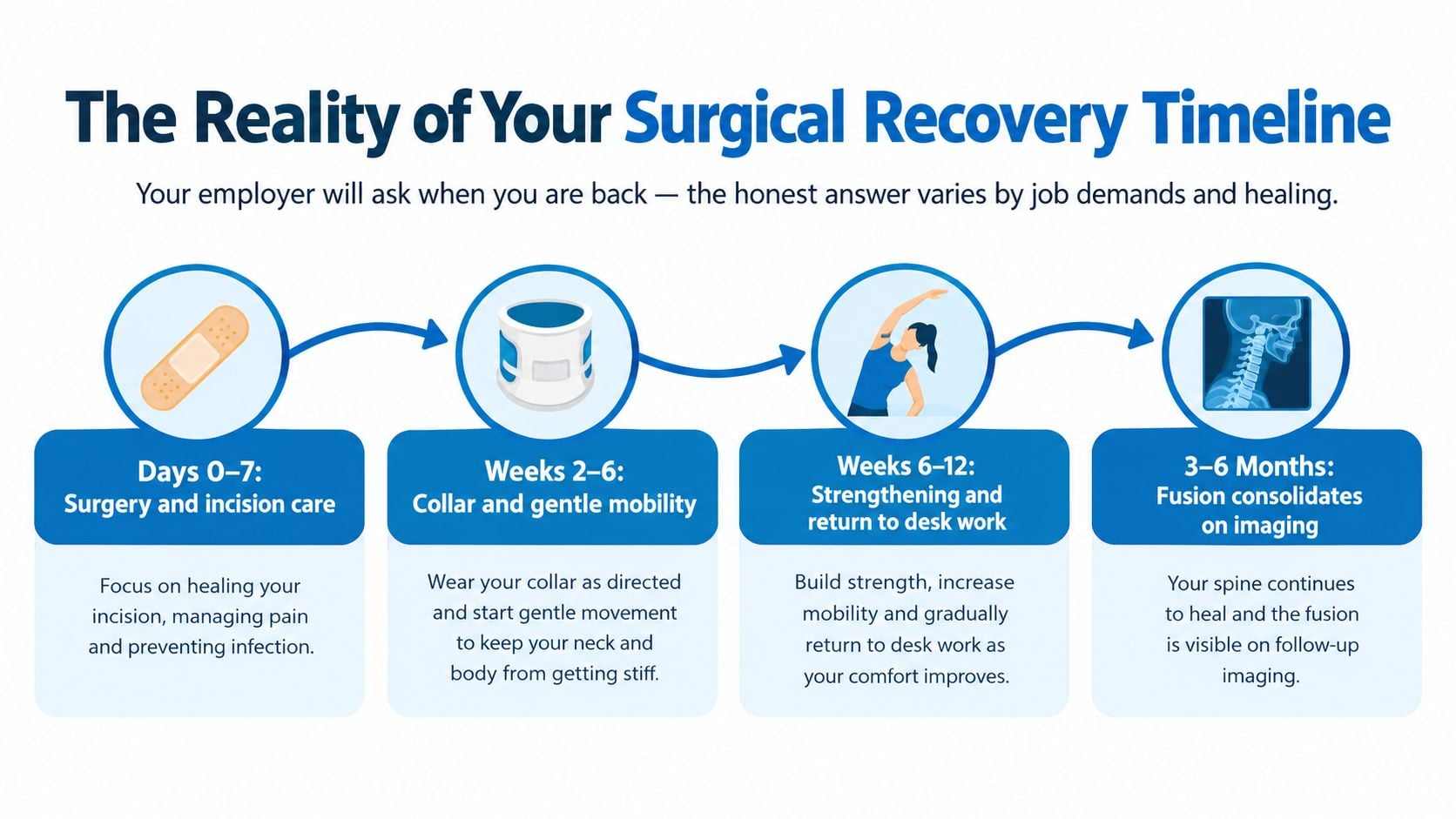
Four ways patients mean “recovery”
- Feeling relief: Arm pain, tingling, or pressure may ease before strength, coordination, and stamina fully return.
- Handling daily tasks: Walking, dressing, eating, and sleeping often improve during the early phase, but each activity still has limits.
- Getting back to work: Readiness depends less on the calendar and more on the task. Desk work, driving, overhead reaching, lifting, and operating equipment stress the neck in different ways.
- Healing beneath the surface: After fusion surgery, the bone continues to mature over months, as described in this rehabilitation review and recovery evidence.
A helpful comparison is a bridge reopening lane by lane. Traffic may resume in stages while the structure underneath keeps strengthening. Recovery works the same way. Each clearance applies to a specific activity level, not to every activity at once.
What to Expect in the First Week After Surgery
The first week usually shifts from hospital monitoring to careful home management. During the first hours, the clinical team checks pain control, walking ability, swallowing, arm and leg movement, and the incision. The neck may feel stiff, the shoulders may ache, and a sore throat or hoarse voice can occur after the breathing tube and the front-of-neck surgical approach.

The first 48 hours
The discharge paperwork should answer practical questions about showering, dressing changes, medication, collar use, and permitted movement. Patients shouldn't improvise wound care. The incision should remain protected exactly as directed, and the neck should be kept dry until the surgeon permits bathing or showering.
Short, gentle walks are generally more useful than remaining in bed all day, provided the care team allows them. Arms and shoulders should move within the prescribed limits, but patients should avoid reaching, pulling, pushing, or using arm movements that make the neck strain.
Days three through seven
Swallowing may feel uncomfortable, so softer foods, smaller bites, and an upright position can make meals easier when approved by the clinical team. Sleep positioning should follow the surgeon's directions, with the neck kept neutral rather than sharply flexed or rotated. A brace, if prescribed, should be worn according to the written protocol.
Patients should contact the surgical team promptly for increasing redness, warmth, drainage, worsening swallowing, new or worsening weakness, or pain that is not controlled as directed. Breathing difficulty, chest pain, rapidly progressing neurologic symptoms, or severe swelling requires emergency attention. A symptom that is mild and improving is different from one that is intensifying, so the direction of change matters.
ACDF Versus Cervical Disc Replacement Recovery Paths
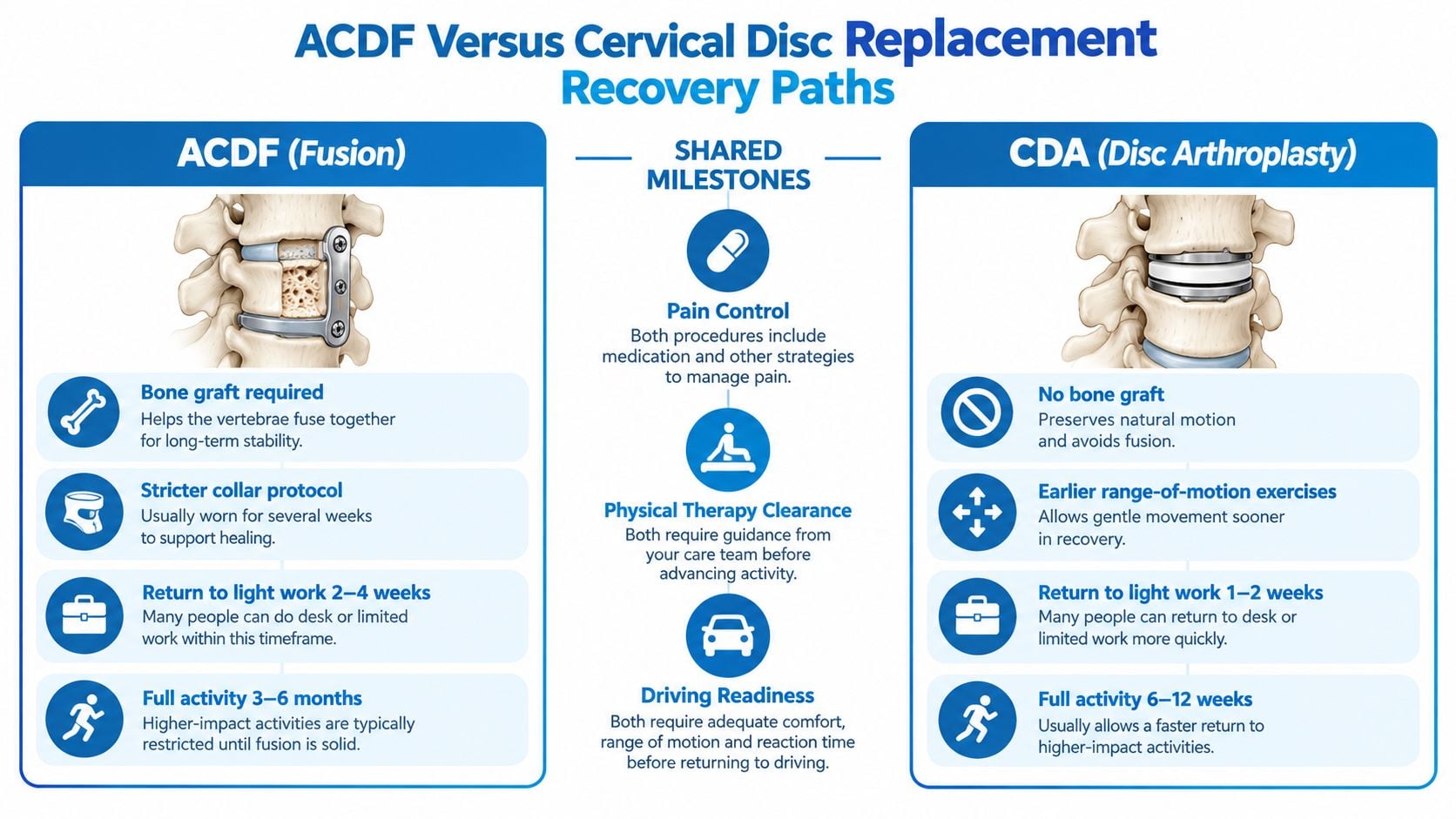
ACDF and cervical disc arthroplasty remove pressure from the nerve, but they create different mechanical conditions afterward. ACDF joins neighboring vertebrae with a graft and hardware, so the body must grow bone across the treated level. Cervical disc arthroplasty places an artificial disc and preserves motion at the operated level when the patient is an appropriate candidate. More information about artificial disc replacement surgery can help patients understand why candidacy matters.
Why the paths differ
Evidence from a 2025 systematic review and meta-analysis of 16 randomized trials involving 5,657 patients found that disc replacement was associated with higher odds of returning to work at 6 weeks, 3 months, and 1 year, with an average return approximately 9.91 days earlier than ACDF (meta-analysis of cervical disc replacement and fusion). The advantage was not statistically significant at 2 years or beyond, which suggests that the main difference is earlier functional recovery, not a guaranteed superior long-term employment outcome.
A separate prospective cohort of 300 people in labor-intensive jobs found a mean return to full-time work of 4.3 months after CDA compared with 6.7 months after ACDF, with a statistically significant difference (labor-intensive work cohort). Workers' compensation status also influenced timing in that study, showing why procedure type alone can't predict an individual date.
The practical comparison
| Recovery question | ACDF | Cervical disc arthroplasty |
|---|---|---|
| What happens mechanically? | The treated level is stabilized while bone grows across it. | An artificial disc is used to preserve motion when clinically suitable. |
| Early work return | Often limited by pain, swallowing symptoms, collar instructions, and fusion protection. | May occur earlier for selected patients, especially in sedentary roles. |
| Physical work | Lifting, vibration, impact, and overhead work require individualized clearance. | Restrictions still apply, even when early motion returns sooner. |
| Long-term interpretation | Imaging confirms whether the fusion is maturing. | Earlier activity doesn't mean every high-load activity is immediately safe. |
Disc replacement isn't appropriate for every patient. Facet-joint disease, instability, osteoporosis, deformity, and other findings may favor fusion or another approach. The operation chosen for the anatomy is more important than pursuing the fastest calendar milestone.
Navigating Return to Work and Daily Activities
A return-to-work date should describe what the employee can safely do, not just when the incision looks healed. A computer-based role may involve limited lifting and a stable seated posture. A construction, warehouse, nursing, delivery, or mechanical job may require repeated bending, overhead reaching, carrying, vibration exposure, emergency movement, or long shifts.
The available evidence shows why a single promise is misleading. In a study of 68 workers undergoing two-level ACDF, 77.9% had returned to work by 3 months, 82.4% by 6 months, and 82.4% by 9 months. At 9 months, 19.6% were working part-time, 80.4% had returned to their previous work, and 17.6% had not returned to work (two-level ACDF return-to-work study). A larger study of surgery for degenerative cervical disease found that 50% had returned by 5 months and 65% by 12 months, after which the rate largely plateaued.
Match clearance to the task
- Desk work: The main questions are sitting tolerance, screen height, medication effects, concentration, and the ability to change position without aggravating symptoms.
- Driving: Clearance depends on neck rotation, arm control, reaction time, pain medication, and the ability to perform emergency braking safely.
- Lifting: The surgeon should define permitted loads and the movement pattern. Lifting close to the body is different from lifting overhead or away from the trunk.
- Overhead work: Repeated reaching can load the neck and shoulder muscles even when the object is not heavy.
- Vibration and impact: Machinery, rough vehicle travel, running, and contact activity may require longer restrictions than ordinary walking.
Patients can give employers a functional plan rather than a vague estimate. A note might specify seated duties, frequent position changes, no overhead work, no lifting beyond the surgeon's limit, and reassessment after follow-up imaging or examination.
Practical rule: A person is ready for a task when strength, control, endurance, symptoms, and surgical healing support that task, not merely when a certain number of days has passed.
Return-to-work outcomes also depend on baseline work status. In a large Quality Outcomes Database analysis, 82.2% returned within three months, but the rate was 89.3% among previously employed patients already working before surgery compared with 52.3% among employed patients not working at baseline (task-specific cervical surgery recovery evidence). Those figures describe populations, not promises. They reinforce the need to discuss the actual job with the surgeon.
Pain Management and Rehabilitation Milestones
Pain control after cervical surgery is usually a shift, not a single on or off switch. The burning or shooting arm pain from a compressed nerve may settle first, while sore throat, incision tenderness, muscle tightness, and fatigue stand out more. That change can feel confusing. It often means the source of discomfort has changed, not that recovery is going off track.
Medication choices affect function as much as comfort. Take them exactly as prescribed, then taper only with guidance. Drowsiness, constipation, slowed reaction time, and dizziness can change how safely you walk, ride in a car, return to desk work, or judge whether you are ready to drive.
A gradual sequence
Early recovery works like turning irritation down before rebuilding endurance. In the first phase, rest, supported positioning, short walks, and the prescribed medication plan help calm tissue that was just operated on. As symptoms ease, the team may guide a move toward nonprescription options. Patients should not add medicines on their own, especially if there are concerns about stomach irritation, kidney function, bleeding risk, or drug interactions.
Formal rehabilitation often starts only after the surgeon is satisfied with the early healing phase. The first visits are usually modest by design. They may focus on posture, walking tolerance, shoulder blade control, gentle motion, and spotting movements that bring symptoms back. That matters for task-based recovery. A person who can sit comfortably may still not be ready for overhead reaching, carrying groceries, or repeated screen work without breaks.
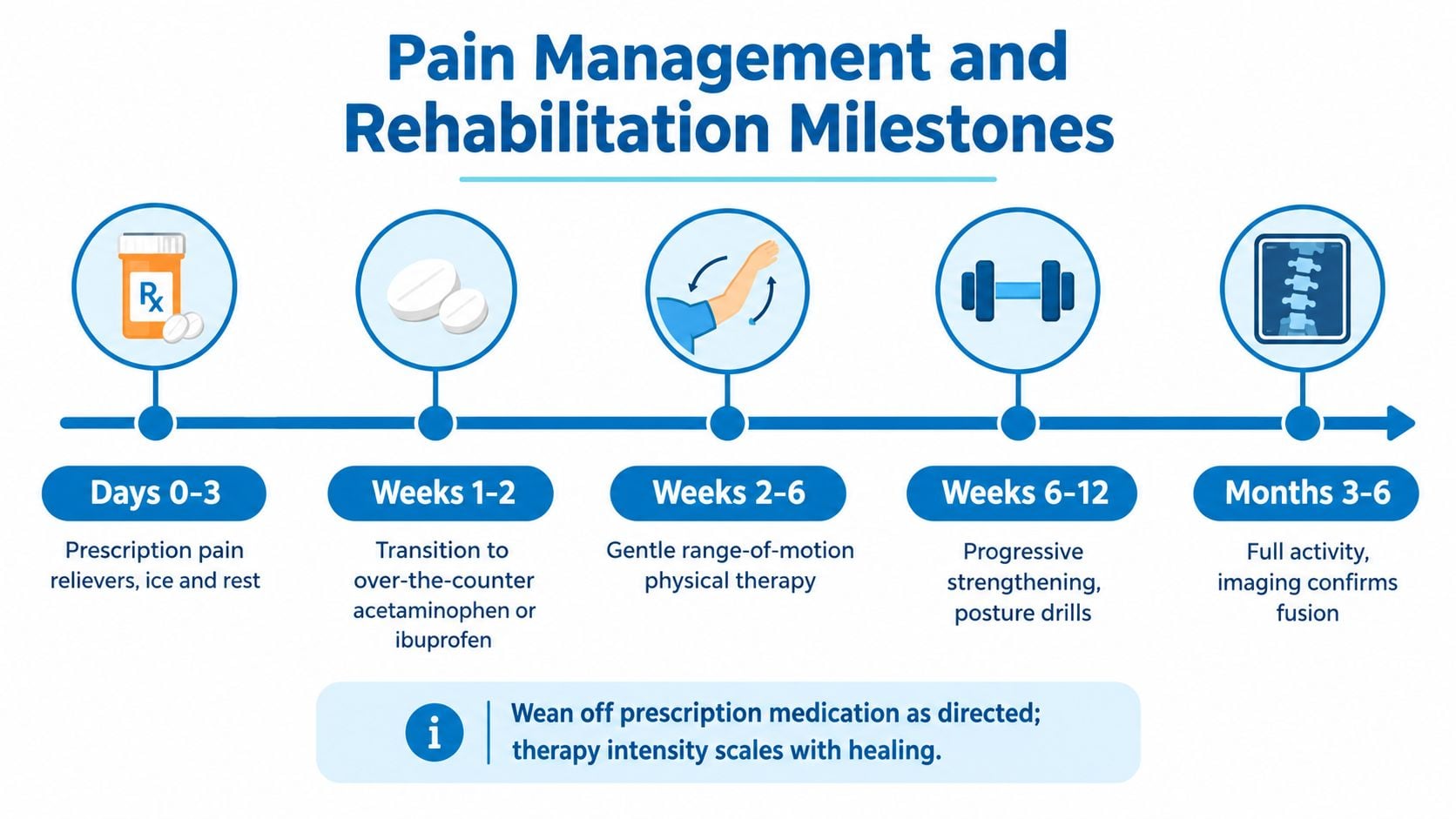
Physical therapy rebuilds the support system around the neck so daily tasks become more tolerable step by step. If exercise triggers new weakness, rising arm pain, worsening swallowing, loss of coordination, or a clear setback, prompt clinical review is warranted.
Understanding Bone Fusion and Biological Healing
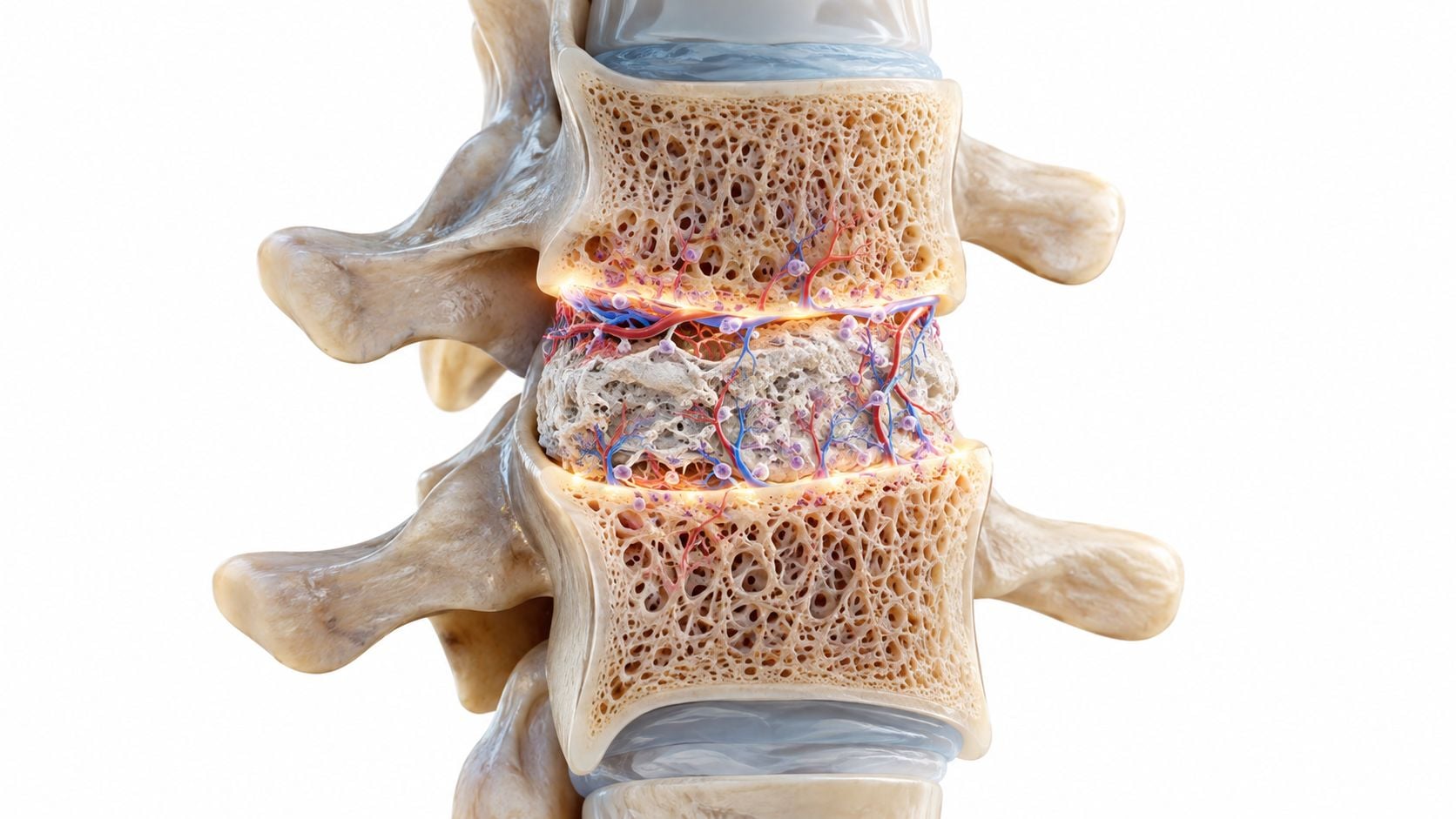
Bone healing follows its own clock. After ACDF, plates or screws can make the neck feel steadier early on, but the long-term goal is different. Your body must build a living bridge of bone across the treated disc space, and that process keeps going long after the incision looks better.
A simple way to picture it is a fracture in a cast. The cast protects the area while bone knits together underneath. In the neck, the hardware plays that protective role, while the graft and nearby vertebrae slowly join into one stable unit. That is why a patient may feel ready for desk work, short drives, or light household tasks before the fusion has fully matured. General information about that process is outlined in this spinal fusion overview.
Symptoms and images answer different questions
Symptoms show how you are functioning. They tell your surgeon whether pain, numbness, strength, swallowing, and day-to-day ability are improving. Imaging answers a separate question. It shows whether the graft, hardware, and connection between the vertebrae are progressing as expected.
That difference matters when you are planning real tasks, not just waiting for a general green light. You may feel comfortable carrying a laptop bag yet still need to avoid heavier lifting, repeated overhead reaching, impact, or contact activity because those loads stress the healing segment in a different way.
Fusion can also progress more slowly after multilevel surgery, neurologic impairment, smoking, complications, or work that places high physical demands on the neck. Two patients can look similar on the surface and still need very different restrictions.
Your Personalized Recovery Roadmap
A practical plan begins before surgery. The patient, family, employer, and surgeon can turn a general cervical discectomy recovery time into specific checkpoints tied to real tasks.
Before discharge
Ask the surgical team:
- Work: What duties are acceptable first, and what movements remain restricted?
- Driving: What neck motion, medication, and reaction-time requirements must be met?
- Wound care: When can the incision get wet, and what drainage or redness requires a call?
- Brace use: Is a collar required, and when may it be removed?
- Exercise: Which walking and shoulder movements are allowed initially?
- Follow-up: When will examination, rehabilitation planning, and imaging occur?
At home
During the first days, organize medication, meals, sleeping arrangements, transportation, and assistance with chores. Track symptoms by function: walking distance, sitting tolerance, swallowing, arm strength, sleep, and the ability to perform light self-care.
By the early follow-up period, the focus usually shifts from protection to controlled participation. A desk worker may need a staged schedule, while a laborer may need temporary duties that exclude lifting, overhead work, vibration, and repeated neck flexion. Rehabilitation can then build endurance and strength as healing permits.
The useful question isn't “Am I recovered?” It is “Which task is safe today, and what evidence supports the next step?”
Moving Forward with Confidence
A successful recovery plan gives the patient enough structure to make decisions without turning the calendar into a promise. Early improvement can be encouraging, but it doesn't cancel restrictions. Conversely, a slow first week doesn't automatically mean the operation failed. Symptoms, strength, work demands, procedure type, number of treated levels, general health, and follow-up findings all shape the pace.
Patients can make recovery more predictable by keeping appointments, taking medication as directed, following wound instructions, walking within the permitted limits, and reporting changes early. Employers often respond better to a functional description than to an uncertain date. “Seated duties with position changes and no lifting” gives a clearer basis for planning than “back when feeling better.”
The most important milestone is safe progress. A patient who gradually regains sleep, concentration, walking tolerance, arm function, and confidence is building a durable return to daily life. For ACDF, the internal fusion continues maturing after ordinary activities begin, so patience protects the long-term result.
Questions and setbacks should go to the surgical team rather than an online comparison. Interventional Pain Management offers evaluation and coordinated care for neck and spine conditions, including interventional treatments, orthopedic assessment, spine surgery services, and rehabilitation planning designed around clinical findings and functional needs. New Jersey and Staten Island patients can visit Interventional Pain Management to request an appointment and discuss a recovery plan linked to work, driving, lifting, and other personal goals.