
A hinged brace isn't a seat belt for a reconstructed ACL. It doesn't heal a torn ligament, guarantee graft protection, or replace the strength and movement training that determine whether a knee is ready for demanding activity. For some patients, an ACL hinged knee brace provides useful mechanical support or confidence during a defined rehabilitation phase. For others, routine use adds bulk, restricts movement, and creates false reassurance without improving the long-term result.
That distinction matters for patients in New Jersey and Staten Island who are deciding whether to buy a brace, continue wearing one, or stop using it. The right question isn't just which brace has the strongest hinges. It's which patient needs support, during which phase, and for what measurable clinical goal.
Table of Contents
- Why ACL Bracing Is More Nuanced Than Most Patients Expect
- What an ACL Hinged Knee Brace Is
- How to Fit and Use an ACL Hinged Knee Brace Correctly
- When an ACL Hinged Knee Brace Is Used in Practice
- Comparing Brace Types for ACL Support
- What the Evidence Says About Brace Use After ACL Injury
- How to Decide Whether an ACL Hinged Knee Brace Is Right for You
- Practical Next Steps for ACL Brace Care and Rehabilitation
Why ACL Bracing Is More Nuanced Than Most Patients Expect
The most popular advice about ACL braces is also the least reliable: wear one and the knee will be protected. A brace can limit selected movements, but it can't restore a torn ligament, control every landing, or substitute for progressive rehabilitation. Quadriceps strength, neuromuscular control, movement quality, adherence, and the injury pattern still matter.
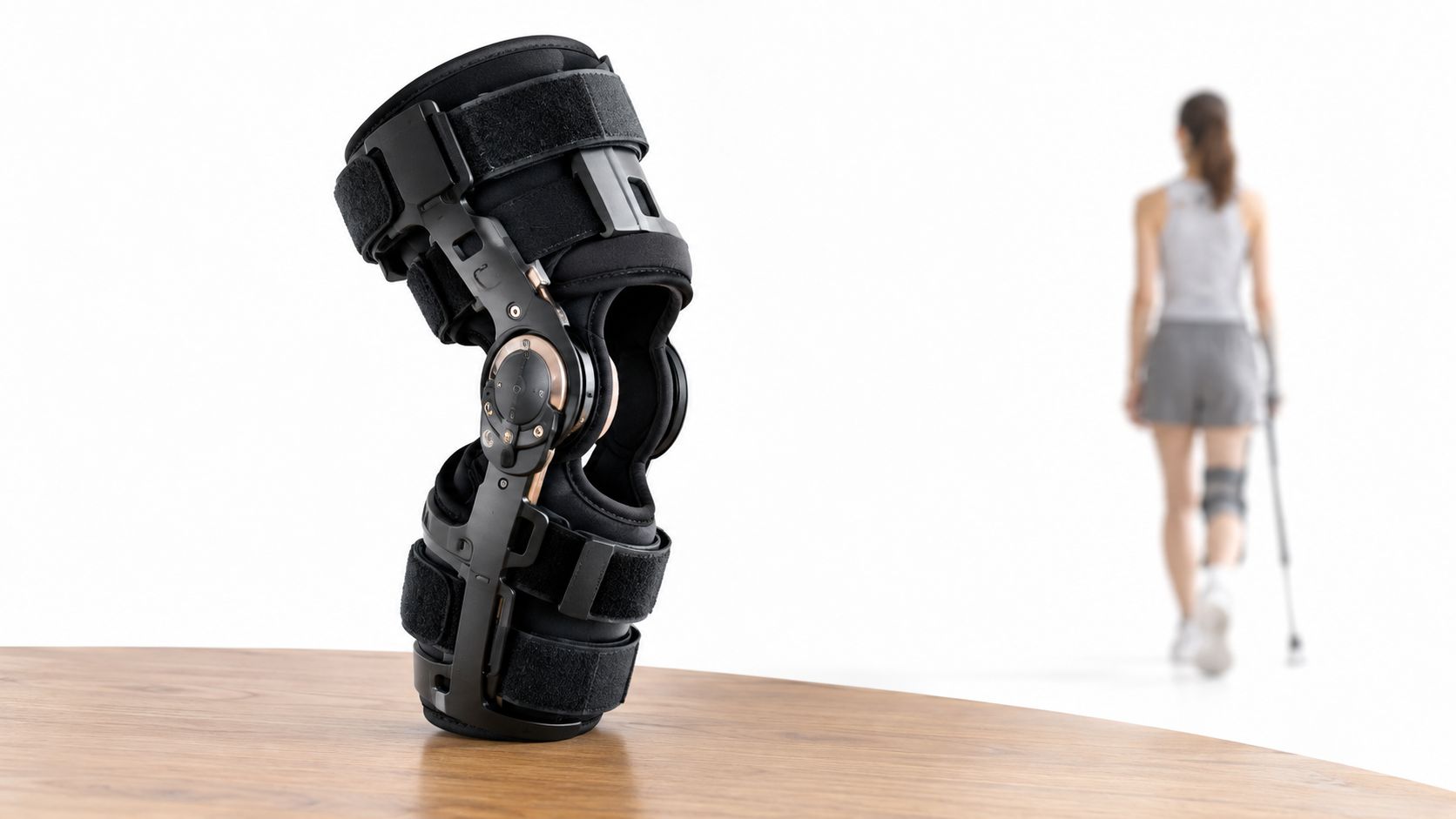
A 2007 systematic review of postoperative bracing examined 7 controlled clinical studies covering 390 ACL reconstructions. Patients who wore braces from the first day after surgery through periods extending to 3 months were compared with patients who didn't. The review found no significant longer-term difference in clinical outcomes between braced and unbraced groups.
That finding shifted ACL care away from assuming that routine immobilization automatically improves recovery. It doesn't mean every brace is unnecessary. A hinged design may still make sense for selected patients with instability, combined ligament damage, unusual surgical findings, or a surgeon-directed protocol.
The clinical goal comes first
A brace should answer a specific problem. Examples include controlling motion while healing tissue is protected, reducing episodes of giving-way, or providing external support during a carefully supervised return to activity. If no one can explain what the brace is expected to accomplish, continued use deserves reassessment.
Practical rule: A brace is an assistive device, not evidence that the graft or native ligament is ready for unrestricted activity.
Fit and adherence also matter more than branding. A poorly aligned brace can migrate, rub the skin, or restrict movement in the wrong way. A well-designed device still has limited value if the patient wears it inconsistently or uses it to justify skipping rehabilitation.
What an ACL Hinged Knee Brace Is
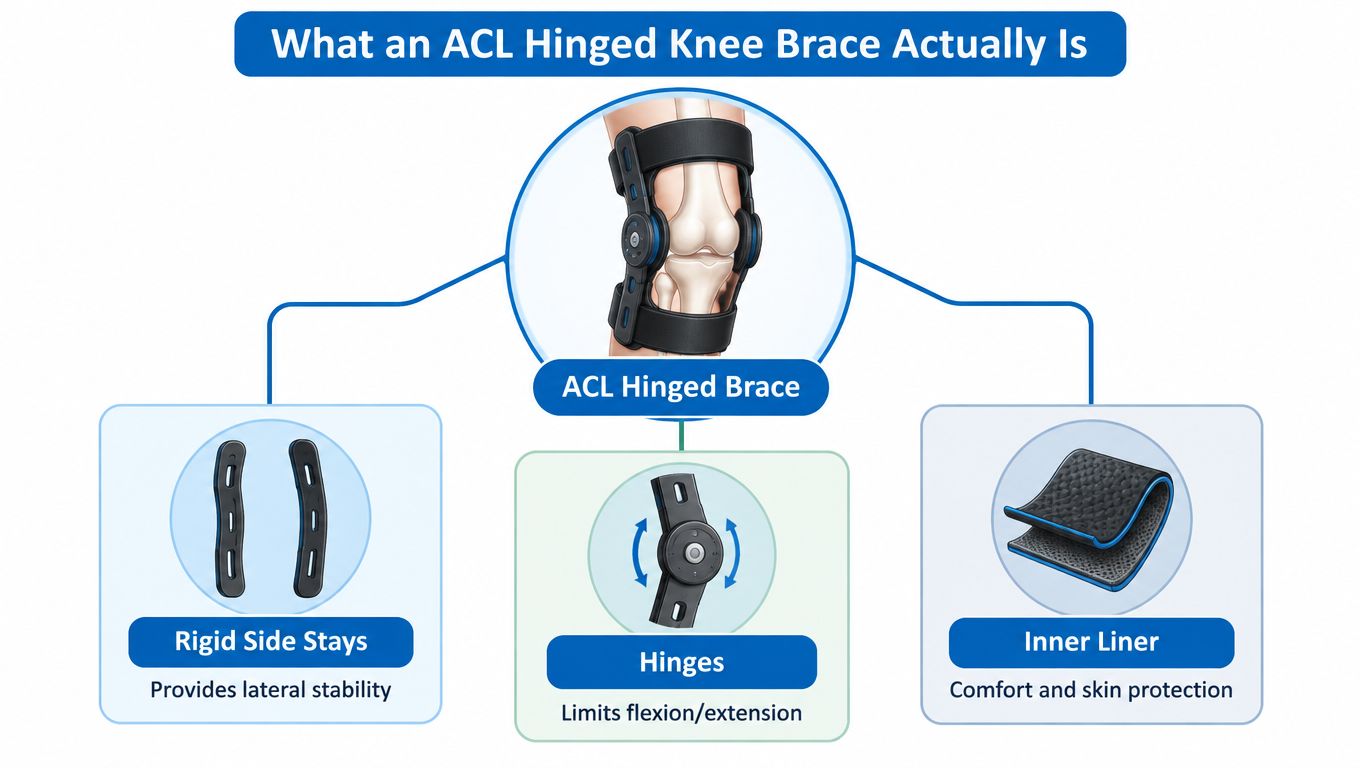
An ACL hinged knee brace is an external orthosis that supports the knee while preserving controlled movement. A compression sleeve mainly provides light compression and proprioceptive input. A hinged brace typically adds rigid side supports, mechanical hinges, straps, and adjustable motion stops. These components can limit unwanted forward translation, side-to-side stress, or rotation without fully immobilizing the joint.
The brace provides mechanical support, not ligament repair. It cannot reconnect a torn ACL, strengthen a graft, or replace progressive rehabilitation. Its value depends on the problem being addressed, the phase of recovery, and whether the design and settings match the patient's knee.
The main components
- Rigid side stays: These run along the inner and outer sides of the knee. They can help limit unwanted lateral movement and support the frame under load.
- Hinges: Hinges allow controlled bending and straightening. Some designs include stops that restrict flexion, extension, or both.
- Straps: Thigh and calf straps secure the brace. Excessive tightness may cause numbness, skin irritation, pressure, or swelling below the device.
- Inner liner: Padding improves skin contact and comfort. It cannot compensate for a hinge that is positioned incorrectly.
- Motion settings: A brace used immediately after surgery may have different limits from one used during later activity. Adjustments should follow the treating clinician's plan, not comfort alone.
Mechanical support is not biological healing
A brace creates an external boundary against selected movements. It does not restore the ACL or graft, and it does not train the muscles to control landing forces. Hinged designs may affect knee motion and proprioceptive feedback, but the effect varies with the brace model, fit, settings, and patient.
A systematic review of hinged brace biomechanics found that hinged designs generally performed better than non-hinged braces across several kinematic and proprioceptive measures. Their effects on knee flexion differed between models. A hinge label alone therefore cannot guarantee protection or predict clinical benefit.
How to Fit and Use an ACL Hinged Knee Brace Correctly
A brace should be fitted as a clinical device, not selected solely from a photograph or a general size label. The patient's diagnosis, leg shape, swelling, surgical restrictions, and intended activity all affect the appropriate design and settings.
A safer fitting sequence
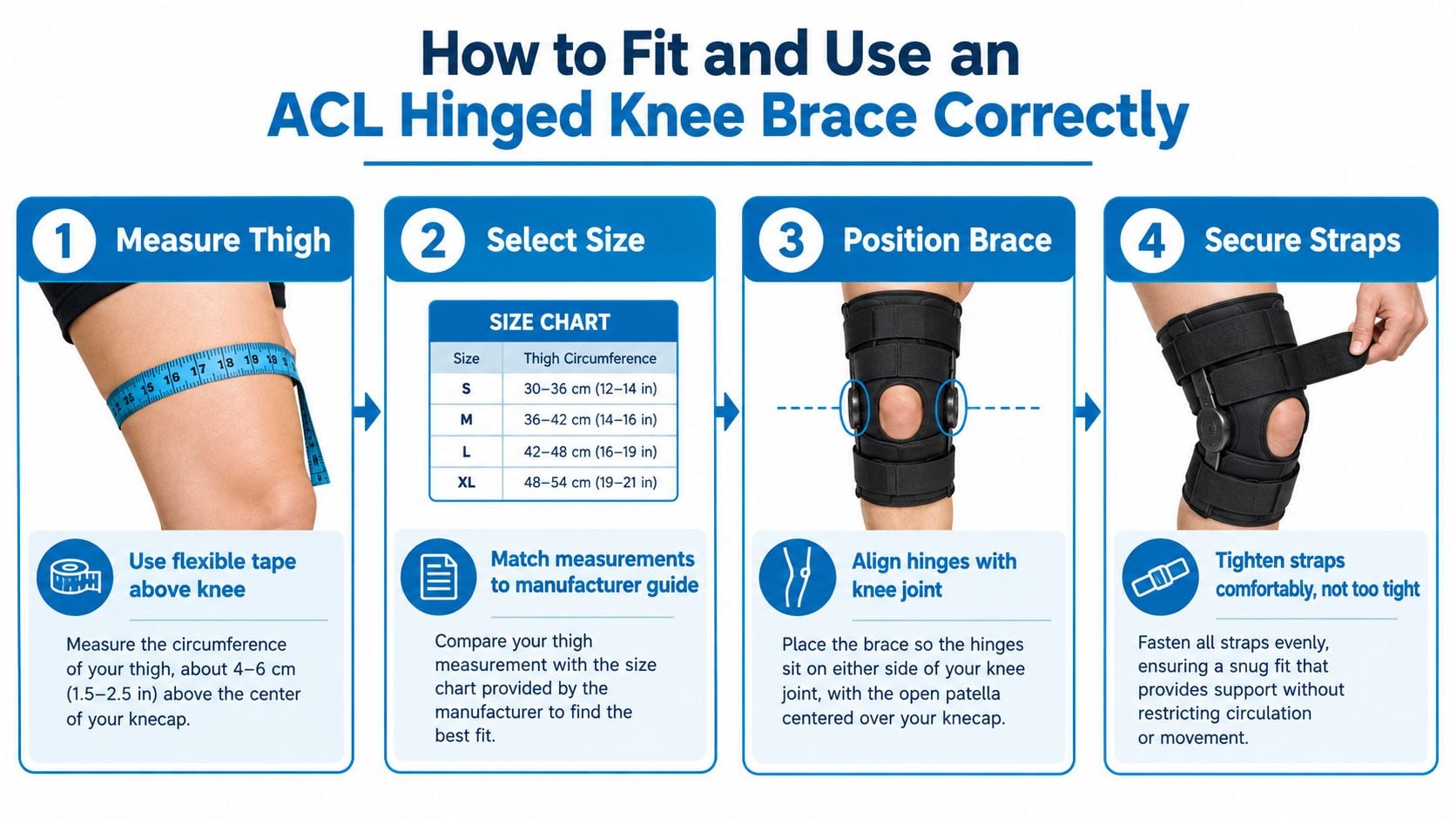
- Confirm the measurements. Use a flexible tape according to the manufacturer's instructions, commonly around the thigh and calf at specified distances from the joint. Measurements should reflect the current leg, not a previous appointment, because swelling and muscle contour can change during recovery.
- Match the size chart. A brace should sit securely without creating a tourniquet effect. If measurements fall between sizes or the leg shape doesn't match the standard frame, a clinician may need to recommend an alternative or custom adjustment.
- Align the hinges. With the knee positioned as instructed, place the hinge centers over the knee joint line. The frame should follow the leg rather than angle away from it.
- Secure the straps in sequence. Fasten the straps so the brace stays stable during walking and flexion. They should be snug, not painfully tight, and the patient shouldn't develop numbness, color change, or increasing swelling below the brace.
Test the fit under movement
A brace that feels fine while sitting may slip during stairs, walking, or repeated bending. The clinician should check for migration while the patient moves, then reassess after the brace has been worn for the prescribed period.
A changing knee needs a changing fit. Swelling reduction can make straps too loose, while persistent swelling can make the same brace too restrictive.
Patients should inspect the skin after use, especially over the hinge edges, strap lines, and bony areas. Slipping, localized swelling, skin breakdown, new numbness, or increasing calf pain warrants contact with the treating team. Severe calf symptoms or neurovascular changes require prompt medical assessment rather than another home adjustment.
Brace settings should follow the rehabilitation protocol. Personal comfort matters, but comfort alone doesn't determine whether a motion stop is safe or whether the device is still necessary.
When an ACL Hinged Knee Brace Is Used in Practice
Brace decisions become clearer when the injury pathway is separated. A patient recovering from isolated primary ACL reconstruction isn't managed in the same way as a patient with a partial tear, a combined ACL and collateral ligament injury, or a revision procedure.
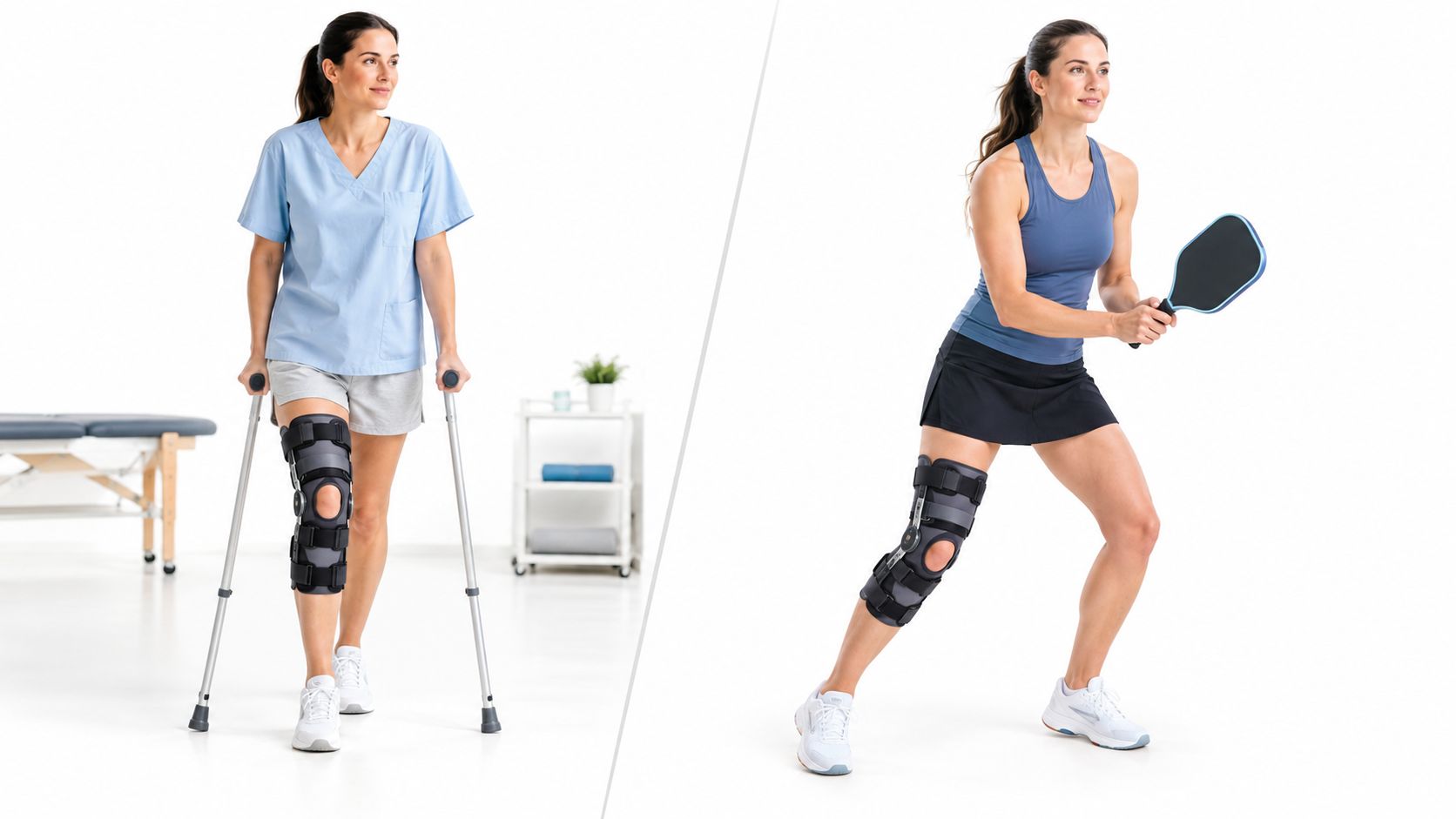
Routine bracing after isolated primary reconstruction often isn't required. The historical evidence described above supports an individualized approach, while a surgeon may still prescribe a hinged brace when instability, associated ligament injuries, unusual operative findings, or specific motion and weight-bearing restrictions make external support useful.
The indication changes by phase
- Early postoperative care: A brace may control motion or support protected walking when the surgical findings and protocol call for it.
- Strengthening: The priority usually shifts toward restoring extension, quadriceps control, balance, and movement quality. The brace shouldn't become a reason to avoid prescribed exercises.
- Return to activity: Some patients use a functional brace during selected drills or sport transitions, particularly when instability symptoms or clinician-assessed risk remains relevant.
- Nonoperative treatment: A partial or complete tear managed without reconstruction may require support during activities that provoke giving-way, but the brace doesn't replace a structured decision about stability and rehabilitation.
- Revision or combined injuries: Additional ligament damage or complex surgical findings can change brace duration, motion limits, and weight-bearing instructions.
Patients seeking background on the injury itself can review the practice's information about an ACL tear, then discuss how the diagnosis affects brace use. A brace can be appropriate in one phase and unnecessary in another, so the prescription should include a review date or a functional milestone rather than an indefinite instruction to keep wearing it.
Comparing Brace Types for ACL Support
More restriction isn't automatically better. A device that blocks needed movement can contribute to stiffness, interfere with gait, or make strengthening harder, while a device with too little structure may not address instability.
| Brace Type | Support Level | Typical Use Cases | Key Limitations |
|---|---|---|---|
| Compression sleeve | Mild | Swelling management, warmth, light proprioceptive feedback | Offers little control of translation, rotation, or side-to-side instability |
| Lace-up brace | Mild to moderate | General support during daily activity, selected mild instability concerns | Adds compression and some medial-lateral support but doesn't provide rigid hinge control |
| Hinged brace | Moderate to high mechanical support | Instability, selected postoperative protocols, combined ligament injuries, and supervised return to activity | Bulkier, more sensitive to fit, and not automatically beneficial for every ACL reconstruction |
A sleeve may be reasonable when the main issue is comfort or mild swelling rather than recurrent instability. A lace-up design can provide a more secure feel, but it still may not control the movements that concern a patient with a clinically unstable knee.
A hinged device has the greatest mechanical capacity of these categories, but that capability creates trade-offs. It may migrate, interfere with clothing or sport equipment, or encourage a patient to trust the brace more than the knee's actual strength and control.
Patients with collateral ligament involvement should also understand that the brace question may not be limited to the ACL. The practice's overview of an MCL tear can help frame why combined injuries often require a different protection and rehabilitation plan.
Selection should follow the task
The relevant questions are practical:
- Is the knee giving way?
- Which movements provoke symptoms?
- Does the surgical protocol require motion control?
- Is the brace intended for walking, therapy, work, or pivoting activity?
- Can the patient wear it without skin, circulation, or gait problems?
Price and appearance don't answer those questions. The correct category is the one that matches the injury, the current phase, and the measurable goal.
What the Evidence Says About Brace Use After ACL Injury
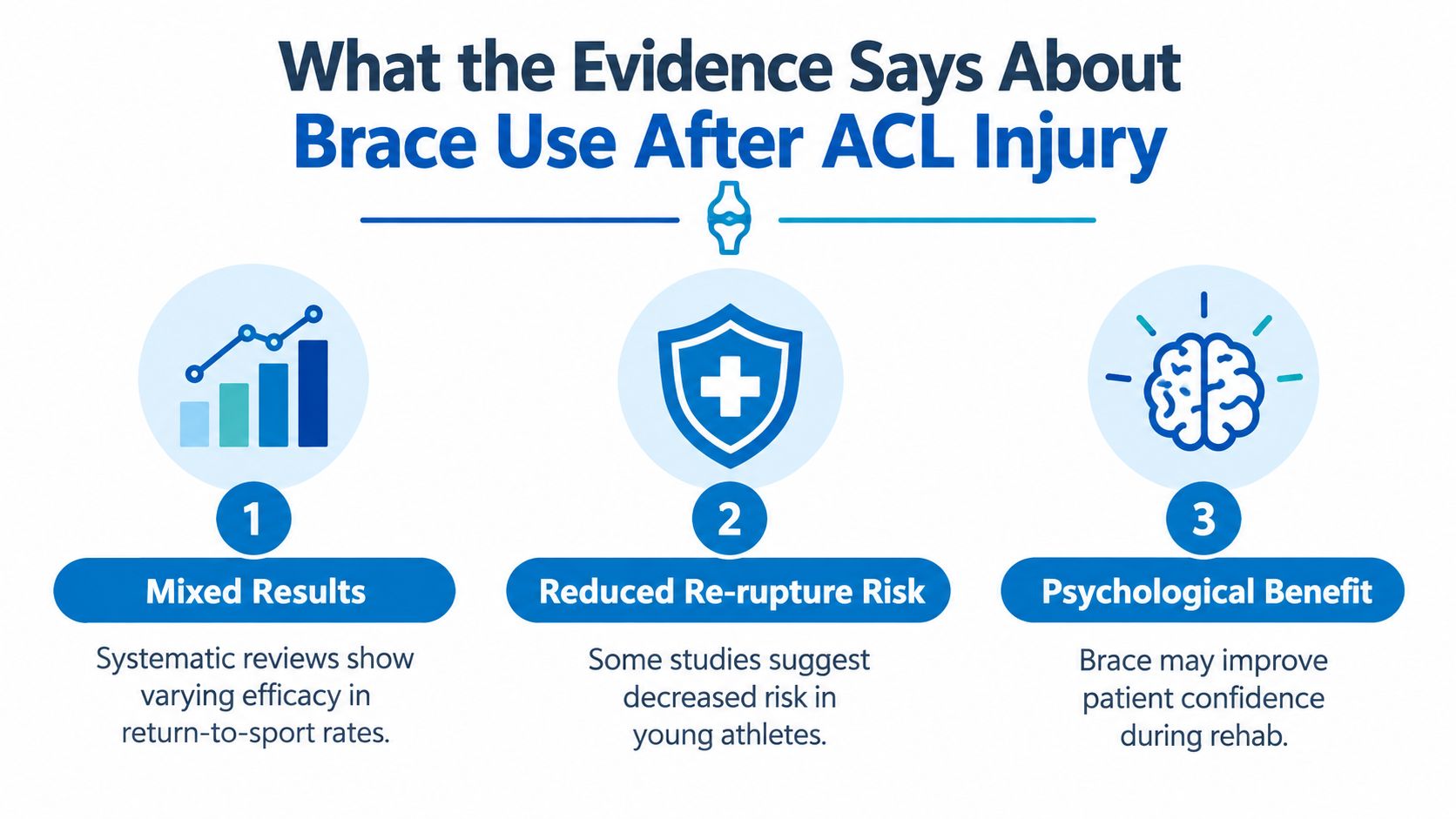
Evidence for a hinged brace after ACL reconstruction is mixed, particularly during return to sport. A 2021 systematic review evaluated 3 studies involving 1,196 patients and found inconsistent findings rather than proof that bracing reliably prevents reinjury.
One comparison recorded reinjury in 2 braced participants, or 4%, versus 3 unbraced participants, or 6%, a difference that wasn't statistically significant. In another analysis of patients aged 17 years or younger, reinjury occurred in 2 of 115 braced patients, approximately 2%, compared with 11 of 89 unbraced patients, approximately 12%. The review emphasized that study limitations and inconsistent methods prevented a firm causal conclusion.
Why the numbers don't settle the decision
The studies were heterogeneous, and follow-up periods ranged from 24 to 96 months according to the review. Different brace designs, patient populations, adherence patterns, sports, and rehabilitation protocols make direct comparisons difficult. A lower reinjury rate in one group doesn't prove that the brace itself caused the difference.
The review also found a statistically meaningful protective effect in a younger subgroup, but that result still needs cautious interpretation. Patients who wear braces may receive different counseling, modify exposure to risky activity, or follow a more conservative return plan.
The safest interpretation is modest: a brace can be one part of risk management, but it isn't a reliable substitute for progressive strength, neuromuscular training, movement retraining, and structured return-to-sport assessment.
Confidence can be clinically useful when it helps a patient participate in rehabilitation without unnecessary fear. It becomes dangerous when reduced pain or increased confidence is treated as proof of ligament stability. The brace should support a plan that measures readiness rather than replace the plan.
How to Decide Whether an ACL Hinged Knee Brace Is Right for You
The decision should start with the diagnosis and the current problem, not the product category. A patient with recurrent giving-way has a different need from a patient whose knee feels stable but swollen after exercise.
Questions that guide a reasonable prescription
- What was injured or reconstructed? Isolated reconstruction, partial tear, complete nonoperative tear, revision surgery, and combined ligament injury each create different restrictions.
- What is the brace supposed to change? The goal might be motion control, stability during walking, protection during selected activity, or confidence during a defined transition.
- What does the knee demonstrate? Examination findings, imaging, episodes of giving-way, swelling, range of motion, and quadriceps control are more informative than the brace's appearance.
- What activity is returning? Straight-line walking, stairs, work duties, cutting, jumping, and pivoting sports place different demands on the knee.
- What can the patient execute safely? A brace shouldn't conceal poor landing mechanics, weakness, or inability to control the knee during rehabilitation drills.
A patient with a meniscus injury may also need a separate assessment of locking, catching, swelling, or load tolerance. Information about a torn meniscus can help patients prepare questions, but only an examination and appropriate imaging can determine how that condition changes brace use.
Confidence has value, but it isn't a test
A brace may make movement feel more controlled. That psychological benefit can help a patient engage with therapy, particularly when fear of reinjury limits participation. It doesn't confirm that the graft, native ligament, or surrounding tissues can tolerate high-risk activity.
Reassessment is appropriate if the knee repeatedly gives way, swelling persists, the brace slips despite fitting changes, or the patient can't progress through prescribed exercises. The answer may be a different brace, a revised rehabilitation plan, further imaging, or a change in activity. Continuing the same device without identifying the underlying problem isn't a complete treatment strategy.
Practical Next Steps for ACL Brace Care and Rehabilitation
Brace care works best as a phase-based process. The patient and treating clinician should be able to identify the diagnosis, the purpose of the brace, the expected wearing situations, and the signs that require a new assessment.
A working checklist
- Confirm the pathway. Document whether the knee has an isolated ACL injury, a reconstruction, a revision, or additional ligament or meniscal damage.
- Define the goal. Write down what the brace should accomplish, such as controlled walking, protection during a specified exercise phase, or support for selected instability symptoms.
- Fit it clinically. Measure the leg, align the hinges with the joint line, set the motion stops as directed, and test the brace during the movements relevant to daily life.
- Pair it with rehabilitation. Continue prescribed range-of-motion work, progressive strengthening, balance training, neuromuscular drills, and movement-quality assessment. The brace isn't a replacement for any of these.
- Monitor the skin and circulation. Look for rubbing, pressure injury, numbness, color change, increased swelling, or a brace that repeatedly migrates.
- Reassess before changing activity. Increased confidence isn't enough reason to resume pivoting, jumping, or contact activity, and reduced pain isn't proof that the knee is stable.
- Review discontinuation. Brace duration should follow the surgical and rehabilitation plan. Stopping may be appropriate after a functional review, while continued use may be reasonable when instability or combined injuries remain.
Postoperative guidance isn't uniform. A 2025 consensus study on ACL rehabilitation reported disagreement about brace duration, weight-bearing restrictions, and return-to-sport timing, especially when ACL injuries coexist with other ligament damage. That uncertainty reinforces the need for individualized instructions rather than a universal calendar.
New calf swelling, severe pain, locking, recurrent giving-way, or neurovascular symptoms should prompt medical assessment. Patients shouldn't tighten the brace further and continue activity while waiting for symptoms to resolve.
The unresolved question isn't which brace is best in the abstract. It's which patient needs an ACL hinged knee brace, during which rehabilitation phase, with what measurable goal.
Interventional Pain Management evaluates ACL and related joint injuries through clinical examination, imaging review, and coordinated orthopedic and rehabilitation planning. Patients in New Jersey and Staten Island can visit Interventional Pain Management to discuss brace fitting, instability symptoms, and phase-appropriate treatment options.