

You can spend weeks treating a “bad shoulder” and still wake up with the same deep ache in the neck, upper back, and arm. That happens because arthritis in the neck and shoulders often sends mixed signals, and the pain location does not always match the true source. A careful exam matters more than guesswork, especially when home stretching, posture fixes, or shoulder exercises keep failing.
Table of Contents
- Why Neck and Shoulder Pain Overlap
- Types of Arthritis Affecting the Upper Body
- Recognizing Your Specific Symptom Patterns
- The Diagnostic Approach Beyond Standard Imaging
- Targeted Interventional and Surgical Care Options
- Safe Movement and Daily Rehabilitation Strategies
- When to Seek Multidisciplinary Pain Management
Why Neck and Shoulder Pain Overlap
A common scenario starts with a stiff neck, a sore shoulder, and a drawer full of exercises that never quite help. The pain may feel local, yet the underlying problem can sit in the cervical spine, the shoulder joint, or both at once. That overlap is why a generic routine often misses the target.

The neck and shoulder share tight anatomical and nerve connections, so pain can travel, settle, or be “felt” in a place that isn't the original pain generator. Cervical facet arthritis may refer pain into the shoulder blade, upper arm, or head without causing obvious weakness, while a shoulder joint problem can make the neck tighten defensively. That's why a patient can be honest, specific, and still describe a pattern that sounds contradictory.
Practical rule: pain location alone doesn't identify the structure that's injured. Movement pattern, neurologic symptoms, and joint behavior matter more.
The result is a frustrating loop. A person stretches the shoulder because it hurts, but the neck is the driver. Or the neck gets treated while the shoulder joint keeps getting overloaded. When symptoms keep bouncing between regions, the evaluation has to look at both areas together, not one in isolation. For a basic overview of neck pain pathways, this neck pain resource can help frame the problem.
Types of Arthritis Affecting the Upper Body
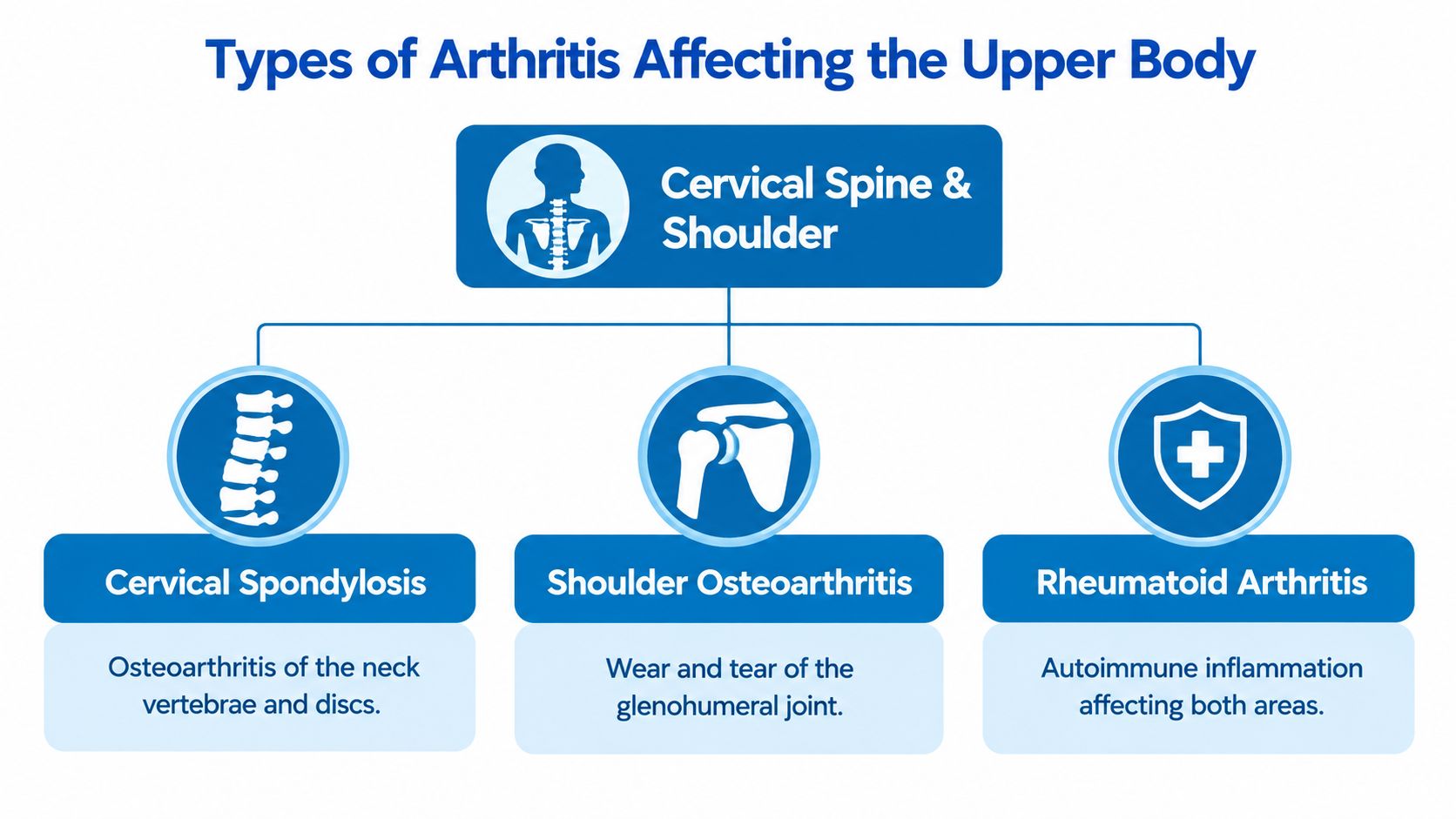
The upper body can be affected by more than one type of arthritis, and the difference matters. Cervical disease, shoulder joint degeneration, and inflammatory arthritis can all produce pain around the same region, yet each one behaves differently when you test motion, strength, and nerve function. Treatment only makes sense once the pain generator is identified.
Cervical spondylosis and facet degeneration
Cervical spondylosis is degenerative arthritis of the neck. It involves the discs, facet joints, uncovertebral joints, and sometimes ligament thickening, which can narrow the spaces around nerves. Age-related degenerative changes are common even in people without symptoms, which is one reason symptoms and scans must be matched carefully.
Shoulder joint arthritis
Shoulder arthritis usually means glenohumeral or acromioclavicular joint degeneration. In the glenohumeral joint, cartilage wears down, the joint space narrows, bone changes develop, and movement becomes painful and limited. That pattern is structurally different from rotator-cuff disease, even though the two can coexist. For a focused look at shoulder osteoarthritis, this shoulder arthritis resource is relevant.
A shoulder joint that hurts through the arc of motion points in a different direction than neck-driven pain that spills into the shoulder region.
Inflammatory arthritis
Inflammatory arthritis can affect both the neck and the shoulder region, but it usually does not follow a simple wear-and-tear pattern. It raises concern when pain is widespread, stiffness lasts longer, or several joints are involved. In those cases, the question is not only how to reduce pain, but whether active inflammation or immune-driven joint damage is part of the problem.
The practical distinction is straightforward. Cervical spondylosis more often causes movement-sensitive neck pain with referred symptoms, while shoulder osteoarthritis more often makes shoulder motion itself painful and restricted. The line is not always clean, which is why careful exam findings matter more than a label alone.
Recognizing Your Specific Symptom Patterns
The easiest trap is assuming every ache near the shoulder belongs to the shoulder. Cervical facet arthritis can create neck stiffness with pain drifting into the scapula, upper arm, or the back of the head. True shoulder arthritis usually behaves more like a joint problem, pain is deeper, movement-based, and tied to specific positions of the arm.
Cervical vs. Shoulder Pain Indicators
| Symptom Feature | Likely Cervical Source | Likely Shoulder Source |
|---|---|---|
| Pain location | Neck, shoulder blade, upper arm, or head | Deep in the shoulder joint, often posterior |
| Motion trigger | Worse with neck turning, looking up, or prolonged posture | Worse with lifting, reaching, or rotating the arm |
| Neurologic symptoms | Numbness, tingling, weakness, radiating pain | Usually absent unless there's a separate nerve issue |
| Joint stiffness pattern | Neck range feels restricted | Both active and passive shoulder motion may be limited |
| Exam clue | Positive neck provocation or arm radiation | Pain reproduced by shoulder movement itself |
A shoulder that hurts only when it moves is different from a shoulder that hurts because the neck is irritated. The exam has to separate those patterns, not merge them.
What points toward nerve involvement
Radiating pain, numbness, tingling, and weakness raise concern for cervical nerve irritation. Those symptoms matter because nerve pain can masquerade as shoulder pain, especially when the person is focusing on the spot that feels worst. If arm symptoms increase with neck movement or if the pain follows a band-like pattern into the hand, the cervical spine deserves close attention.
What points toward true shoulder-joint disease
A shoulder joint problem usually restricts motion in a way the patient can feel immediately. Reaching overhead, reaching behind the back, or rotating the arm outward can trigger pain at the joint itself. When both active and passive motion are limited, that supports joint pathology more than a pure nerve problem.
The practical lesson is simple. Pain pattern beats pain label. A person can point to the shoulder and still have a cervical source, or point to the neck and still have a shoulder joint problem.
The Diagnostic Approach Beyond Standard Imaging
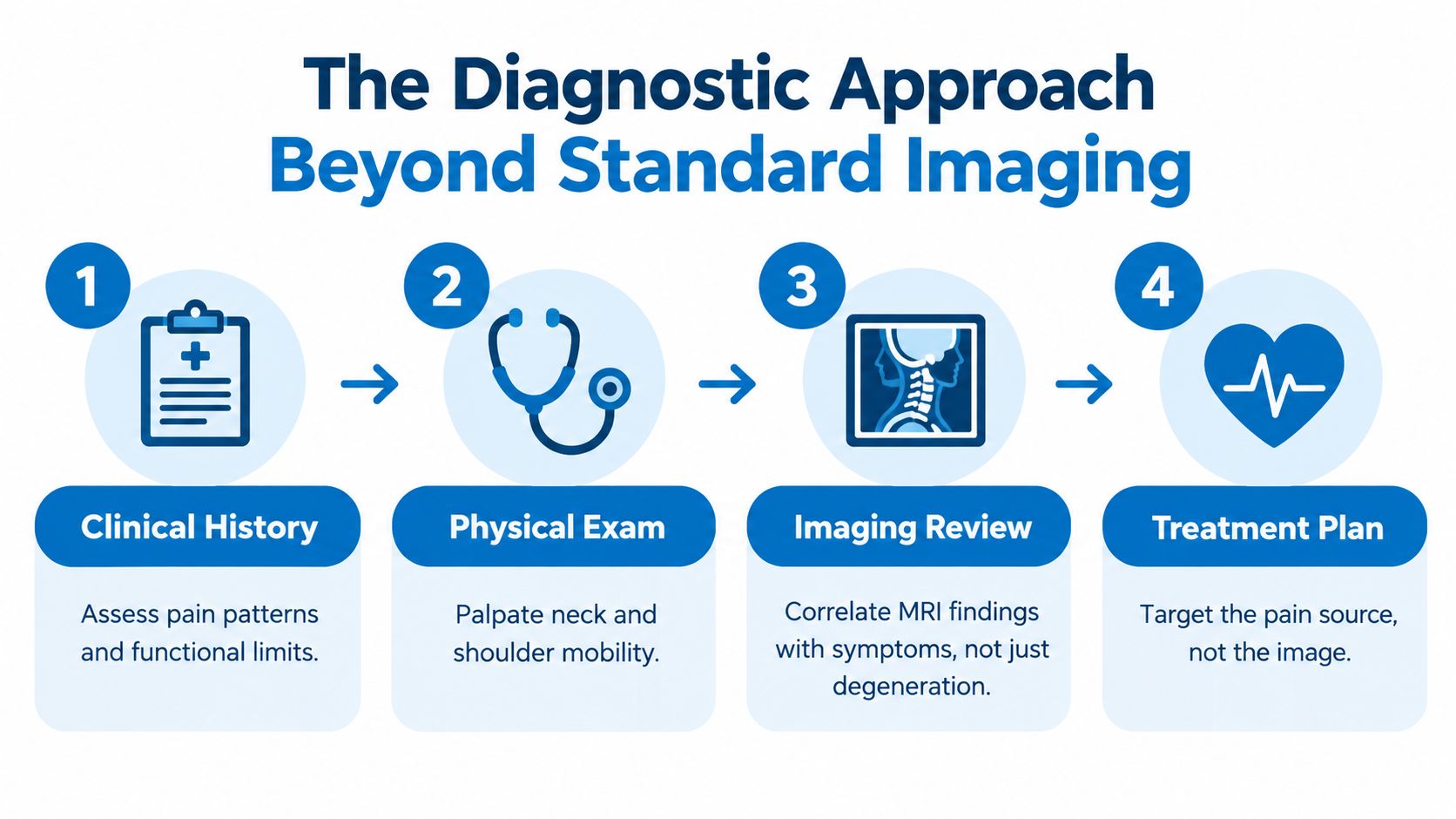
A scan can show real degeneration and still miss the pain generator. Wear and tear on MRI or X-ray does not prove that the neck, the shoulder joint, or the nerves are the structure causing symptoms. That is why treatment fails when the image gets treated instead of the patient.
Why imaging can mislead
Cervical degeneration is common with age, and many adults show changes even when they feel fine. A scan may show narrowing, osteophytes, or disc wear that is incidental. If the pain generator is the facet joint, rotator cuff, capsule, or a nerve root, the scan alone will not answer the question.
What a specialist adds
The clinical exam does the work that images cannot. Range-of-motion testing, neurologic assessment, shoulder mobility comparison, and provocation maneuvers help separate referred cervical pain from true shoulder-joint disease. In the cervical spine, MRI becomes more important when there are objective deficits, progressive symptoms, or concern for cord or nerve compression, because T2 signal changes in the cord can carry real significance (NCBI Bookshelf).
Why diagnostic injections matter
When symptoms and imaging do not line up cleanly, targeted injections can help isolate the source. A cervical nerve block, facet-related block, or joint injection can show whether pain drops when a specific structure is numbed or calmed. That diagnostic step prevents a common failure, treating the wrong site because it looked abnormal on paper.
Clinical point: the right treatment starts with the right pain generator. If the source is cervical, shoulder-directed care alone can stall. If the source is the shoulder joint, neck-only treatment can do the same.
A multidisciplinary practice proves its value here. Interventional Pain Management, for example, uses history, physical examination, and imaging together, then matches treatment to the structure that is responsible.
Targeted Interventional and Surgical Care Options
A patient can have severe pain, a clear MRI abnormality, and still be treating the wrong structure. That is why treatment has to follow the pain generator, not just the scan. Shoulder arthritis care will not calm cervical nerve pain, and neck treatment will not restore a damaged glenohumeral joint that has already lost its mechanics.
Start with the least invasive path
Structured physical therapy, activity changes, posture work, and symptom-guided exercise usually come first. For shoulder arthritis, the aim is to protect the joint while keeping useful motion. For cervical arthritis, the aim is to reduce stress on irritated structures and limit further stiffness. Medication can help as a bridge, but it should not carry the whole plan if daily function keeps slipping.
Use procedures when the pain generator is clear
When the exam and imaging point to the neck, targeted procedures can quiet the structure involved. Cervical epidural steroid injections, facet or medial branch blocks, and trigger point injections, along with corticosteroid injections, are used for different pain patterns, depending on whether the problem is nerve irritation, joint pain, or secondary muscle guarding. For shoulder-joint pain, intra-articular injection can be considered when the joint itself is the confirmed source.
These procedures are most useful when they answer a specific question. If pain drops after the right injection, that result helps confirm the source and guides the next step. If nothing changes, the target was probably wrong.
Escalate only when structural problems demand it
Surgery belongs in the discussion when degeneration is advanced, instability is present, or function stays poor despite well-targeted non-operative care. In the neck, that may mean decompression or another spine procedure when neural compression is the driver. In the shoulder, joint repair or replacement is considered when arthritis is severe and the joint no longer supports daily use. The operation should match the joint, nerve, or disc that failed.
A practical treatment rule helps here.
- Confirm the source first. Do not chase the image.
- Try targeted conservative care. Use the smallest effective step.
- Add an intervention if the structure is clear. Precision matters.
- Reserve surgery for the right anatomy. Not every painful scan needs an operation.
That stepwise logic keeps patients from cycling through treatments that were never designed for their real problem.
Safe Movement and Daily Rehabilitation Strategies
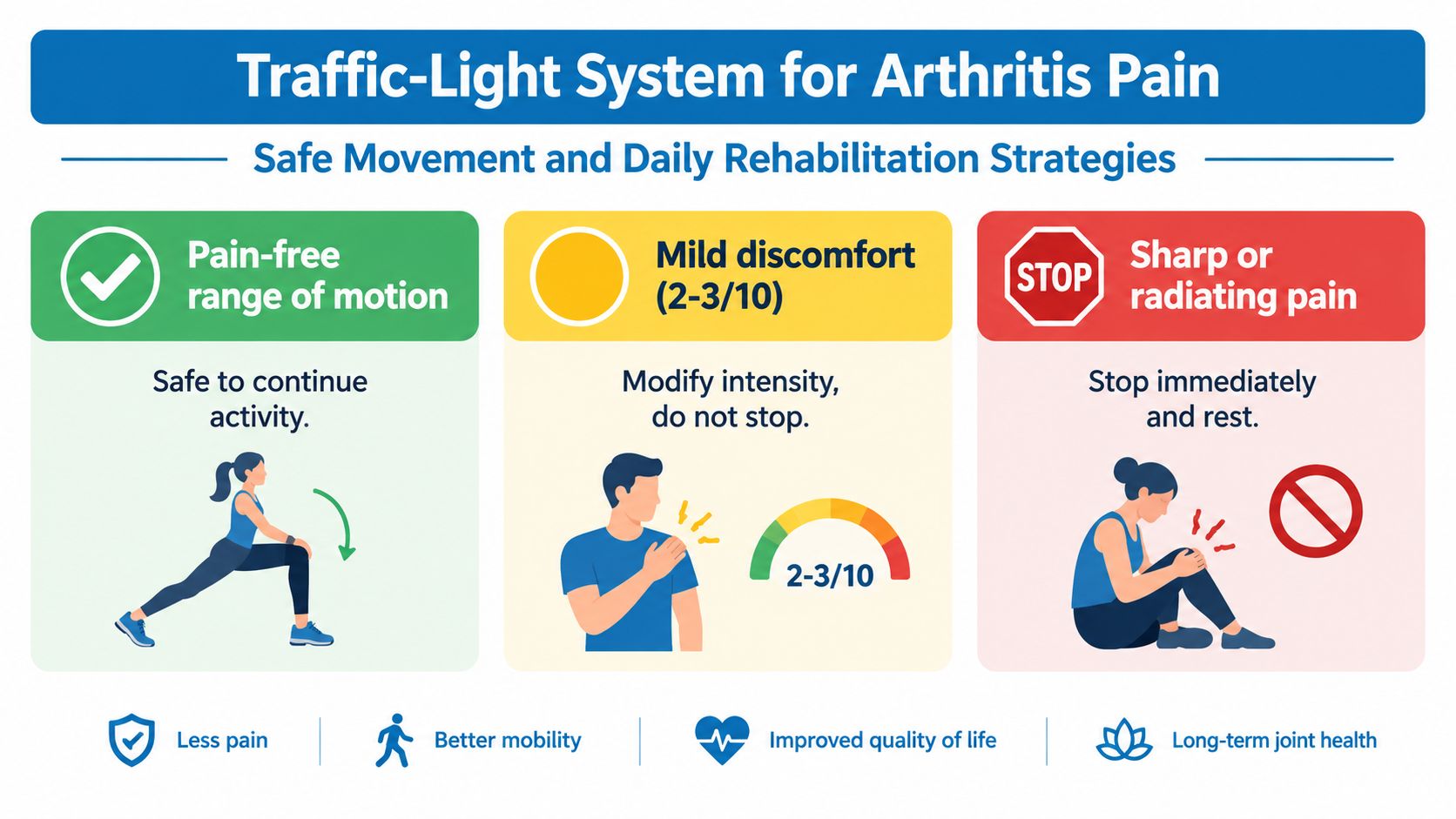
Movement helps, but only when it's scaled to the tissue involved. For overlapping neck and shoulder arthritis, a traffic-light approach works better than a rigid exercise list. Some discomfort is acceptable, some means modify, and some means stop.
Green means continue
Pain-free motion, gentle stiffness, and controlled muscle effort usually belong in the green zone. That includes slow range-of-motion work, posture resets, and light daily activity that doesn't trigger a flare. The purpose is to keep the joints from locking up without provoking the irritated structure.
Yellow means modify
Mild discomfort that stays local and fades shortly after activity usually calls for a smaller dose of the same movement. Reduce range, slow the tempo, or shorten the session. The point is not to avoid all sensation, it's to avoid turning a manageable load into a flare.
Red means stop
Sharp pain, radiating symptoms, tingling, weakness, or dizziness means the exercise is no longer safe in that form. Stop the activity and reassess. For neck arthritis especially, new arm symptoms or balance-related issues should not be pushed through.
Practical rule: muscle effort can be normal, nerve irritation is not. If pain starts traveling, the activity has crossed a line.
Daily life needs the same logic. A pillow that supports the neck, a driving posture that avoids prolonged strain, and lifting mechanics that keep loads close to the body all matter more than a long list of random exercises. For people whose symptoms fluctuate, pacing often beats intensity. The goal is a steadier week, not a heroic workout followed by two days of fallout.
When to Seek Multidisciplinary Pain Management
A specialist evaluation becomes important when pain stays confusing, limits sleep or work, or keeps returning despite basic care. New weakness, progressive numbness, gait trouble, or bowel and bladder changes need prompt medical assessment, not another round of self-directed stretching. Those symptoms can signal nerve or spinal cord involvement that deserves timely attention.
For adults with arthritis, the burden is large and often age-linked. In the United States, an estimated 53.2 million adults reported doctor-diagnosed arthritis during 2019 to 2021, and prevalence rose to 47.3% among adults 65 and older (CDC). That's one reason chronic neck and shoulder pain shouldn't be dismissed as routine aging when function is dropping.
A multidisciplinary clinic is useful because these cases rarely belong to one discipline alone. Pain management, orthopedics, anesthesiology, and spine care each bring a different toolset, and the best plan often combines several of them. The right team doesn't just order scans, it determines which structure hurts, which treatment fits, and when escalation is justified.
If your neck and shoulder pain keeps changing shape, getting worse, or refusing to respond to generic therapy, Interventional Pain Management can evaluate the pain generator and build a targeted plan that fits your anatomy and daily demands. Visit Interventional Pain Management to arrange a focused assessment and get the problem mapped to the right treatment path.