
Searching for an ACDF recovery time often produces one neat answer, such as four to eight weeks. That estimate can be useful, but it can also create a dangerous misunderstanding. A patient may feel much better, return to a desk, and walk comfortably while the bone graft is still slowly joining the vertebrae.
A more accurate question is not, “When will recovery be over?” It's, “Which part of recovery is being measured?” Pain relief, daily function, work clearance, driving, and solid bone fusion follow related but separate timelines. Cleveland Clinic's ACDF patient guidance describes meaningful early progress alongside a fusion process that can continue for many months.
Table of Contents
- What You Actually Need to Know About ACDF Recovery Time
- The First Week After Surgery What to Expect
- Returning to Work and Daily Activities Within Weeks
- Why Your Personal Recovery Timeline Differs
- Comparing Single-Level and Multilevel ACDF Recovery
- Warning Signs That Require Immediate Medical Attention
- Building Realistic Expectations for Long-Term Healing
What You Actually Need to Know About ACDF Recovery Time
A patient may leave the hospital feeling hopeful because the arm pain that disrupted sleep has eased. A few weeks later, that same patient may be answering emails, taking short walks, and assuming the neck is healed. The improvement is real, but it doesn't mean the fusion has finished.
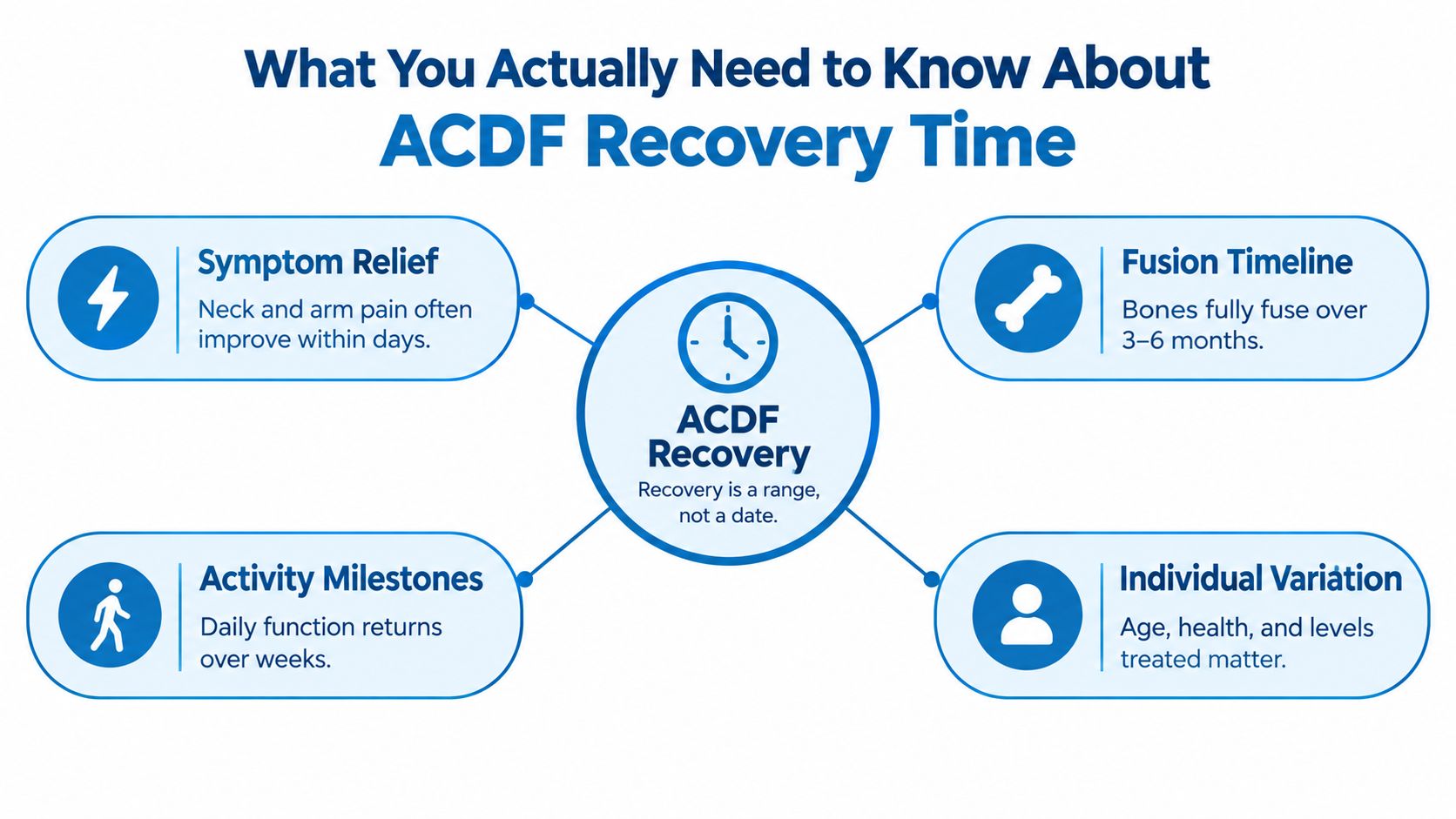
ACDF recovery time is a range, not a finish line. The first major recovery window is commonly about 4 to 6 weeks, while many patients return to desk work in 2 to 4 weeks and reach most regular activities by about 3 to 4 months, according to Cleveland Clinic guidance. The bone itself can take 6 months to 1 year to solidify fully, so functional recovery usually arrives before biological healing is complete.
The two timelines that matter
Symptom recovery includes reduced arm pain, improving numbness, better sleep, and increasing energy. Those changes can begin early. Fusion recovery concerns the graft and vertebrae forming a stable bony bridge, which takes longer and may require follow-up imaging.
The hardware supports the treated area while the body builds bone. That support can make movement feel safer before the fusion has matured. Patients should therefore judge activity by the surgeon's restrictions, not only by how comfortable a movement feels. More detail about the procedure and its recovery phases appears in this anterior cervical discectomy overview.
Practical rule: Feeling better is an important milestone, not proof that the fusion is complete.
The First Week After Surgery What to Expect
The first week is usually less about testing strength and more about protecting the surgical site while restoring basic independence. Cleveland Clinic reports that most patients go home the next day, although discharge timing depends on the operation, medical status, swallowing, walking ability, and the surgeon's protocol. Some patients need closer observation, particularly after a more complex procedure.
Before leaving the hospital
The care team checks pain control, movement, neurological function, and the ability to drink and walk safely. A patient may have throat soreness, neck discomfort, shoulder tightness, fatigue, or temporary swallowing difficulty. These symptoms can be unsettling, but the surgical team should explain which changes are expected and which require a call.
Medication instructions deserve careful attention. Strong pain medicines can cause drowsiness and constipation, and they can make driving unsafe. Cleveland Clinic notes that many patients come off pain medicines within 2 to 3 weeks, but the actual schedule depends on pain severity, medication type, side effects, and the prescribing clinician's instructions.

The first days at home
A practical home plan usually includes:
- Short walks: Gentle walking supports circulation and prevents long periods of stiffness, but distance should increase only as tolerated.
- Incision care: The wound should be kept according to the discharge instructions, with attention to new drainage, spreading redness, warmth, or worsening tenderness.
- Safe positioning: A supportive sleeping position can reduce neck strain. Sudden twisting, repeated bending, and unsupported lifting should be avoided unless the surgical team permits them.
- Food and fluids: Soft foods and careful swallowing may be easier while throat irritation settles. Persistent or worsening swallowing problems should be reported.
- Support at home: Another adult can help with meals, medication organization, transportation, and household tasks during the earliest days.
Strenuous activity should be avoided for at least 6 weeks under Cleveland Clinic guidance. That restriction doesn't mean complete bed rest. It means the patient should move gently while avoiding actions that load or jerk the healing neck.
Returning to Work and Daily Activities Within Weeks
Return to normal life depends on what “normal” requires. A person with computer-based work may need a different plan from a warehouse worker, driver, or healthcare employee who lifts, turns, or remains on the feet for long periods. The surgeon's clearance should match both the medical recovery and the actual demands of the job.
Many patients return to light-duty work in about 4 to 6 weeks, while Cleveland Clinic describes a possible work return in 3 to 6 weeks. Desk work may resume earlier when pain is controlled, posture can be maintained, and medication no longer causes impairment. A gradual schedule can be more realistic than an immediate full workload.
Driving requires more than comfort
Driving is generally considered only when the patient can turn safely, react quickly, control the vehicle, and remain alert without strong pain medication. Published clinical guidance places driving anywhere from 2 weeks to 6 to 12 weeks, depending on symptom control and the surgeon's protocol, as summarized in this clinical recovery analysis.
A patient shouldn't use a short drive as a test without clearance. Neck stiffness, a collar, sedating medicine, and limited ability to check blind spots can each affect safety.
Why the fusion numbers look slower
Functional improvement can precede visible fusion on imaging. A pooled analysis reported fusion in 55.6% of patients at 3 months, 74.4% at 6 months, 88.1% at 12 months, and 91.8% at 24 months. Those figures don't mean that patients without radiographic fusion at an earlier checkpoint are necessarily failing. They show why comfort and imaging shouldn't be treated as interchangeable measures.
| Milestone | What it usually measures |
|---|---|
| Early weeks | Pain control, walking, self-care, and medication reduction |
| Several weeks | Work and driving decisions, based on symptoms and restrictions |
| Later months | Functional gains, follow-up assessment, and fusion progression |
| Extended follow-up | Ongoing bone consolidation and confirmation of stability |
A patient can therefore feel ready for ordinary activities while still needing restrictions on lifting, impact, or strenuous exercise. The safest plan respects both tracks.
Why Your Personal Recovery Timeline Differs
Two people can undergo ACDF on the same day and experience different recoveries. One may notice rapid arm-pain relief but persistent fatigue. Another may have modest early change followed by gradual neurological improvement. Neither pattern automatically means the operation has succeeded or failed.
A recent study of 616 patients found that neck and arm pain improvements typically plateaued within 6 weeks after single-level and multilevel ACDF. Disability and physical-function gains continued improving through 12 weeks to 6 months, and return to activities occurred in about 2 to 6 weeks, with multilevel cases recovering more slowly, as reported in the published ACDF outcomes study.
The diagnosis changes the pattern
Radiculopathy, caused by nerve-root irritation, often presents with arm pain, tingling, numbness, or weakness. Myelopathy involves spinal-cord dysfunction and may affect balance, dexterity, gait, or coordination. The study found later improvement plateaus among patients with myelopathy than among those with radiculopathy alone, so a patient shouldn't expect every symptom to respond on the same schedule.
Symptom duration also matters. In a prospective series of 62 ACDF patients, 83.9% improved, 12.9% were unchanged, and 3.2% worsened at final follow-up. Every patient treated within 6 months improved, compared with 81.3% when symptoms lasted 6 to 24 months and 50% when symptoms persisted longer than 24 months, according to the prospective outcome series.
Other variables shape the calendar
The number of treated levels, baseline health, bone quality, nicotine exposure, sleep, nutrition, job demands, and adherence to restrictions can all affect progress. These factors don't provide a personal prediction by themselves, but they explain why a generic calendar shouldn't replace individualized follow-up.
Recovery should be measured against the patient's preoperative symptoms and functional goals, not against another patient's milestone.
Comparing Single-Level and Multilevel ACDF Recovery
Single-level and multilevel ACDF share the same basic principle, removing pressure and stabilizing the treated segment or segments. They don't place the same physical or functional demands on recovery. More treated levels generally mean a larger surgical area and a greater need to individualize return-to-work, driving, collar, and activity decisions.
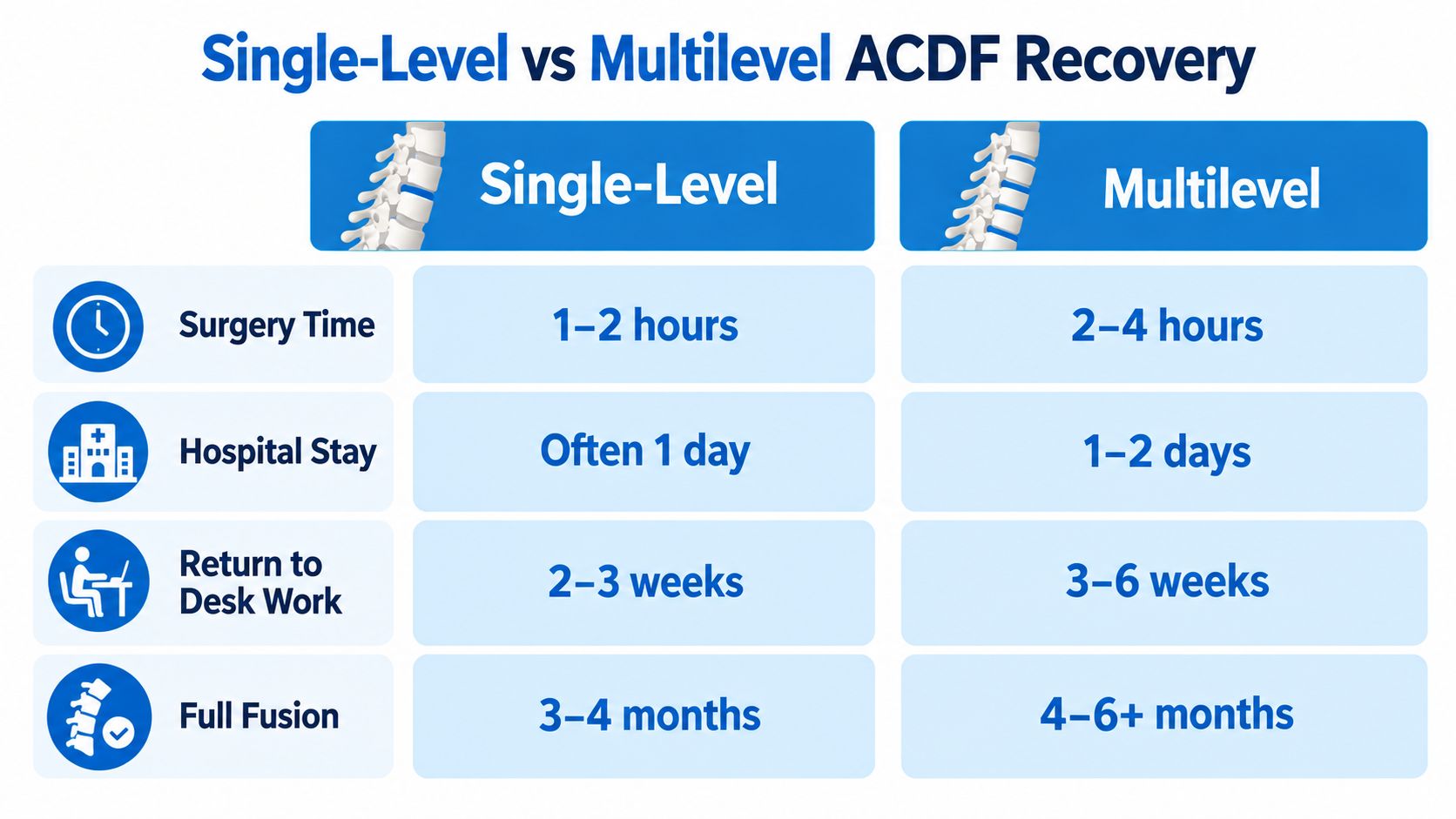
Independent specialty guidance notes that single-level procedures may allow same-day discharge, while multilevel operations often involve an overnight stay and a slower return to driving, work, and full activity. The difference is not just a matter of adding calendar days. A multilevel operation can affect swallowing comfort, neck stiffness, endurance, and the amount of movement a patient can safely tolerate.
A practical side-by-side view
| Recovery question | Single-level ACDF | Multilevel ACDF |
|---|---|---|
| Hospital course | May allow same-day discharge in selected cases | More often requires overnight observation |
| Early symptoms | Can still include throat soreness, stiffness, and fatigue | These symptoms may be more pronounced or last longer |
| Work and driving | Clearance may come sooner when symptoms and movement permit | Clearance often takes longer and depends on the job |
| Fusion assessment | Requires patience beyond early symptom relief | Requires the same patience, with added attention to complexity |
The comparison doesn't establish a personal deadline. A healthy patient with a sedentary job may progress differently from a patient with several treated levels, neurological deficits, or physically demanding work. The spinal fusion guidance also emphasizes that fusion care must account for the treated anatomy and the broader recovery plan.
Why diagnosis belongs in the comparison
Patients with radiculopathy may focus on arm pain and numbness, while patients with myelopathy may track walking, hand coordination, and balance. The 616-patient study found that multilevel patients returned to activities more slowly and that myelopathy patients had later improvement plateaus. That means a patient can have encouraging pain relief while still needing time for more complex functional recovery.
Warning Signs That Require Immediate Medical Attention
Normal recovery can include soreness, fatigue, stiffness, and some swallowing discomfort. The important question is whether symptoms are gradually settling or becoming more severe. A new symptom, rapidly worsening symptom, or symptom that interferes with breathing or neurological function deserves prompt attention.
Call the surgical team promptly
Patients should contact the surgical team for:
- Incision changes: Increasing redness, warmth, swelling, opening, or unusual drainage can signal a wound problem.
- Breathing or swallowing difficulty: Sudden breathing trouble, marked throat tightness, or worsening inability to swallow requires urgent evaluation.
- Neurological changes: New or worsening weakness, numbness, loss of coordination, or difficulty walking should not be watched at home.
- Systemic illness: Fever, chills, or a sudden decline in general condition can indicate infection or another complication.
- Uncontrolled pain: Pain that escalates rather than gradually improves needs professional review, particularly if medication no longer provides relief.
Severe breathing difficulty, rapidly expanding neck swelling, or sudden neurological loss should be treated as an emergency. The patient should seek immediate emergency care rather than waiting for a routine appointment.
The guidance on pain after back surgery can help patients understand why persistent or changing postoperative pain deserves assessment. It shouldn't replace the discharge instructions or direct advice from the operating team.
A simple safety plan helps. Keep the surgeon's office number available, know which symptoms require emergency services, and ask before changing medication or activity. Prompt communication often resolves uncertainty before a minor concern becomes more serious.
Building Realistic Expectations for Long-Term Healing
The most useful long-term expectation is steady progress with occasional uneven days. Arm pain may improve before neck stiffness. Function may continue improving after pain has plateaued. A patient may return to work while still attending follow-up visits and waiting for imaging to confirm how the fusion is developing.
Cleveland Clinic states that full regular activity may be reached around 3 to 4 months, while fusion solidification can take 6 months to 1 year. MedStar guidance places complete recovery at 6 to 8 weeks for many patients, while noting that fusion can take about 3 months and sometimes 6 to 9 months. These ranges aren't contradictory. They describe different definitions of recovery.
What patience protects
Early comfort can tempt a patient to lift more, exercise harder, or seek clearance before the surgeon considers the fusion ready. Restrictions are designed to protect the healing construct while bone develops. Follow-up imaging, medication review, wound assessment, and gradual activity progression help clinicians distinguish expected recovery from delayed healing.
Some patients retain stiffness or experience slower functional improvement beyond the commonly cited 6- to 12-week window. That doesn't automatically indicate a complication, especially when symptoms are improving, but persistent pain, weakness, or declining function should be reviewed rather than dismissed.

The practical definition of success
Success isn't just a date on the calendar. It means the patient can perform important daily tasks with less nerve-related pain, improved strength or coordination where recovery is possible, and a stable surgical result that has been monitored appropriately. The biological fusion may continue maturing after life feels mostly normal.
Patients preparing for ACDF or dealing with persistent symptoms afterward can discuss diagnosis, medication, rehabilitation, and surgical follow-up with Interventional Pain Management, which provides pain, spine, orthopedic, and minimally invasive care matched to clinical needs. Visit Interventional Pain Management to request an evaluation and discuss the next appropriate step.