
You wake up, put a foot on the floor, and feel that sharp pull right above the heel. Walking across the kitchen is harder than it was yesterday, stairs feel worse, and now you're wondering if a boot is the next step or just a way to make the day more awkward. For Achilles tendon pain, that question comes up constantly, and the honest answer is conditional, because a walking boot can calm the tendon down, but it can't rebuild it on its own.
The right approach depends on whether this is Achilles tendinopathy, a partial tear, or a rupture, and on how much pain, swelling, and limp are getting in the way of normal walking. A boot is usually a short-term offloading tool, not a cure. The recovery that lasts comes from what happens after protection, especially the transition back to graded loading and strengthening, not from staying immobilized indefinitely.
Table of Contents
- When a Walking Boot Makes Sense for Achilles Tendonitis
- How a Walking Boot Protects the Achilles Tendon
- Types and Features of Achilles Walking Boots
- Fitting, Wearing, and Weight-Bearing Guidelines
- Rehabilitation and Transitioning Out of the Boot
- Alternatives and When to Escalate Care
- Red Flags and Next Steps for Specialist Care
When a Walking Boot Makes Sense for Achilles Tendonitis
A patient often arrives after a rough morning, limping through the house and asking whether a boot will let the tendon settle. That scenario makes sense when pain is severe enough that normal walking keeps re-irritating the area, especially if every step feels like it's tugging on the back of the ankle. A boot gives the tendon a break from that repeated strain, and the main goal is short-term protection, not permanent rest.
For adult patients managed without surgery, a recent comparative study found that walking boots were broadly similar to molded ankle-foot orthoses on patient-reported outcomes. Satisfaction was high in both groups, with 24 of 27 boot patients, or 89%, satisfied, compared with 53 of 79 mAFO patients, or 67%, and mean Achilles function ratings were 75/100 for boots versus 72/100 for mAFOs (comparative study). That doesn't mean every painful Achilles needs a boot. It means the boot is a legitimate conservative tool when symptoms are flared enough that protection matters.
Tendinopathy is not the same as rupture
That distinction matters more than many expect. Rupture protocols are built around a very different healing biology, and they often keep patients protected for longer, with wedge progression and staged return to movement. Tendinopathy usually needs a shorter, more symptom-guided offloading period, followed by progressive loading once the gait settles.
Practical rule: if walking is still clearly worsening pain from one day to the next, a boot discussion is reasonable. If pain is manageable and the limp is mild, heel lifts, activity modification, and physical therapy may be enough.
Boot use also becomes more relevant when the tendon is irritated enough that a patient can't function without compensating. A significant limp, repeated pain with push-off, or inability to tolerate ordinary daily walking are all reasons clinicians consider temporary immobilization. On the other hand, a boot isn't automatically the best first move for every case, because prolonged immobilization can slow recovery if it replaces rehabilitation instead of supporting it.
The most useful question isn't, “Do I need a boot forever?” It's, “Do I need enough offloading right now to calm the tendon so rehab can start?” That's the decision point that separates a helpful boot from a long detour.
IPMC's Achilles tendinitis overview is a useful reference point for patients trying to match symptoms to treatment intensity, especially when deciding whether a boot is worth discussing with a clinician.
How a Walking Boot Protects the Achilles Tendon
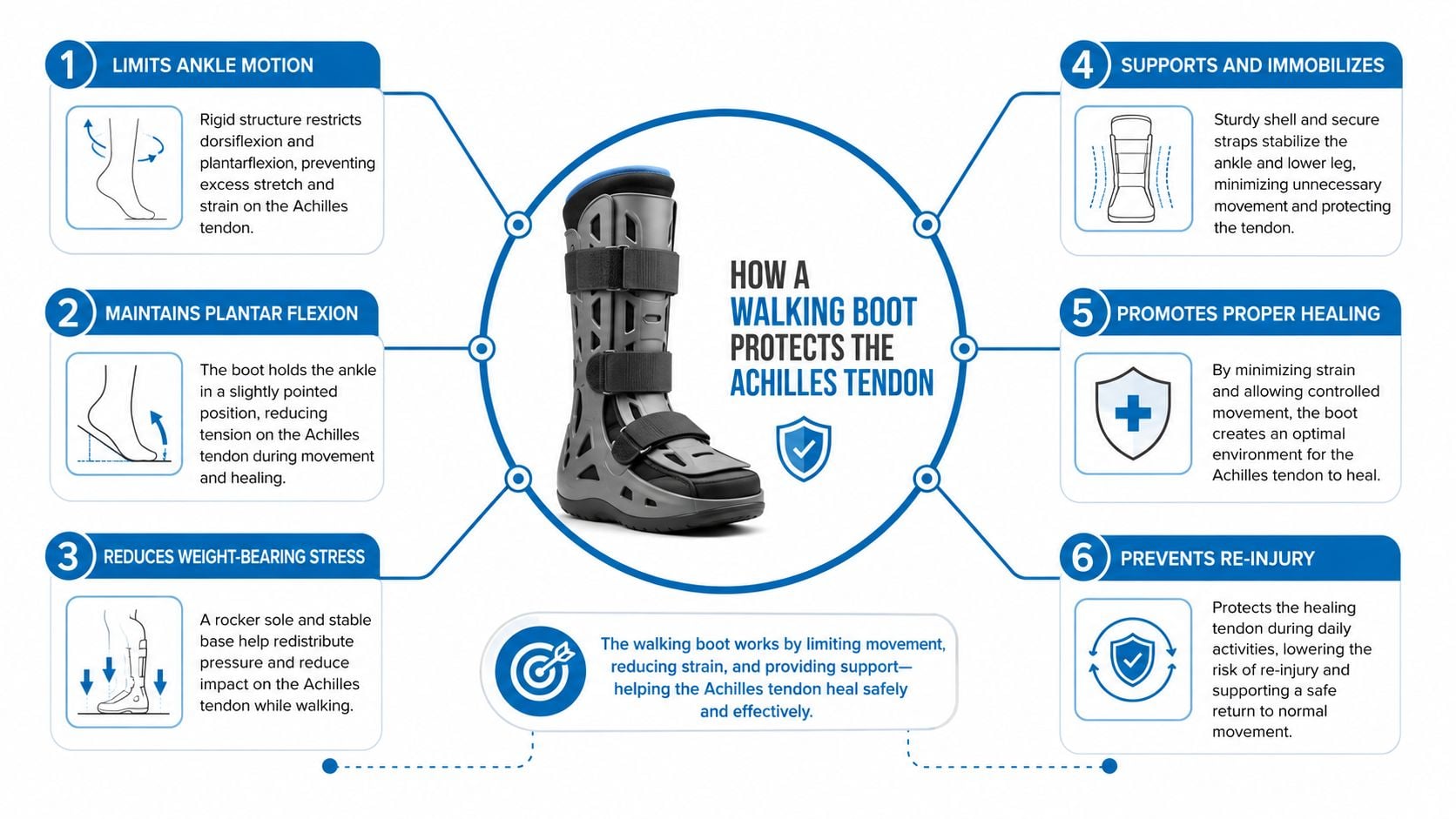
A walking boot protects the Achilles by changing ankle position and reducing how much force the tendon has to absorb during standing and walking. With the ankle held in plantar flexion, the foot points slightly downward, which shortens the Achilles-calf unit and lowers strain during each step. The goal is mechanical unloading, not making the foot feel enclosed.
Why heel wedges matter
Heel wedges do more than soften impact. They place the ankle in a more protected position so the tendon is not stretched as hard at heel strike and push-off, which is the main reason clinicians use them for Achilles offloading. In one loading study, immobilizing boots reduced Achilles tendon load by an average of 68% compared with unsupported shoe walking, and some configurations reduced load by as much as 79.5% at a 30° angle condition (biomechanics and treatment history review). That is a load-management effect, not a comfort feature.
The practical effect is lower tissue demand while the tendon is reactive. Less stretch during each step means fewer repeated irritations while pain is still active.
A boot is not simply a padded shoe. It changes the loading environment so the tendon is not asked to do full work while it is irritated.
Rocker-bottom soles add another layer of protection. They shift the rollover point forward, which can make walking feel less abrupt. That can reduce compensatory stress higher up the chain, including at the knee and hip, while the ankle is protected. The aim is to lower provocation, not to make gait look normal.
What the boot actually does during walking
Each step stresses the tendon most at heel strike and again as the body rolls forward over the foot. In a boot, the ankle is held out of the same range of motion that usually aggravates symptoms in a shoe. That means less lengthening of the gastrosoleus-Achilles unit during stance and push-off, and less repeated micro-strain while the tendon is sensitive.
Setup matters here. A boot that sits too neutral too soon can remove part of that protection. A boot with a wedge system lets the ankle be supported first, then gradually brought toward neutral as symptoms settle. The device is doing its job only if it is configured to change the load the tendon sees.
Types and Features of Achilles Walking Boots
Not every walking boot serves the same purpose. Some are basic CAM walkers, built to stabilize the ankle and lower leg. Others add removable heel wedges or adjustable angle settings, which let the clinician control how much plantar flexion the Achilles sees during the early phase of recovery. For Achilles pain, that difference matters because the amount of tendon tension often matters as much as simple immobilization.
What each feature changes
A standard boot can reduce motion, but it does not always place the ankle in enough plantar flexion for a very irritable Achilles. A wedge-based system starts the ankle in a more protected position, then can be adjusted as symptoms improve. In one specialist design, four interlocking 10° wedges allow the heel angle to be lowered step by step as the tendon settles, so the calf-Achilles unit is lengthened gradually instead of all at once (boot design reference).
That gradual change matters because it avoids jumping straight from protection to full dorsiflexion. The tendon does better with a managed bridge between those states, not a sudden reset.
| Boot Type | Key Features | Best For |
|---|---|---|
| Standard CAM walker | Rigid shell, straps, basic ankle stabilization | General short-term offloading when pain needs a quick reduction |
| Wedge-based Achilles boot | Built-in heel lifts or removable wedges, more plantar flexion | Achilles symptoms where reducing tendon tension is the main goal |
| Rocker-sole boot | Curved sole to ease roll-through | Patients who need smoother gait mechanics during protected walking |
| Adjustable wedge system | Stepwise wedge removal, controlled angle changes | Rehab plans that need gradual progression instead of abrupt neutral positioning |
Choosing the right configuration
A more adjustable boot is usually more useful when symptoms are changing and the clinician wants the ankle to move toward neutral in stages. A simpler boot may be enough when the goal is to calm a flare-up for a brief period. If walking is still very painful, the priority is protection first, not extra features.
Fit matters more than many patients expect. The heel should sit where the device intends, the straps should hold the foot without letting it slide, and the sole should let the person walk without forcing awkward compensations. A boot that feels loose, unstable, or poorly centered is not controlling load the way it should.
The clearest way to think about boot choice is simple. More pain and more tendon irritability call for more protection and more adjustability. Milder symptoms usually call for less hardware and more load management outside the boot.
Fitting, Wearing, and Weight-Bearing Guidelines
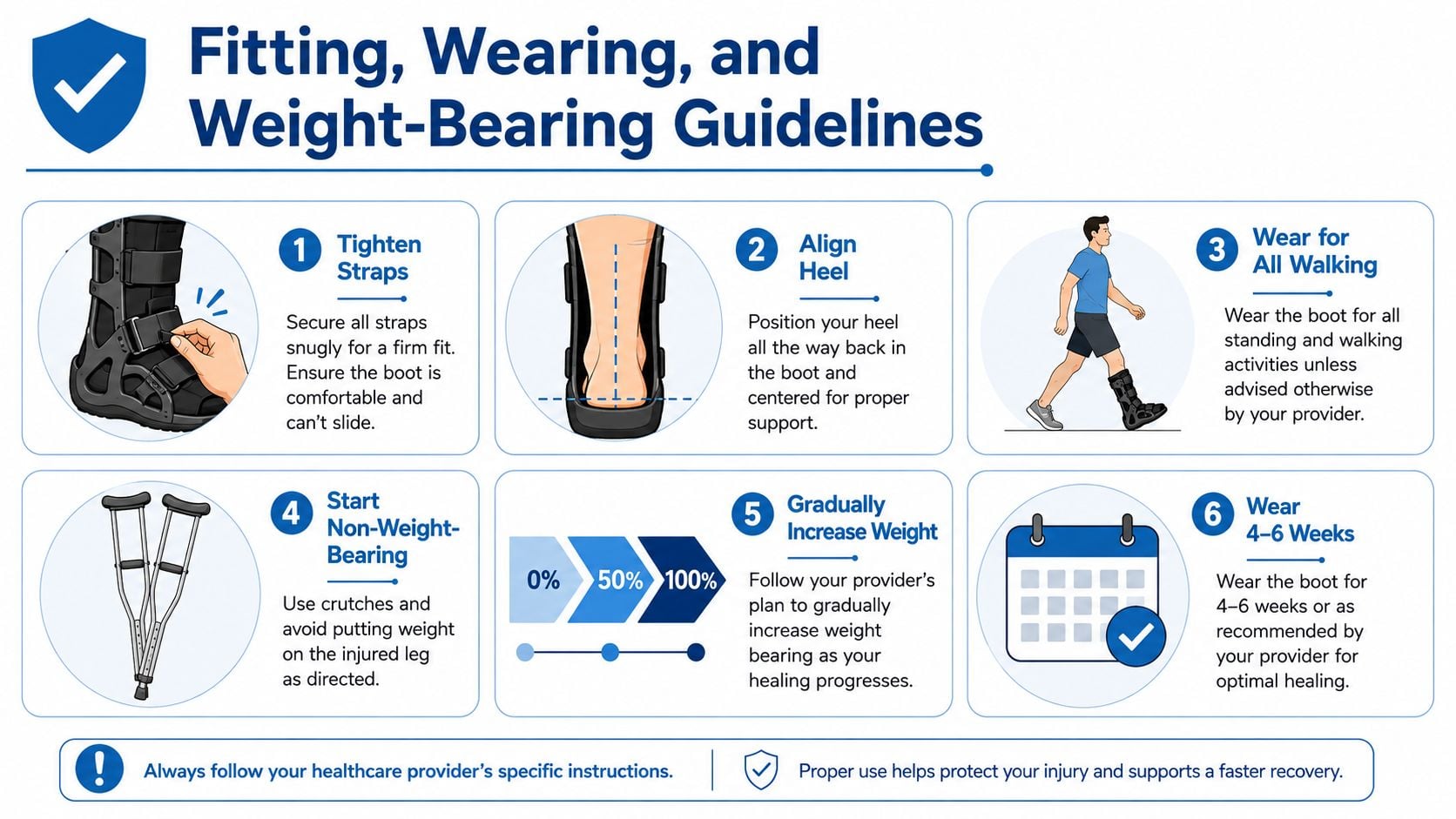
A boot only helps when it is fitted and used correctly. The heel should sit centered, the straps should hold the foot without crushing it, and the ankle should stay in the protected angle the clinician intended. If the foot slides inside the shell, the tendon still gets tugged with each step, which defeats much of the offloading.
How long a boot should stay on
For Achilles tendinopathy, the usual approach is short-term use with symptom-guided progression, not open-ended immobilization. Public guidance varies, but a rehab source notes that some protocols use no more than two weeks for tendinopathy, while rupture protocols often keep patients in a boot with wedges for weeks before moving to shoes and staged exercise (clinical guidance discussion). That difference exists because tendinopathy and rupture protocols are solving different problems.
A clinical review also emphasizes that boot use should be brief and followed by graded return to activity, because prolonged immobilization can decondition the calf-Achilles complex and slow functional recovery (NHS patient instructions). In practice, the end point is not a calendar date. It is pain control, gait normalization, and the ability to begin loading without a flare.
Clinical checkpoint: boot removal should follow healing, strength, and load-tolerance milestones, not just “it's been long enough.”
What the boot does during walking
A walking boot changes how force reaches the Achilles tendon. The heel lift and rigid shell reduce ankle motion, shorten the tendon's working length, and lower the peak strain that comes with each step. That can calm a painful flare, especially when ordinary shoes are provoking symptoms.
The trade-off is real. The boot offloads the tendon, but it also changes gait, reduces calf work, and can make the foot and ankle less responsive if it is used too long without a rehab plan. For tendinopathy, the goal is short-term symptom control and better load management, while the long-term job is restoring tendon capacity through graded exercise.
Weight-bearing depends on the problem
Some patients can walk in the boot right away. Others need a more cautious start, sometimes with temporary crutch support at first. The decision depends on pain, balance, swelling, and whether the clinician is treating tendinopathy, a partial tear, or a rupture-like injury pattern. A boot does not automatically mean full weight-bearing, and it does not automatically mean non-weight-bearing either.
Common fitting mistakes
A loose boot lets the heel drift and can provoke rubbing, skin irritation, and odd gait patterns. Over-tightening creates pressure points and makes people want to take the boot off too often. Wearing it only for longer walks defeats the point if regular household walking is still aggravating the tendon.
Wear the boot for the upright activities the clinician wants protected, especially early on, then recheck skin and comfort after each use block. If the boot becomes the source of new pain, the fit needs to be reviewed rather than ignored.
Rehabilitation and Transitioning Out of the Boot
The boot is a short-term bridge, not the finish line. As pain settles and walking feels more even, the tendon needs a controlled return to load so it can handle daily movement again without flaring. That shift usually means less heel lift, then regular footwear, then strengthening that teaches the calf to produce force without triggering a symptom spike.
The handoff from protection to loading
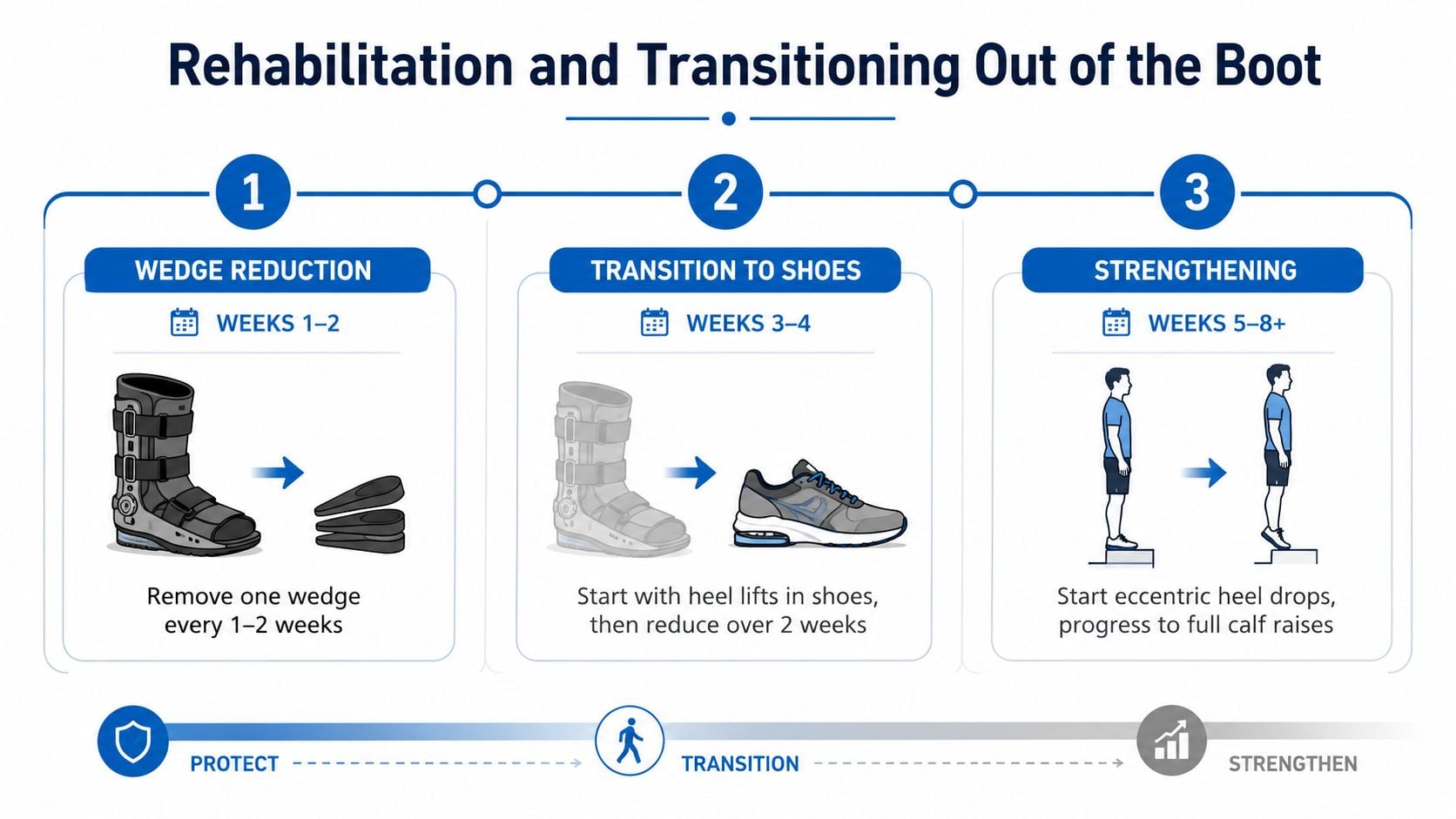
A sensible sequence is gradual wedge reduction, then shoe wear with some heel support, then more active strengthening. A staged boot setup with heel wedges lets the ankle angle come down step by step, which gives the tendon time to adapt instead of forcing it into neutral all at once. That slower handoff fits tendon recovery better than a sudden change.
Prolonged immobilization has a cost. The calf-Achilles unit becomes quieter, weaker, and less tolerant of load if it stays protected too long without a rehab plan. A boot can calm symptoms, but lasting recovery comes from bringing force back in a controlled way that the tendon can tolerate.
The goal is to leave the boot while the tendon is ready for more work, not to wait until every trace of discomfort disappears.
What the shoe transition should look like
Many patients do better moving from the boot to a shoe with a small heel lift before going fully flat. That avoids suddenly lengthening the Achilles under body weight. The shoe phase should also mean shorter walking blocks and close attention to the next morning's symptoms.
Once walking is tolerable, strengthening becomes the main job. Calf raises, controlled lowering, and gradually heavier loading help the tendon regain tolerance. Pain is not the enemy here, but sharp pain and limping are signs the load moved too fast.
Trusting the tendon again
Setbacks often happen because the ankle feels better before the tendon is ready for full duty. That gap leads people to overdo it, especially once the boot comes off and daily life feels normal again. The answer is structure, not guesswork.
A steady transition usually beats a dramatic one. If pain returns after a wedge change or shoe transition, the load likely moved faster than the tissue could absorb. Backing up a step for a short time is often smarter than forcing progress through soreness. For patients who need to place Achilles care in a broader conservative-to-specialty pathway, Interventional Pain Management's tendinitis and bursitis guidance is a useful reference.
Alternatives and When to Escalate Care
A boot is only one tool. For milder Achilles pain, heel lifts, activity reduction, and physical therapy may be enough to settle the tendon without the clunk and inconvenience of a boot. For chronic or stubborn cases, strengthening and load management usually matter more than passive support.
How the options differ
Orthotics and heel lifts can reduce strain without fully immobilizing the ankle. Physical therapy can address calf weakness, movement faults, and load tolerance directly. Injections and surgery are reserved for cases that don't respond to conservative care or when the diagnosis is more serious than simple tendinopathy.
If symptoms keep persisting, the treatment path should widen rather than narrow. That's why a broader musculoskeletal workup is sometimes the right next move, especially when tendon pain is part of a larger joint or biomechanics problem. IPMC's tendinitis and bursitis page is relevant for patients who need to understand where Achilles care fits within a wider conservative-to-specialty pathway.
| Option | Main Role | When It Makes Sense |
|---|---|---|
| Walking boot | Short-term offloading | Severe pain, painful gait, acute flare, or need to protect the tendon briefly |
| Heel lifts or orthotics | Partial strain reduction | Mild to moderate symptoms when full immobilization isn't necessary |
| Physical therapy | Load restoration and movement retraining | Persistent pain, weakness, or return-to-activity planning |
| Injections or surgery | Escalated care | Symptoms that don't settle with conservative treatment or a more serious injury pattern |
When conservative care isn't enough
The hard truth is that a boot won't fix poor load control, weak calf muscles, or a tendon that keeps getting overloaded after every attempted return to normal activity. If the pain keeps coming back, or if walking stays abnormal despite protection, the plan needs review. That may mean imaging, a different rehab strategy, or specialist evaluation.
If the tendon only feels better while the boot is on, the real problem may still be unaddressed.
The boot is best viewed as a temporary traffic controller. It slows the load enough for the tendon to quiet down, but the road back still depends on the quality of the next steps. That's especially true when pain has been dragging on for weeks or the ankle doesn't tolerate normal shoes without a flare.
Red Flags and Next Steps for Specialist Care
Some recovery stalls are just frustrating. Others mean the diagnosis, loading plan, or protective strategy needs a closer look. If pain worsens despite boot use, swelling keeps climbing, or the tendon won't tolerate the next rehab step, that's not a reason to keep guessing.
Persistent symptoms deserve a more structured evaluation. A specialist can check whether the issue is still simple tendinopathy, whether there's another pain generator involved, or whether the tendon needs a different protection strategy. If there's concern for a broader injury pattern, review of associated structures matters too, including fracture-related problems when the presentation doesn't fit a straightforward tendon flare (fracture evaluation reference).
What should trigger a call
The practical warning signs are straightforward. Pain that doesn't trend down, swelling that keeps getting worse, or an inability to move from boot protection into shoe-based loading are all reasons to be re-evaluated. A new limp after a period of improvement is another signal that the tendon isn't tolerating the current plan.
Specialist care is also useful when the timeline is confusing. Tendinopathy and rupture protocols are not interchangeable, and patients often get stuck because they're trying to follow the wrong recovery model. A board-certified physician can sort out that mismatch and tailor the plan to medical history, work demands, and sport goals.
Don't wait for the boot to become the whole treatment. If recovery stalls, the plan needs an expert reset.
For active adults in New Jersey and Staten Island, a well-organized specialist visit can also simplify logistics. Insurance questions, case management, and timely scheduling matter when pain is affecting work, walking, or training. Seven-days-a-week access can be a real advantage when symptoms don't follow a weekday schedule.
If Achilles pain is keeping you in a boot longer than expected, Interventional Pain Management can help clarify what's driving the symptoms and build a more specific recovery plan. Their team offers coordinated evaluation and treatment for Achilles tendinitis, orthopedic and pain conditions, and functional recovery support, and you can visit Interventional Pain Management to take the next step toward getting back to normal walking with a plan that fits your situation.