
Cervical decompression surgery removes the structural pressure on the cervical nerve roots or spinal cord, and most adults reach that point after conservative care hasn't brought lasting relief. For many people, the first sign is a neck problem that starts to travel, numbness in the arm, weakness in the hand, or a change in balance that makes everyday tasks feel unreliable.
That pattern can be unsettling because it doesn't always begin with severe pain. Some people notice a tingling forearm when turning their head, others drop objects more often, and some start walking more carefully because their legs feel unsteady. The question usually isn't whether the neck is involved, it's whether the symptoms are coming from a pinched nerve root, a compressed spinal cord, or both.
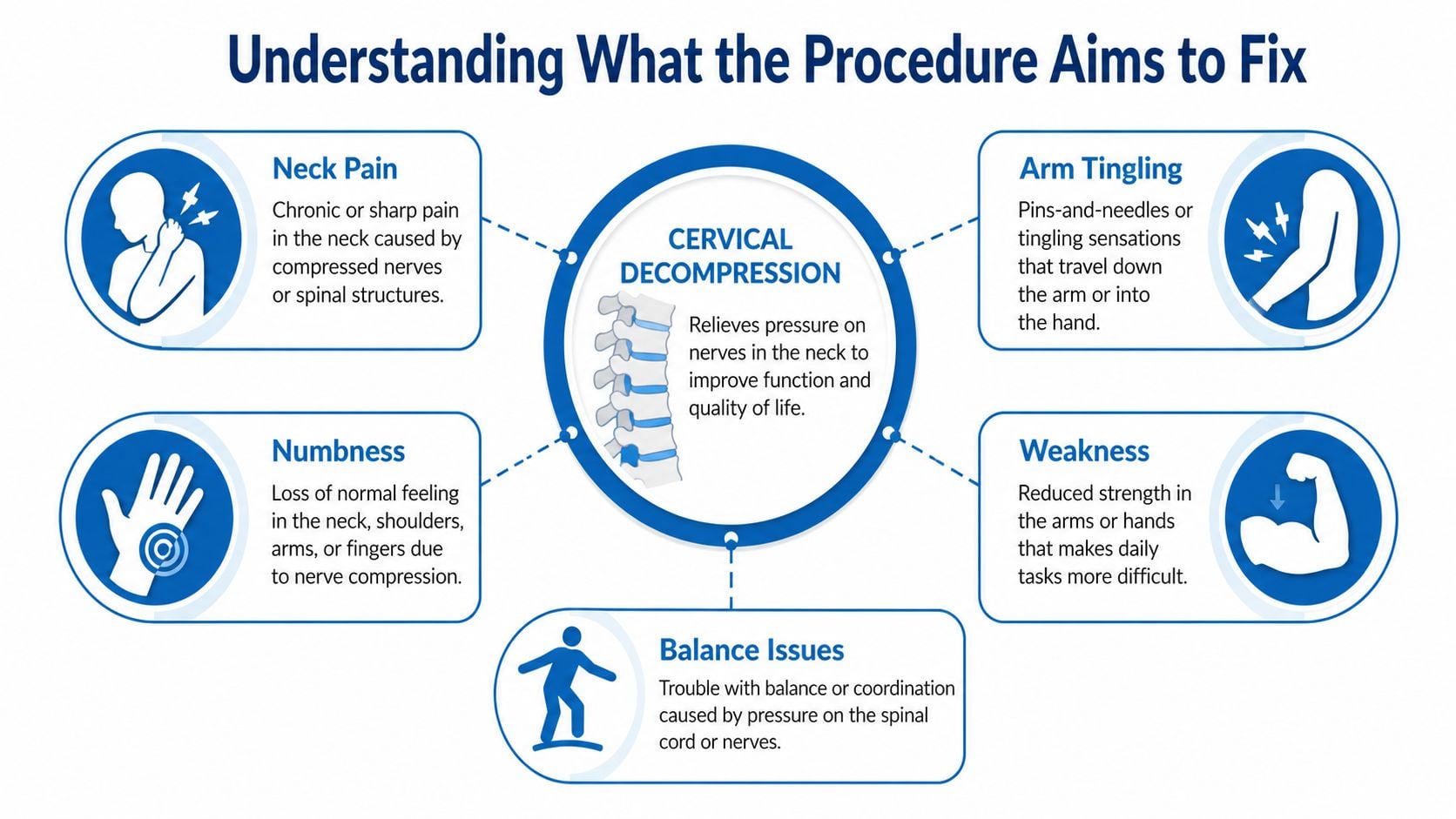
Table of Contents
- Understanding What the Procedure Aims to Fix
- Choosing Between Anterior and Posterior Approaches
- How Imaging and Timing Shape Surgical Decisions
- What to Expect During the Surgical Journey
- Comparing Surgery with Non-Surgical and Interventional Options
- Recovery Realities and Long-Term Outcomes
Understanding What the Procedure Aims to Fix
The clearest way to think about cervical decompression surgery is to picture a narrowed passage that's crowding delicate tissue. Bone spurs, disc material, and thickened ligaments can press on the spinal cord or the exiting nerve roots, and the operation removes that pressure so the nerve tissue has room again. The goal is mechanical, not mystical, and that matters because symptoms improve only when the pressure is actually relieved.
Nerve-root symptoms and spinal-cord symptoms are not the same
A pinched nerve root usually causes pain, tingling, numbness, or weakness that follows an arm pattern. A compressed spinal cord can add balance trouble, hand clumsiness, and broader coordination problems, which is why surgeons pay close attention to gait, reflexes, and fine motor control. The distinction drives the treatment discussion because nerve-root disease often centers on arm pain and function, while spinal-cord disease raises the stakes around preventing further neurological decline.
Practical rule: arm symptoms alone and balance changes do not carry the same meaning, even if they come from the same neck.
The surgery itself removes the compressing tissue and then, when needed, restores stability with a graft or implant. In plain language, the surgeon clears the blockage and, if the area has become unstable or needs support after the decompression, rebuilds that segment so it can hold up under daily motion. That's why the exact operation depends on where the pressure is, how many levels are involved, and whether the spine is aligned and stable.
The historical path to this surgery came from earlier cervical fusion techniques developed in the 1950s, when surgeons began treating structural compression directly instead of only managing symptoms. A 1955 report is cited as the first description of anterior cervical fusion for symptoms of cervical spondylosis, and later work refined the method into modern anterior cervical discectomy and fusion. The evolution matters because today's procedure is not one single operation, it's a family of approaches chosen to match the anatomy and the neurological problem. PMC historical review
Think of it like clearing a garden hose. If the blockage is removed but the hose wall is weak, the surgeon may also need to reinforce it.
Choosing Between Anterior and Posterior Approaches
Surgeons usually decide between an anterior corridor and a posterior corridor by asking where the compression sits, how many levels are involved, and whether the spine needs support after decompression. Anterior surgery is commonly used when the pressure lies mainly in front of the spinal cord or nerve roots. Posterior surgery is often considered when disease spans multiple levels and the alignment is suitable for a back-of-the-neck approach.
Why the choice is rarely simple
The best available comparative evidence shows both routes can help, but they don't produce the same trade-offs. In a systematic review and meta-analysis of 31 comparative studies involving 5,613 patients, the anterior group had slightly higher postoperative neurological scores and recovery, but complication patterns differed by approach. The overall complication rate did not show a significant difference, yet dysphagia was more common after anterior surgery and C5 palsy was more frequent after posterior procedures. Comparative meta-analysis
That evidence supports a customized plan instead of a universal winner. A surgeon may recommend an anterior operation when the problem is in front of the cord, especially if the segment also needs reconstruction with a cage or plate. A posterior approach can make more sense when several levels need room and the neck's alignment allows the cord to drift back safely after decompression.
Approach Comparison Overview
| Feature | Anterior Approach | Posterior Approach |
|---|---|---|
| Surgical corridor | Through the front of the neck | Through the back of the neck |
| Best fit | Compression mainly in front of the cord or nerve roots | Multilevel disease with suitable alignment |
| Reconstruction | Often uses grafts, cages, or plating | May involve laminectomy with or without fusion |
| Common trade-off | Swallowing difficulty is more likely | C5 palsy and persistent neck pain are more likely |
| Planning focus | Level, disc location, stability | Number of levels, alignment, and deformity risk |
The detailed mechanics of an anterior cervical discectomy are also summarized in the procedure overview at IPMC's cervical discectomy page, which aligns with how surgeons think about removing disc material and restoring space. The important point for patients is that the corridor is chosen to fit the anatomy, not to fit a template.
How Imaging and Timing Shape Surgical Decisions
MRI does more than confirm that narrowing exists. Good surgical planning uses the scan to note the level of compression, the extent of canal compromise, alignment, and cord signal changes, because each piece changes what recovery can reasonably look like. A scan that only says “stenosis” leaves out the details that guide expectations and timing.
What the cord signal can suggest
When the spinal cord shows no signal change, the outlook tends to be more favorable than when the scan shows multilevel T2 hyperintensity or the more concerning combination of T1 hypointensity plus T2 hyperintensity. Those patterns are used to judge how much of the cord injury may be reversible and how much may reflect chronic damage. T1 hypointensity is especially worrisome because it can point to tissue loss rather than temporary swelling.
Timing matters for the same reason. Contemporary reviews report that decompression within approximately 4 months of symptom onset is associated with better neurological outcomes, while prolonged symptoms beyond roughly 32 months can reduce recovery potential. The logic is straightforward, ongoing compression keeps injuring the cord, and surgery can remove the pressure but can't reliably erase damage that has already become chronic. Timing and guideline review
Clinician's mindset: surgery can stop the clock on worsening, but it can't always rewind the injury that's already there.
The middle ground is where many families get confused. Mild symptoms, hand clumsiness, a few falls, or a subtle change in gait can still justify a surgical conversation if the pattern suggests cord dysfunction. Moderate and severe myelopathy, often measured with modified Japanese Orthopaedic Association scores of 12–14 and 11 or lower, has strong support for operative treatment, especially if weakness or balance problems are progressing. Asymptomatic cord compression without neurological signs is different, and observation is often the more reasonable path.
Red flags that deserve faster reassessment
- New hand clumsiness: dropping items, buttoning shirts more slowly, or trouble with small tasks can signal cord involvement.
- Walking changes: feeling unsteady, taking shorter steps, or needing more concentration to stay balanced should not be ignored.
- Progressive weakness: weakness that's getting worse, not just sore, needs prompt review.
- Reflex or coordination changes: a clinician can detect these during examination even before pain worsens.
The MRI for cervical myelopathy article at PMC's imaging review explains why the scan should be read together with the exam, not in isolation. That combination is what keeps the conversation honest about both benefit and limitation.
What to Expect During the Surgical Journey
A patient usually starts with a consultation where the surgeon reviews symptoms, imaging, and the neurological exam together. That visit is less about selling a procedure and more about matching the pattern, neck pain alone is not the same as arm pain, and neither is the same as signs of spinal-cord dysfunction. From there, the team decides whether the likely corridor is from the front or the back, and whether stabilization is needed.
From consultation to the operating room
On the day of surgery, anesthesia is given, the patient is positioned carefully, and the surgeon follows the chosen path to the compressed area. The details vary by approach, but the goal stays the same, remove pressure and protect the structures that are already irritated. Many patients stay in the hospital briefly for monitoring, especially if the operation involved multiple levels or a posterior fusion.
The first few days after surgery are usually about basics, walking safely, managing pain, watching the incision, and following activity limits. Some people need a collar, some don't, and that depends on the procedure and the surgeon's plan. Sleep positioning, driving restrictions, and lifting limits are not one-size-fits-all, so discharge instructions matter more than guesses made at home.

A common recovery rhythm
Week one is often about controlled movement and pain control. Weeks after that usually bring a gradual return of neck motion, walking, and light daily tasks, while more demanding work waits until the surgeon clears it. Office-based work, heavy lifting, driving, and caregiving responsibilities all come back on different timelines, because each one loads the neck in a different way.
Patients often worry that any pain means something went wrong. In reality, soreness, stiffness, and incision tenderness are common early on, while new weakness, worsening numbness, fever, drainage, or difficulty swallowing should be reported promptly. A calm recovery is still an active recovery, and follow-up visits are where the plan gets adjusted rather than guessed at.
Comparing Surgery with Non-Surgical and Interventional Options
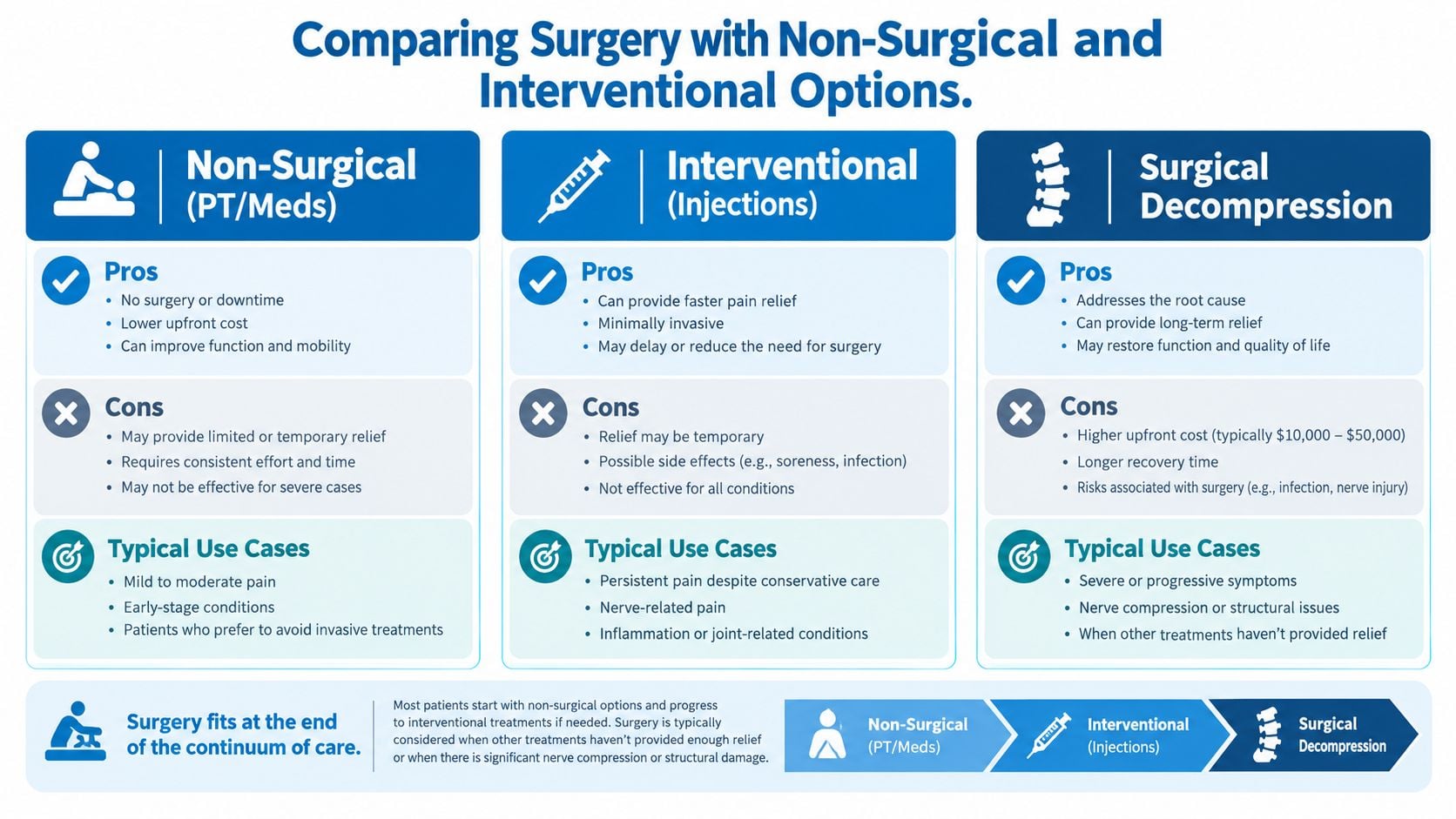
Cervical decompression surgery belongs in a stepwise treatment pathway, not as the first answer for every patient. If symptoms are stable and there is no clear progression, clinicians often begin with physical therapy, activity changes, and medication. Those measures do not remove a disc, spur, or other source of pressure, but they can reduce irritation enough to keep daily life manageable while the team watches the pattern closely.
The gray zone is the patient who feels “mildly” affected but is not clearly getting better. A hand that still works, but tires quickly. A neck that aches, but now comes with numbness or balance trouble. In that setting, the question is not only how bad the pain is, but whether the nerves are starting to lose function. Mild symptoms can still justify surgery when they persist, spread, or begin to interfere with walking, coordination, or hand use.
Where injections fit
Interventional pain procedures are best understood as symptom control, not decompression. Epidural steroid injections, nerve blocks, and trigger-point injections can calm inflammation or reduce pain enough to improve sleep, movement, or participation in therapy, especially when the problem is nerve irritation rather than fixed mechanical pressure. For selected patients with persistent neuropathic pain after surgery, spinal cord stimulation may also enter the discussion.
The difference is straightforward. Injections can quiet the alarm, but they do not create space for the nerve root or spinal cord. Surgical decompression does that directly, which is why it enters the conversation when weakness, gait change, or ongoing symptoms suggest that waiting may no longer be safe.
A multidisciplinary spine program such as Interventional Pain Management can help sort out that decision by having pain management, orthopedics, anesthesia, and spine surgery review the same case. That kind of coordination helps separate pain that may respond to a procedure from compression that needs decompression.
Treatment options at a glance
- Non-surgical care: helps with inflammation, movement habits, and day-to-day function, but it will not remove a compressive lesion.
- Interventional care: can reduce pain and make rehab easier, especially when symptoms come from irritation.
- Surgical decompression: directly relieves pressure on the nerve root or spinal cord when the anatomy and symptoms justify it.
The internal overview on epidural steroid injections fits here because it shows how an injection can be one step in a broader plan rather than a rival to surgery. The smartest path is the one that matches the source of the symptoms, not just the symptom that feels loudest today.
Recovery Realities and Long-Term Outcomes
A successful operation does not automatically mean full neurological recovery. That's the truth most patient handouts soften, but it's the truth that shapes expectations after cervical decompression. The nerve tissue may recover well, partially, or slowly, depending on how long it was compressed and whether the injury was mainly irritation or actual loss of function.
Complications and trade-offs matter
Approach-specific risks should be part of the decision, not a surprise after the fact. Dysphagia is more common after anterior surgery, while C5 palsy is more frequent after posterior procedures. Posterior surgery can also bring persistent neck pain, wound-infection risk, and, after multilevel laminectomy without fusion, a risk of postoperative kyphotic deformity.
Recovery should be measured in function, not in calendar days.
Rehabilitation is still an evolving piece of care. A later systematic review found that programs combining physical, behavioral, and psychosocial strategies produced the most consistent gains, but the timing and content of those programs varied widely. That tells patients something important: recovery is not one standardized protocol handed to everyone; it's a process built around pain control, mobility, confidence, and functional goals.
A practical recovery checklist
- Swallowing and voice: note any persistent trouble swallowing or voice change, especially after anterior surgery.
- Strength and dexterity: watch for whether hand use, grip, and arm strength are improving or stalling.
- Balance and walking: keep track of steadiness, confidence on stairs, and fatigue with longer walks.
- Activity limits: follow restrictions on lifting, driving, twisting, and work duties until cleared.
- Symptom trend: report worsening numbness, new weakness, fever, or drainage quickly.
The long-term goal is usually a better version of normal, not perfection. Surgery may relieve pain, prevent further decline, and restore enough function to work, sleep, drive, and move more comfortably, but the ceiling for recovery depends on the cord or nerve's prior injury. The guidance on pain after back surgery is relevant because persistent pain management often continues after the procedure, not instead of it.
Interventional Pain Management offers coordinated evaluation across pain procedures, spine surgery, and rehabilitation planning, which can help clarify whether cervical decompression surgery is the right next step or whether another treatment should come first. For anyone weighing neck pain, arm symptoms, balance changes, or recovery questions, a direct review of imaging and function can make the decision much clearer. Visit Interventional Pain Management to learn how a multidisciplinary spine team approaches these cases.