
Quad sparing knee replacement is a surgical variation designed to preserve the quadriceps tendon for faster early recovery, but it isn't suitable for every patient and doesn't guarantee better long-term results than traditional knee replacement. The technique entered modern literature in 2002, and comparative studies included 1,112 patients across 1,439 total knee replacements by 2019.
That history matters because quad sparing isn't a brand-new promise supported only by marketing. It is a studied surgical approach with a specific potential advantage, earlier mobility, and a specific concern, more demanding exposure and a greater risk of component malalignment in some studies.
The most popular advice about this procedure is also the least helpful: “less invasive” doesn't automatically mean better. A smaller or more carefully placed surgical route may help a patient activate the quadriceps sooner, but the operation still has to provide accurate implant positioning, stable soft-tissue balance, and durable pain relief. If preserving the tendon makes those goals harder to achieve in a particular knee, a traditional approach may be the safer choice.
Table of Contents
- What Quad Sparing Knee Replacement Actually Is
- How Quad Sparing Differs From Traditional Knee Replacement
- What the Evidence Actually Shows About Recovery and Risks
- Who Is a Good Candidate for Quad Sparing Knee Replacement
- Recovery Expectations and Rehabilitation Timeline
- Making the Right Choice for Your Knee Replacement
What Quad Sparing Knee Replacement Actually Is
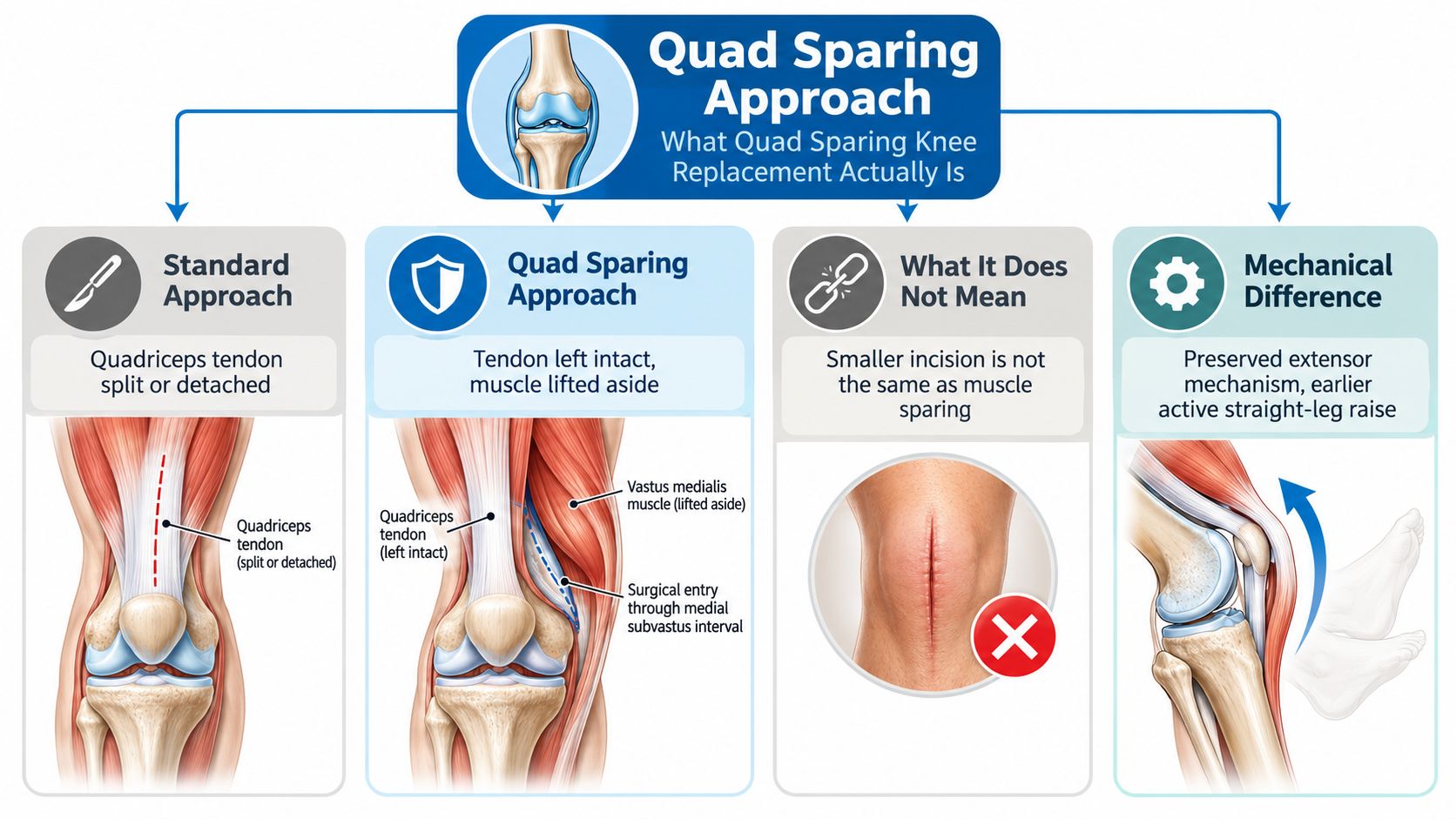
Quad sparing knee replacement is often oversold as a superior version of knee replacement. A more accurate description is a different route to the same joint replacement, one that aims to preserve the quadriceps tendon and the extensor mechanism that straightens the knee.
In a traditional medial parapatellar approach, the surgeon opens the knee through the front and inner side of the joint, with an incision through the tissue alongside the kneecap and into the quadriceps mechanism. This creates broad access to the joint. In a quadriceps-sparing approach, commonly associated with a subvastus route, the surgeon works beneath the vastus medialis muscle and moves that muscle aside rather than cutting directly through the quadriceps tendon.
The replacement components are still prepared and implanted in the same knee joint. The difference is the path used to reach the joint, not the fact that a replacement is being performed.
Practical rule: “Minimally invasive” describes a surgical goal, not a guarantee of less tissue disruption or a better final result.
A useful analogy is entering a room. The traditional route is like opening the main door widely, which gives the surgeon excellent visibility and working space. The quadriceps-sparing route is more like entering through a narrower side passage while keeping the main hinge intact. The side passage may protect an important structure, but it gives the surgeon less room to work and may make positioning the replacement more technically demanding.
Why preserving the quadriceps mechanism matters
The quadriceps muscle, quadriceps tendon, kneecap, and patellar tendon work together to extend the knee. Protecting that chain can make it easier for a patient to perform an active straight-leg raise early after surgery. It may also reduce the sense of sudden weakness that many patients experience when the quadriceps temporarily shuts down because of pain and swelling.
That potential benefit is concentrated in the early recovery period. It doesn't prove that the replacement will function better years later, and it doesn't remove the need for physical therapy. The surgeon still needs adequate visibility to remove damaged joint surfaces, balance the ligaments, and position the components correctly.
Patients considering joint replacement surgery should therefore ask which named approach the surgeon uses and which structures are cut, lifted, or preserved. A precise answer is more useful than a general claim that the operation is “muscle sparing.”
How Quad Sparing Differs From Traditional Knee Replacement
The two approaches perform the same essential operation, replacing damaged knee joint surfaces with prosthetic components. Their differences appear in the access route, tissue handling, visibility, and the balance between early mobility and technical control.
The traditional approach is familiar to orthopedic surgeons and provides broad exposure. That exposure can be particularly useful when the knee is stiff, severely deformed, or difficult to access. Quad sparing limits direct disruption to the quadriceps mechanism, but the narrower corridor can require more careful positioning of instruments and components.
| Feature | Traditional Approach | Quad Sparing Approach |
|---|---|---|
| Incision placement | Usually a central skin incision with access through the medial side of the knee | Uses a medial approach that works around the quadriceps tendon |
| Quadriceps handling | The quadriceps mechanism is opened to expose the joint | The quadriceps tendon is intended to remain intact, with the medial thigh muscle moved aside |
| Visualization for the surgeon | Broad, familiar exposure with generous working space | More limited exposure that demands careful tissue handling and instrumentation |
| Operative time | Often provides an efficient route for component preparation | Can take longer when exposure and positioning are technically difficult |
| Early postoperative function | Quadriceps activation may be limited by pain, swelling, and healing tissues | May support earlier active extension and confidence with movement |
| Main practical strength | Predictable access and flexibility in complex anatomy | Preservation of the extensor mechanism during the approach |
| Main concern | Greater disruption of the quadriceps mechanism | More challenging exposure and potential positioning tradeoffs |
The mechanical difference
The phrase “medial parapatellar arthrotomy” refers to opening the joint capsule along the inner border of the kneecap. This is the standard route used by many surgeons because it allows the kneecap to be moved aside and the joint to be seen clearly.
A quad sparing approach changes the route through the soft tissues. The surgeon works beneath the vastus medialis, the muscle on the inner front of the thigh, and preserves the quadriceps tendon. That distinction is important, but it shouldn't be simplified into “no muscle is affected.” Surgical instruments still pass through a confined area, tissues are retracted, and the knee still undergoes the trauma of joint replacement.
What may be gained and what may be compromised
A patient may gain easier early quadriceps activation and a smoother start to rehabilitation. The tradeoff is that the surgeon may have less room to see the joint and position the components. If the exposure is inadequate, forcing the technique can create more problems than it prevents.
The best approach isn't determined by the smallest skin incision. It is determined by whether the surgeon can safely accomplish the full replacement, including alignment, ligament balance, and stable implant fixation, while matching the route to the patient's anatomy.
What the Evidence Actually Shows About Recovery and Risks
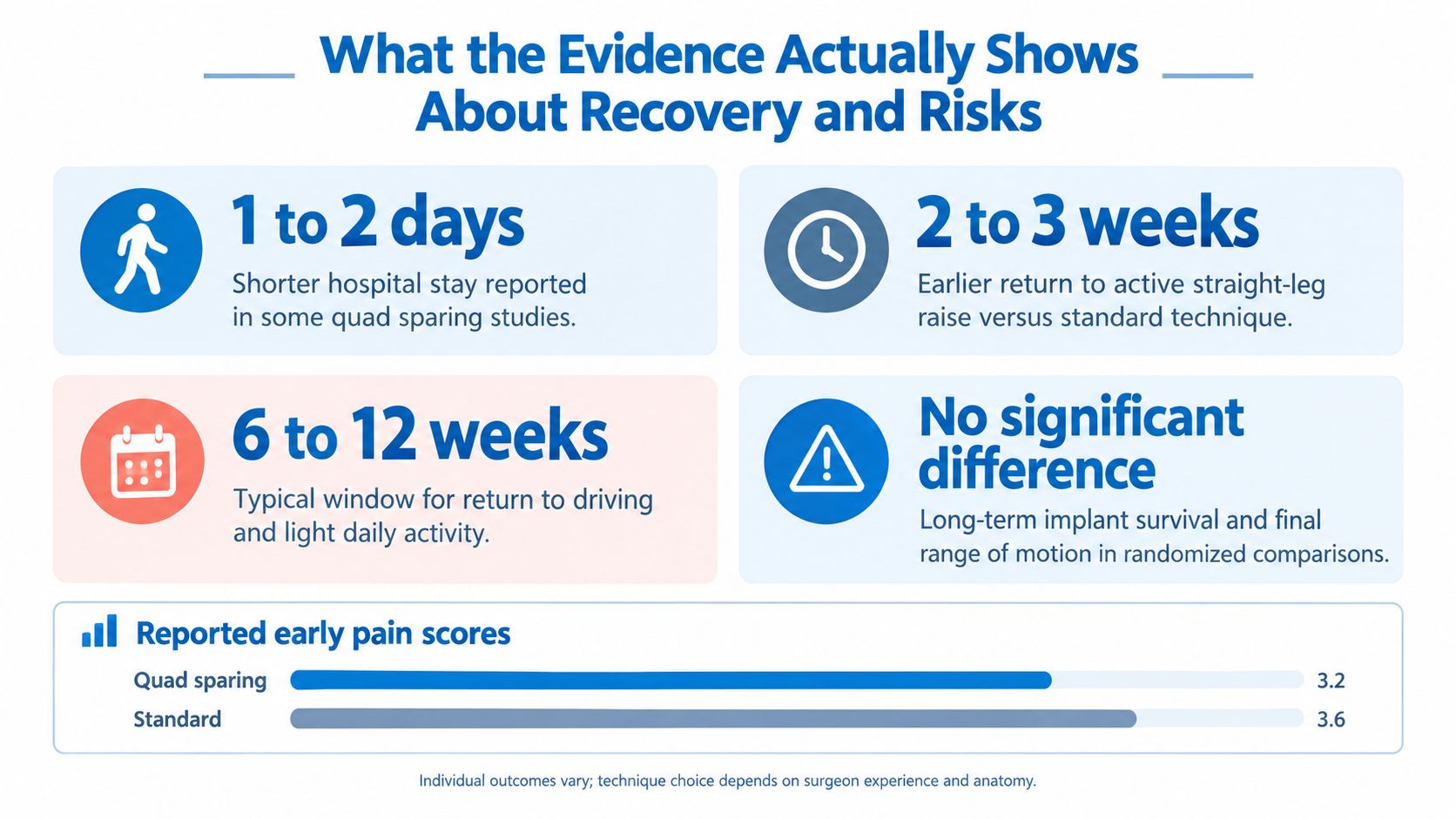
The evidence supports a modest early recovery advantage, not a universal improvement in knee replacement outcomes.
A 2015 meta-analysis found statistically better Knee Society Scores at three months, with a mean difference of 2.88 points and a 95% confidence interval of 1.17 to 4.60, but the same analysis found no meaningful difference in total complications, wound infection, deep vein thrombosis, blood loss, or hospital stay compared with the standard approach. Those findings suggest that the early functional signal is real, while the broader clinical advantage is limited. The systematic review and meta-analysis provides the detailed comparison.
Earlier follow-up studies included in that evidence found less peri-operative pain and greater flexion during early recovery. However, final clinical outcomes were similar to those of standard knee replacement, while the quad sparing approach was associated with longer operating time and less accurate radiological alignment in some reports.
Alignment is the central technical concern
A replacement knee depends on accurate positioning of its components. Alignment affects how forces pass through the implant and surrounding bone, so the surgeon can't treat exposure as a secondary issue.
A randomized-trial meta-analysis found that the quadriceps-sparing approach increased the odds of femoral, tibial, and mechanical-axis alignment outliers, with odds ratios of 4.92, 4.34, and 4.77, respectively. It also added about 19.5 minutes of operative time and 23.3 minutes of tourniquet time. These figures don't mean that every patient will develop a poorly aligned implant. They show that the approach creates a more demanding technical environment and requires careful control. The randomized-trial meta-analysis details these findings.
An alignment outlier is a measurement outside the intended range, not automatically a failed replacement. Still, a surgeon must have enough access to prepare the bone and position the components accurately. Preserving the quadriceps tendon has value only if the replacement itself is implanted safely.
How to interpret the risk-benefit balance
The strongest case for quad sparing is a patient who places high value on early mobility and has anatomy that permits safe exposure. The weakest case is a patient whose deformity, stiffness, scarring, or body habitus makes accurate access difficult.
The useful question isn't “Is quad sparing better?” It is “Can this approach preserve the extensor mechanism without compromising the accuracy of this particular replacement?”
The available evidence supports describing quad sparing as an early-mobility optimization. It doesn't support presenting it as a proven way to achieve superior long-term implant performance.
Who Is a Good Candidate for Quad Sparing Knee Replacement
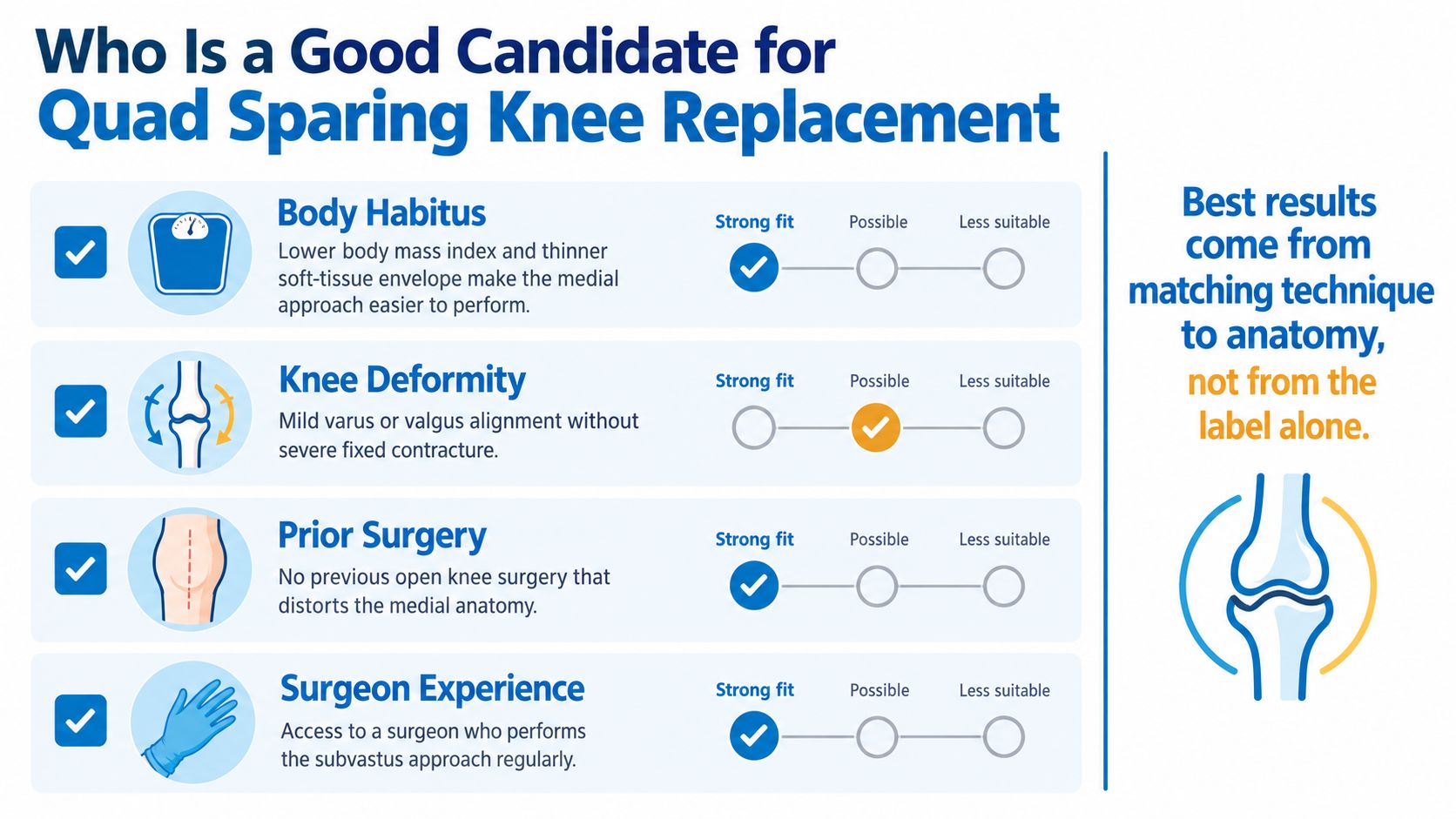
Candidacy depends less on the name of the operation and more on whether the knee can be exposed safely through a narrower corridor. The surgeon has to judge the soft-tissue envelope, deformity, prior operations, preoperative motion, quadriceps control, and their own experience with the approach.
A patient with relatively favorable anatomy and knee osteoarthritis (https://www.ipmchealth.com/osteoarthritis), useful preoperative extension, and good quadriceps control may be more likely to benefit from the intended early mobility advantage. A patient with marked deformity, severe stiffness, or limited exposure may be better served by a traditional approach that gives wider access and more control during bone preparation and balancing.
Four practical selection questions
Body habitus affects access. A thicker soft-tissue envelope can make the medial corridor harder to work through. That does not rule out quad sparing on its own, but it can narrow the room available for instruments and limit visualization.
Deformity changes the difficulty. Mild deformity may fit the approach. Severe fixed deformity, substantial contracture, or a knee that cannot be exposed adequately may favor a traditional route because the surgeon needs direct control of the bone cuts and soft-tissue balance.
Previous surgery can alter the tissue planes. Scarring can make the planned path less predictable. A prior operation does not decide the approach by itself, but it should trigger a careful exam and review of imaging.
Surgeon experience matters. A technically demanding approach should be used by a surgeon who performs it regularly and can change course when exposure is inadequate. The ability to convert to a broader approach is part of safe surgical planning.
The decision should fit the knee in front of you
Candidate selection is not about choosing the approach with the best marketing language. It is about matching exposure to anatomy and deciding whether the smaller incision route still lets the surgeon place the implant accurately and safely. This patient-focused discussion of quad sparing knee replacements reflects that practical point.
That means the consultation should be specific. Bring prior operative reports, current flexion and extension measurements, and body weight or body mass information if you have it, so the surgeon can judge whether the medial corridor is likely to allow safe visualization. Ask whether your knee can be exposed without forcing the approach, whether scar tissue changes the plan, and what would make conversion to a wider exposure necessary.
Before the visit, patients can also think through these points:
- Anatomy: Can the surgeon expose the knee adequately without forcing the approach?
- History: Could prior surgery, scarring, or stiffness make the route less predictable?
- Expectations: Is the goal early movement, or is there an assumption that the knee will be better in every way?
- Rehabilitation: Is the patient prepared to follow therapy and protect healing tissues?
The best outcome comes from matching technique to anatomy, not from selecting the most appealing label.
Recovery Expectations and Rehabilitation Timeline
Quad sparing may make early quadriceps activation easier, but it doesn't create an automatic recovery. Pain control, swelling, sleep, balance, preoperative strength, medical conditions, and participation in therapy all influence how quickly a patient progresses.
Immediately after surgery, the priorities are safe transfers, supported standing, gentle knee motion, swelling control, and quadriceps activation. A patient may be asked to perform an active straight-leg raise when the muscle can control the leg, but the timing varies. The intact tendon can help, but pain and temporary nerve-muscle inhibition can still limit movement.
Early progress should be measured by function
During the first phase at home, walking aids are normal rather than a sign that the operation failed. Physical therapy usually emphasizes controlled bending and straightening, a stable walking pattern, and gradual activation of the quadriceps. The knee shouldn't be forced through sharp pain, and swelling should be managed according to the surgical team's instructions.
As walking becomes steadier, therapy can progress to strengthening, balance work, and functional tasks such as getting into a chair or managing stairs. Patients often want a calendar date for driving or returning to work, but those decisions depend on leg control, reaction time, medication use, and the demands of the activity. A desk-based role and a physically demanding job create different requirements.
Protect the tissues while building strength
Preserving the quadriceps tendon doesn't mean the entire extensor mechanism can be overloaded immediately. Excessive activity can increase swelling, worsen pain, and interfere with the quality of movement. Too little activity can allow stiffness and weakness to persist.
A sensible progression usually moves from supported walking to independent movement, then to controlled strengthening and endurance. Low-impact exercise can be introduced when the surgeon and therapist confirm that the wound, motion, strength, and gait are ready. The exact pace should be individualized rather than copied from another patient's story.
Rehabilitation principle: Earlier movement is useful only when it is controlled movement. A protected, consistent program is more valuable than trying to win a race during the first phase of healing.
By the later recovery period, the distinction between approaches may become less important than the quality of implant positioning, the patient's preoperative condition, and adherence to rehabilitation. Quad sparing can improve the starting point for some patients, but it doesn't replace the work required to regain strength and confidence.
Making the Right Choice for Your Knee Replacement
Quad sparing knee replacement is a valid option, but it isn't a universal upgrade. Its clearest value lies in protecting the quadriceps mechanism and potentially making early mobility easier for a carefully selected patient. Its principal limitation is the technical challenge of working through a more restricted exposure while maintaining accurate component positioning.
Three questions can make a surgical consultation more useful:
- Is the anatomy favorable? The surgeon should explain the deformity, stiffness, soft-tissue access, and any prior surgical changes that affect the choice.
- How often is the approach performed? Experience with the named technique matters because the operation requires disciplined exposure, positioning, and judgment about when to broaden access.
- Does the expected benefit match the recovery goal? A patient prioritizing mobility during the early recovery window may value the approach differently from a patient focused mainly on long-term pain relief.
Patients should also ask what happens if the surgeon cannot obtain adequate exposure. A responsible plan includes adapting the approach when necessary rather than preserving a tendon at the expense of accurate surgery.
Nonoperative care may still have a role for some people with painful knee arthritis. Depending on the diagnosis, options can include physical therapy, activity modification, medication management, or injections such as hyaluronic acid injections. When replacement is appropriate, the decision should be made with a qualified, board-certified orthopedic surgeon who can discuss both quad sparing and traditional techniques without treating either as a marketing category.
The right operation is the one that provides the safest access, the most accurate replacement, and a recovery plan suited to the patient's goals. Quad sparing is a tool, not a miracle.
Interventional Pain Management evaluates joint pain and offers individualized pathways that can include nonoperative care, injections, orthopedic assessment, and joint replacement when clinically appropriate. Patients in New Jersey and Staten Island who want to discuss knee pain, treatment alternatives, or recovery planning can visit Interventional Pain Management to request an evaluation.