
Most trigger point injections begin easing pain within 24 to 72 hours, and the relief typically lasts about one month, often ranging from a few weeks to several months depending on the case. The exact answer to “how long do trigger point injections last” depends on what was injected, which muscle was treated, why the trigger point formed, and what continues to stress that muscle.
A patient may arrive after weeks of neck, shoulder, or back pain, hoping one carefully placed injection will provide a permanent reset. A more realistic expectation is a treatment window that creates room for movement, sleep, rehabilitation, and correction of the factors that keep the muscle irritated. The injection can be useful, but its duration is a range, not a fixed expiration date.
Table of Contents
- What to Expect Right After a Trigger Point Injection
- What Trigger Points Are and How Injections Work
- Typical Relief Timeline from Hours to Months
- Comparing Injectate Types and Their Duration
- Personal Factors That Change How Long Relief Lasts
- Common Misconceptions About Treatment Duration
- Follow-Up Care and Repeat Treatment Planning
- Key Takeaways on Trigger Point Injection Duration
What to Expect Right After a Trigger Point Injection
A patient with a tight upper trapezius may feel a brief sting, pressure, or cramping sensation as the needle reaches the trigger point. If lidocaine is used, the area may become temporarily numb, which can make the muscle feel lighter before the longer clinical response has had time to develop.
Mild soreness at the injection site can follow. Many patients describe it as a small post-workout ache that settles over one to two days. Early numbness shouldn't be confused with the full therapeutic effect, because the local anesthetic wears off before the muscle and pain cycle have fully responded.
The first week is the calibration period
Meaningful pain easing commonly appears within 24 to 72 hours, while the initial benefit often lasts roughly one month. Cleveland Clinic describes relief as typically lasting around a month, and Medicare coverage guidance recognizes a benefit that should last at least four weeks, with some patients experiencing relief for several months. The clinical literature varies considerably, with many studies following patients for only a few weeks.
During the first week, clinicians generally encourage gentle movement of the treated muscle, adequate hydration, and avoidance of strenuous loading. A patient who begins heavy lifting or a new workout immediately may irritate the same tissue before the response can be judged.
Practical rule: The first week should be treated as a protected testing period. Gentle motion helps reveal the benefit, while heavy loading can blur the result.
For example, a person treated for desk-related shoulder pain might record easier head turning and better sleep after several days. That functional change matters as much as the pain score. It shows whether the injection is helping the activity that originally brought the patient to care.
What Trigger Points Are and How Injections Work
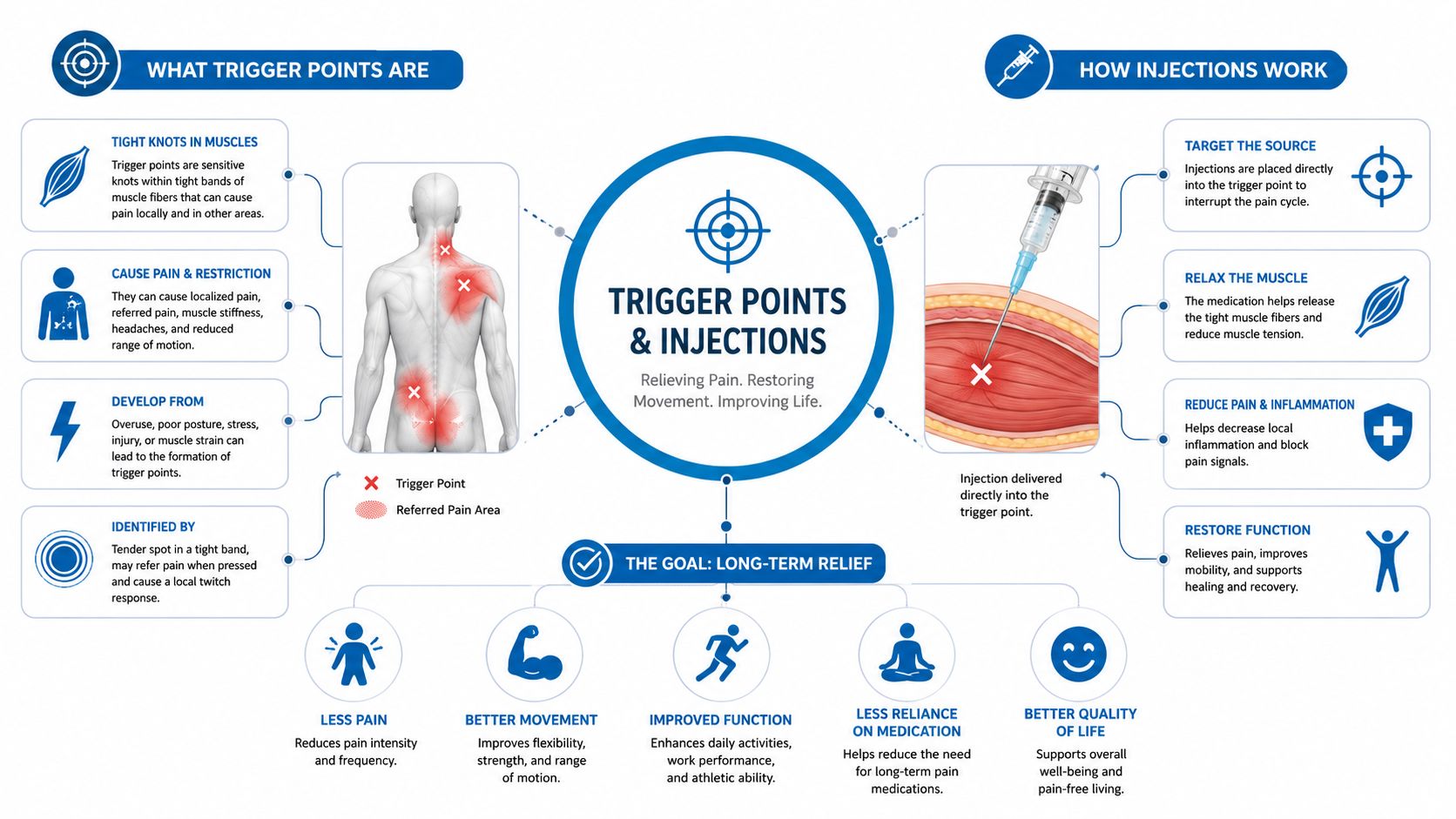
A trigger point is a sensitive, irritable area within a tight band of muscle fibers. It can feel like a knot beneath the skin, remain painful when pressed, and send discomfort to another location. A trigger point in the neck may contribute to shoulder or head pain, while one near the shoulder blade may make the upper back feel painful beyond the exact injection site.
A useful analogy is a rubber band pulled too tightly for too long. Most of the band remains tense, but a few strands become frayed and snarled. Those snarled strands don't relax normally, and every movement can keep provoking the area.
People experiencing persistent muscle-based pain can learn more about the broader condition in this overview of myofascial pain syndrome.
The needle and medication have different jobs
The procedure works through two related actions:
- Mechanical release: The fine needle enters the taut area and disrupts the knotted fibers. That physical stimulation can help the contracted band release.
- Pain-signal interruption: A local anesthetic, commonly lidocaine, temporarily quiets nearby pain nerves. This reduces protective muscle guarding and gives the tissue an opportunity to reset.
The numbness doesn't explain the entire duration of relief. Local anesthetic activity fades relatively quickly at the pharmacologic level, but the clinical benefit can last longer when the muscle relaxes and the trigger-point activity no longer keeps the pain cycle active.
A corticosteroid may be included when inflammation is an important contributor. Botulinum toxin may be considered when persistent muscle contraction or spasm plays a larger role. The objective isn't just to cover up discomfort. It's to interrupt the cycle in which pain causes guarding, guarding increases muscle tension, and tension creates more pain.
Typical Relief Timeline from Hours to Months
The most useful way to understand duration is to follow the response over time rather than judge the injection in the first few hours.
Hours after treatment
The injection site may sting or feel pressured briefly. When lidocaine is used, numbness can provide early relief, but that effect is temporary and may fade within hours. Some patients then notice the original discomfort returning briefly or experience a mild soreness flare as the needle site settles.
Twenty-four to seventy-two hours
The first meaningful reduction in pain often appears during this window. The anesthetic's immediate effect and the mechanical release of the tight muscle are no longer the only factors. The treated tissue may now move with less guarding, allowing the patient to distinguish genuine improvement from temporary numbness.
The first several weeks
Relief commonly becomes easier to assess during the first month. Daily activities may feel less restricted, sleep may become more comfortable, and stretching or physical therapy may become more manageable. Cleveland Clinic reports that relief typically lasts about a month, while Medicare guidance notes that benefit may continue for at least four weeks and sometimes several months. Clinical guidance on trigger point injection duration is useful for setting that initial expectation.
Several weeks to a few months
After the initial response, patients separate into different patterns. Some maintain most of the improvement, some notice a gradual return of symptoms, and others continue benefiting beyond several months. An NIH-hosted review describes wide variation, including wet needling relief ranging from 2 to 12 weeks, while another cited study found recurrence in half of the patients studied and an average effect lasting 5.3 weeks. The same review reported statistically significant botulinum toxin pain control at 5 weeks, with fewer pain days between 5 and 12 weeks. These findings help explain why clinicians use ranges rather than promise a precise date.
Readers comparing medical timelines with laboratory handling questions may find a separate resource on storage duration for reconstituted peptide useful, although storage duration and clinical pain relief are entirely different concepts.
Comparing Injectate Types and Their Duration
The phrase “trigger point injection” describes a treatment approach, not one universal medication. A lidocaine injection, a steroid-containing injection, and a botulinum toxin injection can have different onset patterns and different expected durations.
Lidocaine-only treatment is often chosen when the clinician wants targeted anesthetic relief and mechanical release without adding a steroid. An academic review reports that lidocaine trigger point injections relieved myofascial pain for up to one week in some randomized trials, showing why the medication's pharmacologic action and the broader clinical response shouldn't be treated as identical. Combined local anesthetic and steroid regimens have produced pain reduction for 2 to 4 months in some patients, with some reports lasting 8 months or longer. These longer outcomes aren't guaranteed and depend heavily on the condition and treatment context. Clinical discussion of injectate and duration
| Injectate Type | Onset of Relief | Typical Duration | Best Use Case |
|---|---|---|---|
| Local anesthetic | Early numbness, followed by clinical assessment over the next several days | Often short-term, though clinical benefit may outlast numbness | A focal trigger point where diagnostic and mechanical release are important |
| Local anesthetic with corticosteroid | Depends on the tissue response and the reason for adding steroid | Can last several weeks to several months in some patients | A selected case where inflammation appears to contribute |
| Botulinum toxin | Delayed response rather than immediate numbness | Can extend for several weeks to a few months | Persistent spasm or difficult-to-control muscle contraction |
The evidence doesn't establish that adding steroid always creates a longer-lasting result. Repeated steroid exposure also requires a risk discussion, including possible soft-tissue changes. Information about the broader role of corticosteroid injections can help a patient prepare questions for the treating clinician.
Personal Factors That Change How Long Relief Lasts
Four levers usually determine where a patient lands on the duration range: injectate, muscle, cause, and lifestyle. The medication matters, but it rarely acts alone.
The underlying cause
A focal myofascial trigger point often responds more predictably than widespread pain driven by a systemic or centrally amplified condition. In a patient with fibromyalgia, for example, localized muscle treatment may help one painful area while broader pain processing continues elsewhere. The injection can still have a role, but it may not control the entire symptom pattern.
The muscle involved
A muscle that carries the head, shoulders, pelvis, or spine through the day faces continuous demand. The trapezius and quadratus lumborum, for instance, may be repeatedly loaded by posture and movement. A smaller stabilizing muscle may remain comfortable longer after release if the patient corrects the movement pattern that caused the irritation.
Posture, sleep, and daily load
A workstation that keeps the shoulders raised, a sleep position that twists the neck, or repetitive lifting can recreate the same strain after treatment. The patient who changes the perpetuating factor may preserve relief longer than someone who returns immediately to the original mechanical stress.
Activity, stress, and recovery
Exercise can support recovery when reintroduced gradually, but an abrupt increase in training can provoke the treated muscle again. Stress and poor sleep can also increase guarding and reduce the practical benefit of an otherwise well-targeted procedure.
A patient with the same injection as another patient may therefore have a very different result. Duration reflects the interaction between the treated tissue and the demands placed on it afterward.
Common Misconceptions About Treatment Duration
The first misconception is that one injection should permanently eliminate a chronic myofascial problem. An injection can relax a painful area and interrupt the pain cycle, but it doesn't automatically remove poor ergonomics, sleep-related strain, repetitive work, an old injury pattern, or a broader pain condition.
Relief that lasts weeks or months can still represent a meaningful treatment response. It may create a period in which the patient can strengthen the area, restore normal movement, improve desk or sleep positioning, and address the factor that keeps the trigger point active.
The second misconception is that short relief means the procedure failed. A brief but clear response can provide useful clinical information. If the familiar pain decreases after the targeted muscle is treated, the clinician may gain support for that muscle as a pain source, even if the benefit later fades.
Duration is information, not a verdict
A short response may prompt a review of the diagnosis, injection location, medication choice, or rehabilitation plan. A longer response may support repeating the same approach only when symptoms return and the overall plan remains appropriate.
A temporary response doesn't answer only “Did it work?” It also helps answer “What needs to change so the next response lasts longer?”
Patients shouldn't interpret recurrence as proof that nothing helped. They should bring the timing, activities, sleep changes, and function gains to follow-up so the clinician can decide whether to repeat, modify, or replace the treatment.
Follow-Up Care and Repeat Treatment Planning
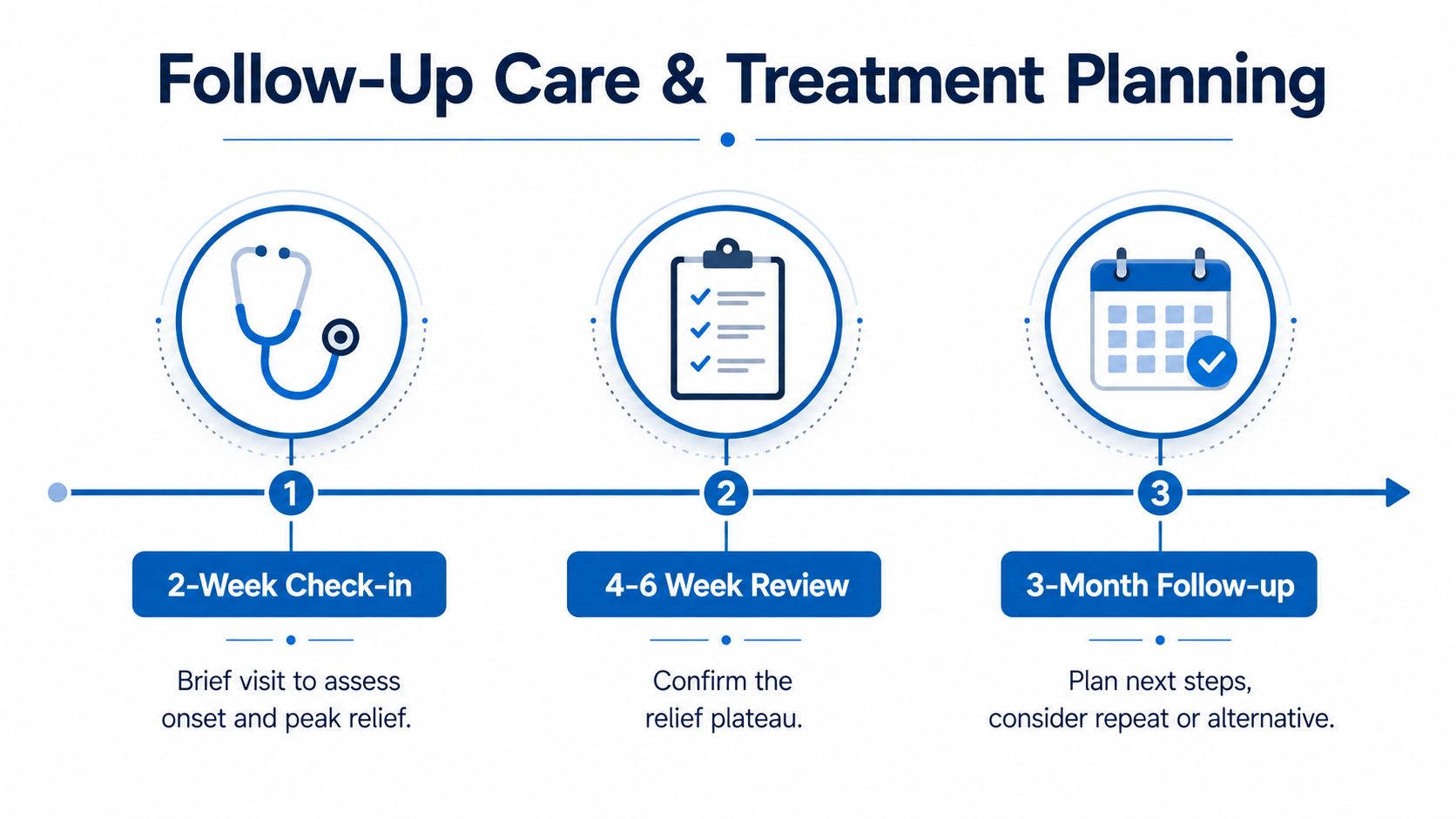
Repeat treatment should follow the patient's response, not an automatic calendar. A practical discussion with the pain physician can include an early check around two weeks, a review at four to six weeks, and a reassessment around three months if symptoms recur. Those intervals help separate delayed improvement from an early plateau and identify whether the benefit is fading.
Track function, not only pain
A simple notebook or phone app can record:
- Daily pain: Note the location, intensity, and whether the familiar pain has changed.
- Sleep quality: Record whether falling asleep, staying asleep, or changing position has become easier.
- Functional milestones: Write down specific changes, such as turning the head, sitting at a desk, walking, or lifting household items.
- Activity exposure: Mark unusual exertion, a new workout, prolonged sitting, or other events that might explain a flare.
A pattern is more useful than a single good or bad day. The clinician can compare the injection date with the onset of relief, the strongest improvement, and the return of symptoms.
During the relief window, heavy lifting and new gym programs should be avoided in the first week unless the treating clinician gives different instructions. Load can then be reintroduced gradually, ideally alongside prescribed mobility or strengthening work. A broader overview of injection options in pain management can help patients understand why the next step may not always be another trigger point injection.
Know when to contact the clinic
Same-day or next-day medical contact is appropriate for spreading redness, fever, sudden severe pain, or new neurological symptoms such as limb weakness or numbness. These symptoms shouldn't be explained away as ordinary post-injection soreness.
Repeat injections work best as one part of a stepped plan. The plan may also address posture, sleep ergonomics, physical therapy, activity pacing, and the underlying mechanical or systemic driver. An indefinite repeat prescription without reassessing those factors misses the reason duration varies.
Key Takeaways on Trigger Point Injection Duration
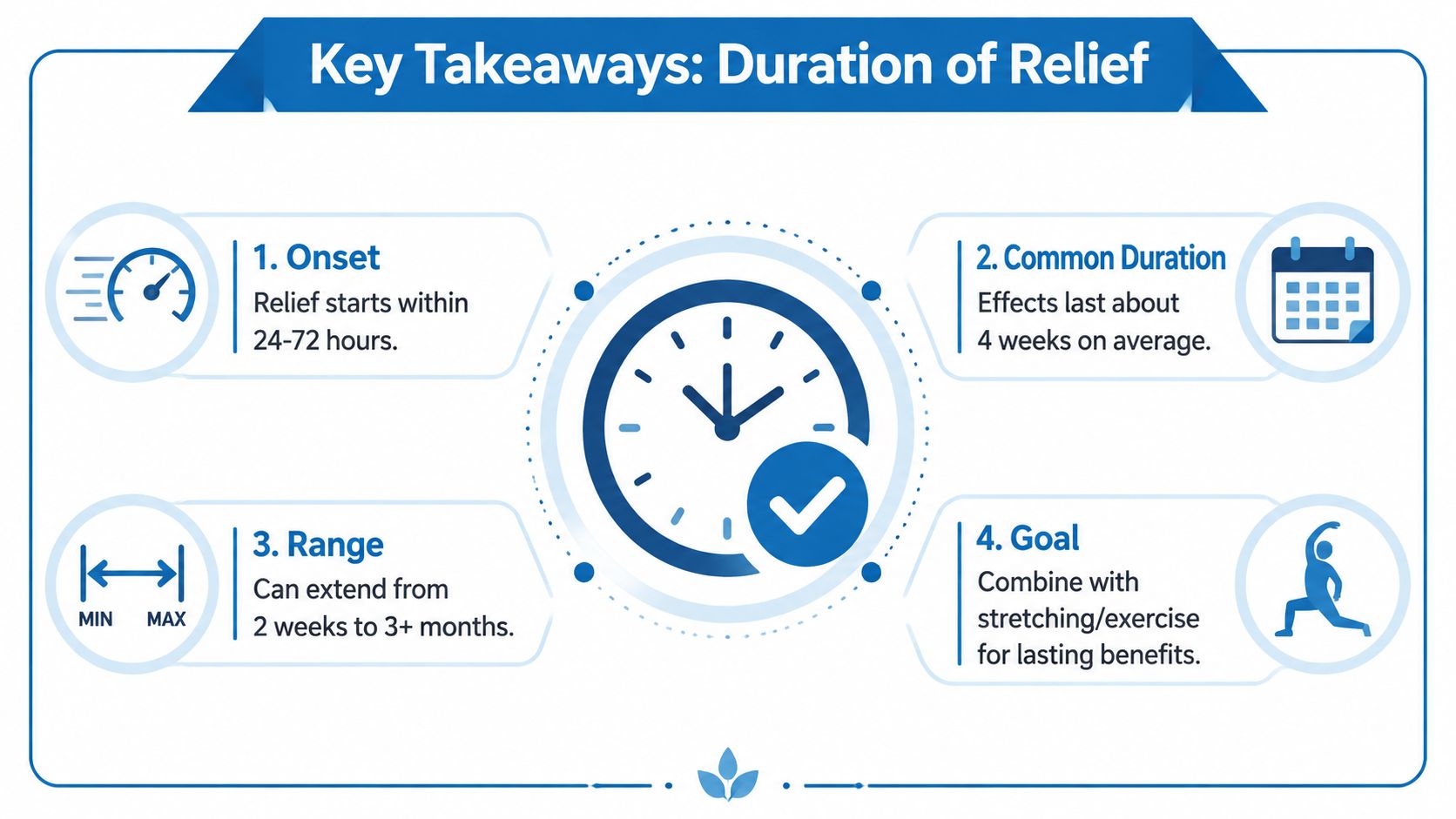
Most patients begin noticing meaningful improvement within 24 to 72 hours, and relief commonly lasts about one month. The broader range can extend from a few weeks to several months, with clinical reviews describing outcomes that vary according to technique, injectate, muscle, and diagnosis. The Cleveland Clinic overview and academic literature support using an honest range rather than a guaranteed endpoint.
Four questions help explain an individual result:
- What was injected? Local anesthetic, steroid-containing medication, and botulinum toxin act differently.
- Which muscle was treated? Constantly loaded postural muscles may face more repeated irritation.
- What caused the trigger point? A focal muscle problem can behave differently from widespread or systemic pain.
- What happened afterward? Posture, sleep position, stress, activity, and rehabilitation can either protect or shorten the treatment window.
Short relief doesn't automatically equal failure. It may indicate that the original mechanical driver remains active, that another pain source is involved, or that the treatment plan needs an adjustment. Physical therapy, ergonomic changes, and evaluation of contributing health conditions may be more important than scheduling another injection.
Patients who remain comfortable beyond eight weeks can discuss whether future injections should be spaced farther apart. Patients whose relief consistently lasts less than two weeks should request a reassessment of the diagnosis, injectate, injection target, and supporting therapies rather than assuming another identical procedure is the answer.
For a broader, practical approach to managing chronic pain step by step, patients can use the injection response as one piece of a longer plan. Before the next pain specialist visit, they should bring a written symptom log and a current medication list.
Interventional Pain Management evaluates trigger point pain alongside spinal, joint, and other musculoskeletal causes, then matches treatment with the patient's symptoms and functional goals. Patients can visit Interventional Pain Management to request an evaluation and discuss whether trigger point injections, rehabilitation, or another pain-management option fits the next step.