

Nerve block surgery is usually not surgery at all. It's a targeted injection of local anesthetic near a nerve to stop pain signals, and the procedure itself typically takes only minutes.
That distinction matters when a clinician uses the phrase during a discussion about persistent back pain, an upcoming joint operation, or pain that continues after an injury. The word “surgery” can suggest an incision, nerve removal, or a permanent alteration. In most cases, a nerve block is a temporary, image-guided injection used either to control pain, provide anesthesia, or test whether a particular nerve is contributing to symptoms.
A true nerve-targeting surgery is different. It may involve physically releasing, repairing, removing, or altering tissue around a nerve. A block usually leaves the nerve intact. The medication wears off, sensation gradually returns, and the result helps the care team decide what should happen next.
Table of Contents
- Why Your Doctor May Be Talking About Nerve Block Surgery
- How a Nerve Block Stops Pain Signals
- Diagnostic Versus Therapeutic Nerve Blocks
- Common Types of Nerve Blocks and When Each Is Used
- What Happens During a Nerve Block Procedure
- Real Risks and Complication Rates by Block Type
- Recovery Timeline and What Wear-Off Feels Like
- When to See a Pain Management Specialist
Why Your Doctor May Be Talking About Nerve Block Surgery
After months of stabbing pain down the leg, burning pain after shingles, or shoulder pain that has not improved with medication and physical therapy, your doctor may discuss a targeted nerve block. Imaging can show several abnormalities, yet a scan does not always reveal which structure is producing the symptoms. A carefully chosen block can help connect the examination, the scan, and the pain pattern.
The phrase “nerve block surgery” can arise in several situations:
- Conservative treatment has not been enough: Oral medicines, activity changes, and physical therapy may reduce symptoms without resolving them.
- The pain appears neuropathic: Burning, electric shocks, tingling, or pain caused by light touch can suggest nerve involvement, although the examination still matters.
- A procedure is being planned: A block may provide anesthesia during surgery or reduce pain afterward.
- Pain continues after an operation or injury: A targeted injection may calm symptoms while the clinician assesses healing, scar tissue, or ongoing nerve irritation.
A nerve block is a regional anesthesia technique. Medication is placed near a peripheral nerve or plexus to temporarily affect sensation in the area that nerve supplies. A clinical guideline on peripheral nerve blocks describes their use for surgical anesthesia, acute pain control, and diagnostic localization, sometimes without general anesthesia.
Why a block may come before surgery
A back scan may show an abnormal disc, but that finding does not automatically prove it is the pain source. A diagnostic block tests whether a suspected nerve or joint contributes to the symptoms. A meaningful change can support that target. Little or no change may lead the physician to reconsider the target before recommending a more invasive operation.
Blocks can also form part of an anesthetic plan. For a suitable procedure, a patient may receive regional anesthesia, sedation, or both rather than general anesthesia. The choice depends on the operation, medical history, blood-thinner use, airway considerations, and personal preferences.
The practical distinction is straightforward: a block usually acts as a temporary test or treatment while leaving the nerve intact. Nerve-targeting surgery physically releases, repairs, removes, or alters tissue and carries a different commitment and risk profile.
How a Nerve Block Stops Pain Signals
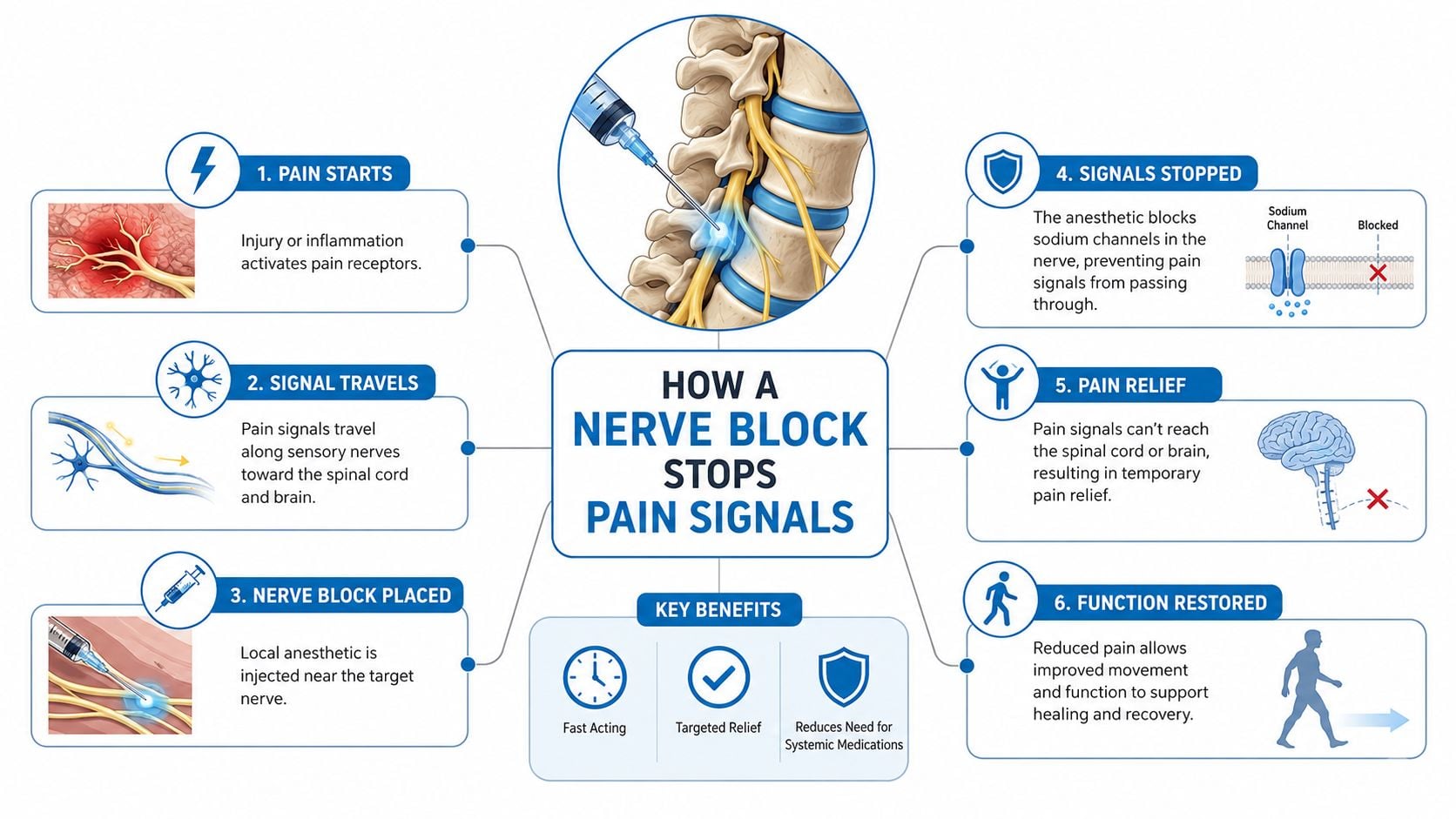
Suppose your shoulder still hurts after the original injury has begun to heal. A nerve block does not remove the nerve or operate on the painful tissue. It temporarily quiets selected electrical messages traveling from that region to the brain, much like closing one lane on a busy road while traffic uses the others.
The mechanism in simple steps
- The clinician identifies the target. Ultrasound or another imaging method helps show the nerve, blood vessels, and nearby structures.
- Local anesthetic is placed beside the nerve. The medicine surrounds selected nerve fibers. It does not cut, remove, or permanently alter them.
- Sodium-channel activity is interrupted. Nerves rely on voltage-gated sodium channels to create and conduct electrical impulses. Local anesthetic temporarily blocks this process, so the signal cannot travel normally.
- Sensation changes in the nerve's territory. Pain and temperature may fade first, while touch can feel different. Depending on the location and dose, movement may also become weak.
- The medicine wears off. As the anesthetic leaves the area, tingling, warmth, heaviness, or pins and needles may occur before normal sensation returns.
The response differs from person to person. Sensory fibers may be affected before motor fibers, allowing pain to improve while movement remains fairly strong. Other blocks influence both types of fibers, leaving an arm or leg heavy or difficult to control temporarily. That effect is expected for some procedures, but it changes what you can safely do until strength returns.
The anesthetic's duration is chosen according to the procedure and the intended period of relief. A clinician may add another medicine when appropriate, but temporary numbness does not guarantee lasting pain control. A successful block quiets a defined pathway for a planned interval. It does not repair a torn tendon, correct a disc problem, or reverse established nerve damage. Those problems may require a separate treatment plan, including surgery when appropriate.
Diagnostic Versus Therapeutic Nerve Blocks
A nerve block can answer a clinical question or provide symptom relief. Those goals overlap, but they aren't interchangeable.
A diagnostic block is designed to test whether a particular nerve or structure contributes to pain. For example, a clinician may numb a suspected nerve while asking the patient to perform a movement that normally triggers symptoms. A meaningful, temporary reduction supports that nerve as a pain contributor, but the result still requires careful interpretation because pain can fluctuate and nearby structures may also be affected.
A therapeutic block aims to provide relief. The injection may include a local anesthetic and, in selected situations, an anti-inflammatory medication. Relief can outlast the initial numbness, but the duration varies widely and recurrence doesn't automatically mean the procedure failed.
| Feature | Diagnostic Block | Therapeutic Block |
|---|---|---|
| Main purpose | Tests whether a targeted nerve or structure contributes to pain | Attempts to reduce symptoms |
| Medication approach | Often emphasizes a controlled local-anesthetic response | May combine local anesthetic with another medication |
| Timing | Assessed during the expected anesthetic effect | Followed over the ensuing recovery period |
| Clinical use | Helps refine the pain generator | Supports function, rehabilitation, or postoperative recovery |
| Next decision | May guide another procedure or avoid an incorrect target | May support repetition, a different intervention, or surgery when appropriate |
Why the distinction changes the plan
A diagnostic response can help prevent a patient from undergoing surgery aimed at the wrong pain generator. That doesn't mean a positive block automatically proves that surgery is necessary. It means the clinician has gained one piece of evidence that must be weighed with the examination, imaging, symptom pattern, and functional limitations.
For facet-mediated back pain, a medial branch block may be used as a diagnostic step before a treatment such as radiofrequency ablation. The block itself isn't the ablation, and a patient shouldn't treat temporary numbness as proof of a permanent cure.
Common Types of Nerve Blocks and When Each Is Used
The right block depends on the question being asked. A clinician considers the painful region, the suspected nerve, the planned procedure, medication risks, and whether the patient needs temporary anesthesia, diagnostic information, or longer analgesia.
Blocks for the spine and lower body
An epidural block places medication near the spinal nerves in the epidural space. It can support labor analgesia, surgical anesthesia, or treatment of selected forms of radicular pain. A patient evaluating an injection for nerve-root irritation can review epidural steroid injection information, while recognizing that suitability depends on the diagnosis and examination.
A spinal block places anesthetic into spinal fluid and commonly provides dense anesthesia for operations involving the lower body. Unlike a peripheral block, it affects a broader region below the injection level and may temporarily weaken both legs.
Peripheral blocks for focused coverage
Peripheral nerve blocks are placed near named nerves or plexuses. Examples include:
- Interscalene block: Often used for shoulder procedures, with respiratory considerations that require specific screening.
- Femoral or adductor canal block: Used for selected knee and thigh procedures, with motor weakness varying by technique.
- Popliteal block: Targets nerves behind the knee for foot and ankle procedures.
- Transversus abdominis plane block: Provides abdominal-wall analgesia for selected operations, but doesn't cover every source of deeper abdominal pain.
Sympathetic blocks and continuous delivery
Sympathetic blocks, such as stellate ganglion, celiac plexus, or lumbar sympathetic blocks, target autonomic nerve pathways. They may be considered for selected complex regional pain or visceral pain patterns after a detailed evaluation.
A continuous catheter leaves a small tube near the target so medication can be delivered over time. That approach may extend analgesia beyond a single injection, but it adds care instructions, movement precautions, and the need to monitor the catheter site.
Insurance authorization may not align perfectly with what appears clinically reasonable. The treating team can explain the expected purpose, alternatives, and coverage requirements before scheduling.
What Happens During a Nerve Block Procedure
On the day of a nerve block, the clinician reviews your diagnosis, medicines, allergies, blood-thinner instructions, and consent. An intravenous line may be placed, depending on the setting and type of block. If sedation, weakness, or numbness could affect you, arrange for a responsible adult to accompany you. You should not drive yourself home.
Your position depends on the target. You may lie on your back or side for a peripheral block, or face down for some spine and sympathetic procedures. After cleaning the skin, the clinician numbs it with a small injection, then guides the needle with ultrasound or fluoroscopy. Imaging shows the needle and medication spread, but careful technique and communication remain necessary.
Most patients feel pressure or a brief pinch, rather than sharp, sustained pain. The clinician may pause, draw back on the syringe, or inject gradually to check the needle's position and reduce the chance of placing medication where it should not go. Tell the team if you feel sudden, severe, or unusual pain.
The confirmation and recovery period
After the injection, the team may test sensation with cold spray or gentle touch. Warmth, heaviness, less pain, or weakness can follow. A sensory-focused block may preserve movement, while a motor-involving block can make the limb feel unreliable. This response helps show whether the intended nerves were reached, but it does not by itself prove that the underlying condition is cured.
Recovery staff repeat relevant checks and observe you before discharge. Contemporary regional anesthesia guidance recommends close observation after peripheral or fascial plane blocks in emergency settings, including at least 1 hour in that context. Many patients leave the same day, although some need longer monitoring for breathing, blood pressure, or other concerns.
Protect the numb area from heat, pressure, and injury. Do not drive, operate machinery, walk without help while a limb is weak, or treat numbness as protection. Before leaving, confirm when to start prescribed pain medicine and whom to call if weakness, pain relief, or sensation changes unexpectedly.
Real Risks and Complication Rates by Block Type
A nerve block may leave you with a numb, weak, or sore area for a while. Those effects are usually temporary, but low risk never means no risk. The risk profile changes with the body region, injection depth, nearby blood vessels or spinal cord, medication dose, and any existing neurologic or structural condition.
Common short-lived effects include numbness, weakness, bruising, dizziness, soreness, and a vasovagal episode. More serious concerns include injection into a blood vessel, local anesthetic systemic toxicity, infection, and nerve injury. Persistent neurologic injury after regional anesthesia is uncommon, with frequently reported estimates around 2 to 4 per 10,000 blocks. Pre-existing neurologic or structural problems may increase vulnerability. The Royal College of Anaesthetists guidance provides further context.
| Block Type | Common Effects | Neurologic Injury | Infection | Signature Risk |
|---|---|---|---|---|
| Peripheral nerve block | Temporary numbness, weakness, bruising | Persistent injury is uncommon overall | Uncommon | Local anesthetic systemic toxicity or limb injury while numb |
| Interscalene block | Arm numbness and weakness | Risk varies with technique and patient factors | Uncommon | Hemidiaphragmatic paralysis can occur in up to 100% of patients in some reports, review |
| Epidural or spinal block | Temporary leg weakness, blood-pressure changes | Risk is influenced by the spinal location and patient factors | Uncommon | Dural puncture, bleeding, or infection |
| Sympathetic block | Temporary blood-pressure or temperature changes | Depends on the target and needle path | Uncommon | Effects on nearby vessels or organs |
The region-specific questions worth asking
An interscalene block needs careful discussion if you have significant respiratory disease. Temporary diaphragm weakness may matter more when breathing reserve is limited. A peripheral block also carries a systemic toxicity risk if too much anesthetic enters the circulation. Clinicians reduce that risk with incremental injection, aspiration, ultrasound visualization, monitoring, and treatment protocols prepared in advance.
The location changes the main concern. Near the neck, breathing mechanics may be relevant. Near the spine, bleeding, infection, or dural puncture require attention. In an arm or leg, numbness can hide pressure, burns, falls, or other injuries.
Serious complications are uncommon, but they remain possible. The safest plan matches the block to the patient, not only to the operation.
Contact your medical team promptly for persistent or worsening weakness, severe pain out of proportion to the procedure, spreading numbness, trouble breathing, ringing in the ears, seizures, fever, or increasing redness and swelling. Trouble breathing, seizures, or rapidly worsening symptoms require emergency evaluation.
Recovery Timeline and What Wear-Off Feels Like
The first sign of a block wearing off is often not a sudden return of full pain. Sensation may reappear as warmth, heaviness, tingling, or pins and needles. Muscle control may return gradually, followed by normal touch and then the underlying pain.
A single-shot block may last for hours or into the following day, depending on the medication, location, dose, and individual response. A continuous catheter can provide relief for a longer planned period, but it requires specific instructions for protecting the numb area and managing the dressing or pump.
| Block Type | Numbness Duration | Return to Activity | Pain Relief Window |
|---|---|---|---|
| Short peripheral single shot | Several hours, varying by medication and target | Gradual, with protection until strength and sensation return | Usually limited to the anesthetic effect unless additional treatment helps |
| Longer-acting peripheral block | May extend into the next day | Activity resumes according to strength, balance, and surgical instructions | Can outlast numbness in some patients |
| Spinal block | Wears off as lower-body sensation and movement return | Walking requires clearance and stable motor control | Primarily covers the procedure and early recovery |
| Continuous catheter | Continues while medication is delivered | Requires catheter precautions and supervision | Continues through the planned infusion period |
Protecting the area during the numb phase
A numb limb can be burned, cut, twisted, or overloaded without producing a warning signal. Patients should follow the procedure-specific instructions, use assistance when walking, and avoid placing weight on a weak leg unless the care team has approved it.
The emotional pattern can be confusing. A patient may feel excellent while the block is active and discouraged when the original pain returns. That return doesn't automatically mean the injection failed. Complete relief during the expected anesthetic window can support the diagnosis, while partial relief may show that the target is only one contributor.
A response that lasts beyond the immediate anesthetic period may influence whether the clinician repeats the injection, considers another intervention, or recommends a surgical consultation. The decision should be based on function and diagnosis, not on duration alone.
When to See a Pain Management Specialist
Mild, intermittent sciatica can improve with time, activity modification, and conservative care. Escalation becomes more reasonable when pain continues despite a sustained trial of treatment, interferes with sleep, restricts walking, or produces symptoms that suggest a specific nerve pathway.
Patients should consider a specialist evaluation when:
- Pain remains limiting: Symptoms continue after medication, physical therapy, and activity adjustments have been tried.
- Medication demands are rising: Increasing reliance on opioids or other rescue medicine deserves a structured review rather than indefinite continuation.
- Sleep and function deteriorate: Repeated sleep disruption, difficulty working, or inability to complete ordinary tasks changes the treatment threshold.
- Walking becomes restricted: Neurogenic claudication, leg heaviness, or pain that limits walking distance may warrant evaluation for spinal stenosis or another cause.
- Nerve pain follows an injury or rash: Persistent burning or sensitivity after the visible rash from shingles has resolved can require targeted management.
Symptoms that shouldn't wait
Progressive weakness, new bowel or bladder changes, saddle anesthesia, or rapidly worsening neurologic symptoms require urgent medical evaluation. Those signs are not routine reasons to schedule an elective block and wait for a convenient appointment.
A board-certified interventional pain specialist can combine physical examination, imaging review, medication planning, and image-guided procedures. The specialist may also coordinate rehabilitation, surgical consultation, or advanced options such as spinal cord stimulation when injections don't provide a durable answer. Pain management services may include both diagnostic and therapeutic approaches, depending on the source and behavior of the pain.
Patients can request a referral and ask about fellowship training, board certification, experience with the specific block, blood-thinner protocols, emergency preparedness, and the clinic's follow-up process. Those questions clarify whether the proposed injection is a diagnostic test, a treatment, part of anesthesia, or a step toward true nerve-targeting surgery.
Interventional Pain Management offers image-guided nerve block injections, diagnostic medial branch blocks, epidural procedures, and coordinated care for spine, joint, and neuropathic pain. Patients considering a block can visit Interventional Pain Management to request an evaluation and discuss whether a targeted injection, another nonsurgical treatment, or a surgical consultation fits the diagnosis.