
Most patients return to normal activities within 1 to 2 weeks after varicose vein surgery, although the exact recovery depends heavily on the procedure performed and the demands of the job. A desk-based worker may resume routine tasks sooner than someone who stands, walks, or lifts for much of the day.
Why does conventional advice still treat every varicose vein procedure as if it has the same recovery path? Endovenous ablation, phlebectomy, and traditional stripping affect tissue differently, so the sensible recovery plan should reflect those differences rather than offer one universal timetable.
Varicose vein surgery recovery is also less about staying in bed than many patients expect. Current discharge guidance emphasizes early, controlled walking, appropriate compression, leg elevation, and gradual progression. The practical challenge is knowing how much movement supports healing, when discomfort remains normal, and which symptoms require prompt medical attention.
Table of Contents
- Understanding Your Varicose Vein Surgery Recovery Timeline
- How Recovery Differs by Procedure Type
- Essential Post-Operative Walking and Compression Guidelines
- Activity Restrictions and Return-to-Work Planning
- Distinguishing Normal Recovery from Warning Signs
- Optimizing Your Varicose Vein Recovery with Practical Tips
Understanding Your Varicose Vein Surgery Recovery Timeline
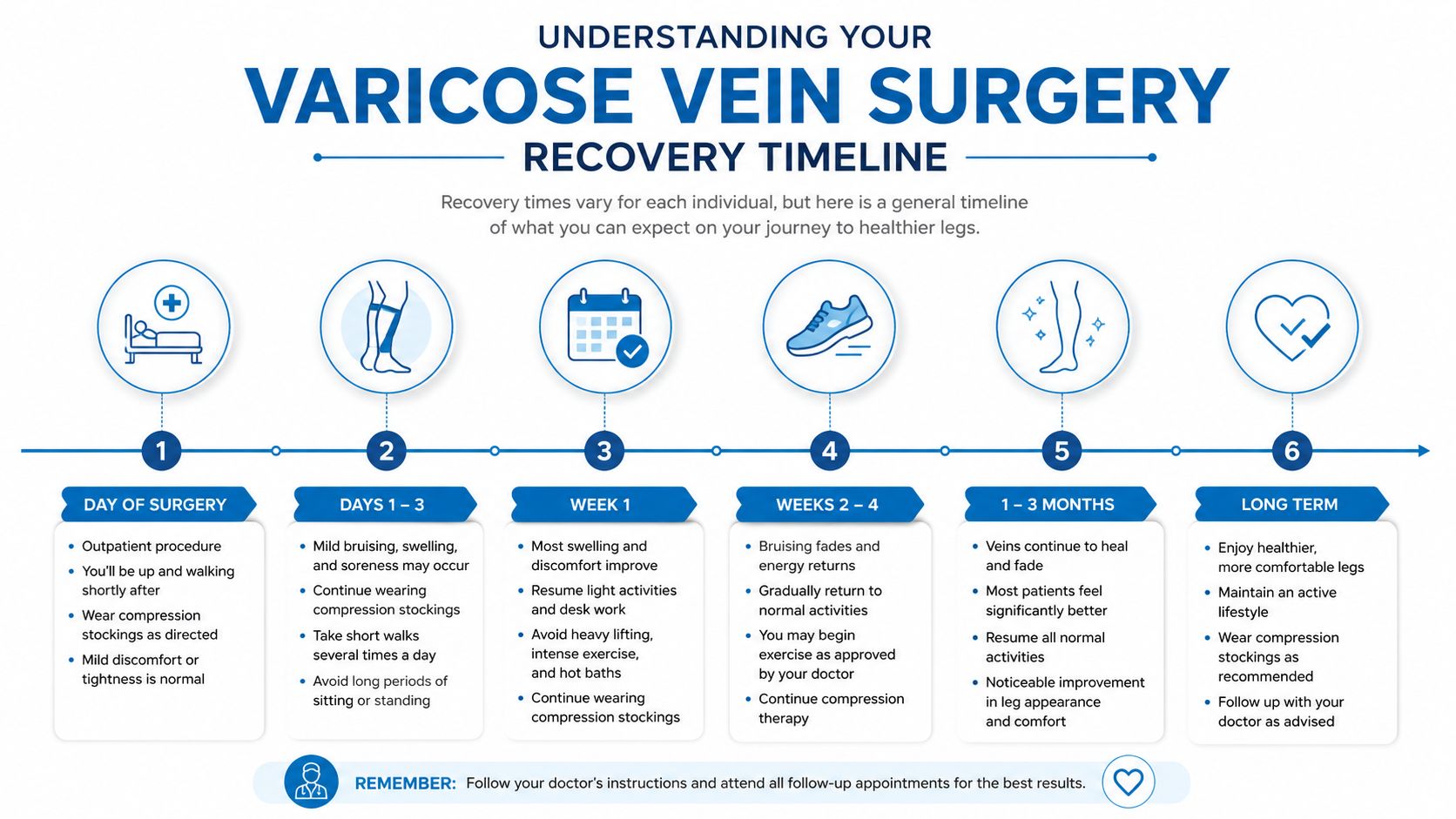
The broad NHS answer is reassuring: many can return to normal activities within 1 to 2 weeks after treatment, although work demands and the type of treatment can change that expectation. Guy's and St Thomas' NHS guidance uses this timeframe as a practical milestone, not a promise that every bruise, tight sensation, or area of swelling will have disappeared.
A more useful way to think about recovery is as a sequence of functional milestones. The first priority is safe movement. The next is managing swelling and discomfort while normal daily tasks return. Exercise, prolonged standing, and physically demanding work usually come later because they place greater strain on healing tissue.
Why one timeline doesn't fit every patient
A person with a computer-based job may tolerate a return to work once walking, sitting, and commuting are comfortable. A teacher, retail worker, nurse, or warehouse employee may need more time or temporary adjustments because prolonged standing, repeated stair climbing, and lifting can aggravate swelling.
The same distinction applies to procedure type. Minimally invasive ablation often involves smaller access points and less tissue disruption than traditional stripping, while phlebectomy uses small removal sites along the leg. Those differences can affect tenderness, bruising, mobility, and the speed at which ordinary tasks feel manageable. Patients considering treatment can review the broader evaluation pathway through varicose vein and spider vein care, then ask the treating clinician to provide a procedure-specific plan.
Planning rule: “Back to normal activities” doesn't necessarily mean “ready for every activity.” It usually means ordinary movement is becoming practical, while strenuous exercise and long periods on the feet may still need to wait.
Recovery is active, not bed-based
Older expectations often center on prolonged rest. Modern instructions instead encourage walking soon after treatment, combined with rest periods and elevation when seated. This approach supports circulation and helps limit stiffness and postoperative edema, while avoiding the physical cost of remaining still for too long.
Patients should use the discharge paperwork from the treating team as the controlling instruction. General timelines are helpful for planning, but anesthesia, the treated veins, other medical conditions, pain control, and the physical demands of daily life can all alter the pace.
How Recovery Differs by Procedure Type
The procedure name matters because it describes how the vein is treated and how much surrounding tissue is disturbed. Endovenous laser ablation, radiofrequency ablation, phlebectomy, and traditional stripping shouldn't be presented as interchangeable operations.
Endovenous ablation
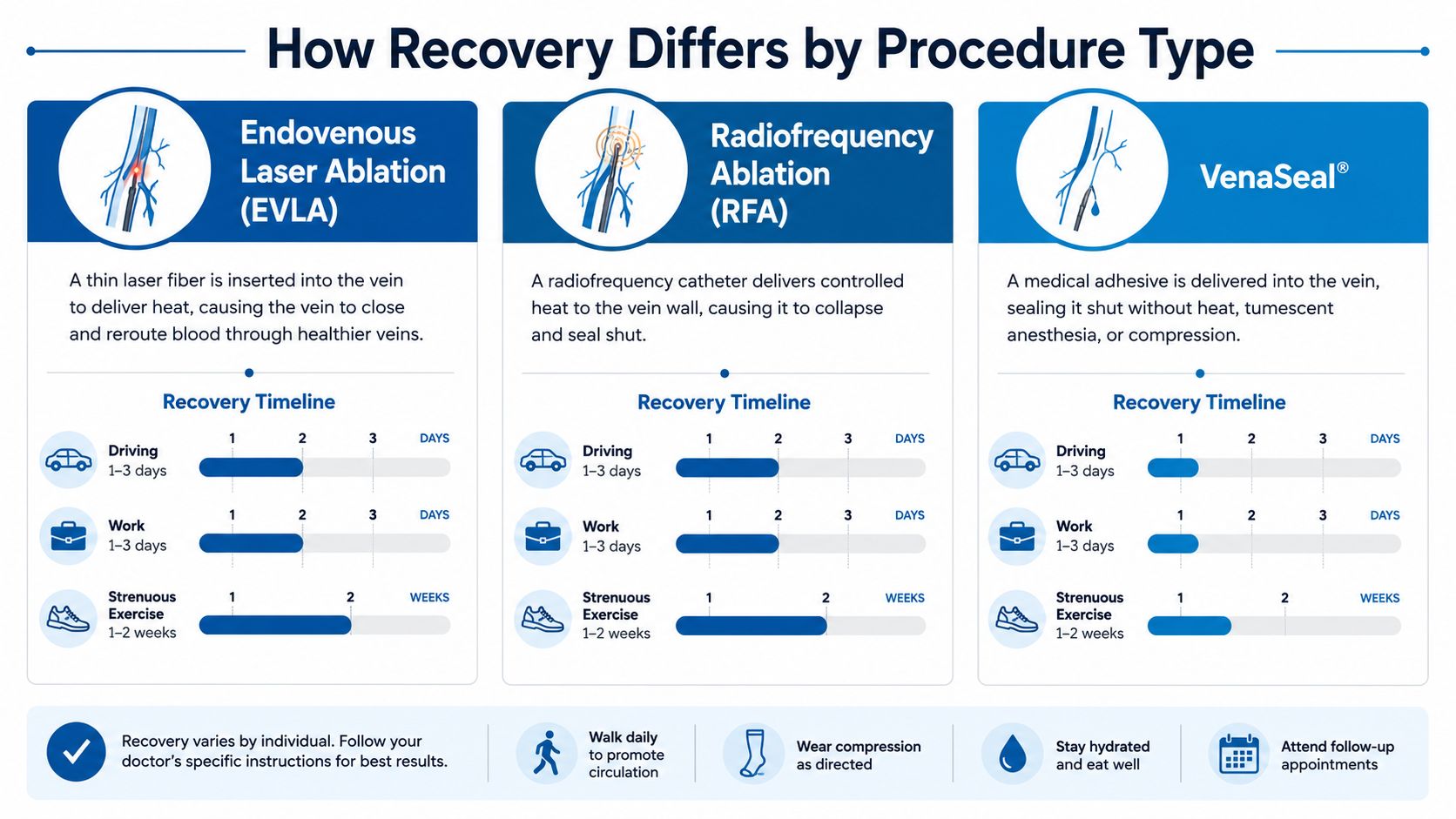
Endovenous laser ablation, often called EVLA, uses heat delivered through a catheter to close the problem vein from within. Radiofrequency ablation, or RFA, uses a related catheter-based approach with radiofrequency energy. Both are endothermal techniques, and their limited access points generally mean less tissue trauma than physically removing a vein.
An evidence review reported return to work at 4 days after endothermal laser treatment versus 17 days after conventional surgery. That comparison appears in the health technology evidence review of endovascular ablation. It doesn't mean every patient will follow those exact intervals, but it demonstrates why a generic “vein surgery recovery” figure can mislead.
Patients may still experience bruising, tenderness, tightness, or a pulling sensation along the treated vein. Smaller access sites can make walking and basic tasks easier, yet recovery still depends on the clinician's instructions and the patient's response.
Phlebectomy and traditional stripping
Phlebectomy removes visible varicose vein segments through small skin openings. Recovery can be quite manageable, but multiple access sites may produce scattered bruising and local soreness. The leg may feel tender in several separate areas rather than along one continuous line.
Traditional stripping involves removing the diseased vein through surgical incisions. It usually creates more tissue disruption than catheter-based closure, so swelling, bruising, wound care, and time away from physically demanding work may be greater. The evidence review above supports the broad trade-off, faster functional recovery with endothermal treatment compared with conventional surgery, but the treating surgeon remains the appropriate source for an individualized estimate.
The procedure should therefore be confirmed before booking time off. Patients can use the clinic's treatment information to prepare questions, including whether the planned treatment is EVLA, RFA, phlebectomy, stripping, or a combination.
Essential Post-Operative Walking and Compression Guidelines
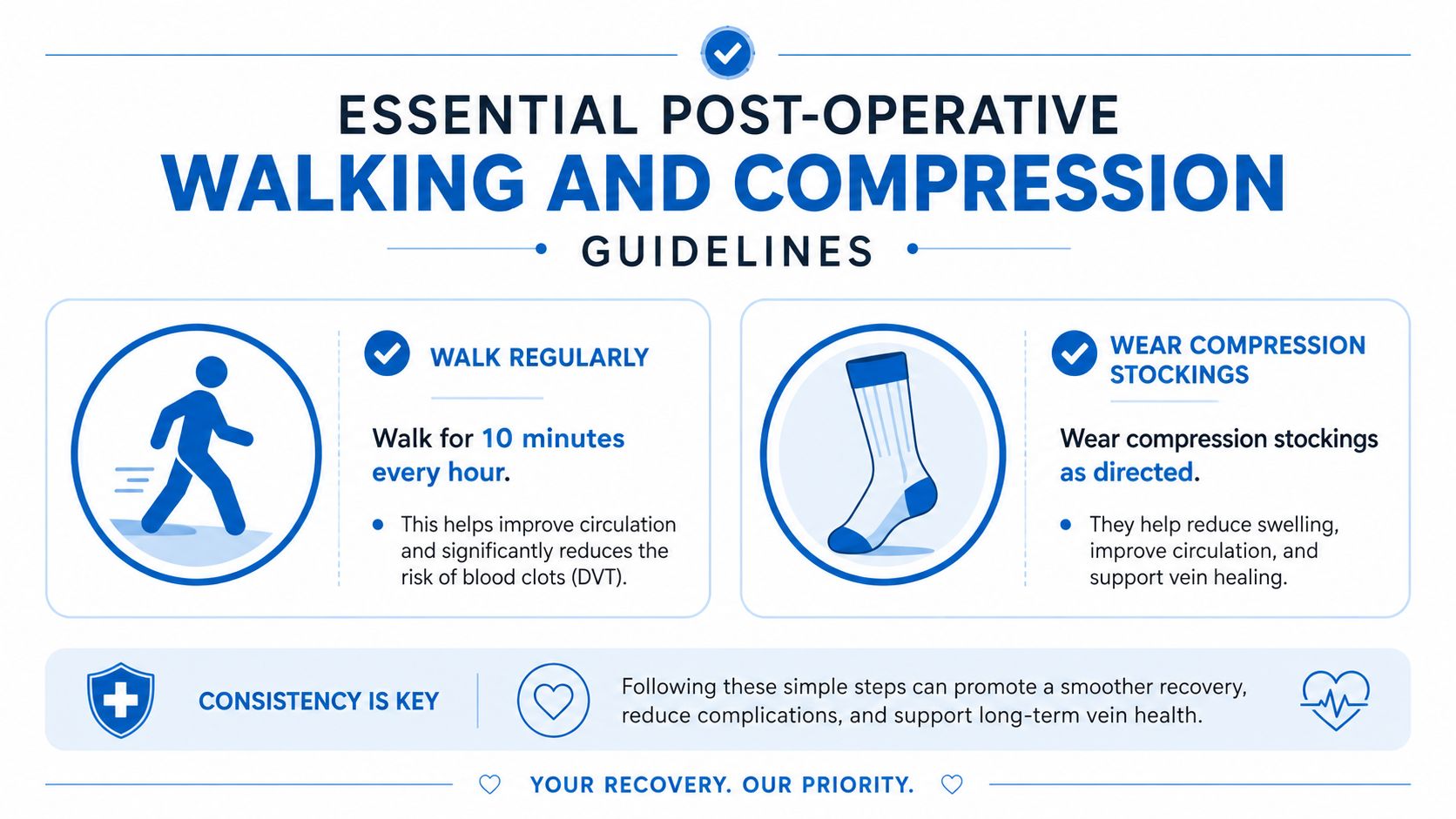
Walking and compression are not competing instructions. They work together. Walking activates the calf muscles, which help move blood through the leg, while compression supports the tissues and can reduce postoperative swelling.
NHS discharge guidance advises beginning a regular walking program the day after surgery, starting with a few minutes and progressing to 15 to 20 minutes at a time, 2 to 3 times daily. The NHS discharge instructions for varicose vein surgery also advise avoiding prolonged standing and elevating the legs when seated.
A practical movement pattern
The first walks should be deliberately easy. The aim isn't to test endurance or prove that recovery is complete. The aim is to move frequently enough to support circulation without creating a spike in pain or swelling.
A workable routine may include:
- Start gently: Take a short walk the day after surgery, unless the treating team has given different instructions.
- Build gradually: Progress toward 15 to 20 minutes, 2 to 3 times daily, as comfort allows.
- Break up stillness: Avoid sitting or standing in one position for prolonged periods.
- Support when seated: Support the legs so the feet are raised, rather than allowing them to hang down for long stretches.
- Stop before symptoms escalate: Mild tightness may be expected, but increasing pain or swelling should prompt a call to the clinical team.
Bed rest doesn't provide the same benefit as controlled movement. Early mobilization supports venous return, limits stiffness and edema, and forms part of clot-risk reduction after surgery. However, walking shouldn't become prolonged standing. Standing still places a different load on the legs and may worsen dependent swelling.
Compression needs consistency
One NHS leaflet advises wearing support stockings day and night during the first week, followed by daytime-only use during the second week. Another patient leaflet advises that stockings be worn for a total of 2 weeks, so the exact schedule should come from the treating team and the procedure-specific discharge paperwork. The NHS varicose vein surgery patient leaflet also notes that an adult should remain with the patient for the first 24 hours after surgery.
Stockings should fit correctly and be applied exactly as instructed. If they cause severe pressure, numbness, tingling, color change, or worsening pain, the patient shouldn't endure the problem. The clinical team should review the fit and the symptom.
Activity Restrictions and Return-to-Work Planning
How quickly can you return to normal life after varicose vein surgery? The answer depends on the procedure and the demands placed on your leg. Endovenous ablation, phlebectomy, and traditional stripping do not create the same wounds or recovery burden, so driving, work, and exercise should not follow one blanket timetable.
Driving may be possible 2 days after the operation if pain allows, according to UCLH recovery information. Before driving, you should be able to sit comfortably, operate the pedals fully, and make an emergency response without pain restricting your movement. Follow the treating team's instructions if they set a longer restriction, particularly after stripping or combined procedures.
Match the plan to the job
Return to work is commonly around 7 to 10 days, while heavy-standing jobs or severe disease may require up to 6 weeks away. The treating team should relate this range to the operation performed and the patient's progress.
Describe the actual workday before surgery, rather than labelling a role “light” or “physical.” Discuss:
- How long you must stand without sitting.
- Whether lifting, stairs, kneeling, or repeated walking is required.
- Whether seated duties, shorter shifts, or phased work are available.
- How commuting involves driving or public transport.
A desk worker may need a raised leg rest and regular walking breaks. Someone standing throughout the day may need reduced lifting, planned sitting periods, and a gradual increase in hours. Endovenous ablation often permits an earlier functional recovery than stripping, while multiple phlebectomies can leave several tender access sites that affect bending, clothing, or prolonged activity.
Exercise comes back in stages
Most activities may resume after about 7 to 10 days, while full gym activity or contact sports are typically delayed until 3 to 4 weeks after surgery, as summarized in the endovascular ablation evidence review. Begin with ordinary movement and build intensity gradually. Do not jump from comfortable walking to intense training.
Pain sets one limit, but swelling and tenderness matter too. If the leg becomes more swollen later in the day, or access sites become increasingly sore after an activity, reduce the workload and contact the surgical team if symptoms persist. Clearance from the surgeon takes priority after stripping, combined treatment, or an unexpectedly difficult recovery.
Distinguishing Normal Recovery from Warning Signs
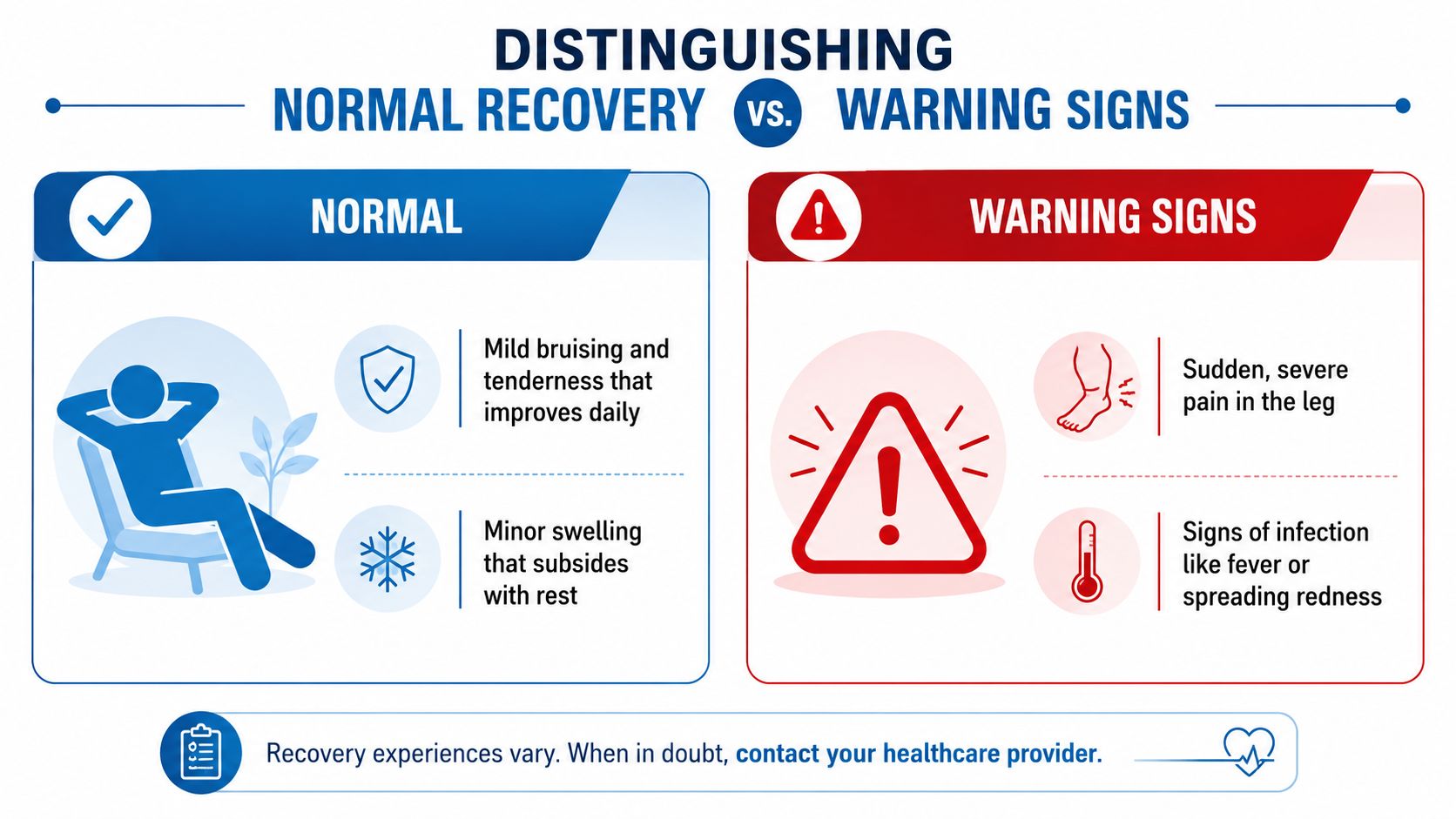
Not every swollen or uncomfortable leg is developing a complication. Soreness, stiffness, bruising, and swelling can remain normal for 1 to 3 weeks after surgery, and another NHS patient leaflet notes that swelling and bruising can remain normal for up to 3 months. The relevant question is whether symptoms are stable or gradually improving, rather than whether the leg looks completely normal immediately.
Mild aching, tightness, ankle or calf swelling, and bruising often reflect the body's response to treatment. Elevation and the prescribed compression routine can make these symptoms easier to manage. Bruises may change color as they resolve, and treated areas may feel firm or sensitive before they settle.
Symptoms that need clinical review
Discharge instructions provide a clear safety net. Patients should contact the treating service promptly for:
- Increasing leg pain or swelling: Worsening symptoms are more concerning than a steady, mild ache.
- Numbness or tingling: New or progressive altered sensation needs assessment.
- Fever, redness, or drainage: These may indicate infection, especially around an incision or access point.
- Chest pain or shortness of breath: These symptoms require urgent medical attention.
The Alberta Health aftercare guidance includes these escalation symptoms in its postoperative advice. Patients shouldn't wait for a routine follow-up if a warning sign is severe, sudden, or rapidly worsening.
Use the direction of symptoms
A leg that is mildly sore after activity and feels better with rest is different from a leg that becomes increasingly painful despite rest. A small amount of swelling that eases when raised is different from swelling that continues to increase.
Patients shouldn't diagnose a clot or infection independently, but they also shouldn't dismiss significant changes as ordinary healing. Recording when symptoms began, what makes them better or worse, and whether they are improving gives the clinical team useful information.
Optimizing Your Varicose Vein Recovery with Practical Tips
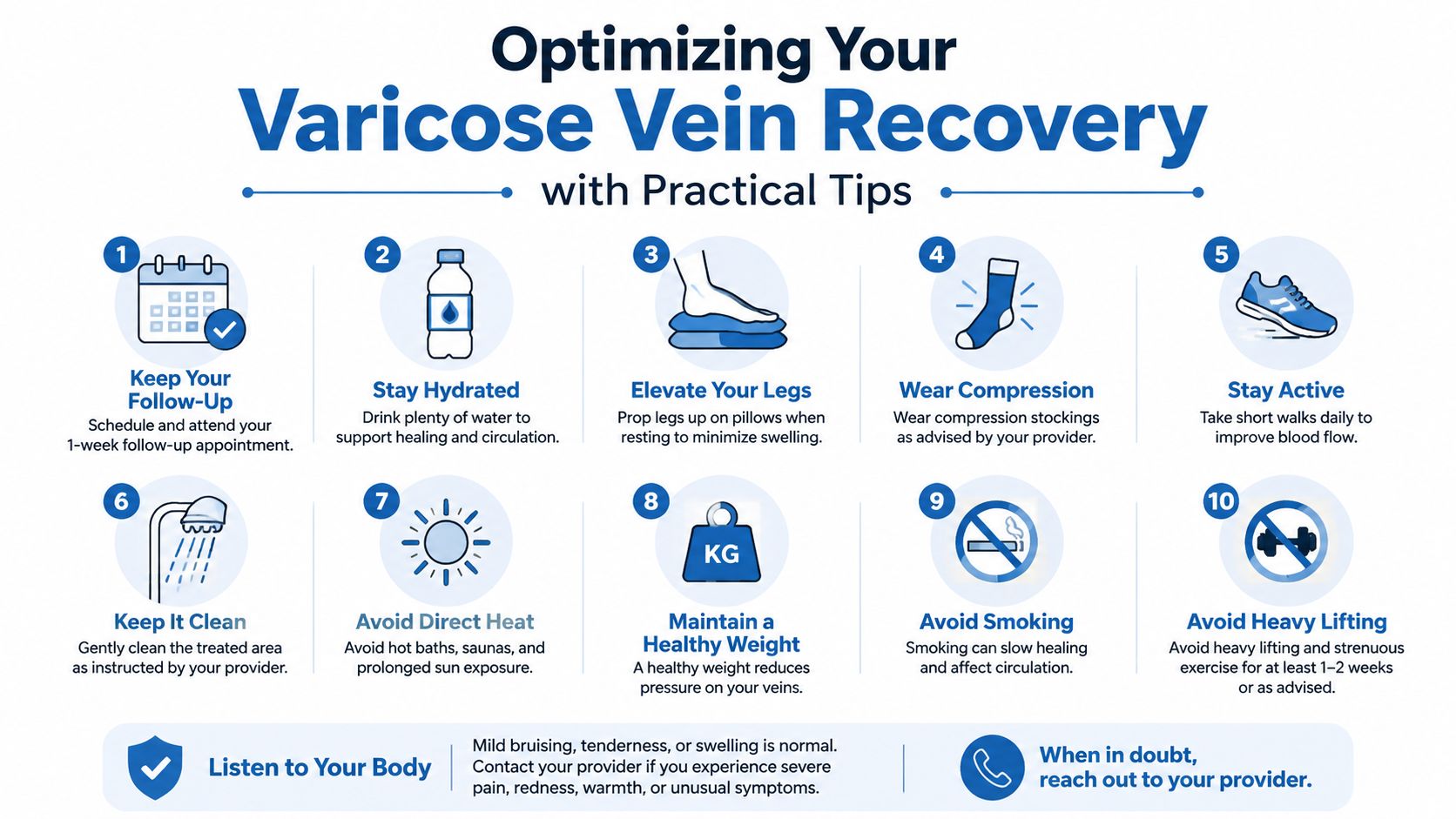
Successful recovery is easier when patients treat it as a planned rehabilitation period rather than an inactive convalescence. The core habits are simple: follow the procedure-specific instructions, walk regularly, use compression as directed, rest the leg when resting, and increase activity in measured steps.
A practical recovery checklist
Before the procedure, arrange an adult to stay with the patient for the first 24 hours, organize transport if driving isn't yet safe, and clear a comfortable place for leg elevation. Work planning should happen before treatment, especially for jobs involving prolonged standing or lifting.
During the first week, keep walks short and regular, avoid prolonged standing, and use compression according to the discharge schedule. Rest remains useful, but it should alternate with gentle movement rather than replace it.
During the second week, reassess ordinary tasks by function. If walking, sitting, and commuting are comfortable and symptoms are improving, work may become realistic. Strenuous exercise should still wait until the treating clinician's restrictions have been met.
Additional habits can make the routine more manageable:
- Prepare loose clothing: Tight garments can make stockings and dressings harder to manage.
- Rest with legs raised: Use pillows or a footstool when seated, while keeping the position comfortable.
- Maintain hydration and regular meals: Recovery requires practical support, not extreme dietary rules.
- Keep follow-up appointments: The clinician can assess healing and arrange duplex follow-up when indicated.
- Ask about pain control: The appropriate option depends on the procedure, medical history, and other medicines.
For household planning and general postoperative organization, NHS discharge home care advice offers a useful companion resource. For patients whose recovery is complicated by broader musculoskeletal pain, the pain management service can be part of a coordinated clinical discussion, though vein-specific instructions must remain with the treating vein team.
The most reliable recovery plan is individualized. A patient who knows the procedure type, expected mobility milestones, compression schedule, work demands, exercise restrictions, and warning signs can respond calmly without ignoring meaningful changes.
Interventional Pain Management evaluates varicose and spider vein conditions and can discuss minimally invasive treatment options, expected downtime, and follow-up planning based on individual needs. Visit Interventional Pain Management to request an evaluation and create a practical recovery plan before treatment.