

You felt a pop behind the knee while standing up, turning, squatting, or walking down stairs, and now you're trying to decide whether it's a harmless noise or a real injury. The location matters. A pop in the back of the knee points to a different set of causes than the front-of-knee crepitus most articles talk about, and the difference changes what should happen next.
Table of Contents
- Why a Pop Behind the Knee Deserves Your Attention
- Anatomy of the Back of the Knee
- Common Causes of Popping Behind the Knee
- Red Flags That Require Urgent Evaluation
- How Doctors Diagnose Posterior Knee Popping
- Treatment Options From Self-Care to Surgery
- When to See a Specialist and What to Look For
Why a Pop Behind the Knee Deserves Your Attention
A person can feel a sharp pop behind the knee while getting out of a car, then notice fullness in the joint later that day. Another person may hear the pop during a workout and assume it's just a normal joint sound because the knee still bends. Those situations are not the same.
The back of the knee has its own set of likely causes, especially Baker's cysts, which are fluid-filled swellings behind the knee and are commonly linked to inflammatory joint disease, osteoarthritis, or overuse and injury. In adults, MRI-based studies have reported popliteal cyst prevalence at 5% to 19%, and the condition has two age-incidence peaks, 4 to 7 years and 35 to 70 years (GPnotebook). That age pattern matters because a middle-aged or older adult with posterior knee popping is not dealing with the same differential as a teenager with an athletic twist injury.
Practical rule: location narrows the list faster than sound alone. A pop in the back of the knee makes cysts, tendons, and deeper joint problems more relevant than simple front-of-knee noise.
For readers comparing symptoms and next steps, a practical knee pain resource like knee pain solutions Kansas City can be useful for understanding where a broader knee workup fits. The key point is straightforward. A posterior pop deserves attention when it comes with fullness, a lump, pain, swelling, or repeated episodes.
Anatomy of the Back of the Knee
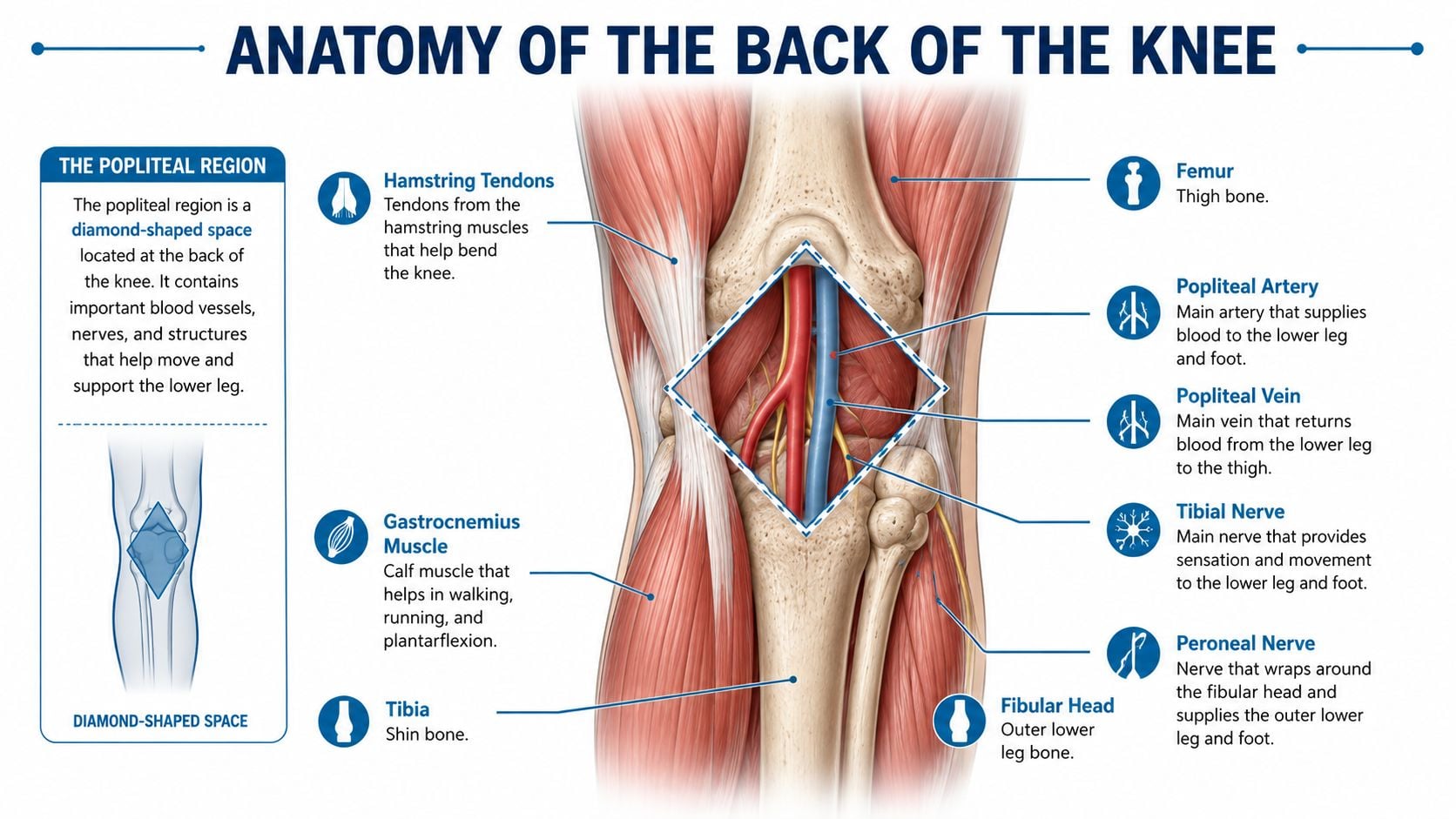
Think of the popliteal area as a crowded intersection
The space behind the knee is called the popliteal fossa, and it is more like a busy crossing than an empty pocket. The popliteal artery and vein, the tibial nerve, the peroneal nerve, the hamstring tendons, the gastrocnemius muscle, the fibular head, and the joint capsule all sit close together there. When one of those structures moves, swells, or gets irritated, the sensation can be felt as a pop, snap, tug, or sudden fullness.
That closeness explains why patients often describe the same symptom in different ways. One person feels a lump. Another notices a pulling sensation when straightening the knee. A third hears a click and assumes it must be the joint itself.
Why fluid buildup changes the picture
The gastrocnemius-semimembranosus bursa can communicate with the knee joint, which helps explain how joint fluid can track into the popliteal region and create a Baker's cyst. Once fluid collects there, it can be felt behind the knee, and if the cyst enlarges or decompresses, discomfort can extend toward the upper calf. That is one reason a back-of-knee pop can feel more like pressure than a mechanical click.
A lump behind the knee changes the differential immediately. It raises the question of a cyst, joint fluid buildup, or a deeper posterior-knee process that deserves an exam.
What the anatomy helps distinguish
A tendon-related snap tends to behave differently from a fluid-filled swelling. A vascular or nerve-related problem can add warning signs such as calf symptoms, tingling, or color change. A joint-capsule problem often comes with stiffness, swelling, or a sense that the knee is not moving normally. That is why a clear mental map of the back of the knee helps patients describe the symptom in a way that is useful during evaluation.
Common Causes of Popping Behind the Knee
The most useful question is not, “What popped?” It's, “What structure is likely to have moved, stretched, or filled with fluid right there behind the knee?” The answer usually falls into one of a few patterns.
Posterior Knee Pop Causes at a Glance
| Cause | Mechanism | Key Symptoms | Typical Profile |
|---|---|---|---|
| Baker's cyst | Fluid collects behind the knee from joint irritation | Fullness, lump, posterior pain, possible calf discomfort | Adults with arthritis, inflammatory disease, or overuse history |
| Posterior meniscal tear | Cartilage injury in the back part of the meniscus | Painful pop, catching, locking, swelling | Twisting injury, sports activity, or degenerative tear |
| Popliteus tendon dysfunction | Tendon irritation or snapping in the back of the knee | Posterolateral pain, snapping with motion | Runners, pivoting athletes, repetitive loading |
| Hamstring tendon snapping | Tendon shifts over nearby bony structures | Audible snap, tightness, pain with flexion or extension | Active people with muscle tightness or overuse |
| Loose body in the joint | Small fragment moves within the joint space | Intermittent catching, sudden sharp sensation, motion block | Arthritis, prior injury, cartilage wear |
| Ligament instability | Mechanical failure or laxity of a stabilizing ligament | Giving way, swelling, pain after a traumatic pop | Sudden pivot, collision, or awkward landing |
Why Baker's cysts lead the posterior list
A Baker's cyst is often the first posterior-specific diagnosis to consider because it is linked to underlying joint pathology, especially osteoarthritis, inflammatory disease, or meniscal or cartilage injury. A patient may notice a soft lump, tightness when fully straightening the leg, or a pop after the cyst changes size. The cyst is not the root problem by itself, it is usually the result of something else inside the knee.
Where meniscal tears fit
Posterior horn and root tears can create a painful pop, especially when twisting or squatting. In a study of posterior root tears of the medial meniscus, painful popping was reported in 96.5% of cases (PMC study). That doesn't mean every pop is a meniscus tear, but it does mean painful posterior popping should not be brushed off.
For a deeper look at meniscal patterns and what exam findings matter, torn meniscus is a useful clinical reference.
Clinical takeaway: a painless click is not the same problem as a painful pop with catching or locking. Symptoms attached to the pop matter more than the sound itself.
Red Flags That Require Urgent Evaluation
Some posterior knee pops can wait for a clinic visit. Others should be treated as same-day problems. The difference is usually in the symptom cluster, not the noise.
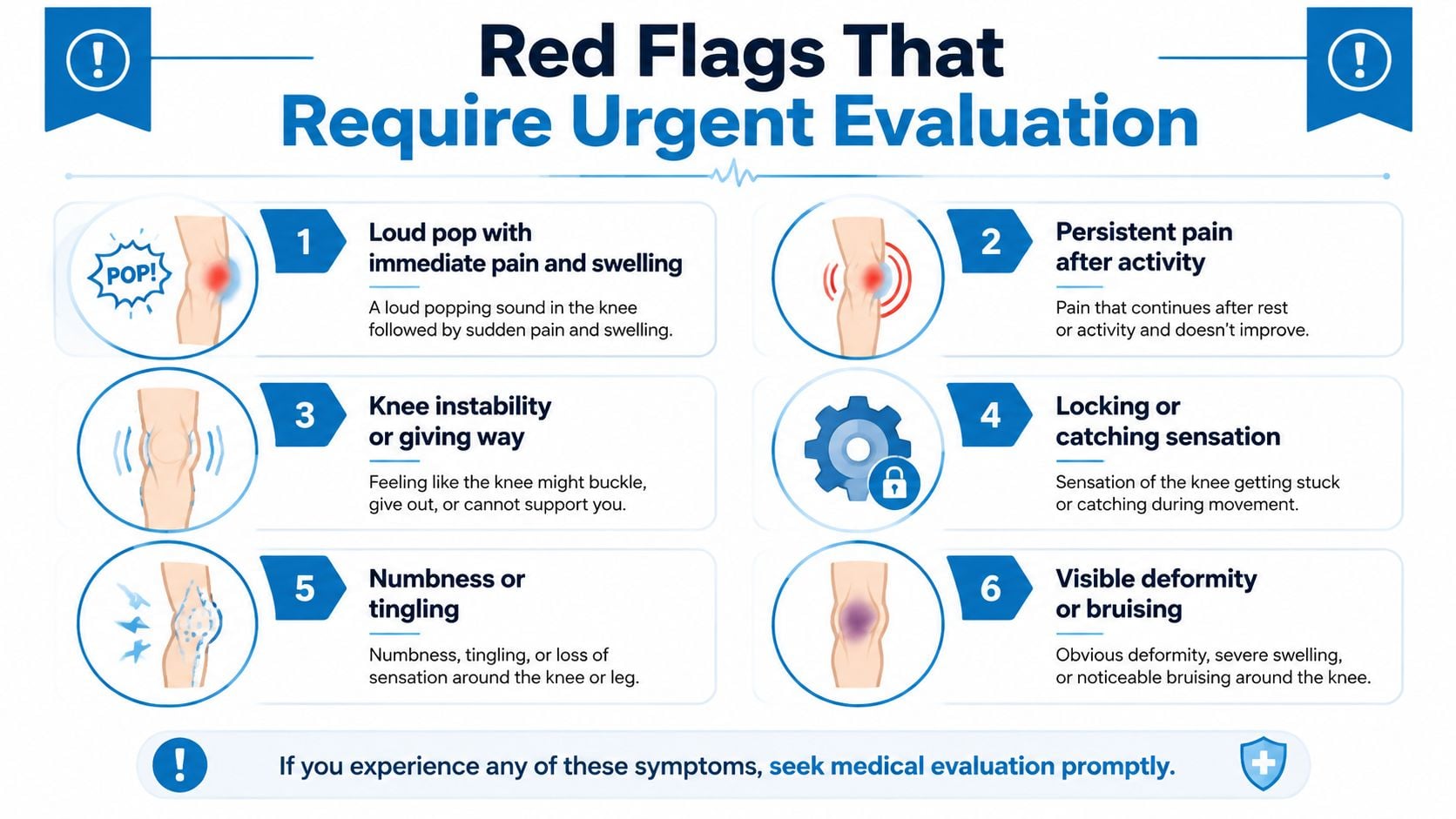
A loud pop with swelling is different from a quiet snap
A loud pop with immediate pain and swelling is a classic pattern for acute ligamentous injury, especially an ACL tear and sometimes an MCL tear. That pop reflects mechanical failure, not harmless joint cavitation, and it usually warrants prompt imaging and orthopedic evaluation rather than watchful waiting (Healthline). A similar urgency applies if the knee feels unstable or gives way right away.
Posterior symptoms can overlap with vascular problems
Calf swelling, warmth, or redness after a posterior knee pop deserves careful attention. A Baker's cyst can be involved, but the same symptom cluster can overlap with deeper problems that need urgent review, including a blood clot. NHS guidance for Baker's cysts specifically advises medical review for a lump, and that advice is sensible when the swelling is persistent or the calf changes too.
What should trigger same-day care
- Immediate swelling after the pop, especially with pain or trouble walking.
- Locking or catching, because that can point to a meniscal fragment or loose body.
- Numbness, tingling, or color change in the lower leg, which raises concern for nerve or vascular involvement.
- Visible deformity or bruising, which suggests structural injury rather than a benign snap.
- Calf warmth or swelling, which should never be written off without evaluation.
For ligament-focused injuries, ACL tear is the kind of problem that often presents with this urgent pattern. Posterior knee pain plus swelling is not a “wait and see” combination when weight-bearing is difficult or the lower leg looks different from the other side.
How Doctors Diagnose Posterior Knee Popping
A careful evaluation starts with the story, not the scan. The clinician wants to know when the pop happened, what the person was doing, whether swelling came immediately or later, and whether there is locking, weakness, or calf symptoms. That history often separates a tendon snap from a cyst, or a meniscal tear from ligament instability.
The exam usually focuses on three things
The first step is inspection and palpation of the popliteal fossa. A clinician feels for fullness, tenderness, or a discrete lump behind the knee. Next comes motion testing, because limited extension, painful flexion, or mechanical catching can point toward internal derangement. Then come stability tests, including meniscal maneuvers and ligament assessment, to see whether the joint behaves normally under load.
Imaging follows the question being asked
- X-rays help rule out arthritis, bone spurs, and other bony problems.
- Ultrasound is especially useful for a Baker's cyst, fluid collection, and some tendon issues, and it can also help evaluate for a clot when symptoms suggest that possibility.
- MRI is the best next step when the concern is a meniscal tear, ligament injury, or loose body.
A cyst can also be aspirated in selected cases. That procedure can confirm what the lump is and reduce pressure, but the value is temporary if the underlying joint problem is still driving the fluid.
The scan should match the question. A lump gets one line of thinking, a locked knee gets another, and calf symptoms change the urgency entirely.
Treatment Options From Self-Care to Surgery
Treatment only works well when it matches the cause. A Baker's cyst, a meniscal tear, and a snapping tendon do not need the same plan, even if the symptom described by the patient is “a pop.”
Start with the least invasive option that fits the diagnosis
Conservative care usually begins with activity modification, relative rest, ice, and compression. Targeted physical therapy can help when the problem is mechanical overload, especially when the program addresses hamstring flexibility, popliteus control, and quadriceps strength. A practical exercise reference like Flourish-Everyday's knee exercise guide can be helpful when a clinician has already confirmed that strengthening is appropriate.
For inflammatory pain, anti-inflammatory strategies may help, but they should not be used to mask a worsening structural problem. If the knee keeps popping, swelling returns, or the leg feels unstable, the plan needs to change.
Interventions and surgery treat the cause, not just the sound
Image-guided aspiration can reduce pressure from a Baker's cyst, and corticosteroid injection may help when inflammation is part of the picture. Recurrent cysts are different, because they usually return unless the underlying knee pathology is addressed.
For structural tears, the options may include meniscal repair or debridement, depending on the tear pattern and tissue quality. If the root problem is ligament instability, reconstruction may be the durable solution. In a recurrent cyst linked to joint communication, surgery may be considered to close off the pathway and address the source of fluid production.
The treatment approach described here is consistent with the broader range of services outlined in treatment options. The key trade-off is simple. Quick symptom relief can help, but durable relief usually depends on finding and treating the actual source behind the knee.
When to See a Specialist and What to Look For
Posterior knee popping that lasts more than a short period deserves a focused exam, especially if it's recurring or tied to activity limits. A specialist visit is also appropriate when there is a visible lump, swelling that keeps returning, locking, a sensation of giving way, or calf symptoms that don't fit a simple overuse strain.
What good specialist care should include
A strong clinic should offer musculoskeletal expertise, access to imaging, and the ability to move from conservative care to procedures or surgery when needed. That matters because posterior knee symptoms can sit at the intersection of pain management, orthopedics, and soft-tissue injury. A clinic that can examine the knee, review imaging, and decide whether aspiration, rehabilitation, injection, or surgery makes sense saves time and reduces guesswork.
The best fit is usually a practice that doesn't stop at one treatment lane. If the knee needs only therapy, the plan should stay conservative. If the exam suggests a cyst with a joint tear, instability, or a vascular concern, the patient should be able to move quickly to the right next step.
Good care is not about doing more. It's about matching the workup and treatment to the structure that's actually causing the pop.
For patients in New Jersey and Staten Island, the practical advantage is access to a multidisciplinary team with board-certified physicians, coordinated imaging, and seven-day scheduling when symptoms can't wait.
If a pop behind the knee keeps happening, comes with swelling, or leaves the knee feeling unstable, Interventional Pain Management can help sort out the cause and build a treatment plan that fits the diagnosis. Visit Interventional Pain Management to learn more about evaluation and treatment options for posterior knee symptoms.