

Both knees hurt, neither feels trustworthy, and ordinary tasks have become negotiations. A patient may be using a railing for every stair, avoiding shopping because standing is exhausting, and wondering whether replacing both knees at once would end the ordeal sooner. Then the surgeon confirms that both joints qualify for replacement and asks a harder question: one operation or two?
That decision shouldn't be framed as a test of toughness or patience. Cardiopulmonary reserve, anemia, frailty, clotting history, mobility, and home support matter more than the appeal of a single recovery. For many patients, staged bilateral knee replacement is the safer default. Simultaneous surgery has a legitimate role, but only for carefully selected patients who can tolerate a larger single-session physiologic burden and manage an unusually demanding early rehabilitation period.
Table of Contents
- Two Knees Failing at Once and a Decision to Make
- What Bilateral Knee Replacement Actually Means
- Comparing the Two Surgical Pathways Head to Head
- Who Is a Real Candidate for Simultaneous Surgery
- How Long to Wait Between Staged Operations
- Recovery and Rehab for Each Approach
- Which Option Fits Your Situation
Two Knees Failing at Once and a Decision to Make
A patient with severe arthritis in both knees may arrive at the consultation expecting a simple answer. If both knees are equally damaged, replacing both during one hospitalization can sound efficient. There would be one anesthetic, one hospital episode, and one broad rehabilitation effort. That logic is understandable, but it leaves out the most important variable: how the body will handle the operation.
The first question is whether the patient is medically fit for bilateral surgery. The surgeon and anesthesiologist need to consider heart and lung function, previous blood clots, kidney health, anemia, frailty, sleep-disordered breathing, weight-related risk, and the patient's ability to recover strength. A patient living alone also faces a different risk profile from a patient with reliable help for transfers, meals, medication management, and transportation.
Severe disease in both knees doesn't automatically make simultaneous replacement the right choice. A patient may have advanced osteoarthritis affecting both knees, yet still be better served by replacing the more limiting knee first and allowing the body to recover before addressing the second.
Practical rule: Convenience can influence the decision only after medical safety and discharge support have been established.
Four issues deserve direct attention:
- Candidate selection: Is the patient fit enough for one prolonged physiologic challenge?
- Complication profile: Does the patient face high risk from blood loss, clots, heart strain, or lung complications?
- Timing: If surgery is staged, what milestones should determine readiness for the second knee?
- Rehabilitation: Can the patient move safely when both legs are recovering, or would one stable leg make rehabilitation more manageable?
Staged surgery isn't a failure to commit. It distributes surgical stress across separate episodes and gives the first knee time to become useful before the second operation. Simultaneous surgery can be reasonable, but the patient who wants it should be able to explain why the medical profile supports it, not merely why two recoveries sound inconvenient.
What Bilateral Knee Replacement Actually Means
Bilateral knee replacement means replacing both knee joints with implants. The term describes the number of knees involved, not necessarily the timing. Patients often combine two separate decisions into one, but the distinction is straightforward.
The timing question asks whether both knees are replaced during one operative episode or on separate dates. The anesthesia question asks whether the patient undergoes one anesthesia event or two. In simultaneous bilateral total knee replacement, both knees are operated on under one anesthetic and during one hospitalization. In staged replacement, each knee has its own operation, anesthesia plan, hospital course, and rehabilitation phase.
Staged operations can occur after an interval chosen around wound healing, strength, blood counts, mobility, medical optimization, and available support. The second knee doesn't have to be scheduled just because a calendar target has arrived. A patient who has technically recovered from the incision but still can't walk safely or manage daily activities isn't ready for another major operation.
A Canadian national analysis illustrates how these choices are used in practice. Among elective primary knee replacement cases examined from 2006 to 2007 through 2013 to 2014, the dataset included 30,188 staged bilateral cases and 7,369 simultaneous bilateral cases, representing 80.4% and 19.6% of bilateral cases. Simultaneous procedures had a median acute-care stay of 6 days, compared with 8 days for staged procedures, while discharge to inpatient rehabilitation was more common after simultaneous surgery, 44.7% versus 8.5%. These figures come from the Canadian Institute for Health Information analysis of bilateral knee replacement.
Defining the three common approaches
| Approach | Anesthesia events | Interval between knees | Typical inpatient stay |
|---|---|---|---|
| Simultaneous bilateral replacement | One | None | Median acute-care stay was 6 days in the Canadian dataset |
| Staged bilateral replacement during separate episodes | Two | Determined by recovery and medical readiness | Median acute-care stay was 8 days across the staged episodes in the Canadian dataset |
| One knee replacement only | One | The second knee may never require surgery | Depends on the patient and care pathway |
Implant design is a separate conversation. Cruciate-retaining and posterior-stabilized implants, among other choices, are selected according to anatomy, ligament function, alignment, surgeon judgment, and rehabilitation goals. The decision to operate on one knee or both doesn't determine which implant design is appropriate.
Comparing the Two Surgical Pathways Head to Head
Simultaneous bilateral replacement concentrates the entire surgical burden into one episode. That can reduce duplicated preparation and create one recovery arc, but it also means both legs are weak and painful at the same time. The body has less opportunity to compensate during transfers, walking, and early therapy.
Staged replacement divides that burden. The first operation still requires serious rehabilitation, but the recovering patient eventually has one operated knee and one untreated knee available for support. The second operation then occurs after the first knee, blood count, conditioning, and home routine have improved.
The safety evidence doesn't support presenting either pathway as universally superior. A systematic review and meta-analysis of 18 comparative studies included 73,617 simultaneous cases and 61,838 staged cases. The pooled analysis found higher risks of mortality, pulmonary embolism, and deep-vein thrombosis with simultaneous surgery, while deep infection and respiratory complications were lower in the simultaneous group. The review reported no significant differences in several other endpoints, including revision, superficial infection, arthrofibrosis, cardiac, neurologic, and urinary complications. The findings are detailed in the systematic review of simultaneous and staged bilateral knee replacement.
Outcomes that deserve the most attention
| Outcome | Simultaneous | Staged | Difference |
|---|---|---|---|
| Mortality | Higher in pooled comparative analysis | Lower in pooled comparative analysis | Favors staged surgery |
| Pulmonary embolism | Higher risk in pooled analysis | Lower risk in pooled analysis | Favors staged surgery |
| Deep-vein thrombosis | Higher risk in pooled analysis | Lower risk in pooled analysis | Favors staged surgery |
| Deep infection | Lower risk in pooled analysis | Higher risk in pooled analysis | Favors simultaneous surgery in that review |
| Implant revision | 2.58% | 1.83% | No statistically significant difference in the review, despite the numerical difference |
| Several cardiac, neurologic, urinary, and superficial infection outcomes | No consistent disadvantage | No consistent disadvantage | No clear winner |
The table shows why a single slogan is unsafe. Simultaneous surgery may consolidate hospitalization and rehabilitation, but the larger single-session stress matters most for patients with limited cardiopulmonary reserve or increased clotting risk. Staged surgery adds another operation and another recovery, yet it gives the body two separate opportunities to recover.
Blood loss and transfusion exposure also belong in the consent discussion. A patient with anemia, a history of difficult transfusion, or limited cardiovascular reserve shouldn't treat the two pathways as interchangeable. Long-term implant survival and functional improvement may be similar, but short-term safety is where the choice carries its greatest practical consequence.
Who Is a Real Candidate for Simultaneous Surgery
A strong candidate isn't defined by motivation alone. The candidate has adequate heart and lung reserve, no uncontrolled medical issue that would make a prolonged operation hazardous, sufficient blood count, manageable clotting risk, and dependable help at home. The surgical team should also assess frailty and whether the patient can participate in bilateral rehabilitation without placing both knees at unnecessary risk.
The American Academy of Orthopaedic Surgeons guidance summarized in the comparative evidence supports considering simultaneous bilateral total knee arthroplasty in appropriately selected patients while urging caution in those at high risk for cardiopulmonary complications. That guidance supports a selective approach, not a convenience-first policy.
The risk factors that change the recommendation
A patient should generally move toward staged surgery when any of the following is unresolved:
- Cardiopulmonary disease: Limited exercise tolerance, poorly controlled rhythm problems, significant lung disease, or uncertain cardiac clearance raises concern about one larger anesthetic and postoperative stress.
- Thromboembolic history: Previous venous thromboembolism or an active clotting concern makes the higher pooled thromboembolic signal associated with simultaneous surgery especially relevant.
- Anemia or transfusion concern: A low or declining hemoglobin level needs evaluation and correction before either pathway, particularly before bilateral surgery in one session.
- Frailty or poor conditioning: A patient who already needs substantial assistance may not safely manage two newly operated knees.
- Insufficient home support: Living alone isn't an automatic exclusion, but a lack of reliable help can make discharge unsafe and can undermine therapy.
- Medical uncertainty: Pending cardiac workup, poorly controlled diabetes, untreated sleep-related breathing problems, or unresolved infection should delay elective bilateral surgery.
One pooled analysis reported odds ratios of 2.35 for mortality, 1.45 for deep-vein thrombosis, and 4.42 for transfusion requirement with simultaneous surgery compared with staged procedures. Those figures, reported in the same evidence summary, reinforce that selection should focus on physiologic reserve rather than the patient's desire to finish treatment quickly.
A practical consent checklist
Before agreeing to simultaneous replacement, the patient and surgeon should document:
- Cardiac and pulmonary clearance for the larger single-session burden.
- Current blood count and a plan for correcting anemia.
- Previous clotting events, anticoagulant use, and the postoperative prevention plan.
- Frailty, balance, baseline walking ability, and fall risk.
- A realistic discharge destination and dependable caregiver availability.
- Access to inpatient rehabilitation or skilled support if home recovery isn't safe.
- The patient's ability to follow bilateral weight-bearing and therapy instructions.
A patient seeking a joint replacement surgery evaluation should bring medication records, recent laboratory results, cardiac information, and a clear description of home circumstances. The surgeon's recommendation should follow that assessment, not precede it.
How Long to Wait Between Staged Operations
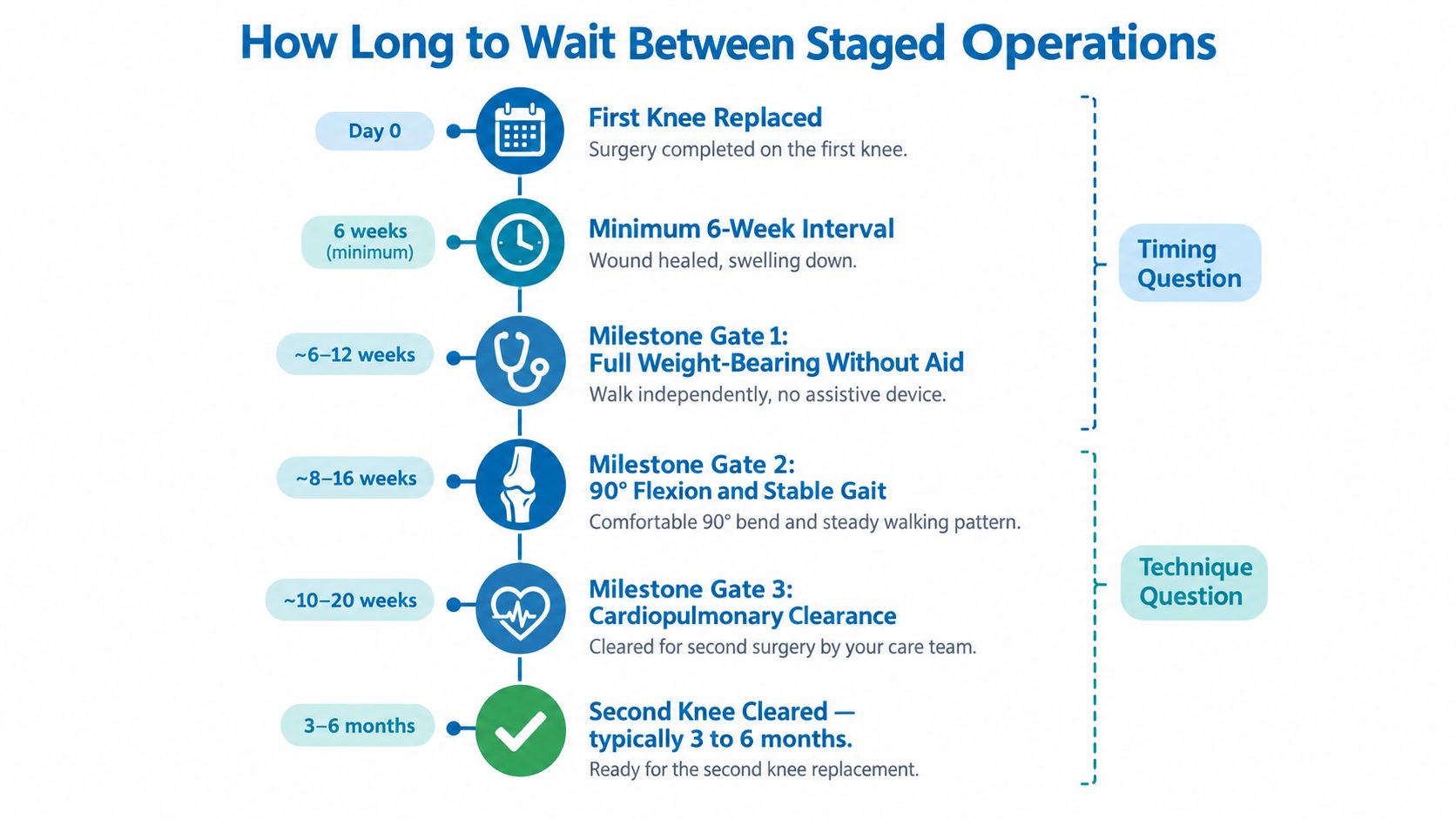
The interval between staged operations is a separate decision from the choice between simultaneous and staged technique. A patient can choose staged surgery without committing to a long delay, but the second knee should be gated by recovery milestones rather than impatience or an arbitrary date.
Evidence summarized in a recent timing analysis found lower mortality risk when the operations were separated by more than six weeks, with intervals of three to six months ranking favorably for one-year mortality and early complications. Another retrospective enhanced-recovery analysis found more complications and longer hospital stays when the second operation occurred within six months, although patient selection and baseline health may have influenced those findings. The timing analysis of staged bilateral knee replacement supports a readiness-based conversation rather than a universal deadline.
The milestones that should gate the second operation
The first knee should be rehabilitated, not merely survived. Before scheduling the second procedure, the clinical team should confirm:
- Wound stability: The incision is closed, dry, and free of drainage or signs of infection.
- Medical recovery: Blood counts are stable or improving, medications have been reviewed, and cardiopulmonary issues are controlled.
- Functional independence: The patient can transfer, walk safely, and manage essential daily activities with an appropriate aid.
- Strength and gait: The first leg can provide dependable support, with improving quadriceps control and a stable walking pattern.
- Therapy participation: The patient can attend and tolerate rehabilitation without being overwhelmed by pain or fatigue.
- Home readiness: Transportation, caregiving, equipment, meals, and assistance with bathing and stairs are arranged again.
Formal scores such as the Knee injury and Osteoarthritis Outcome Score or Oxford Knee Score can help track symptoms and function, but they shouldn't replace clinical judgment. Timed walking and transfer assessments may also help the team judge whether the first knee is contributing useful stability.
A short interval may suit a medically fit patient who regains mobility quickly. A longer interval is more sensible when anemia, weakness, wound concerns, cardiopulmonary disease, or limited home assistance remains. The second operation should happen when the first knee has become an asset, not while it is still the patient's main obstacle.
Recovery and Rehab for Each Approach
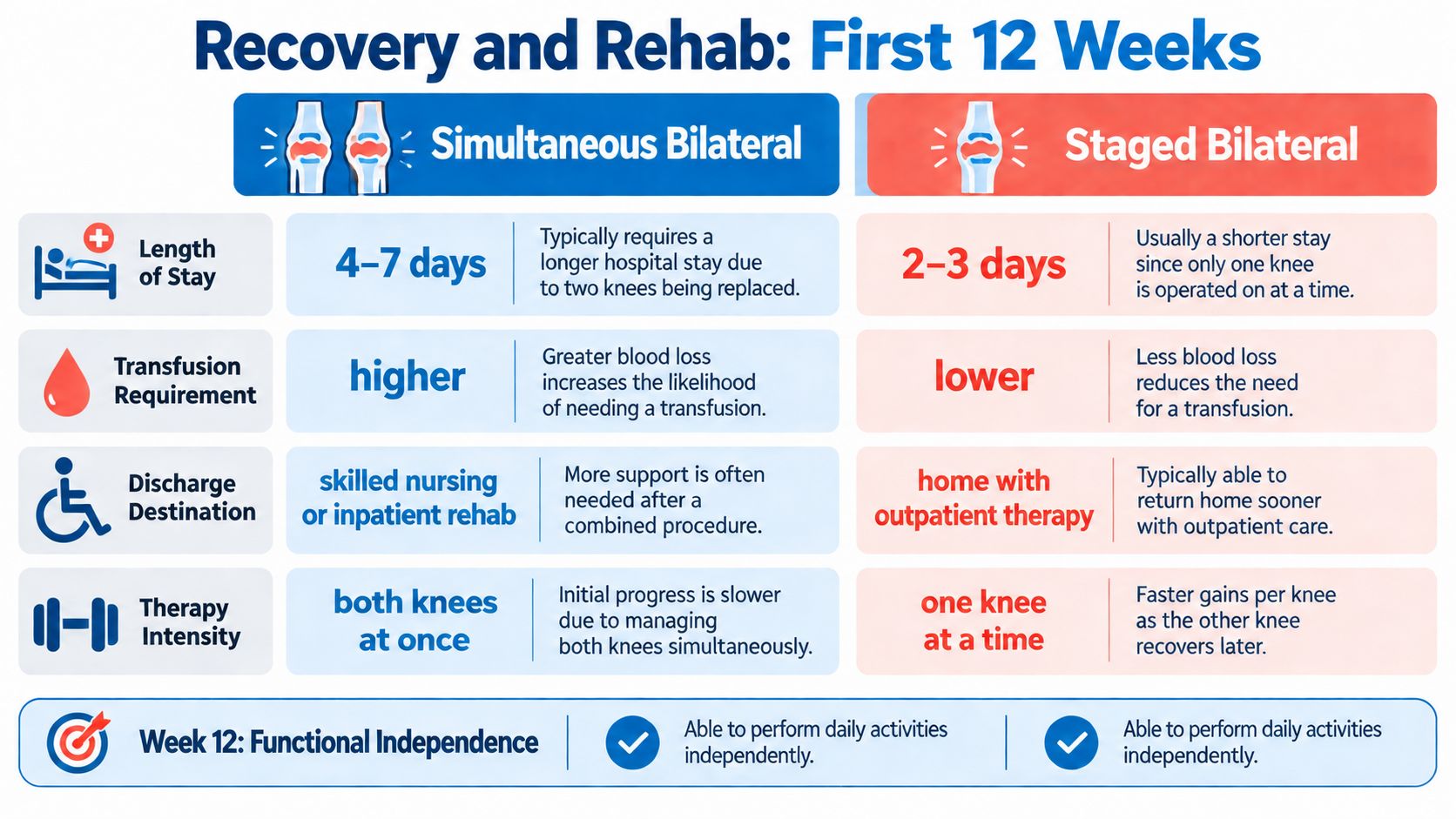
The first twelve weeks follow a different rhythm for each pathway. After simultaneous replacement, both knees need rehabilitation at the same time. The patient may stand with therapy early, but transfers, toileting, stair practice, and getting into bed require careful coordination because neither leg provides normal support.
The hospital course may also demand more planning. Simultaneous surgery can reduce acute-care time in some settings, yet patients may be more likely to need inpatient rehabilitation before going home. Fewer hospital days do not automatically mean an easier recovery. The key question is whether the patient can move safely and manage basic tasks outside the hospital.
The simultaneous pathway
Simultaneous surgery requires one coordinated rehabilitation plan for both knees. Therapy addresses pain control, swelling, transfers, walking progression, and clot prevention together. Progress may feel slow at first because both quadriceps muscles are recovering, and neither knee offers a reliable reference point for balance.
Home discharge must be earned by function, not incision appearance alone. The patient needs clear walking routes, stable chairs, organized medications, and help with meals and basic tasks. Without that setup, inpatient rehabilitation is the safer recommendation.
The staged pathway
Staged surgery creates two separate recovery curves. After the first operation, the untreated leg can often assist with balance, transfers, and short walks. After the second operation, that advantage temporarily disappears, while the first replaced knee should provide a stronger base if rehabilitation has gone well.
The cost is time. Staged treatment means another preoperative assessment, another operation, another period of pain and swelling, and another interruption to work or family duties. The interval should be based on recovery milestones rather than convenience or a preset calendar. The second procedure belongs after the first knee functions as dependable support, not while it remains the main limitation.
Technique choice and timing are separate decisions. A patient may be fit for two operations but not for both knees under one anesthetic, or may prefer simultaneous surgery yet lack the cardiopulmonary reserve and home assistance it demands. Discuss those questions separately with the surgical team.
Patients preparing for any pathway can review broader orthopedic and rehabilitation options through Interventional Pain Management's treatment services. Preoperative strengthening, realistic home planning, and consistent postoperative therapy matter more than forcing recovery to match a printed schedule.
Which Option Fits Your Situation
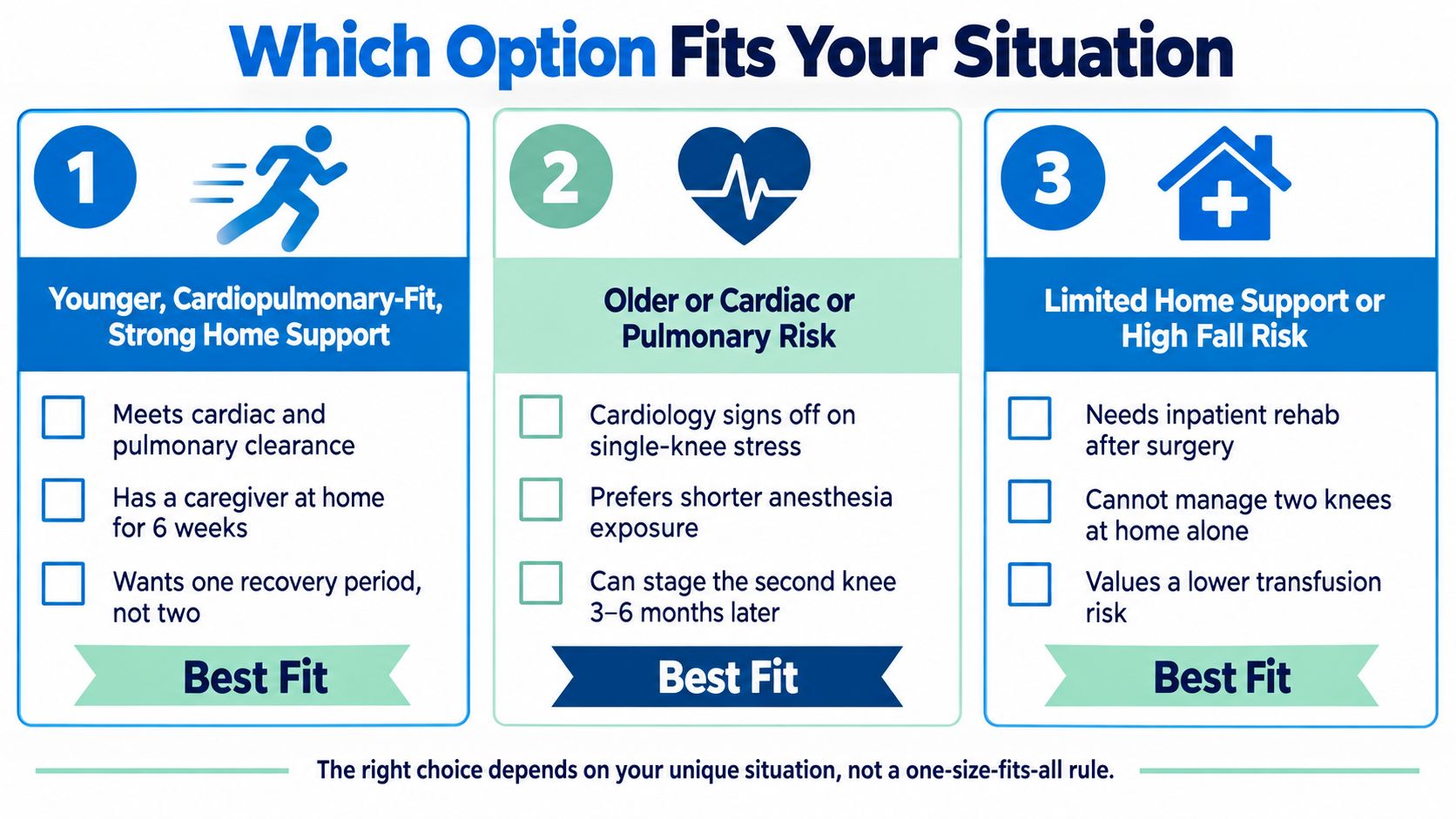
The most defensible recommendation is situational.
A medically fit patient with bilateral mechanical disease, strong conditioning, dependable home support, and a clear reason to consolidate recovery may be considered for simultaneous surgery. Even then, the patient should understand that a single recovery isn't necessarily an easier recovery. The early period can require more assistance, and thromboembolic and cardiopulmonary risks deserve explicit discussion.
An older or frail patient, or anyone with cardiac, pulmonary, renal, anemia, or clotting concerns, should generally default to staged surgery. The same applies to a patient without reliable discharge support. Two operations are burdensome, but dividing the physiologic stress can be the more responsible choice.
A middle group may benefit from staged surgery with a relatively short interval once the first knee meets the required milestones. The timing can be adjusted around wound healing, blood counts, gait, strength, medical clearance, caregiving, work, transportation, and therapy access.
A direct decision framework
- Cardiopulmonary-fit patient with strong support: Simultaneous replacement may be reasonable after specialist clearance and a realistic bilateral rehabilitation plan.
- Patient with meaningful medical risk: Staged replacement is the safer default because recovery can be assessed after the first operation.
- Patient with limited home support or high fall risk: The discharge plan should drive the decision. Simultaneous surgery may be unsuitable if both legs cannot be managed safely at home.
- Patient with anemia or clotting concerns: Medical optimization should come before choosing the surgical format.
- Patient with unequal knee symptoms: Replacing the more limiting knee first may clarify how much disability remains and whether the second operation is still needed.
No patient should arrive at the consultation with a preset preference based only on wanting one recovery. Cardiac clearance, recent laboratory results, medication history, mobility assessment, and a specific home-support plan should determine the recommendation.
Interventional Pain Management evaluates joint and musculoskeletal conditions, coordinates diagnostic review, and offers orthopedic and joint replacement care alongside noninvasive and interventional treatment options. Patients considering bilateral knee replacement can visit Interventional Pain Management to arrange an evaluation focused on medical readiness, surgical planning, and the safest path to restored mobility.