
Many patients can walk within days and return to light activity in 4 to 6 weeks, but meaningful symptom improvement after partial meniscectomy usually takes 3 to 6 months. Return to sport is often reported anywhere from 5 to 15 weeks, depending on age and tear location, so the “back in 3 weeks” promise leaves out a lot of the recovery.
That gap matters because walking well and functioning well are not the same thing. A knee can look fine from the outside while swelling, strength loss, and pain with rotation still limit work, sport, and even long periods of standing.
Table of Contents
- Why Recovery Takes Longer Than Most Sources Suggest
- The First Two Weeks After Surgery
- Week-by-Week Recovery Milestones
- Factors That Speed Up or Slow Down Recovery
- Rehabilitation Exercises and Progression Criteria
- Returning to Work and Sport Safely
- Pain Management and When to Seek Help
Why Recovery Takes Longer Than Most Sources Suggest
The biggest mistake around partial meniscectomy recovery time is treating it like one fixed timeline. The procedure often allows immediate full weight-bearing and full range of motion as tolerated, so patients do get moving quickly, but early movement is only the first stage of recovery, not the finish line. In practical terms, that means a person may leave the surgery center walking, yet still be far from ready for kneeling, lifting, pivoting, or a full work shift.
Practical rule: If a knee can walk but still swells after a normal day, it's not truly recovered for higher-demand activity.
That distinction shows up clearly in the literature. A review notes that return to sport can happen as early as 5 weeks and may take up to 15 weeks, while a cohort of 56 patients with a mean age of 26.7 years returned in a mean of 54 days if they were younger than 30, compared with 89 days in patients 30 or older (meniscectomy recovery review). The age gap makes the point plainly, recovery isn't one number because age, activity demands, and how much meniscal tissue was removed all change the result.
A useful way to think about it is to separate mobility milestones from functional milestones. Mobility comes first, swelling control comes next, then strength, then tolerance for impact and twisting. A patient can be off crutches, back to ordinary walking, and still not be ready for the forces of a job that requires stairs, squatting, or prolonged standing.
For patients trying to interpret online advice, the confusion often starts. Many posts blur the line between “doing well” and “fully recovered,” but those are different targets. For a broader explanation of meniscus injury patterns and when surgery is needed, this overview on a torn meniscus can help anchor expectations: torn meniscus.
A second reason recovery feels slower than advertised is that symptom improvement and activity return don't move at the same pace. Patient-facing advice often emphasizes early walking, but the literature below shows that the body's pain and function scores keep changing long after the incision has healed. That's why recovery should be judged by swelling, strength, mechanics, and tolerance, not by the calendar alone.
The First Two Weeks After Surgery
The first 48 hours are usually about getting the knee calm, not proving anything to anyone. After anesthesia wears off, soreness and swelling are expected, and the main job is to protect the joint, control inflammation, and start gentle motion. Ice, elevation, and short bouts of walking are the usual anchors, while long sitting with the knee hanging down tends to make the leg throb more.
What the knee should feel like
Pain should gradually settle rather than intensify day after day. Swelling commonly fluctuates in this phase, especially if the patient spends too much time on the feet or ramps activity too fast. A little stiffness is normal, but a hot, increasingly red knee, fever, or severe calf pain needs prompt medical attention.
The first week is about quiet motion, not athletic effort.
The most important exercise early on is quadriceps activation. Straightening the knee fully and learning to “wake up” the thigh muscle early helps prevent the quad from shutting down, which is one of the biggest reasons people feel weak for longer than they expected. That reactivation starts almost immediately, usually with simple contractions, ankle pumps, and short walks around the house.
Wound care matters too. The incisions must stay clean and dry until the surgeon says showering is safe, and that timing depends on the closure method and how the skin is healing. Patients often feel better by the end of the first week and then make the mistake of doing too much, which can bring swelling right back.
A good checkpoint by day 10 to 14 is simple. The knee should be moving more smoothly, pain should be trending down, and crutch use should be decreasing if the surgeon has allowed it. If the knee is locking, swelling is escalating, or walking is getting worse instead of better, that's a reason to call the care team instead of waiting it out.
Week-by-Week Recovery Milestones
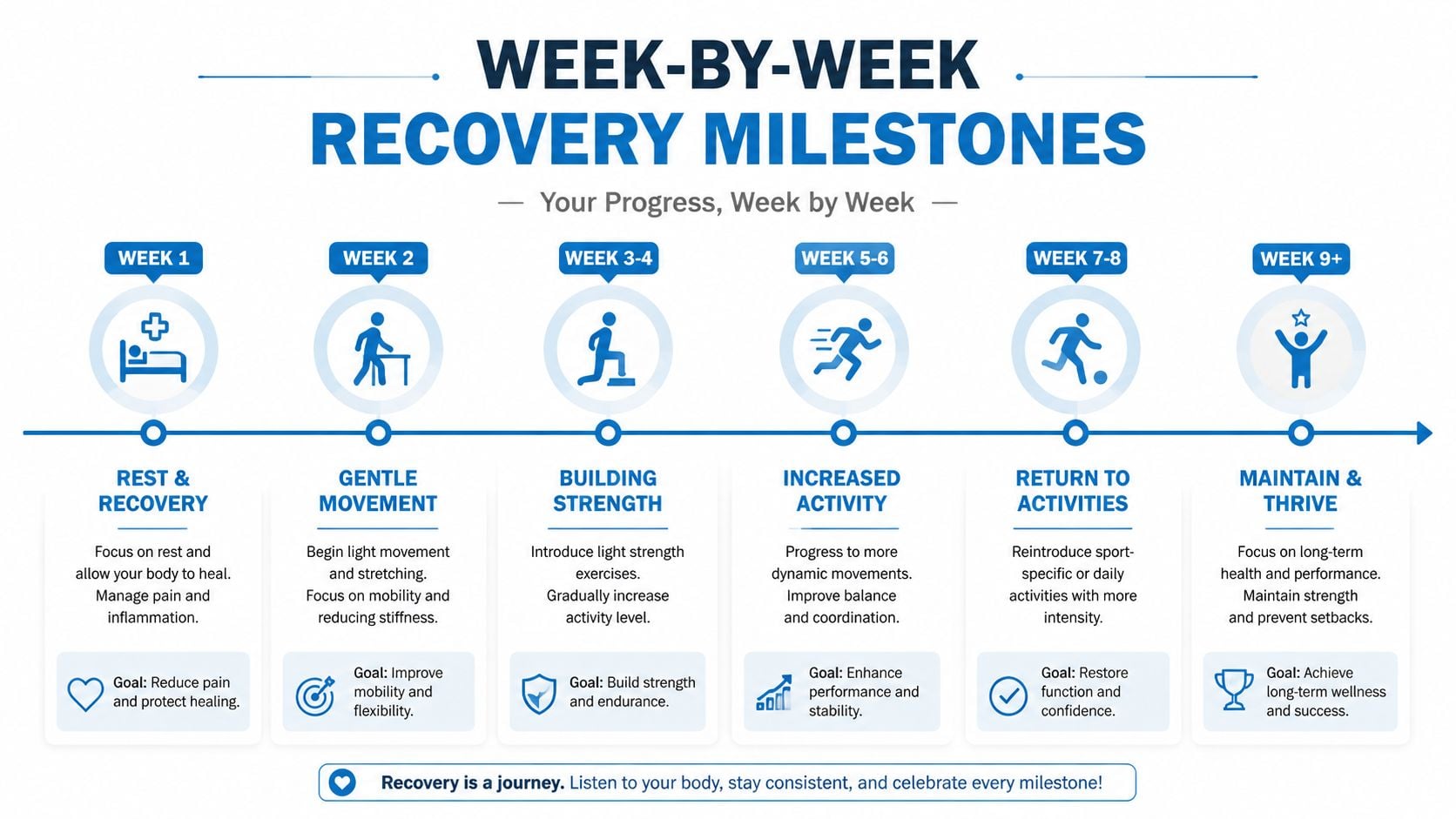
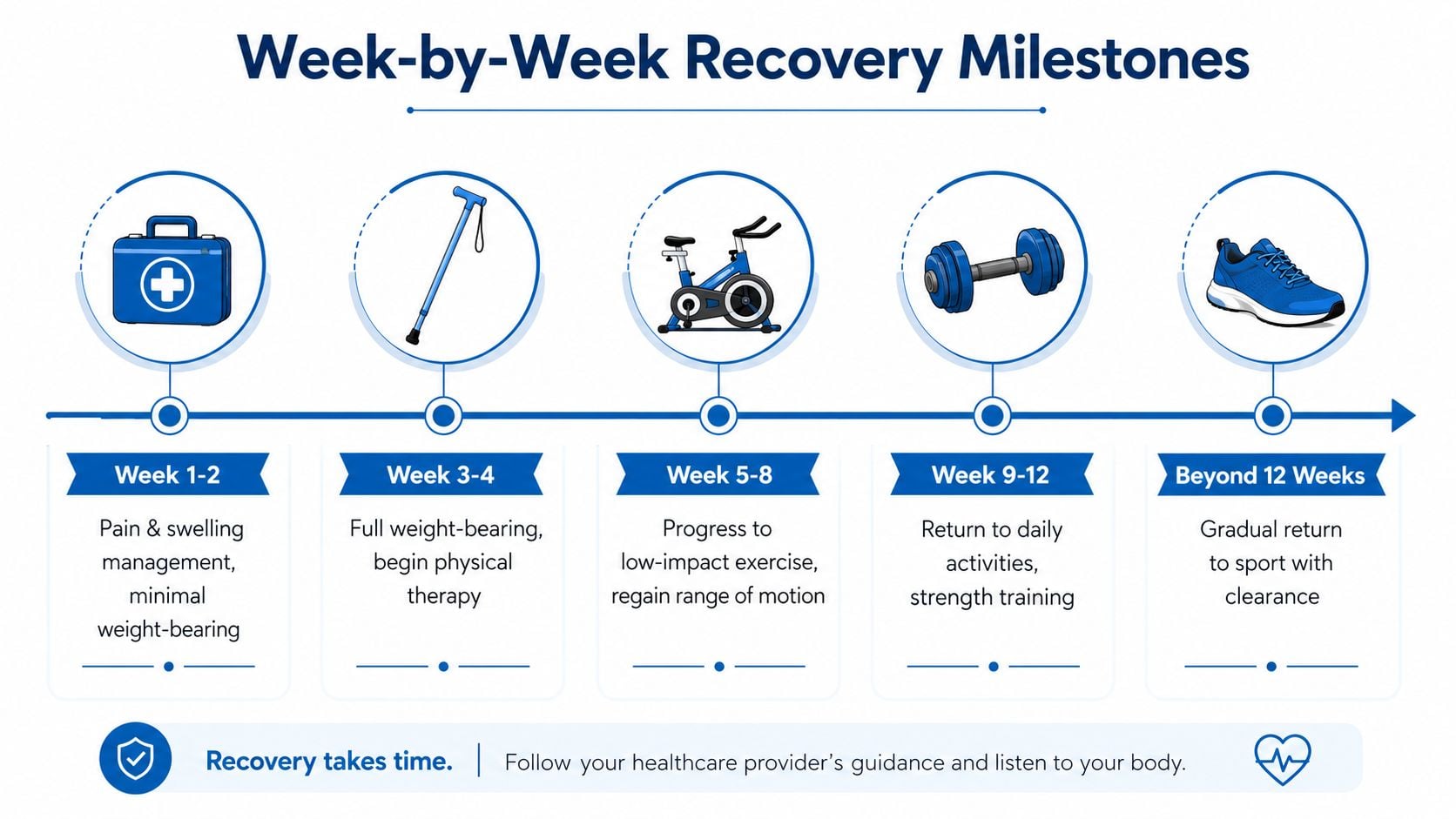
A helpful recovery map starts with the first two weeks, when the job is mostly swelling control, protected walking, and regaining extension. Many patients can move around the house independently by this point, but that doesn't mean the knee is ready for long drives, long shifts, or workouts. The incision may look good before the joint feels good.
Weeks 1 to 2
This phase is usually about basic function. Patients often transition away from crutches as gait improves, but only if the knee can accept weight without a pronounced limp. Desk work may be possible for some people, while jobs that require standing, climbing, or kneeling usually need more time.
Weeks 3 to 6
The gap between “better” and “recovered” becomes obvious at this stage. Light strengthening, balance work, and low-impact conditioning usually start to matter more than simple walking, and symptoms should keep trending downward. Some patients resume driving and return to sitting-based work in this window if pain control and reaction time are adequate.
Weeks 6 to 12 and beyond
The knee should be tolerating longer walks, more dynamic strengthening, and controlled impact progression before any serious sport-specific work. This is also when many people realize that swelling still appears after a heavy day, even though daily life feels mostly normal. That's common, and it's one reason clinicians avoid clearing high-torque activity too early.
The most useful way to frame these milestones is through examples rather than fixed dates. A younger recreational runner with a small medial tear will often progress faster than a patient with more swelling, more tissue removed, or a job that demands kneeling all day. For a broader discussion of how surgery fits into the overall picture of knee degeneration and long-term joint health, see osteoarthritis considerations.
Factors That Speed Up or Slow Down Recovery
Age is one of the clearest separators in the outcome data. In athletes treated with partial meniscectomy, return to play was reported at about 5 weeks for medial meniscectomy and about 7 weeks for lateral meniscectomy, with the same series showing more postoperative pain and swelling in the lateral group, plus occasional revision arthroscopy (athlete outcomes after partial meniscectomy). That difference matters because lateral compartment symptoms tend to interfere more with cutting, pivoting, and running tolerance.
Recovery factors and their impact
| Factor | Faster Recovery | Slower Recovery |
|---|---|---|
| Age | Younger patients | Older patients |
| Tear location | Medial compartment, less swelling | Lateral compartment, more swelling |
| Tissue removed | Smaller resection | Larger resection |
| Activity demands | Desk-based or light duties | Kneeling, lifting, pivoting |
| Knee response | Effusion settles quickly | Persistent swelling or pain |
| Pre-op condition | Strong quads, good motion | Weakness, stiffness, cartilage wear |
The amount of tissue removed also matters because less meniscus means less shock absorption. That doesn't guarantee a poor result, but it can make the knee less forgiving under load. Pre-existing cartilage wear or arthritis can slow symptom relief too, because the torn meniscus isn't always the only pain generator in the joint.
Workload is another major variable. A desk worker can often return sooner than someone whose job includes repeated squatting, ladder use, or carrying loads on uneven ground. The same surgery can therefore mean very different timelines depending on what the knee has to tolerate after discharge.
The thing patients can influence most is rehab quality. Consistent swelling control, strengthening, and gradual loading help the knee adapt. Skipping rehab, pushing through limping, or trying to prove readiness with a sudden return to sport usually backfires.
A deeper point often gets missed in office discussions. Recovery is not only about the meniscus itself, it's about how the whole knee behaves after surgery, including quadriceps inhibition, altered gait, and sensitivity to impact. That's why a careful plan beats wishful thinking every time.
Rehabilitation Exercises and Progression Criteria
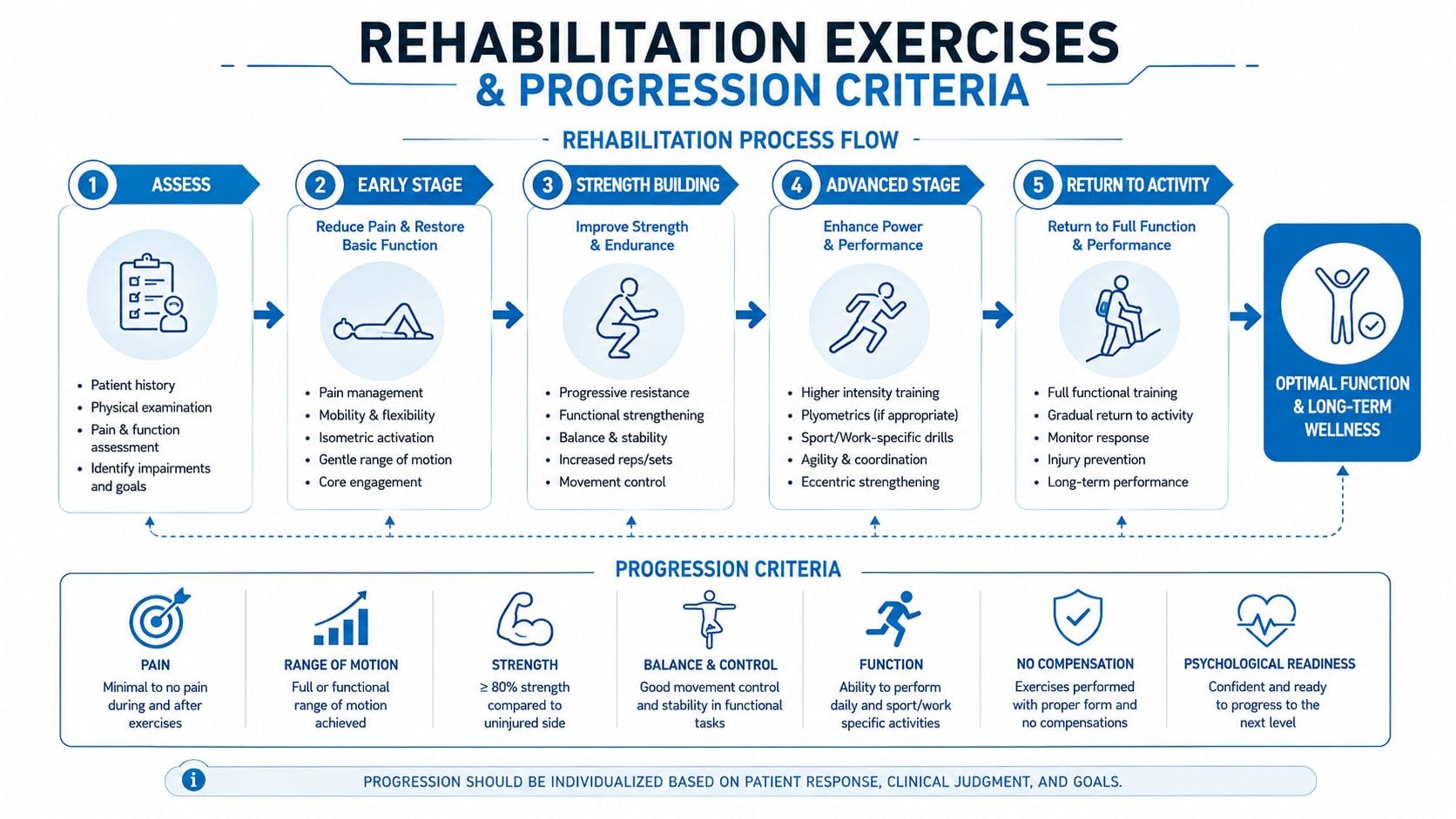
The best rehab plan after partial meniscectomy is not the most aggressive one. It's the one that matches the knee's current capacity, then progresses only when swelling, motion, and strength say it's ready. A patient can do “more” and still recover worse if the knee keeps reacting with pain and effusion.
The sequence that usually works
- Range of motion first. Full extension is the early priority, because a knee that won't straighten well tends to walk poorly and fatigue quickly.
- Quadriceps reactivation next. The thigh has to “turn on” again before stairs, squats, or running make sense.
- Balance and proprioception. Single-leg control matters because the knee must trust the leg before it can handle uneven surfaces or directional change.
- Strength progression. Closed-chain exercises, then more demanding loading, should come only when swelling stays quiet.
- Sport-specific drills. Cutting, pivoting, and hopping are last, not early tests of bravery.
Progression should be symptom-guided, not calendar-driven.
That principle keeps setbacks down. If the knee swells after a session, or if soreness lingers into the next day, the load was probably too much. The goal is to finish rehab sessions feeling challenged, not inflamed.
A useful resource for patients who want to understand recovery-support ideas is research peptides for recovery, but any adjunct should be discussed with the treating surgeon before use. The essentials remain the basics: motion, strength, sleep, nutrition, and adherence to the plan.
Before higher-level drills start, the knee should tolerate everyday life without a limp. If stairs still trigger swelling or the quadriceps won't support controlled single-leg work, running is premature. That conservative approach protects the joint and reduces the stop-start pattern that frustrates so many patients.
Returning to Work and Sport Safely
Work and sport need different clearance standards, even though patients often ask about them in the same breath. A desk job asks for sitting tolerance and basic mobility, while a warehouse, construction, or nursing role asks the knee to handle standing, lifting, stairs, kneeling, and sudden direction changes. Those are not the same recovery goals.
For sedentary work, many patients return relatively early if pain is controlled and commuting is manageable. For jobs that require prolonged standing or walking, the knee usually needs a more stable gait and less swelling before a full shift feels realistic. For physically demanding work, the issue is not just pain, it's whether the knee can tolerate repeated load without flaring later in the day.
Sport demands a stricter standard. Straight-line running comes before agility, and agility comes before full contact or competition. The knee should show no meaningful swelling after the earlier drills, the quadriceps should be back online, and single-leg mechanics should look controlled before pivoting or cutting is introduced.
A broad note on expectations is helpful here. One review of partial meniscectomy recovery found that return to activity can average 3.3 months in a nonathlete cohort, with a wide range from 1 week to 1.5 years, while another study reported median return-to-work time of 4.8 months and 79% of patients back by 6 months (return-to-activity and return-to-work discussion). Those numbers show why “back to work in days” can be misleading when the job is physical or the knee remains reactive.
Psychological readiness matters too. Many patients are physically able to jog before they trust the knee during faster direction changes or contact. That hesitation isn't weakness, it's part of safe return, because confidence often lags behind strength.
Pain Management and When to Seek Help
Some pain during rehab is normal, especially after increased activity or a physical therapy session. The goal is not zero discomfort, it's steady improvement with pain that settles as swelling comes down. Ice, elevation, prescribed medication, and activity modification are the usual tools, and they work best when the patient respects the knee's limits instead of testing them daily.
A practical pain plan also includes knowing what is not normal. Rapidly worsening swelling, redness, fever, calf pain, shortness of breath, new locking, or a sudden loss of motion should prompt immediate contact with the surgical team. For a fuller overview of supportive care, the office guidance at pain management is a useful reference.
Follow-up visits usually focus on incision healing, gait, swelling, and progression of rehab. That's the right time to ask whether the current activity level is helping or provoking the knee. Good recovery is monitored, not guessed.
Interventional Pain Management offers coordinated orthopedic and pain-focused care for patients recovering from knee surgery, including partial meniscectomy recovery time questions that need a realistic, individualized plan. If the knee is still swollen, painful, or holding back work and activity, visit Interventional Pain Management to review options and get a recovery strategy that fits real life.