
You wake up from hip arthroscopy with two questions that usually crowd out everything else. How much should this hurt, and when will walking, sitting, and exercise feel normal again? That's the right way to think about recovery, because it doesn't move on one clock. Pain, physical function, and return to activity all recover at different speeds, and a good plan respects those differences instead of forcing them into one date on the calendar.
Table of Contents
- What Hip Arthroscopy Recovery Really Looks Like
- Preparing Before Surgery and the First Two Weeks
- Weeks 0 to 6 Milestones and Early PT Exercises
- Weeks 6 to 12 and the 3 to 6 Month Transition
- Return to Sport and What the Numbers Show
- When Lingering Pain Is Not Just Healing
- Red Flags, Follow-Up, and Local Logistics
What Hip Arthroscopy Recovery Really Looks Like
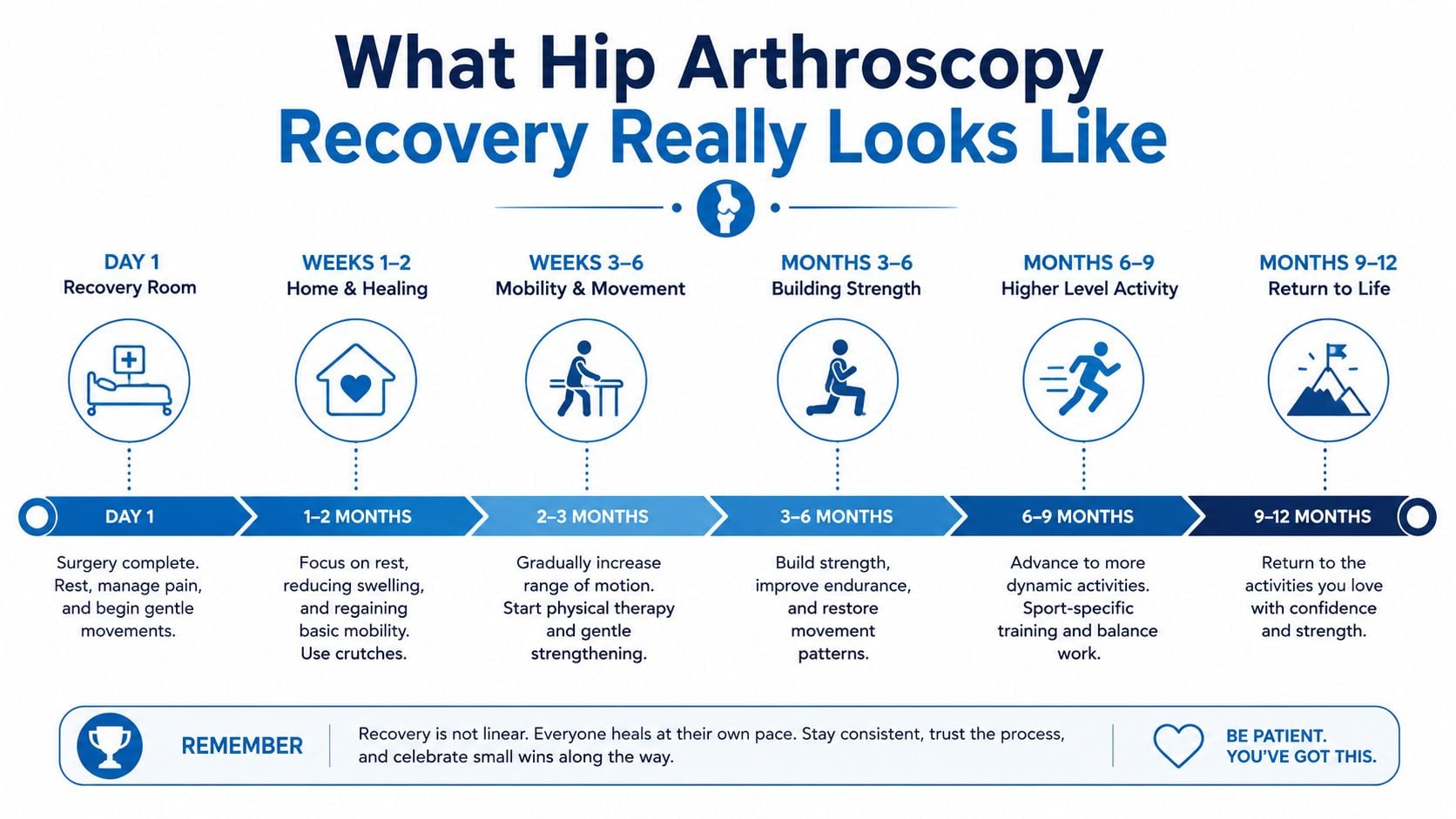
A patient often sits upright in the recovery room thinking the hardest part is over. The work starts later, when the hip feels swollen, the crutches are awkward, and the calendar on the wall suddenly matters more than the surgery itself. That first day is where expectations matter most, because hip arthroscopy recovery is not one countdown, it's several parallel recoveries happening at once.
Three timelines, not one
Pain often improves first, then everyday function catches up, and sport or heavy loading comes last. That pattern shows up clearly in a 2025 recovery-trajectory study of 92 patients, where the estimated time to 50% recovery was 6.7 weeks for pain interference, 11.0 weeks for physical function, and 18.5 weeks for activity level, with full recovery estimated at 17.0 weeks for physical function, 37.4 weeks for pain, and 28.8 weeks for activity (PubMed). Pain scores declined at 0.22 points per week and plateaued by 12 weeks in that study (PubMed).
That is why clinic handouts sometimes disagree. One handout may mean walking without crutches, another may mean returning to desk work, and a third may mean playing sport without symptoms. Those are not the same milestone, and patients do better when they know which one they're chasing.
Practical rule: if the outside looks healed but the hip still hates load, the internal healing timeline is usually still doing its job.
A clearer roadmap
The recovery arc usually makes more sense when it's divided into four blocks. The first block is protection and pain control, the second is restoring motion and gait, the third is rebuilding strength, and the fourth is return to activity or sport. A useful primer on labral injury mechanics can also help patients understand why this surgery needs patience, especially when the repair involves the labrum and surrounding hip structures, as discussed in this labral tear overview.
Families often need help in the first week, not because the surgery is complicated to explain, but because simple tasks become annoying fast. For patients who need extra support at home, carevo's home recovery services are the kind of practical resource that can reduce avoidable stress during that early transition.
Preparing Before Surgery and the First Two Weeks
The best recovery starts before the operation. A home that is set up for the first week saves more pain than any motivational speech, because patients make dozens of small decisions early on, and each one either protects the hip or irritates it. The goal is simple, reduce friction before it starts.
Set up the house before the day of surgery
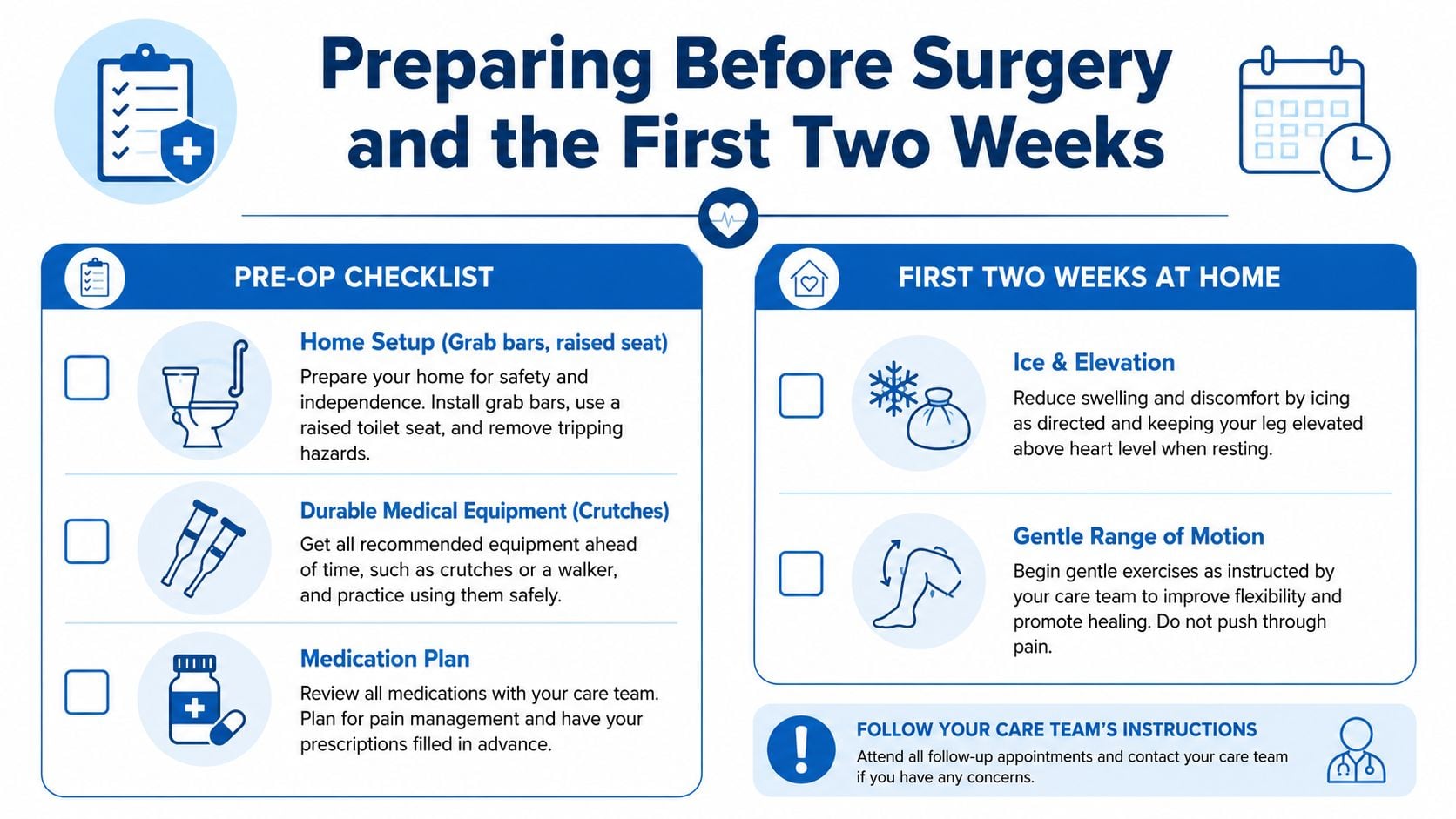
A patient should arrange the basics before arriving home. That means a clear path from bed to bathroom, a stable chair with arms, a raised seat if sitting to stand is difficult, and whatever durable medical equipment the surgeon prescribes. Transportation also needs to be planned in advance, because the first few days are not the time to discover that a ride is unavailable.
Medication planning matters too. Prescribed pain medication should be picked up early, ice should already be in the freezer, and meals should be easy to heat without standing for long periods. A one-week plan for food, hydration, and rest cuts down on the temptation to “just push through” when fatigue sets in.
What the first fourteen days usually require
Wound care is straightforward, but it has to be done consistently. Dressings should stay clean and dry unless the surgeon gives different instructions, and incision changes like spreading redness, drainage, or worsening warmth deserve a call rather than a guess. Crutches need to be fitted properly, because poor height settings create shoulder and wrist pain that distract from hip rehab.
Weight-bearing rules depend on the exact procedure, so the surgeon's instructions beat any generic timeline. Sleeping positions matter too, since twisting through the pelvis at night can undo an otherwise calm day. Gentle ankle pumps, short walks as allowed, ice, elevation, and the prescribed medication plan usually work together better than relying on medication alone.
Hip recovery is often won or lost in the first two weeks, not because the hip is fragile forever, but because patients either respect the repair or keep testing it too early.
A brief note on related hip pathology is useful here, especially when groin pain predated surgery or tendon irritation coexisted with the labral problem. The rehabilitation logic changes when inflammation extends beyond the joint, which is why the broader context in tendinitis and bursitis care can matter during recovery.
Weeks 0 to 6 Milestones and Early PT Exercises
The first six weeks are about restoring motion without provoking the repair. Patients often feel impatient here because pain is already better, but the tissue inside the joint is still adapting to controlled stress. That mismatch, feeling better than the hip is ready to do, is where many setbacks start.
Early PT is movement with rules
Physical therapy in this phase usually emphasizes gentle range of motion, gait retraining, and muscle activation without forceful loading. Common early exercises include heel slides, stationary biking with no resistance, isometric glute and quadriceps sets, prone hip extensions, and controlled aquatic walking once the incisions are sealed. Manual therapy may be used to reduce guarding and restore motion, but it should support the plan, not replace it.
A focused glute program matters here because weak lateral hip muscles make every later phase harder. For patients who want a cleaner breakdown of that muscle group's role in hip control, the gluteus medius workout guide is a practical companion piece, especially when the therapist is building single-leg stability.
Clinical shortcut: if an exercise changes the gait for the rest of the day, it was probably too much for week 2, even if it looked easy in the clinic.
What unlocks the next phase
| Milestone | Target Window | Unlock Criteria |
|---|---|---|
| Incisions closed and dry | Early days to 2 weeks | No drainage, no increasing redness |
| Smooth walking with the prescribed aid | 2 to 4 weeks | Minimal limp, controlled weight bearing |
| Early hip motion without flare-up | 2 to 6 weeks | No rebound pain the next day |
| Crutch weaning | Often during weeks 2 to 6 | Surgeon approval, stable gait, safe load tolerance |
| Light bike or pool work | During weeks 2 to 6 | Wounds sealed, motion tolerated |
Sitting and hip flexion limits vary by procedure, but the principle stays the same. A deep seated position creates more compression and can irritate the repair, so short, frequent bouts of sitting usually work better than long stretches. Follow-up visits and imaging are used to confirm that symptoms are tracking in the expected direction, not to chase every ache.
Weeks 6 to 12 and the 3 to 6 Month Transition
This is the phase where the hip starts to behave better in daily life, but the body can still be behind the calendar. Patients often feel good enough to take on more, which is exactly why this stage needs structure. The stronger the hip feels, the easier it is to overdo closed-chain work, longer walks, or gym sessions that look harmless but trigger swelling later.
Strength returns before sport does
PT usually shifts toward mini squats, step-ups, hip-focused core work, progressive resistance on the bike, elliptical introduction, and controlled single-leg balance training. The goal is not intensity for its own sake, it's clean force transfer through the pelvis, trunk, and leg. A hip that can balance well and resist collapse under body weight is usually better prepared for the next block than one that just tolerates more reps.
Driving and desk work belong in this conversation because they're often the first “normal life” goals people try to reclaim. Driving is typically considered when reaction time is adequate, weight-bearing status is stable, and the operated side can handle the mechanics of braking or gas control without a protective limp. Desk work usually comes back earlier than labor-intensive work, but long sitting still needs breaks so the hip doesn't stiffen for hours.
The 3 to 6 month transition
Running, lifting, and sport drills should begin by criteria, not by date alone. A patient who can't walk briskly without compensation is not ready for impact work just because the calendar says 3 months. Conversely, a patient with excellent strength, motion, and symptom control may progress faster than someone whose hip remains irritable at rest.
The middle months reward discipline more than enthusiasm. That's the stage where consistent rehab beats occasional “big” workouts every time.
For patients with sedentary jobs or heavier physical work, load management matters. Desk workers often need position changes, while those with standing or lifting demands may need a staged return that respects fatigue, trunk control, and the ability to pivot without pain. The point is not to delay life, it's to keep one hard day from turning into three weeks of inflammation.
Return to Sport and What the Numbers Show
Sport is where expectations need the most honesty. Many patients feel ready to jog or train lightly long before they are ready to compete, and those are different goals. A controlled return usually goes better than a rushed one, especially when cutting, rotation, and deceleration are part of the sport.
What the published data says
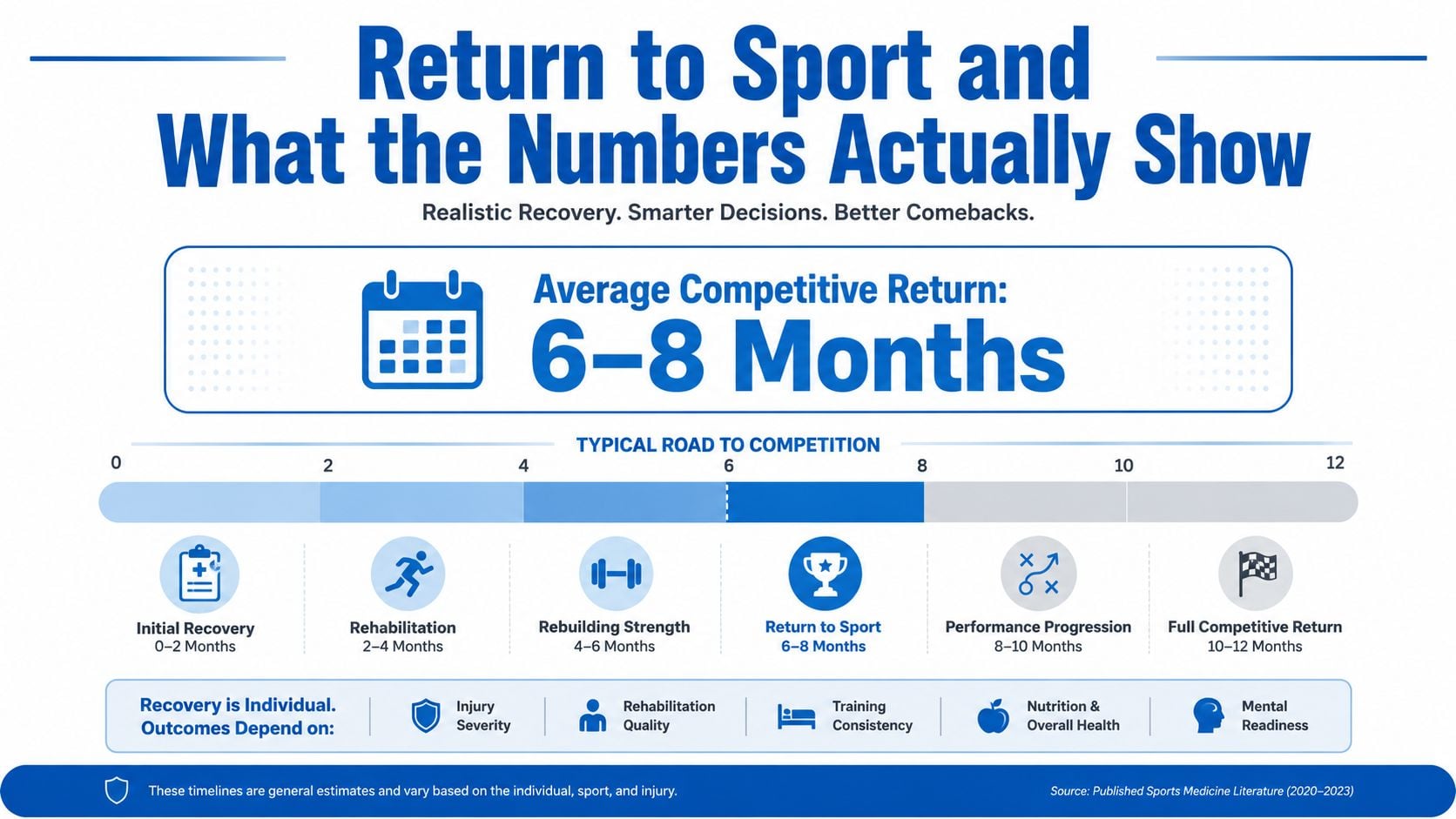
A practical benchmark from clinical guidance is that running often begins around 3 months and competitive sport return is usually 6 to 8 months, while full symptom benefit can take 10 to 12 months or longer in some patients. In one outcomes analysis, the average time to postoperative success was under 6 months, and overall clinical success was 81.1% at a minimum 2-year follow-up. That same guidance notes that return to prior sport performance was about 70%, which is a useful reminder that symptom relief and preinjury performance are not identical outcomes.
The first year deserves caution because recovery and durability are not the same thing. Patients can be improving, yet still be exposed to overload if they resume sprinting, pivoting, or heavy lifting before the hip tolerates those demands. One timeline summary for athletes returning after a serious injury also helps frame the pace of progression as staged rather than immediate. A timeline graphic showing the typical recovery phases for athletes returning to competition after a serious injury.
Longer-term follow-up still paints a favorable but not perfect picture. In one long-term femoroacetabular impingement study, mean modified Harris Hip Score improved from 62.0 to 83.6, pain on a visual analog scale improved from 7.7 to 3.1, 83.1% of patients achieved the minimum clinically important difference, and return-to-sport and return-to-work rates were 96.2% and 96.9% respectively (PubMed). The same body of literature also reports that some patients still need further treatment, which is why I counsel athletes to judge recovery by function, symptoms, and repeatability of movement, not by a single good workout.
That tension matters. Recovery is often favorable, but the first year still carries a real risk of failure or revision, especially in broader real-world populations. Another large dataset reported an 18% overall failure rate after hip arthroscopy, with 8% revision arthroscopy and 10% conversion to THA at minimum 1-year follow-up (PMC). At 12 years, one cohort still showed 55% PASS achievement, 5% revision arthroscopy, and 9% THA conversion (PMC).
If pain is still limiting stride length, hip rotation, or single-leg control, it is too early to chase performance. If the joint stays calm and strength keeps improving, the next step is usually to layer in load gradually, then test sport-specific demands before competition. When the hip stays irritable despite a sensible rehab plan, some clinicians will also consider whether a targeted intervention such as hip injection options for persistent joint irritation has a role in the overall pain plan.
When Lingering Pain Is Not Just Healing
Pain that lingers for months is not automatically a failure, but it also shouldn't be waved away. The danger is assuming all postoperative pain is identical. It isn't. Some pain is healing pain, some is stiffness, some is tendon irritation, and some is a clue that the hip needs another look.
How normal healing usually behaves
Normal recovery discomfort tends to settle gradually, not bounce unpredictably. It may flare after a long day, after sitting too long, or after a new exercise, then calm with rest, ice, and load reduction. That pattern is different from pain that gets more reactive over time or starts to limit motion that had already come back.
Persistent pain can last longer than many patients expect. Hopkins notes that hip pain on the operated side may take 3 to 6 months to significantly diminish or disappear, which is a useful correction to the common marketing promise of a quick recovery (Hopkins Medicine). That timeline doesn't mean every ache is normal, it means the hip can still be healing while the surface symptoms come and go.
When to re-evaluate instead of waiting
Mechanical catching, swelling that returns, loss of motion that had previously improved, night pain that keeps disrupting sleep, or pain that keeps worsening despite appropriate rehab all deserve clinical review. Those patterns can suggest stiffness, overuse, tendon irritation, or a structural problem that needs diagnostic reassessment. The point is not self-diagnosis at home, it's knowing when the pattern has changed enough to call.
If symptoms persist beyond expected healing, the workup may include repeat exam, imaging review, and targeted interventions such as intra-articular injections or nerve blocks when appropriate. That broader approach helps separate joint-driven pain from surrounding soft-tissue pain, which matters when the original surgery was technically successful but the recovery is still stalled. A structured discussion of injection-based options is also relevant in the context of hyaluronic acid injections when symptoms point toward persistent joint irritation rather than simple soreness.
If pain is predictable, improving, and linked to load, it usually belongs to rehab. If it's becoming more random, more mechanical, or more disruptive at rest, it deserves reassessment.
Red Flags, Follow-Up, and Local Logistics
Certain symptoms should never be treated as routine recovery. Fever, calf swelling, sudden loss of motion, drainage from the incision, worsening pain despite medication, and new numbness all need prompt attention. If the incision is draining or the calf is swollen, the office should be called quickly, and chest symptoms or severe systemic illness should push the patient toward urgent evaluation rather than waiting for the next appointment.
How to escalate concerns
The safest approach is simple. Call the office for incision concerns, increasing pain, or motion loss that is clearly worse than the day before. Seek urgent care when symptoms look significant but not unstable. Use the emergency department for chest pain, shortness of breath, severe calf swelling, major neurologic change, or any symptom that feels dangerous rather than merely uncomfortable.
Logistics matter more than most patients expect
Follow-up care works best when the scheduling process is smooth, physical therapy referrals are coordinated early, and transportation is not left until the morning of the visit. Insurance questions should be handled before frustration builds, especially for workers' compensation or motor vehicle accident cases where documentation matters. Patients also benefit from knowing whether fee estimates are available under the New Jersey Out-of-Network Law, because financial clarity reduces the chance of delayed care.
A realistic year-long view helps here. The hip may feel “fine enough” long before it is fully conditioned for repeated impact, rotation, or long workdays, so staying consistent through the slower middle months is what usually separates a good outcome from a frustrating one. Recovery is less about hoping the hip behaves and more about giving it the load, time, and triage it needs.
If hip pain, lingering stiffness, or a stalled recovery has made the next step feel unclear, Interventional Pain Management can help with diagnostic review, coordinated treatment, and practical follow-up for joint and post-surgical pain. Visit Interventional Pain Management to discuss hip arthroscopy recovery with a team that understands when to keep rehab moving and when symptoms deserve a closer look.