
Uninsured varicose vein treatment in the United States can cost roughly $400 to $13,000 per procedure. The three biggest swing factors are the technique chosen, disease severity, and facility setting.
That range isn't marketing exaggeration. It reflects the difference between a cosmetic sclerotherapy visit and a medically necessary procedure performed in a hospital outpatient department. A patient asking, “How much does varicose vein treatment cost?” needs more than a single advertised price. The useful answer is a price framework that separates the treatment itself from facility charges, imaging, anesthesia, follow-up, and insurance responsibility.
For New Jersey patients, the out-of-network question matters just as much as the procedure name. A quote can look reasonable until the facility applies a separate charge or the insurer processes the physician and facility under different benefit rules. The safest approach is to compare complete treatment episodes, not headline prices.
Table of Contents
- What Varicose Vein Treatment Costs in 2026
- Cost of the Most Common Vein Procedures
- Why Full Episode Costs Tell a Different Story
- How Facility Fees and Site of Service Change the Bill
- Factors That Push Your Quote Up or Down
- Insurance, Medicare, and Workers' Comp Coverage
- How to Question and Negotiate Your Final Price
- Key Numbers to Remember and Quick Answers
What Varicose Vein Treatment Costs in 2026
The national uninsured range is about $400 to $13,000 per procedure, based on this U.S. varicose vein treatment cost roundup. The lower end usually reflects cosmetic or less invasive care. The upper end reflects premium technology, complex disease, or a more expensive treatment setting. For a New Jersey self-pay patient, that range is a screening tool, not a final quote.
Start with four questions:
- Which technique is appropriate?
- How extensive is the venous disease?
- Where will the procedure take place?
- What amount will the insurer allow or cover?
A treatment plan may involve one procedure, staged care on separate legs, or additional work on visible tributary veins. Ask whether the quote includes ultrasound imaging, facility charges, anesthesia, compression garments, and follow-up. In New Jersey, an out-of-network physician and facility can bill under different benefit rules. A lower professional fee can still produce the larger total bill.
Four anchors for judging a quote
National averages provide the first check. The cited U.S. roundup estimates $428 for spider-vein sclerotherapy, $1,274 for varicose-vein ligation, and $3,131 for endovenous ablation. Use those figures to question a quote that sits far outside the range, then request an itemized episode estimate.
Episode-cost research adds a stronger comparison than a procedure-only price. A 2015 health-economics study reported mean total treatment costs of $1,827 for endovenous laser ablation, $2,106 for radiofrequency ablation, $2,165 for polidocanol injectable foam, $2,374 for surgery, and $2,844 for multimodality care in its analyzed setting. The study is available through AHDB's chronic venous disease cost analysis.
Site-of-service benchmarks explain major bill differences. Medicare data cited in this site-of-service cost discussion places endovenous ablation at about $1,814 in an ambulatory surgical center versus $3,303 in a hospital outpatient department.
For insured New Jersey patients, the final responsibility depends on the deductible, coinsurance, prior authorization, network status, and facility participation. Get those details in writing before scheduling.
Cost of the Most Common Vein Procedures
Procedure choice creates the largest visible difference in price. Cosmetic sclerotherapy treats smaller surface veins and is often priced by session. Thermal ablation treats a refluxing source vein and generally carries a larger single-procedure charge. Phlebectomy removes bulging surface veins through tiny skin openings, while adhesive closure uses a premium technology that can sit near the top of the national range.
The figures below use the available U.S. benchmarks. Ranges are practical interpretations of the cited national pricing categories, not guarantees for a specific New Jersey practice.
| Procedure | National Average | Typical Session/Leg | Likely Coverage |
|---|---|---|---|
| Sclerotherapy for spider veins | $428 average | Often a treatment series | Usually cosmetic when treating spider veins alone |
| Endovenous laser ablation | $3,131 average | Commonly one treated vein or leg at a time | Often medically necessary when symptoms and reflux are documented |
| Radiofrequency ablation | $3,000 to $5,000 | Commonly one treated vein or leg at a time | Often medically necessary when clinical criteria are met |
| Ambulatory phlebectomy | $2,000 to $4,000 | Often organized by leg or treatment area | May be covered for symptomatic bulging veins |
| VenaSeal | $5,000 to $13,000 | Usually a one-time source-vein procedure | Coverage varies and may require specific authorization |
| Ligation of varicose veins | $1,274 average | Generally a surgical episode | May be medically necessary, depending on the diagnosis |
| Traditional stripping | $2,374 mean treatment cost in the cost study | Usually a surgical episode | Coverage depends on medical necessity and plan rules |
The national source reports laser ablation commonly at $1,000 to $3,000, radiofrequency ablation at $3,000 to $5,000, ambulatory phlebectomy at $2,000 to $4,000, and VenaSeal at $5,000 to $13,000. Those categories explain why a premium adhesive quote can produce sticker shock even when the treatment plan involves only one procedure.
A low session price isn't automatically a low total price. Small-vein treatment can require repeated visits, while ablation and phlebectomy may address a larger problem in fewer planned procedures. Patients comparing techniques should first confirm which vein is being treated and whether the recommendation is cosmetic or medical. A vein treatment and spider-vein overview can help patients understand that distinction before comparing quotes.
Why Full Episode Costs Tell a Different Story
A procedure price covers only one part of the bill. For a fair comparison, price the full episode cost, including evaluation, imaging, facility use, supplies, follow-up, and treatment required by the diagnosis. In New Jersey, an out-of-network quote can separate these charges, so ask for the complete patient responsibility before choosing a technique.
The 2015 episode-cost study cited earlier shows why procedure comparisons should not rely on one office charge. Its broader lesson is practical: minimally invasive care and surgery can look different once the entire course of care is counted. A New Jersey self-pay estimate should still reflect today's office, facility, and follow-up pricing rather than copy an old national figure.
What belongs in the episode
Ask whether your written estimate includes:
- Diagnostic evaluation: The consultation and required venous imaging.
- Procedure fee: The physician's work and selected technique.
- Facility and supplies: Room use, equipment, sterile materials, and recovery space.
- Follow-up: Post-procedure assessment and any required ultrasound.
- Additional treatment: Tributary removal or cosmetic finishing work when clinically appropriate.
Follow-up can change the total more than patients expect. Sclerotherapy may begin with a lower per-visit charge but require several sessions and reassessments. Ablation may include a post-procedure ultrasound to confirm the treated vein, while phlebectomy can add a review of healing or treatment of remaining tributaries. Confirm how many visits the quote assumes and what each visit costs.
A self-pay patient should also ask whether the quote covers one leg, both legs, one vein, or multiple treatment areas. Those details matter more than a procedure label.
Practical rule: A quote is incomplete until it states whether it covers diagnostic workup, procedure, facility, follow-up, and foreseeable additional treatment.
For a clearer list of treatment types and follow-up questions, review Interventional Pain Management's treatment information before calling the billing office. Then request an itemized New Jersey out-of-network estimate that identifies every expected charge.
How Facility Fees and Site of Service Change the Bill
The Medicare site-of-service benchmark shows why location can change the bill substantially. For endovenous ablation, the total is about $1,814 at an ambulatory surgical center, compared with about $3,303 at a hospital outpatient department. Patient responsibility rises from about $362 to about $660 in that comparison. Review the Medicare varicose-vein coverage and cost explanation for the benchmark details.
For New Jersey self-pay patients, the Medicare comparison is a useful national reference point, not a quote. An out-of-network practice may price the physician's work separately from the facility, while a hospital may add a facility charge, recovery-room charge, supplies, and staffing costs. The same procedure code can therefore produce very different totals.
The same procedure, different bill
| Procedure | ASC Facility Rate | HOPD Facility Rate | Difference |
|---|---|---|---|
| Endovenous ablation, Medicare benchmark | About $1,814 total | About $3,303 total | HOPD is about $1,489 higher |
The benchmark also shows patient responsibility increasing from about $362 in the ASC to about $660 in the HOPD. Commercial insurance can apply different deductibles, coinsurance, allowed amounts, and network rules, so do not treat those figures as your personal balance.
For an out-of-network New Jersey estimate, ask the billing coordinator these questions before scheduling:
- Will treatment occur in an office, ambulatory surgical center, or hospital outpatient department?
- Is the physician in-network at that exact location?
- Does the written estimate include the facility fee?
- Will anesthesia, imaging, supplies, or recovery services generate separate bills?
Check the practice's New Jersey vein-care locations, then confirm the exact treatment site and billing participation with the office. Compare like with like. A physician-only quote is not comparable to a bundled quote that includes facility charges.
Factors That Push Your Quote Up or Down
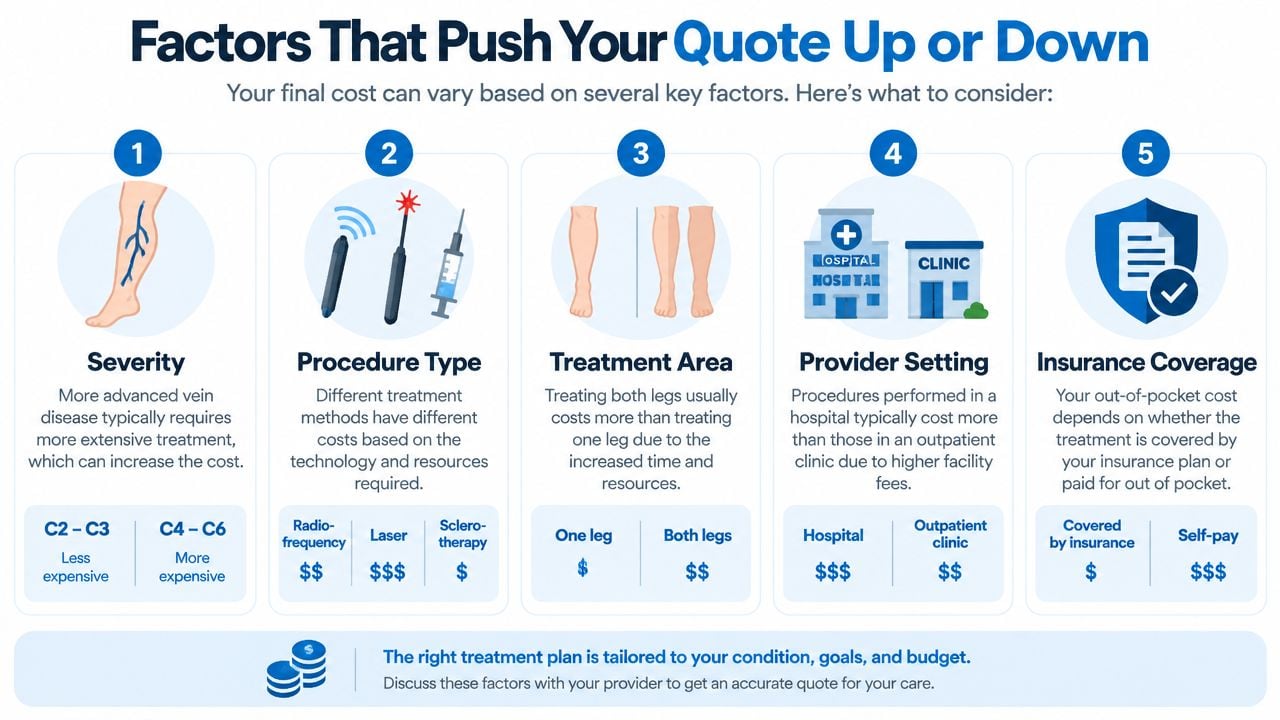
A first estimate becomes a realistic out-of-pocket budget only after the practice identifies what it will treat and how it will bill the care. Five variables deserve particular attention.
Severity changes the workload. Less advanced symptomatic disease generally requires a simpler plan than disease involving significant skin changes or ulceration. The clinical classification affects imaging, supplies, treatment time, and follow-up needs.
Procedure type changes the starting price. Sclerotherapy, thermal ablation, phlebectomy, and adhesive closure don't use the same equipment or billing structure. The national ranges in the earlier comparison are useful for checking whether a quote is in the expected category.
Treatment area changes the scope. One leg isn't automatically equivalent to both legs, and one refluxing vein isn't equivalent to multiple treated veins. The written estimate should identify the leg, vein, and planned procedure.
Imaging may be separate. Ultrasound helps the clinician map reflux and guide treatment. A patient should ask whether diagnostic and procedure-related imaging are included or billed independently.
Anesthesia and follow-up can add line items. Tumescent local anesthesia may be handled within the procedure structure, while monitored anesthesia can involve another professional charge. Follow-up ultrasound, compression garments, and additional sessions should appear in the estimate if they're anticipated.
A useful quote worksheet
The patient can pressure-test an estimate by writing down:
- Diagnosis and severity: What symptoms and clinical findings support treatment?
- Procedure and location: Which technique, which leg, and which facility?
- Included services: Does the price include imaging, supplies, compression, and follow-up?
- Excluded services: Could anesthesia, pathology, additional veins, or touch-up care be billed separately?
- Coverage status: Is the care being processed as medically necessary or cosmetic?
A clear estimate should let a patient identify the price of the procedure without guessing which charges are waiting outside the package.
Insurance, Medicare, and Workers' Comp Coverage
Insurance usually turns on one distinction: medical necessity versus cosmetic treatment. Aching, heaviness, swelling, documented skin changes, or ulceration can support a medical claim when the clinical evaluation confirms venous disease. Isolated spider veins without qualifying symptoms are commonly treated as cosmetic, which usually leaves the patient responsible for the charge.
How the payer decision usually works
| Payer | Medical Necessity Trigger | Typical Prior-Auth Requirements | Common Denial Reason |
|---|---|---|---|
| Medicare | Documented symptomatic venous disease and an appropriate diagnostic evaluation | Conservative care documentation and supporting clinical records may be requested | Cosmetic-only treatment or insufficient documentation |
| Commercial insurance | Symptoms linked to confirmed venous disease | Reflux imaging, conservative treatment history, and prior authorization may be required | Missing records, non-covered technique, or cosmetic classification |
| New Jersey workers' compensation | A work-related aggravation or contribution supported by medical documentation | Claim records, employer information, and specialist narrative | Weak connection between work duties and the condition |
| Self-pay | Patient elects treatment regardless of coverage | Written estimate and informed financial consent | Price excludes facility, imaging, or follow-up charges |
Medicare Part B coverage depends on the clinical facts and applicable policy requirements. Patients should ask the practice to verify the relevant Medicare policy, document the symptoms, and confirm that the diagnostic findings support the proposed procedure rather than assuming every vein treatment qualifies.
Commercial plans often require a documented trial of compression, a venous reflux study, and prior authorization. The exact process varies by plan. A denial can reflect missing paperwork rather than a conclusion that treatment is never medically appropriate.
The New Jersey workers' compensation angle
For New Jersey workers' compensation cases, the connection between the job and the vein condition needs to be explained clearly. Prolonged standing or heavy lifting may be relevant when a qualified clinician documents how work duties aggravated or contributed to the condition. A specialist's narrative should connect symptoms, diagnosis, work exposure, treatment recommendation, and expected medical need.
Patients facing broader financial pressure from medical care may also benefit from reviewing a resource on Georgia bankruptcy for medical bills. That information isn't a substitute for a coverage determination, but it can help households understand the consequences of unpaid medical balances.
Cosmetic carve-outs remain the most common source of surprise. A patient may have both medically necessary source-vein treatment and optional cosmetic treatment, so the office should separate those portions before scheduling.
How to Question and Negotiate Your Final Price
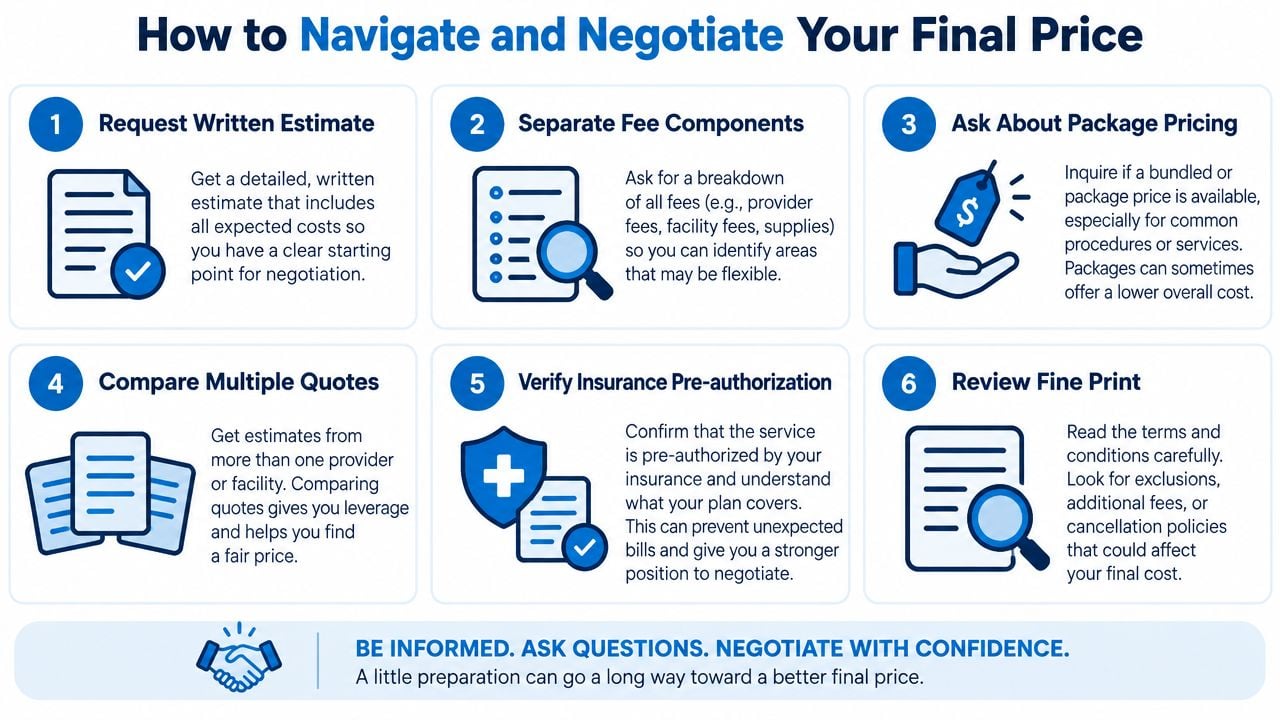
A self-pay quote is a contract in practical terms, not a casual verbal estimate. Request a written document that separates the physician fee, facility fee, anesthesia, imaging, supplies, and follow-up. That breakdown matters in New Jersey, where an out-of-network physician and facility may bill separately. A low quote can easily leave charges out.
The four documents worth requesting
- A written treatment estimate. It should identify the procedure, leg, treatment area, and expected number of visits.
- An itemized facility breakdown. Confirm whether care will occur in an office, ambulatory surgery center, or hospital outpatient department.
- The out-of-network fee schedule. Ask whether the physician and facility participate in your plan separately.
- A benefits verification summary. Have the billing team show how the estimate changes under in-network and out-of-network processing.
Ask which billing codes the office expects to use. Codes give the billing office and insurer a common description of the service, although the final allowed amount still depends on the plan and location of care.
Questions that prevent a second bill
- Is the estimate bundled? Confirm whether compression garments, follow-up ultrasound, and routine aftercare are included.
- What could change the price? Ask about additional veins, staged treatment, anesthesia, and unexpected imaging.
- Is there a prompt-payment policy? Request the written cash-pay terms. Do not rely on a verbal promise.
- Can treatment be staged? Staging can make sense when several areas need treatment and the full episode cannot be completed at once.
- What happens after a denial? Identify who handles documentation, appeals, and patient billing.
Price transparency applies beyond one procedure. Employers and patients seeking cost certainty in healthcare for employees can apply the same rule: document the total expected cost before care begins, identify each billing party, and record the assumptions behind the estimate.
Negotiation advice: Ask, “Which services are included, which are excluded, and what is the complete amount for the planned episode?” That question produces a more useful answer than simply asking for a lower price.
Key Numbers to Remember and Quick Answers
Use these figures to test a quote, not to replace one. The national averages cited earlier place spider-vein sclerotherapy at $428 and endovenous ablation at $3,131, according to this U.S. cost roundup. Those are national reference points, not New Jersey out-of-network prices.
The procedure table already shows the expected ranges for radiofrequency ablation, ambulatory phlebectomy, and VenaSeal. Do not add those figures together automatically. A quote may cover one vein, several treatment areas, facility charges, ultrasound, follow-up care, or a staged treatment plan.
The Medicare site-of-service benchmark makes the billing issue clear: the same type of ablation can cost more in a hospital outpatient department than in an ambulatory surgery center, with higher patient responsibility as well. Ask where the procedure will occur before comparing prices. The facility is part of the treatment price.
Quick answers after a quote arrives
Can one procedure fix every vein? Usually not when ultrasound shows a refluxing source vein alongside visible surface veins. The number of visits depends on the findings, the areas treated, and the clinical goal. A quote for one procedure may therefore represent only the first part of the plan.
Is medically necessary treatment tax-deductible? That depends on the patient's circumstances and applicable tax rules. A qualified tax professional should decide whether an expense qualifies. The clinic and this article should not make that determination.
How long will results last? Treatment closes or removes targeted veins, but it cannot prevent every future vein from developing. New reflux, the underlying venous pattern, clinical factors, and follow-up recommendations all affect durability.
For a New Jersey out-of-network quote, request four documents: the written estimate, facility breakdown, out-of-network schedule, and benefits verification. Check whether compression garments, follow-up ultrasound, routine aftercare, anesthesia, and additional veins are included. Ask which billing codes the office expects to use and what could trigger a second bill.
Interventional Pain Management evaluates varicose and spider veins, coordinates diagnostic review, and helps patients understand treatment and insurance questions in New Jersey and Staten Island. Patients can request a personalized discussion through Interventional Pain Management.