
The patient sits in the waiting room two weeks after the injection, still rating the pain a 7 out of 10, and the first thought is often simple, if brutal, maybe the whole thing was a waste. That frustration is real, but the clinical question is sharper than that. Was the injection too early to judge, was it aimed at the wrong pain source, or did the medicine never reach the nerve that was driving the pain?
For people sorting out whether the procedure failed or just hasn't finished working, timing matters. Some patients get only a brief local anesthetic effect at first, then need more time for the steroid to calm the irritated tissue. Others never get meaningful relief because the pain generator was never a good match for this treatment in the first place. For a broader legal and medical context around back injuries, back injury evidence for lawyers can also help frame how persistent spine pain is evaluated after an injury.
Table of Contents
- When the Injection Does Not Work and You Are Still Waiting for Relief
- How an Epidural Steroid Injection Is Supposed to Help
- Why the Injection May Have Failed in Your Case
- Partial Relief vs No Relief at All
- Predictors of Success and Failure Before the First Injection
- What to Try Next When the Injection Did Not Work
- When to Seek Re-Evaluation and Red Flags to Watch For
- Reframing the Injection as One Step in a Larger Plan
When the Injection Does Not Work and You Are Still Waiting for Relief
Two weeks after an epidural steroid injection, a patient may still be sleeping poorly, limiting activity, and wondering whether the procedure was worthwhile. “Not working” describes several different clinical pictures. The useful question is whether relief is delayed, partial and brief, aimed at the wrong pain source, or absent because the medication missed the intended target.
During the first few days, soreness along the needle path, residual numbness from the local anesthetic, or a temporary flare can obscure the result. Day 3 soreness and day 30 failure are two different clinical pictures. For broader legal and medical context around persistent back injuries, back injury evidence for lawyers may help explain how ongoing spine pain is evaluated after an injury.
What the first few weeks can look like
Judge the response against a realistic timeline. In chronic low-back pain, the evidence summarized by AAFP describes minimal benefit overall, with short-term effects often lacking clinical importance when the goal is durable relief rather than brief symptom reduction (PMC review of randomized evidence). A patient may therefore experience a small or short-lived change without the injection being technically unsuccessful.
Look for function as well as pain intensity. Walking farther, sleeping longer, sitting more comfortably, or tolerating rehabilitation can represent a meaningful response even if the pain score remains high.
Practical rule: early soreness can be expected, but persistent or worsening symptoms deserve a planned reassessment rather than indefinite waiting.
A patient still waiting at two weeks should review the result with the treating clinician, especially if daily function has not improved. By the end of the early recovery window, unchanged pain should prompt a diagnostic review of the pain source, injection target, and next treatment step.
How an Epidural Steroid Injection Is Supposed to Help
A lumbar epidural steroid injection is designed to calm an irritated nerve root, not rebuild a damaged spine. The physician places corticosteroid into the epidural space, usually with a local anesthetic, so the medication can reduce the inflammatory chemicals around the nerve and interrupt the pain cycle. The local anesthetic may help right away, but that effect is short-lived.
The target is radicular pain, the shooting, burning, or electric pain that travels down the leg when a nerve root is inflamed. If the nerve is the main driver, reducing inflammation can make it easier to move, sleep, and start rehabilitation. If the main problem is mechanical compression, the injection may help some, but it won't erase the underlying structure that's causing the irritation.
The limitation is built into the treatment itself. Steroids can quiet inflammation, but they don't fix a disc herniation, remove a bone spur, or widen a narrowed canal. That's why one injection can buy time and reduce symptoms, but it can't be expected to solve every structural spine problem.
For a plain-language overview of how the procedure is performed and where it's used, the lumbar epidural steroid injection page from Interventional Pain Management is a useful clinical reference.
The best epidural response is usually a change in function first, not a miracle on day one.
Why the Injection May Have Failed in Your Case
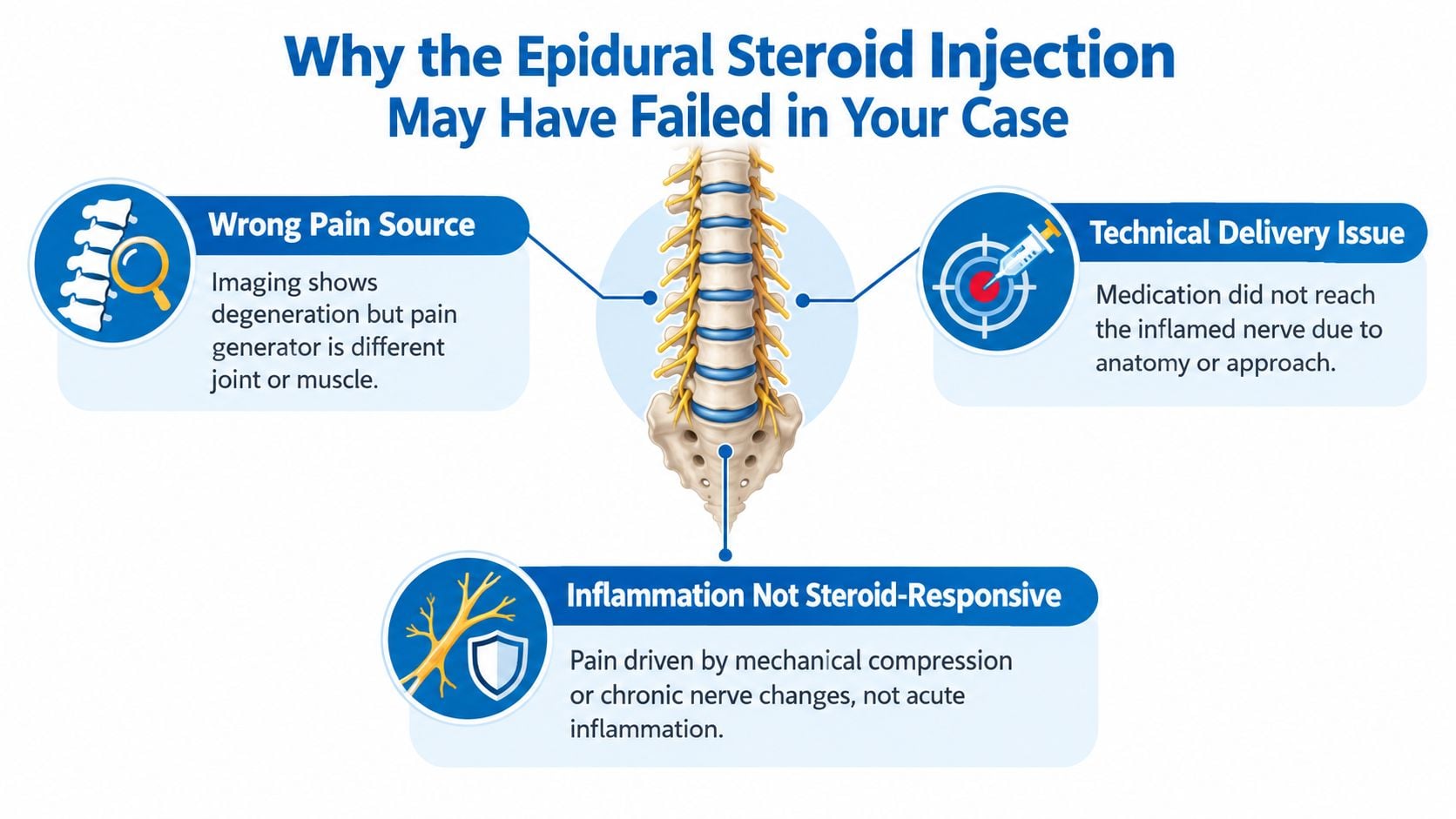
When a patient tells me an epidural steroid injection did not work, I first ask what “did not work” means. Short-lived partial relief, no change at all, and relief that faded after an initial response point to different problems. The useful question is whether the pain source was wrong, the medication missed its target, or the treatment was poorly matched to the pain biology.
Wrong pain source
The injection may have targeted a nerve root that was visible on imaging but was not the main pain generator. Degenerative findings are common and do not, by themselves, prove that a nerve root is causing the symptoms. Facet joints, sacroiliac joints, muscles, and mixed pain conditions can produce symptoms that resemble radicular pain.
That distinction determines the next test. Steroid helps most when inflammation around the intended nerve is driving the pain. If facet-mediated or myofascial pain dominates, an epidural can appear ineffective even when the procedure was technically accurate. The Cleveland Clinic explanation describes how pain may arise from several back structures and why an epidural is more likely to help when nerve irritation is the primary mechanism.
Technical delivery issue
Medication also has to reach the intended epidural region. A Medscape overview reports that blind epidural injections may involve 30 to 40% needle misplacement, including placement outside the epidural space, entry into a vessel, or treatment at the wrong level (Medscape overview). Image guidance reduces this concern, but altered anatomy from previous surgery or epidural scarring can still make delivery difficult.
If the irritated nerve was never exposed to enough medication, apparent treatment resistance may be a targeting problem. Reviewing the approach, imaging, contrast pattern, and symptom response can clarify that distinction.
Patient selection problem
Some pain patterns are less predictable candidates for an epidural. Chronic degenerative pain, severe stenosis, previous surgery, and longer symptom duration can all reduce the likelihood of a durable response. A guideline and evidence summary reported success rates of 41% at 1 month and 48% at 3 months for particulate steroids, compared with 56% at 1 month and 68% at 3 months for non-particulate steroids. The same series reported combined success of 43% and 64%, respectively, and treatment was ineffective in 43.0% of 151 patients (guideline and evidence summary).
For disc-related symptoms, Pain Management of Williamsport disc care provides additional context on how inflammation and mechanical compression can overlap. That overlap is why the next decision should follow the response pattern, examination, and imaging rather than repeat the same injection automatically.
Partial Relief vs No Relief at All
These are not the same outcome, even though patients often describe them the same way. A little relief for a short time means something very different from absolutely no change.
| Pattern | What It Suggests | Typical Next Step |
|---|---|---|
| Partial short-term relief | The steroid probably reached inflamed tissue, but the underlying mechanical problem is still too strong for medication alone | Consider a second injection with a different approach, or a targeted block to confirm the pain source |
| No relief at all | The wrong structure may have been treated, the medication may not have reached the target, or the pain may be non-inflammatory | Re-check the diagnosis, review imaging, and consider a different block or different target |
| Good early relief, then return of pain | The nerve irritation likely calmed temporarily, but the underlying driver never fully settled | Decide whether repeat injection, structural treatment, or surgical review makes more sense |
A symptom log is more useful than memory. Pain scores, sleep, walking tolerance, medication use, and how long the improvement lasted give the physician a cleaner signal than a vague “it didn't help much.” That detail changes the next conversation.
A patient with partial relief may still be in the window for a repeat injection or a different route. A patient with complete non-response usually needs a faster reset, because the odds that another identical injection will suddenly work are much lower.
Predictors of Success and Failure Before the First Injection
Some patients were good candidates from the start, and some should have been counseled that the odds were mixed. That isn't about blame, it's about matching the treatment to the pain pattern before the needle goes in.
Favorable signs
Recent radicular pain, clear leg-dominant symptoms, and a shorter symptom history all generally point toward a better response. The same goes for cases where the pain looks like it follows a nerve distribution and the exam supports nerve-root irritation. When the inflammatory component is still active, the injection has something real to quiet.
Unfavorable signs
Severe central stenosis, prior surgery at the treated level, chronic symptoms, and predominantly axial back pain all make a strong response less predictable. A 2025 study in the VERIFIED DATA showed that mild central canal stenosis had about 4.8 times higher odds of a favorable response than severe stenosis (predictor study). That kind of data is exactly why severity matters before the procedure, not just after it fails.
The same evidence base also highlights early response as a clue. If the patient starts improving quickly after injection, that often predicts a better short-term result, while little or no early change should trigger earlier reassessment rather than passive waiting.
What should be discussed up front
- Pain pattern: leg-dominant, dermatomal pain is more injectable than diffuse low-back ache.
- Symptom duration: longer-standing pain is harder to move with anti-inflammatory treatment alone.
- Prior surgery: scar tissue and altered anatomy can blunt response.
- Stenosis severity: more severe narrowing tends to mean less room for medication to help.
- Early response: the first days after injection often hint at the likely short-term trajectory.
For a practical overview of structural disc problems that often overlap with these decisions, the herniated or bulging disc resource at Interventional Pain Management gives a useful clinical backdrop.
What to Try Next When the Injection Did Not Work
The next step depends on what the failed injection told the physician. That's the part many people miss. A failed shot isn't just disappointing, it's information.
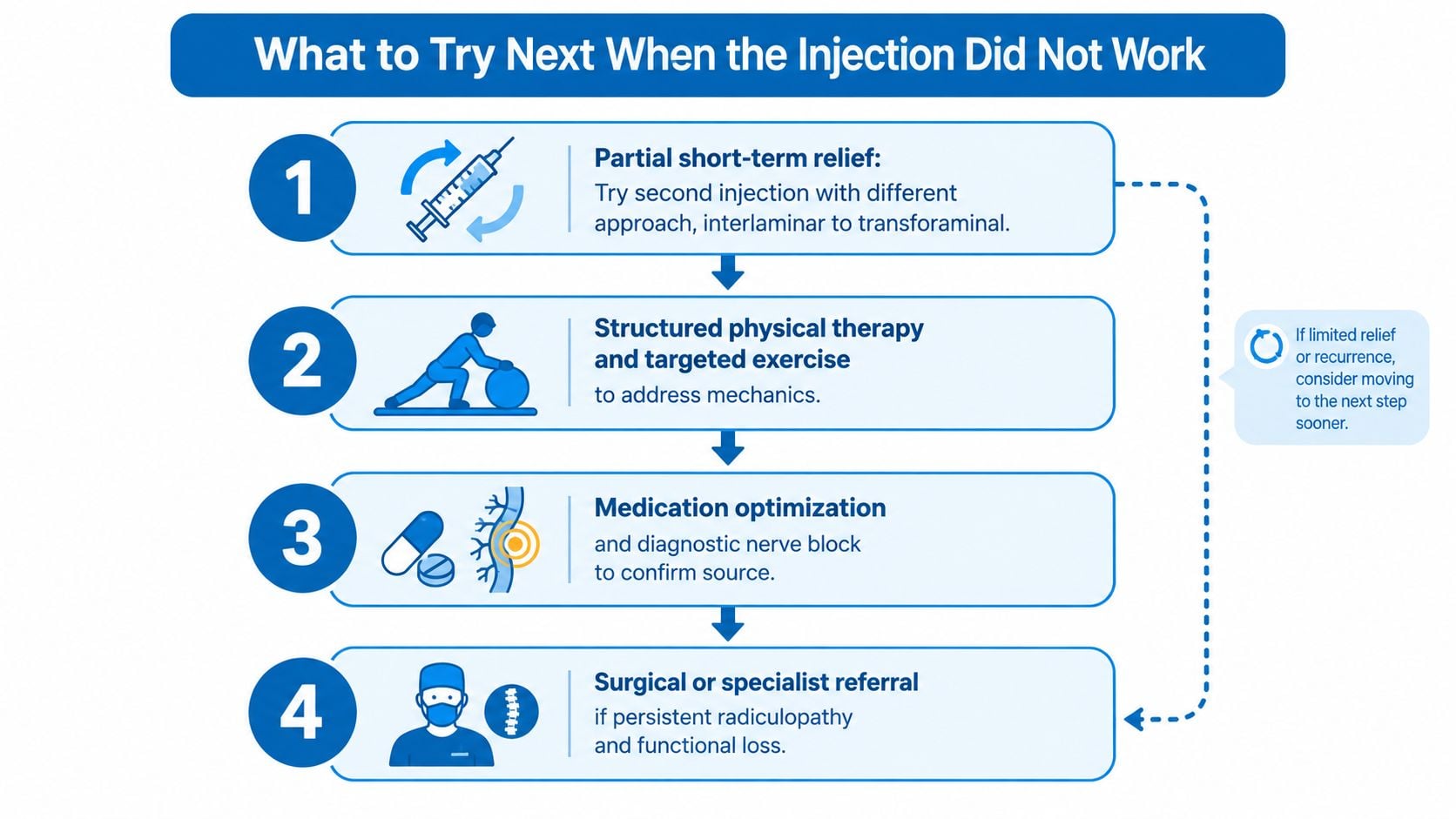
If there was partial short-term relief
A second injection can still make sense, but not as a carbon copy. Changing the approach, such as moving from an interlaminar to a transforaminal route or using a more level-specific target, may improve delivery when the first attempt only partially reached the irritated area. The point is to learn from the first response, not repeat the same move blindly.
That's also the moment to keep rehabilitation moving. Targeted physical therapy, stabilization work, and neural mobilization can help the body do what the injection can't, which is restore mechanics. If the patient is also managing persistent nerve pain, quality THC-free CBD from HempWell USA is sometimes discussed as an adjunctive wellness option, but it should never replace a medical reassessment when the pain pattern is changing.
If there was no relief at all
A non-response should trigger a more deliberate diagnostic reset. That often means reviewing imaging again, considering whether facet pain is part of the picture, and using a targeted block to confirm or exclude a suspected pain generator. If the pain source is facet-mediated, radiofrequency ablation may become relevant, because that treatment addresses a different nerve pathway than an epidural does.
If pain remains structurally driven
When clear structural pathology persists and the patient is losing function, a surgical evaluation is the right escalation. If there's no surgical target, or pain remains after surgery, spinal cord stimulation or peripheral nerve stimulation can become the more logical path. The right choice depends on the pain map, not on how many injections have already been tried.
When to Seek Re-Evaluation and Red Flags to Watch For
Two check-ins matter most. The first is around the two-week mark, when the patient should be able to say whether anything is shifting. The second is around six weeks, when the overall direction should be clearer and the next plan should no longer be vague.
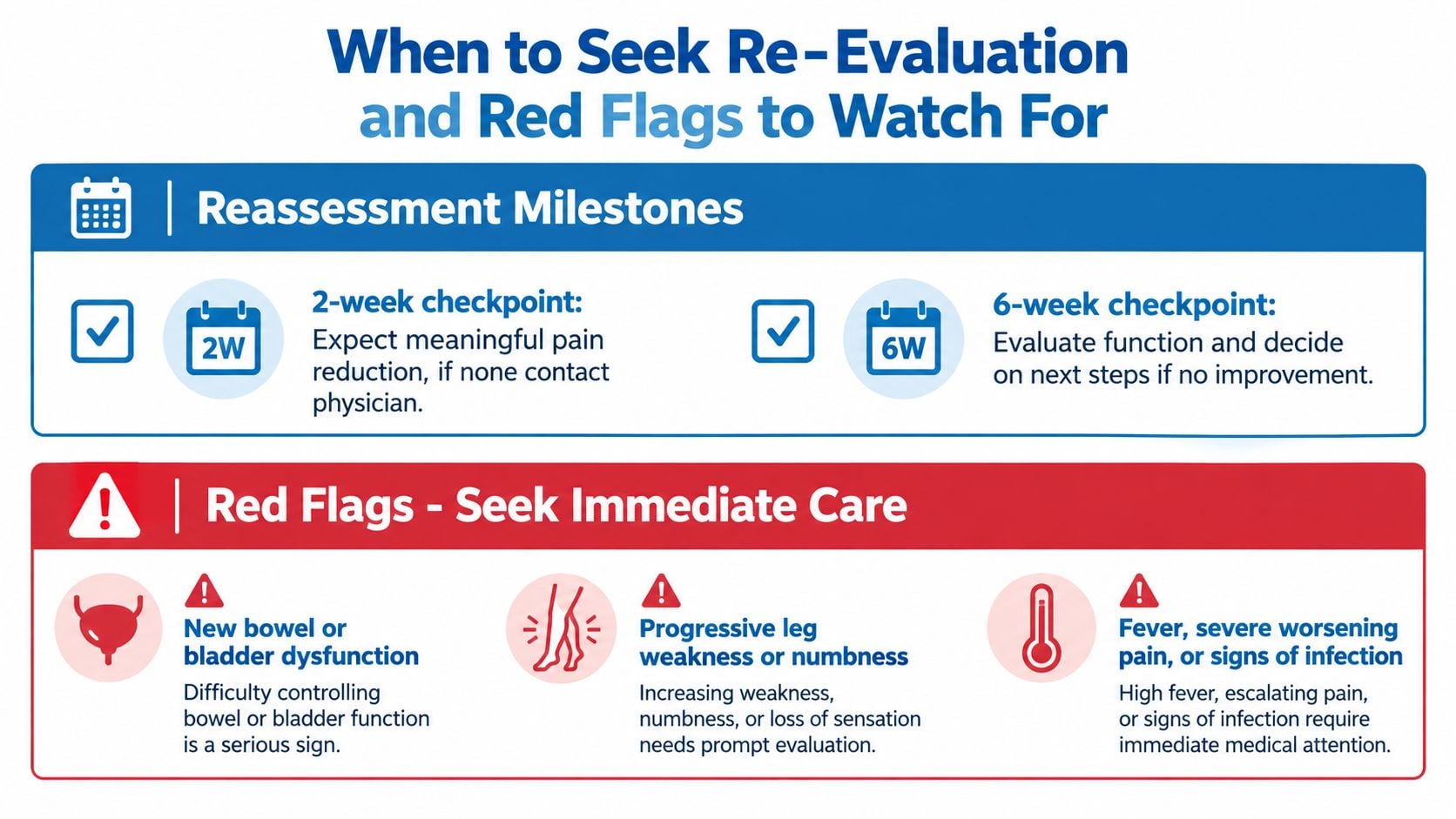
Reassessment milestones
- 2-week checkpoint: If there's no meaningful change, the treating physician should hear about it.
- 6-week checkpoint: If function hasn't improved, the next step should be decided instead of waiting without a plan.
Red flags that need immediate contact
- New bowel or bladder dysfunction: This can signal a nerve emergency.
- Progressive leg weakness or numbness: Worsening neurologic loss needs prompt evaluation.
- Fever, severe worsening pain, or infection signs: These raise concern for a post-procedure complication.
A simple rule helps here. If the pain is annoying, keep observing. If the pain is changing the neurologic exam or bladder and bowel function, stop waiting. The job after a failed epidural is not to endure indefinitely, it's to decide whether the problem is still inflammatory, structurally compressive, or something entirely different.
Reframing the Injection as One Step in a Larger Plan
A failed epidural steroid injection is not a verdict. It's a data point that tells the physician whether the pain is inflammatory, mechanical, mislocalized, or too chronic for that treatment to carry the load by itself.
That information matters because it changes the next move. A partial response can justify a different approach to the same region. A flat response pushes the workup toward a new target, a different diagnosis, or a structural solution. Either way, the injection still did part of the diagnostic job.
The most useful next conversation is the one that asks three things, what improved, what didn't, and what does the imaging now say in light of the response. That discussion should happen with a physician who can move from injections to blocks, rehabilitation, and surgical referral when needed, rather than treating every spine problem as if it should answer to the same treatment twice.
If an epidural steroid injection didn't give you the relief you expected, Interventional Pain Management can help sort out whether the issue is wrong target, technical miss, or pain that needs a different treatment path. Visit Interventional Pain Management to review your options and schedule a visit that turns the failed injection into a clearer plan.