
Formal outpatient physical therapy typically begins around 12 weeks after spinal fusion, while gentle mobilization and education start immediately after surgery. During the early phase, walking, breathing exercises, ankle pumps, and fully supported neutral-spine movements protect recovery without placing unnecessary stress on the fusion.
Leaving the hospital can feel strangely anticlimactic. A patient may have undergone a major operation, received several pages of restrictions, and still wonder what “rehabilitation” means at home. The answer isn't bed rest, and it isn't an immediate strengthening program. A spinal fusion rehabilitation protocol usually separates early protection and mobility from later, supervised exercise.
The timeline gives healing tissues time to tolerate increasing loads. It also gives the rehabilitation team a safer way to judge progress, using symptoms, walking tolerance, movement quality, and functional goals rather than a calendar alone. The surgeon's instructions always take priority, because fusion level, surgical approach, bone quality, medical history, and complications can change the plan.
Table of Contents
- Understanding Your Spinal Fusion Recovery Timeline
- Immediate Post-Operative Care and Early Mobilization
- Why Formal Physical Therapy Starts at 12 Weeks
- Structured Rehabilitation Phase and Exercise Progression
- Combined Exercise and Behavioral Support for Better Outcomes
- Modifying Rehabilitation by Procedure Type
Understanding Your Spinal Fusion Recovery Timeline
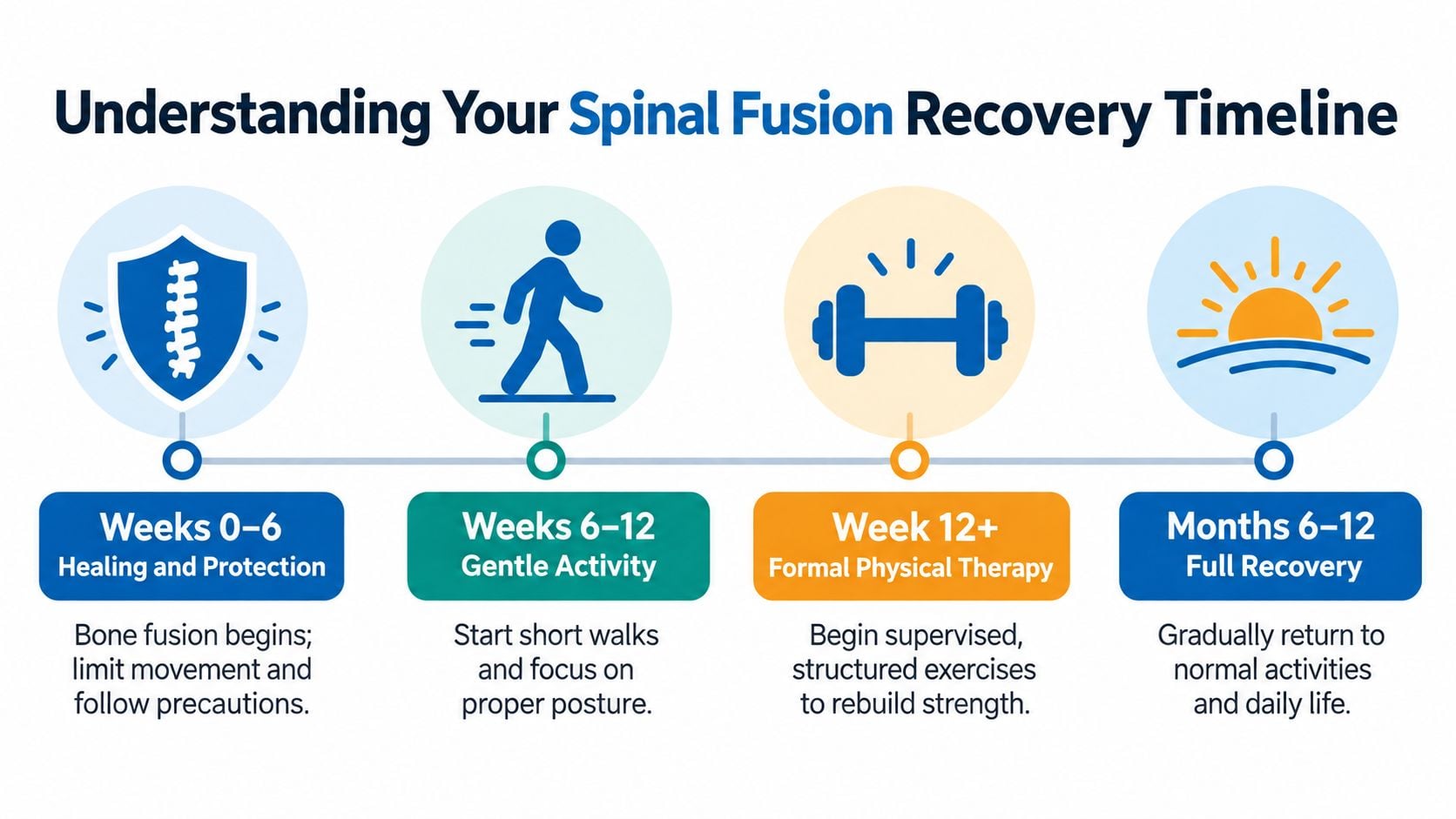
A patient may leave the hospital able to walk short distances, yet still feel unsure about what comes next. The recovery pathway works like a bridge: hospital staff provide hands-on support first, home routines maintain safe movement, and formal therapy later builds strength and function after surgical clearance. Each stage has a different job.
The early healing window
During the first several weeks, the priority is protection rather than performance. Short walks, breathing exercises, ankle pumps, and supported neutral-spine movements keep the body active while limiting bending, twisting, and lifting. By about six weeks, a lumbar fusion protocol may still restrict excessive lifting, twisting, and bending, while gradually increasing walking tolerance toward 15 to 30 minutes of cardiovascular activity daily (Lahey Hospital and Medical Center's lumbar fusion rehabilitation protocol).
Those time points guide progression, not dictate it. Someone with increasing leg symptoms, wound concerns, dizziness, or a clear decline in function should contact the medical team before increasing activity. The surgeon's instructions take precedence because fusion level, surgical approach, bone quality, medical history, and complications can alter the plan.
The transition from mobility to rehabilitation
The gap after discharge can be confusing. A patient may be walking more comfortably but still lack clearance for strengthening, repeated bending, or higher-load exercise. Early mobilization supports daily function and general health. Formal rehabilitation begins when a therapist can assess impairments, establish measurable goals, and apply progressive loading safely.
Evidence reviews describe variation in rehabilitation protocols after cervical and lumbar surgery, with guidance supporting early education and gradual mobilization, followed by formal exercise rehabilitation around the two to three month point (review of rehabilitation after spinal surgery). In practice, many patients begin structured outpatient physical therapy at about 12 weeks, if healing and symptoms support that step.
The timeline is a framework, not a promise. A sound spinal fusion rehabilitation protocol connects each next activity to evidence of readiness, including symptom response, walking tolerance, movement quality, and meaningful daily goals.
Immediate Post-Operative Care and Early Mobilization
The first phase begins as soon as the surgical team considers movement safe. A nurse or therapist may help the patient sit at the edge of the bed, stand, and take short walks. Assistance isn't a sign of failure. Anesthesia, pain, weakness, and unfamiliar movement strategies can temporarily affect balance and confidence.

What early movement is designed to accomplish
Early activity has a narrow purpose. It helps the patient change positions, walk safely, maintain circulation, and regain confidence without challenging the fusion with heavy or uncontrolled loading.
Common activities include:
- Short assisted walks: The distance should remain within the patient's current tolerance, with attention to posture, foot clearance, breathing, and symptom response.
- Ankle pumps: Repeatedly moving the ankles supports lower-limb circulation while the patient is resting.
- Breathing exercises: Slow, deliberate breathing supports chest expansion and gives the patient a controlled way to manage tension.
- Supported neutral-spine exercises: The trunk stays aligned while the limbs move within the range approved by the surgical team.
Neutral spine doesn't mean holding the back rigidly all day. It means avoiding a combination of slumped posture, forceful bending, twisting, or sudden extension. For example, turning the whole body with the feet is usually more protective than rotating at the waist to reach a bedside object.
The first days at home
At home, movement is usually spread across the day rather than concentrated into one demanding session. A patient may walk from room to room, rest before symptoms escalate, and use the prescribed method for getting in and out of bed. The exact pain plan belongs to the surgical team, and new or worsening pain shouldn't be managed by exercise alone.
Practical rule: A movement is only useful if it can be performed with control and without a worsening symptom pattern afterward.
Bending to dress, lifting household objects, twisting while getting into a car, and reaching from an unstable position can create more stress than a short, careful walk. The patient should ask the clinical team for alternatives, adaptive equipment, and clear instructions for bathing, sleeping, stairs, and transportation. Guidance about pain after back surgery can also help distinguish expected discomfort from symptoms that warrant a call.
The early phase is active recovery, but it isn't formal strengthening. It establishes safe habits that later therapy can build on.
Why Formal Physical Therapy Starts at 12 Weeks
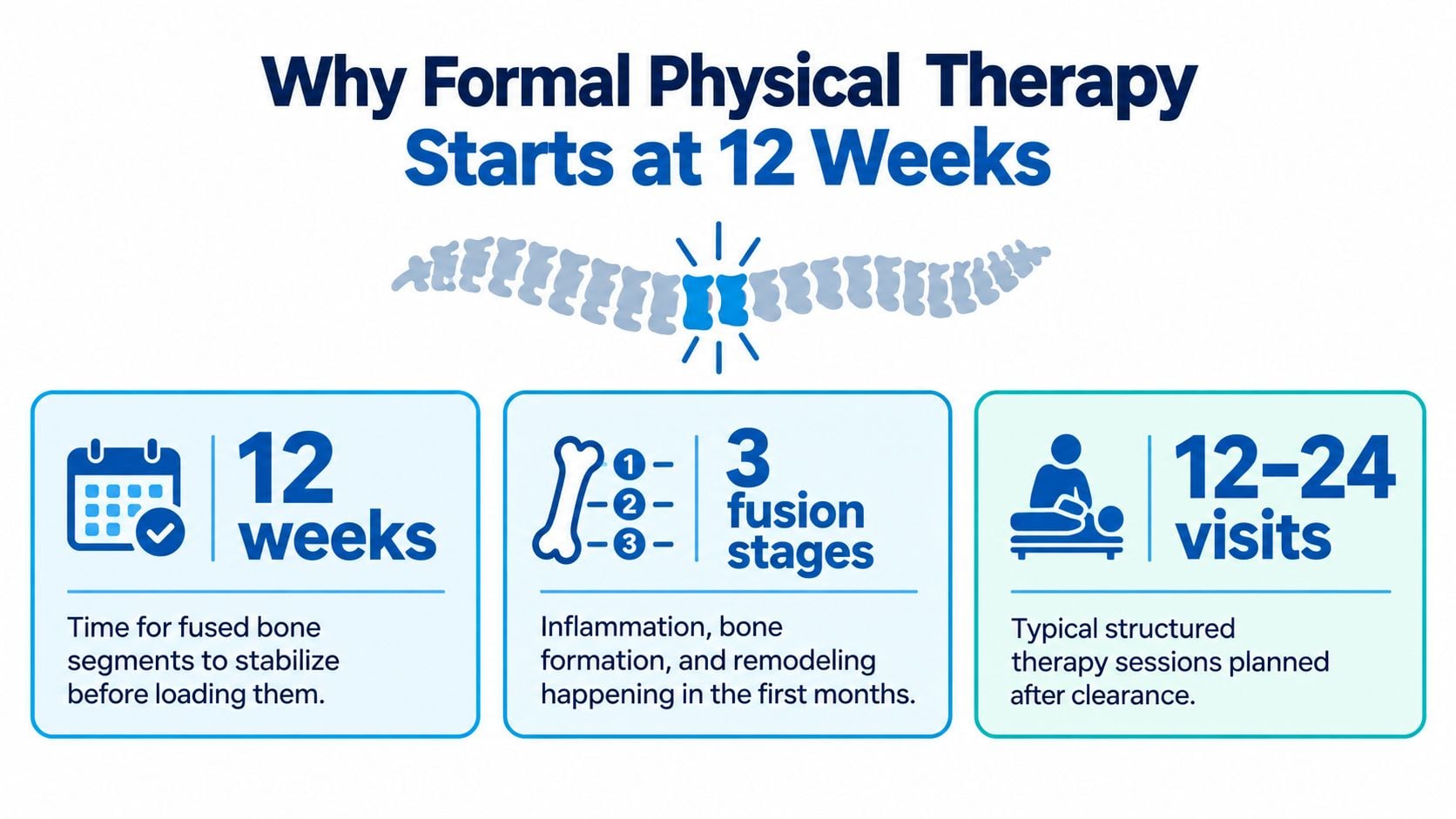
A patient may leave the hospital walking short distances, changing position, and practicing safe transfers, then wonder why a formal therapy appointment is scheduled much later. The gap can feel like lost treatment time. In practice, it separates two different goals: early movement protects daily function, while structured therapy adds repeated loading and resistance only after healing has progressed.
A fusion construct needs protection while bone and surrounding tissues heal. Hardware provides stability, but it does not complete the biological fusion on its own. Early mobilization is useful, yet forceful bending, twisting, lifting, or strengthening can place stress on healing tissues before the surgical team considers them ready. Formal rehabilitation also asks more of the body than walking. It may include repeated exercises, postural correction, progressive resistance, and practice with demanding functional tasks.
Protection is not inactivity
Patients can remain active while respecting surgical limits. Approved walking, position changes, ankle pumps, and safe transfers all support recovery. These actions do not replace later therapy. They keep the early weeks from becoming completely sedentary while avoiding the repeated strain of formal strengthening.
Evidence supports a phased approach: education and gentle mobility begin immediately, while formal exercise rehabilitation commonly starts around two to three months after surgery (independent review of postoperative rehabilitation). The review also describes insufficient evidence for one universal protocol across every cervical or lumbar procedure. Your plan therefore needs to match the operation, healing response, and surgeon's instructions.
Why the calendar can't make the decision alone
Twelve weeks is a common point for formal outpatient therapy, not automatic clearance for every exercise. Timing may change with the number of fused levels, surgical approach, imaging, symptoms, neurological findings, wound status, and general health. Persistent or increasing symptoms should prompt reassessment before progression.
Discussions about bone grafting may also help explain why fusion depends on biological healing as well as hardware and movement protection. Ask which activities are permitted before clearance and which symptoms require an earlier review.
Waiting for formal PT doesn't mean waiting to recover. It means using low-load movement while the surgical team protects the conditions needed for healing.
Structured Rehabilitation Phase and Exercise Progression
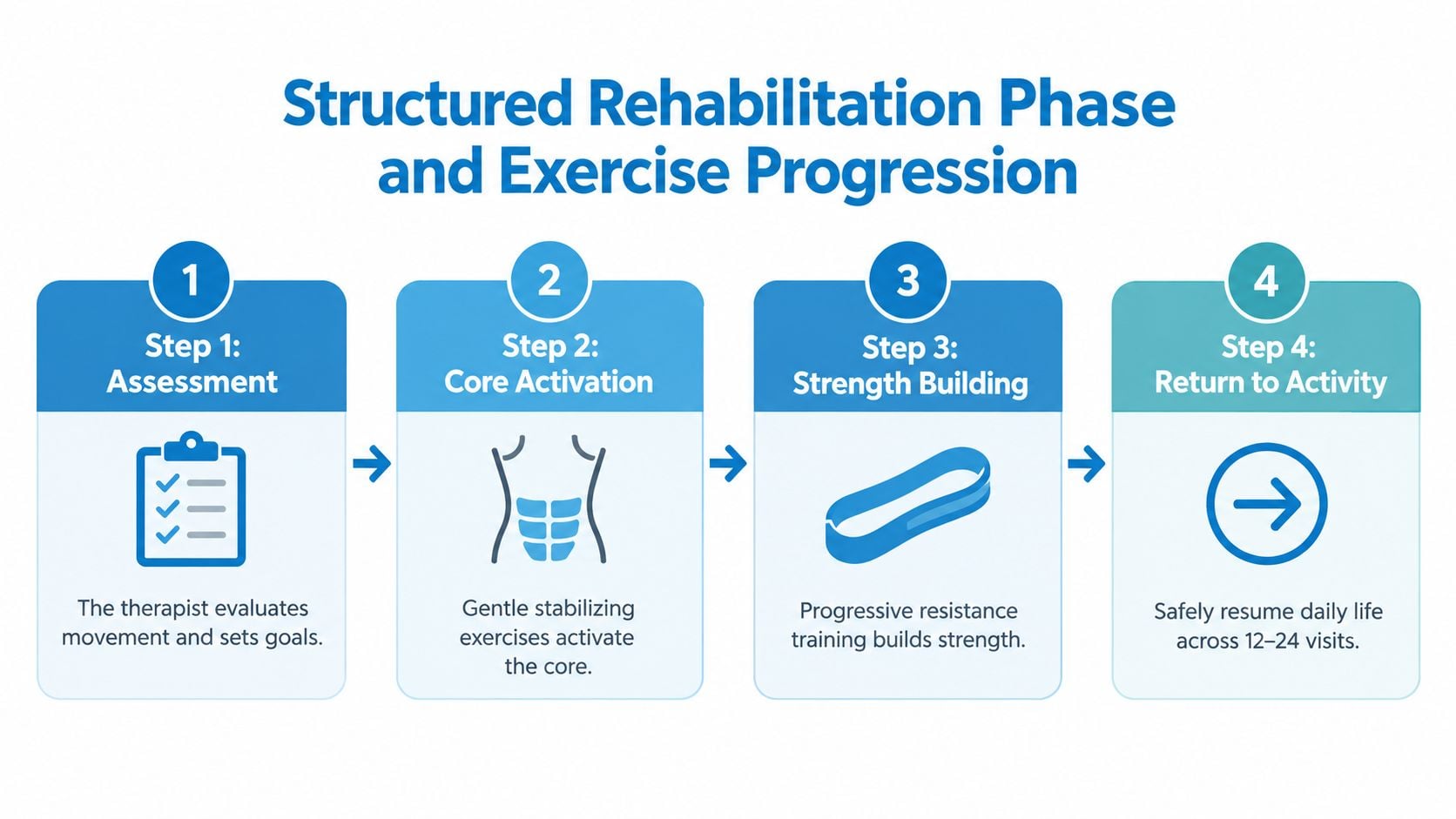
Clearance marks the shift from protecting the fusion to rebuilding useful movement. A supervised outpatient plan may run two to three times per week for six to eight weeks, with 12 to 24 visits, based on the patient's needs and the treating team's assessment (Lahey Hospital and Medical Center's rehabilitation protocol). These figures describe a common framework, not a required scorecard. Some patients progress faster, while others need slower loading or additional review.
Assessment comes before exercise selection
The first visit should connect clinical findings with daily goals. The therapist may watch walking, chair transfers, posture, and symptom responses during simple movements. The discussion should also cover tasks that matter to the patient, such as standing at work, shopping, caring for family, or climbing stairs.
Baseline measures may include the Oswestry Disability Index, which describes disability related to low back pain, and the Fear-Avoidance Beliefs Questionnaire, which can identify beliefs that make movement feel unsafe. These questionnaires support clinical judgment rather than replace it. Repeating them can show whether pain, confidence, walking ability, and daily function are improving together.
Progression follows control and response
Exercise usually advances in layers, like adding weight to a stable foundation:
- Walking capacity: The therapist adjusts pace, duration, rest periods, and surface demands while observing symptoms and gait quality.
- Core stabilization: Early work focuses on controlled trunk support, gentle bracing, breathing, and alignment during limb movement rather than forceful spinal motion.
- Strength and endurance: Resistance increases gradually after the patient can maintain form and recover without a lasting symptom flare.
- Functional practice: Exercises become connected to real tasks, including stair use, reaching, work positions, and lifting technique after clearance.
The patient should receive clear progression criteria. The next step may depend on stable form, longer walking without worsening symptoms, appropriate recovery between sessions, or greater confidence with movement. The calendar matters, but response to loading matters more.
Home practice makes the plan continuous
Home exercises should be easy to perform correctly and linked to a specific purpose. The plan may include walking, gentle stabilization, posture practice, and a symptom log recording activity, pain response, leg symptoms, fatigue, and recovery by the following day.
A pain increase is information, not an automatic sign of damage. Repeated or escalating symptoms should be reported rather than pushed through independently. The therapist can lower the load, modify the exercise, or contact the surgical team when the pattern needs medical review. This creates a measured bridge between formal visits and the patient's ordinary day.
Combined Exercise and Behavioral Support for Better Outcomes
After discharge, a patient may understand the surgical precautions yet still hesitate before standing, bending, or walking farther. Written advice explains limits, while rehabilitation shows how to move safely, interpret symptoms, and rebuild trust in the body after a painful episode.
A 2024 review reports that a meta-analysis found standard treatment after lumbar fusion did not significantly reduce disability or pain at six months compared with rehabilitation combining exercise and cognitive behavioral therapy (review of rehabilitation after lumbar fusion). This does not mean every patient needs psychological treatment, and it does not make pain imaginary. Fear, low confidence, and protective movement habits can affect how well a patient uses restored physical capacity.
Two approaches, different levels of support
Standard advice alone may cover restrictions, walking guidance, medication instructions, and follow-up. That information matters, but the patient must still decide how to increase activity, interpret discomfort, and resume demanding tasks.
Structured exercise with behavioral support adds supervised activity, graded exposure, pain education, and methods for reducing fear-avoidance. A therapist might ask the patient to practise a feared movement in a controlled setting, examine an unhelpful prediction, and replace it with a specific, observable goal.
A patient may say, “My back feels healed, but movement still feels dangerous.” Reassurance alone may not change that response. Carefully graded practice provides direct evidence that movement can be performed safely within the surgeon's restrictions.
Selecting the right model
A patient who is progressing steadily and feels confident may need exercise supervision without formal behavioral treatment. Persistent pain, fear of reinjury, poor sleep, low activity, or repeated avoidance may support a coordinated plan addressing both physical and behavioral barriers.
A 2025 review described phase-based programs using cervical strengthening, postural correction, and home exercises. A separate systematic review found that exercise likely reduces pain and disability up to six months after lumbar fusion. Evidence is not uniform, so clinicians should adjust the plan to the procedure, symptoms, examination findings, and recovery between sessions rather than promise a fixed result.
Modifying Rehabilitation by Procedure Type
A general spinal fusion rehabilitation protocol becomes useful only after it is adapted to the operation performed. An anterior lumbar interbody fusion, posterior lumbar interbody fusion, and cervical fusion place different demands on the body, even when the shared goal is stabilization.
The surgical approach can affect incision care, position tolerance, muscle irritation, gait, and the movements that feel threatening. The number and location of fused segments can also change how the patient compensates during walking, transfers, reaching, or work tasks.
Questions that clarify the plan
Before progressing, the patient should ask the surgeon and therapist:
- What was fused: Which spinal levels were treated, and does the number of levels change the expected restrictions?
- What is protected: Which movements, loads, positions, or household tasks remain restricted?
- What confirms progression: Will clearance depend on symptoms, examination, imaging, or a combination?
- What changes the schedule: Which findings would delay or accelerate formal therapy?
- Who coordinates care: Which clinician should be contacted if pain, weakness, wound changes, or walking ability worsens?
For a posterior lumbar procedure, the patient may need especially careful instruction for transfers and trunk control. A patient recovering from an PLIF procedure may receive a plan that differs from a patient with an anterior approach because the tissues affected by surgery and the patient's movement strategy aren't identical.
Procedure-specific adaptation in practice
Cervical fusion rehabilitation may emphasize neck protection, shoulder-blade control, posture, walking, and upper-limb function rather than lumbar trunk loading. Lumbar fusion rehabilitation may focus more heavily on gait, hip strength, neutral-spine mechanics, and gradual tolerance for standing and walking. An anterior approach can require attention to approach-specific precautions, while a posterior approach may make certain positions or transitional movements more uncomfortable.
Recognizing reasons to pause
Progression should stop for clinical review when symptoms show a persistent worsening pattern, new neurological changes appear, the incision develops concerning changes, or the patient loses function rather than gradually regaining it. Severe or unexpected symptoms require prompt contact with the surgical team or urgent medical evaluation.
The safest plan isn't the most aggressive one. It is the plan that matches the procedure, respects biological healing, measures function, and adjusts when the patient's response provides new information.
Interventional Pain Management offers coordinated evaluation and treatment for spine and persistent postsurgical pain, with services spanning pain management, orthopedic care, spine surgery, and rehabilitation planning. Patients can discuss procedure-specific recovery questions and ongoing symptoms by visiting Interventional Pain Management.