
The day after spine surgery can feel cruel. A person wakes up expecting the leg pain to ease, the burning to quiet, or the back to finally settle down, then the same pain is still there, or a new pain has moved in. That mismatch is exactly where failed back surgery syndrome begins, and the word failed is often more misleading than helpful.
This label does not mean the person failed, and it does not automatically mean the surgeon made a mistake. It means the operation did not deliver the relief that was expected, and the cause needs to be identified more carefully. In modern care, that usually means separating the problem into the kind of pain that is present, because radicular leg pain, axial back pain, and scar-related pain do not respond to the same path.
Table of Contents
- When Spine Surgery Does Not End the Pain
- Why Back Pain Survives Surgery
- Symptoms and the Workup That Actually Pinpoints the Problem
- Matching Treatment to the Type of Pain You Have
- Why Repeat Surgery Has Sharply Diminishing Returns
- How a Multidisciplinary Team Coordinates Your Care
- Choosing the Right Clinic and What to Ask First
When Spine Surgery Does Not End the Pain
A patient comes back to clinic months after a fusion that looked successful on paper. The incision healed, the hardware is in place, and the operative note says the decompression was completed, yet the same leg pain still wakes them at night. That scene is common enough that spine specialists have a name for it, persistent pain after surgery, and it is one reason the older term failed back surgery syndrome keeps getting replaced by more precise language such as persistent spinal pain syndrome.
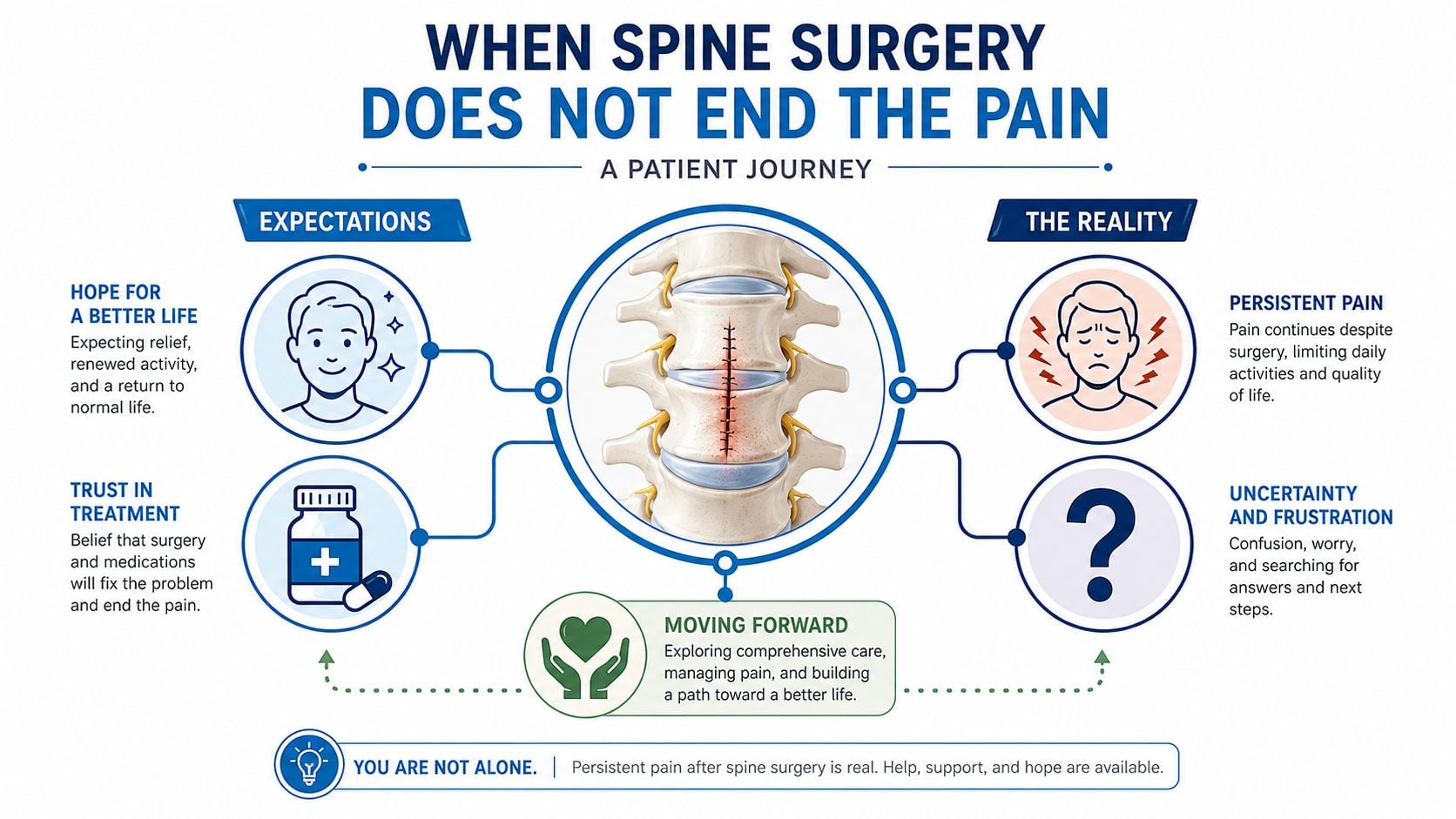
The label is clinical, not moral. It does not say the person was a bad candidate, and it does not prove the surgery was wrong. It says the pain generator is still active, or a new one has appeared, and the next step is to identify what kind of pain is being treated. A detailed consultation usually starts by asking whether the pain is mostly in the leg, mostly in the back, or mixed, because each pattern points in a different direction.
What the Diagnosis Means in Practice
In practice, the diagnosis is considered when pain lasts beyond the usual healing window, often around three to six months, or when pain returns after an initial improvement. That time frame matters because surgery triggers a long recovery arc, and not every ache in the first weeks means the operation has failed. But persistent pain that never settles, or pain that changes character after surgery, deserves a deeper look.
Practical rule: A surgical scar can be healed while the pain problem is still unsolved.
Patients also deserve a cleaner explanation of why the old label feels so discouraging. It collapses several different problems into one bucket, which is exactly why many specialty teams now use mechanism-based terms instead of a single catchall diagnosis. That shift is reflected in specialty care pathways, including the approach used in Interventional Pain Management's spine surgery resources, where the goal is to trace the pain back to its source rather than stop at the label.
Why Back Pain Survives Surgery
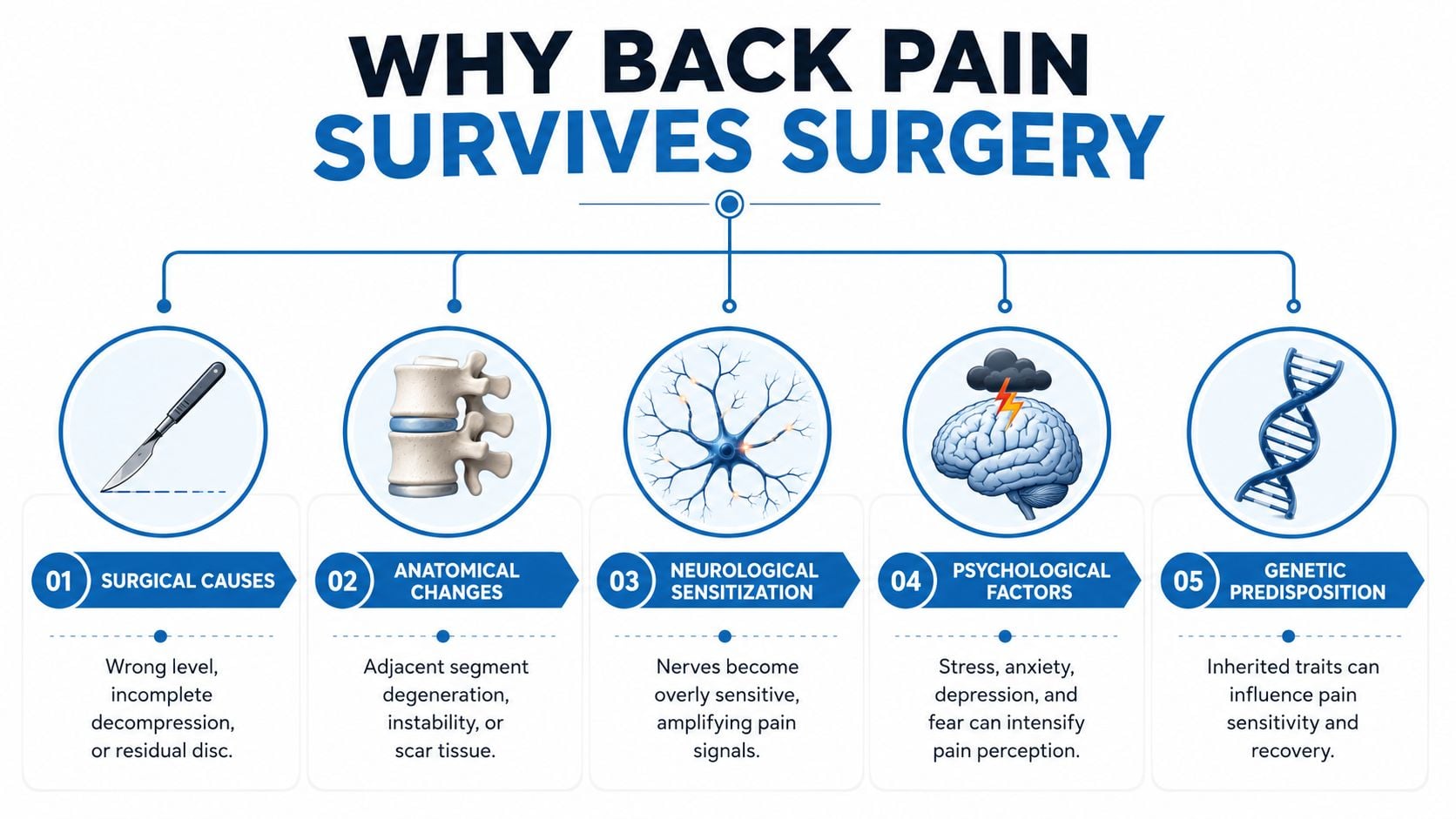
Pain can survive surgery for more than one reason, and that is the part many patients never get told clearly. Some causes are technical, some are biological, and some are related to how the nervous system has adapted after months or years of pain. A useful way to think about it is to separate the problem into surgical, anatomic, scar-related, and nervous system causes, because those categories lead to different next steps.
The Technical Misses That Matter Most
One of the most actionable technical problems is inadequate decompression of the lateral recess or neural foramina, which accounts for about 25% to 29% of cases tied to poor surgical technique (NCBI Bookshelf). That figure matters because it explains how a postoperative scan can look “done” while a nerve root is still being pinched. If the foramina are still tight, the nerve can keep sending pain signals even after a well-intended operation.
Wrong-level surgery and treating only one level when more than one level is causing symptoms are also avoidable causes of ongoing pain. Hardware irritation can join the picture too, especially when implants are prominent or not well tolerated. In plain language, a spine can be fused correctly and still hurt if the original pain source was misidentified or only partly treated.
The Biology That Keeps Pain Alive
Other causes aren't about a missed cut or a loose screw. Scar tissue, also called epidural fibrosis, can tether nerve roots and make them painful when they move. Disease can also progress at nearby levels after surgery, so the operated segment isn't the only structure worth reviewing. A patient who had one disc problem may later develop another level that now carries the load.
Psychological vulnerability also belongs in the cause list. Anxiety, depression, and poor coping can amplify pain and make recovery harder, not because the pain is imagined, but because pain processing is influenced by the whole person. When clinicians understand that, they stop asking whether the pain is “real” and start asking which mechanism is dominant.
For people trying to understand the mental side of chronic pain, a practical overview like this chronic pain and coping guide can be useful alongside medical evaluation. And for readers with degenerative disc disease, it helps to compare the current pain pattern with the original spine problem, which is why the broader context in degenerative disc disease care matters so much.
Symptoms and the Workup That Actually Pinpoints the Problem
The symptom pattern usually gives away more than the scan does. Radicular pain tends to shoot, burn, tingle, or travel down the leg in a nerve-like pattern. Axial pain stays centered in the low back, feels deeper and heavier, and often worsens with standing, twisting, or prolonged sitting. Scar-related pain can feel strange, tight, or electric, especially when movement pulls on sensitized tissue.
What a Serious Evaluation Includes
A thorough visit starts with symptom mapping. The patient should be able to say where the pain starts, where it travels, what sets it off, and what eases it, even if only a little. Prior operative notes matter too, because the exact level, approach, implants, and any intraoperative complications change the way the next workup is interpreted.
Fresh imaging is usually part of the picture, and contrast MRI is often used when clinicians need to separate scar from new compression. That distinction is important because scar tissue and recurrent disc material can look similar without the right study. Targeted diagnostic blocks are also useful, because a temporary numbing response can confirm whether a suspected pain generator is really the one driving the symptoms. A focused explanation of that process is available through nerve block evaluation.
Ask for a diagnosis that names the pain generator, not just the surgery site.
Why the Whole Person Still Matters
Good workup doesn't stop at anatomy. Screening for anxiety, depression, and coping burden is part of serious spine care because those factors change how pain is experienced and how treatment is tolerated. A patient with strong leg pain and clear nerve symptoms needs a different plan than a patient whose main problem is diffuse back pain plus high distress and limited function.
A specialty clinic should be able to explain whether the next concern is recurrent compression, scar tethering, mechanical irritation, or a more generalized pain state. If nobody can describe the pain in those terms, the workup probably hasn't gone far enough.
Matching Treatment to the Type of Pain You Have
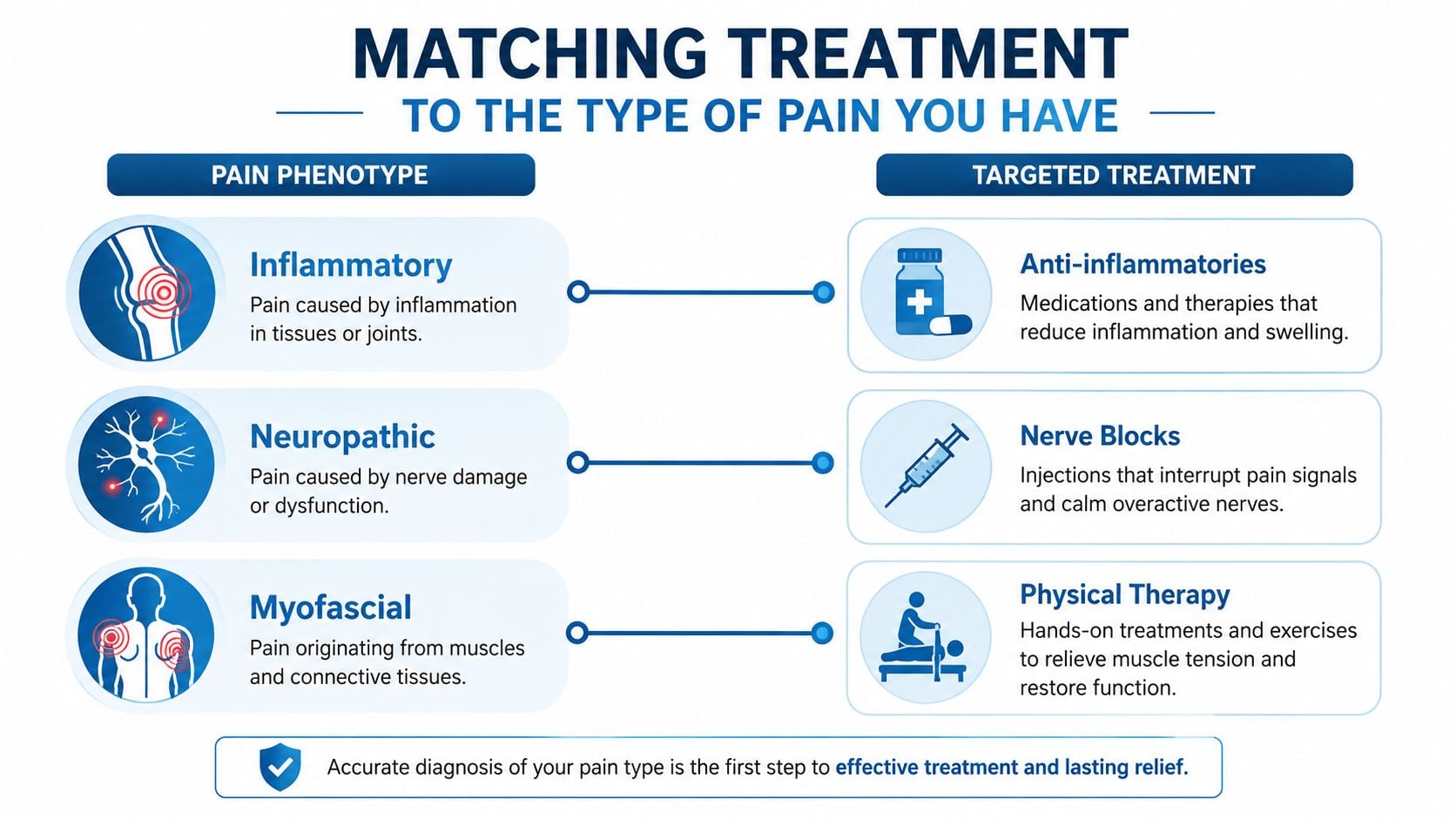
The biggest mistake in managing failed back surgery syndrome is treating it like one condition with one answer. That approach is too blunt. The better approach is to match the treatment to the pain phenotype, because radicular pain, axial pain, and scar-related pain don't all respond to the same intervention.
Conservative Care for Axial or Mild Mixed Pain
When the pain is mostly axial, or when neuropathic features are mild, conservative care usually belongs at the foundation. That can mean targeted physical therapy, graded exercise, medication optimization, and weight management when appropriate. These steps don't undo structural problems, but they can reduce mechanical load and calm secondary muscle guarding.
Practical rule: If movement patterns and deconditioning are driving the pain, the first treatment should not be another implant.
Conservative care also matters because it buys time to see whether the pain is stabilizing or evolving. Some people need a reset in movement mechanics, not another procedure. Others need a combination of medicine and rehabilitation before any device or injection can be judged fairly.
Interventions for Radicular or Scar-Driven Pain
When the pain is nerve-centered, interventional procedures make more sense. Epidural steroid injections, selective nerve blocks, radiofrequency ablation, and adhesiolysis are all tools that target specific generators rather than the whole back. Scar-related pain is one area where this precision matters, because the goal is to interrupt the pain source that tethered tissue is feeding.
Coverage and access often shape how patients move through this phase, so it helps to understand insurance considerations for chronic conditions before a plan is set in stone. The right procedure can still be the wrong fit if it isn't coordinated with the patient's benefits, timeline, and functional goals.
Neuromodulation for Persistent Neuropathic Leg Pain
Spinal cord stimulation is usually considered when pain is predominantly neuropathic, especially leg pain, and when conservative care plus any clearly indicated surgery have not solved the problem. Reviews consistently treat this as a better match for radicular pain than for nonspecific axial pain. In other words, it is not a universal answer, but it can be a strong one for the right pain phenotype.
That is why mechanism-based selection matters more than the label itself. Two patients can both be told they have failed back surgery syndrome, but one may need rehabilitation and medication tuning while the other may be a neuromodulation candidate. A one-size-fits-all protocol misses that difference.
Why Repeat Surgery Has Sharply Diminishing Returns
A patient may sit in the exam room and ask the same hard question in plain language, should the operation be done again. The answer starts with a simpler question, is there a clear structural problem that surgery can fix. If there is no defined target, repeat operations usually help less each time, and that is one reason modern spine care has moved away from surgery alone.
A widely cited review reports that more than 50% of primary spinal surgeries are successful, but the chance of a successful outcome falls to no more than 30% after a second surgery, 15% after a third, and 5% after a fourth PMC review. Those numbers explain why surgeons become cautious before recommending another pass through scarred tissue. Each reoperation has to work around more fibrosis, altered anatomy, and a higher chance that the main pain source is somewhere else entirely.
The size of the surgery-first approach also helps explain why these choices carry so much weight. The same review notes that the annual direct cost of spinal fusion surgery in the United States was over US$16 billion in 2004 PMC review. The figure is old, but it still shows how large the surgical burden is and why getting the first operation right matters so much.
When Revision Surgery Still Makes Sense
Revision surgery still has a place when imaging and symptoms point to a fixable problem. Recurrent disc herniation, hardware loosening, adjacent-level disease with new compression, or a nerve that was not fully decompressed can justify another operation. The target has to be visible and believable, not just assumed.
In the clinic, pain type matters. A patient with clear radicular pain, such as leg pain that follows a nerve pattern, is in a different category from someone whose pain is mostly axial, centered in the low back, or from scar-related pain that comes from tethered tissue. Revision surgery is more likely to help the first group when there is a matching structural cause. The other two groups often need a different pathway, because another operation can reopen the same problem without changing the generator.
If the pain is diffuse and the anatomy is unclear, another surgery is more likely to repeat the disappointment.
Patients should ask direct questions before agreeing to another procedure. What exactly is the pain generator, what new structure is being corrected, and what would make the revision a success rather than another incomplete fix. Those answers matter more than the word “revision” itself.
How a Multidisciplinary Team Coordinates Your Care
FBSS care works best when the right specialists talk to each other instead of sending the patient in circles. A strong team usually includes interventional pain management, orthopedic spine surgery, physical therapy, and behavioral health, with case management when access or insurance is complicated. That mix matters because pain after surgery is rarely one-dimensional.

What Each Discipline Actually Adds
Pain management can clarify the pain generator and perform targeted blocks or injections. Spine surgery can decide whether there is a true structural problem that should be revised. Physical therapy helps restore movement tolerance and reduces guarding, while behavioral health addresses anxiety, depression, and pain coping that can otherwise derail progress.
A coordinated clinic also shortens the gap between diagnosis and action. In a multi-specialty setting, one visit can lead to imaging review, procedure planning, and surgical opinion without forcing the patient to rebuild the story at every door. That matters for people who are already exhausted by repeated appointments and mixed explanations.
Why Local Access Changes the Experience
For patients in New Jersey and Staten Island, local access can be the difference between moving forward and drifting. A practice such as Interventional Pain Management and Ortho-Spine Center brings board-certified physicians across pain management, anesthesiology, orthopedics, and spine surgery into one system, with multiple locations and seven-days-a-week scheduling. That kind of structure is useful when the plan may include conservative care, injections, spinal cord stimulation, or surgical reassessment, depending on the pain phenotype.
The point isn't that one office solves everything. The point is that FBSS usually needs coordinated decision-making, not a single rushed recommendation. When the team can compare anatomy, symptoms, and function together, the patient gets a clearer path.
Choosing the Right Clinic and What to Ask First
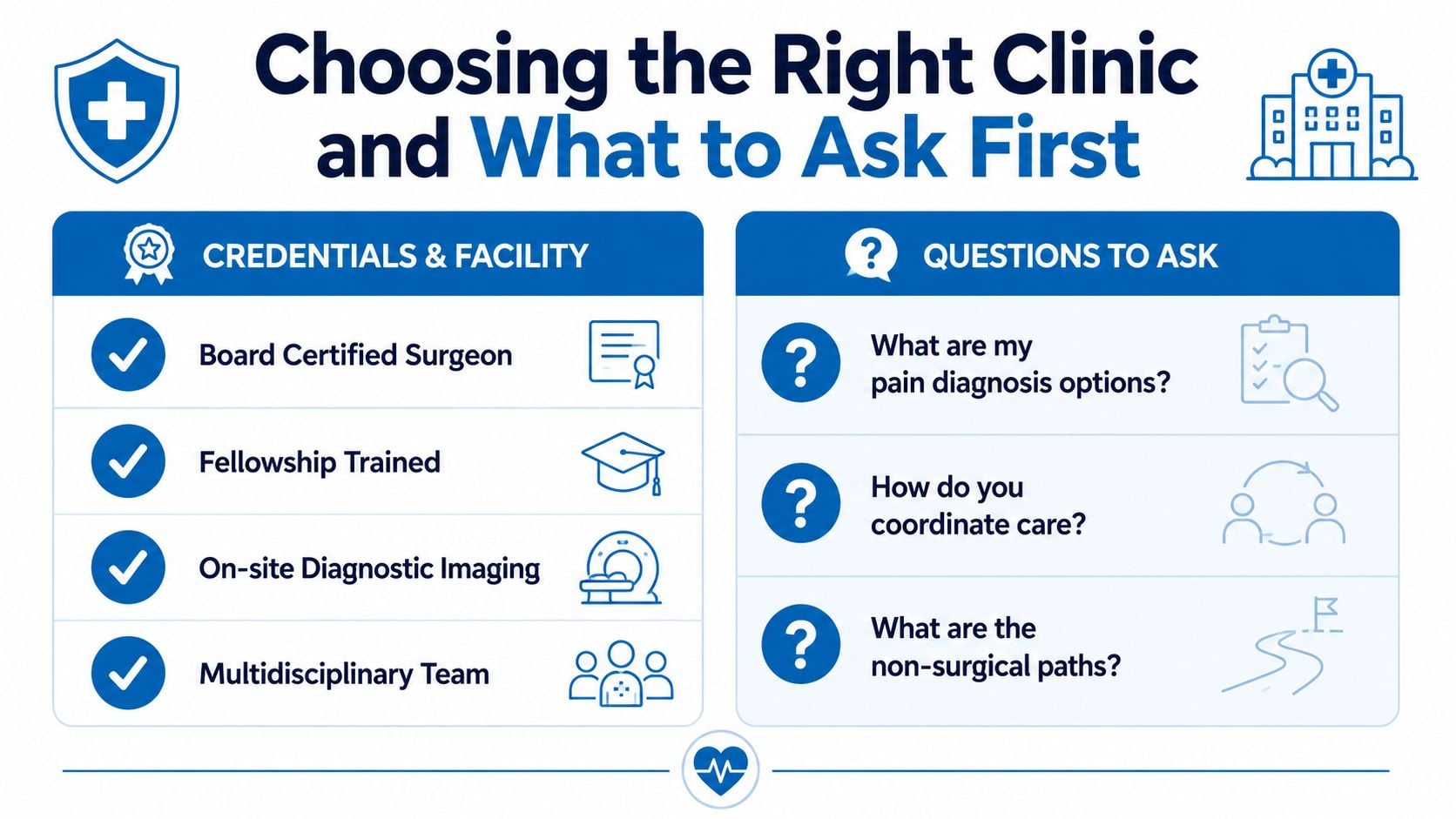
A good FBSS clinic should be able to prove two things quickly, that it understands the diagnosis and that it has more than one treatment lane. Look for board certification, fellowship training, access to imaging review, and a multidisciplinary structure. If the only answer offered is more surgery, the evaluation is probably too narrow.
Questions Worth Bringing to the First Visit
- What pain generator do you think is driving the symptoms? The answer should name a likely source, not just repeat the surgery history.
- What are the non-surgical paths? A serious clinic should be able to explain conservative care, injections, blocks, or neuromodulation when appropriate.
- How do you coordinate care? Patients do better when the clinic can connect the surgical, procedural, and rehabilitation pieces.
Access also matters. Multiple locations, help with transportation, and insurance navigation make it easier to stay in care long enough to find out what works. If a clinic can't discuss those details clearly, the treatment plan may be harder to complete than it needs to be.
A Brief FAQ
Can FBSS resolve on its own? Sometimes pain improves as healing continues, but persistent or worsening symptoms should be reassessed rather than waited out.
How long does a spinal cord stimulation trial last? The exact timing is set by the treating team, but the purpose is to see whether pain relief and function improve before any permanent implant is considered.
What red flags should prompt urgent reassessment? New weakness, bowel or bladder changes, fever, severe worsening pain, or sudden loss of function should never be ignored.
If pain has lingered after spine surgery, the next step is a careful re-evaluation, not another guess. Interventional Pain Management offers coordinated assessment, image-guided procedures, spine surgery consultation, and pain-focused care that can help match the treatment to the pain pattern. A patient who's stuck after surgery can visit Interventional Pain Management to start a more precise conversation about what's really causing the pain and what to do next.