
A rolled ankle during a pickup game can look minor for the first few minutes. The foot swells, walking feels awkward, and there's a strong temptation to either shake it off or shut everything down for a week. Sports injury treatment works better than either instinct, because the right response depends on what was injured, how badly, and how the body is likely to recover without losing strength or motion.
The first decision is rarely “Do surgery or do nothing?” It's usually whether the injury needs protection, imaging, rehabilitation, pain control, or a surgical opinion, sometimes in that order, sometimes not. A good recovery plan moves through those steps deliberately, because acute care, physical therapy, interventional pain procedures, and surgery each solve different problems.
Table of Contents
- Why Sports Injuries Need More Than a First-Aid Mindset
- Where Sports Injuries Are Treated
- The First 72 Hours After Injury
- How Multimodal Rehabilitation Works
- Interventional Pain Procedures and When They Are Used
- When Surgery Becomes the Right Next Step
- The Mental Side of Recovery Most Guides Ignore
- Choosing the Right Local Practice in New Jersey or Staten Island
Why Sports Injuries Need More Than a First-Aid Mindset
A weekend athlete lands on another player's foot, the ankle turns, and the first thought is often simple, “It's probably just a sprain.” Sometimes that is true. Sometimes the same-looking injury hides a fracture, a joint injury, or a problem that will not settle unless the first few days are handled the right way.
That is why sports injury treatment starts with triage, not bravado. Acute evaluation, imaging, immobilization, and follow-up planning matter because sports-related injuries have long been shaped by urgent decision-making, especially for sprains, fractures, superficial injuries, and head trauma. In the United States, sports-related injuries accounted for about 2.8 million emergency department visits in 2013 and 105,490 hospital inpatient stays, so ED visits were 27 times more common than inpatient admissions, and 63% of discharged ED visits were sprains, fractures, or superficial injuries, while fractures and intracranial injury represented 70% of sports-related inpatient stays, according to 2013 data from the AHRQ HCUP sports injury brief.
A common early mistake
The first error is undertreating a real injury because the pain does not feel dramatic. The second is over-resting an injury that needed early protection followed by timely loading. Those mistakes pull in opposite directions, but they lead to the same result, slower recovery and a higher chance of returning too soon.
A better mental model is a pathway. The first stage is to figure out what is injured and whether it can safely be treated conservatively. The later stages are to restore motion, rebuild strength, and decide whether a more advanced intervention belongs in the plan.
Practical rule: if the injury changes weight-bearing, joint stability, or normal movement, it deserves more than an ice pack and hope.
The key question is where the patient sits on the care spectrum, from simple protection to rehabilitation to procedural care to surgery. A sprain that is stable and improving may stay in conservative care. A tear that keeps causing instability, a fracture that needs immobilization or fixation, or pain that lingers despite appropriate loading may need a more specialized plan. Once that path is clear, the rest of the recovery plan is easier to follow.
Where Sports Injuries Are Treated
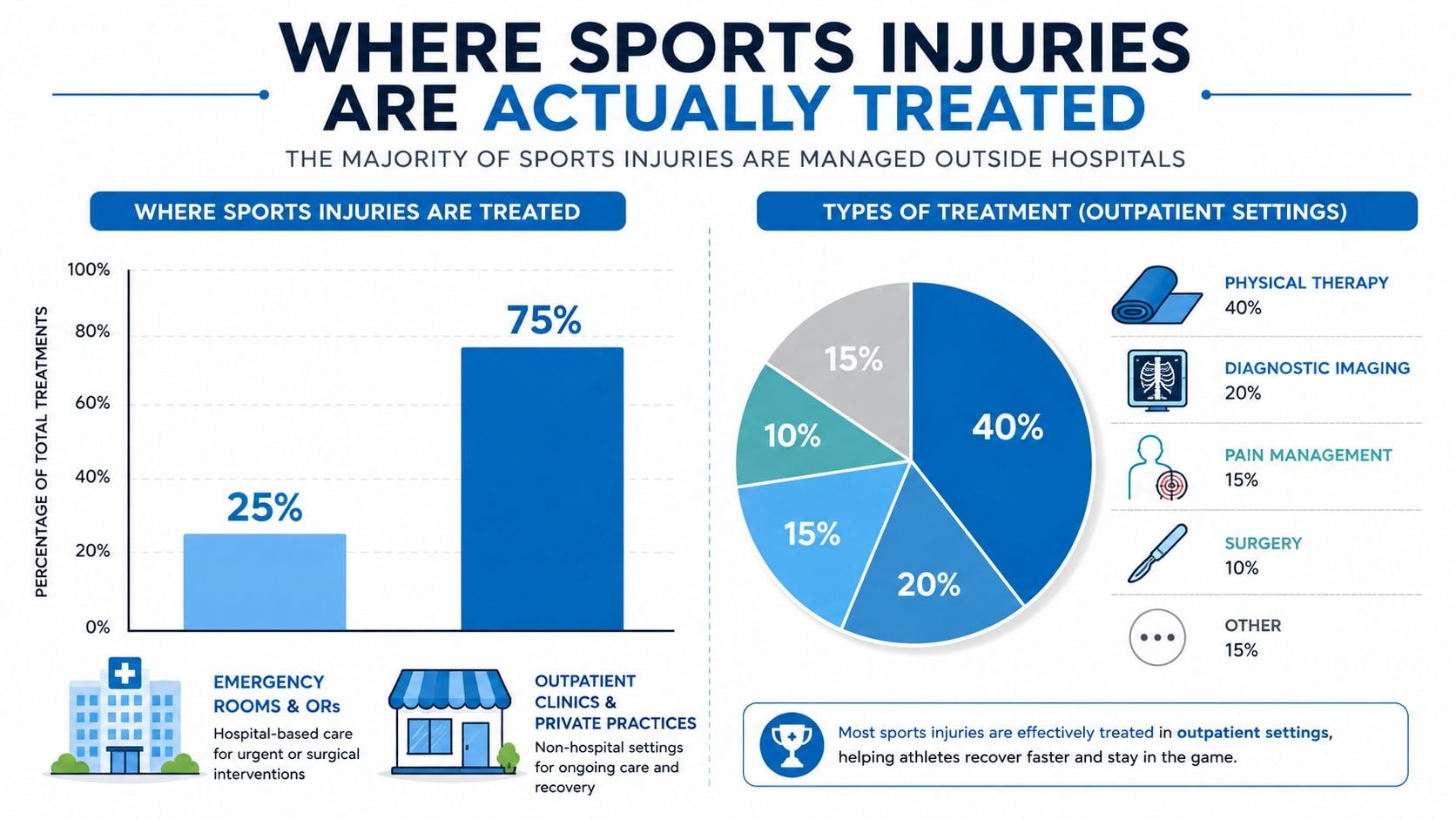
A pulled muscle after practice, a swollen ankle after a turn on the field, or lingering shoulder pain after a throw does not always start in the emergency room. In a National Center for Health Statistics report, the United States averaged 8.6 million sports- and recreation-related injury episodes per year, with an age-adjusted rate of 34.1 per 1,000 population, and 50.0% of those episodes were treated in a doctor's office or other health clinic without an ED visit or hospitalization (CDC NCHS report). A large share of care starts outside the hospital.
What that means for a patient
An outpatient clinic can do more than many patients expect. It can examine how the injury happened, decide whether imaging is needed, begin conservative care, and arrange referral when the problem is more complex. In organized-sport research from the same CDC report, only 8.9% of treated injuries reached a hospital setting, while physiotherapists treated 26.6% and general practitioners 15.6% of cases.
That pattern matters because it shows where recovery usually unfolds. The hospital is important for emergencies, but many sprains, tendon injuries, overuse problems, and spine-related complaints improve through coordinated outpatient care. The patient often does better when the first stop can also be the next stop, rather than a place that sends the patient elsewhere for every decision.
A clinic that can escalate care without restarting the conversation saves time, and it also reduces the chance that a problem gets lost between referrals.
Why a multi-specialty setting changes the path
A board-certified, multi-specialty team can move between conservative care, rehabilitation, interventional procedures, and surgical review without forcing the patient to repeat the same story at each visit. That matters for recurrent ankle sprains, ACL-type instability, spine pain with nerve symptoms, or injuries that need imaging and then a more precise plan.
The advantage is continuity. If the injury settles with rest and therapy, the patient stays on a non-operative path. If the exam suggests instability, locking, or nerve compromise, the plan can change quickly. That flexibility often separates a smooth recovery from a stalled one.
The First 72 Hours After Injury
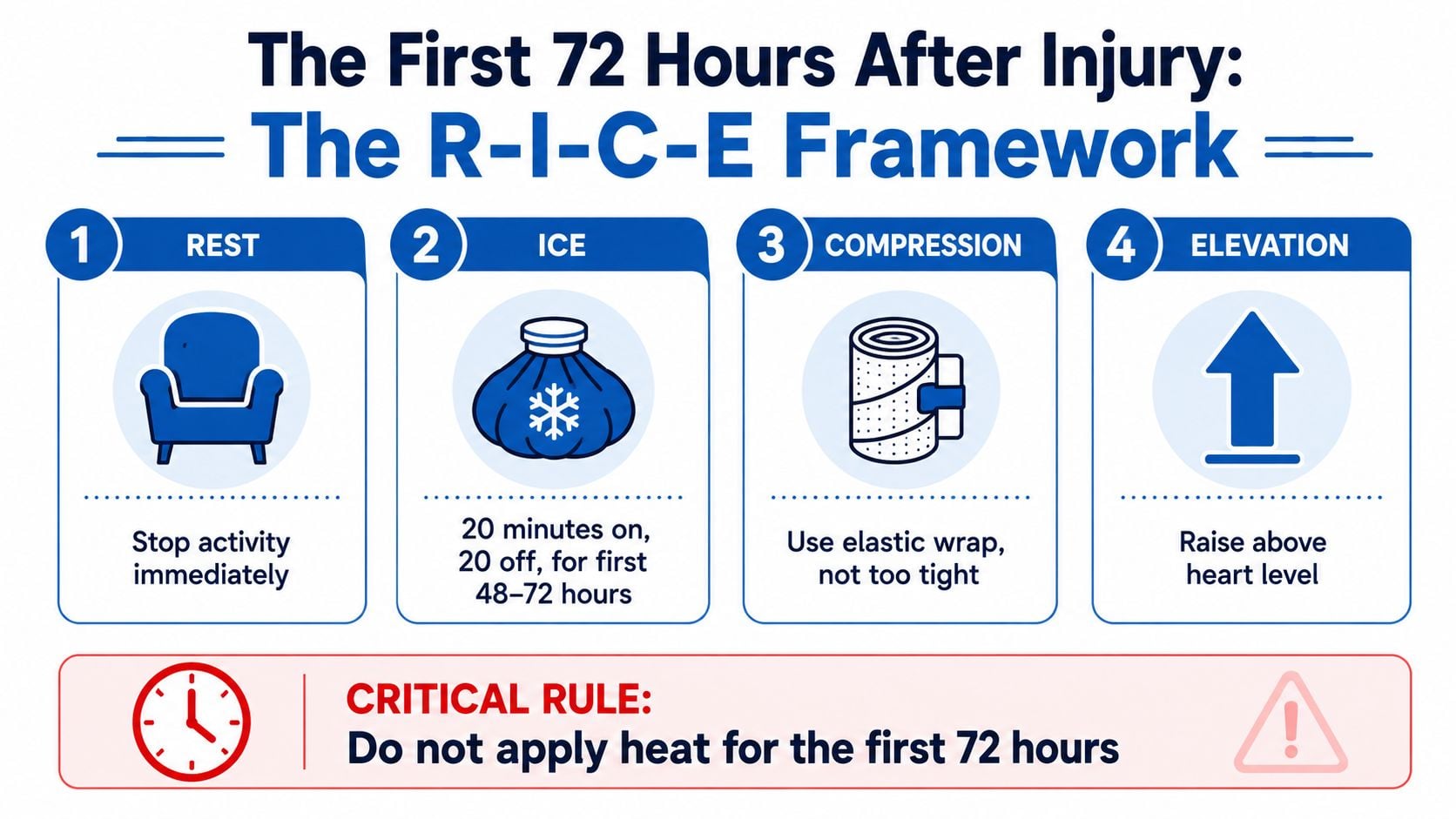
A fresh sports injury can feel minor at first, then stiffen, swell, and become harder to judge once the body has had time to react. The first three days are meant to keep that early reaction from causing more trouble. NIAMS recommends immediate immobilization for serious musculoskeletal injuries and the R-I-C-E protocol during the first phase, with ice for 20 minutes at a time, four to eight times per day, and no heat during the first 72 hours because warmth can increase inflammation and swelling (NIAMS sports injury guidance).
How to use R-I-C-E without overdoing it
Rest means stopping the activity that caused the injury and not repeatedly testing the painful area. A strained hamstring does not need sprint drills on day one, and a suspected finger dislocation does not need forceful checking. Protection matters more than proving you can tolerate it.
Ice helps with pain and swelling when it is used in the right window. NIAMS' timing is specific, 20 minutes at a time, four to eight times per day. Compression with an elastic wrap can help control swelling, but it should never be so tight that it causes numbness or discoloration. Elevation works best when the injured area is raised above heart level.
These steps are meant to calm the tissue, not to erase every symptom instantly. A little discomfort is expected, but worsening pain, spreading swelling, or a limb that feels increasingly tight deserves more attention.
What not to do
Heat is the biggest early mistake. NIAMS advises avoiding heat for the first 72 hours because it can increase inflammation and swelling (NIAMS sports injury guidance). That warning matters for a lateral ankle sprain, a hamstring strain, or a jammed finger, because the body is already in its inflammatory phase.
The rest-versus-loading trade-off shows up quickly here. Staying still for too long can lead to stiffness, loss of muscle tone, and slower recovery, but loading the area too early can also turn a manageable injury into a worse one. The practical middle ground is to protect the tissue long enough for the swelling and pain to settle, then begin movement in a controlled way once it is safe to do so. A sports medicine treatment pathway often starts with that conservative phase and then adds rehabilitation if the exam shows the injury needs more than home care.
Clinical checkpoint: if weight-bearing is impossible, deformity is visible, numbness appears, or pain escalates instead of easing, same-day evaluation is warranted.
A simple first-72-hour checklist can help, but the injury still has to be read in context. If the joint feels unstable, the pain is out of proportion, or motion is clearly blocked, home care has already reached its limit. For patients who are already coordinating follow-up care, a structured rehab plan like the Vanta Sports physiotherapy guide can help explain why early protection and later loading need to be balanced rather than treated as opposites.
How Multimodal Rehabilitation Works
A patient can do everything right in the first few days and still stall if recovery is treated like a single treatment problem. A twisted ankle may need swelling control first, then motion work, then strength, then balance, then a return to cutting drills. A sore shoulder after a collision may need protection early, then guided loading once the tissue tolerates it. That is the basic logic of multimodal rehabilitation, and the sports rehabilitation review describes it as a cycle of defining the injury, identifying the mechanism and cause, applying a rehabilitation plan, and then checking the outcome against the original injury pattern. The plan stays tied to the injury, not to a fixed calendar.
Why one therapy alone usually falls short
The strongest recovery plans are usually multimodal. Manual therapy can ease stiffness and make movement feel less guarded. Progressive strength and conditioning rebuild the capacity that disappeared when the athlete stopped using the area normally. Proprioception training matters after ankle, knee, and other joint injuries because stability depends partly on how well the body senses position and reacts to load. Psychological support belongs in the plan too, especially when fear, hesitation, or poor confidence changes the way someone moves.
A single treatment rarely covers all of that. Pain relief can make a person feel better before the tissue is ready for hard use, which is where confusion often starts. A knee may settle down enough to walk without much discomfort and still lack the strength, control, or range of motion needed for sprinting, cutting, pivoting, or contact. That gap is why a clinic pathway matters. A sports medicine treatment pathway can begin with conservative care, then add rehabilitation, then escalate if the exam shows the injury is not responding the way it should.
Return-to-play has to be functional
Return-to-play decisions should be made from function, not wishful thinking. The clearest checkpoints are restored strength, joint stability, range of motion, and sport-specific tolerance. The same sports rehabilitation review notes that these are the benchmarks that show whether an athlete is ready to resume the demands of play. If those pieces are still missing, the athlete is not ready, even if normal walking feels fine.
| Return-to-Play Readiness Factors | Specific Benchmark | Why It Matters |
|---|---|---|
| Strength | Near-normal force production in the injured limb or joint | Helps prevent compensatory movement and repeat injury |
| Stability | No giving way, slipping, or sense of joint looseness | Supports safe cutting, landing, and contact |
| Range of Motion | Movement that matches the demands of the sport | Reduces altered mechanics and overload |
| Sport-Specific Tolerance | Ability to practice the actual movements of the sport | Tests whether the tissue can handle real use |
For patients who want a clearer picture of how therapy sessions turn into day-to-day recovery work, the Vanta Sports physiotherapy guide is useful because it shows how early protection, guided exercise, and later loading fit together instead of competing with each other.
The same approach also fits a coordinated clinic model, where rehabilitation is matched with imaging, injections, or referral if progress slows. A general treatment overview from the clinic side is outlined in the Interventional Pain Management treatment services.
Interventional Pain Procedures and When They Are Used
When pain becomes the main barrier, not the only problem but the main barrier, interventional care can be the next step. These procedures are designed to reduce pain enough that the patient can move, rehab, and heal more effectively. They are not interchangeable, and they don't all solve the same kind of pain.
Different procedures for different pain patterns
Epidural steroid injections are typically used for radicular spine pain, where an irritated nerve root sends pain down the arm or leg. Nerve blocks can help when a specific nerve is identified as the source of irritation. Trigger point injections are often used for myofascial pain, where tight, painful muscle bands keep the area guarded and inflamed. Spinal cord stimulation is reserved for chronic neuropathic pain or post-surgical pain syndromes when simpler measures have plateaued.
A helpful way to think about them is this. Conservative care tries to let tissue calm down on its own. Interventional care tries to lower the pain signal enough that function can return while the underlying problem continues to be addressed.
What these procedures can and can't do
They can reduce pain, improve tolerance for therapy, and buy time for healing. They can't knit a torn ligament back together, replace cartilage, or make an unstable structure mechanically stable. That's why the diagnosis has to be accurate before any procedure is chosen.
If the injury is a spine problem with nerve irritation, the question is whether the pain pattern fits. If the injury is myofascial, the question is whether the muscle is the driver rather than a nearby joint or disc. If the diagnosis is wrong, even a technically successful procedure can miss the issue.
Useful rule: an injection should support rehab, not replace it.
For a patient-oriented summary of how muscle pain procedures fit into care, see the trigger point injection overview. The value of this approach is timing. It's often appropriate when conservative care has plateaued, but the injury doesn't yet call for surgery.
When Surgery Becomes the Right Next Step
Surgery is not the failure of treatment. It's the correct tool for the wrong kind of problem to leave alone. The clearest surgical indications are mechanical instability, joint displacement or locking, fractures with displacement, progressive neurological deficits, and structural lesions that have failed a documented course of conservative and interventional care.
The structural problems that push care toward surgery
An ACL or MCL tear with functional loss can leave the joint unreliable for pivoting and cutting. A displaced fracture needs alignment, not repeated rest. A locked joint can't fully do its job if something inside is physically blocking motion. Progressive numbness or weakness changes the urgency because nerve compromise is not something to watch casually.
Those are not cosmetic complaints. They are mechanical or neurologic problems, and they belong in a surgical conversation when the exam and imaging line up with that need.
Modern surgical care can be minimally invasive, arthroscopic, or more extensive depending on the diagnosis. In spine care, that may include endoscopic decompression, fusion, or scoliosis correction when the anatomy and symptoms justify it. In orthopedics, the goal is the same, restore stability, relieve blockage, and repair or replace the structure that conservative care can't fix.
Why the right timing matters
A patient shouldn't push for surgery just to get back faster. The choice has to match the tissue problem. A mild strain doesn't need a surgeon, and a clearly unstable knee doesn't benefit from endless conservative delay.
The useful question is whether the injury has crossed from “can heal with protection and rehab” into “needs structural correction.” Once that line is crossed, surgery can be the most efficient route back to safe function.
The Mental Side of Recovery Most Guides Ignore
A body part can look healed while the patient is still hesitant, guarded, or overwhelmed. That's not a motivational issue, it's part of the clinical picture. A multidisciplinary rehabilitation study of Division I athletes found that mental-health supports were among the most missed services during injury rehab, and broader sport-medicine scholarship points to pressure to return, willingness to follow restrictions, and the availability of trained staff as ongoing issues during recovery (WVU rehabilitation study).
Why fear changes movement
Pain can make athletes move differently. They protect the injured area, shorten the stride, stiffen the shoulder, or avoid loading the knee fully. That guarding may feel safer in the moment, but it can slow progress and create a new pattern of compensation.
The same issue shows up in adherence. If a coach, employer, or teammate pushes for a quick return, the athlete may ignore restrictions even when the tissue isn't ready. That turns a healing problem into a re-injury problem.
For patients who need structured behavioral support alongside physical recovery, it can help to find CBT for pain in Arizona through reVIBE Mental Health, especially when fear, frustration, or persistent pain is interfering with rehab.
Return-to-play readiness factors
| Readiness Domain | Specific Benchmark | Why It Matters |
|---|---|---|
| Physical Function | Strength, stability, and motion are back for the sport's demands | Reduces re-injury risk |
| Pain Response | Pain is controlled without guarded movement | Prevents altered mechanics |
| Confidence | The athlete can perform sport tasks without freezing up | Supports full participation |
| Adherence | Restrictions and home exercises are followed consistently | Keeps the rehab plan on track |
Persistent pain, guarded movement, and poor adherence can all complicate outcomes even when the structural injury is simple. That's why return to sport has to reflect both tissue healing and behavior. If either piece is missing, the recovery isn't finished yet.
Choosing the Right Local Practice in New Jersey or Staten Island
A strong local practice should make the next decision easier, not harder. For athletes and active adults in New Jersey or Staten Island, the best fit is usually a team that can evaluate the injury, coordinate imaging, and move between non-invasive care, procedures, and surgery without friction. The practice should also be able to explain insurance, scheduling, and follow-up clearly from the first visit.
What to look for first
A board-certified, multidisciplinary team matters because sports injuries don't always stay in one lane. Pain management, orthopedics, and spine care should be coordinated, not competing. The practice should also have access to diagnostic review and treatment planning on site, so the patient isn't stuck waiting for separate opinions just to find the starting point.
A practical local option should also be easy to reach when symptoms flare or recovery stalls. The Staten Island location page is a useful place to confirm access and scheduling details for patients who need care close to home.
Red flags that should bypass routine scheduling
- Inability to bear weight: This can point to a more serious joint or bone problem.
- Visible deformity: That raises concern for dislocation or fracture.
- Progressive numbness or weakness: Nerve involvement needs prompt attention.
- Symptoms that worsen overnight: Deterioration instead of improvement deserves urgent review.
A good practice should be able to match the injury to the right level of care on the first visit and stay involved through the whole process. That means conservative management when appropriate, interventional care when pain blocks progress, and surgical referral when the structure itself needs correction.
If a sports injury isn't improving the way it should, Interventional Pain Management can help connect the dots between diagnosis, treatment, and recovery. Visit Interventional Pain Management to explore a coordinated approach that can move from conservative care to procedures or surgical evaluation when the injury calls for it.