
The MRI report can feel like a verdict. A person walks in with back pain, leaves with the phrase degenerative disc disease, and suddenly every possible treatment seems to be on the table, from stretching to injections to surgery. That's where the confusion usually starts, because the diagnosis names the disc, but it does not automatically tell the whole story of the pain.
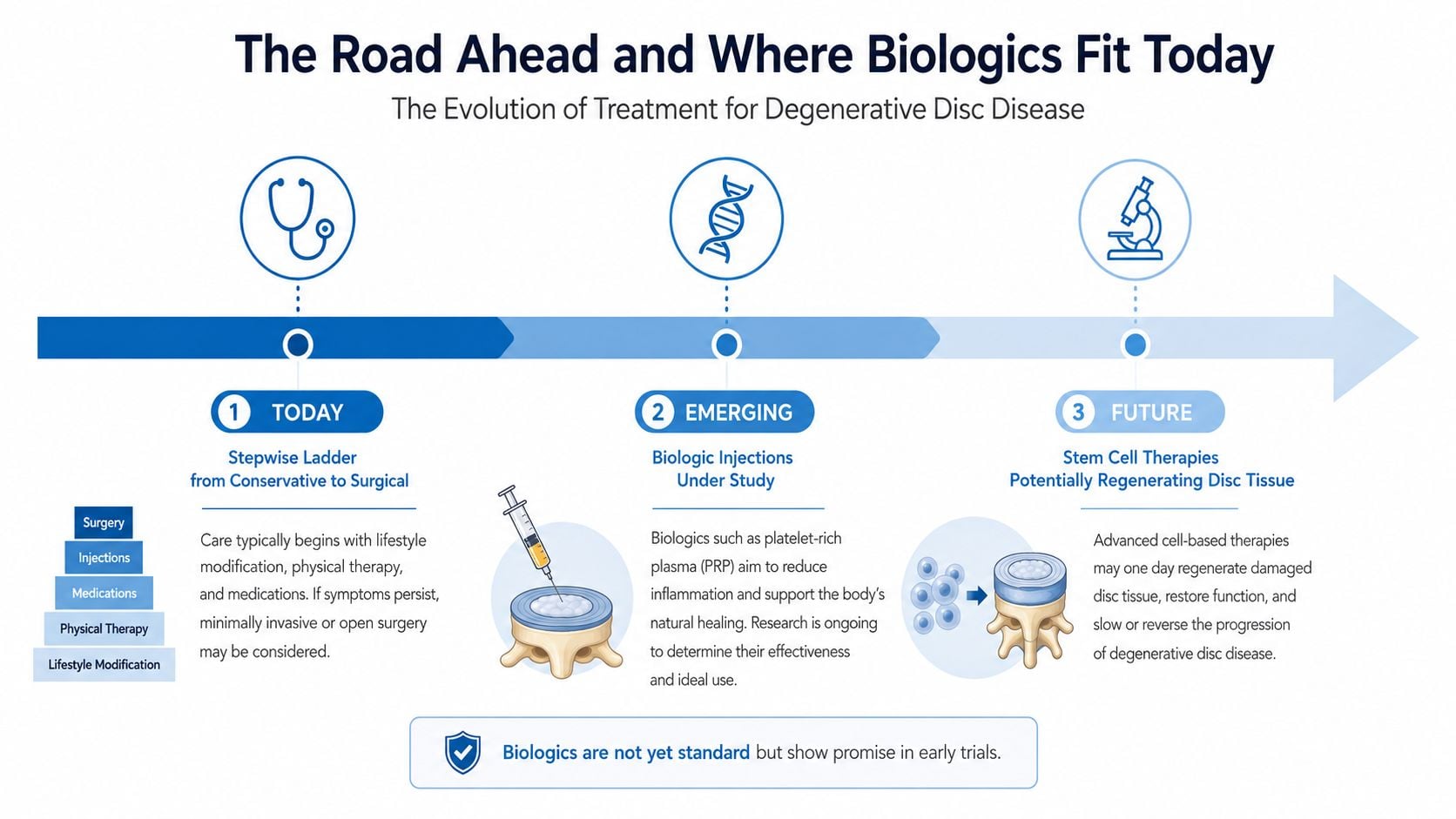
The cleanest way to think about treatment options for degenerative disc disease is as a ladder. Most major academic centers still begin with conservative care, then move to image-guided injections or other minimally invasive procedures when symptoms fit that branch, and reserve surgery for persistent or severe cases. That stepwise model has stayed remarkably consistent across decades, even as the menu of procedures has expanded, because most cases do not need immediate surgery and many people improve without it (historical review and academic-center guidance).
The key is matching the treatment to the pain pattern. Discogenic pain, radicular pain, and facet-mediated pain are not the same problem, so they should not travel down the same branch of the ladder. Once that distinction is clear, the whole plan becomes easier to read.
Table of Contents
- When the MRI Shows Disc Degeneration
- Understanding Degenerative Disc Disease and Identifying the Pain Source
- Effective Conservative Care Options
- Image-Guided Injections and Nerve Blocks
- Surgical and Advanced Options Worth Considering
- Recovery Timelines and When to Call Your Physician
- How a Multidisciplinary Team Builds Your Plan
- The Road Ahead and Where Biologics Fit Today
When the MRI Shows Disc Degeneration
The hardest part is often the moment after the scan. The report uses words like degeneration, height loss, or disc wear, and it can sound as if surgery is already next. In reality, the MRI is only one piece of the story, and major centers still start with symptom control, rehabilitation, and selective escalation rather than rushing straight to an operation (academic-center guidance).
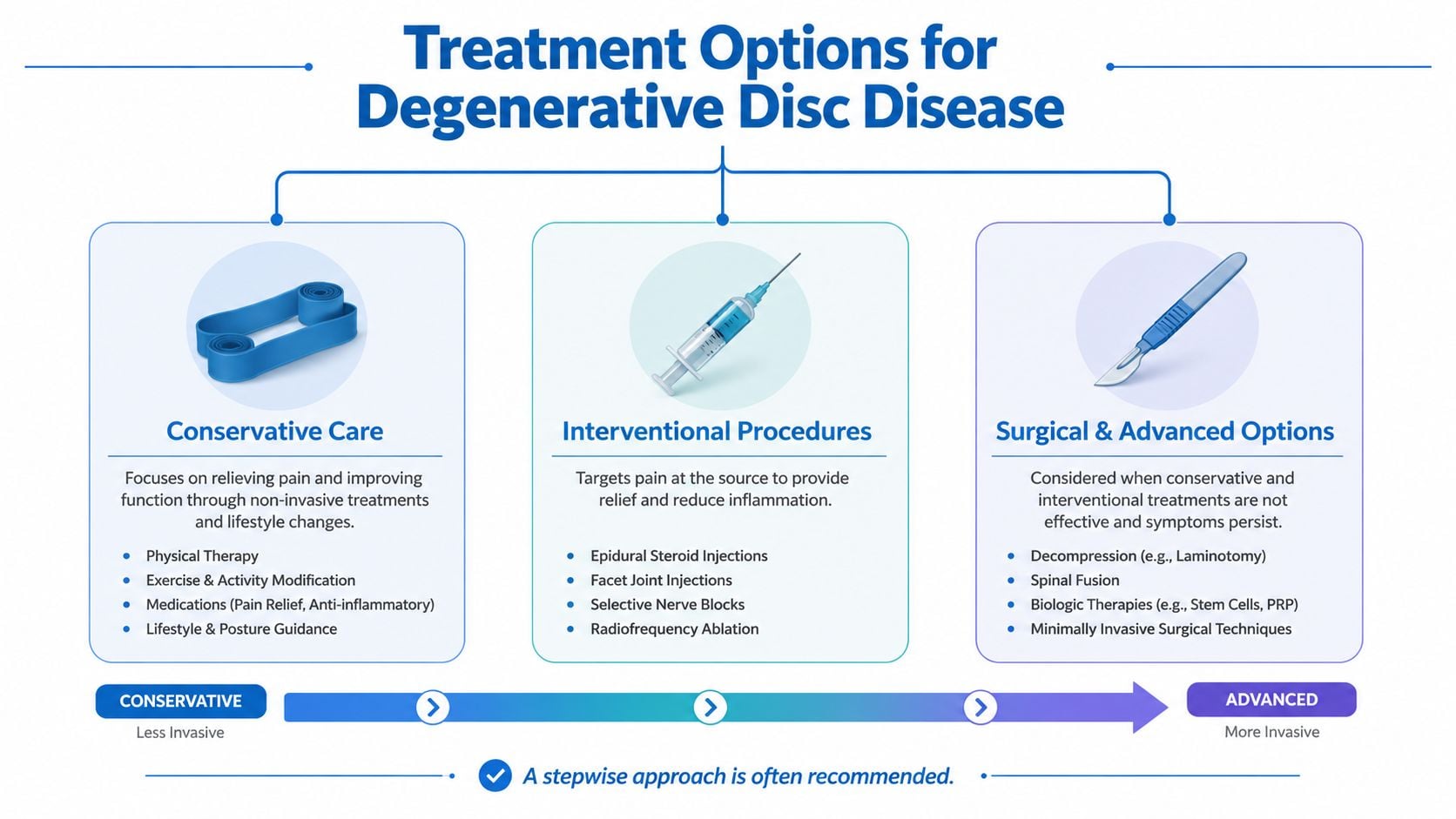
The ladder matters more than the label
A stepwise plan helps avoid two common mistakes. One is treating every abnormal MRI like a surgical emergency. The other is assuming that because pain has lasted a while, the only answer must be an operation.
Practical rule: the MRI describes structure, but the treatment decision follows symptoms, function, and exam findings.
That is why the same scan can lead to very different plans. A person with back-only aching may stay on the conservative rung. Someone with leg pain from nerve-root irritation may move toward an injection. A patient with weakness or persistent disabling pain after nonoperative care may need a surgical conversation.
The important reassurance is simple, a diagnosis is not a sentence to surgery. Conservative-first care remains the core philosophy because it works for many people, and because the spine often improves enough to make the more invasive steps unnecessary.
Understanding Degenerative Disc Disease and Identifying the Pain Source
A healthy spinal disc works like a cushion between the bones of the spine. With age and wear, it can lose water content, flatten a bit, and absorb shock less effectively. Those changes matter, but they do not tell the whole story. The key question is still the same, where is the pain coming from?
Three pain patterns, three different branches
Discogenic pain means the disc itself is the pain generator. It often shows up as localized low back or neck pain, stiffness, and pain that worsens with loading or certain positions. Radicular pain is different, because it means a nerve root is irritated or compressed, so pain can travel into the arm or leg. Facet-mediated pain comes from the small joints in the back of the spine, and it often feels more mechanical, with pain that flares during extension, twisting, or rotation.
The pattern matters because each branch points to a different treatment path. A patient whose pain stays in the back and worsens with sitting or bending may fit a disc-driven picture. A patient with pain that shoots into a limb may be following a nerve-root branch. A patient whose pain sharpens with extension or rotation may be dealing with the facet joints instead. The spine can wear in more than one place, so the symptom pattern helps sort out which structure is doing most of the talking.
Imaging helps, but it does not identify pain by itself. A worn disc on MRI can appear in someone with little or no symptoms, while a painful back can sometimes show only modest-looking changes. That mismatch is one reason the history and physical exam matter so much. The scan gives part of the picture. The exam shows how the spine behaves in real life.
Why the pain source changes the treatment
If the pain is mainly discogenic, care usually starts with symptom control and stabilization. If the pain is radicular, the problem is often the irritated nerve pathway, so the next step may shift toward calming that nerve. If the pain behaves like facet pain, the treatment branch changes again, because the target is no longer the disc alone.
The smartest treatment plan follows the pain pattern, not the prettiest or worst-looking image.
That is the value of understanding the diagnosis. Readers can start to recognize whether they are dealing with back pain from the disc, leg pain from a nerve, or joint-driven pain from the back of the spine. Once that pattern is clear, the rest of the ladder starts to make sense.
Effective Conservative Care Options
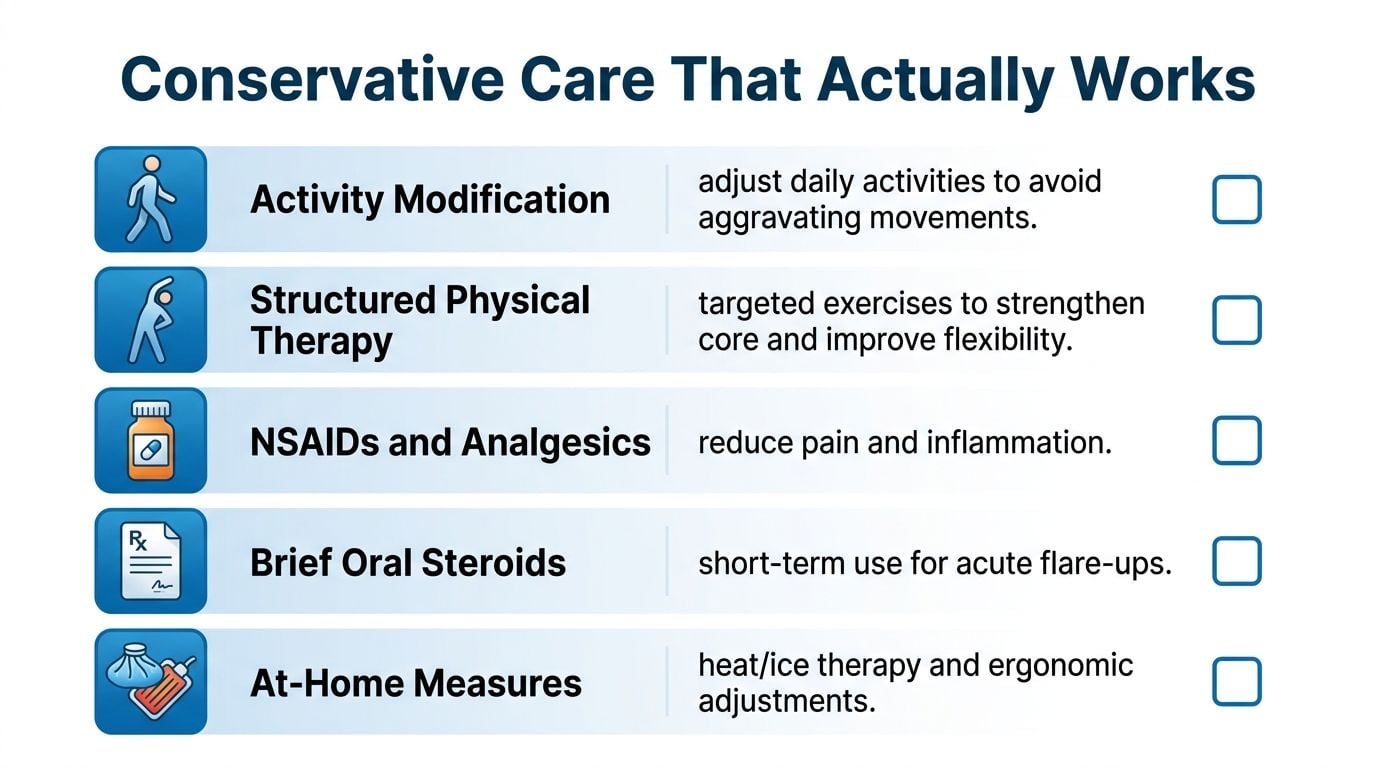
Clinical guidelines recommend starting with conservative care. That does not mean doing nothing while the spine settles on its own. It means using targeted tools to lower irritation, control pain, and rebuild the support system around the spine. Major centers still list heat or ice, activity modification, oral medications, physical therapy, and epidural steroid injections before any surgical referral is considered (academic-center guidance).
What each conservative tool is doing
Activity modification changes the movement pattern that keeps triggering pain. That may mean breaking up long sitting periods, avoiding repeated bending or twisting during a flare, or spacing chores so the back is not asked to do too much too fast. The goal is not permanent rest. Long avoidance usually makes the spine less tolerant, not more.
Structured physical therapy rebuilds the system that supports the spine. A good program usually focuses on trunk stability, movement tolerance, and a gradual return to daily tasks, rather than generic exercises alone. Some patients need mobility work first, while others need stabilization first, but the point stays the same, teach the body to tolerate normal life again.
NSAIDs and analgesics target the pain and inflammatory part of the problem. They do not reverse disc wear, but they can reduce the pain signal enough for a person to move, sleep, and take part in rehab.
Brief oral steroids can help during a flare when inflammation is more intense, especially if a temporary bridge is needed.
Heat, ice, and ergonomic changes are simple, but they matter. A supportive chair, a better desk setup, smarter lifting, and the right temperature therapy can make the difference between a day that spirals and a day that settles.
The hopeful part is that conservative care often does enough. Major academic guidance notes that about 80% of acute radiculopathy, or sciatica, improves with conservative treatment (Mayo Clinic Health System). That does not mean every case is easy, but it does explain why this rung stays first.
If symptoms still point to a clear nerve-root pattern after a fair trial of these measures, the next step may be an injection-based branch of the ladder. For a closer look at one of those options, see epidural steroid injection guidance from Interventional Pain Management.
Image-Guided Injections and Nerve Blocks
A patient may reach this rung of the ladder after conservative care has helped only part of the way, yet the pain pattern is still clear. Pain that travels into the leg or arm often points toward nerve-root inflammation. Pain that stays centered in the low back and behaves more like facet pain points somewhere else. The procedure should match the pattern, because injections work best when the target is chosen for a reason.
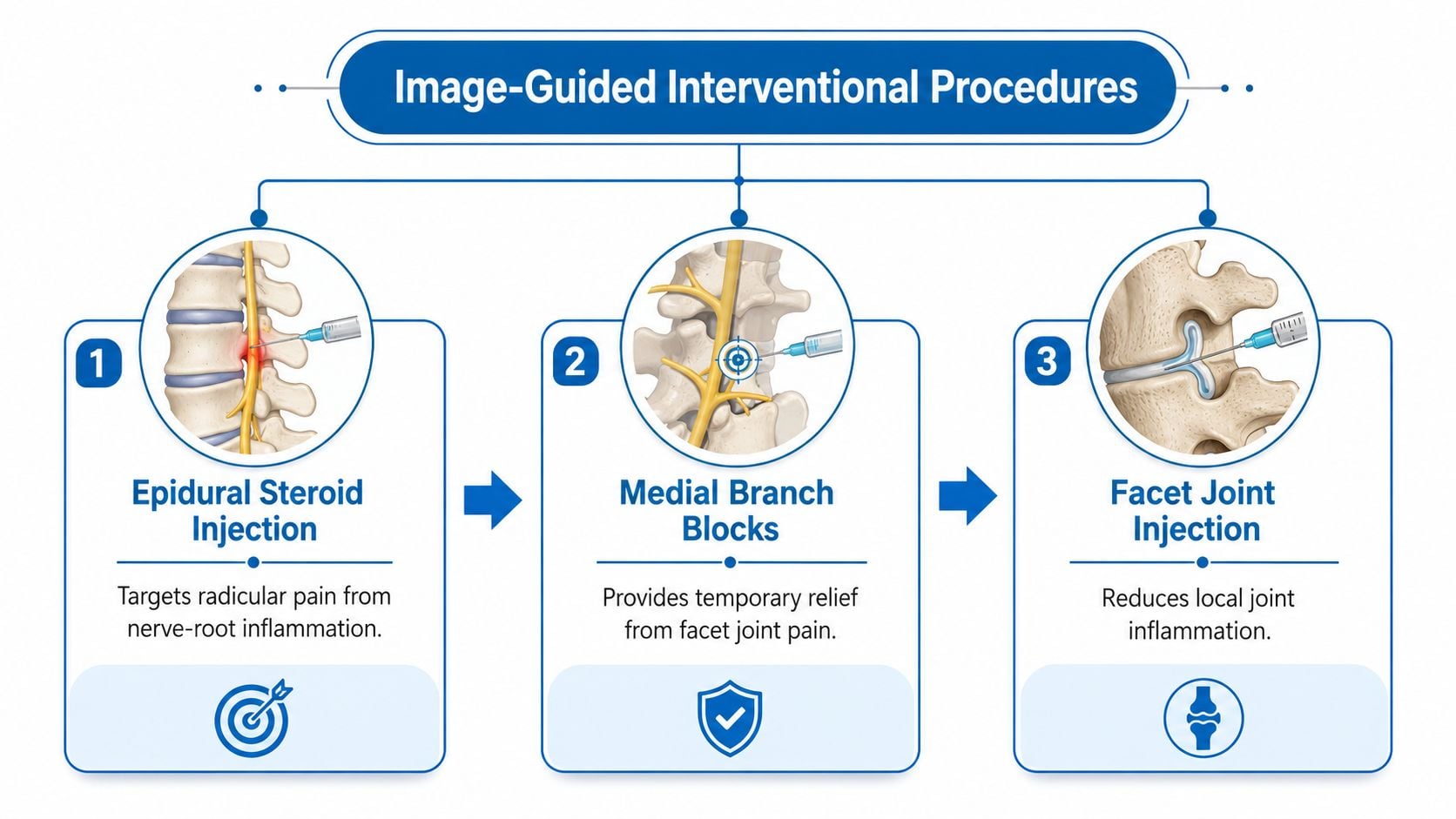
Matching the injection to the pain source
Epidural steroid injections are used when radicular pain suggests inflammation around a nerve root. Under image guidance, medicine is placed close to the irritated area to calm that inflammation and make movement more tolerable. For a patient whose leg pain is interrupting sleep, walking, or therapy, that relief can create a window where rehabilitation has a better chance to work.
Medial branch blocks serve a different purpose. They are diagnostic and therapeutic steps used when facet joints are suspected as the pain source. If the block eases pain in a way that fits the facet pattern, the next step may be radiofrequency neurotomy, which aims to interrupt pain transmission for a longer interval in selected patients.
A third option is facet joint injection, which may be considered when pain seems to come directly from the joint itself rather than from the nearby nerve pathway. The key question is simple, where is the pain coming from? That question matters more than trying to force every ache into the same category.
A positive diagnostic block matters because it does not just treat pain, it helps confirm the pain generator.
Image guidance is what gives these procedures their value. They are most useful when they function as a map, not just as a shot. For a closer look at a common use case for nerve-root inflammation, this overview of epidural steroid injections fits naturally into the pathway.
The expectation should stay realistic. In selected patients, injections can reduce inflammation and interrupt pain signals long enough to get the person moving again. They do not rebuild a disc, but they can buy time, and that time can be what allows the rest of the plan to succeed.
Surgical and Advanced Options Worth Considering
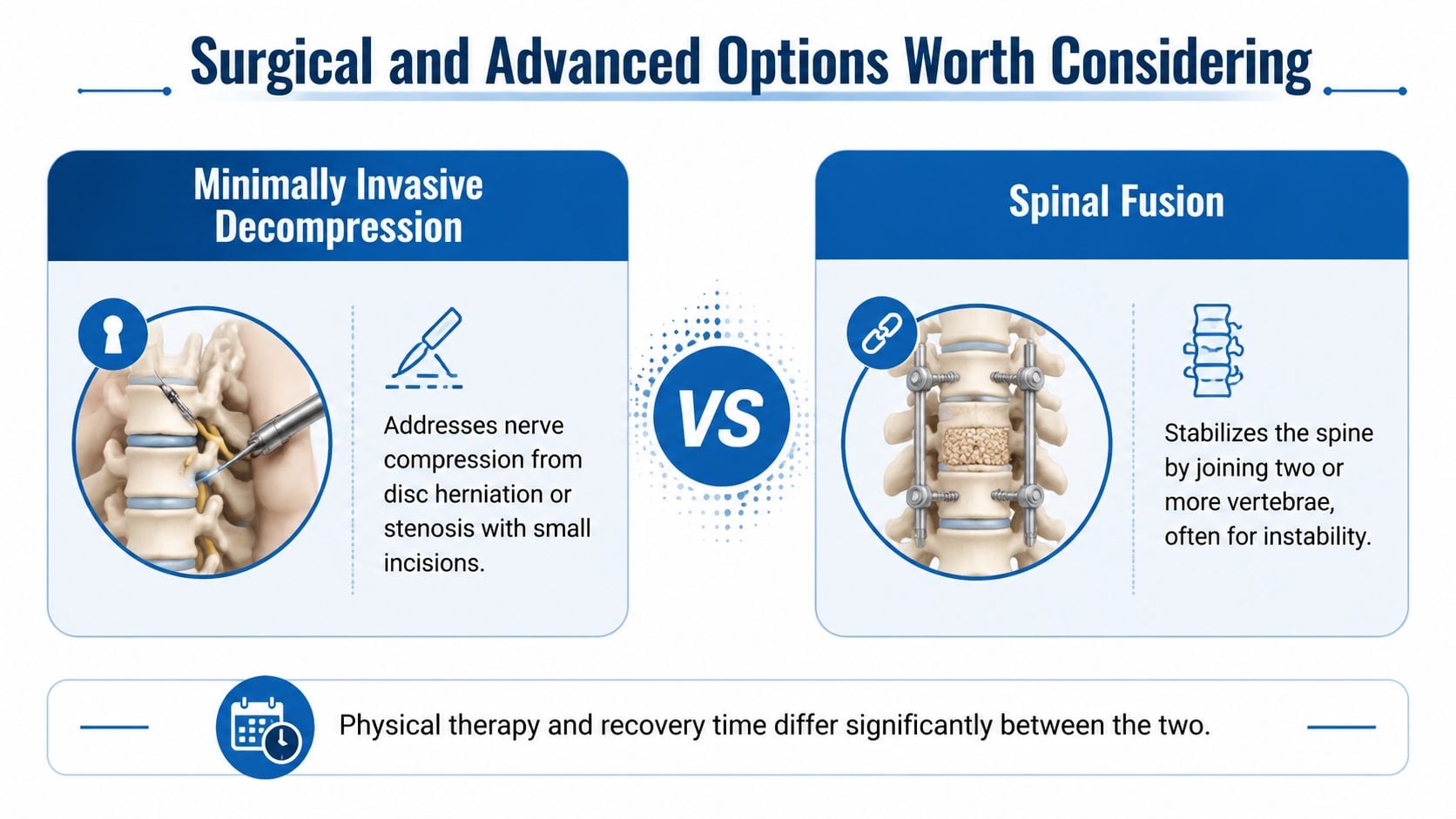
Surgery is not one thing. It's a set of different strategies, each with a different goal. Some procedures decompress a nerve. Some stabilize a painful segment. Others try to preserve motion. The right choice depends on what is causing the pain and what the spine still needs to do.
Four distinct philosophies
Minimally invasive decompression is designed to free up a pinched nerve. If a disc bulge or herniation is crowding nerve space, the surgeon removes the structure causing the compression through a smaller approach. The goal is nerve relief, not disc replacement.
Artificial disc replacement aims to preserve motion at a single painful level. That makes it a very different idea from fusion, because it tries to keep the segment moving while replacing the damaged disc.
Spinal fusion removes motion at the painful level so the segment stops moving against itself. Historically, this has been the dominant surgical pattern in lumbar degenerative disc disease, and the national trends study from the 2000s found 380,305 surgical cases for lumbar DDD from 2000 to 2009, with the population-adjusted incidence increasing 2.4-fold over that period (national trends study). In that same dataset, fusion procedures dominated, while total disc replacement remained a small share of cases.
Spinal cord stimulation sits in a different category altogether. It doesn't fix structure. It's used for chronic neuropathic pain in carefully selected patients, including some with persistent pain after prior surgery.
The trade-offs are real. Decompression can help a compressed nerve but may not solve instability. Fusion can stabilize a painful segment but sacrifices motion there. Motion-preserving surgery can be appealing, but it's only appropriate in selected cases. That is why “advanced” doesn't mean “better” in every patient, it means more targeted to the right problem.
Decision point: surgery becomes a serious conversation when pain stays limiting despite good nonoperative care, or when neurologic deficits or structural problems change the risk-benefit balance.
For readers discussing motion-preserving options, artificial disc replacement surgery is one example of how that branch is approached. For structural stability questions, bone grafting in spine care often enters the discussion as part of the fusion pathway.
Recovery Timelines and When to Call Your Physician
Recovery matters because even the right treatment can feel wrong if the timing isn't understood. Conservative care usually gets a trial period before it is judged, injections are often used to create a window for movement, and surgery changes the recovery arc more dramatically. That's why expectations should be practical, not hopeful in a vague way.
What recovery often looks like
A reasonable physical therapy trial usually lasts long enough to judge whether pain is settling and function is improving, not just whether the exercises feel easy. After an injection, some people are back to routine activities quickly, while others need a short period of lighter activity as the medication settles in. After decompression, return to activity is usually staged. Fusion and disc replacement tend to require a longer, more deliberate rehab course because the spine needs time to heal and adapt.
| Recovery Milestones by Treatment Option | Typical Return-to-Activity | Key Warning Signs |
|---|---|---|
| Conservative care | Gradual return over a trial of structured rehab and symptom control | New weakness, worsening numbness, bowel or bladder changes |
| Epidural steroid injection | Often quick return to light activity after a brief adjustment period | Fever, severe new pain, neurologic change |
| Minimally invasive decompression | Staged return over several weeks to a longer recovery arc | Increasing leg weakness, uncontrolled pain, wound issues |
| Fusion or disc replacement | Longer healing and rehab period with progressive activity limits | Saddle numbness, bladder or bowel changes, fever, progressive weakness |
When not to wait it out
Some changes deserve same-day medical attention. New weakness, worsening numbness, bowel or bladder changes, saddle anesthesia, fever after a procedure, or sudden severe pain should not be treated as routine flare-ups. Those are the moments to call the physician rather than “see how it goes.”
A useful rule is that pain can be watched, but dysfunction should be taken seriously. If the leg stops working normally, if numbness spreads, or if the body starts sending new warning signs, the plan needs to be reassessed quickly.
How a Multidisciplinary Team Builds Your Plan
A real spine plan usually comes from more than one set of eyes. History, exam, imaging, and functional demands all need to line up before a treatment path makes sense. That's why a multidisciplinary evaluation often feels more careful than a simple yes-or-no answer.
Who looks at what
A pain management physician often starts by sorting the pain pattern, the triggers, and the level of daily limitation. A spine surgeon then weighs whether the problem is structural enough to justify a procedure. Imaging is reviewed alongside the actual symptoms, because a dramatic scan that doesn't match the pain pattern can lead to the wrong branch of care.
The questions patients bring matter a lot. Which structure is probably driving the pain? Is this discogenic, radicular, or facet-mediated? What is the ceiling of each option? Those questions help expose whether the plan should stay conservative, add an injection, or move toward a surgical opinion.
A useful consult also includes the patient's work and life demands. A desk worker, a caregiver, and a person doing heavy physical labor may all need different versions of the same treatment ladder. The goal is function, not just symptom suppression.
For clean note-taking and visit summaries, AIDictation's clinical note tools can help a practice keep the history, exam, and decision points organized during a spine consultation. In a treatment pathway that depends so heavily on details, documentation quality matters.
There's also room for combined care. A plan may include physical therapy, an injection, and an ergonomic change together, because the spine often responds best to layered support instead of a single fix. In that setting, an interventional practice such as Interventional Pain Management can fit naturally into the care path when a patient needs image-guided procedures, medication-based pain care, or coordinated spine evaluation.
The Road Ahead and Where Biologics Fit Today
The future of disc treatment is active, but it's not settled. Stem cells, PRP, and other biologic or regenerative injections remain under study, and recent reviews describe bioactive therapies for degenerative disc disease as still in a challenging development phase (2025 review). That means the excitement is real, but the standard of care has not shifted into “regeneration instead of everything else.”
What is changing, and what is not
The big change is the research direction. More attention is going toward biologics, device-assisted regeneration, and minimally invasive procedures. What has not changed is the practical ladder patients follow today, physical therapy, medication, image-guided injections, radiofrequency treatment in the right pain pattern, and surgery for selected cases.
For readers exploring what regenerative care might eventually look like, advanced stem cell therapy is an example of the kind of emerging conversation patients often ask about. It belongs in the “investigational and evolving” category, not in the category of guaranteed disc repair.
The most useful takeaway is restraint. The right next step is usually not the final step, and a thoughtful conservative-first plan keeps every later option open without burning bridges too early.
If the pain pattern still isn't clear, or if the next step feels uncertain, Interventional Pain Management can help sort out whether the problem is discogenic, radicular, or facet-driven and match it to the right rung of care. Visit Interventional Pain Management to discuss a treatment plan that fits the symptoms, the imaging, and the goals without jumping straight to surgery.