

A slipped disc can turn a normal week into a string of worries. The pain may shoot down a leg, sitting may feel impossible, and the word “surgery” can make everything feel more serious than you were ready for. For many people, the next question is simple, what is minimally invasive spine surgery, and could it solve the problem without a large operation?
Minimally invasive spine surgery, or MISS, is not one single procedure. It's a family of techniques that use smaller incisions, specialized retractors or scopes, and image guidance to treat spinal problems while limiting disruption to muscle and soft tissue. In plain language, surgeons are trying to reach the problem through a narrow corridor instead of opening a wide one, which is why MISS can feel less intimidating than traditional open surgery Orthopaedic and educational overview of MISS.
MISS is now mainstream in spine care. One review reported that MIS instrumented surgeries made up 1/6 of all spine surgeries in 2010 and 1/3 in 2016, with authors projecting they would pass 1/2 by 2020. A more recent industry summary reported that minimally invasive techniques now account for over 70% of spinal procedures in the United States and about 46% of total spine surgeries globally in 2025, with a 2020 survey showing common MISS techniques include spinal endoscopy (59.9%), mini-open approaches (55.1%), and tubular retractors (41.8%) NIH-hosted review and adoption summary.
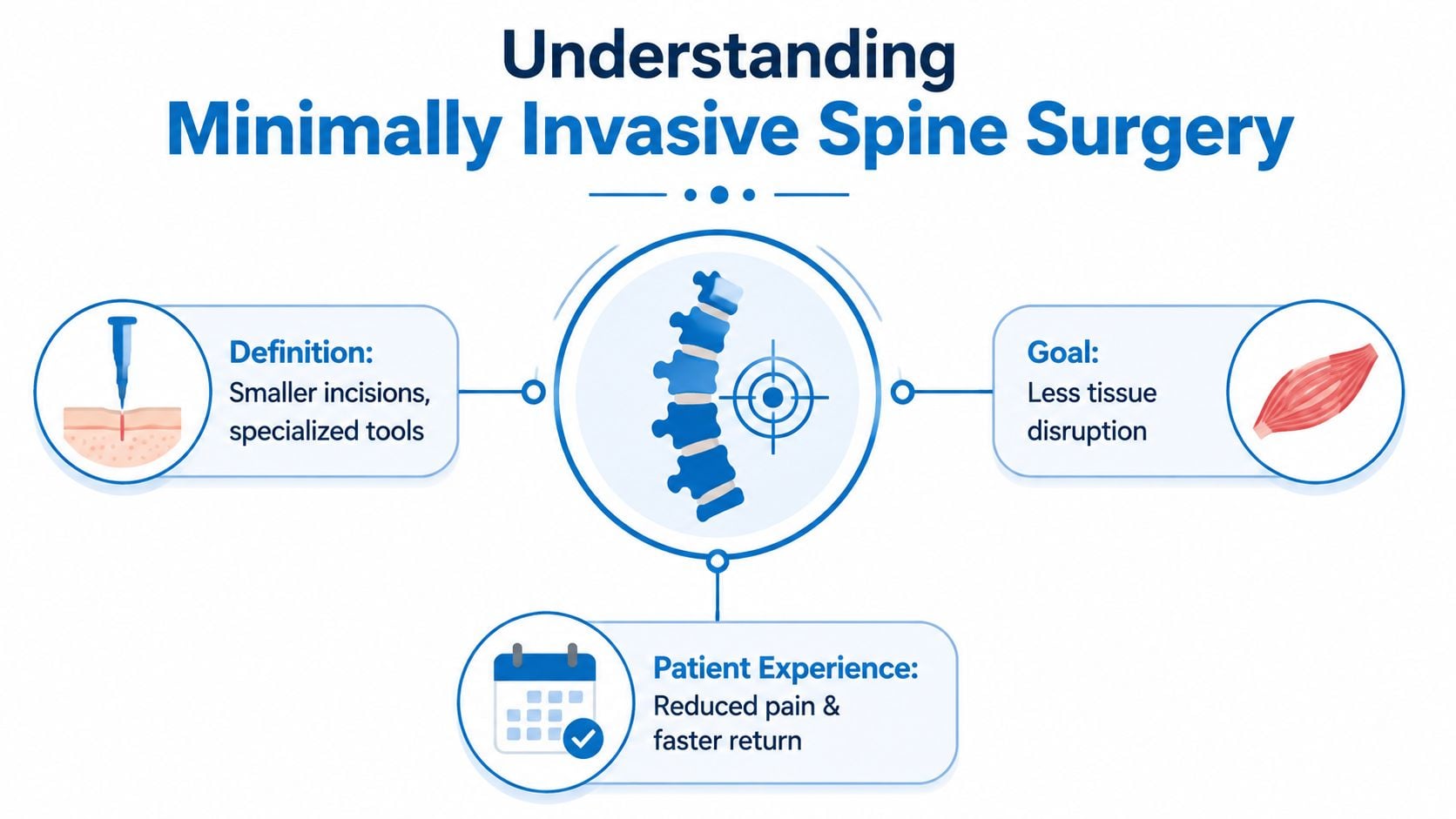
Table of Contents
- Understanding Minimally Invasive Spine Surgery
- How Minimally Invasive Spine Surgery Works
- MISS Versus Traditional Open Spine Surgery
- Common Techniques Used in MISS
- Who Is a Good Candidate and When MISS Is Not the Right Choice
- What the Perioperative Course and Recovery Actually Look Like
- Benefits, Risks, and Realistic Outcomes
- Questions to Ask Your Surgeon and When to Seek Specialty Care
Understanding Minimally Invasive Spine Surgery
A patient hears “you may need spine surgery” and often pictures a long incision, a big scar, and weeks of lying flat on a couch. That is usually the moment the search begins for a less intimidating option. MISS often comes up first because the name sounds smaller, but the core idea is simpler. It aims to reach the painful structure with less tissue disruption than an open exposure.
In spine care, the approach uses smaller skin openings, tubular retractors or endoscopes, and image guidance so the surgeon can decompress a nerve, remove a disc fragment, or stabilize a spinal segment through a narrow working corridor MISS definition and access sizes. That narrow corridor matters because the muscles beside the spine do not have to be peeled back as widely. The result is a procedure that can feel more targeted, more controlled, and less physically disruptive.
A family of techniques, not a single operation
Many patient pages blur the details. MISS is a category, not one standardized surgery. A disc problem, a narrowed spinal canal, and an unstable segment can each be treated with a different minimally invasive technique, even though all of them sit under the same umbrella.
Practical rule: when someone says “minimally invasive,” the next question should be, “which technique, for which problem, and why this one?”
That question matters because the evidence base is broad, not anecdotal. A NIH-hosted review cited outcomes research showing that endoscopic microdiscectomy results were equivalent to open microdiscectomy in a large patient group, and it also described a multi-institutional series with low complication rates, including 0.54% durotomy and 0.36% epidural hematoma MISS outcomes review. Those data points do not make every patient a candidate, but they do show that MISS has moved far beyond an experimental phase.
A good mental model is to compare MISS with reaching a house problem through a carefully cut access panel instead of tearing down a wall. The tool set changes depending on the job. For a straightforward disc fragment, minimally invasive microdiscectomy may be one option, while a more complex problem may call for a different technique entirely. The following sections walk through how those tools work, where they fit best, and where they do not.
How Minimally Invasive Spine Surgery Works
The easiest way to picture MISS is as a keyhole corridor. Traditional open surgery is closer to opening a wide window into the spine, while MISS uses a smaller opening and a guided tunnel to reach the problem. That tunnel is built with muscle-splitting dilation, tubular retractors, and a camera or microscope that brightens and magnifies the target area Hopkins overview of muscle-splitting and image guidance.
The surgeon does not work blindly through the tiny incision. Fluoroscopy helps confirm the exact level of the spine, and the corridor may be paired with an endoscope, microscope, or sometimes navigation tools that help place screws and other implants more precisely. The visual advantage comes from technology, not from opening more tissue. That is one reason blood loss and hospital stay are often lower in these workflows than in traditional open surgery.
What happens through the corridor
For a pinched nerve, the surgeon may trim bone, remove ligament, or take out a fragment of disc that is pressing on the nerve root. For instability, the same narrow access can be used for percutaneous screw placement and interbody fusion components. The specific steps change, but the principle stays the same, reach the target directly and leave as much supporting tissue alone as possible.
The patient usually sees a small incision, but the important detail is what happens beneath it, careful dilation, limited muscle splitting, and continuous imaging at each step.
That is why MISS is often described as tissue-sparing, not tissue-free. Some muscle has to be moved aside, and bone may still need to be removed. The difference is that the surgeon is trying to preserve the posterior support structures as much as the diagnosis allows.
An internal example of one common disc operation can help make the corridor idea feel more concrete, microdiscectomy details. The operation name changes by problem and by anatomy, but the basic logic stays consistent, create a narrow pathway, work precisely, and keep surrounding tissue disturbance as low as the case allows.
MISS Versus Traditional Open Spine Surgery
The clearest comparison is narrow access versus wide exposure. MISS aims to address the same spinal problem while disturbing the muscles and soft tissues around the spine as little as possible. Open surgery gives the surgeon a larger field, which can matter when the case involves complex reconstruction, deformity correction, or work across several levels.
A simple way to sort the difference is by what the surgeon needs to see and do. If the job is focused, a smaller corridor may be enough. If the anatomy is distorted, the compression is broad, or the spine needs major rebuilding, a wider approach may be safer and more complete.
| Variable | Minimally Invasive | Traditional Open |
|---|---|---|
| Incision and access | Smaller incisions with tubular or endoscopic access | Larger incision with wider exposure |
| Muscle disruption | Less paraspinal dissection and splitting | More muscle dissection and retraction |
| Blood loss | Often reduced | Often greater |
| Hospital stay | Often shorter | Often longer |
| Early postoperative pain | Often less | Often more |
| Best fit | Selected, targeted problems | Complex deformity, trauma, or broad reconstruction |
Those differences follow from how each operation is built. In MISS, surgeons use smaller access paths and image guidance to reach the problem with less tissue trauma, which can shorten hospitalization and reduce recovery burden. Open surgery gives broader exposure, which is useful when the surgeon needs direct visualization for a reconstruction that is more complicated, more extensive, or made harder by distorted anatomy.
When open surgery still makes sense
MISS is not the right answer for every spine problem. Some cases need the flexibility of open access, especially when deformity is severe, compression is spread across a wide area, or prior operations have left scar tissue that makes a narrow corridor unsafe. A patient's diagnosis matters more than the label “minimally invasive.”
Good surgical planning is case-specific, not slogan-based. A smaller incision only helps if it still lets the surgeon treat the problem completely.
A spinal fusion that needs broad correction may also be better served by open exposure, and that is the kind of discussion a patient should expect in a careful consult. The question is not whether an incision is small. The question is whether the chosen approach lets the surgeon decompress, stabilize, or reconstruct the spine in a way that matches the anatomy and the goal of treatment.
The trade-off is important. MISS may offer a gentler early recovery, but it still depends on surgeon experience and the right anatomy. A broader fusion or complex correction may be safer, faster, or more complete through an open approach, and a good consultation should say that plainly.
Common Techniques Used in MISS
The phrase “minimally invasive spine surgery” covers several different procedures, not one single operation. A patient may hear one name in the clinic, another in the operative plan, and a third in the discharge paperwork, while the umbrella label stays the same. A global survey showed that the field includes spinal endoscopy, mini-open approaches, and tubular retractors adoption summary.
The names patients are likely to hear
Tubular microdiscectomy usually means removing a disc fragment through a small tube. It is often used for a herniated disc that is pressing on a nerve, and it fits best when the problem is focal rather than spread across multiple levels.
Endoscopic discectomy uses a thin scope and camera to reach the disc through a small opening. The surgeon sees the target area directly on a screen, while surrounding muscle and soft tissue are disturbed less than in a wider exposure. An endoscopic spine surgery overview can help patients recognize the language that often appears in consult notes.
Minimally invasive lumbar decompression targets nerve compression from narrowed spaces in the lower back. It is commonly discussed for lumbar stenosis when the problem is localized and the anatomy allows a smaller access route.
Percutaneous pedicle screw fixation means screws are placed through small skin openings with imaging guidance. Surgeons use it when a spinal segment needs stabilization, often as part of a fusion plan.
Minimally invasive transforaminal lumbar interbody fusion places fusion material from a side-back corridor. That approach can reduce the amount of tissue disturbed during access. It is generally considered when instability and disc collapse need to be addressed together.
Anterior or lateral lumbar interbody fusion reaches the spine from the front or side through small incisions. The goal is still fusion, but the path avoids some posterior muscle disruption.
A useful way to read these names is to separate problem, path, and goal. The problem might be disc herniation, stenosis, or instability. The path is the approach. The goal is decompression, stabilization, or both.
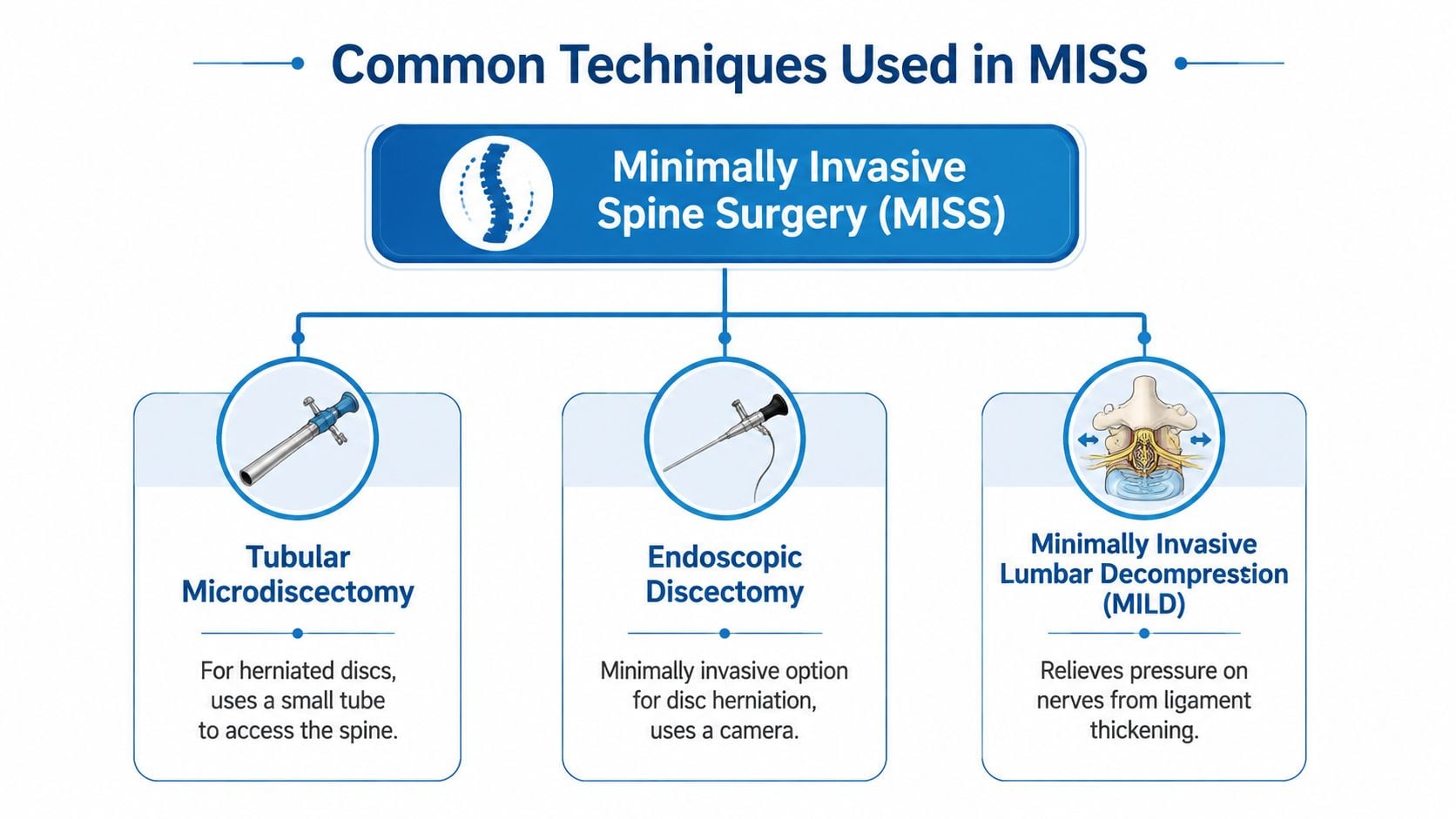
These names matter because they do not describe the same operation. A patient who can tell the difference between decompression and fusion is better prepared to ask whether the plan is meant to remove pressure from a nerve, stabilize a moving segment, or do both.
Who Is a Good Candidate and When MISS Is Not the Right Choice
MISS tends to work best when the problem is focal and well-defined. A contained disc herniation, a single-level stenosis, or a targeted fusion plan are the kinds of situations where a narrow corridor may solve the issue without the disruption of open exposure. The key idea is not that the surgery is smaller, it's that the problem is localized enough to be reached safely through a smaller path.
The best candidates usually have clear imaging findings that match the symptoms. If the scan shows one compressed nerve root and the pain pattern matches that nerve, the surgical plan is easier to justify. If the symptoms are diffuse, unstable, or mixed with multiple pain generators, the decision becomes more complicated.
When a surgeon may lean away from MISS
Some cases still favor open surgery or another non-MISS strategy. Severe deformity, heavy scar tissue from prior operations, multiple levels that need reconstruction, and anatomy that prevents safe access all change the calculation. Expert commentary also notes that endoscopic and other MIS techniques can have a steep learning curve, can take longer for newer surgeons, and are often best suited to selected cases such as isolated herniated discs expert commentary on indications and learning curve.
Access matters too. Recent reviews point out that endoscopic and other minimally invasive techniques face barriers in low-income settings because of limited surgeon training, inadequate equipment, and underrepresentation in research review of access and implementation gaps. That means a patient may be a reasonable candidate in theory but still need referral to a center that performs the technique regularly.
Useful question for the consult: “If this were your spine, would you still choose a minimally invasive approach, or would open surgery solve the problem more reliably?”
That question cuts through marketing language and forces the discussion back to anatomy, goals, and surgeon experience. A patient should also ask whether conservative care has been fully tried, what the fallback plan is if the narrow approach can't fully address the pathology, and whether another surgeon's opinion would change the recommendation. The point is not to chase the smallest operation. The point is to choose the operation that fits the spine problem.
What the Perioperative Course and Recovery Actually Look Like
The days around surgery feel less mysterious when they're broken into stages. Before the operation, patients usually complete imaging review, medication reconciliation, and anesthesia evaluation, then receive instructions about fasting, stopping certain medicines, and arranging help at home. On the day of surgery, the team checks the spine level carefully, because precision matters even more when the corridor is narrow.
For many MISS procedures, patients go home the same day or after a short stay, and some fusion cases need a little longer in the hospital. Early movement is usually encouraged, because walking helps with stiffness and circulation. The incision is small, but the body still needs time to settle after tissue manipulation and nerve decompression.
What recovery often feels like
The first few days are usually about pain control, short walks, and protecting the incision. Patients are often told to avoid bending, twisting, and lifting while the tissues heal. A brace may be used in some fusion cases, but not every MISS procedure needs one.
Physical therapy often begins early, then progresses from walking and gentle mobility to core strengthening and safer movement patterns. The healing timeline is still real. A minimally invasive fusion is still a fusion, and the bone still has to heal before the spine is fully stable.
One practical point deserves emphasis, nerve pain can calm down before the whole body feels normal. A leg that's been irritated for months may take time to settle even after the pressure is relieved. That's why the recovery visit schedule matters, it lets the surgeon confirm that symptoms are improving in the expected direction.
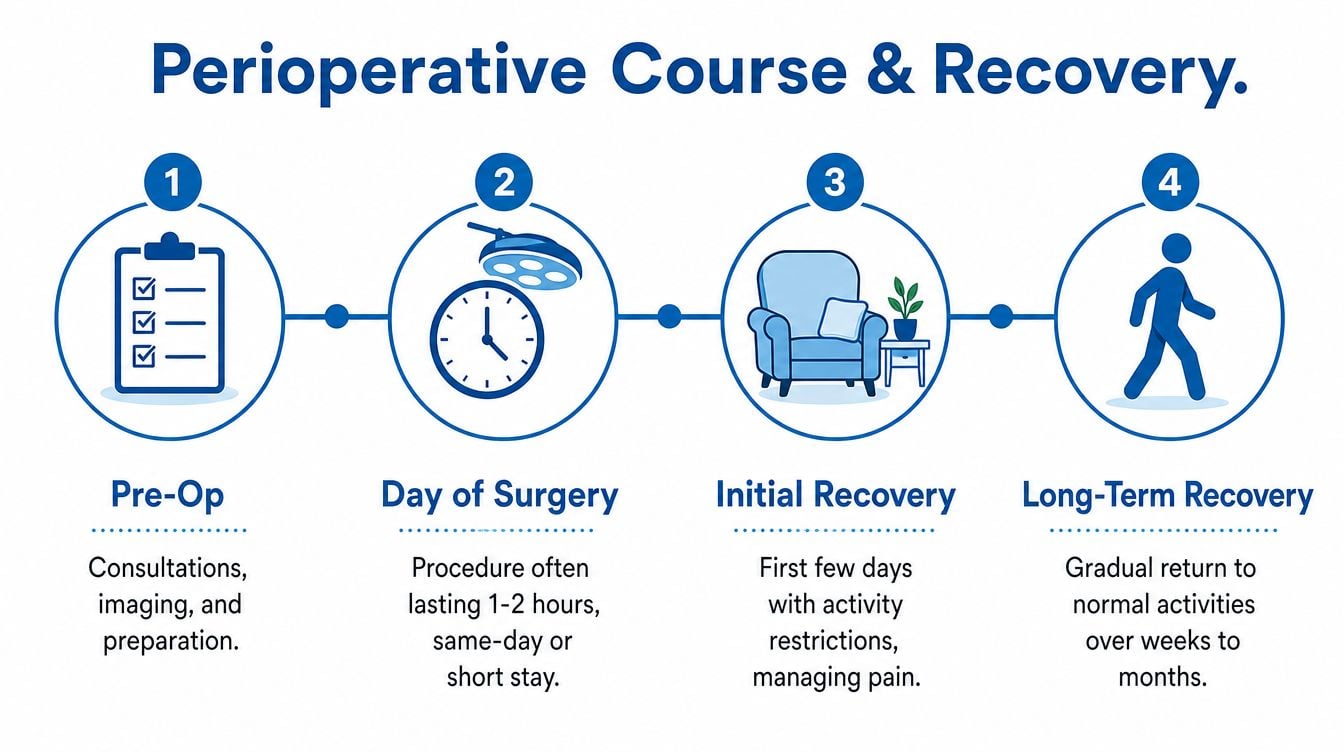
A well-run recovery plan should also include clear thresholds for driving, returning to desk work, lifting, and exercise. Those details vary by procedure and by surgeon, but the structure should feel consistent, do a little more each week, avoid a sudden spike in activity, and report any new weakness or bladder or bowel changes promptly.
Benefits, Risks, and Realistic Outcomes
A patient usually notices the benefits of MISS first in the days after surgery. The incision is smaller, the exposed muscle is often less disturbed, and that can mean less blood loss, a shorter hospital stay, and an easier start to walking and basic self-care. Early pain may also be lower, which is one reason many people need less opioid medicine right after surgery.
Those early advantages can be real, but they should not be confused with a different category of operation. MISS is a family of techniques, and the result still depends on what problem the surgeon is treating, how much compression or instability is present, and whether the anatomy allows a narrow corridor to do the job safely. As noted earlier in the outcomes review, smaller access does not automatically mean weaker results. It means the surgeon is using a different path to reach the same clinical goal.
A useful way to frame the conversation is this. The opening is smaller, but the target is the same. If the nerve still needs room, the disk still needs removal, or the spine still needs to be stabilized, the technique has to solve that problem completely, not just look less invasive from the outside.
What still can go wrong
Every spine operation carries risk. Nerve irritation or injury, a tear in the covering around the spinal cord, infection, incomplete decompression, and the need for another operation can still happen. Fusion success also depends on factors that are not limited to the incision, including bone quality, smoking status, and how well the patient follows postoperative restrictions.
Some cases do not fit a narrow approach well. If the surgeon cannot see and treat the full problem safely through a limited corridor, the plan may need to change during surgery, or a different operation may be the better choice from the beginning. That is not a failure of the concept. It is the surgeon matching the approach to the anatomy in front of them.
| What patients often hope for | What a realistic consult should confirm |
|---|---|
| Smaller incision and scar | Whether the anatomy actually allows a safe narrow approach |
| Less early pain | Whether the problem is focal enough for MISS |
| Faster early mobility | Whether fusion or decompression is the right goal |
| Shorter hospital time | Whether other risks make open surgery more appropriate |
The other point to keep in mind is that early recovery and final outcome are not the same thing. A patient may feel better quickly because the incision and surrounding tissue were handled more gently, yet the deeper healing process still takes time. That is why the question is not just whether the approach is smaller. It is whether the operation addresses the painful structure, protects nerve function, and gives the spine a stable long-term result.
Bottom line: MISS can make the early recovery period easier, but the main measure of success is still whether it solves the spinal problem completely and safely.
Questions to Ask Your Surgeon and When to Seek Specialty Care
A good spine consult should feel specific, not vague. The surgeon should be able to name the exact procedure, explain why that approach fits the anatomy, and say what would change the plan if the findings are more complex than expected. If the explanation stays at the level of “minimally invasive is better,” that's not enough detail.
Patients can bring a short checklist into the visit:
Am I a candidate for a minimally invasive approach?
This question forces the discussion back to anatomy and symptoms instead of marketing language.What specific technique do you recommend for my condition?
The answer should distinguish between decompression, discectomy, and fusion when relevant.What experience do you have with this exact technique?
Volume and training matter because MISS has a learning curve.What conservative options have already been exhausted?
That includes medication, physical therapy, activity modification, and injections when appropriate.What are the realistic goals and recovery limits?
A patient needs to know what improvement is likely, and what may not fully change.What complications should be watched for after surgery?
New weakness, fever, drainage, or worsening neurologic symptoms should not be brushed off.What's the fallback plan if the minimally invasive route doesn't fully work?
That answer should be clear before any consent form is signed.
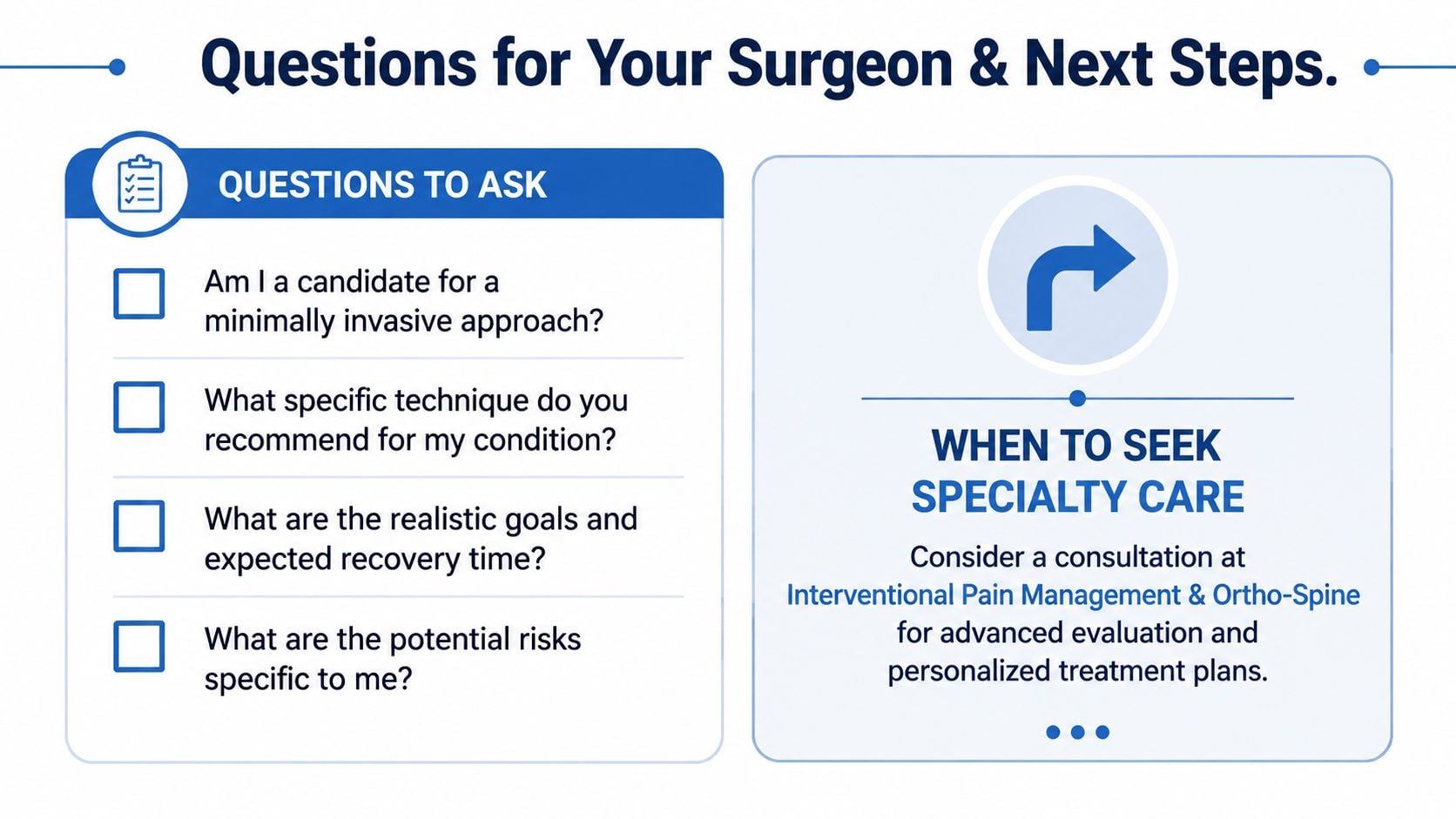
Patients in New Jersey and Staten Island who want a multidisciplinary evaluation can consider Interventional Pain Management and Ortho-Spine Center, where board-certified physicians across pain management, orthopedics, and spine surgery review back, neck, and radicular pain in one setting, with seven-days-a-week availability and care that ranges from non-invasive treatment to minimally invasive and complex surgical options. That kind of setup can help patients compare options without bouncing between disconnected offices.
Seek specialty care promptly if weakness is progressing, numbness is spreading, or bowel or bladder function changes. Those symptoms need timely assessment, not watchful waiting.
If back or neck pain is keeping daily life on hold, schedule a consultation with Interventional Pain Management to review the right level of care, from conservative treatment to minimally invasive spine options. A focused evaluation can clarify what's causing the symptoms and what approach fits the anatomy, goals, and recovery needs.