
A patient sees the veins first. Bulging lines behind the knee, aching after standing, swelling by evening, maybe a search online that labels the treatment “cosmetic” and makes the whole problem feel like a dead end. In real clinic work, that's usually where the confusion starts, because varicose vein treatment covered by insurance is rarely a simple yes-or-no question. It turns on symptoms, duplex findings, vein anatomy, and the exact language a payer wants to see in the chart.
What matters most is not whether the veins look bad. What matters is whether the record shows medical necessity, and that usually means a documented symptom story, a focused exam, a venous duplex ultrasound, and the right conservative-therapy history. A treatment can be considered covered in one plan and self-pay in another, even when the veins look almost identical. That's why approval tends to follow paperwork, not appearance.
Table of Contents
- When a Vein Treatment Stops Being Cosmetic and Starts Being Medical
- The Medical-Necessity Checklist Every Insurer Looks For
- Which Procedures Insurers Typically Cover and Which They Don't
- How Private Insurance, Medicare, and Medicaid Handle Vein Coverage Differently
- The Preauthorization Process From the Clinic Side
- What to Do When Coverage Is Denied
- What You Will Still Owe Even After Approval
- Your Next Steps in New Jersey and Staten Island
When a Vein Treatment Stops Being Cosmetic and Starts Being Medical
A common first visit sounds like this. The patient has lived with leg heaviness and visible varicose veins for months, maybe years, and assumes insurance will shrug it off as a cosmetic concern. Then the conversation shifts to standing tolerance, end-of-day swelling, nighttime cramping, skin changes, or bleeding, and the picture changes fast.
Coverage follows the clinical story that gets built in the record. The same vein can be treated as elective if it's only being removed for appearance, or as medically necessary if the chart shows symptoms plus objective reflux on duplex ultrasound. That difference is why a careful consult matters before anyone talks about procedure scheduling.
Practical rule: insurers rarely approve based on the word “varicose” alone. They approve when the chart shows symptoms, reflux, and function impact.
The practical start point is not “Can this vein be removed?” It's “What problem is the vein causing?” If the leg pain interferes with work, walking, exercise, sleep, or prolonged standing, that belongs in the history. If the swelling worsens later in the day, that belongs too. If there's skin discoloration, itching, ulceration, or bleeding, those details are even more important because they move the case away from a cosmetic frame and toward chronic venous disease.
For patients comparing options, the clinical distinction is often easier to understand after a basic vein evaluation. A specialist's intake usually looks at visible varicosities, symptom distribution, and whether the problem follows a reflux pattern that can be confirmed on ultrasound. An accessible overview of that kind of evaluation is available through this vein education page, but the core takeaway is simple. The insurer doesn't care that the veins are visible. It cares whether the condition is documented as causing medical harm or persistent functional limits.
The early signal that treatment may qualify is this combination, not appearance alone. Symptoms are present, the exam supports them, and the workup is headed toward duplex-confirmed reflux. Once that happens, the question stops being cosmetic versus medical and becomes whether the documentation is complete enough for the payer's rulebook.
The Medical-Necessity Checklist Every Insurer Looks For
The chart has to tell one consistent story
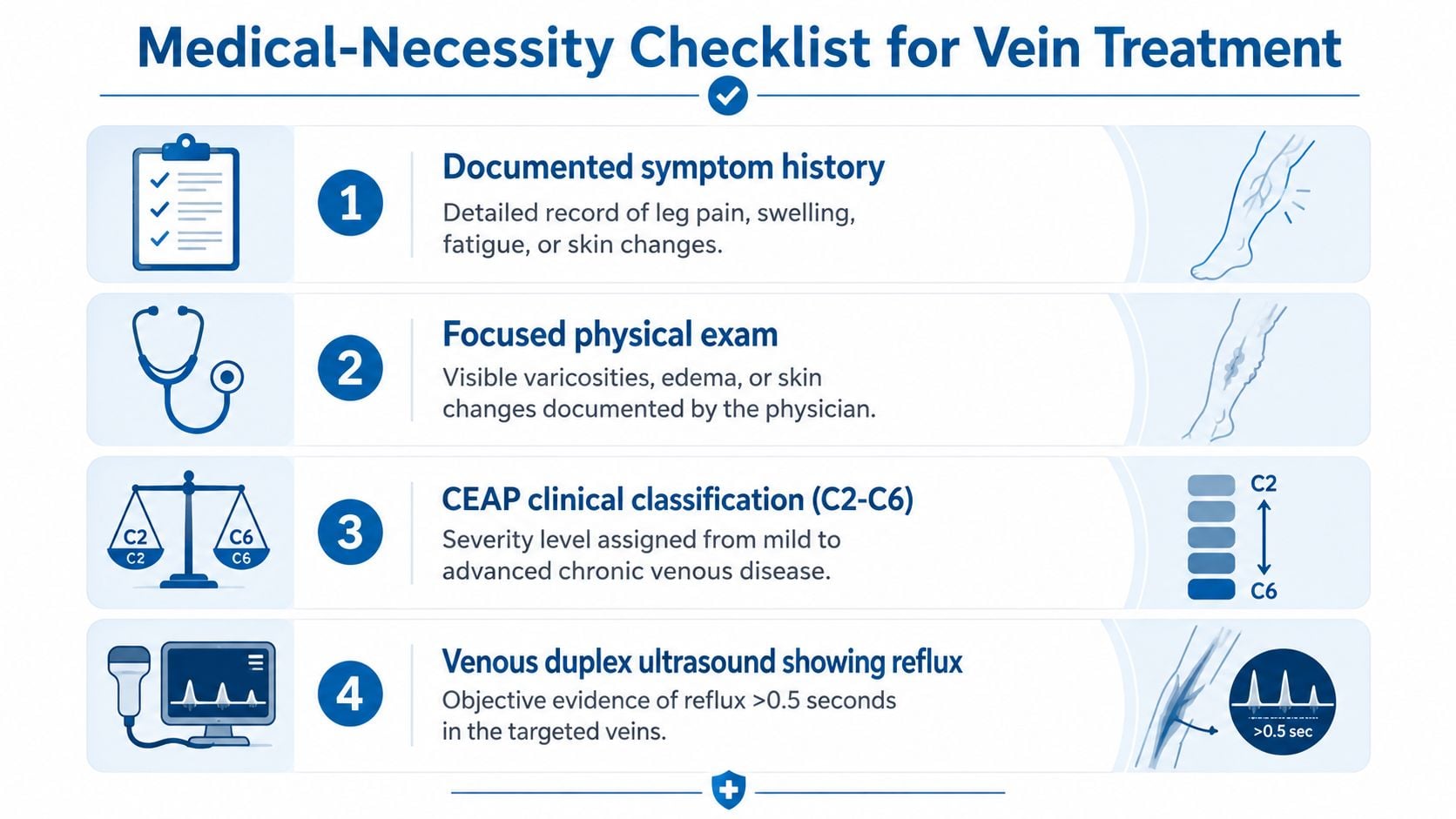
A payer reviewer wants the chart to read like a single, coherent case. The history, physical exam, severity classification, and ultrasound need to point to the same conclusion. Medicare's LCD requires history, physical exam, CEAP clinical classification, and duplex evidence of reflux >500 ms before invasive care is considered reasonable and necessary (CMS LCD 39121).
Commercial carriers often build the same logic into their own utilization rules, even if the exact wording changes. The record should show where the symptoms are, how long they have been present, what worsens them, and how they interfere with daily life. Pain, edema, skin changes, ulceration, and bleeding carry more weight than vague discomfort because they document disease impact, not just visible veins.
If the chart looks assembled from separate visits that do not match, the request is harder to defend. If it reads as one clear sequence, symptoms first, exam findings second, ultrasound third, the reviewer has less room to argue that the treatment is cosmetic.
What usually makes or breaks the request
The ultrasound is what turns a complaint into objective evidence. A duplex study should identify the target vein and record reflux time in the exact segment that is being treated. The Medicare policy threshold is more than 500 milliseconds (CMS LCD 39121). Many private plans use the same benchmark, but they often add their own requirements, including failed conservative therapy and symptoms that interfere with function.
Many plans also want proof that compression was tried before they approve an invasive procedure. In the 2024 review of U.S. payer policies, as many as 33% required a documented conservative-therapy trial before ablation could proceed (policy review). That does not mean every plan asks for the same duration or the same stocking strength. It means the office has to match the payer's exact wording.
The details that help most are usually the plain ones. A symptom log that records leg pain, swelling, heaviness, skin changes, and the time of day symptoms worsen gives the reviewer a clearer picture than a vague summary at the visit. Short, dated notes are easier to use than memory alone.
Patients also do better when the record ties symptoms to daily function. Standing at work, driving, cooking, exercise, sleep, and swelling by evening are the kinds of specifics that show medical necessity in a way a checkbox never can. If the payer sees a repeated pattern, the request is easier to support.
For patients who want to see how treatment pathways are organized in clinic, the list of vein treatment options helps show how the documentation has to match the procedure selected. The medical-necessity checklist is less about sounding sick and more about showing a consistent, documented pattern that supports treatment.
Which Procedures Insurers Typically Cover and Which They Don't
A coverage decision starts with the vein named in the request. Insurers are far more likely to approve treatment of refluxing truncal veins when the chart supports medical necessity, while isolated cosmetic vein work is handled under a different rule set. That is why one patient can receive approval for thermal ablation and another can be denied after what looks like the same office visit, if the target vein, anatomy, or symptom record does not fit the plan's policy language.
Coverage depends on the vein segment and the intervention
Endovenous thermal ablation, meaning radiofrequency or laser, is commonly covered when reflux and symptoms are documented. A 2024 review of insurance policies found that coverage for radiofrequency or laser ablation was present in many plans, while other plans did not cover it or left the policy unclear. A separate 2024 review of anterior saphenous vein treatment found broad coverage, but many of the approving policies required prior treatment of the great saphenous vein first (ASV review).
That pattern is why the anatomy written in the chart has to match the procedure chosen. A payer may cover ablation of one venous segment and not another, or may require that a more proximal source of reflux be addressed first. The office has to request the service the payer recognizes for that specific disease pattern.
What tends to be covered, and what tends to be pushed to self-pay
| Procedure | Typical Coverage | Key Documentation |
|---|---|---|
| Endovenous thermal ablation, RFA or EVLT | Often covered when symptomatic reflux is proven | Duplex reflux, symptoms, CEAP class, conservative therapy |
| Foam or liquid sclerotherapy | Often covered for symptomatic refluxing veins, more variable for small superficial veins | Vein-specific reflux, symptom burden, insurer criteria |
| Ambulatory phlebectomy | Often covered when tied to symptomatic varicose disease | Exam findings, reflux study, medical-necessity narrative |
| Spider-vein treatment without reflux | Usually treated as cosmetic | Lack of reflux and lack of symptoms typically drive self-pay |
A few plans also put technical constraints on the request. One insurer policy requires symptomatic disease with reflux ≥500 ms, a vein diameter ≥4.5 mm, and procedure-specific limits such as 12 mm for RFA and 20 mm for laser (coverage criteria policy). That does not mean every plan uses those exact limits, but it shows how narrow the lane can be.
For a practical overview of the types of care a vein practice may offer, the procedure menu at Interventional Pain Management's treatment page is a useful reference point. The insurance lesson is unchanged. The payer covers the procedure that matches the documented disease, not whichever procedure looks simplest to schedule. For clinics that want the paperwork to match the request from the start, compliance-ready onboarding templates can help standardize intake, symptom capture, and prior-authorization packets.
How Private Insurance, Medicare, and Medicaid Handle Vein Coverage Differently
A patient can have the same varicose veins and still get three different coverage answers. That is normal. The diagnosis starts the review, but the payer type determines how much proof is required, which vein segments are eligible, and how much flexibility the office has if the first submission is incomplete.
Private plans lean on utilization rules
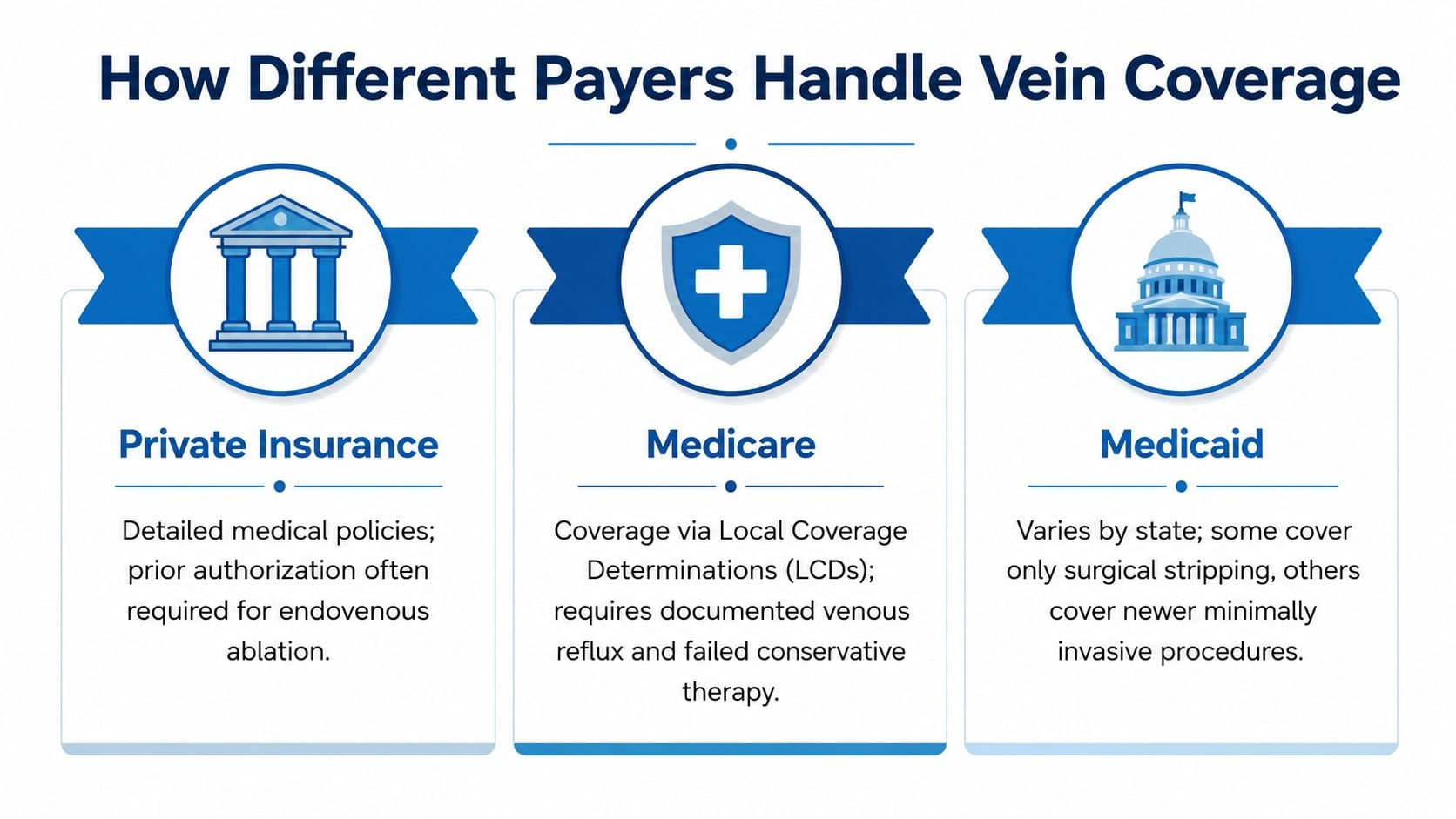
Commercial plans usually write detailed medical policies around reflux thresholds, symptom requirements, and conservative therapy. Coverage can turn on small details that look minor in the chart but matter to the reviewer, such as whether the note clearly ties symptoms to the treated vein and whether the office documented a real trial of stockings. One policy review found that plans vary widely in how they treat endovenous ablation and the supporting paperwork they expect, which is why one carrier may approve quickly while another asks for more ultrasound detail or stronger proof that conservative care failed (policy review).
Medicare uses a more explicit clinical framework
Medicare is more predictable on paper. Its coverage language requires history, physical examination, CEAP classification, and duplex evidence of reflux >500 ms before invasive treatment is considered reasonable and necessary (CMS LCD 39121). That makes the charting burden clear, but it does not make the process light. If the note is vague, the request usually stalls.
Medicaid depends on the state
Medicaid is the most variable bucket because the rules run through state programs. Some states allow minimally invasive vein care with a fairly direct path, while others are tighter and still follow older authorization habits. The safest assumption is that the state policy, not the diagnosis alone, controls the approval path. For clinics that want intake data collected in a consistent way before submission, compliance-ready onboarding templates can help staff gather the details that payers ask for.
Practical rule: the same duplex report can produce three different answers if the payer rules differ on conservative therapy, vein segment, or procedure type.
That variation is why the first clinic conversation should include the exact insurance product, not just the member card. A patient may qualify clinically and still face a policy-specific delay if the office sends the wrong code set or misses a documentation item the plan treats as required.
The Preauthorization Process From the Clinic Side
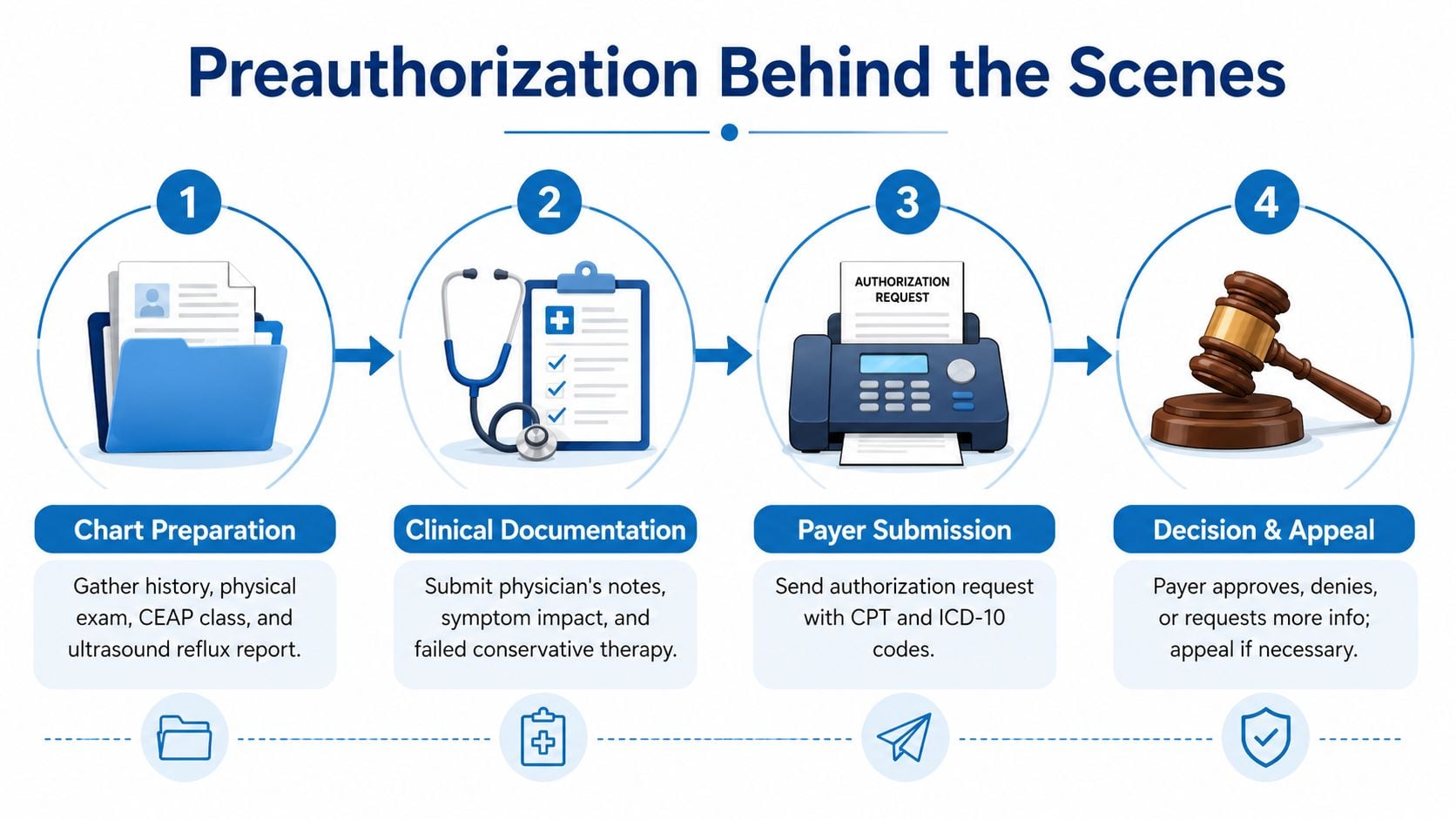
Most denials begin with missing paper, not bad medicine. The clinic gathers the office note, ultrasound report, symptom history, and proof of conservative therapy, then maps them to the payer's policy language before the request goes out. If one of those pieces is weak, the case often pends instead of getting a clean approval.
The request packet has to be tight
A strong packet usually includes the history, focused physical exam, CEAP class, and duplex reflux report, then attaches the conservative-therapy trial and the procedure plan. The office also has to use the right diagnosis and procedure codes, because a mismatch can trigger a medical review or a denial. The payer is looking for a document that answers its own rulebook, not a general narrative about unhappy veins.
When the plan asks for more information, the case usually stalls because the chart doesn't yet prove one of the required elements. That's where patient cooperation matters. Wearing compression as prescribed, keeping symptom notes, and responding quickly when the office asks for photos or additional history can shorten the delay.
Peer-to-peer review is part of normal practice
If the insurer is still unconvinced, the next step is often a physician-to-physician call. During that peer-to-peer review, the treating doctor explains why the patient's symptoms, exam findings, and ultrasound results fit the policy criteria. The conversation works best when the notes are specific, because vague statements usually don't move a skeptical reviewer.
Useful habit: complete the compression trial before the ultrasound follow-up if the office recommends it. Waiting until after a denial usually adds another round of paperwork.
Patients often think authorization is a single fax. In reality it's a sequence, charting, submission, review, then either approval or a request for more detail. The smoother the documentation from the start, the less likely the request is to bounce back.
What to Do When Coverage Is Denied
A denial is frustrating, but it isn't the end of the case. The first question is usually not “How do we fight this?” It's “What part of the policy did the payer say was missing?” That answer matters because appeals that directly address the denial reason are far more useful than generic letters.
When a denial arrives, the most effective next move is to build the appeal around the missing element. If the plan says reflux wasn't documented clearly, the appeal should point to the duplex report. If the plan says conservative therapy wasn't completed, the appeal should attach stocking records and symptom notes. If the plan wants more evidence of functional impact, the appeal should state how pain, edema, or heaviness affects work and daily activity.
A denial gets reversed when the right record is sent back
The appeal should be short, factual, and tied to the policy language. A peer-to-peer discussion between the treating physician and the payer's medical director can be especially useful when the chart is strong but the reviewer missed a detail. For a structured way to organize the denial workflow on the billing side, master healthcare claim denials is a helpful operational reference.
If the first appeal fails, many plans allow internal review and then external review through the state's independent process. That path is not a sign that the case is weak. It usually means the first reviewer applied the policy narrowly or missed part of the record. Appeals work best when they stay focused on the exact reason for denial instead of repeating the original request unchanged.
The strongest appeals don't argue that vein treatment should always be covered. They show that this patient met this plan's criteria and the denial overlooked the evidence.
Persistent follow-through is part of the approval process. Many cases that look closed after the first denial are reopened when the office sends the ultrasound, symptom documentation, and conservative-therapy proof in a cleaner format.
What You Will Still Owe Even After Approval
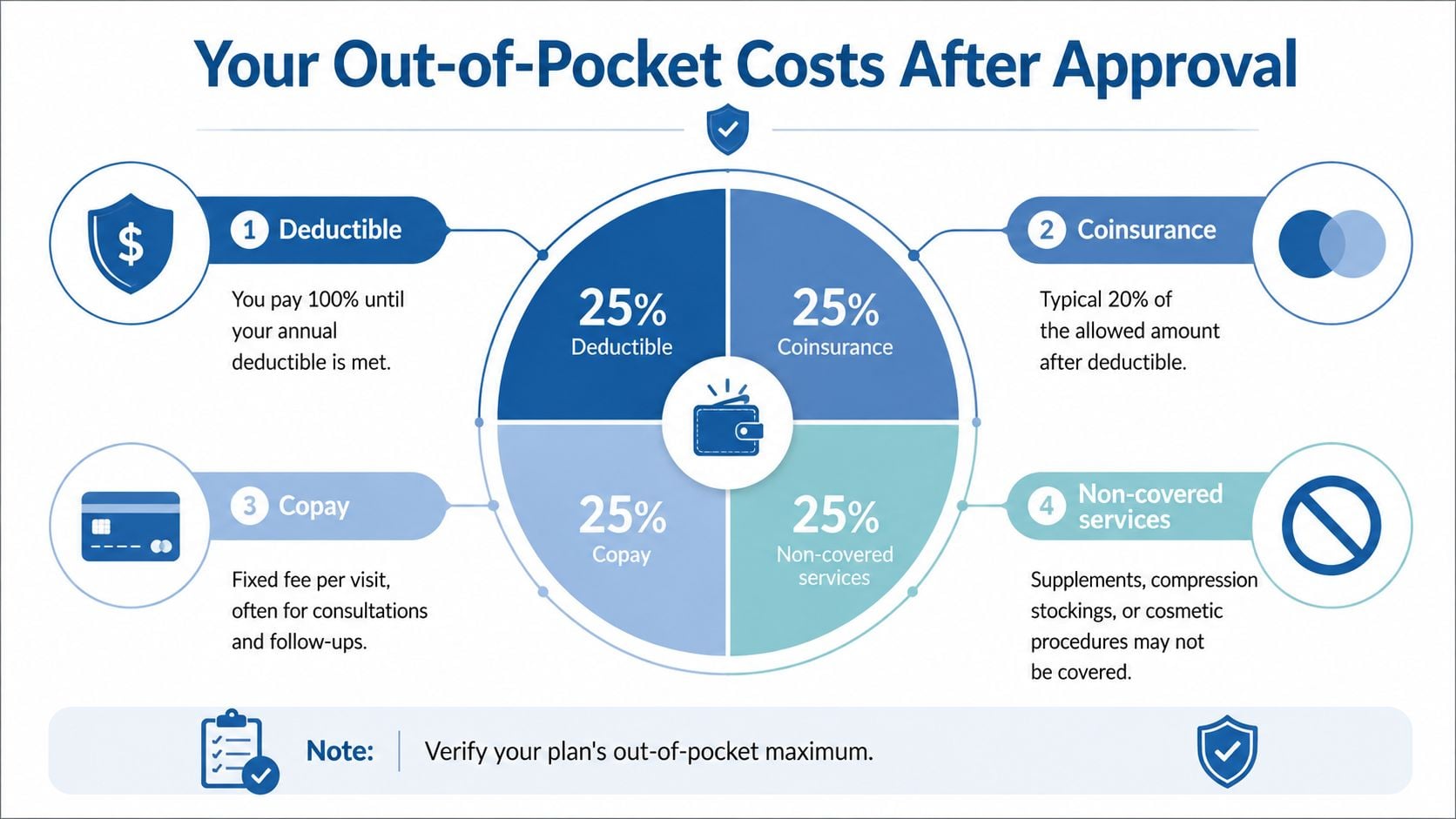
Approval doesn't erase the bill. It only means the plan agrees the treatment fits the medical policy. The patient can still owe a deductible, coinsurance, or copay, and the final amount depends on whether the office, facility, and anesthetic or follow-up services are in network.
Approval and affordability are different questions
A patient may get coverage for the core procedure but still owe for separate parts of the episode, especially if the plan treats some follow-up care, stockings, or cosmetic vein work differently. Compression stockings are a common example of a benefit that may not behave the same way as the covered procedure itself. Spider-vein treatment without documented reflux can still be excluded even when the patient is already in a covered vein episode.
Budget rule: always confirm the allowed amount and the network status before treatment day. That matters more than the approval letter alone.
Bilateral procedures can also change the amount owed because they can affect how the plan processes the episode of care. Out-of-network billing is another issue, especially when a specialist and facility are not both in network. Even with surprise-billing protections, patients should not assume every charge disappears just because the procedure was authorized.
The cleanest way to avoid a surprise is to ask about benefits before the procedure, not after. The office should verify the plan rules, but the patient still needs to know whether the deductible has been met and whether any part of the visit is classified as non-covered.
Your Next Steps in New Jersey and Staten Island
A patient who wants a clearer answer this week should start with the three things insurers care about most. Get a venous reflux evaluation with duplex ultrasound, write down symptoms in a simple log, and follow the conservative-therapy plan exactly as prescribed. Those three steps make the chart stronger before authorization even begins.

The checklist for a smoother approval
- Confirm symptoms in writing: note pain, swelling, heaviness, skin changes, bleeding, or limitations with standing.
- Bring the right records: prior ultrasound reports, compression history, and any previous vein treatment details.
- Verify network status early: both the specialist and the facility matter.
- Ask for the plan rulebook: the office needs the specific payer criteria, not just the member card.
For patients in the region, the Staten Island location page is the right starting point for scheduling and location details. The same benefit-navigation logic applies whether the case is routine, tied to work-related injury, or part of a broader medical record that needs coordination.
Interventional Pain Management helps patients sort out vein evaluation, documentation, and insurance navigation without guessing at the next step. If varicose vein symptoms are affecting daily life in New Jersey or Staten Island, visit Interventional Pain Management to request an evaluation and get the insurance process started with a team that knows how these cases are approved.